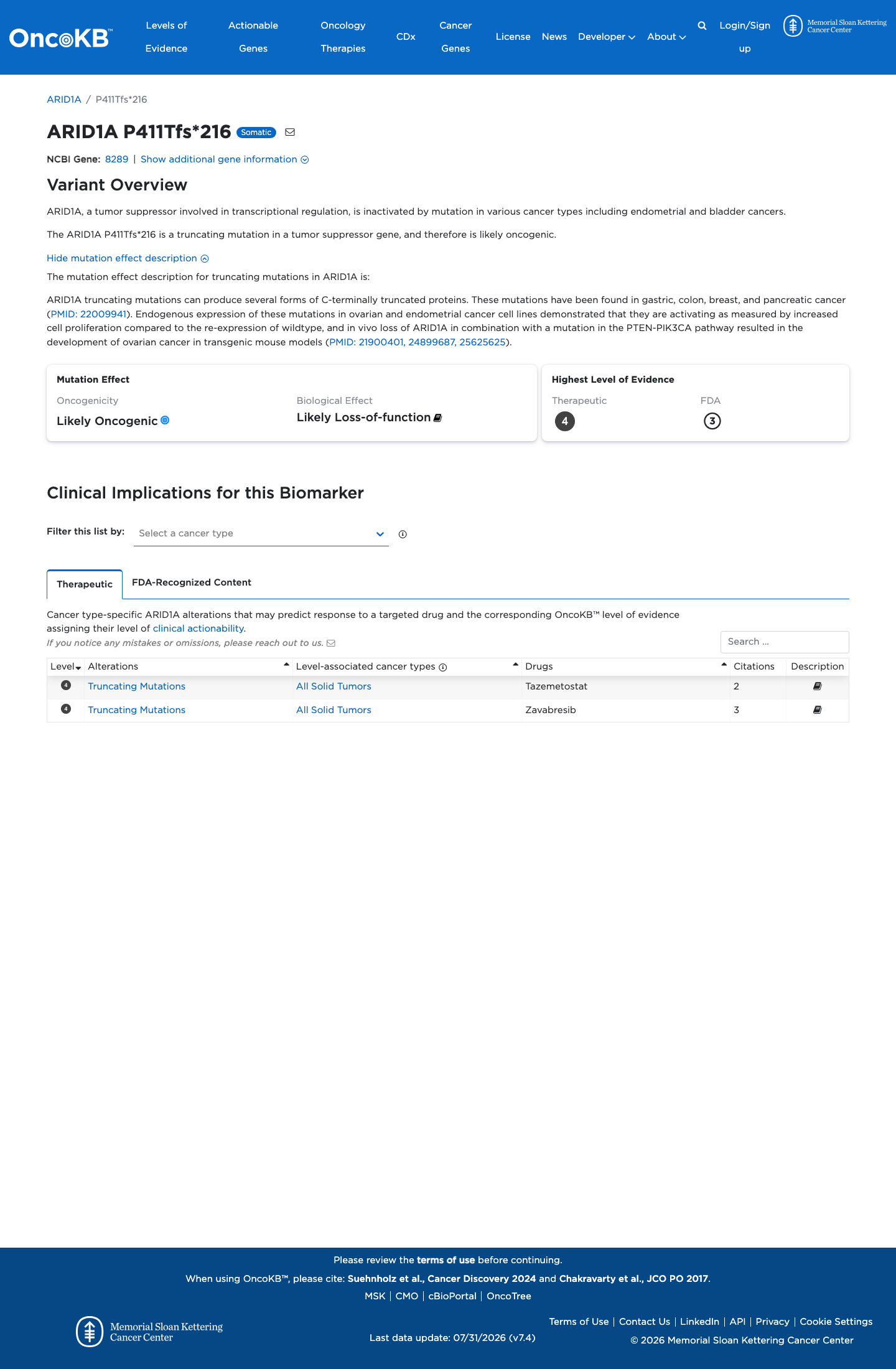
ARID1A encodes a component of the SWI/SNF chromatin-remodeling complex, which regulates gene expression by altering chromatin structure around target genes. It binds AT-rich DNA sequences and helps recruit the remodeling complex to its targets. Germline mutations in ARID1A cause Coffin-Siris syndrome, a condition marked by developmental delay and coarse facial features. ARID1A also acts as a tumor suppressor in several cancer types, including gynecologic cancers, ovarian clear cell carcinomas, and endometrial cancers.
This variant
This likely pathogenic frameshift is predicted to eliminate one functional copy of ARID1A, matching the haploinsufficiency mechanism that underlies Coffin-Siris syndrome and consistent with ARID1A's tumor-suppressor role in gynecologic, ovarian clear cell, and endometrial cancers. The classification therefore supports a loss-of-function disease mechanism for this variant.
Transcript
NM_006015.5
HGVS · transcript:coding
NM_006015.5:c.1217_1229dup
GRCh38
chr1:26729725 A>ACAGGGACCTCCGT
GRCh37
chr1:27056216 A>ACAGGGACCTCCGT
BasisLikely Pathogenic: PVS1 very strong (frameshift predicted to trigger NMD; established LOF mechanism) plus PM2 supporting (absent from gnomAD v2.1, v4.1, and gnomAD-Canada).▾
Likely Pathogenic: PVS1 very strong (frameshift predicted to trigger NMD; established LOF mechanism) plus PM2 supporting (absent from gnomAD v2.1, v4.1, and gnomAD-Canada).
Classification rationale
PVS1PM2Likely Pathogenic
ARID1A c.1217_1229dupframeshift · exon 2
PVS1 (Very Strong): the 13-bp frameshift is predicted to trigger nonsense-mediated decay, and loss of function is an established ARID1A disease mechanism. PM2 (Supporting): the exact 13-bp duplication is absent from gnomAD v2.1, v4.1, and gnomAD-Canada. Overall: Likely Pathogenic under generic ACMG/AMP 2015 combination rules (PVS1 very strong + PM2 supporting).
PVS1 + PM2→Likely Pathogenic
Gene diagram
· NM_006015.5 · variants mapped to exon structure
ARID1ANM_006015.5
Fetching transcript structure from UCSC…
Exons
—
Transcript span
—
Strand
—
Variants mapped
—
Source
UCSC ncbiRefSeqCurated
All variants in ARID1A—click a row to locate it on the plot · use the link column to open its page
Variant ↕
Protein
Location
Classification
Link
Applied criteria · 2 applied · 18 assessed
MetEvidence satisfies this criterion.
Not metEvaluated against available evidence; threshold not reached.
Not assessedApplies in principle, but no evidence was found to evaluate it.
N/ADoesn't apply to this variant type.
Applied · 2
Strength Supporting Moderate Strong Very strong
✓
PVS1very strongPathogenic
Met (Very Strong): the 13-bp frameshift creates a premature stop at codon 626 predicted to trigger nonsense-mediated decay.
pvs1_variant_assessment classifies the variant as consequence_class=frameshift, variant_bucket=frameshift, with suggested_default_strength=PVS1 and apply_generic_pvs1_framework=true under the PMC6185798 framework.pvs1_gene_context reports pvs1_gene_gate=eligible and lof_mechanism_supported=true, citing germline disease-focused literature (including ARID1A gene variants and fetal hydrocephalus / BAFopathy spectrum, PMID:40962111) as evidence that ARID1A loss-of-function is an established germline disease mechanism.Mutalyzer/VariantValidator exon and CDS coordinate maps (prefetch.json) place the c.1217_1229 duplication in exon 2 (c.1138-1350) and the resulting premature stop (~codon 626, ~c.1876) far upstream of the final exon (beginning c.5125) and outside the terminal 50 bp of the penultimate exon, consistent with NMD-predicted transcript decay rather than protein truncation/elongation escape.
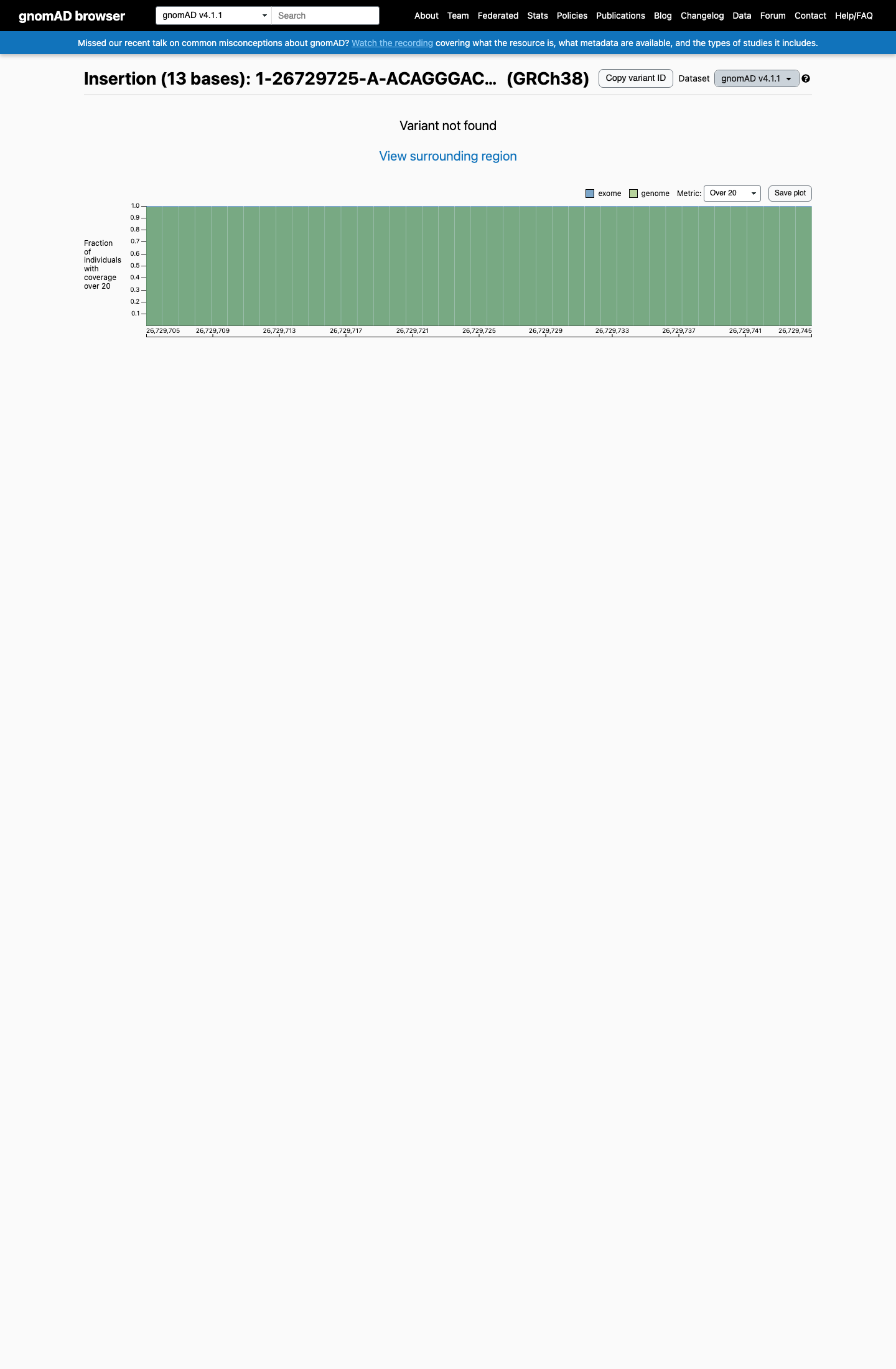
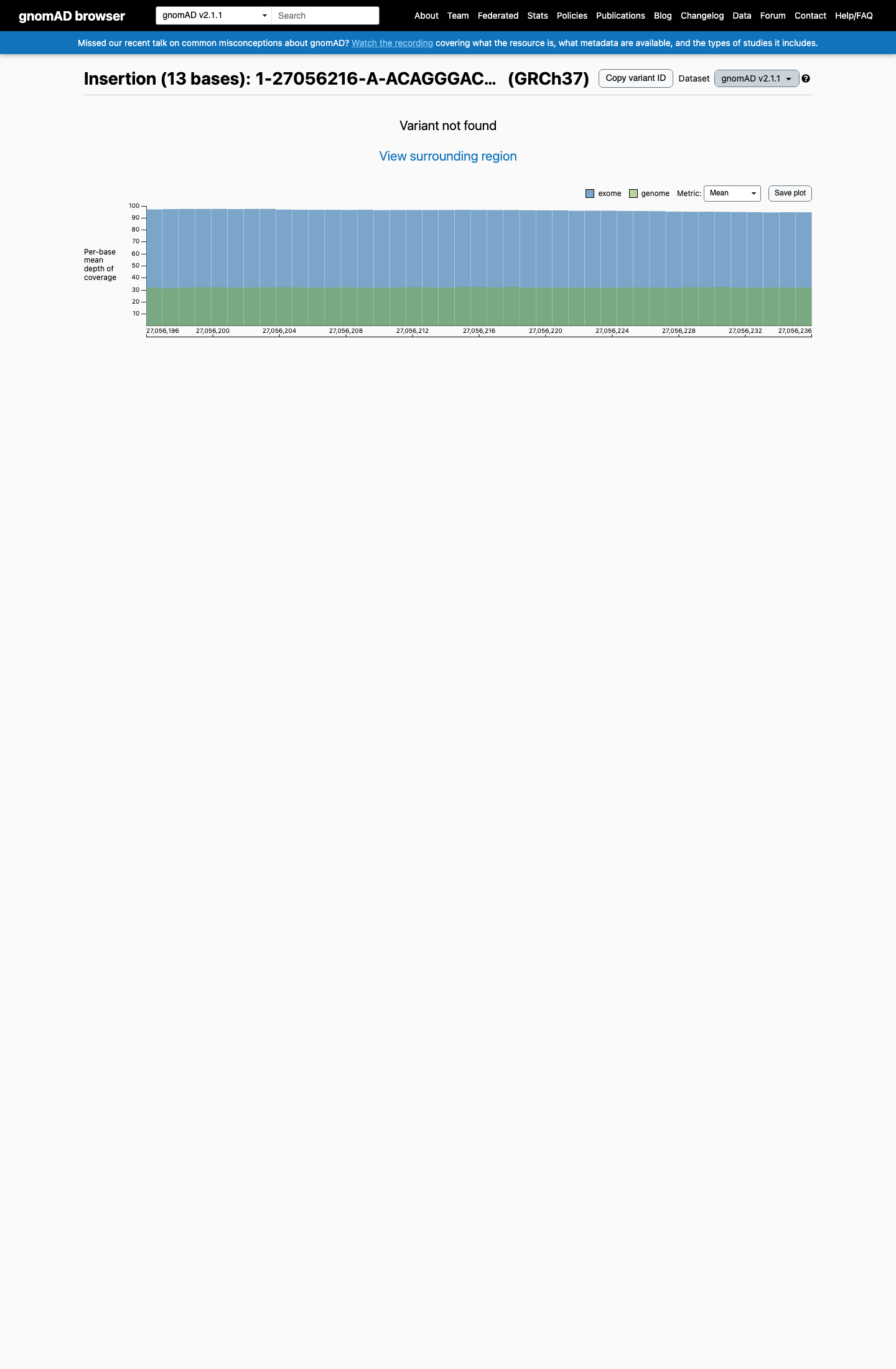
Met (Supporting): the exact 13-bp duplication is absent from gnomAD v2.1, v4.1, and gnomAD-Canada.
gnomAD v2.1 reports the exact variant as absent.gnomAD v4.1 reports the exact variant as absent.gnomAD-Canada v1.0 reports the exact variant as absent.