0%
complete
Final classification
VUS
PM2
ARID1A
c.673C>T
p.Pro225Ser
missense · exon 1

ARID1A encodes a component of the SWI/SNF chromatin-remodeling complex, which regulates gene expression by altering chromatin structure around target genes. It binds AT-rich DNA sequences and helps recruit the remodeling complex to its targets. Germline mutations in ARID1A cause Coffin-Siris syndrome, a condition marked by developmental delay and coarse facial features. ARID1A also acts as a tumor suppressor in several cancer types, including gynecologic cancers, ovarian clear cell carcinomas, and endometrial cancers.

This variant

ARID1A encodes a SWI/SNF chromatin-remodeling complex component involved in gene regulation and is associated with Coffin-Siris syndrome when altered in the germline.

Transcript
NM_006015.5
HGVS · transcript:coding
NM_006015.5:c.673C>T
GRCh38
chr1:26697076 C>T
GRCh37
chr1:27023567 C>T
VUS: PM2 (supporting) for extreme rarity is the only applied criterion and does not meet generic ACMG/AMP thresholds for a definitive classification.
Classification rationale
PM2 VUS
ARID1A c.673C>T missense · exon 1

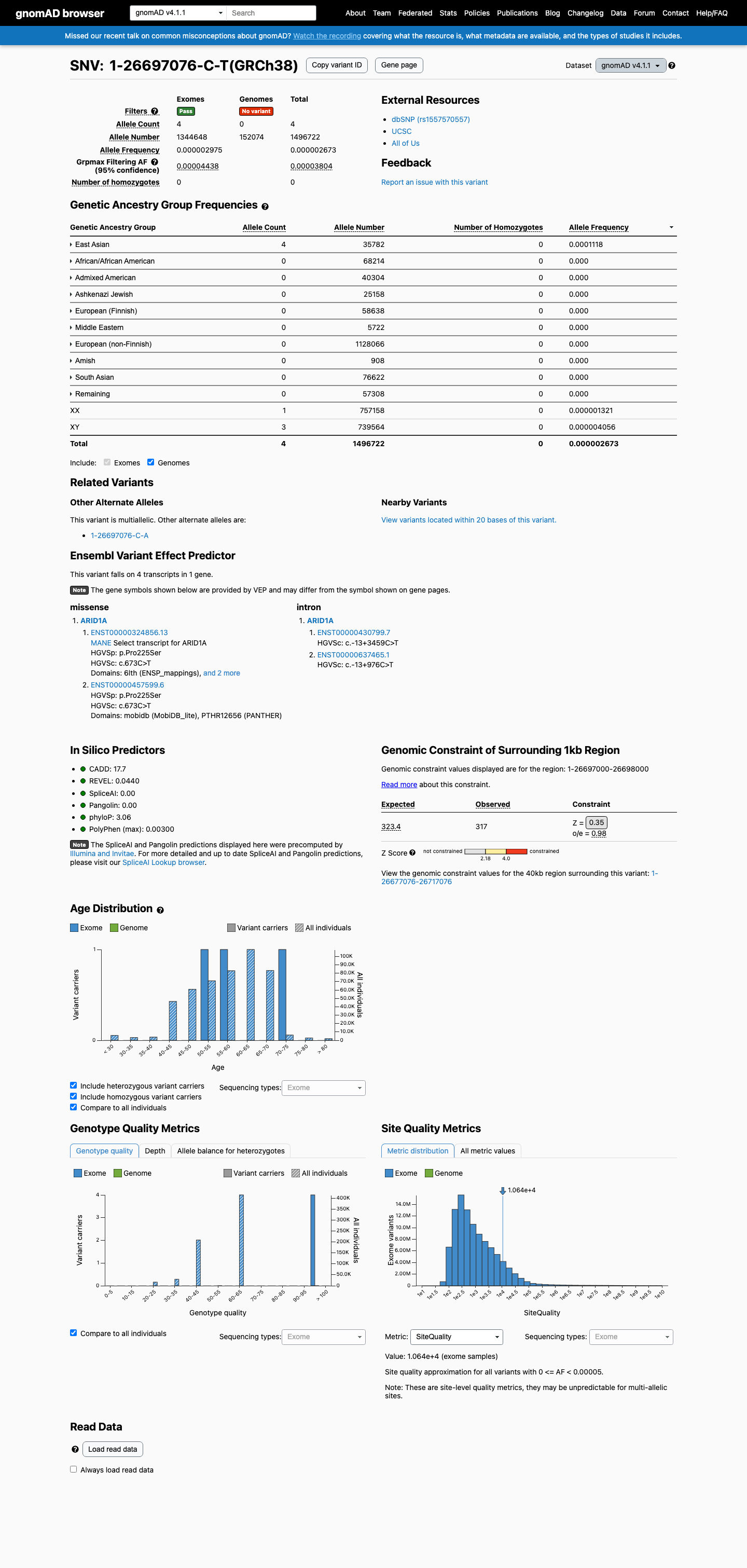
PM2 supporting: gnomAD v4.1 shows extreme rarity at 4/1,496,722 alleles (AF 2.67251e-06) with zero homozygotes.

PM2 VUS
Gene diagram · NM_006015.5 · variants mapped to exon structure
ARID1A NM_006015.5
Fetching transcript structure from UCSC…
Applied criteria · 1 applied · 23 assessed
MetEvidence satisfies this criterion.
Not metEvaluated against available evidence; threshold not reached.
Not assessedApplies in principle, but no evidence was found to evaluate it.
N/ADoesn't apply to this variant type.
Applied · 1
Strength Supporting Moderate Strong Very strong
PM2 supporting Pathogenic
Met at supporting strength: gnomAD v4.1 shows 4/1,496,722 alleles (AF 2.67251e-06), zero homozygotes, and grpmax FAF 3.804e-05.
No official CSPEC/VCEP or local ARID1A-specific population framework was available; generic ACMG/AMP criteria were used.gnomAD v2.1 exomes: variant absent.The case data report absence from gnomAD v2.1 non-cancer and gnomAD v3.1 non-cancer subset queries.
Assessed · not applied · 6 not met · 17 not assessed
Pathogenic
PS1 Not assessed: no validated pathogenic comparator producing the same p.Pro225Ser amino-acid change was identified.
PS2 Not assessed: no proband phenotype, parental genotypes, maternity/paternity confirmation, or independent confirmed de novo observations are documented.
PS3 Not assessed: no variant-specific validated functional assay, assay controls, or quantitative result was available to support a damaging functional conclusion.
PS4 Not assessed: no exact-variant case-control counts or enrichment statistic are available to establish increased prevalence of ARID1A c.673C>T.
PM1 Not assessed: hotspot evidence is negative, while no authoritative ARID1A domain boundaries establish whether residue 225 is functionally critical.
PM3 Not assessed: no affected proband, second pathogenic variant, phase information, or inheritance mode is documented for the tested ARID1A variant.
PM5 Not assessed: no validated pathogenic alternate missense variant at ARID1A residue 225 was available for PM5 comparison.
PM6 Not assessed: no affected-proband de novo observation or parental testing is documented, so presumed de novo evidence cannot be evaluated.
PP1 Not assessed: no relatives, informative meioses, pedigree, or variant–phenotype segregation data are reported.
PP2 Not met: ARID1A missense mechanism is unestablished, and gnomAD v4.1 shows AF 2.67251e-06 without proving PP2's gene-level requirement.
PP3 Not assessed: the missense variant lacks an available calibrated REVEL or BayesDel score, while SpliceAI is not the applicable path for this exonic missense change.
PP4 Not assessed: no proband phenotype or disease-specific clinical presentation is available to evaluate phenotype specificity for ARID1A c.673C>T.
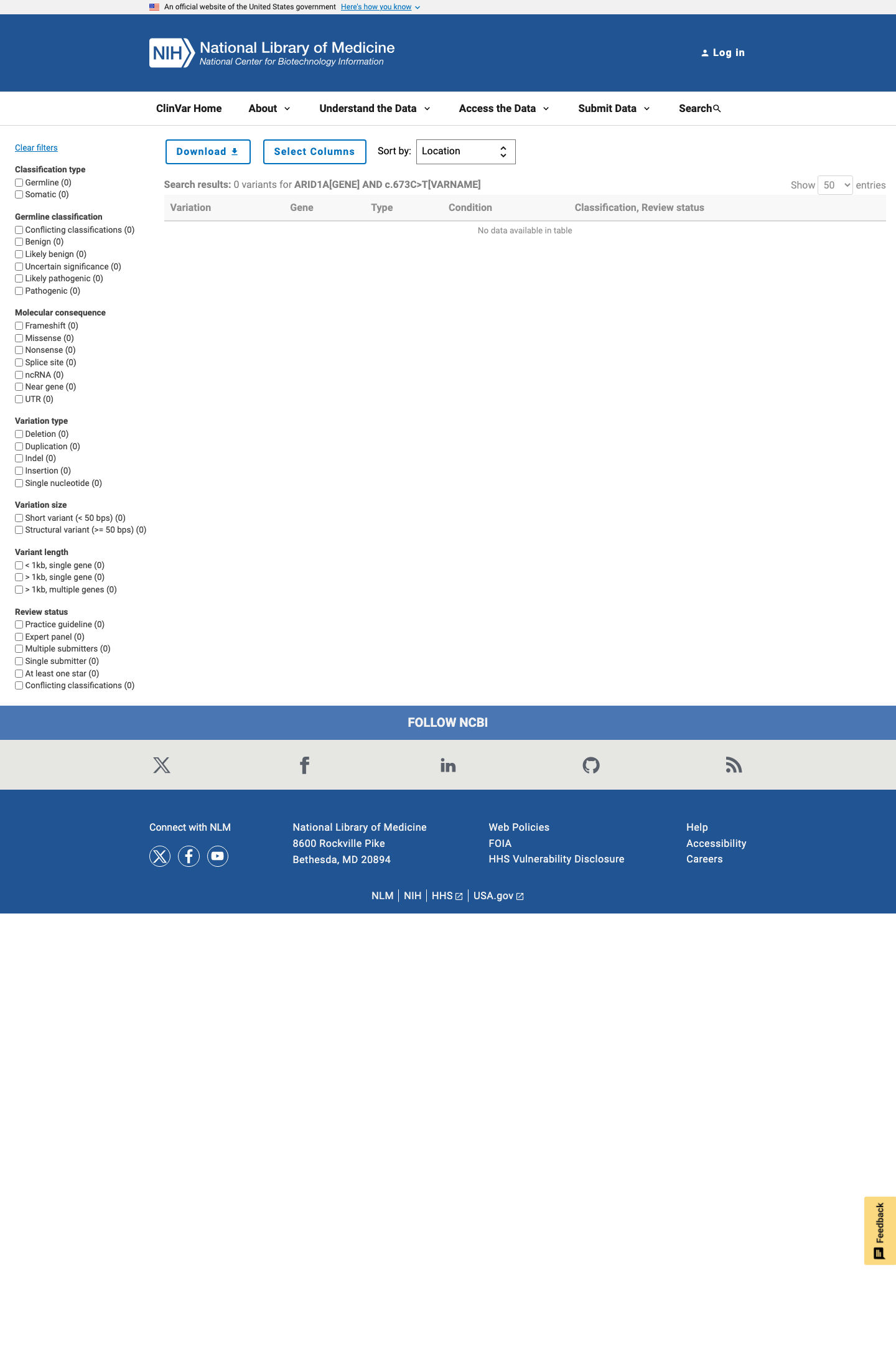
PP5 Not met: ClinVar has no record for this exact variant, so no expert-panel Pathogenic or Likely pathogenic classification exists to support PP5.
Benign
BA1 Not met: gnomAD v4.1 maximum reported population AF is 1.11788e-04, far below the generic BA1 threshold of 5%.
BS1 Not met: gnomAD v4.1 grpmax FAF is 3.804e-05, with no frequency evidence showing the variant is too common for a rare ARID1A disorder.
BS2 Not met: gnomAD v4.1 reports zero homozygotes and only 4 total alleles, providing no required healthy-adult observation pattern for BS2.
BS3 Not assessed: no variant-specific validated functional assay, assay controls, or quantitative result was available to support a benign functional conclusion.
BS4 Not assessed: no unaffected relatives with reliable phenotypes and genotypes are available to evaluate non-segregation.
BP1 Not assessed: ARID1A loss-of-function evidence does not quantify whether disease is predominantly truncating, and gnomAD AF is 2.67251e-06.
BP2 Not assessed: no paired pathogenic allele, family or proband observation, phase result, or inheritance mode is documented to evaluate BP2.
BP4 Not assessed: the missense variant lacks an available calibrated REVEL or BayesDel score, while SpliceAI is not the applicable path for this exonic missense change.
BP5 Not assessed: no alternate molecular diagnosis or other proband-level evidence is available to determine whether another cause explains the phenotype.
BP6 Not met: ClinVar has no record for this exact variant, so no expert-panel Benign or Likely benign classification exists to support BP6.
N/A · 4 PVS1 · PM4 · BP3 · BP7
Research & evidence
Population frequency
v4.1
This variant is present in gnomAD v4.1 (AF= 2.67251e-06; MAF= 0.00027%, 4/1496722 alleles, homozygotes = 0) and has highest observed frequency in the East Asian population (AF= 0.000111788; MAF= 0.01118%, 4/35782 alleles, homozygotes = 0); grpmax FAF= 3.804e-05.
v2.1
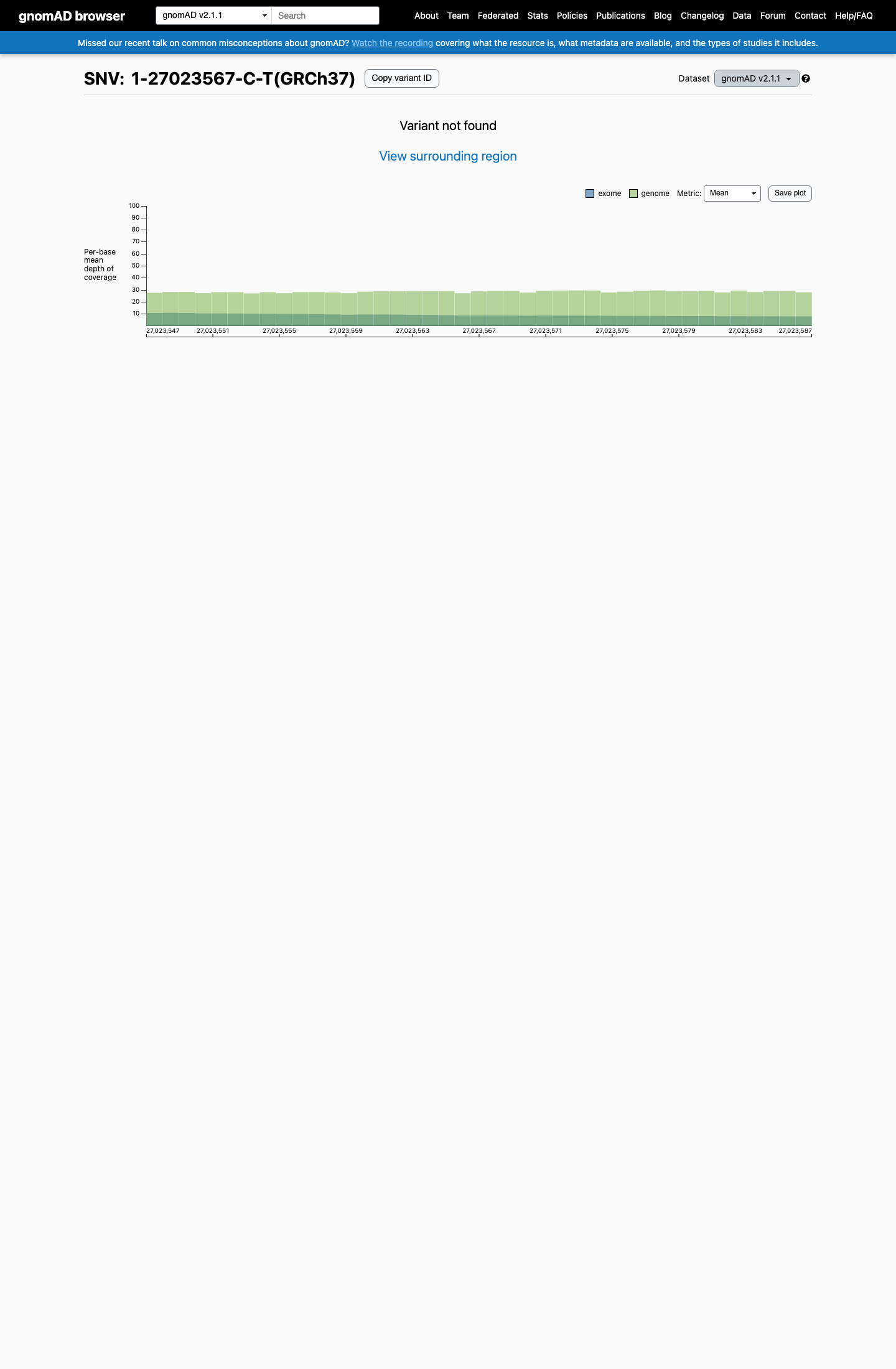
Absent from gnomAD v2.1.
🇨🇦 CA
Absent from gnomAD-Canada v1.0.
Allele frequency by ancestry
three datasets · side by side
gnomAD v4.1
0.00027% · 4 / 1,496,722
0 hom · FAF 0.0038%
East Asian
4 / 35,782
0.011%
+ 9 not observed (Remaining individuals, Admixed American, European (Finnish), Amish, Middle Eastern, South Asian, Ashkenazi Jewish, African/African American, European (non-Finnish))
gnomAD v2.1
Absent · 0 / ?
0 hom
Not observed in any ancestry group.
gnomAD Canada 🇨🇦
Absent · 0 / ?
0 hom
Not observed in any ancestry group.
ClinVar
This variant is absent from ClinVar.
In silico
SpliceAI predicts no significant splice impact for this variant (max delta score = 0.00).
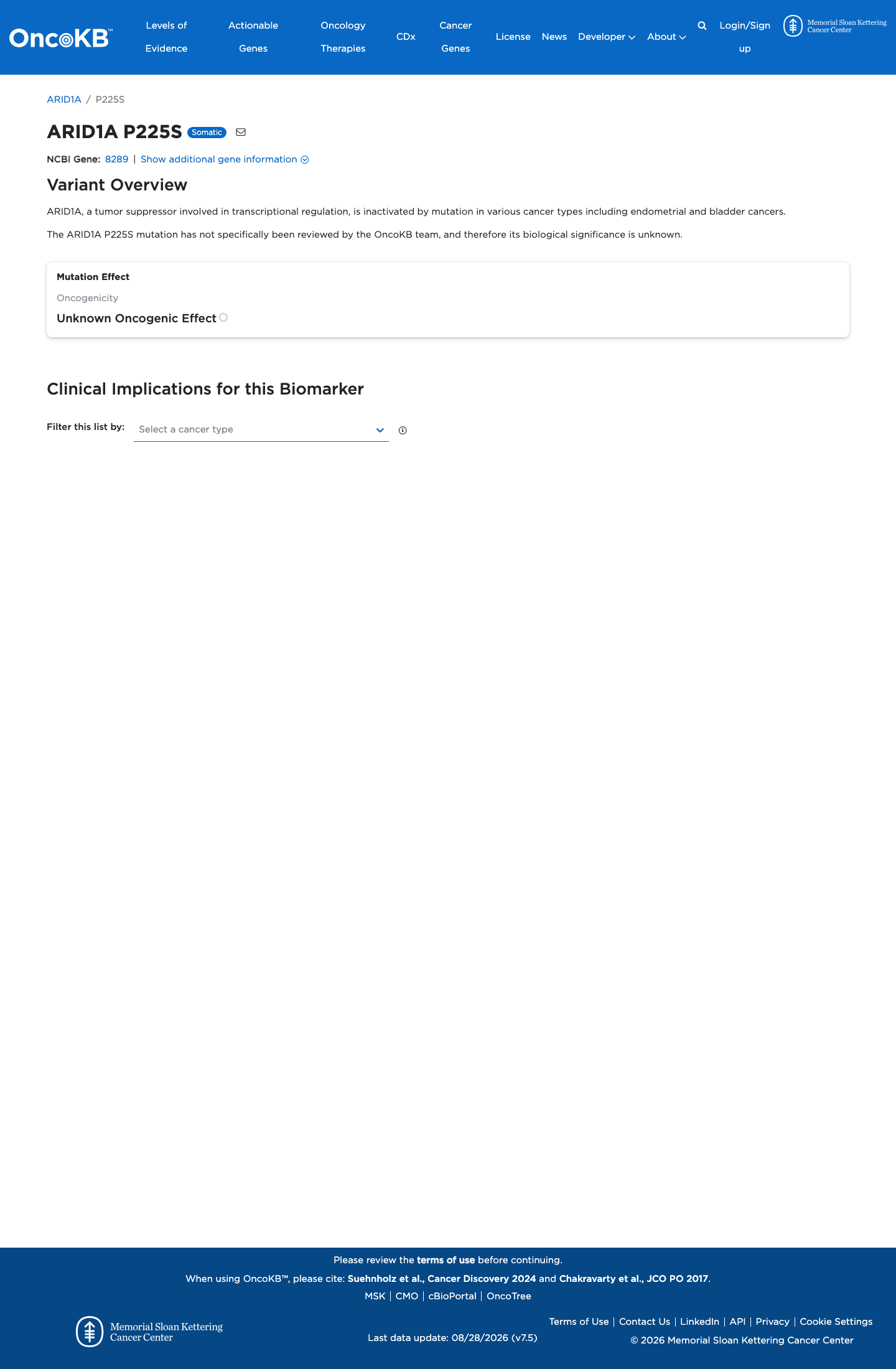
Functional Unknown Oncogenic Effect
OncoKB did not identify variant-specific reviewed functional evidence for this variant; gene-level curated context is available for reviewer follow-up. ARID1A, a tumor suppressor involved in transcriptional regulation, is inactivated by mutation in various cancer types including endometrial and bladde
OncoKB ↗
Somatic evidence Not in COSMIC / hotspots
COSMIC
This variant does not lie in a statistically significant hotspot. This variant has not previously been reported in somatic cancers (COSMIC).
Hotspots
This variant does not lie in a statistically significant hotspot.
Sources & reference links
8Sources
ClinVar
gnomAD v2.1
gnomAD v4.1
gnomAD-Canada
SpliceAI
OncoKB
COSMIC
Cancer hotspots