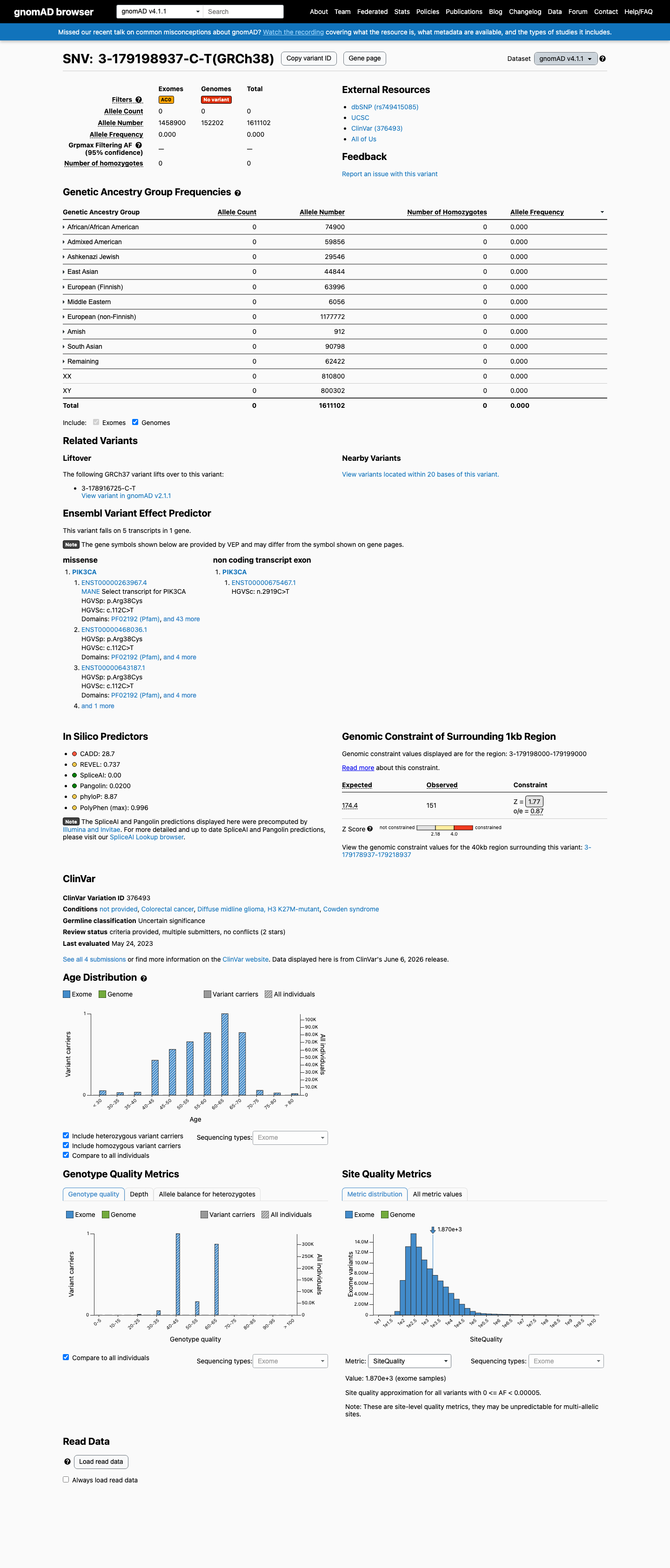
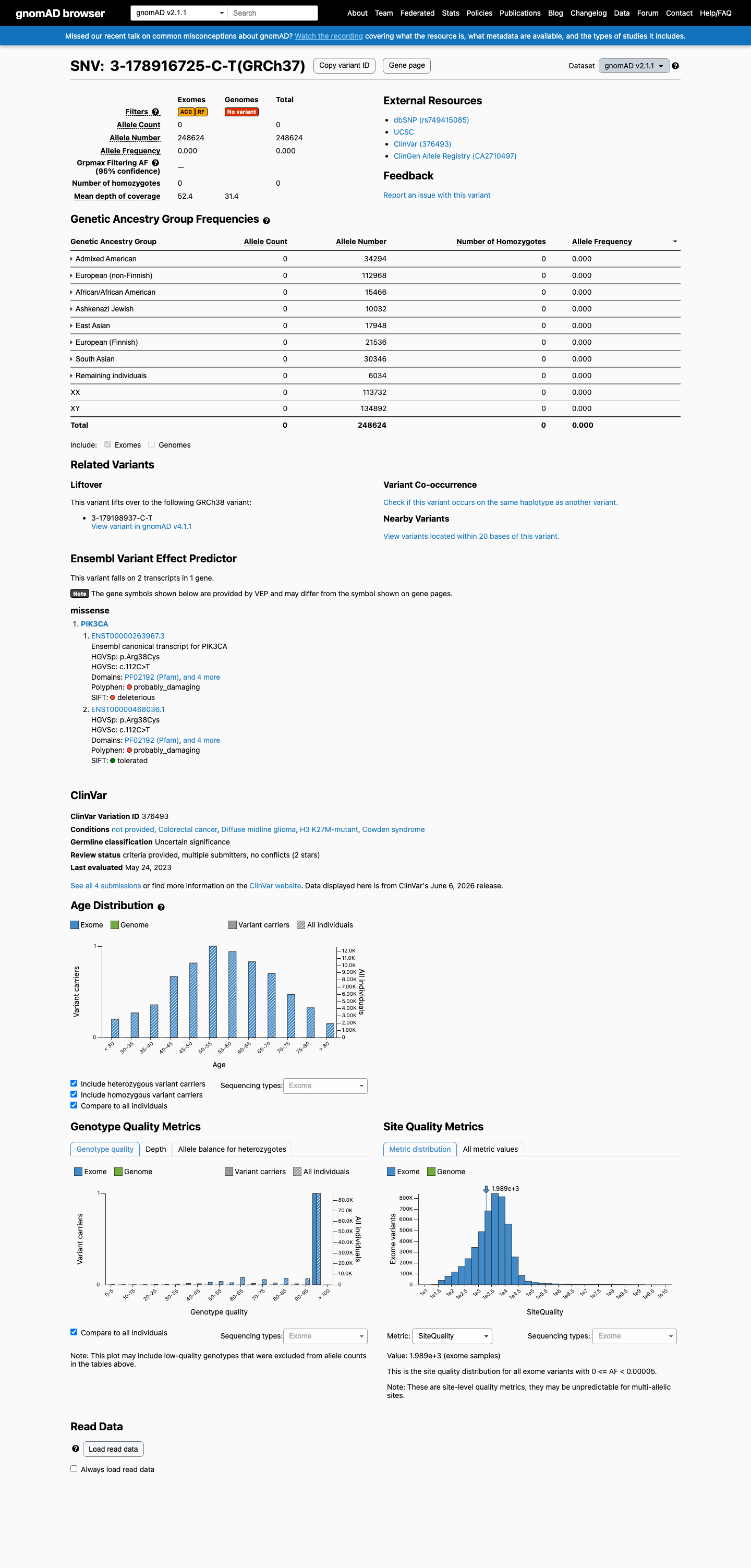
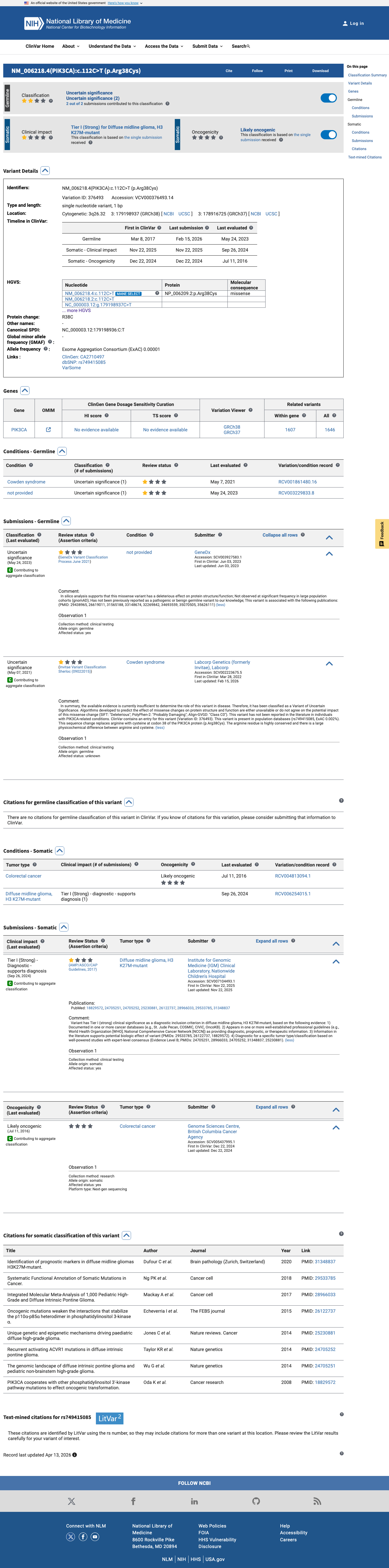
This variant is completely absent from population databases including gnomAD v2.1 (0/248,624 alleles) and gnomAD v4.1 (0/1,611,102 alleles), meeting PM2_Supporting per the Brain Malformations VCEP.1 No other pathogenic or benign criteria are met under the Brain Malformations VCEP v1.1.0 framework. PVS1, PP3, PP4, PP5, BS4, PM6, BP1, BP4, BP6, BP7, and PP1 are explicitly not applicable per the VCEP. Most remaining criteria lack variant-specific evidence in the published literature.2 OncoKB curates p.Arg38Cys as Likely Oncogenic with Likely Gain-of-function biological context; however, no variant-specific functional data was identified in the reviewed full-text publications, and the Brain Malformations VCEP PS3 criterion requires validated functional assays meeting specific quality metrics.3 This variant has been reported in ClinVar as Uncertain significance by two clinical laboratories (ClinVarID 376493). No de novo reports, segregation data, or brain malformation phenotype cases were identified.4 Variant has been observed in somatic cancers (COSMIC, n=39 occurrences) but this does not independently support germline brain malformation pathogenicity under the VCEP PS4 framework.
Final classification
VUS
PM2
PIK3CA
c.112C>T
p.Arg38Cys
This variant
This variant is completely absent from population databases including gnomAD v2.1 (0/248,624 alleles) and gnomAD v4.1 (0/1,611,102 alleles), meeting PM2_Supporting per the Brain Malformations VCEP.
Brain Malformations Specification Tavtigian point framework v1.1.0 point-based framework: PM2 supporting (+1) = 1 points, which maps to VUS.
Classification rationale
PM2
VUS
PIK3CA c.112C>T
PM2
→
VUS
LYFE Sciences is an AI system, and it can make mistakes. Criteria
may be applied incorrectly, sources may be misread, and a confident-looking
classification can still be wrong. Double-check every criterion and
its underlying evidence before relying on any call.
Gene diagram
· NM_006218.4 · variants mapped to exon structure
PIK3CA
NM_006218.4
Fetching transcript structure from UCSC…
Applied criteria · 1 applied · 13 assessed
MetEvidence satisfies this criterion.
Not metEvaluated against available evidence; threshold not reached.
Not assessedApplies in principle, but no evidence was found to evaluate it.
N/ADoesn't apply to this variant type.
Applied · 1
Strength
Supporting
Moderate
Strong
Very strong
PM2
supporting
Pathogenic
This variant is completely absent from all gnomAD population databases: gnomAD v2.1 (0/248,624 alleles), gnomAD v4.1 (0/1,611,102 alleles), and gnomAD-Canada v1.0. Per the Brain Malformations VCEP, PM2_Supporting is awarded when the variant is absent or rare (≤1) in ethnically-matched population cohorts.
gnomAD v2.1: 0/248624 allelesgnomAD v4.1: 0/1
Assessed · not applied
· 8 not met · 5 not assessed
Pathogenic
PS1
No previously established pathogenic variant causing the same amino acid change (p.Arg38Cys) via a different nucleotide change was identified.
PS2
No de novo observation of this variant has been identified in any reviewed publication or ClinVar submission.
PS3
No variant-specific functional data confirming a damaging effect was identified in any reviewed full-text publication.
PS4
No published cases of this variant in individuals with brain malformation phenotypes were identified in the reviewed literature.
PM1
Residue Arg38 lies outside the Table 4 PIK3CA critical functional domains (kinase domain AA 322–483 and AA 797–1068) per the Brain Malformations VCEP.
PM5
No pathogenic comparator variant at residue Arg38 was identified in ClinVar or the literature.
PP2
The Brain Malformations VCEP specifies PP2_Supporting for PIK3CA if the missense constraint z-score from ExAC/gnomAD exceeds 3.09.
Benign
BA1
Variant is completely absent from all gnomAD populations (0/248,624 in v2.1, 0/1,611,102 in v4.1).
BS1
Variant is completely absent from all gnomAD populations.
BS2
No homozygotes present in gnomAD (0/248,624 in v2.1, 0/1,611,102 in v4.1) and no well-phenotyped heterozygous family members without disease have been reported.
BS3
No well-established in vitro or in vivo functional studies demonstrate a benign effect.
BP2
No evidence that this variant has been observed in cis or in trans with a known pathogenic variant in PIK3CA.
BP5
No evidence that this variant has been found in a case with an alternative molecular basis for disease.
N/A · 11
PVS1 · PM6 · PP1 · PP3 · PP4 · PP5 · BS4 · BP1 · BP4 · BP6 · BP7
Research & evidence
Population frequency
gnomAD v4.1
gnomAD v2.1
v4.1
This variant is present in gnomAD v4.1 (AF= 0; MAF= 0.00000%, 0/1611102 alleles, homozygotes = 0) and has highest observed frequency in the African/African American population (AF= 0; MAF= 0.00000%, 0/74900 alleles, homozygotes = 0).
v2.1
This variant is present in gnomAD v2.1 (AF= 0; MAF= 0.00000%, 0/248624 alleles, homozygotes = 0) and has highest observed frequency in the African/African American population (AF= 0; MAF= 0.00000%, 0/15466 alleles, homozygotes = 0).
🇨🇦 CA
Absent from gnomAD-Canada v1.0.
Allele frequency by ancestry
three datasets · side by side
gnomAD v4.1
Absent
· 0 / 1,611,102
0 hom
0 hom
Not observed in any ancestry group.
+ 10 not observed (Remaining individuals, Admixed American, European (Finnish), Amish, East Asian, Middle Eastern, South Asian, Ashkenazi Jewish, African/African American, European (non-Finnish))
gnomAD v2.1
Absent
· 0 / 248,624
0 hom
0 hom
Not observed in any ancestry group.
+ 8 not observed (African/African American, Admixed American, Ashkenazi Jewish, East Asian, European (Finnish), European (non-Finnish), Remaining individuals, South Asian)
gnomAD Canada 🇨🇦
Absent
· 0 / ?
0 hom
0 hom
Not observed in any ancestry group.
ClinVar
This variant has been reported in ClinVar as Uncertain significance (2 clinical laboratories). (ClinVarID = 376493)
In silico
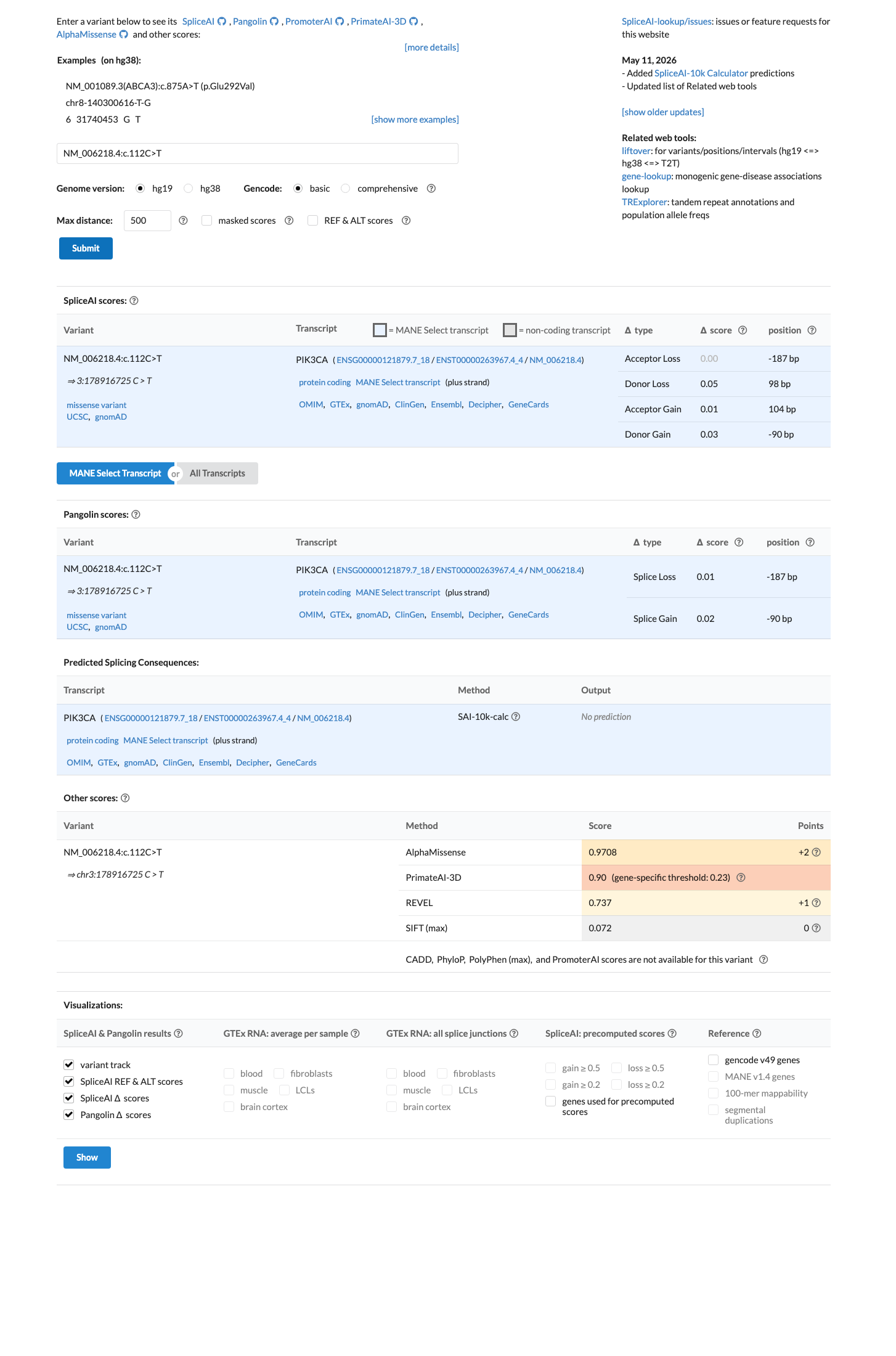
SpliceAI predicts no significant splice impact for this variant (max delta score = 0.05). REVEL score = 0.737. BayesDel score = 0.244629.
Functional
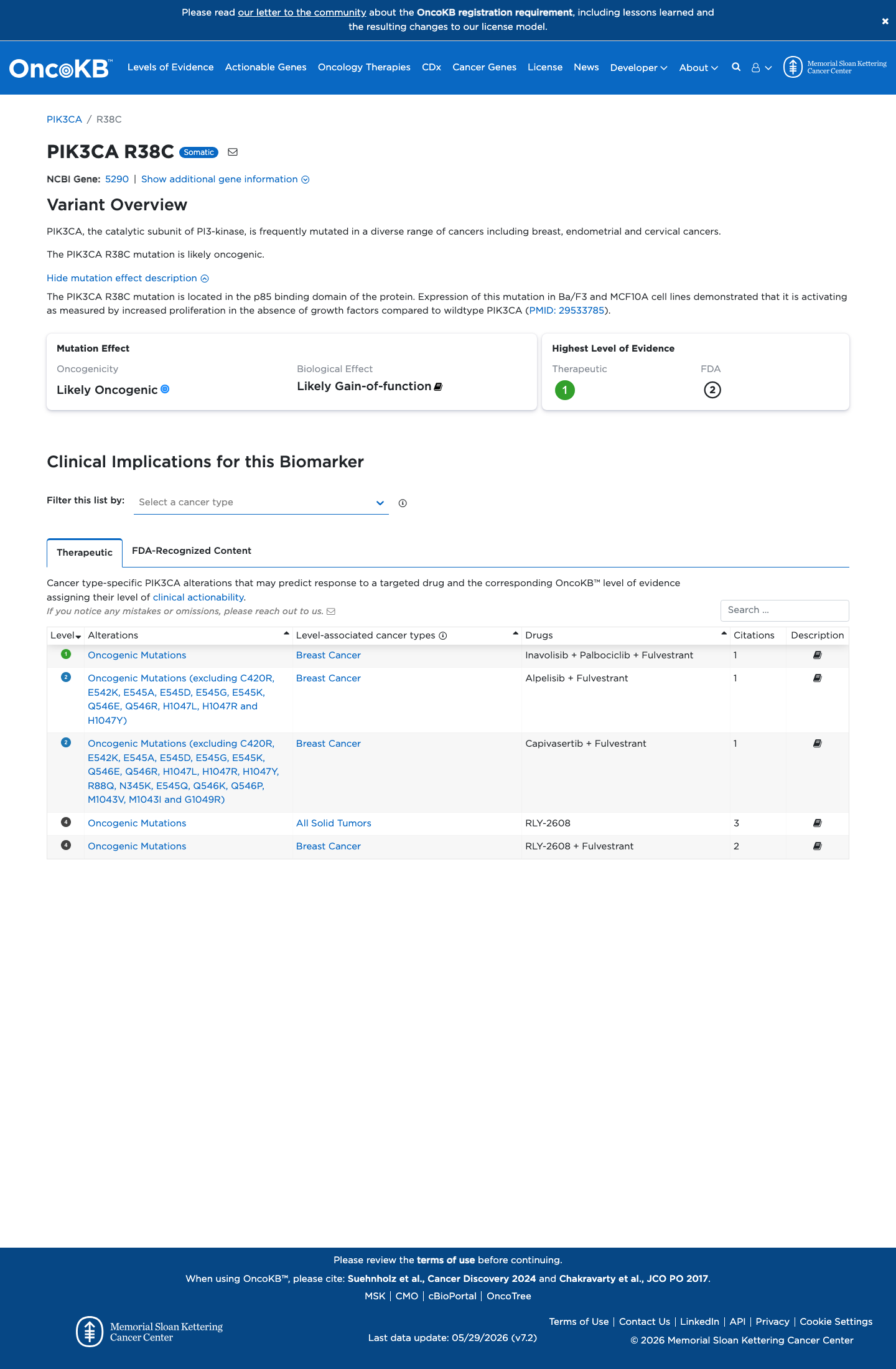
Likely Oncogenic
OncoKB identified variant-specific curated literature and context relevant to functional review; biological-effect context: Likely Gain-of-function; curated oncogenicity label: Likely Oncogenic.
COSMIC

Cancer hotspots
Somatic evidence
Hotspot
COSMIC
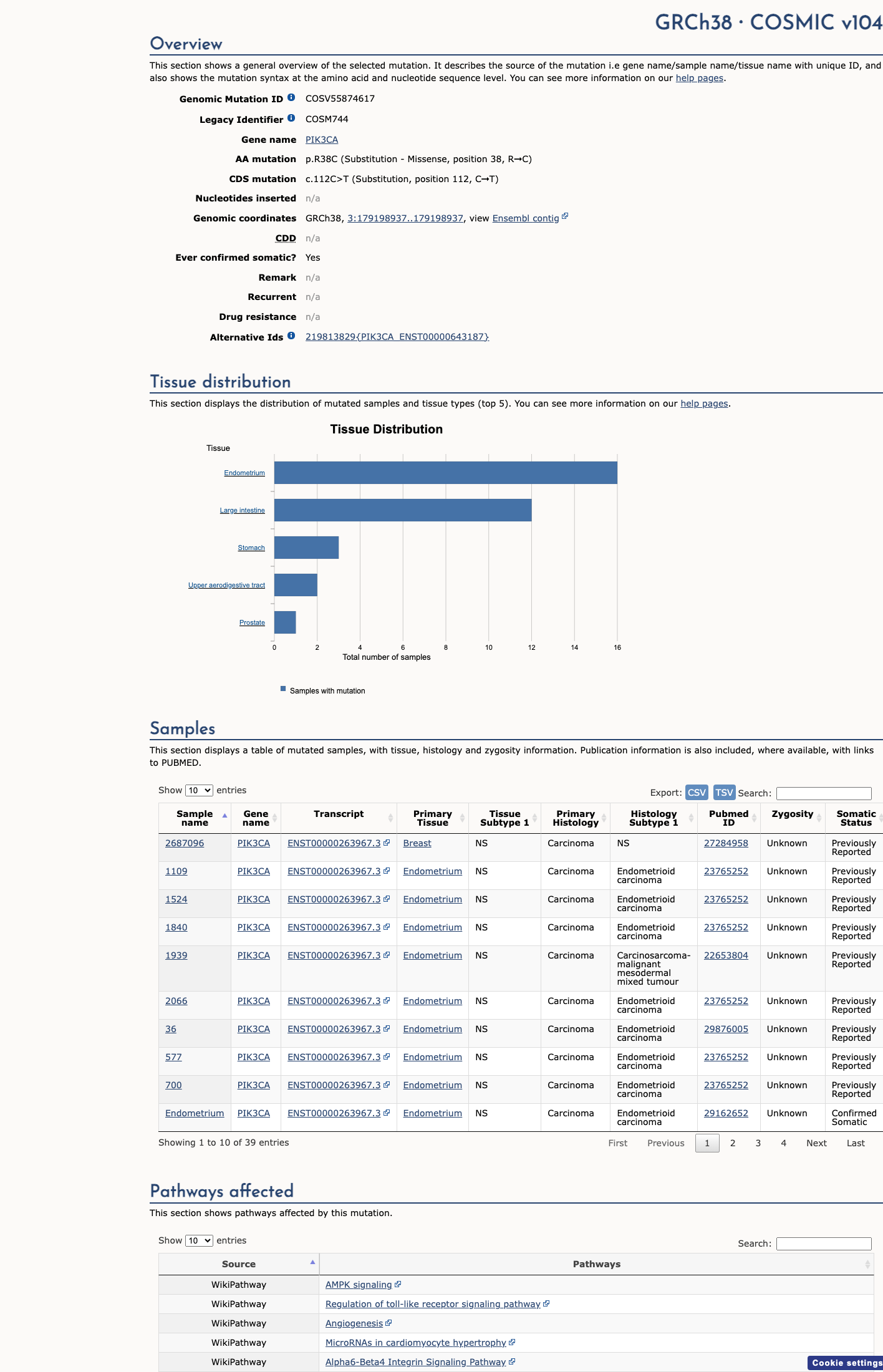
This variant lies in a statistically significant hotspot. This variant has previously been reported in somatic cancers (COSMIC; COSV55874617, n = 39 times).
Hotspots
This variant lies in a statistically significant hotspot.
Sources & reference links
9Sources
Triaged references · 6 PMIDs not cited in assessment
26122737 ↗
Oncogenic mutations weaken the interactions that stabilize the p110α-p85α heterodimer in phosphatidylinositol 3-kinase α.
CLINVAR
28966033 ↗
Integrated Molecular Meta-Analysis of 1,000 Pediatric High-Grade and Diffuse Intrinsic Pontine Glioma.
CLINVAR
26389258 ↗
Cancer Genetics Risk Assessment and Counseling (PDQ®): Health Professional Version.
CLINVAR