NM_006218.4:c.2850A>G (p.Glu950=) is a synonymous variant in PIK3CA exon 20. The ClinGen Brain Malformations VCEP (v1.1) framework was applied for criterion adjudication.1 The variant falls within the C-terminal kinase domain (AA 797-1068), a Table 4 critical functional domain for PIK3CA per the VCEP specification, meeting PM1 at Supporting strength.2 The variant is extremely rare in population databases: gnomAD v2.1 AF=0.00080% (2/248,508 alleles), gnomAD v4.1 AF=0.00006% (1/1,611,758 alleles), with zero homozygotes. PM2 is met at Supporting strength under VCEP rules.3 PVS1, PS1, PM5, PM6, PP1, PP2, PP3, PP4, PP5, BS4, BP1, BP6, and BP3 are not applicable under the VCEP framework or due to the synonymous nature of the variant.4 SpliceAI predicts no significant splicing impact (max delta=0.05), but BP4 requires two of three tools (varSEAK, SpliceAI, MaxEntScan) per VCEP specifications; only SpliceAI is available. BP7 requires a PhyloP score <0.1, which is not available. Both BP4 and BP7 remain not assessed.5 No functional studies, de novo reports, case observations, or segregation data were identified for this synonymous variant. PS2, PS3, PS4, BS2, BS3, BP2, and BP5 are not met.6 With PM1_Supporting (+1) and PM2_Supporting (+1), the total points sum to +2. Per the VCEP Tavtigian point-combination framework (Pathogenic ≥10, Likely Pathogenic 6-9, VUS 0-5, Likely Benign -6 to -1, Benign <-6), a score of +2 falls within the VUS (0-5) range.7
Final classification
VUS
PM1PM2
PIK3CA
c.2850A>G
p.Glu950=
This variant
NM_006218.4:c.2850A>G (p.Glu950=) is a synonymous variant in PIK3CA exon 20. The ClinGen Brain Malformations VCEP (v1.1) framework was applied for criterion adjudication.
ClinGen Brain Malformations Expert Panel Specifications to the ACMG/AMP Variant Interpretation Guidelines Version 1.1 v1.1 lacked a usable explicit final combination framework, so generic ACMG/AMP 2015 final-combination rules were applied as fallback; applied criteria: PM1 supporting, PM2 supporting; combination = 2 supporting, which maps to VUS.
Classification rationale
PM1PM2
VUS
PIK3CA c.2850A>G
PM1 + PM2
→
VUS
LYFE Sciences is an AI system, and it can make mistakes. Criteria
may be applied incorrectly, sources may be misread, and a confident-looking
classification can still be wrong. Double-check every criterion and
its underlying evidence before relying on any call.
Gene diagram
· NM_006218.4 · variants mapped to exon structure
PIK3CA
NM_006218.4
Fetching transcript structure from UCSC…
Applied criteria · 2 applied · 11 assessed
MetEvidence satisfies this criterion.
Not metEvaluated against available evidence; threshold not reached.
Not assessedApplies in principle, but no evidence was found to evaluate it.
N/ADoesn't apply to this variant type.
Applied · 2
Strength
Supporting
Moderate
Strong
Very strong
PM1
supporting
Pathogenic
Residue 950 (Glu950) falls within the C-terminal kinase domain (AA 797-1068) defined in Table 4 of the ClinGen Brain Malformations VCEP specification (v1.1) as a critical functional domain for PIK3CA. Under this VCEP, PM1 is awarded at Supporting strength for residues located within approved Table 4 domains, independent of hotspot recurrence.
VCEP Table 4 approved PIK3CA kinase domain: AA 797-1068. Residue E950 is within this interval. Domain membership established.
PM2
supporting
Pathogenic
This variant is extremely rare in population databases. In gnomAD v2.1, it is present at AF=0.00080% (2/248,508 alleles) and in gnomAD v4.1 at AF=0.00006% (1/1,611,758 alleles), with zero homozygotes in both datasets. The highest subpopulation frequency is 0.00177% in European (non-Finnish) in v2.1. Under the VCEP, PM2 is awarded at Supporting strength for variants absent or rare (≤1 person) in ethnically-matched controls. The pooled allele count across datasets supports PM2 at supporting level.
gnomAD v2.1: 2/248508 (AF 8.05e-06)0 hom. gnomAD v4.1: 1/1
Assessed · not applied
· 9 not met · 2 not assessed
Pathogenic
PS2
VCEP PS2 requires de novo evidence with confirmed maternity/paternity plus tissue differential allele fraction (strong) or at minimum criterion 1 alone (moderate).
PS3
No functional studies were identified for NM_006218.4:c.2850A>G, a synonymous variant.
PS4
VCEP PS4 requires phenotype point assignment (Tables 2A/2B) and is dependent on PM2 being met first for absent/rare in controls.
Benign
BA1
VCEP BA1 threshold is allele frequency >0.0926%.
BS1
VCEP BS1 threshold is allele frequency >0.0185%.
BS2
VCEP BS2 requires ≥3 homozygotes in gnomAD or ≥3 heterozygous in well-phenotyped family members.
BS3
No well-established in vitro or in vivo functional studies demonstrating no damaging effect on protein function or splicing exist for this variant.
BP2
BP2 requires observation of this variant in cis or trans with a known pathogenic variant in the same gene.
BP4
VCEP BP4 requires two out of three splicing prediction tools (varSEAK, SpliceAI, MaxEntScan) to predict no impact on splicing.
BP5
BP5 requires evidence that the variant is found in a case with an alternate molecular basis for disease.
BP7
VCEP BP7 is applicable to synonymous variants and requires a PhyloP score <0.1 indicating the nucleotide is non-conserved.
N/A · 12
PVS1 · PS1 · PM5 · PM6 · PP1 · PP2 · PP3 · PP4 · PP5 · BS4 · BP1 · BP6
Research & evidence
Population frequency
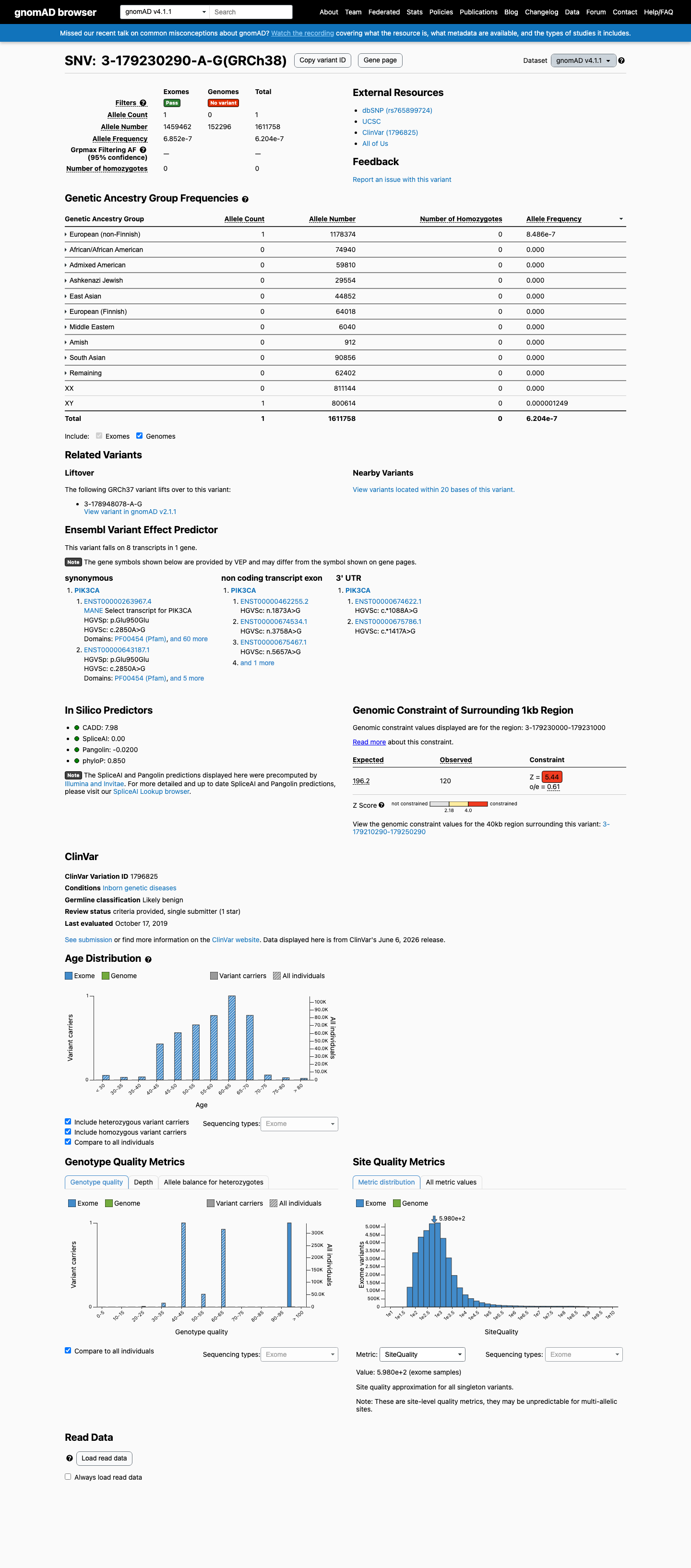
gnomAD v4.1
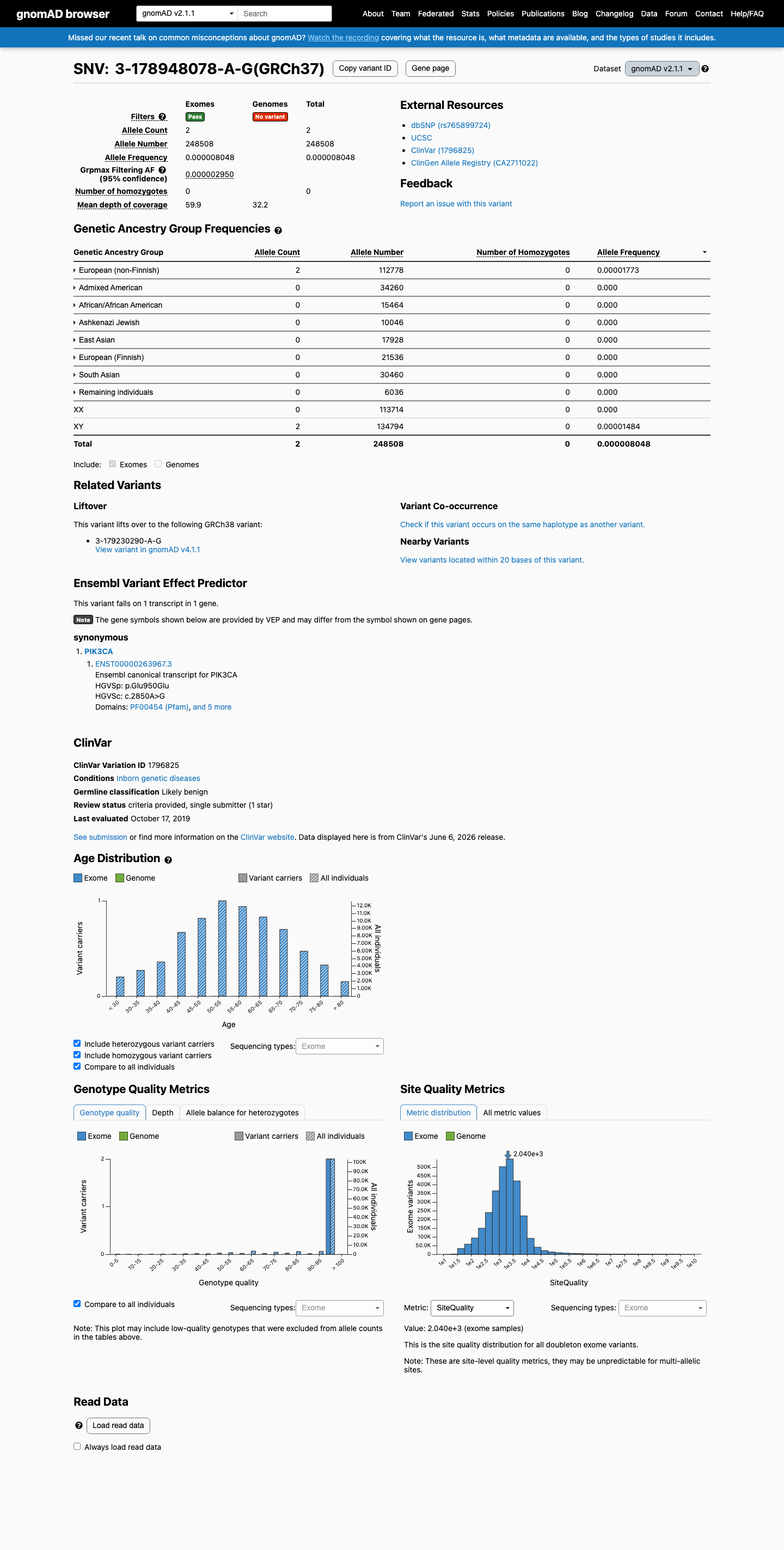
gnomAD v2.1
v4.1
This variant is present in gnomAD v4.1 (AF= 6.20441e-07; MAF= 0.00006%, 1/1611758 alleles, homozygotes = 0) and has highest observed frequency in the European (non-Finnish) population (AF= 8.48627e-07; MAF= 0.00008%, 1/1178374 alleles, homozygotes = 0).
v2.1
This variant is present in gnomAD v2.1 (AF= 8.04803e-06; MAF= 0.00080%, 2/248508 alleles, homozygotes = 0) and has highest observed frequency in the European (non-Finnish) population (AF= 1.7734e-05; MAF= 0.00177%, 2/112778 alleles, homozygotes = 0); grpmax FAF= 2.95e-06.
🇨🇦 CA
Absent from gnomAD-Canada v1.0.
Allele frequency by ancestry
three datasets · side by side
gnomAD v4.1
6.2e-05%
· 1 / 1,611,758
0 hom
0 hom
European (non-Finnish) 1 / 1,178,374 |
8.5e-05% |
+ 9 not observed (Remaining individuals, Admixed American, European (Finnish), Amish, East Asian, Middle Eastern, South Asian, Ashkenazi Jewish, African/African American)
gnomAD v2.1
0.0008%
· 2 / 248,508
0 hom · FAF 0.0003%
0 hom · FAF 0.0003%
European (non-Finnish) 2 / 112,778 |
0.0018% |
+ 7 not observed (African/African American, Admixed American, Ashkenazi Jewish, East Asian, European (Finnish), Remaining individuals, South Asian)
gnomAD Canada 🇨🇦
Absent
· 0 / ?
0 hom
0 hom
Not observed in any ancestry group.
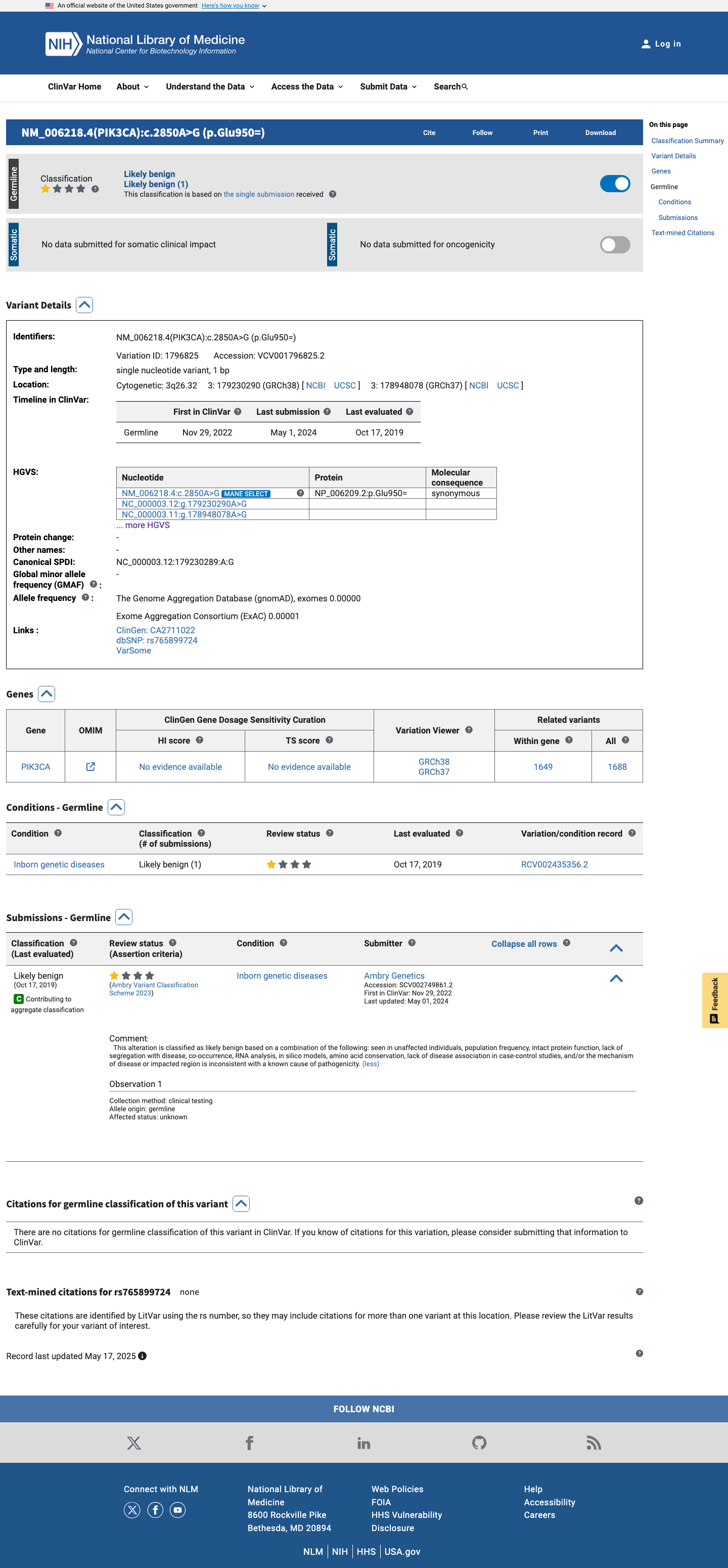
ClinVar
This variant has been reported in ClinVar as Likely benign (1 clinical laboratory). (ClinVarID = 1796825)
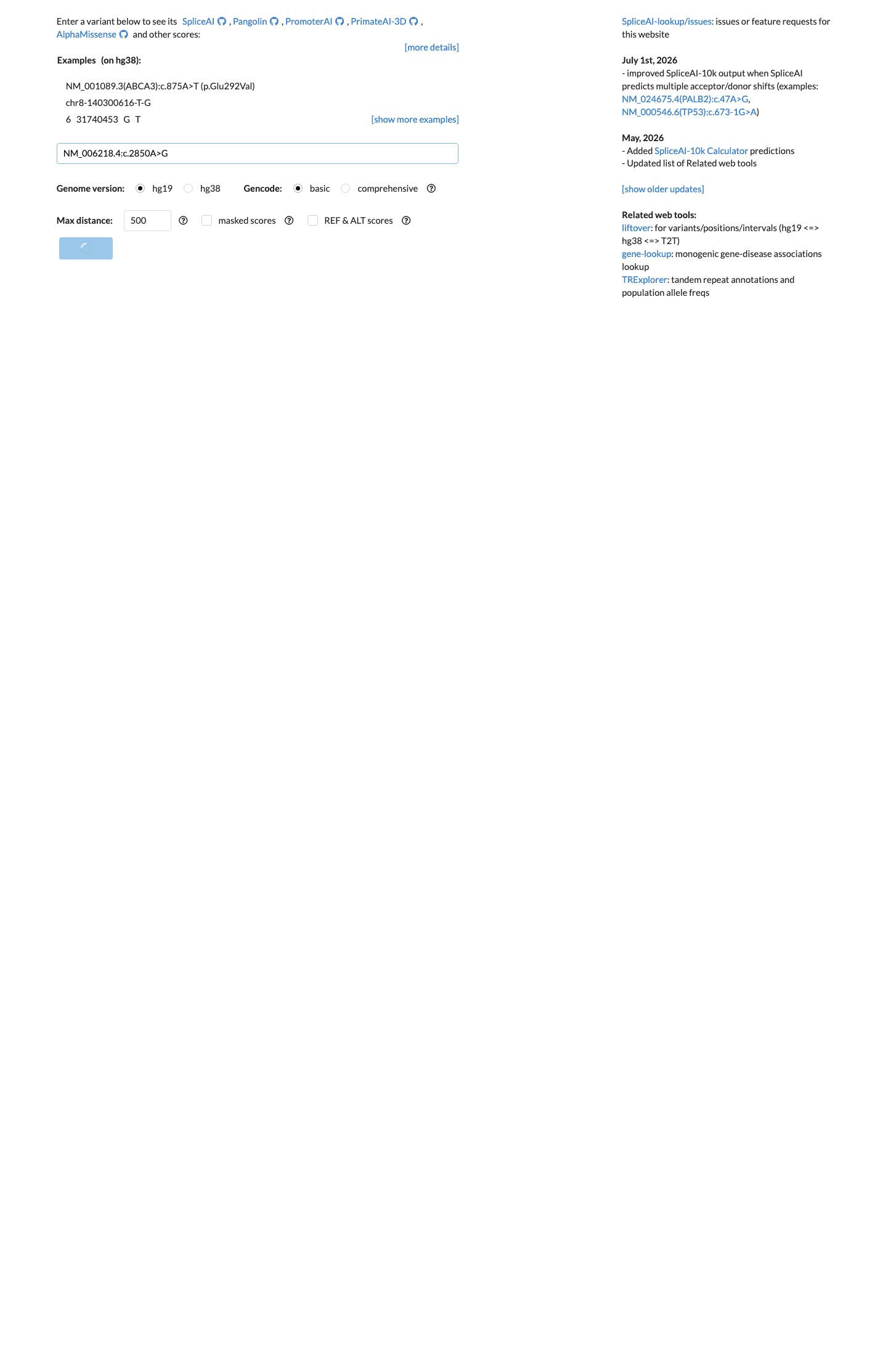
In silico
SpliceAI predicts no significant splice impact for this variant (max delta score = 0.05).
Functional
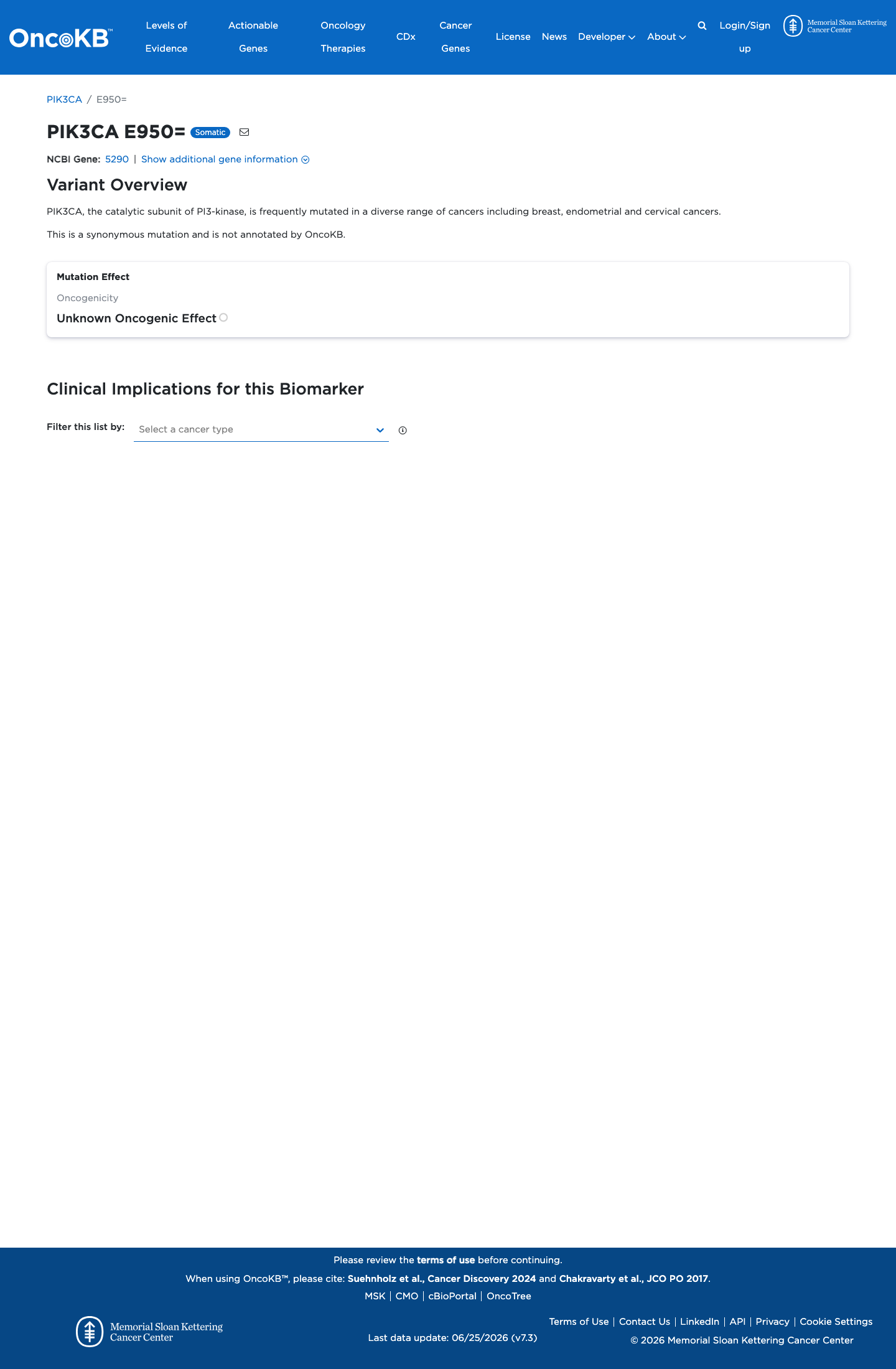
Unknown Oncogenic Effect
OncoKB identified curated literature and non-variant-specific oncogenicity context for review; listed oncogenicity label: Unknown Oncogenic Effect.

COSMIC

Cancer hotspots
Somatic evidence
Not in COSMIC / hotspots
COSMIC
This variant does not lie in a statistically significant hotspot. This variant has not previously been reported in somatic cancers (COSMIC).
Hotspots
This variant does not lie in a statistically significant hotspot.
Sources & reference links
9Sources
Triaged references · 5 PMIDs not cited in assessment
25730230 ↗
Expanded carrier screening in reproductive medicine-points to consider: a joint statement of the American College of Medical Genetics and Genomics, American College of Obstetricians and Gynecologists, National Society of Genetic Counselors, Perinatal Quality Foundation, and Society for Maternal-Fetal Medicine.
CLINVAR
23037933 ↗
Including the initial newborn screening bloodspot collection device serial number on birth certificates: basis and recommendations from the Secretary of Health and Human Services' Advisory Committee on Heritable Disorders in Newborns and Children.
CLINVAR
24022298 ↗
Offering prenatal diagnostic tests: European guidelines for clinical practice [corrected].
CLINVAR
24394680 ↗
Parental permission for pilot newborn screening research: guidelines from the NBSTRN.
CLINVAR