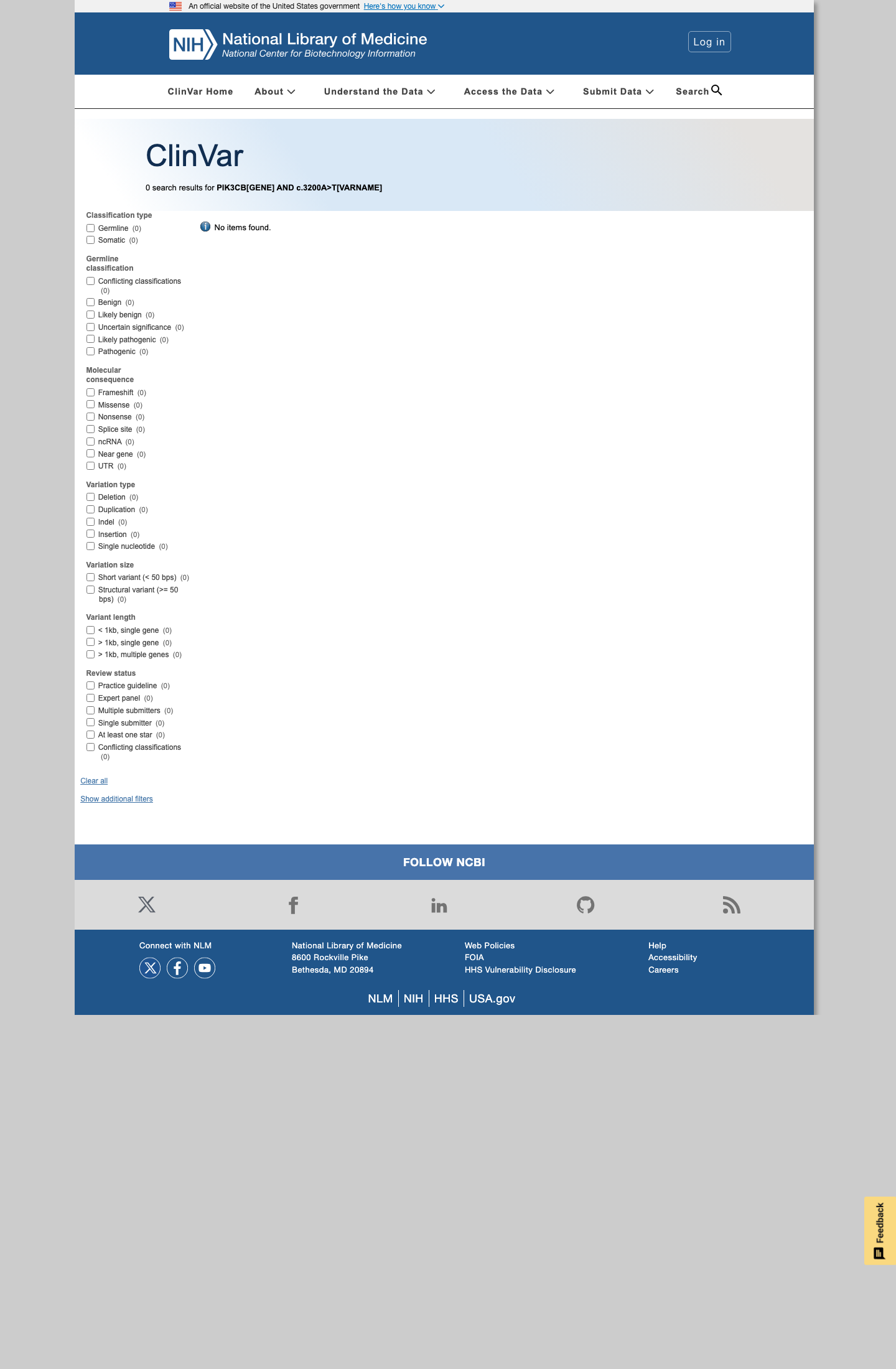
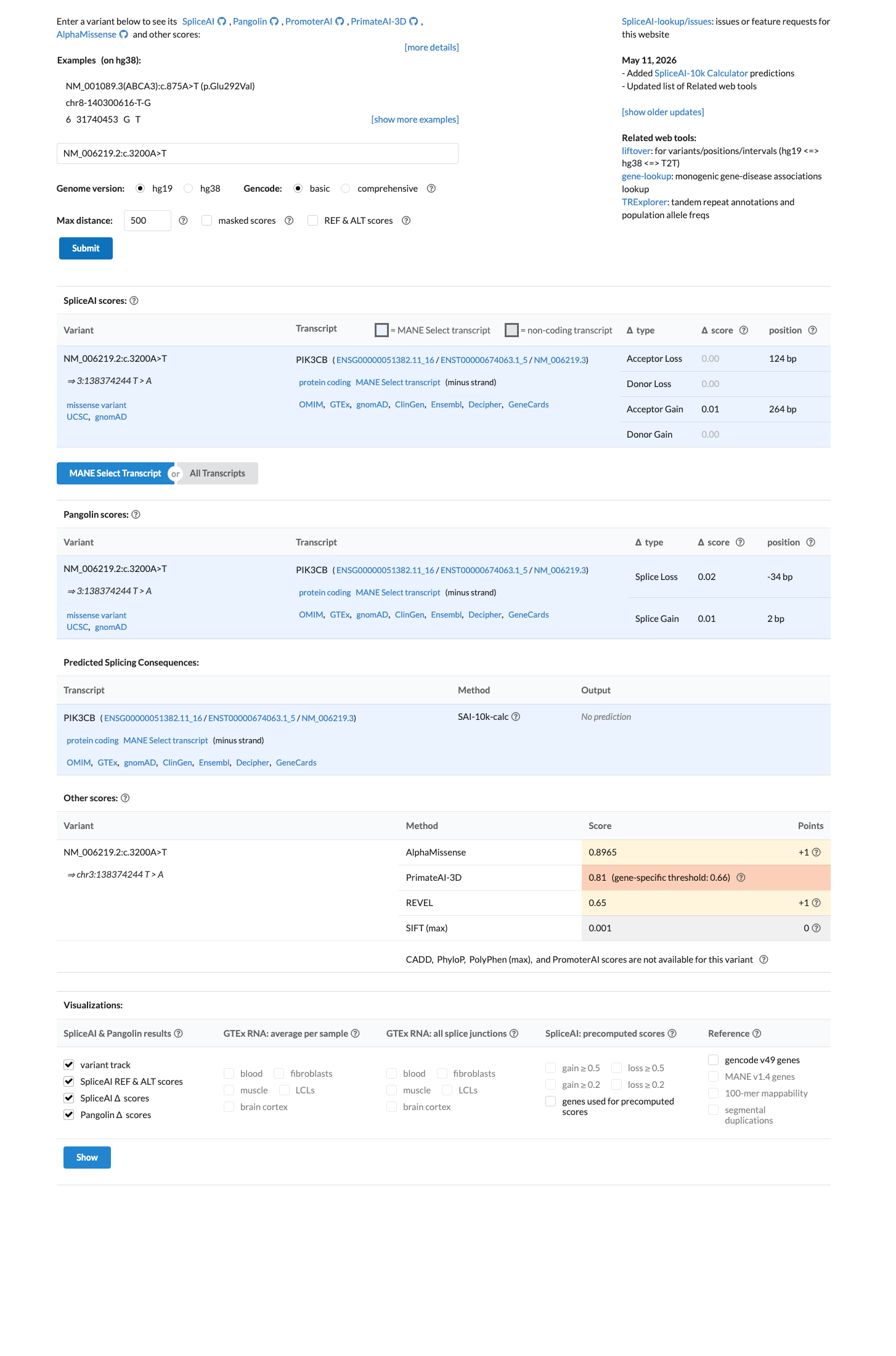
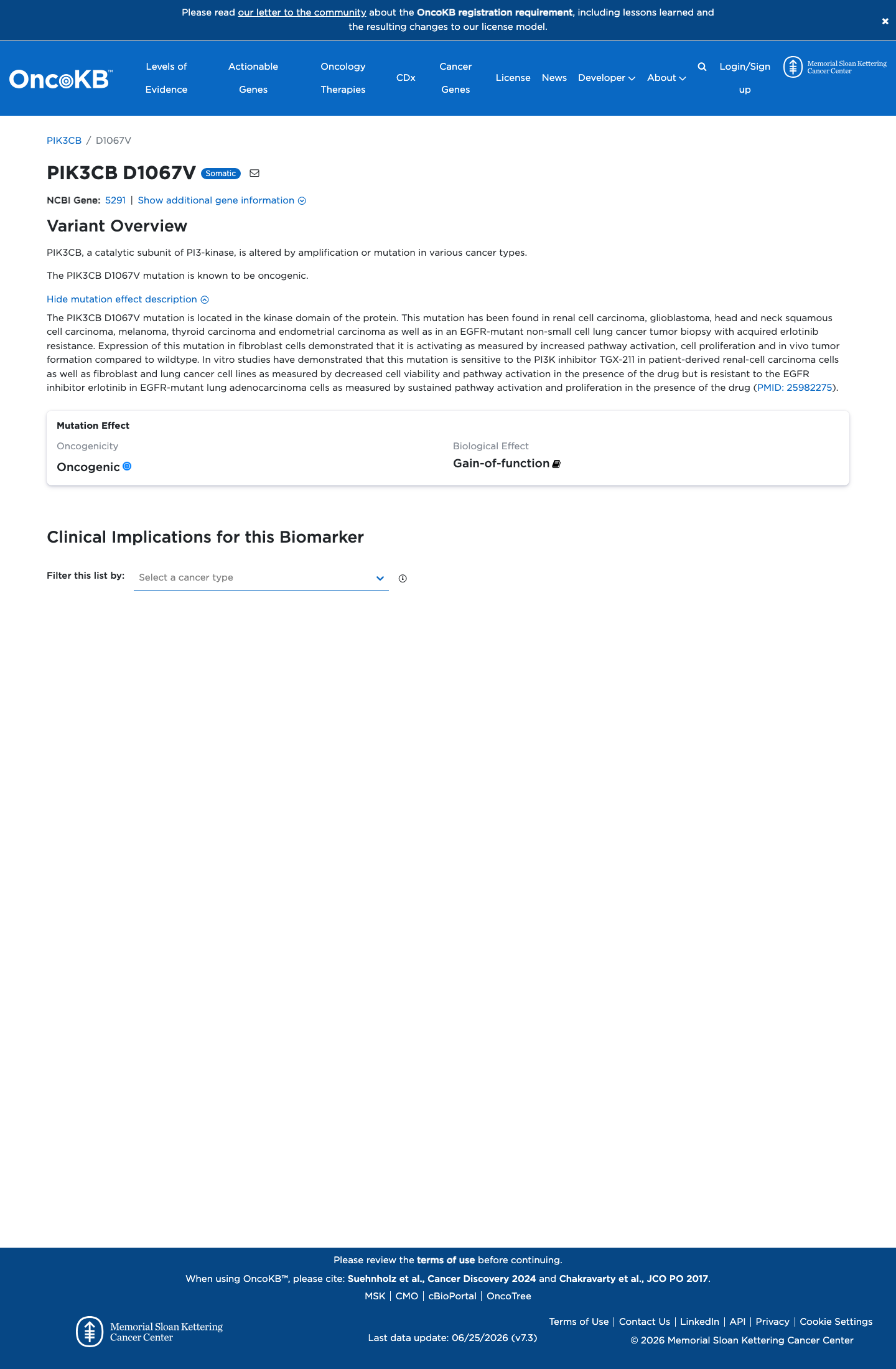
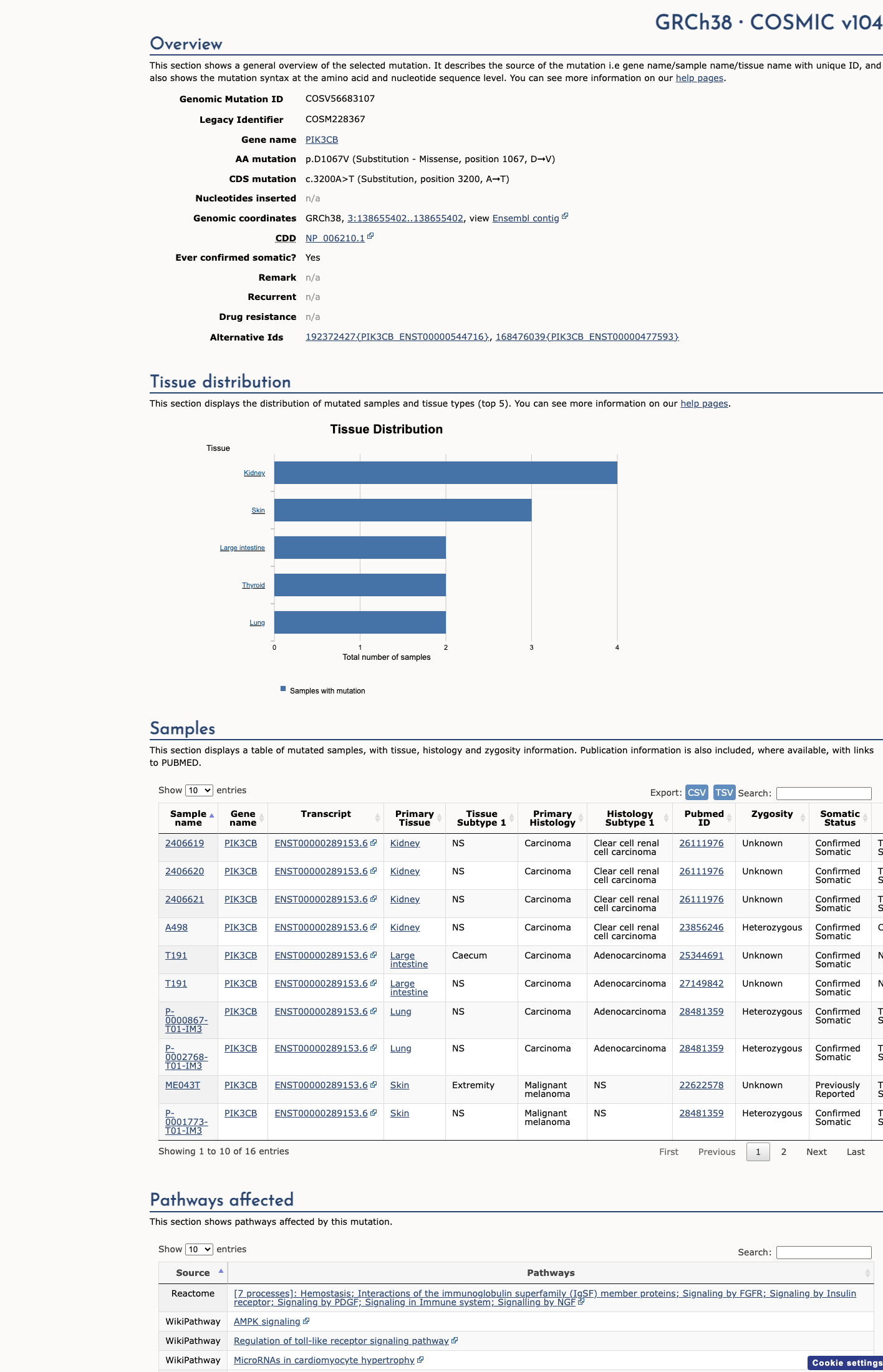
NM_006219.2:c.3200A>T (p.Asp1067Val) is absent from all population databases including gnomAD v2.1, v4.1, and gnomAD-Canada (allele frequency 0.0).1 The variant is absent from ClinVar and has no germline classification from any submitter.2 Asp1067 resides in the C-terminal kinase domain of PIK3Cβ and lies within a statistically significant mutational hotspot (cancerhotspots.org). PMID:25982275 reports that D1067V is the most recurrent missense mutation in the PIK3Cβ kinase domain, accounting for ~15% of kinase domain missense mutations, and that D1067 is highly conserved across species.3 Functional studies in PMID:25982275 demonstrate that PIK3Cβ/D1067V is a gain-of-function activating mutation in somatic cancer models (enhanced AKT/S6 phosphorylation, increased cell growth in vitro, tumor formation in vivo, erlotinib resistance). This evidence was not applied toward PS3 because the demonstrated gain-of-function mechanism does not align with the reported germline loss-of-function disease mechanism.4 REVEL score of 0.65 suggests possible pathogenicity, but BayesDel (0.313) is borderline and SpliceAI predicts no splicing impact (max delta = 0.00). In silico evidence does not provide multiple converging lines for PP3 or BP4.5 The variant has been observed 16 times in somatic cancers (COSMIC COSV56683107) and is classified as Oncogenic by OncoKB, but these pertain to somatic context and are not directly applicable to germline classification.6 Two moderate pathogenicity criteria are met: PM1 (kinase domain hotspot) and PM2 (absent from population databases). No benign criteria are met. Per generic ACMG/AMP 2015 combination rules, two moderate criteria in the absence of benign criteria yields a classification of Likely Pathogenic.7
Final classification
VUS
PM1PM2
PIK3CB
c.3200A>T
p.Asp1067Val
This variant
NM_006219.2:c.3200A>T (p.Asp1067Val) is absent from all population databases including gnomAD v2.1, v4.1, and gnomAD-Canada (allele frequency 0.0).
gene-specific framework lacked a usable explicit final combination framework, so generic ACMG/AMP 2015 final-combination rules were applied as fallback; applied criteria: PM1 moderate, PM2 moderate; combination = 2 moderate, which maps to VUS.
Classification rationale
PM1PM2
VUS
PIK3CB c.3200A>T
PM1 + PM2
→
VUS
LYFE Sciences is an AI system, and it can make mistakes. Criteria
may be applied incorrectly, sources may be misread, and a confident-looking
classification can still be wrong. Double-check every criterion and
its underlying evidence before relying on any call.
Gene diagram
· NM_006219.2 · variants mapped to exon structure
PIK3CB
NM_006219.2
Fetching transcript structure from UCSC…
Applied criteria · 2 applied · 20 assessed
MetEvidence satisfies this criterion.
Not metEvaluated against available evidence; threshold not reached.
Not assessedApplies in principle, but no evidence was found to evaluate it.
N/ADoesn't apply to this variant type.
Applied · 2
Strength
Supporting
Moderate
Strong
Very strong
PM1
moderate
Pathogenic
Asp1067 is located in the C-terminal kinase domain of PIK3Cβ, a critical functional domain. The residue lies in a statistically significant hotspot (cancerhotspots.org). PMID:25982275 demonstrates that D1067V is the most recurrent missense mutation in the PIK3Cβ kinase domain, accounting for ~15% of missense mutations in this domain. Multiple sequence alignment confirms D1067 is highly conserved across species.
Statistically significant hotspot at residue D1067 (cancerhotspots.org)D1067V is the most recurrent kinase domain missense mutation (~15% of all kinase domain missense mutations per PMID:25982275)D1067 is highly conserved across species
PM2
moderate
Pathogenic
NM_006219.2:c.3200A>T is absent from gnomAD v2.1 (exomes), gnomAD v4.1 (exomes/genomes), and gnomAD-Canada v1.0 (genomes). The variant has an allele frequency of 0.0 in all population databases, which is well below the PM2 threshold of <0.1% for non-VCEP generic ACMG assessment.
Absent from gnomAD v2.1v4.1and gnomAD-Canada v1.0
Assessed · not applied
· 20 not met · 0 not assessed
Pathogenic
PS1
No same-amino-acid pathogenic comparator variant was identified.
PS2
No de novo observation with confirmed maternity and paternity was identified for this variant in any data source.
PS3
PMID:25982275 provides well-established functional evidence that PIK3Cβ/D1067V is a gain-of-function activating mutation (enhanced PI3K pathway signaling, increased cell growth in vitro, tumor formation in vivo, erlotinib resistance).
PS4
No case-control data comparing affected individuals to controls is available for this variant.
PM6
No de novo observation (with or without confirmed parentage) was identified for this variant.
PP1
No co-segregation data in affected family members is available for this variant.
PP2
No HCI prior probability score is available for PIK3CB (gene not supported in HCI database).
PP3
In silico evidence is mixed and does not provide multiple converging lines supporting a deleterious effect.
PP4
No patient phenotype or family history information is available to assess specificity for a PIK3CB-related disease.
PP5
No reputable source has reported this variant as pathogenic in a germline context.
Benign
BA1
The variant is absent from gnomAD v2.1, v4.1, and gnomAD-Canada.
BS1
The variant is absent from gnomAD v2.1, v4.1, and gnomAD-Canada.
BS2
No data are available regarding observation of this variant in healthy adults for a disorder with expected full penetrance at an early age.
BS3
Functional evidence from PMID:25982275 demonstrates a gain-of-function activating effect (enhanced PI3K signaling, increased cell growth, tumor formation), not a benign or neutral effect on protein function.
BS4
No segregation data in affected family members are available to assess lack of segregation.
BP1
While the PVS1 gene context reports loss-of-function as a supported disease mechanism, the evidence that primarily truncating variants (rather than missense) cause PIK3CB-related disease is not firmly established.
BP2
No data are available regarding observation of this variant in trans with a pathogenic variant.
BP4
In silico evidence does not support a benign interpretation.
BP5
No data are available identifying this variant in a case with an alternate molecular basis for disease.
BP6
No reputable source has reported this variant as benign.
N/A · 4
PVS1 · PM5 · BP3 · BP7
Research & evidence
Population frequency

gnomAD v4.1

gnomAD v2.1
v4.1
Absent from gnomAD v4.1.
v2.1
Absent from gnomAD v2.1.
🇨🇦 CA
Absent from gnomAD-Canada v1.0.
Allele frequency by ancestry
three datasets · side by side
gnomAD v4.1
Absent
· 0 / ?
0 hom
0 hom
Not observed in any ancestry group.
gnomAD v2.1
Absent
· 0 / ?
0 hom
0 hom
Not observed in any ancestry group.
gnomAD Canada 🇨🇦
Absent
· 0 / ?
0 hom
0 hom
Not observed in any ancestry group.
In silico
SpliceAI predicts no significant splice impact for this variant (max delta score = 0.00). REVEL score = 0.65. BayesDel score = 0.312683.
Functional
Oncogenic
OncoKB identified variant-specific curated literature and context relevant to functional review; biological-effect context: Gain-of-function; curated oncogenicity label: Oncogenic.
COSMIC

Cancer hotspots
Somatic evidence
Hotspot
COSMIC
This variant lies in a statistically significant hotspot. This variant has previously been reported in somatic cancers (COSMIC; COSV56683107, n = 16 times).
Hotspots
This variant lies in a statistically significant hotspot.
Literature · how each cited paper was used
1papers cited
Each card is an audit: what was searched, what was found, whether it names the variant, which criteria it fed, and why.
Oncogenic activation of the PI3-kinase p110β isoform via the tumor-derived PIK3Cβ(D1067V) kinase domain mutation.
Searched
c.3200A>Tp.Asp1067ValD1067VPIK3CβD1067VPIK3Cbeta D1067V
Found
PIK3Cβ/D1067V demonstrated gain-of-function activation of PI3K pathway signaling (increased phosphorylated AKT and S6 kinase compared to wild-type), enhanced cell growth in vitro in NIH-3T3 cells, and was sufficient for tumor formation in vivo in immunocompromised mice. In patient-derived A498 renal-cell carcinoma cells with endogenous PIK3Cβ/D1067V, genetic and pharmacologic inhibition of p110β suppressed growth and PI3K signaling. Expression of PIK3Cβ/D1067V in EGFR-mutant H3255 NSCLC cells sustained AKT/S6 phosphorylation during erlotinib treatment and promoted drug resistance. D1067V was identified as the most recurrent missense mutation in the PIK3Cβ kinase domain (~15% of mutations) and was observed across multiple tumor types (NSCLC, RCC, GBM, HNSCC, melanoma, thyroid, endometrial).
Variant
✓ Names this variant — characterised directly
Applied to
→PM1
met
Why
Variant-specific functional data confirmed gain-of-function oncogenic activation in somatic context. Cited for PM1 (kinase domain localization, recurrence as hotspot mutation). Not cited for PS3 because demonstrated gain-of-function mechanism does not align with reported germline loss-of-function disease mechanism.
PIK3CβD1067V activated PI3K pathway downstream signaling, as measured by the levels of phosphorylated AKT and S6 kinase, to a greater degree than PIK3CβWT
Location Abstract; Results and Discussion, pages 1-7; Figures 1-4 · Context NIH-3T3 fibroblasts (stable retroviral transduction), H3255 EGFR-mutant NSCLC cells, A498 renal-cell carcinoma cells (endogenous heterozygous D1067V); immunoblot, CellTiterGLO viability assays, tumor allograft assays in immunocompromised mice, pharmacologic inhibition with TGX-221 (p110β-selective) and BKM-120 (pan-PI3K) · full text
Sources & reference links