Analysis in progress
Initialising…
0%
complete
This report is still being assembled — sections appear as each stage finishes. It isn't final yet.
POLE
Final classification
VUS
POLE c.2137G>A · p.Glu713Lys
POLE

The POLE c.2137G>A (p.Glu713Lys; p.E713K) variant has not been identified as a recurrent somatic POLE hotspot in the endometrial carcinoma datasets summarized by León-Castillo et al. and has been reported in ClinVar as a variant of uncertain significance.

Gene
POLE
Transcript
NM_006231.4
HGVS · transcript:coding
NM_006231.4:c.2137G>A
Consequence
N/A
GRCh38
chr12:132668392 C>T
GRCh37
chr12:133244978 C>T
Basis León-Castillo et al. 2020 custom POLE framework using ACMG/AMP 2015 final classification thresholds with POLE-specific criterion specifications
León-Castillo et al. 2020 custom POLE framework using ACMG/AMP 2015 final classification thresholds with POLE-specific criterion specifications
Classification rationale
PM2 VUS
POLE c.2137G>A

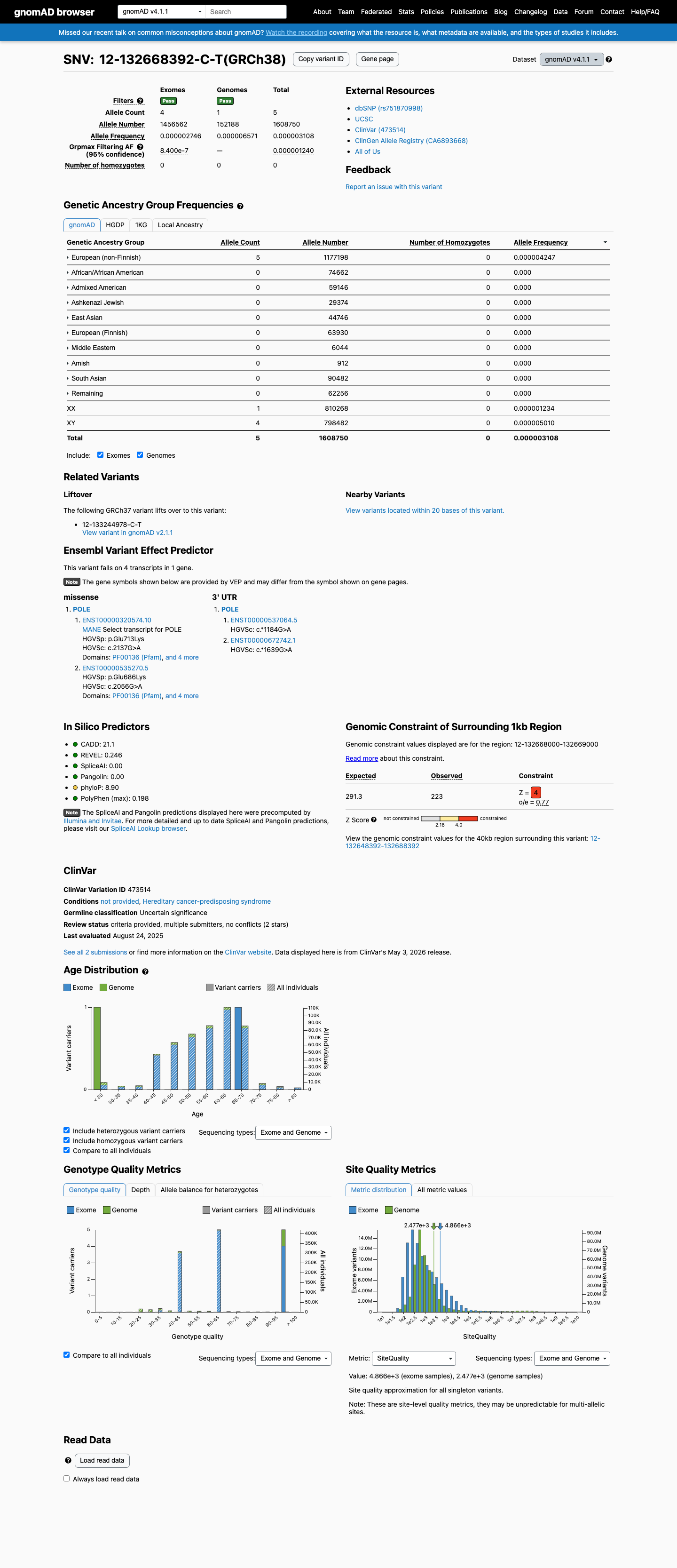
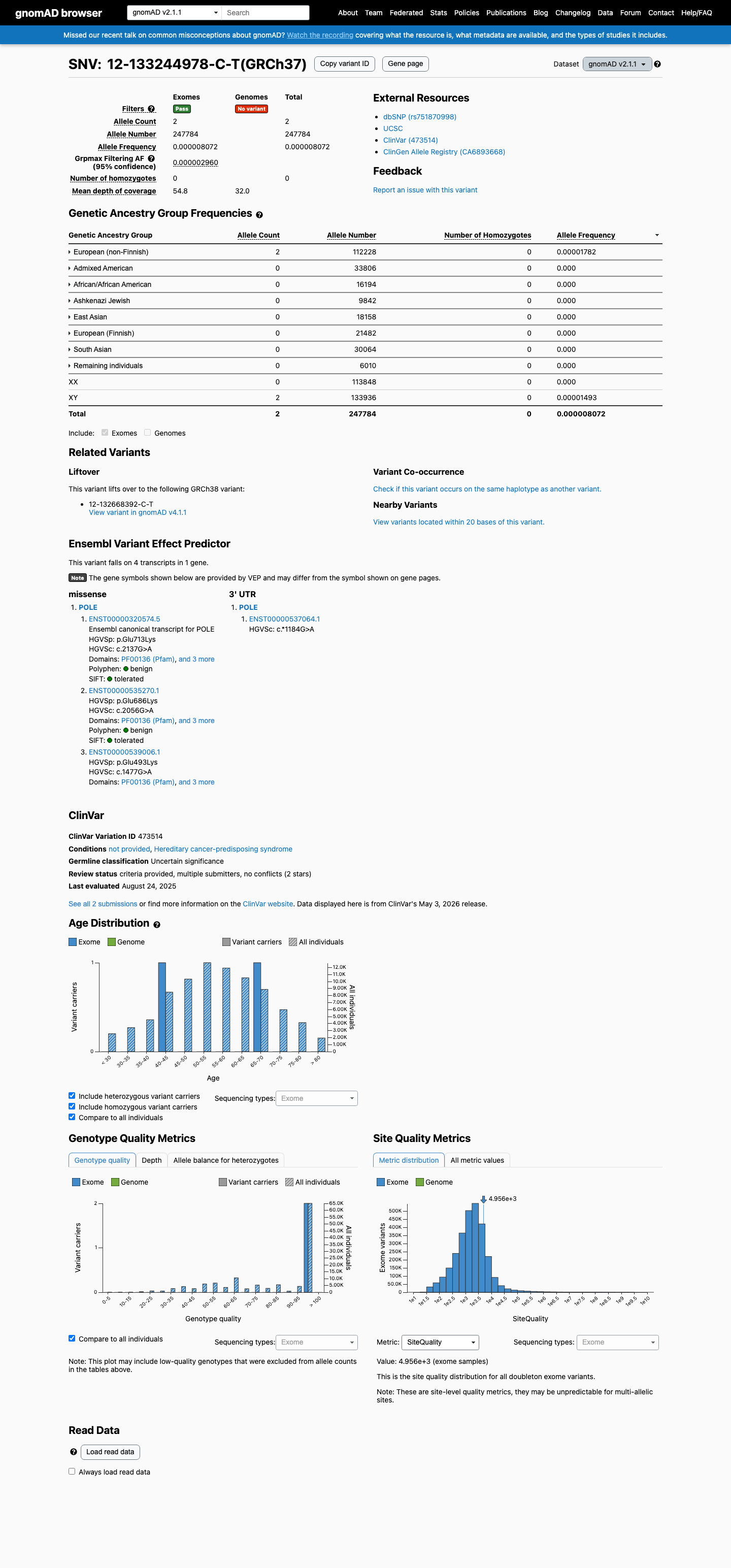
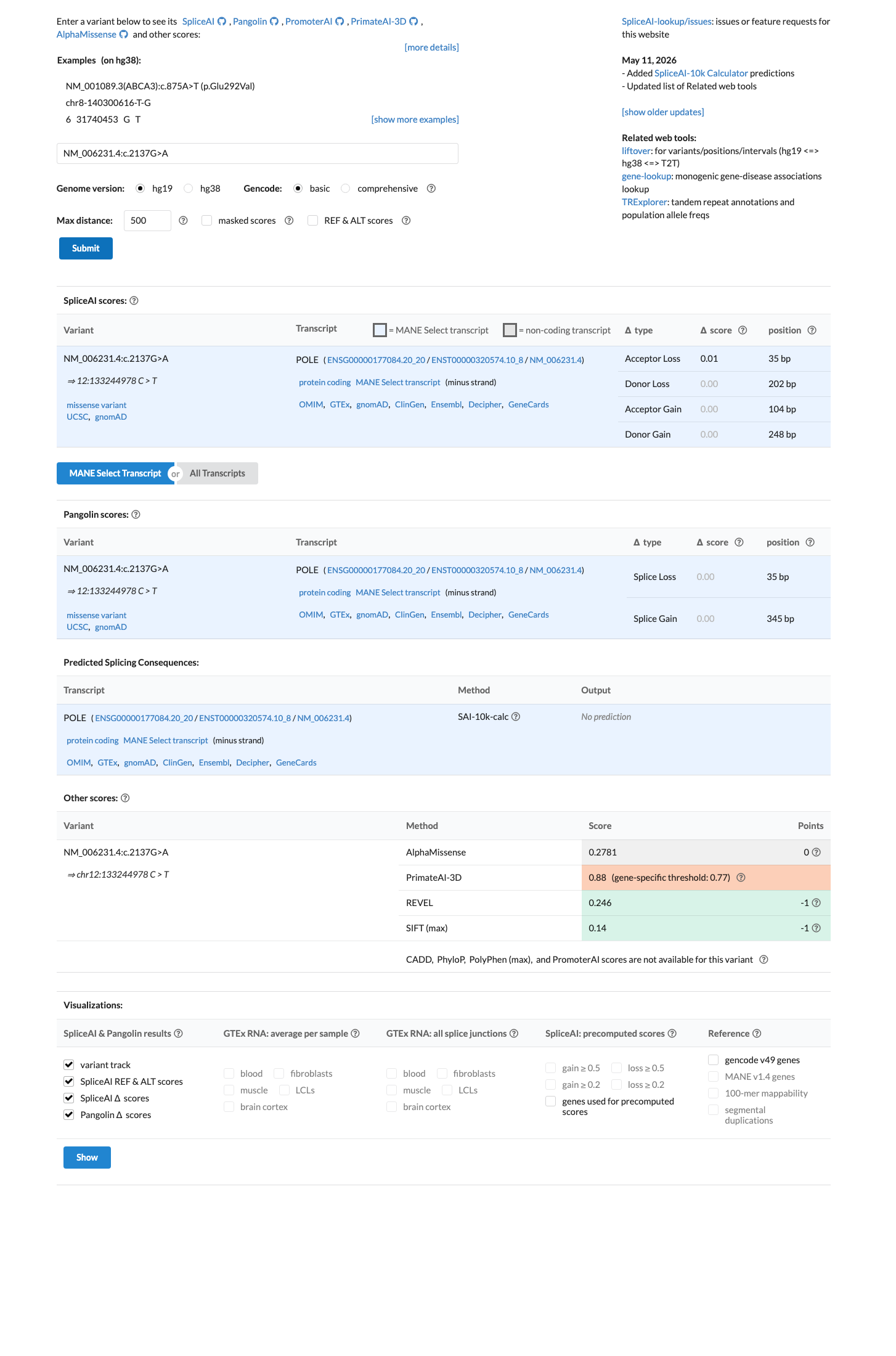
The POLE c.2137G>A (p.Glu713Lys; p.E713K) variant has not been identified as a recurrent somatic POLE hotspot in the endometrial carcinoma datasets summarized by León-Castillo et al. and has been reported in ClinVar as a variant of uncertain significance.1 This variant is rare in population databases, with an allele frequency of 0.00081% (2/247784) in gnomAD v2.1 and 0.00031% (5/1608750) in gnomAD v4.1, and it is absent from gnomAD-Canada.2 Computational evidence does not support a splice-disrupting effect, with a SpliceAI maximum delta score of 0.01, and the missense predictor scores are not strongly damaging (REVEL 0.246; BayesDel -0.033673).3

PM2 VUS
1 vcep_path_250_323_s002clinvar ↗
3 spliceai ↗revelbayesdel
Gene diagram · NM_006231.4 · variants mapped to exon structure
POLE NM_006231.4
Fetching transcript structure from UCSC…
Applied criteria · 1 applied · 19 assessed
Applied · 1
Strength Supporting Moderate Strong Very strong
PM2 supporting review Pathogenic
This variant is rare in population databases. Its allele frequency is 0.00081% in gnomAD v2.1 (2/247784) and 0.00031% in gnomAD v4.1 (5/1608750), both below the 0.1% PM2 threshold, and it is absent from gnomAD-Canada.
gnomAD v2.1 AF 8.07155e-06gnomAD v4.1 AF 3.108e-06Absent from gnomAD-Canada
Assessed · not applied
Pathogenic
PS1 No evidence was identified that this nucleotide change produces the same amino acid change as an established pathogenic or likely pathogenic variant.
PS2 No confirmed de novo data were identified.
PS3 No variant-specific functional study demonstrating a damaging effect was identified.
PS4 Under the local POLE framework, PS4_Supporting requires the exact missense variant to be recurrent in both COSMIC and TCGA endometrial carcinoma cohorts with a combined count of at least 10 and to belong to the established pathogenic set.
PM1 Under the local POLE framework, PM1 is restricted to specific exonuclease-domain hotspot or recurrent substitutions from León-Castillo et al.
PM3 No evidence was identified for this variant occurring in trans with a pathogenic variant in a recessive disease context.
PM6 No assumed de novo data were identified.
PP1 No segregation data were identified.
PP2 No gene-specific evidence set was identified to support applying PP2 to this missense variant.
PP3 Under the local POLE framework, PP3 requires the exact missense variant to appear in the reviewed supplementary in silico tables with a 'likely disease causing' REVEL class and no more than one benign in silico result.
PP4 No phenotype or tumor signature data specific enough to support PP4 were identified.
Benign
BA1 The population frequency is far below the 1% BA1 threshold: 0.00081% in gnomAD v2.1 and 0.00031% in gnomAD v4.1.
BS1 The population frequency is below the 0.3% BS1 threshold: 0.00081% in gnomAD v2.1 and 0.00031% in gnomAD v4.1.
BS2 No evidence was identified showing this variant in well-phenotyped healthy individuals at a frequency sufficient for BS2.
BS3 No variant-specific functional study demonstrating a normal or benign effect was identified.
BS4 No non-segregation data were identified.
BP2 No phase data with another variant were identified.
BP4 Under the local POLE framework, BP4 requires the exact missense variant to appear in the reviewed supplementary in silico tables with a benign-leaning REVEL class and at least four benign in silico results.
BP5 No alternate molecular explanation data were identified for the observed condition.
N/A · 8 PVS1 · PM4 · PM5 · PP5 · BP1 · BP3 · BP6 · BP7
Research & evidence
Population frequency
gnomAD v4.1 screenshot
gnomAD v4.1
gnomAD v2.1 screenshot
gnomAD v2.1
v4.1
This variant is present in gnomAD v4.1 (AF= 3.108e-06; MAF= 0.00031%, 5/1608750 alleles, homozygotes = 0) and has highest observed frequency in the European (non-Finnish) population (AF= 4.24737e-06; MAF= 0.00042%, 5/1177198 alleles, homozygotes = 0); grpmax FAF= 1.24e-06.
v2.1
This variant is present in gnomAD v2.1 (AF= 8.07155e-06; MAF= 0.00081%, 2/247784 alleles, homozygotes = 0) and has highest observed frequency in the European (non-Finnish) population (AF= 1.78209e-05; MAF= 0.00178%, 2/112228 alleles, homozygotes = 0); grpmax FAF= 2.96e-06.
🇨🇦 CA
Absent from gnomAD-Canada v1.0.
Allele frequency by ancestry
three datasets · side by side
gnomAD v4.1
0.00031% · 5 / 1,608,750
0 hom · FAF 0.00012%
European (non-Finnish)
5 / 1,177,198
0.00042%
+ 9 not observed (Remaining individuals, Admixed American, European (Finnish), Amish, East Asian, Middle Eastern, South Asian, Ashkenazi Jewish, African/African American)
gnomAD v2.1
0.00081% · 2 / 247,784
0 hom · FAF 0.0003%
European (non-Finnish)
2 / 112,228
0.0018%
+ 7 not observed (African/African American, Admixed American, Ashkenazi Jewish, East Asian, European (Finnish), Remaining individuals, South Asian)
gnomAD Canada 🇨🇦
Absent · 0 / ?
0 hom
Not observed in any ancestry group.
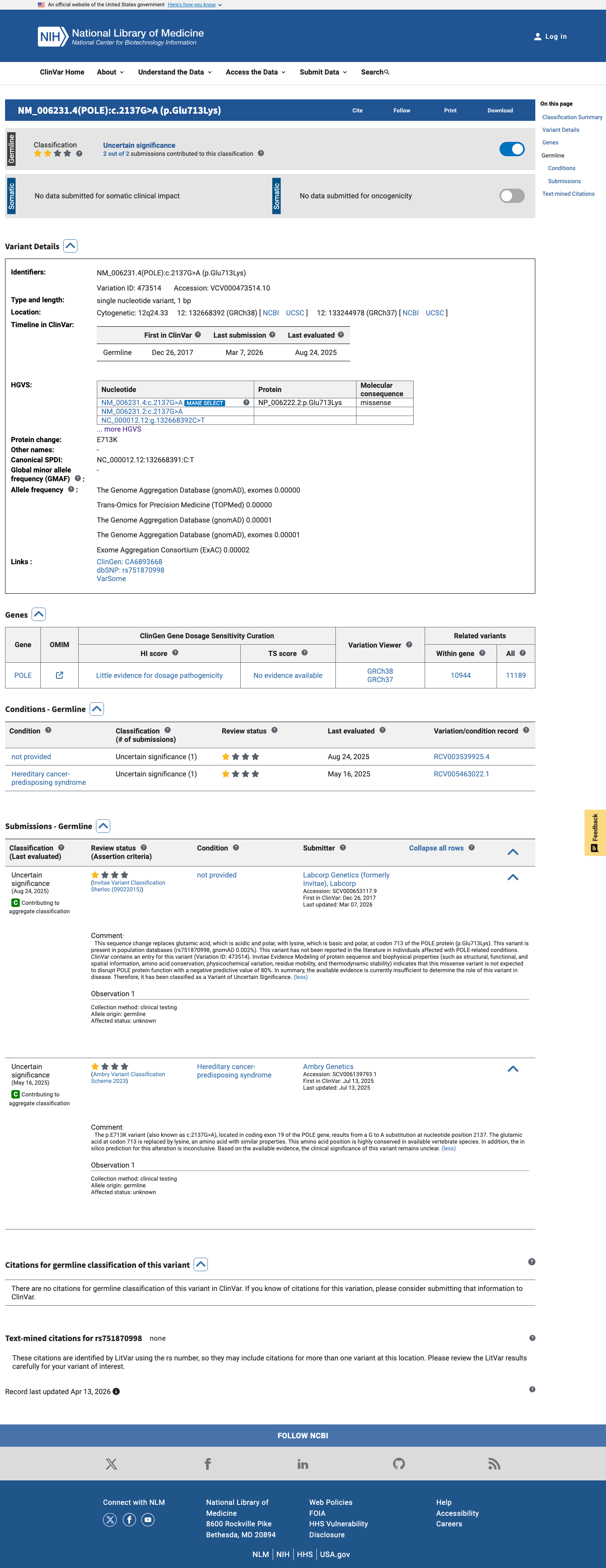
ClinVar screenshot
ClinVar
This variant has been reported in ClinVar as Uncertain significance (2 clinical laboratories). (ClinVarID = 473514)
SpliceAI screenshot
In silico
SpliceAI predicts no significant splice impact for this variant (max delta score = 0.01). REVEL score = 0.246. BayesDel score = -0.033673.
Functional / OncoKB screenshot
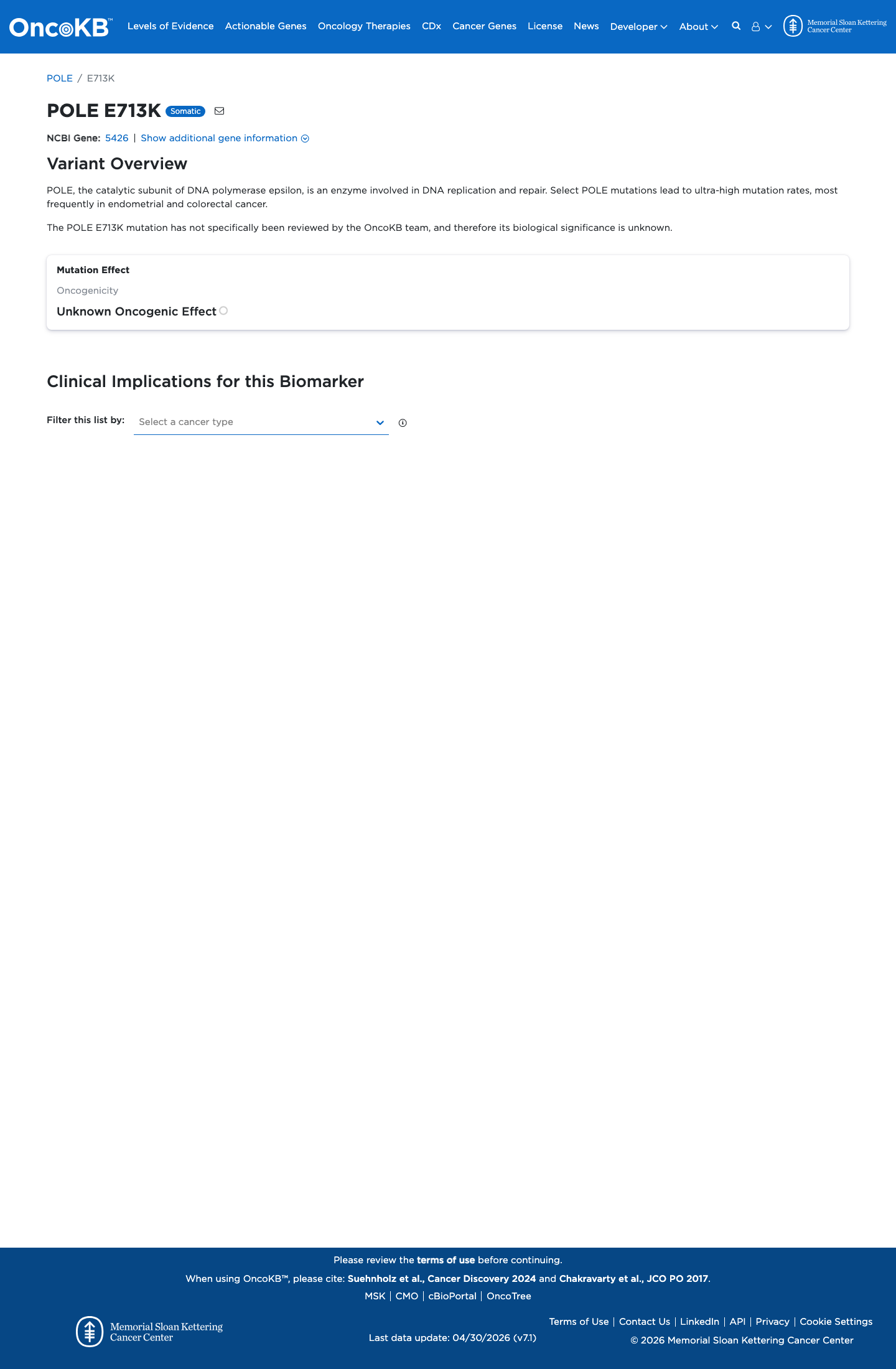
Functional Unknown Oncogenic Effect
OncoKB did not identify variant-specific reviewed functional evidence for this variant; gene-level curated context is available for reviewer follow-up. POLE, the catalytic subunit of DNA polymerase epsilon, is an enzyme involved in DNA replication and repair. Select POLE mutations lead to ultra-high m
OncoKB ↗
COSMIC screenshot
COSMIC
Cancer hotspots screenshot
Cancer hotspots
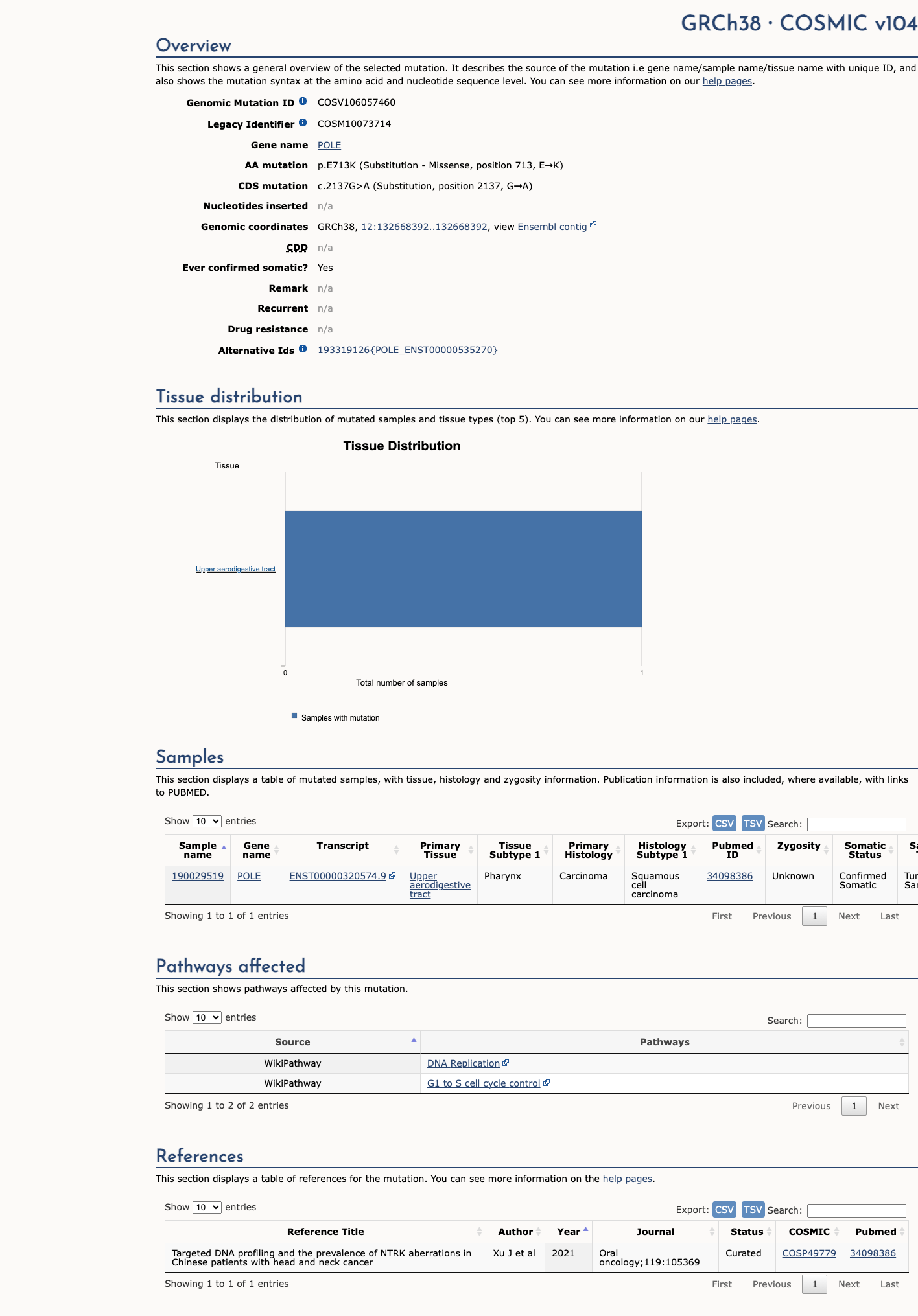
Somatic evidence Not in COSMIC / hotspots
COSMIC
This variant does not lie in a statistically significant hotspot. This variant has previously been reported in somatic cancers (COSMIC; COSV106057460, n = 1 times).
Hotspots
This variant does not lie in a statistically significant hotspot.
Sources & reference links
8Sources
ClinVar
gnomAD v2.1
gnomAD v4.1
gnomAD-Canada
SpliceAI
OncoKB
COSMIC
Cancer hotspots
Triaged references · 2 PMIDs not cited in assessment
25394175 ↗ A practice guideline from the American College of Medical Genetics and Genomics and the National Society of Genetic Counselors: referral indications for cancer predisposition assessment. CLINVAR
28492532 ↗ Sherloc: a comprehensive refinement of the ACMG-AMP variant classification criteria. CLINVAR