POLE encodes the catalytic subunit of DNA polymerase epsilon, the enzyme that replicates the leading strand of DNA during cell division and participates in DNA repair. It contains a proofreading domain that corrects replication errors, keeping the accumulation of mutations in check. Germline mutations in POLE cause polyposis and predispose to colorectal cancer, and are also linked to a rare syndrome of facial dysmorphism, immunodeficiency, livedo, and short stature. Somatic mutations, particularly in the proofreading domain, occur in colorectal and endometrial cancers, where they drive an ultra-mutated tumor phenotype and are associated with better responses to immune checkpoint inhibitors.
This variant
POLE encodes the catalytic subunit of DNA polymerase epsilon, and germline loss-of-function mutations in it cause polyposis and predispose to colorectal cancer. This frameshift, predicted to trigger nonsense-mediated decay and to remove the C-terminal domains needed for holoenzyme assembly, would eliminate this essential replication and repair function, consistent with the gene's established loss-of-function disease mechanism and supporting a Likely Pathogenic classification.
Transcript
NM_006231.4
HGVS · transcript:coding
NM_006231.4:c.4519_4520del
GRCh38
chr12:132643254 CTG>C
GRCh37
chr12:133219840 CTG>C
BasisNo official ClinGen POLE VCEP specification exists, so standard ACMG/AMP 2015 combination logic was applied; only PVS1 (Very Strong) and PM2 (Moderate) are met.▾
No official ClinGen POLE VCEP specification exists, so standard ACMG/AMP 2015 combination logic was applied; only PVS1 (Very Strong) and PM2 (Moderate) are met.
Classification rationale
PVS1PM2Likely Pathogenic
POLE c.4519_4520delframeshift · exon 35
PVS1 (Very Strong): 2-bp frameshift (p.Gln1507AlafsTer37) in exon 35 of 49 predicted to trigger nonsense-mediated decay, removing essential C-terminal domains. PM2 (Moderate): highest observed allele frequency 0.000176%, far below the <0.1% rarity threshold. PVS1 (Very Strong) plus PM2 (Moderate) under standard ACMG/AMP 2015 combination rules supports Likely Pathogenic.
PVS1 + PM2→Likely Pathogenic
Gene diagram
· NM_006231.4 · variants mapped to exon structure
POLENM_006231.4
Fetching transcript structure from UCSC…
Exons
—
Transcript span
—
Strand
—
Variants mapped
—
Source
UCSC ncbiRefSeqCurated
All variants in POLE—click a row to locate it on the plot · use the link column to open its page
Variant ↕
Protein
Location
Classification
Link
Applied criteria · 2 applied · 16 assessed
MetEvidence satisfies this criterion.
Not metEvaluated against available evidence; threshold not reached.
Not assessedApplies in principle, but no evidence was found to evaluate it.
N/ADoesn't apply to this variant type.
Applied · 2
Strength Supporting Moderate Strong Very strong
✓
PVS1very strongPathogenic
Met (Very Strong): 2-bp frameshift (p.Gln1507AlafsTer37) in exon 35 of 49 predicted to trigger nonsense-mediated decay.
pvs1_variant_assessment.json: consequence_class='frameshift', variant_bucket='frameshift', protein_1l='NP_006222.2:p.(Q1507Afs*37)', apply_generic_pvs1_framework=true, suggested_default_strength='PVS1', framework_source=PMC6185798.pvs1_gene_context.json: germline_disease_context_found=true, lof_mechanism_supported=true, pvs1_gene_gate='eligible'; no official CSPEC/VCEP POLE PVS1 framework exists so generic fallback per PMC6185798 was used.prefetch.json VariantValidator exon/CDS map: variant falls in coding exon 35 of 49 total exons (c.4445-4551), far from the terminal exon/penultimate-exon 50bp NMD-escape boundary, supporting NMD.
Met (Moderate): highest observed allele frequency 0.000176%, far below the <0.1% rarity threshold.
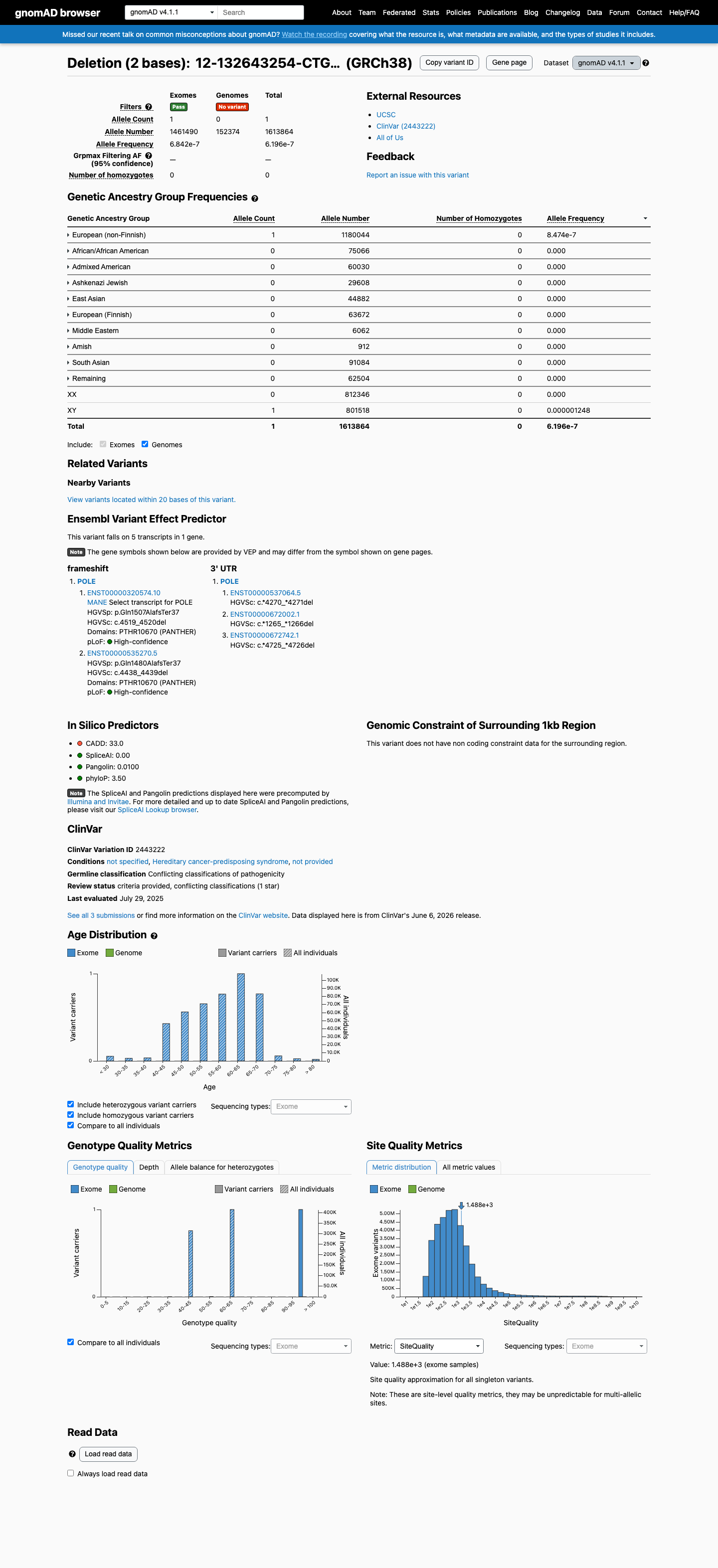
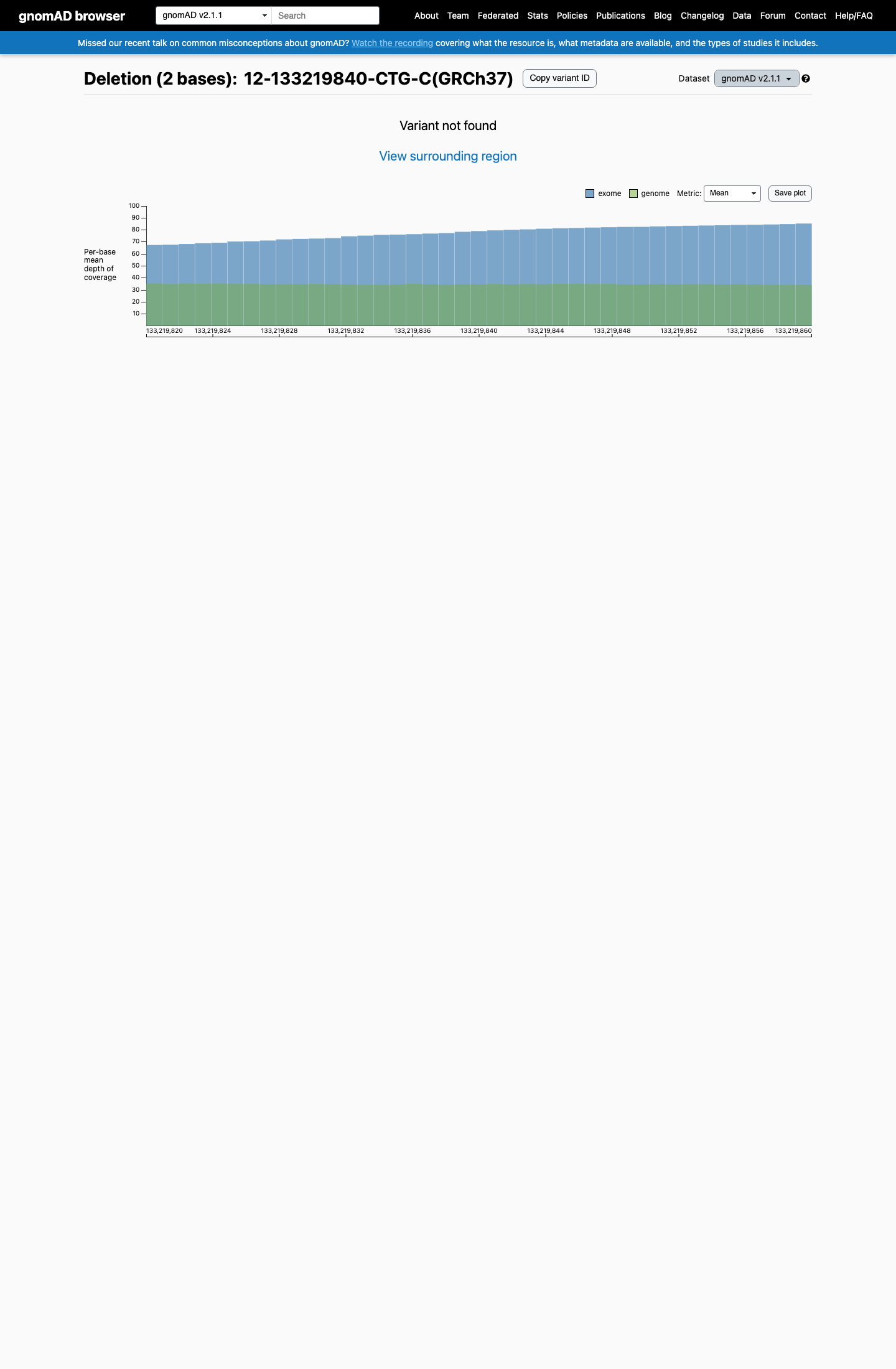
gnomAD v2.1 reports the variant as absent.gnomAD v4.1 reports one allele among 1,613,864 total alleles (overall AF 6.19631e-07; 0 homozygotes); highest reported frequency is 1/568,400 non-Finnish European XY alleles (AF 1.75932e-06).gnomAD-Canada v1.0 reports the variant as absent.
This variant is present in gnomAD v4.1 (AF= 6.19631e-07; MAF= 0.00006%, 1/1613864 alleles, homozygotes = 0) and has highest observed frequency in the European (non-Finnish) population (AF= 8.47426e-07; MAF= 0.00008%, 1/1180044 alleles, homozygotes = 0).
v2.1
Absent from gnomAD v2.1.
🇨🇦 CA
Absent from gnomAD-Canada v1.0.
Allele frequency by ancestry
three datasets · side by side
gnomAD v4.1
6.2e-05%
· 1 / 1,613,864
0 hom
European (non-Finnish)
1 / 1,180,044
8.5e-05%
+ 9 not observed (Remaining individuals, Admixed American, European (Finnish), Amish, East Asian, Middle Eastern, South Asian, Ashkenazi Jewish, African/African American)
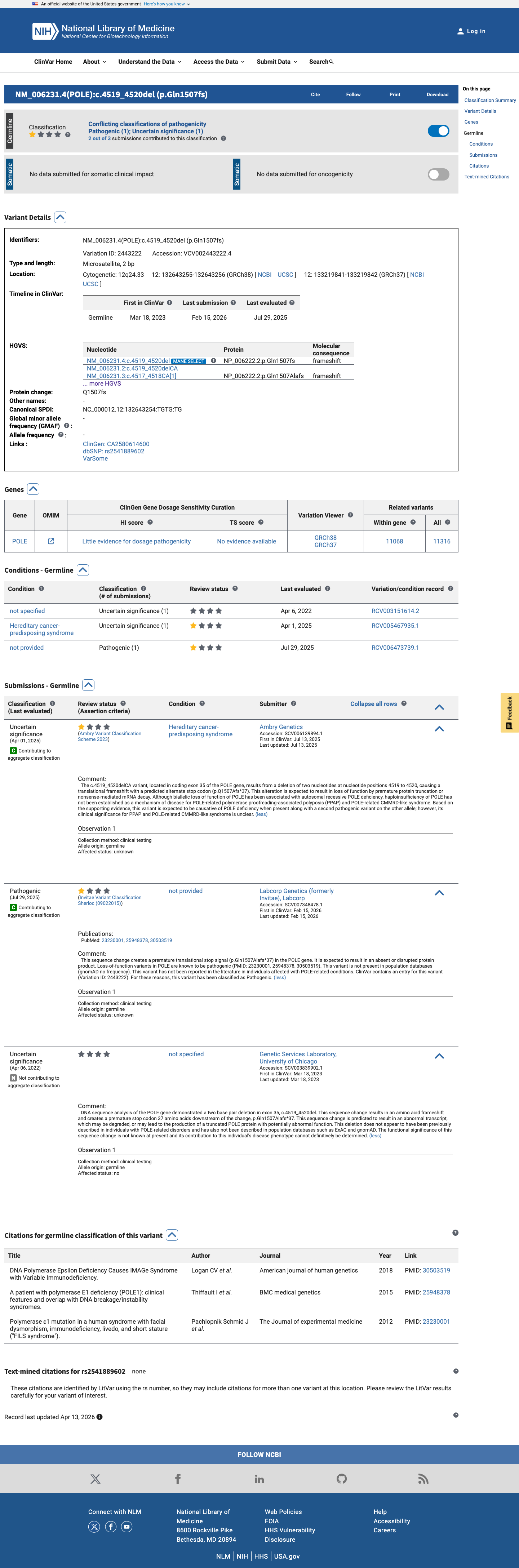
This variant has been reported in ClinVar as Uncertain significance (2 clinical laboratories) and as Pathogenic (1 clinical laboratory). (ClinVarID = 2443222)
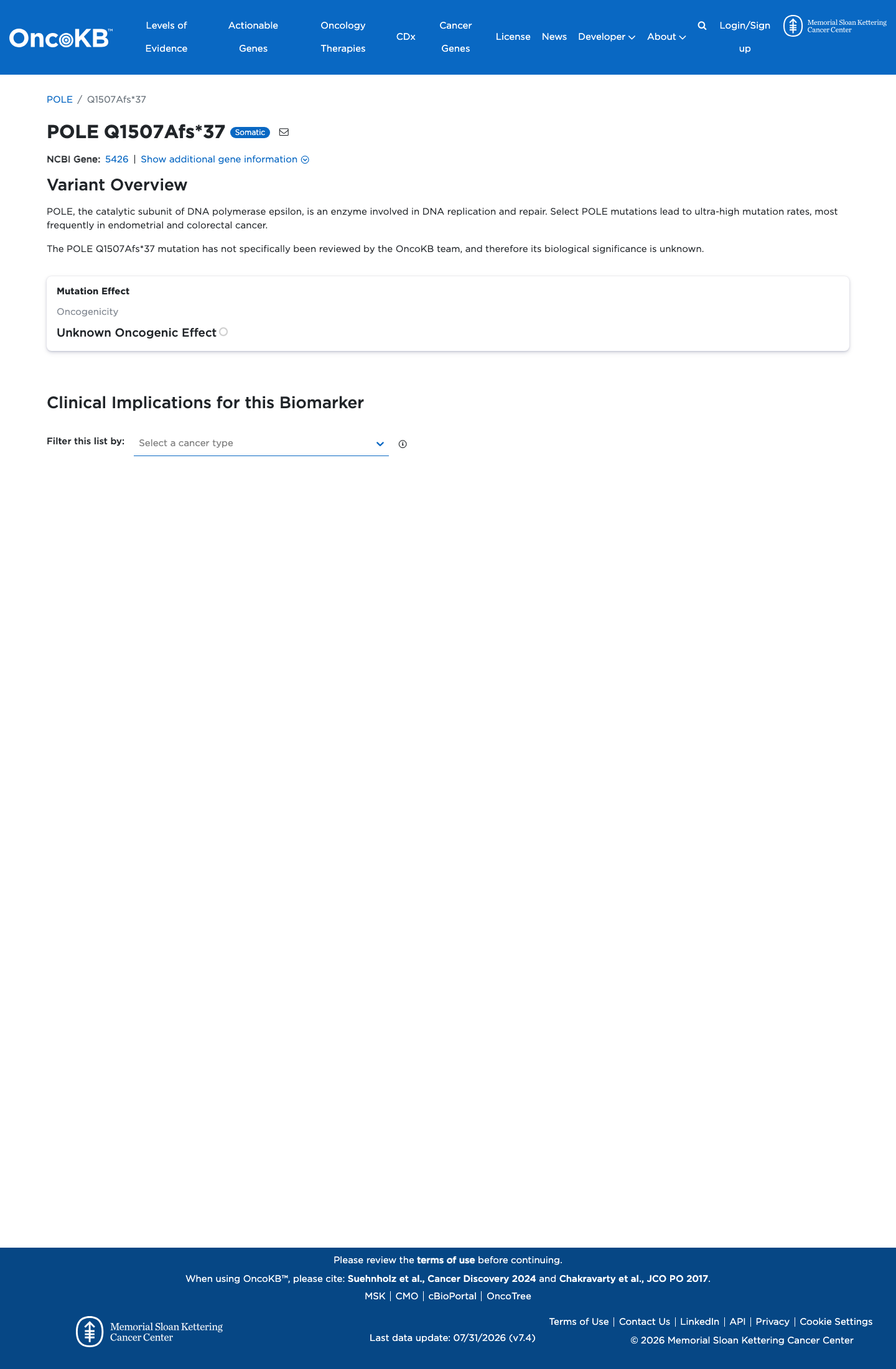
OncoKB did not identify variant-specific reviewed functional evidence for this variant; gene-level curated context is available for reviewer follow-up. POLE, the catalytic subunit of DNA polymerase epsilon, is an enzyme involved in DNA replication and repair. Select POLE mutations lead to ultra-high m
Each card is an audit: what was searched, what was found, whether it names the variant, which criteria it fed, and why. 2 further PMIDs triaged but not cited — see Sources & references.
Rule & framework references · cited for criterion definitions, not variant evidence
23230001 ↗Polymerase ε1 mutation in a human syndrome with facial dysmorphism, immunodeficiency, livedo, and short stature ("FILS syndrome").
Triaged references · 2 PMIDs not cited in assessment
25948378 ↗A patient with polymerase E1 deficiency (POLE1): clinical features and overlap with DNA breakage/instability syndromes.CLINVAR
25394175 ↗A practice guideline from the American College of Medical Genetics and Genomics and the National Society of Genetic Counselors: referral indications for cancer predisposition assessment.CLINVAR