Starting
Initialising…
0%
PRPF8
Final classification
Benign
PRPF8 c.2409G>A · p.Ala803=
PRPF8

The PRPF8 NM_006445.3:c.2409G>A (p.Ala803=) variant has not been reported in ClinVar as a pathogenic germline variant and is listed there as benign.

Gene
PRPF8
Transcript
NM_006445.3
HGVS · transcript:coding
NM_006445.3:c.2409G>A
Consequence
N/A
GRCh38
chr17:1676350 C>T
GRCh37
chr17:1579644 C>T
Basis gene-specific framework lacked a usable explicit final combination framework, so generic ACMG/AMP 2015 final-combination rules were applied as fallback; applied criteria: BA1 stand-alone benign, BP7 supporting; combination = 1 stand-alone benign + 1 supporting benign, which maps to Benign.
gene-specific framework lacked a usable explicit final combination framework, so generic ACMG/AMP 2015 final-combination rules were applied as fallback; applied criteria: BA1 stand-alone benign, BP7 supporting; combination = 1 stand-alone benign + 1 supporting benign, which maps to Benign.
Classification rationale
BA1BP7 Benign
PRPF8 c.2409G>A

The PRPF8 NM_006445.3:c.2409G>A (p.Ala803=) variant has not been reported in ClinVar as a pathogenic germline variant and is listed there as benign.1 This variant is common in population databases, with a highest observed allele frequency of 3.582% in gnomAD v2.1, 3.636% in gnomAD v4.1, and 3.627% in gnomAD-Canada, which is above the 1% BA1 threshold.2 In silico splice prediction does not support an abnormal splicing effect, with a SpliceAI maximum delta score of 0.05.3

BA1 + BP7 Benign
Gene diagram · NM_006445.3 · variants mapped to exon structure
PRPF8 NM_006445.3
Fetching transcript structure from UCSC…
Applied criteria · 2 met · select any tile
Met
Not met
Not assessed
N/A
Strength very strong supporting
Pathogenic evidence
PVS
PS
PM
PP
Benign evidence
BA
BS
BP
Rationale
Select a criterion.
Sources
Evidence used
    Gaps remaining
      Rule
      Research & evidence
      Population frequency · supports benign
      gnomAD v4.1 screenshot
      gnomAD v4.1
      gnomAD v2.1 screenshot
      gnomAD v2.1
      v4.1
      This variant is present in gnomAD v4.1 (AF= 0.00247129; MAF= 0.24713%, 3989/1614136 alleles, homozygotes = 56) and has highest observed frequency in the African/African American population (AF= 0.03636; MAF= 3.63600%, 2727/75000 alleles, homozygotes = 50); grpmax FAF= 0.0352217.
      v2.1
      This variant is present in gnomAD v2.1 (AF= 0.00494237; MAF= 0.49424%, 1398/282860 alleles, homozygotes = 26) and has highest observed frequency in the African/African American population (AF= 0.035823; MAF= 3.58230%, 894/24956 alleles, homozygotes = 24); grpmax FAF= 0.0335152.
      🇨🇦 CA
      This variant is present in gnomAD-Canada v1.0 (AF= 0.00211864; MAF= 0.21186%, 39/18408 alleles, homozygotes = 1) and has highest observed frequency in the afr population (AF= 0.0362745; grpmax FAF95= 0.027053).
      Allele frequency by ancestry
      three datasets · side by side
      gnomAD v4.1
      0.25% · 3989 / 1,614,136
      56 hom · FAF 3.5%
      African/African American
      2727 / 75,000
      3.6%
      50 hom
      European (Finnish)
      774 / 64,026
      1.2%
      3 hom
      Remaining individuals
      169 / 62,508
      0.27%
      2 hom
      Admixed American
      155 / 60,024
      0.26%
      Middle Eastern
      3 / 6,062
      0.049%
      European (non-Finnish)
      152 / 1,180,040
      0.013%
      South Asian
      9 / 91,082
      0.0099%
      1 hom
      + 3 not observed (Amish, East Asian, Ashkenazi Jewish)
      gnomAD v2.1
      0.49% · 1398 / 282,860
      26 hom · FAF 3.4%
      African/African American
      894 / 24,956
      3.6%
      24 hom
      European (Finnish)
      324 / 25,108
      1.3%
      1 hom
      Remaining individuals
      18 / 7,228
      0.25%
      1 hom
      Admixed American
      72 / 35,440
      0.2%
      European (non-Finnish)
      89 / 129,194
      0.069%
      South Asian
      1 / 30,616
      0.0033%
      + 2 not observed (Ashkenazi Jewish, East Asian)
      gnomAD Canada 🇨🇦
      0.21% · 39 / 18,408
      1 hom · FAF 2.7%
      African/African American
      37 / 1,020
      3.6%
      1 hom
      Remaining individuals
      1 / 1,138
      0.088%
      European (non-Finnish)
      1 / 11,728
      0.0085%
      + 6 not observed (Latino/Admixed American, Ashkenazi Jewish, East Asian, European (Finnish), Middle Eastern, South Asian)
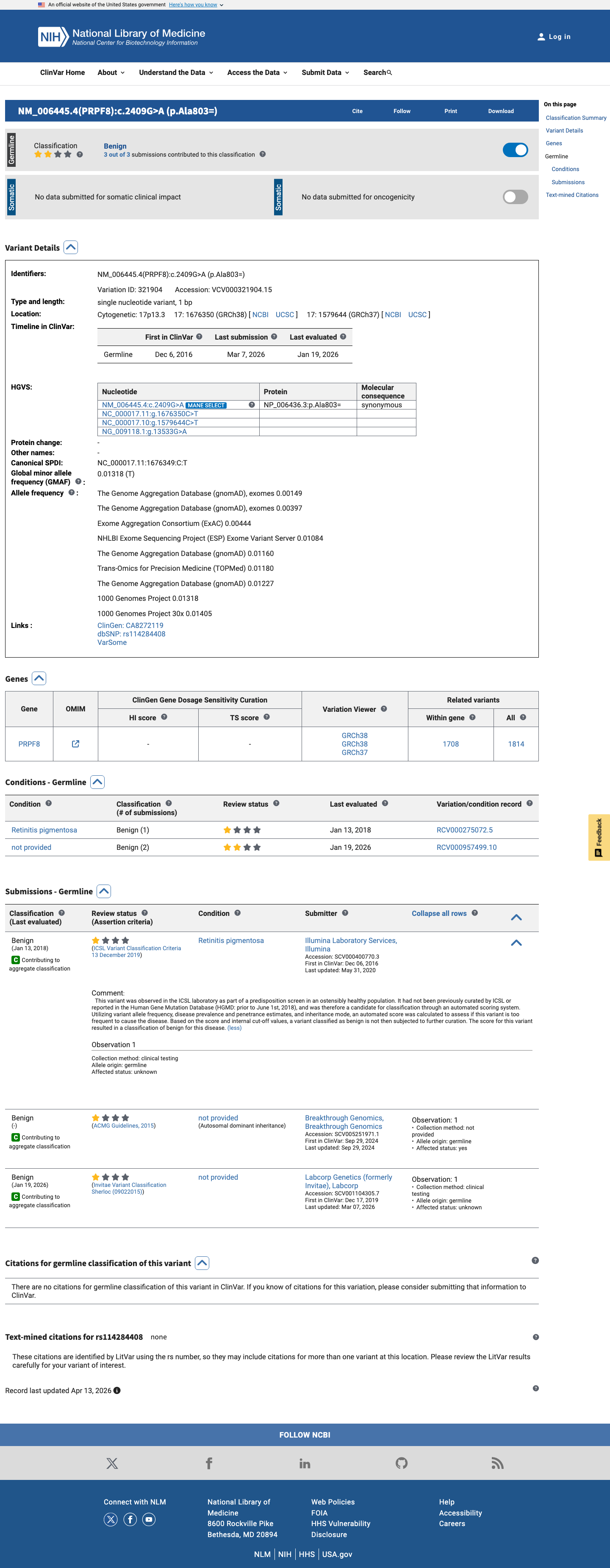
      ClinVar screenshot
      ClinVar
      This variant has been reported in ClinVar as Benign (2 clinical laboratories). (ClinVarID = 321904)
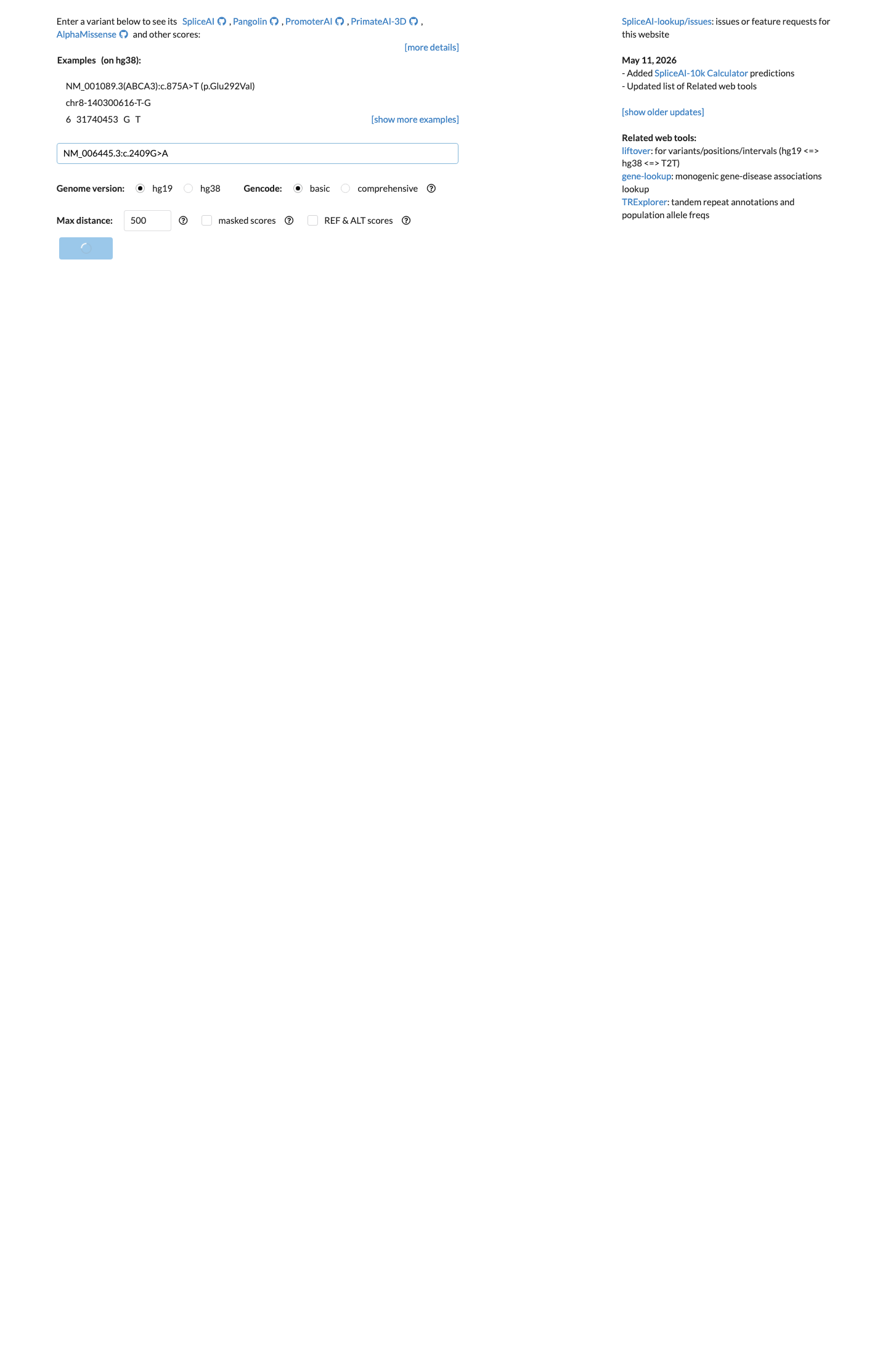
      SpliceAI screenshot
      In silico
      SpliceAI predicts no significant splice impact for this variant (max delta score = 0.05).
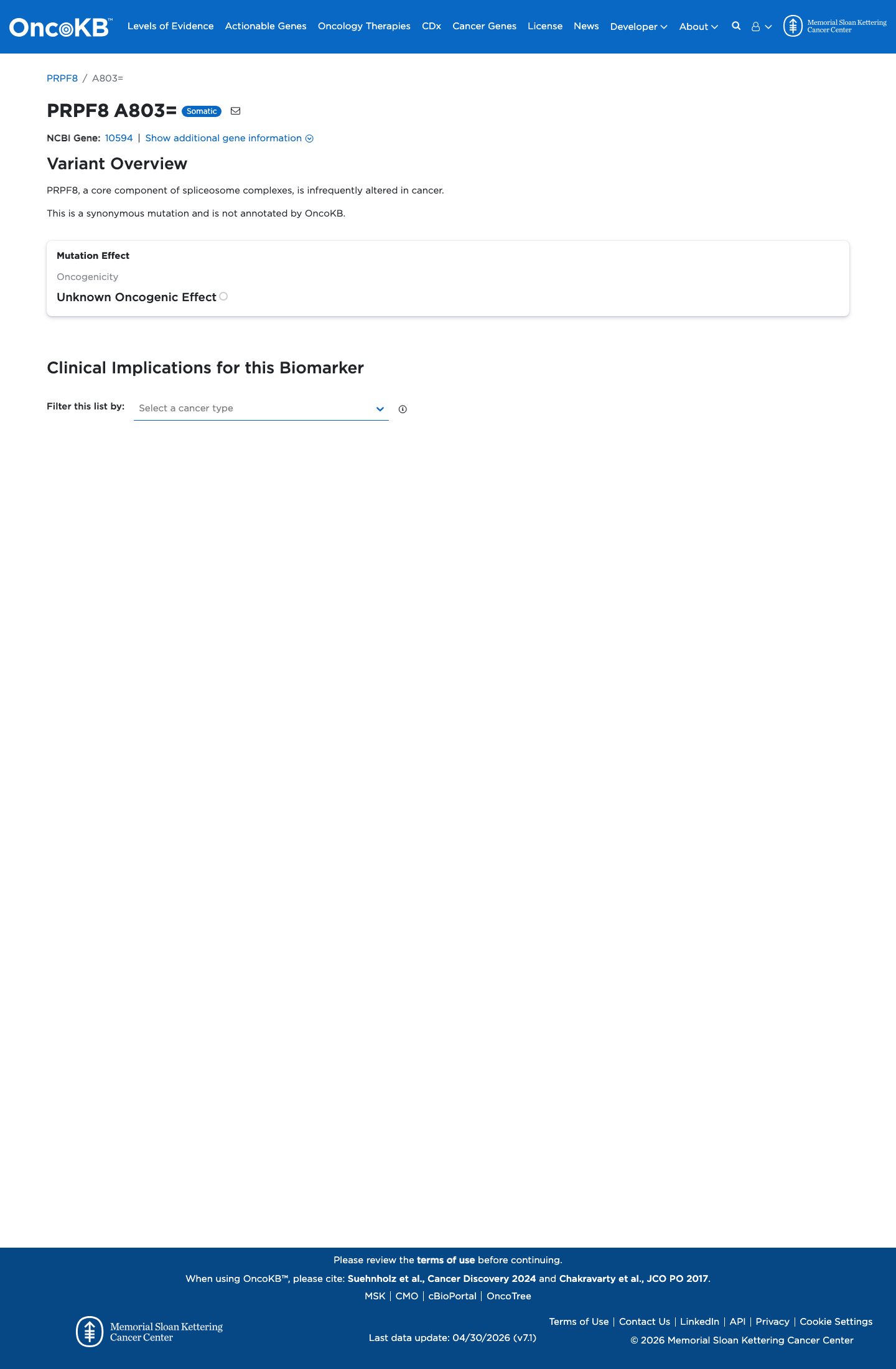
      Functional / OncoKB screenshot
      Functional Unknown Oncogenic Effect
      OncoKB identified curated literature and non-variant-specific oncogenicity context for review; listed oncogenicity label: Unknown Oncogenic Effect.
      OncoKB ↗
      COSMIC screenshot
      COSMIC
      Cancer hotspots screenshot
      Cancer hotspots
      Somatic evidence Not in COSMIC / hotspots
      COSMIC
      This variant does not lie in a statistically significant hotspot. This variant has not previously been reported in somatic cancers (COSMIC).
      Hotspots
      This variant does not lie in a statistically significant hotspot.
      Sources & reference links
      8Sources
      ClinVar
      gnomAD v2.1
      gnomAD v4.1
      gnomAD-Canada
      SpliceAI
      OncoKB
      COSMIC
      Cancer hotspots
      Triaged references · 5 PMIDs not cited in assessment
      25741868 ↗ Standards and guidelines for the interpretation of sequence variants: a joint consensus recommendation of the American College of Medical Genetics and Genomics and the Association for Molecular Pathology. CLINVAR
      26666451 ↗ In Vivo CRISPR/Cas9 Gene Editing Corrects Retinal Dystrophy in the S334ter-3 Rat Model of Autosomal Dominant Retinitis Pigmentosa. CLINVAR
      20301590 ↗ Nonsyndromic Retinitis Pigmentosa Overview. CLINVAR
      22234150 ↗ Clinical utility gene card for: BEST1-related dystrophies (Bestrophinopathies). CLINVAR
      28492532 ↗ Sherloc: a comprehensive refinement of the ACMG-AMP variant classification criteria. CLINVAR