NM_007294.4:c.1367T>C (p.Ile456Thr) is a missense substitution in BRCA1 exon 10(11) at amino acid position 456, which lies outside the recognized clinically important functional domains (RING aa 2–101, coiled-coil aa 1391–1424, BRCT aa 1650–1857).1 BP1_Strong is met: the variant is a missense substitution outside all clinically important functional domains with no splicing predicted (SpliceAI max delta = 0.00), satisfying the ENIGMA v1.2.0 BP1_Strong rule.2 BP5_Supporting is met: clinical-history likelihood ratio from Li et al. 2020 (PMID:31853058) is 0.34 (LOG(LR) = −1.078) based on 4 probands, meeting the BP5_Supporting threshold of LR ≤ 0.48.3 The Parsons et al. 2019 (PMID:31131967) combined multifactorial analysis yielded a combined LR of 0.797 (moderate in favour of benign), directionally consistent with the Li 2020 clinical-history finding, though not independently meeting ENIGMA BP5 thresholds.4 No pathogenic evidence criteria are met. The variant is present in gnomAD at extremely low frequency (v2.1: 2/251,050 alleles, AF=0.0008%; v4.1: 5/1,614,086 alleles) and is reported in ClinVar with conflicting classifications (Variation ID: 54222). No functional studies, case-control data, co-segregation data, or variant-specific literature were identified.5 Under ENIGMA BRCA1 v1.2.0 Table 3 combination rules, 1 Strong Benign criterion (BP1_Strong) plus 1 Supporting Benign criterion (BP5_Supporting) meets the threshold for Likely Benign.6
Final classification
Likely Benign
BP1BP5
BRCA1
c.1367T>C
p.Ile456Thr
This variant
NM_007294.4:c.1367T>C (p.Ile456Thr) is a missense substitution in BRCA1 exon 10(11) at amino acid position 456, which lies outside the recognized clinically important functional domains (RING aa 2–101, coiled-coil aa 1391–1424, BRCT aa 1650–1857).
ENIGMA BRCA1/2 v1.2.0 Table 3 classification framework: 1 Strong Benign criterion (BP1_Strong) plus 1 Supporting Benign criterion (BP5_Supporting) satisfies the Likely Benign combination rule. No pathogenic criteria are met, so no point-system reconciliation is needed.
Classification rationale
BP1BP5
Likely Benign
BRCA1 c.1367T>C
BP1 + BP5
→
Likely Benign
1
cspec ↗
3
PMID:31853058 ↗vcep_pmid_31853058_brca1_clinical_history_lr
4
vcep_humu_40_1557_s001
6
cspec ↗
LYFE Sciences is an AI system, and it can make mistakes. Criteria
may be applied incorrectly, sources may be misread, and a confident-looking
classification can still be wrong. Double-check every criterion and
its underlying evidence before relying on any call.
Gene diagram
· NM_007294.4 · variants mapped to exon structure
BRCA1
NM_007294.4
Fetching transcript structure from UCSC…
Applied criteria · 2 applied · 14 assessed
MetEvidence satisfies this criterion.
Not metEvaluated against available evidence; threshold not reached.
Not assessedApplies in principle, but no evidence was found to evaluate it.
N/ADoesn't apply to this variant type.
Applied · 2
Strength
Supporting
Moderate
Strong
Very strong
BP1
strong
Benign
ENIGMA BP1_Strong applies to missense variants located outside all (potentially) clinically important functional domains (RING aa 2–101, coiled-coil aa 1391–1424, BRCT aa 1650–1857) with no splicing predicted (SpliceAI ≤0.1). p.Ile456Thr is at position 456, outside all three domains. SpliceAI max delta = 0.00. Both conditions satisfied for BP1_Strong.
Ile456 is outside RING (2-101)coiled-coil (1391-1424)and BRCT (1650-1857) domains
BP5
supporting
Benign
ENIGMA BP5 captures combined likelihood ratio against pathogenicity from multifactorial likelihood clinical data. For NM_007294.4:c.1367T>C, the clinical-history LR from Li et al. 2020 (PMID:31853058) is 0.34 (LOG(LR) = −1.078, N=4 probands). This meets the BP5_Supporting threshold (LR ≤ 0.48). The Parsons et al. 2019 (PMID:31131967) combined multifactorial LR of 0.797 (co-occurrence LR=1.139, pathology LR=0.700) is directionally consistent with a benign interpretation but falls in the neutral zone for BP5. Only the Li 2020 clinical-history LR is used for code assignment per ENIGMA specifications.
Clinical history LR = 0.34 (Li 2020N=4 probands) meets BP5_Supporting threshold of ≤0.48Parsons 2019 combined LR = 0.797 is directionally concordant.
Assessed · not applied
· 14 not met · 0 not assessed
Pathogenic
PS1
No previously classified pathogenic or likely pathogenic variant resulting in the same amino acid change (Ile456Thr) or a different missense at codon 456 was identified in ClinVar or ENIGMA reference datasets.
PS3
NM_007294.4:c.1367T>C (p.Ile456Thr) was not found in ENIGMA Specifications Table 9 (curated functional assay results) or Supplementary Table 4 (full functional assay dataset).
PS4
No case-control study with p-value ≤0.05 and OR ≥4 (lower CI excludes 2.0) was identified for this variant.
PM2
ENIGMA PM2_Supporting requires absence from gnomAD v2.1 (non-cancer, exome-only) and gnomAD v3.1 (non-cancer) in outbred populations.
PP1
No co-segregation data are available for NM_007294.4:c.1367T>C.
PP3
ENIGMA PP3 for missense variants requires the variant to be inside a clinically important functional domain (RING aa 2–101, coiled-coil aa 1391–1424, or BRCT aa 1650–1857) AND BayesDel no-AF score ≥0.28.
PP4
ENIGMA PP4 uses the clinical-history likelihood ratio from Li et al.
Benign
BA1
ENIGMA BA1 requires filter allele frequency (FAF) > 0.1% (>0.001) in gnomAD v2.1 (non-cancer, exome-only) and/or v3.1 (non-cancer) non-founder populations.
BS1
ENIGMA BS1_Supporting requires FAF > 0.002% (>0.00002) and ≤0.01% in gnomAD non-cancer, non-founder populations.
BS2
ENIGMA BS2 requires evaluation using Specifications Table 8 points system based on observations in individuals without a Fanconi anemia phenotype.
BS3
NM_007294.4:c.1367T>C (p.Ile456Thr) was not found in ENIGMA Specifications Table 9 (curated functional assay results with pre-assigned BS3 strengths) or Supplementary Table 4 (full functional assay dataset).
BS4
No lack-of-segregation data are available for NM_007294.4:c.1367T>C.
BP4
ENIGMA BP4_Supporting for missense variants requires the variant to be inside a clinically important functional domain with BayesDel ≤0.15 AND SpliceAI ≤0.1.
BP7
ENIGMA BP7_Strong (RNA) requires well-established in vitro or in vivo functional studies showing no damaging effect on mRNA transcript profile.
N/A · 9
PVS1 · PS2 · PM1 · PM5 · PM6 · PP2 · PP5 · BP2 · BP6
Research & evidence
Population frequency · supports benign
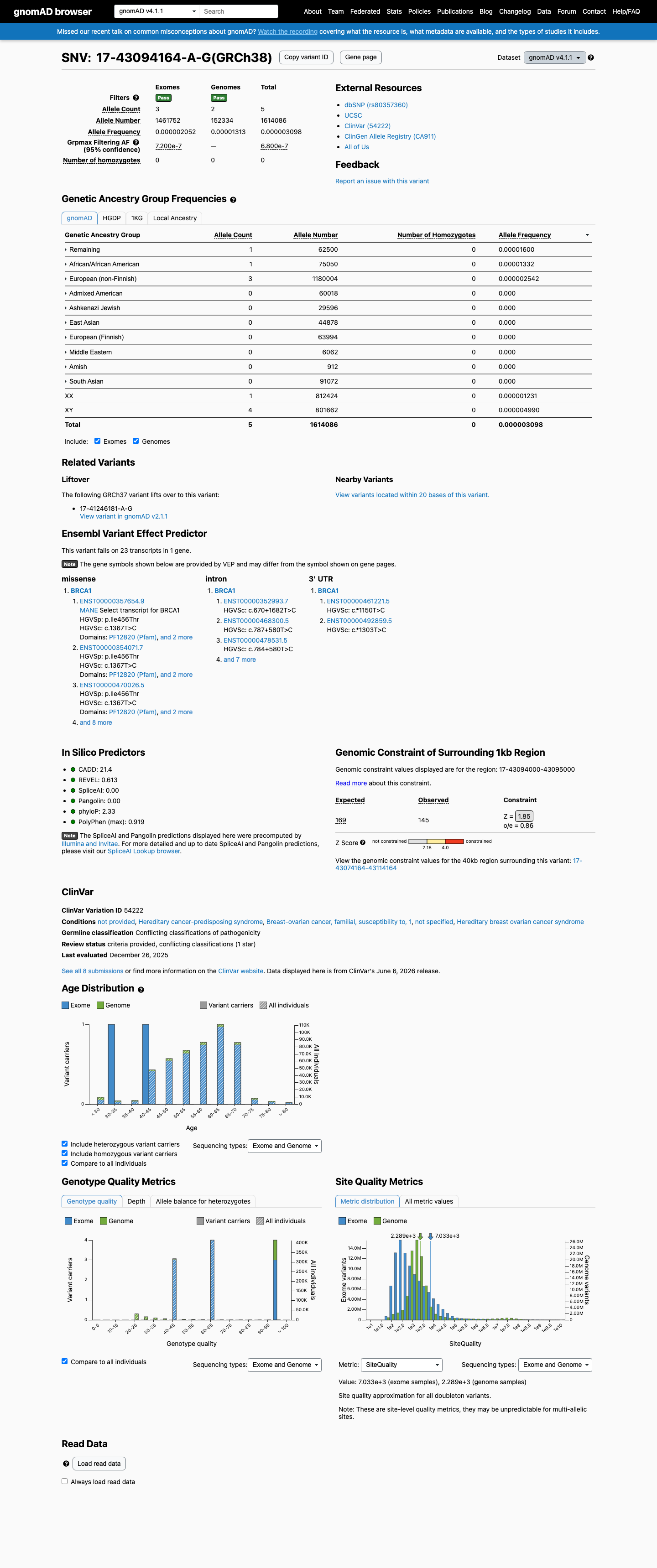
gnomAD v4.1
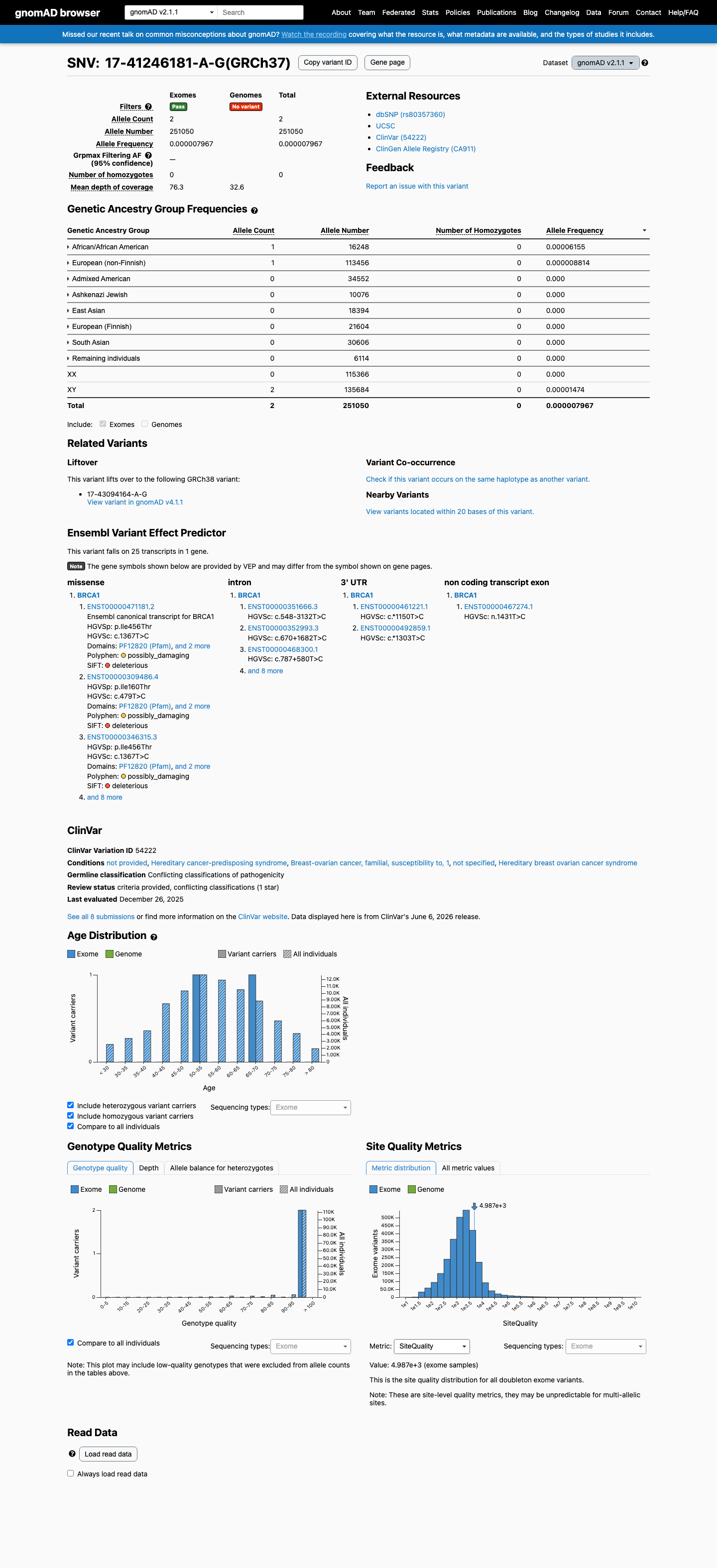
gnomAD v2.1
v4.1
This variant is present in gnomAD v4.1 (AF= 3.09773e-06; MAF= 0.00031%, 5/1614086 alleles, homozygotes = 0) and has highest observed frequency in the Remaining individuals population (AF= 1.6e-05; MAF= 0.00160%, 1/62500 alleles, homozygotes = 0); grpmax FAF= 6.8e-07.
v2.1
This variant is present in gnomAD v2.1 (AF= 7.96654e-06; MAF= 0.00080%, 2/251050 alleles, homozygotes = 0) and has highest observed frequency in the African/African American population (AF= 6.1546e-05; MAF= 0.00615%, 1/16248 alleles, homozygotes = 0).
🇨🇦 CA
Absent from gnomAD-Canada v1.0.
Allele frequency by ancestry
three datasets · side by side
gnomAD v4.1
0.00031%
· 5 / 1,614,086
0 hom · FAF 6.8e-05%
0 hom · FAF 6.8e-05%
Remaining individuals 1 / 62,500 |
0.0016% |
African/African American 1 / 75,050 |
0.0013% |
European (non-Finnish) 3 / 1,180,004 |
0.00025% |
+ 7 not observed (Admixed American, European (Finnish), Amish, East Asian, Middle Eastern, South Asian, Ashkenazi Jewish)
gnomAD v2.1
0.0008%
· 2 / 251,050
0 hom
0 hom
African/African American 1 / 16,248 |
0.0062% |
European (non-Finnish) 1 / 113,456 |
0.00088% |
+ 6 not observed (Admixed American, Ashkenazi Jewish, East Asian, European (Finnish), Remaining individuals, South Asian)
gnomAD Canada 🇨🇦
Absent
· 0 / ?
0 hom
0 hom
Not observed in any ancestry group.

ClinVar
This variant is present in ClinVar (Variation ID: 54222); submission details unavailable.

In silico
SpliceAI predicts no significant splice impact for this variant (max delta score = 0.00). REVEL score = 0.613. BayesDel score = 0.121631.
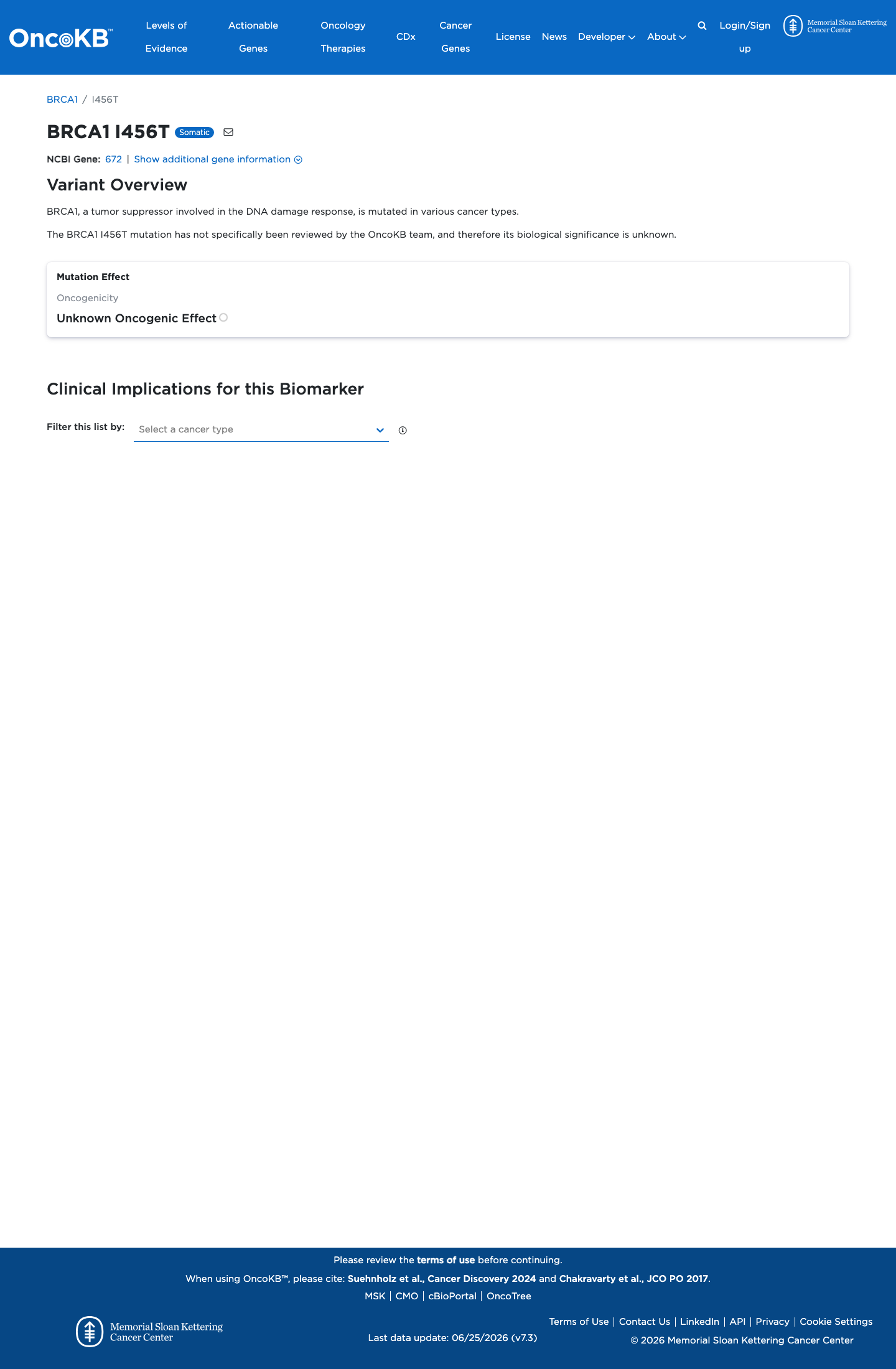
Functional
Unknown Oncogenic Effect
OncoKB did not identify variant-specific reviewed functional evidence for this variant; gene-level curated context is available for reviewer follow-up. BRCA1, a tumor suppressor involved in the DNA damage response, is mutated in various cancer types.
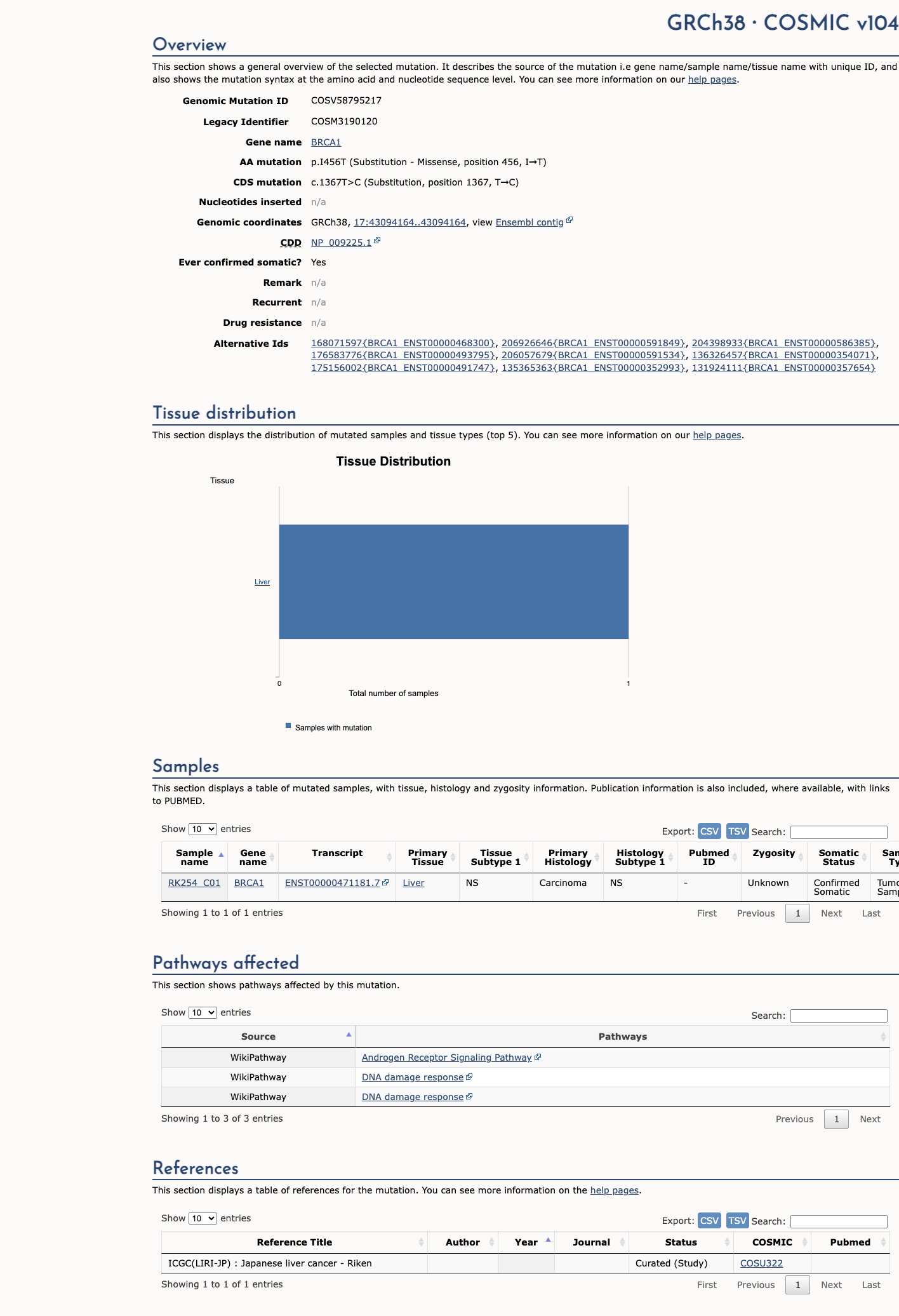
COSMIC

Cancer hotspots
Somatic evidence
Not in COSMIC / hotspots
COSMIC
This variant does not lie in a statistically significant hotspot. This variant has previously been reported in somatic cancers (COSMIC; COSV58795217, n = 1 times).
Hotspots
This variant does not lie in a statistically significant hotspot.
Literature · how each cited paper was used
1papers cited
Each card is an audit: what was searched, what was found, whether it names the variant, which criteria it fed, and why. 5 further PMIDs triaged but not cited — see Sources & references.
Li et al. 2020 BRCA1/2 clinical-history likelihood-ratio model
Searched
c.1367T>CI456TIle456Thr
Found
Li et al. 2020 (Genetics in Medicine) classified variants of uncertain significance in BRCA1 and BRCA2 using personal and family history of cancer from a large multigene panel testing cohort. NM_007294.4:c.1367T>C (p.Ile456Thr) was assessed with a clinical-history LOG(LR) = −1.078 (LR = 0.34) based on 4 probands, indicating a benign-leaning personal/family-history profile.
Variant
✓ Names this variant
Applied to
→BP5
met
Why
Clinical-history LR of 0.34 meets ENIGMA BP5_Supporting threshold (LR ≤ 0.48); used as primary evidence for BP5_Supporting adjudication.
LOG(LR) = −1.077894806861877; LR = 0.3403111928598089; N_Probands = 4
Location MOESM2 clinical history LR table (PMID_31853058_BRCA1_clinical_history_LR.xlsx); variant-level data extracted from supplementary material.
Sources & reference links
9Sources
Triaged references · 5 PMIDs not cited in assessment
17392385 ↗
American Cancer Society guidelines for breast screening with MRI as an adjunct to mammography.
CLINVAR
23188549 ↗
NSGC practice guideline: risk assessment and genetic counseling for hereditary breast and ovarian cancer.
CLINVAR
24366376 ↗
Risk assessment, genetic counseling, and genetic testing for BRCA-related cancer in women: U.S. Preventive Services Task Force recommendation statement.
CLINVAR
24366402 ↗
Summaries for patients. Assessing the genetic risk for BRCA-related breast or ovarian cancer in women: recommendations from the U.S. Preventive Services Task Force.
CLINVAR
24493721 ↗
American Society of Clinical Oncology Expert Statement: collection and use of a cancer family history for oncology providers.
CLINVAR