Analysis in progress
Initialising…
0%
complete
This report is still being assembled — sections appear as each stage finishes. It isn't final yet.
SF3B1
Final classification
VUS
SF3B1 c.1874G>T · p.Arg625Leu
SF3B1

One moderate pathogenic criterion (PM1) and three supporting pathogenic criteria (PM2, PS3, PP3) are met.

Gene
SF3B1
Transcript
NM_012433.3
HGVS · transcript:coding
NM_012433.3:c.1874G>T
Consequence
N/A
GRCh38
chr2:197402759 C>A
GRCh37
chr2:198267483 C>A
Basis gene-specific framework lacked a usable explicit final combination framework, so generic ACMG/AMP 2015 final-combination rules were applied as fallback; applied criteria: PS3 supporting, PM1 moderate, PM2 supporting, PP3 supporting; combination = 1 moderate + 3 supporting, which maps to VUS.
gene-specific framework lacked a usable explicit final combination framework, so generic ACMG/AMP 2015 final-combination rules were applied as fallback; applied criteria: PS3 supporting, PM1 moderate, PM2 supporting, PP3 supporting; combination = 1 moderate + 3 supporting, which maps to VUS.
Classification rationale
PS3PM1PM2PP3 VUS
SF3B1 c.1874G>T

One moderate pathogenic criterion (PM1) and three supporting pathogenic criteria (PM2, PS3, PP3) are met.1 Under generic ACMG/AMP 2015 combination rules (PMID:25741868), the combination of 1 moderate and 3 supporting pathogenic criteria is insufficient to reach Likely Pathogenic (requires ≥1 Moderate + ≥4 Supporting, ≥2 Moderate + ≥2 Supporting, or other qualifying combinations).2 No benign criteria are met. Final classification: Variant of Uncertain Significance (VUS).

PS3 + PM1 + PM2 + PP3 VUS
2 generic_acmg_combination_rules
Gene diagram · NM_012433.3 · variants mapped to exon structure
SF3B1 NM_012433.3
Fetching transcript structure from UCSC…
Applied criteria · 4 applied · 19 assessed
Applied · 4
Strength Supporting Moderate Strong Very strong
PS3 supporting Pathogenic
The variant p.Arg625Leu was detected in uveal melanoma and MDS tumors and is associated with aberrant alternative splicing. The SF3B1 R625 codon is a recurrent hotspot where mutations induce neomorphic cryptic 3' splice site selection. The variant was explicitly identified in patient tumors exhibiting the alternative splicing signature (PMID:23861464, PMID:24434863). Mechanistic studies (PMID:26565915) experimentally demonstrated that hotspot mutations in the HEAT domain (residues 622-781) cause aberrant splicing through altered branch point usage, and the authors concluded that functional consequences are similar across hotspot mutations. However, R625L was not directly tested in a controlled experimental system (minigene assay, overexpression, or knockdown rescue), limiting the strength to supporting.
PMID:23861464: R625L detected in 1/105 uveal melanomasSF3B1-mutant tumors showed alternative splicing of CRNDEABCC5
PM1 moderate Pathogenic
The variant alters Arg625, located within the HEAT domain (H4-H8 repeats, residues 622-781) of SF3B1. This is a well-characterized critical functional domain required for branch point sequence recognition and pre-mRNA splicing. Residue R625 is a statistically significant hotspot in cancer (CancerHotspots.org) and is the most frequently mutated codon in uveal melanoma (PMID:23861464). Mutations in this domain have been experimentally shown to induce neomorphic aberrant splicing activity (PMID:26565915).
Residue R625 is in the HEAT domain (H4-H8 repeats)a critical functional domain for branch point sequence recognition.Statistically significant hotspot at cancerhotspots.org.
PM2 supporting Pathogenic
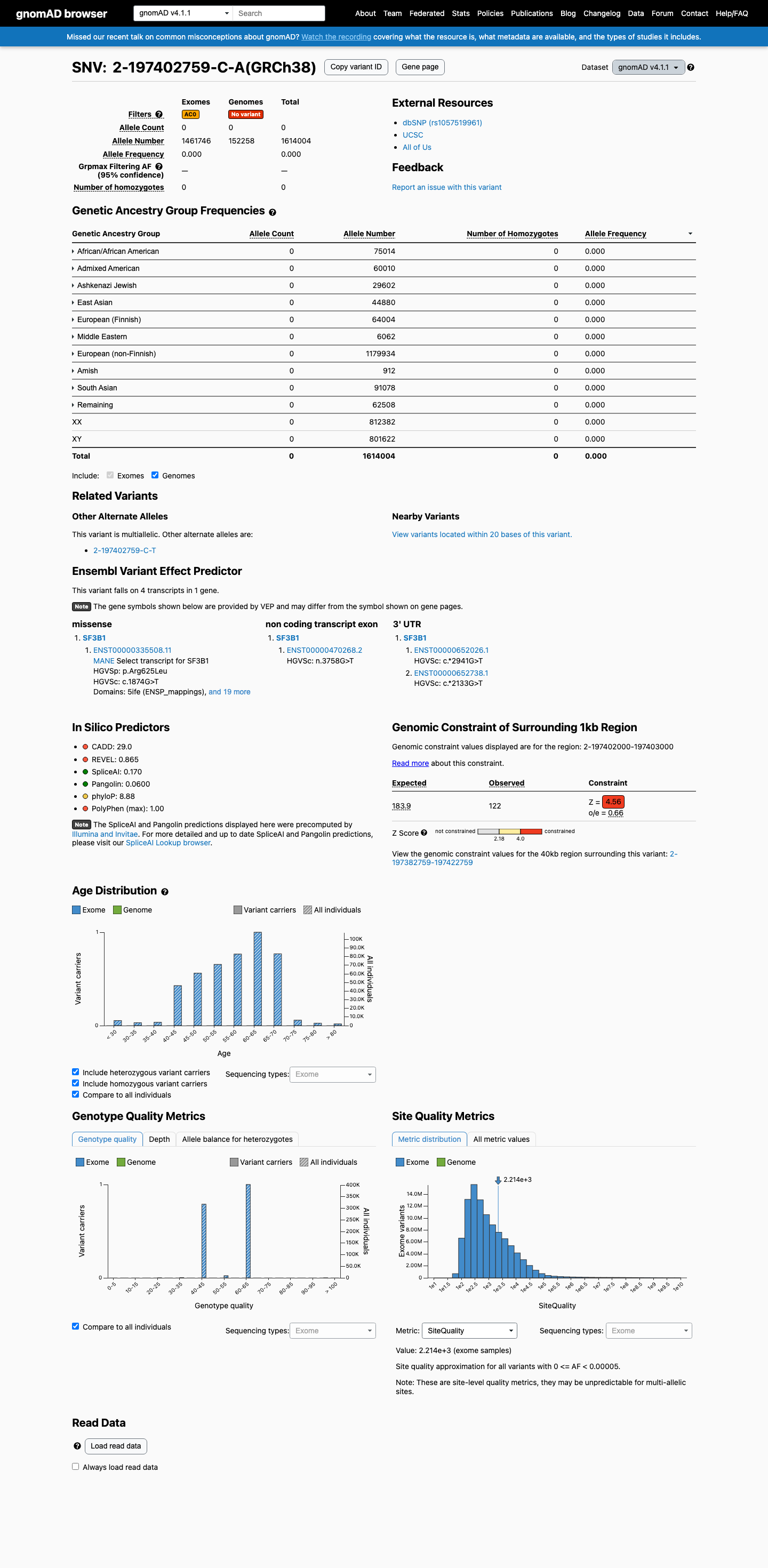
The variant is absent from gnomAD v2.1 (exomes) and v4.1 (0/1,614,004 alleles, AF=0.0%), meeting the PM2 threshold of <0.1% allele frequency in population databases for a gene without a CSPEC framework.
gnomAD v2.1: absent.gnomAD v4.1: 0/1614
PP3 supporting Pathogenic
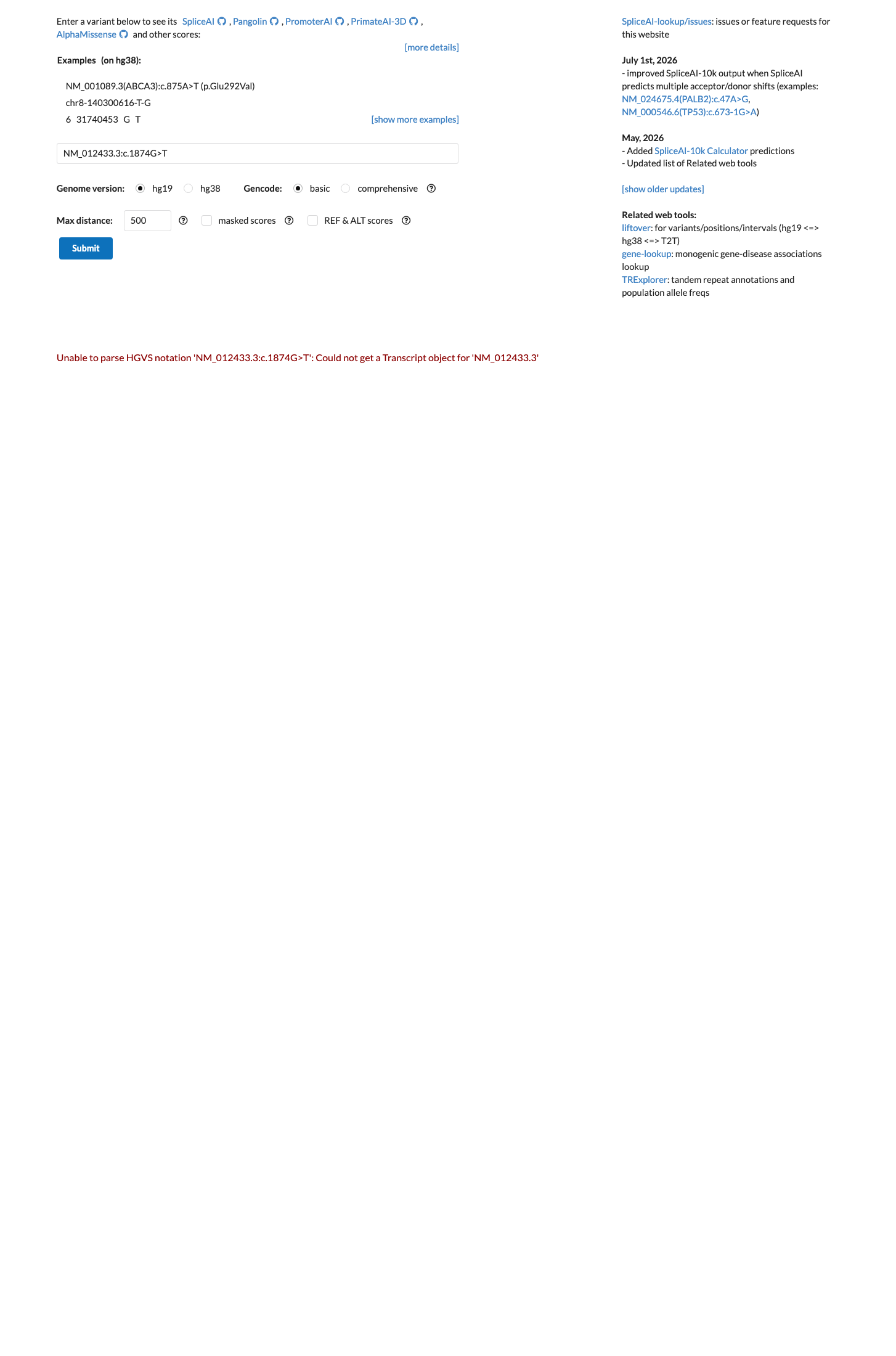
REVEL score of 0.865 predicts a deleterious effect on protein function. BayesDel score of 0.3522 is inconclusive. SpliceAI predicts no significant splice impact (max delta score 0.17). While only one of three in silico tools strongly supports pathogenicity, the high REVEL score in a well-conserved functional domain supports a deleterious effect.
REVEL: 0.865 (deleterious).BayesDel: 0.3522 (inconclusive).SpliceAI: max delta 0.17 (no predicted splice impact
Assessed · not applied
Pathogenic
PS1 No alternative nucleotide change at position c.1874 resulting in the same amino acid substitution (p.Arg625Leu) has been identified.
PS2 No de novo observation of NM_012433.3:c.1874G>T has been reported.
PS4 No germline case-control data are available to demonstrate statistically significant enrichment of this variant in affected individuals.
PM5 No pathogenic missense variant at the same amino acid position (Arg625) has been identified in ClinVar for PM5 comparator analysis.
PM6 No de novo observation of this variant has been reported.
PP1 No segregation data are available for this variant in affected families.
PP2 SF3B1 germline disease mechanisms are still emerging.
PP4 No specific patient phenotype information is available for germline assessment of this variant.
PP5 No reputable germline source has classified this variant as pathogenic.
Benign
BA1 The variant is absent from gnomAD v4.1 (0/1,614,004 alleles, AF=0.0%), far below the BA1 threshold of >1%.
BS1 The variant is absent from gnomAD (AF=0.0%), far below the BS1 threshold of >0.3% allele frequency.
BS2 The variant is absent from gnomAD.
BS3 Functional studies demonstrate that SF3B1 hotspot mutations in the HEAT domain, including at codon R625, induce neomorphic gain-of-function activity (aberrant cryptic 3' splice site selection, altered branch point usage) rather than having no deleterious effect.
BS4 No segregation data are available to demonstrate lack of cosegregation with disease.
BP1 SF3B1-related disease is not caused primarily by truncating variants.
BP2 No observation of this variant in trans with a known pathogenic variant has been reported.
BP4 Computational evidence does not support a benign impact.
BP5 No alternative molecular basis for disease has been identified in a case harboring this variant.
BP6 No reputable source has classified this variant as benign.
N/A · 2 PVS1 · BP7
Research & evidence
Population frequency
gnomAD v4.1 screenshot
gnomAD v4.1
gnomAD v2.1 screenshot
gnomAD v2.1
v4.1
This variant is present in gnomAD v4.1 (AF= 0; MAF= 0.00000%, 0/1614004 alleles, homozygotes = 0) and has highest observed frequency in the African/African American population (AF= 0; MAF= 0.00000%, 0/75014 alleles, homozygotes = 0).
v2.1
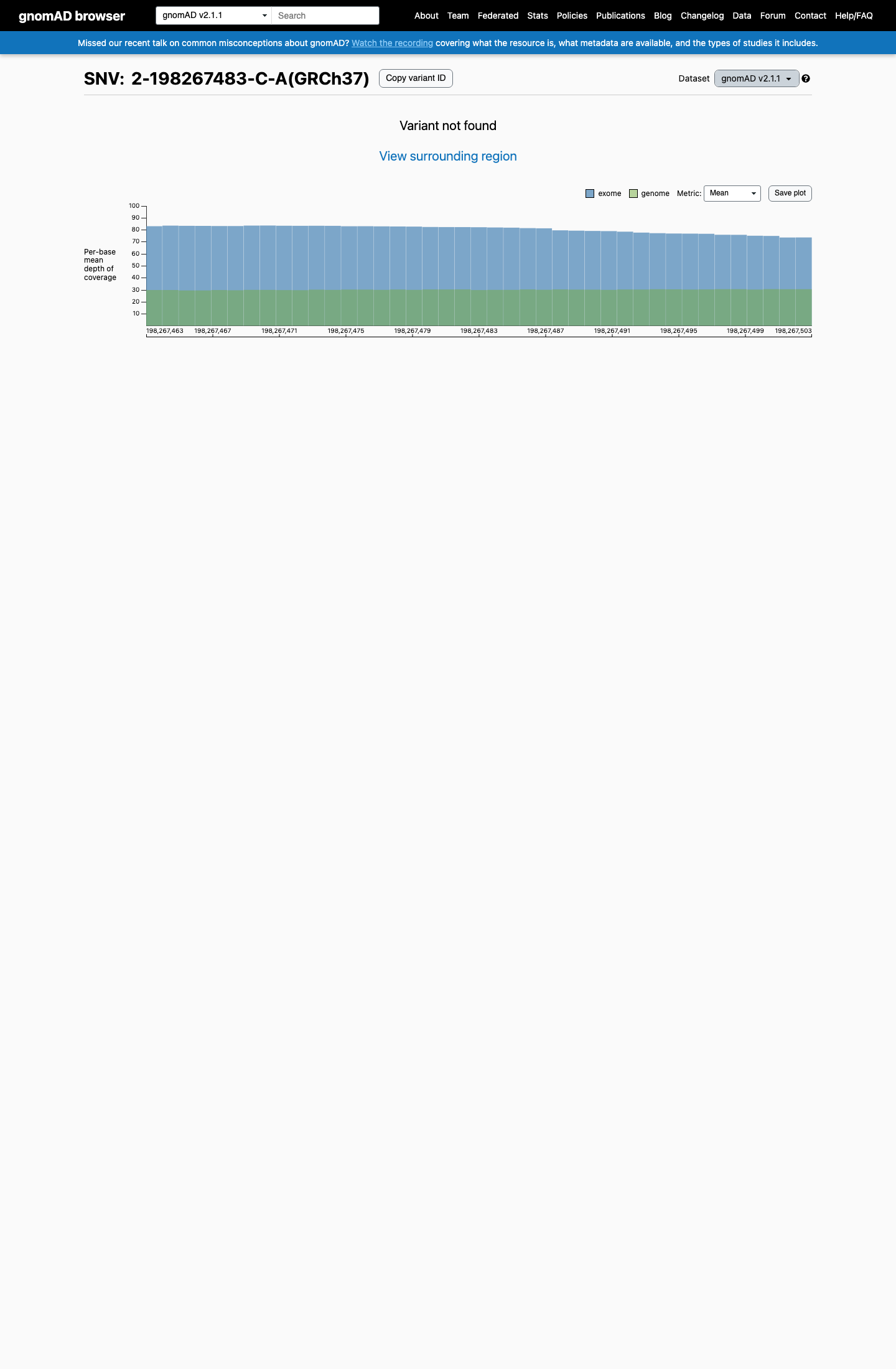
Absent from gnomAD v2.1.
🇨🇦 CA
Not available in gnomAD-Canada v1.0.
Allele frequency by ancestry
three datasets · side by side
gnomAD v4.1
Absent · 0 / 1,614,004
0 hom
Not observed in any ancestry group.
+ 10 not observed (Remaining individuals, Admixed American, European (Finnish), Amish, East Asian, Middle Eastern, South Asian, Ashkenazi Jewish, African/African American, European (non-Finnish))
gnomAD v2.1
Absent · 0 / ?
0 hom
Not observed in any ancestry group.
gnomAD Canada 🇨🇦
Absent · 0 / ?
0 hom
Not observed in any ancestry group.
ClinVar screenshot
ClinVar
This variant is absent from ClinVar.
SpliceAI screenshot
In silico
SpliceAI predicts no significant splice impact for this variant (max delta score = 0.17). REVEL score = 0.865. BayesDel score = 0.3522.
Functional / OncoKB screenshot
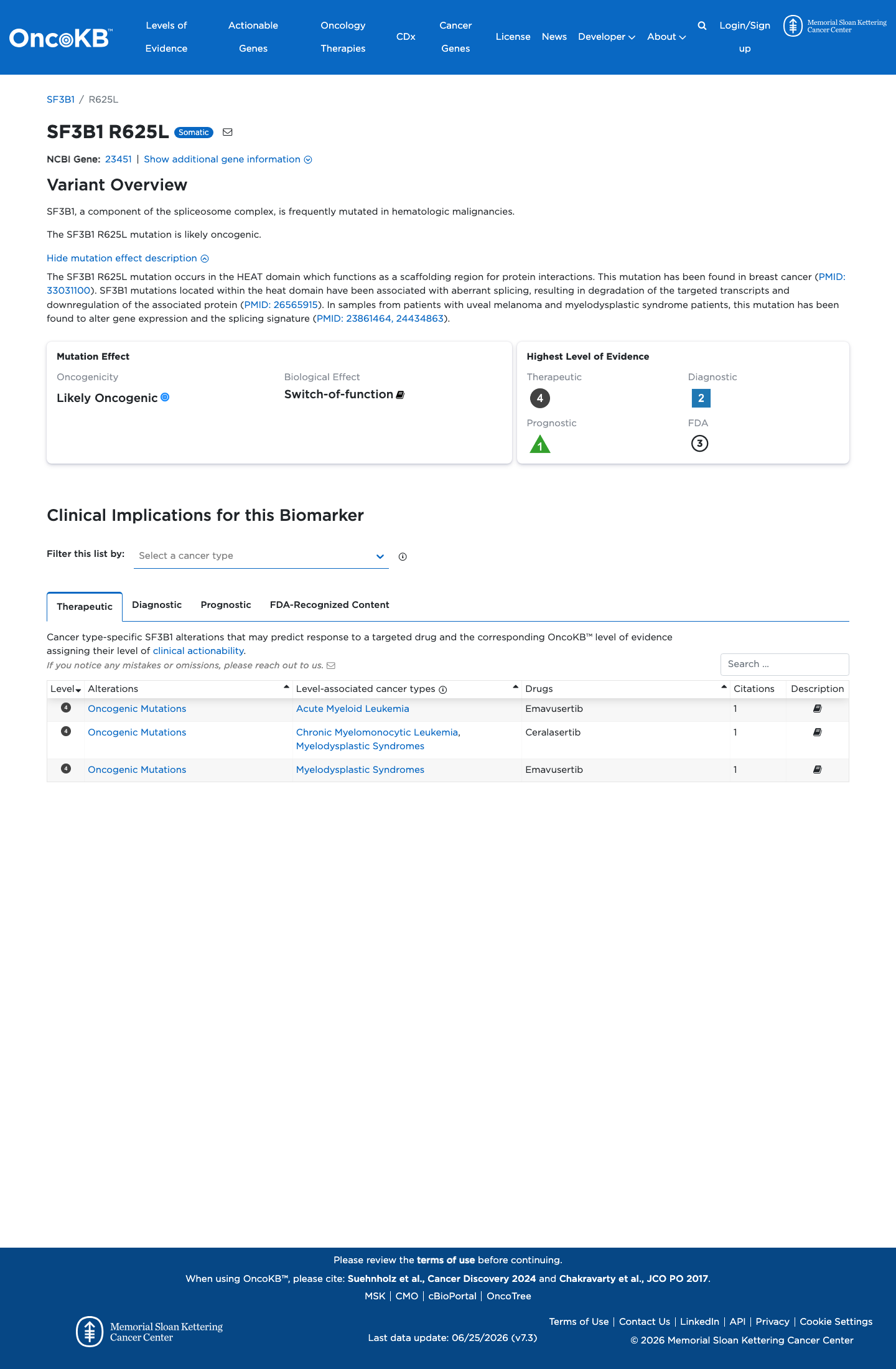
Functional Likely Oncogenic
OncoKB identified variant-specific curated literature and context relevant to functional review; curated oncogenicity label: Likely Oncogenic.
OncoKB ↗
COSMIC screenshot
COSMIC
Cancer hotspots screenshot
Cancer hotspots
Somatic evidence Hotspot
COSMIC
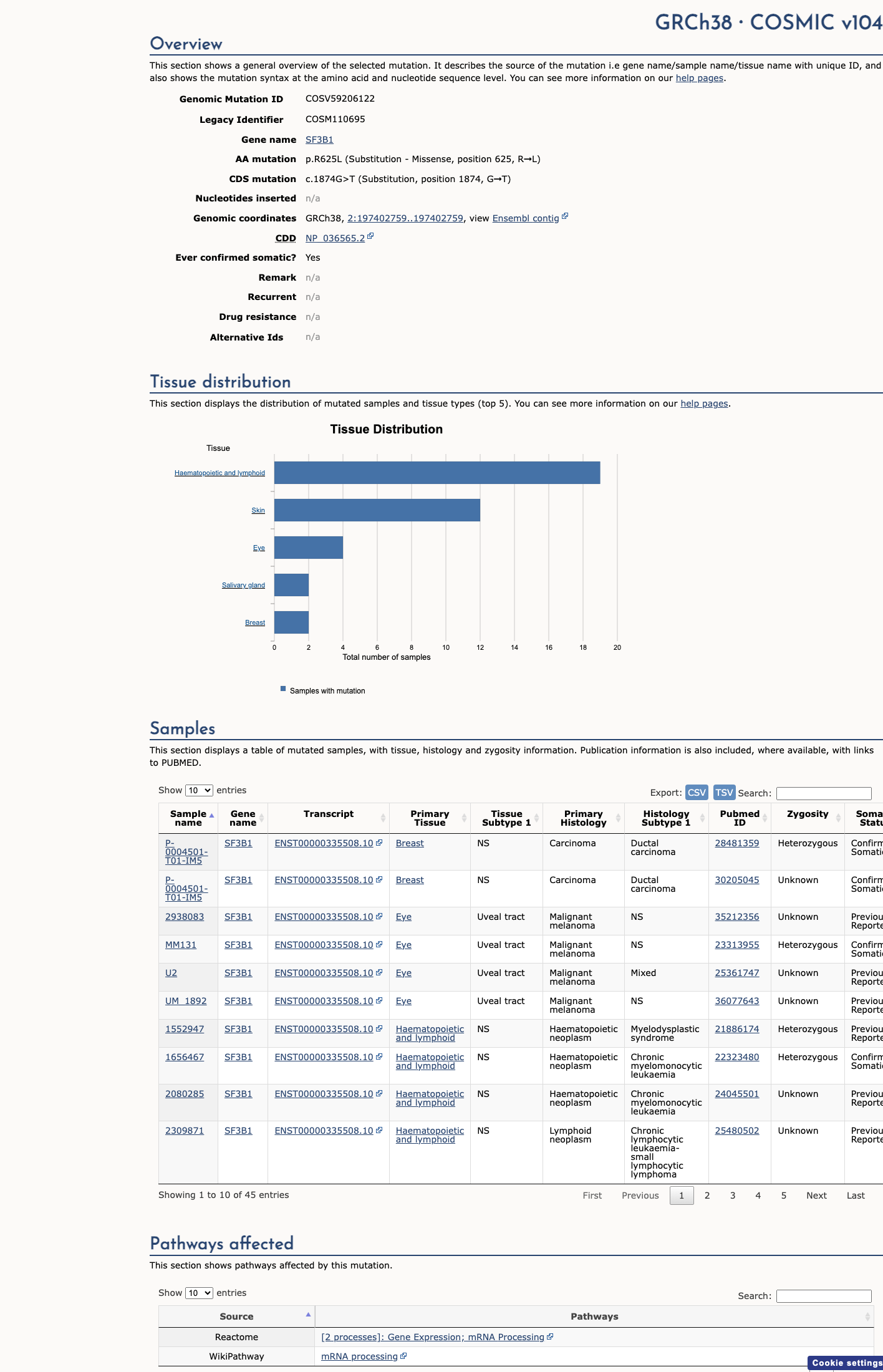
This variant lies in a statistically significant hotspot. This variant has previously been reported in somatic cancers (COSMIC; COSV59206122, n = 40 times).
Hotspots
This variant lies in a statistically significant hotspot.
Literature · how each cited paper was used
3papers cited
Each card is an audit: what was searched, what was found, whether it names the variant, which criteria it fed, and why. 1 further PMID triaged but not cited — see Sources & References.
SF3B1 mutations are associated with alternative splicing in uveal melanoma.
Searched
R625Lc.1874G>TArg625Leu625L
Found
Identified p.Arg625Leu (R625L) in 1 of 105 uveal melanoma tumor samples in the validation cohort. SF3B1-mutant tumors, including those with codon R625 mutations, demonstrated aberrant alternative splicing affecting CRNDE, ABCC5, UQCC, and five other genes, validated by microarray, RNA-seq, and qRT-PCR.
Variant
✓ Names this variant — characterised directly
Applied to
PM1 supports · met PS3 supports · met
Why
Variant explicitly detected and associated with alternative splicing in uveal melanoma; used to support PS3 (supporting) and PM1 (moderate).
We screened SF3B1 in 105 additional consecutive archival primary uveal melanomas and detected 15 additional mutations (8 p.R625H, 4 p.R625C, 1 p.R625P, 1 p.R625L, 1 p.K666T; Supplementary Table 7).
Location Results section: 'We screened SF3B1 in 105 additional consecutive archival primary uveal melanomas and detected 15 additional mutations (8 p.R625H, 4 p.R625C, 1 p.R625P, 1 p.R625L, 1 p.K666T; Supplementary Table 7).'  ·  Context Patient tumor samples (primary uveal melanoma); Affymetrix HTA2.0 microarrays, RNA-seq, and qRT-PCR for splicing analysis  ·  full text
A common alternative splicing signature is associated with SF3B1 mutations in malignancies from different cell lineages.
Searched
R625Lc.1874G>TArg625Leu625L
Found
R625L listed among SF3B1-mutant MDS samples (4 MDS cases with R625L/H/D/C). All SF3B1-mutated samples, including R625-mutant tumors, clustered together by splicing signature, confirming a common alternative splicing pattern across uveal melanoma, MDS, and CLL.
Variant
✓ Names this variant — characterised directly
Applied to
PS3 supports · met
Why
Variant explicitly listed in the MDS cohort; splicing signature validated across SF3B1 R625 mutations; used to support PS3 (supporting).
24 MDS SF3B1 mutated samples cases [K700E (14), H622Q (4), D781G (2), R625L/H/D/C (4)] and 19 SF3B1 mutated UM samples [K625H/C/L/P (16), K666M/T (2), D700E (1)].
Location Results section: '24 MDS SF3B1 mutated samples cases [K700E (14), H622Q (4), D781G (2), R625L/H/D/C (4)] and 19 SF3B1 mutated UM samples [K625H/C/L/P (16)]...'  ·  Context Patient tumor samples; RT-QPCR splicing analysis of UQCC, CRNDE, ANKHD1, GUSBP1, ABCC5 across 161 tumors  ·  full text
Cancer-Associated SF3B1 Hotspot Mutations Induce Cryptic 3' Splice Site Selection through Use of a Different Branch Point.
Searched
R625Lc.1874G>TArg625Leu625LR625
Found
Experimentally demonstrated that SF3B1 hotspot mutations in the HEAT domain (residues 622-781) induce neomorphic cryptic 3' splice site selection through use of a different branch point. The study tested K700E, K666N, and H662Q experimentally and concluded that all hotspot mutations share similar functional consequences. R625L was not directly tested.
Variant
◇ Residue / gene-level — variant not named
Applied to
PM1 supports · met PS3 supports · met
Why
Variant R625L not directly tested; study provides mechanistic framework for hotspot-domain functional effects; used to support PS3 (supporting) and PM1 (moderate).
all hotspot mutations are co-localized in a limited, positively charged region even though they are distributed across five different HEAT domains... our data suggest the functional consequences on splicing for these changes are similar.
Location Introduction: 'The recurrent hotspot mutations in SF3B1 are found exclusively in the C-terminal HEAT domains (residues 622-781).' Discussion: 'all hotspot mutations are co-localized in a limited, positively charged region...our data suggest the functional consequences on splicing for these changes are similar.'  ·  Context Nalm-6 isogenic cell lines, K562 cells, 293FT cells; RNA-seq, Nanostring, minigene splicing assays, lariat PCR, SILAC proteomics  ·  full text
Sources & reference links
8Sources
ClinVar
gnomAD v2.1
gnomAD v4.1
gnomAD-Canada
SpliceAI
OncoKB
COSMIC
Cancer hotspots
Triaged references · 1 PMID not cited in assessment
33031100 ↗ Mutant SF3B1 promotes AKT- and NF-&#x3ba;B-driven mammary tumorigenesis. ONCOKB