SF3B1 c.2098A>G (p.Lys700Glu) is a missense variant located in the HEAT repeat domain (H4-H8), a critical functional region essential for 3' splice site recognition during pre-mRNA splicing.1 This variant is the most recurrent SF3B1 hotspot across hematologic malignancies and solid tumors, with 811 somatic occurrences in COSMIC and statistical significance at cancerhotspots.org. Multiple independent functional studies demonstrate that K700E causes aberrant 3' splice site selection, cryptic branchpoint usage, and a conserved alternative splicing signature, confirmed in isogenic Nalm-6 cell lines and conditional Sf3b1 K700E/+ knock-in mice.2 Mechanistically, K700E promotes MYC protein stabilization through aberrant splicing and nonsense-mediated decay of PPP2R5A, a regulatory subunit of the PP2A phosphatase complex, leading to oncogenic transformation.3 The variant is present at very low frequency in population databases (gnomAD v2.1: 0.0083%, 23/276,636 alleles; gnomAD v4.1: 0.0045%, 72/1,604,090 alleles), meeting the PM2 threshold for rarity.4 ClinVar reports conflicting classifications: Uncertain significance (2 laboratories), Likely pathogenic (2 laboratories), and Pathogenic (1 laboratory, somatic), with an aggregate 1-star review status (criteria provided, single submitter).5 In silico predictions are mixed: REVEL (0.619) supports a deleterious effect, while BayesDel (0.234) is ambiguous and SpliceAI (0.03) predicts no splicing impact.6 This variant meets PS3 (moderate), PM1 (moderate), PM2 (supporting), and PP3 (supporting). No benign criteria are met. The functional data strength is tempered by its derivation from somatic cancer models; correlation with germline disease phenotype requires clinical review.
Final classification
Likely Pathogenic
PS3PM1PM2PP3
SF3B1
c.2098A>G
p.Lys700Glu
This variant
SF3B1 c.2098A>G (p.Lys700Glu) is a missense variant located in the HEAT repeat domain (H4-H8), a critical functional region essential for 3' splice site recognition during pre-mRNA splicing.
gene-specific framework lacked a usable explicit final combination framework, so generic ACMG/AMP 2015 final-combination rules were applied as fallback; applied criteria: PS3 moderate, PM1 moderate, PM2 supporting, PP3 supporting; combination = 2 moderate + 2 supporting, which maps to Likely Pathogenic.
Classification rationale
PS3PM1PM2PP3
Likely Pathogenic
SF3B1 c.2098A>G
PS3 + PM1 + PM2 + PP3
→
Likely Pathogenic
LYFE Sciences is an AI system, and it can make mistakes. Criteria
may be applied incorrectly, sources may be misread, and a confident-looking
classification can still be wrong. Double-check every criterion and
its underlying evidence before relying on any call.
Gene diagram
· NM_012433.3 · variants mapped to exon structure
SF3B1
NM_012433.3
Fetching transcript structure from UCSC…
Applied criteria · 4 applied · 21 assessed
MetEvidence satisfies this criterion.
Not metEvaluated against available evidence; threshold not reached.
Not assessedApplies in principle, but no evidence was found to evaluate it.
N/ADoesn't apply to this variant type.
Applied · 4
Strength
Supporting
Moderate
Strong
Very strong
PS3
moderate
review
Pathogenic
SF3B1 K700E has been directly tested in multiple independent publications demonstrating unequivocal gain-of-function effects on RNA splicing. K700E expression causes aberrant 3' splice site selection and cryptic branchpoint usage (PMID:21909114, PMID:26565915), generates a conserved alternative splicing signature across cancer types (PMID:24434863, PMID:25424858), and promotes tumorigenesis through MYC stabilization via PPP2R5A mis-splicing, confirmed in isogenic Nalm-6 cell lines and conditional Sf3b1 K700E/+ knock-in mice (PMID:32188705). Functional effects are well-established; however, data derive from somatic cancer models and the relevance to germline disease is not fully resolved.
K700E identified as recurrent hotspot in MDSgain-of-function splicing defects (PMID:21909114)K700E-associated splicing signature conserved across MDS
PM1
moderate
Pathogenic
Residue K700 lies within the HEAT repeat domain (H4-H8) of SF3B1, a structurally and functionally critical region essential for branchpoint recognition and 3' splice site selection during pre-mRNA splicing. This residue is a statistically significant mutational hotspot in cancer (cancerhotspots.org) and is the most frequently mutated codon in SF3B1 across hematologic malignancies and solid tumors (PMID:21909114, PMID:32188705).
K700 is the predominant SF3B1 hotspot across cancers (PMID:21909114: K700E=44 casesPMID:32188705)Located in HEAT H4-H8 domain critical for U2 snRNP-branchpoint interaction
PM2
supporting
Pathogenic
This variant is present at very low frequency in population databases. gnomAD v2.1 allele frequency is 8.31×10⁻⁵ (0.0083%, 23/276,636 alleles, 0 homozygotes); gnomAD v4.1 allele frequency is 4.49×10⁻⁵ (0.0045%, 72/1,604,090 alleles, 0 homozygotes). Both are below the 0.1% PM2 threshold for a rare variant absent from population controls.
gnomAD v2.1: AF=8.31×10⁻⁵23/276636 alleles
PP3
supporting
Pathogenic
REVEL score of 0.619 exceeds the commonly used 0.5 threshold, supporting a deleterious effect. BayesDel score of 0.234 is below most pathogenicity thresholds. SpliceAI max delta of 0.03 predicts no splicing impact. In silico evidence is mixed but REVEL provides supporting-level evidence for pathogenicity.
REVEL score: 0.619 (above 0.5 threshold)BayesDel score: 0.234 (below 0.27 threshold)SpliceAI max delta: 0.03 (no predicted splicing impact)
Assessed · not applied
· 20 not met · 1 not assessed
Pathogenic
PVS1
NM_012433.3:c.2098A>G is a missense variant (p.Lys700Glu) and does not fall into any generic PVS1 null-variant category (nonsense, frameshift, or canonical ±1,2 splice site).
PS1
No evidence that a different nucleotide change at codon 700 resulting in the same amino acid substitution (p.Lys700Glu) has been previously established as pathogenic in a germline context.
PS2
No de novo occurrence data available for this variant with confirmed maternity and paternity.
PS4
No case-control study demonstrating statistically significant enrichment of this variant in affected individuals versus controls in a germline context.
PM5
No qualifying comparator variant at the same residue (K700) with a different amino acid change classified as pathogenic was identified.
PM6
No confirmed de novo occurrence of this variant with maternity and paternity testing has been reported.
PP1
No co-segregation data with disease in multiple affected family members is available for this variant.
PP2
Constraint metrics (e.g., gnomAD missense Z-score, LOEUF) were not directly reviewed for SF3B1.
PP4
No patient-specific phenotypic information was available for review.
PP5
ClinVar aggregate classification is Uncertain significance (review status: criteria provided, single submitter; 1-star).
Benign
BA1
gnomAD v2.1 allele frequency of 0.0083% is well below the 1% BA1 threshold for a benign stand-alone classification.
BS1
gnomAD v2.1 allele frequency of 0.0083% is below the 0.3% BS1 threshold for a benign strong classification.
BS2
No evidence of observation in healthy adult individuals for a disorder with full penetrance expected at an early age.
BS3
Functional studies uniformly demonstrate deleterious gain-of-function effects: K700E causes aberrant 3' splice site selection, cryptic branchpoint usage, MYC stabilization, and oncogenic transformation (PMID:21909114, PMID:25424858, PMID:32188705).
BS4
No evidence of lack of segregation in affected family members.
BP1
This is a missense variant (p.Lys700Glu).
BP2
No evidence of observation in trans with a known pathogenic variant for a fully penetrant dominant disorder, nor in cis with a pathogenic variant in a recessive disorder.
BP4
In silico evidence is mixed and does not meet the requirement for multiple lines of computational evidence suggesting no impact.
BP5
SF3B1 is a gene in which variants have been reported as pathogenic.
BP6
ClinVar aggregate classification is Uncertain significance (1-star).
BP7
This is a missense variant (c.2098A>G, p.Lys700Glu), not a synonymous or intronic variant.
Research & evidence
Population frequency · supports pathogenic
gnomAD v4.1
gnomAD v2.1
v4.1
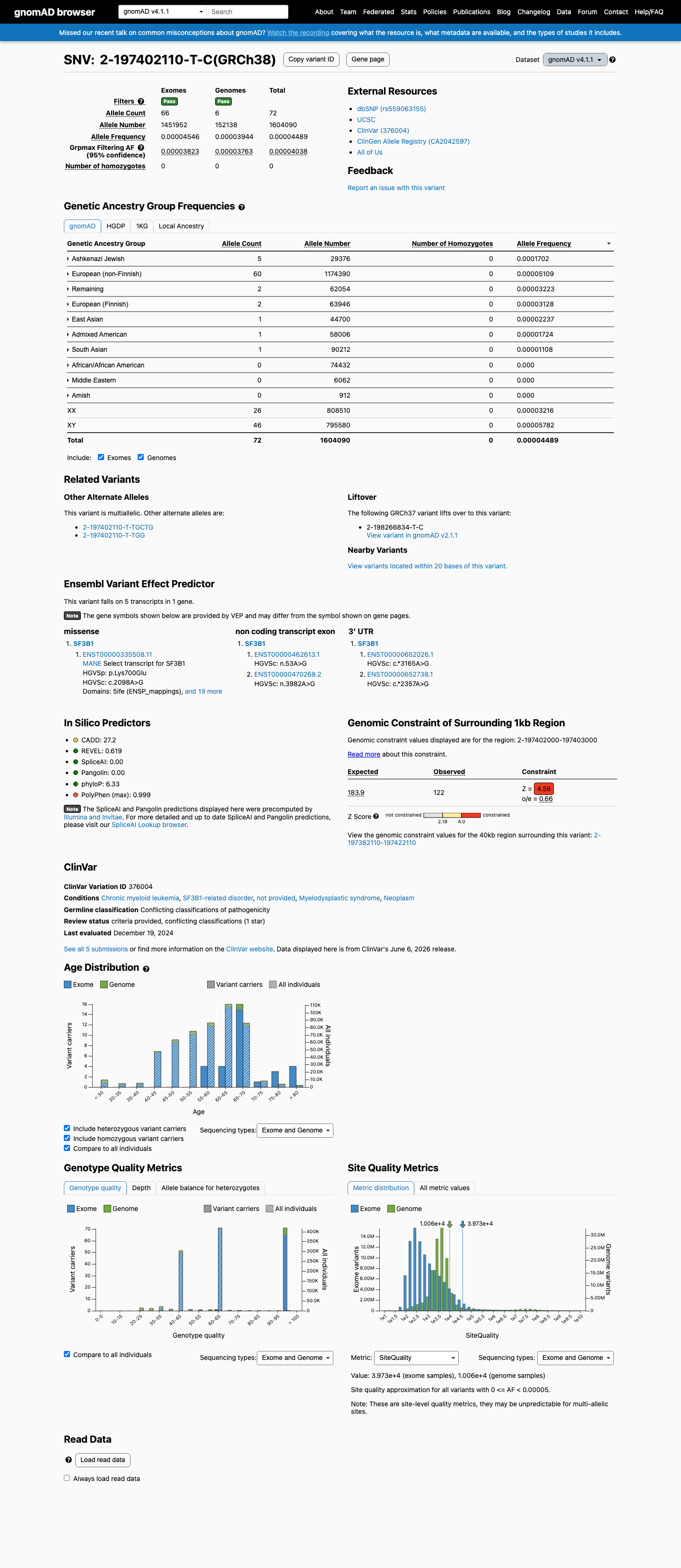
This variant is present in gnomAD v4.1 (AF= 4.48853e-05; MAF= 0.00449%, 72/1604090 alleles, homozygotes = 0) and has highest observed frequency in the Ashkenazi Jewish population (AF= 0.000170207; MAF= 0.01702%, 5/29376 alleles, homozygotes = 0); grpmax FAF= 4.038e-05.
v2.1
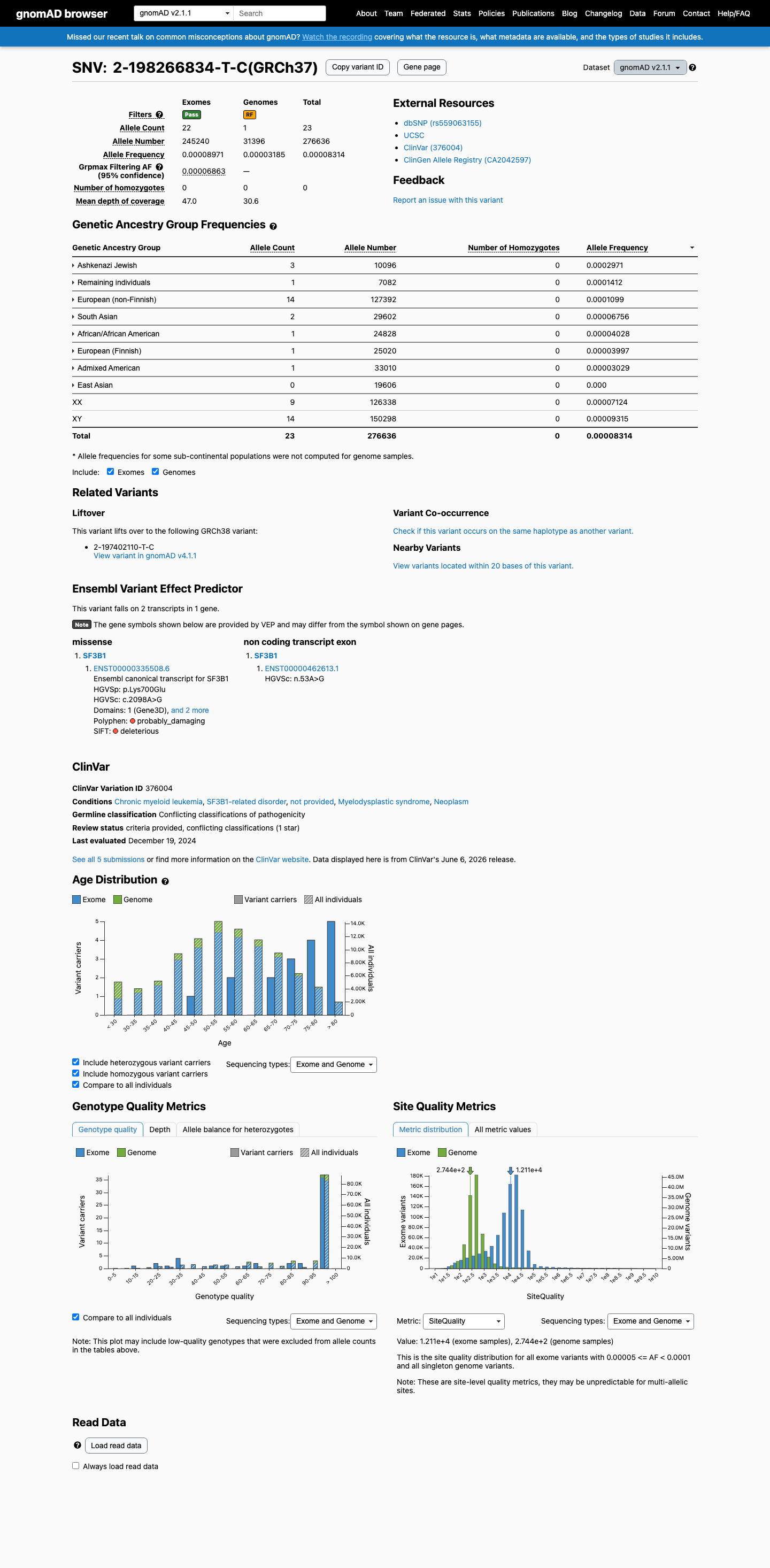
This variant is present in gnomAD v2.1 (AF= 8.31417e-05; MAF= 0.00831%, 23/276636 alleles, homozygotes = 0) and has highest observed frequency in the Ashkenazi Jewish population (AF= 0.000297147; MAF= 0.02971%, 3/10096 alleles, homozygotes = 0); grpmax FAF= 6.863e-05.
🇨🇦 CA
This variant is present in gnomAD-Canada v1.0 (AF= 0.00027165054873410846, 5/18406 alleles, homozygotes = 0).
Allele frequency by ancestry
three datasets · side by side
gnomAD v4.1
0.0045%
· 72 / 1,604,090
0 hom · FAF 0.004%
0 hom · FAF 0.004%
Ashkenazi Jewish 5 / 29,376 |
0.017% |
European (non-Finnish) 60 / 1,174,390 |
0.0051% |
Remaining individuals 2 / 62,054 |
0.0032% |
European (Finnish) 2 / 63,946 |
0.0031% |
East Asian 1 / 44,700 |
0.0022% |
Admixed American 1 / 58,006 |
0.0017% |
South Asian 1 / 90,212 |
0.0011% |
+ 3 not observed (Amish, Middle Eastern, African/African American)
gnomAD v2.1
0.0083%
· 23 / 276,636
0 hom · FAF 0.0069%
0 hom · FAF 0.0069%
Ashkenazi Jewish 3 / 10,096 |
0.03% |
Remaining individuals 1 / 7,082 |
0.014% |
European (non-Finnish) 14 / 127,392 |
0.011% |
South Asian 2 / 29,602 |
0.0068% |
African/African American 1 / 24,828 |
0.004% |
European (Finnish) 1 / 25,020 |
0.004% |
Admixed American 1 / 33,010 |
0.003% |
+ 1 not observed (East Asian)
gnomAD Canada 🇨🇦
0.027%
· 5 / 18,406
0 hom · FAF 0.0069%
0 hom · FAF 0.0069%
Middle Eastern 1 / 144 |
0.69% |
Ashkenazi Jewish 1 / 830 |
0.12% |
European (non-Finnish) 3 / 11,730 |
0.026% |
+ 6 not observed (African/African American, Latino/Admixed American, East Asian, European (Finnish), Remaining individuals, South Asian)

ClinVar
This variant has been reported in ClinVar as Uncertain significance (2 clinical laboratories) and as Likely pathogenic (2 clinical laboratories) and as Pathogenic (1 clinical laboratory). (ClinVarID = 376004)

In silico
SpliceAI predicts no significant splice impact for this variant (max delta score = 0.03). REVEL score = 0.619. BayesDel score = 0.233816.
Functional
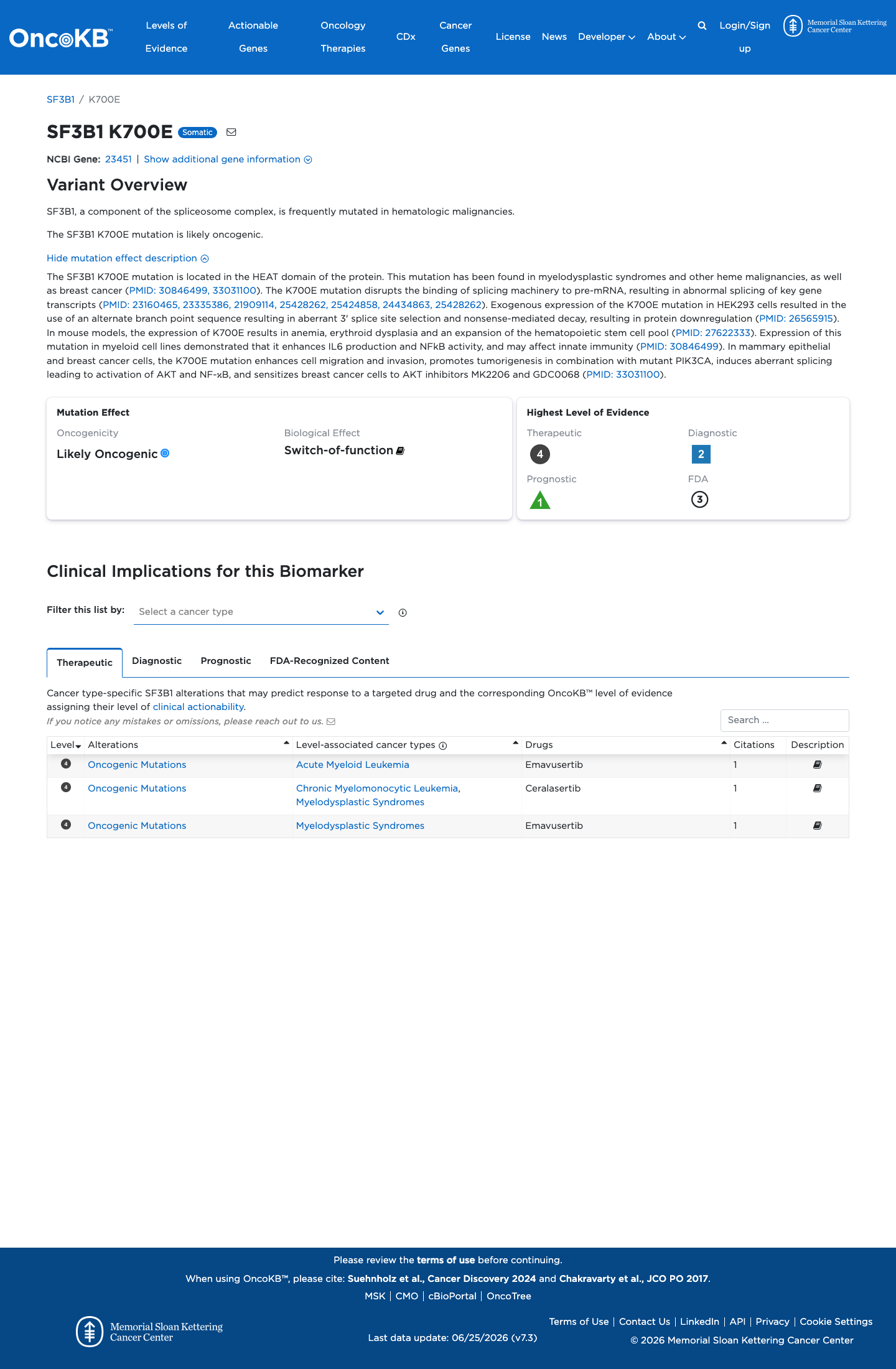
Likely Oncogenic
OncoKB identified variant-specific curated literature and context relevant to functional review; curated oncogenicity label: Likely Oncogenic.
COSMIC

Cancer hotspots
Somatic evidence
Hotspot
COSMIC
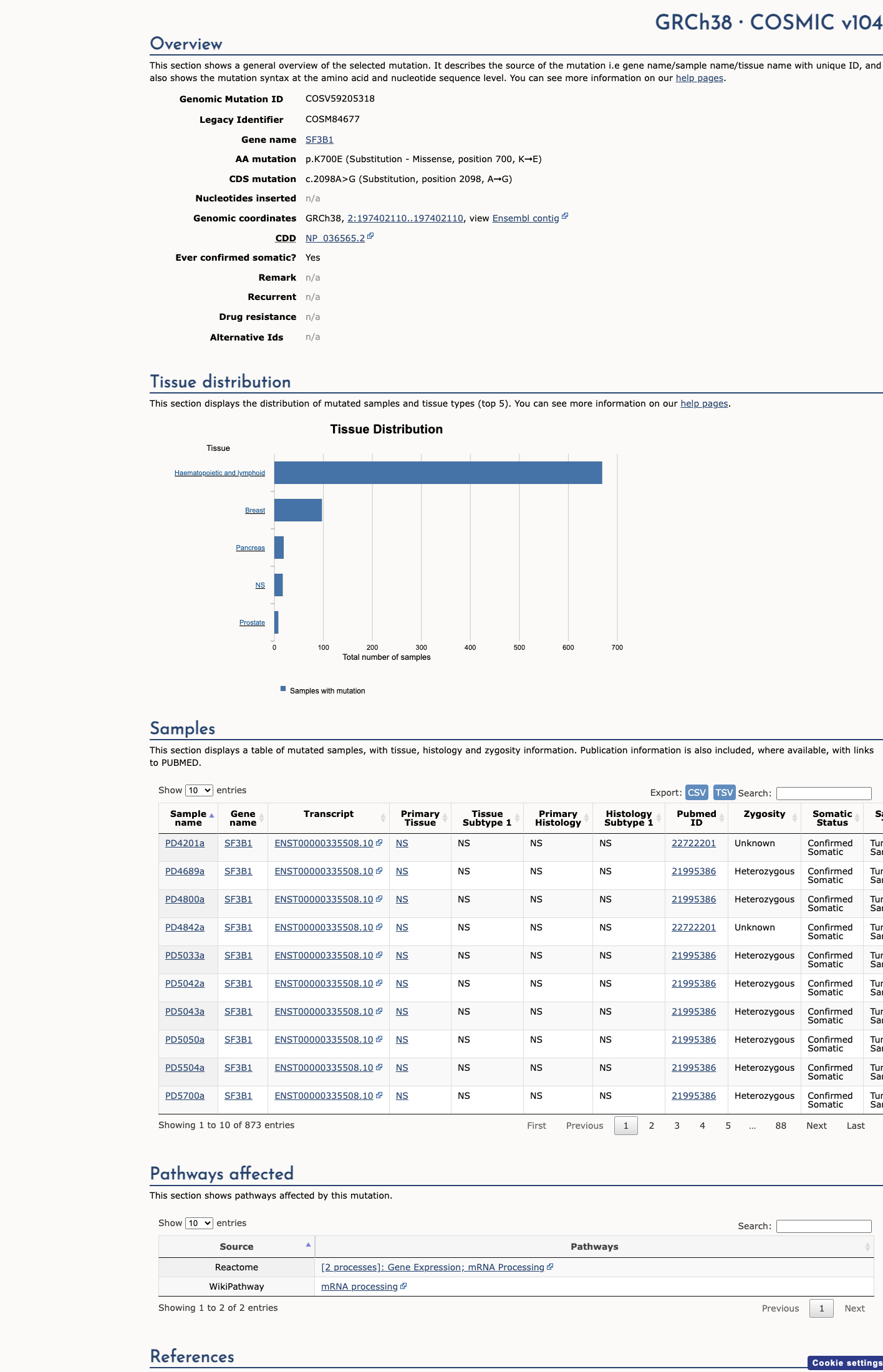
This variant lies in a statistically significant hotspot. This variant has previously been reported in somatic cancers (COSMIC; COSV59205318, n = 811 times).
Hotspots
This variant lies in a statistically significant hotspot.
Literature · how each cited paper was used
5papers cited
Each card is an audit: what was searched, what was found, whether it names the variant, which criteria it fed, and why. 4 further PMIDs triaged but not cited — see Sources & references.
Frequent pathway mutations of splicing machinery in myelodysplasia.
Searched
K700ELys700Gluc.2098A>G
Found
SF3B1 K700E identified as the predominant recurrent hotspot mutation in myelodysplastic syndromes through whole-exome sequencing. K700E accounted for 44 of 79 SF3B1 mutations. Mutations were mutually exclusive with other splicing factor mutations and strongly associated with ring sideroblasts. Functional studies demonstrated that mutant spliceosome components induce abnormal RNA splicing and compromised hematopoiesis.
Variant
✓ Names this variant — characterised directly
Applied to
→PS3
met
→PM1
met
Why
K700E directly identified and functionally characterized in splicing context; foundational reference for PS3 and PM1 assessments.
SF3B1 mutations predominantly involved K700 and, to a lesser extent, K666, H662 and E622, which are also conserved across species.
Location Figure 2; Results paragraphs 2-4 · Context Whole-exome sequencing of 29 MDS specimens; large cohort validation in 582 myeloid neoplasms; HeLa cell expression of mutant U2AF35 with GSEA · full text
Biologic and clinical significance of somatic mutations of SF3B1 in myeloid and lymphoid neoplasms.
Searched
K700ELys700Gluc.2098A>G
Found
Comprehensive review of SF3B1 mutations in myeloid and lymphoid neoplasms. K700E is described as accounting for more than 50% of all observed SF3B1 variants. Mutations cluster in exons 12-16 within HEAT domains. SF3B1 mutations are founding genetic lesions in MDS with ring sideroblasts and are associated with favorable prognosis in MDS but poor prognosis in CLL.
Variant
✓ Names this variant — characterised directly
Applied to
→PS3
met
Why
Review-level confirmation of K700E as the predominant SF3B1 mutation; supports PS3 functional evidence by summarizing collective findings.
The K700E mutation accounted for more than 50% of the variants observed, and additional codons (666, 662, 622, and 625) were found to be hot spots for mutation.
Location Paragraph 'SF3B1 mutations in myeloid neoplasms' · full text
A common alternative splicing signature is associated with SF3B1 mutations in malignancies from different cell lineages.
Searched
K700ELys700Gluc.2098A>G
Found
Identified a common alternative splicing signature associated with SF3B1 mutations across malignancies from different cell lineages (CLL, MDS, uveal melanoma). K700E was the most frequent mutation in CLL (6/8) and MDS (14/24) samples. The splicing signature was independent of the specific mutated HEAT repeat and tumor type, arguing for a direct consequence of the mutation.
Variant
✓ Names this variant — characterised directly
Applied to
→PS3
met
Why
Direct evidence of K700E-specific splicing signature conserved across cancer types; supports PS3 functional evidence.
K700E (6), K666T (1) and G742D (1) ... K700E (14), H622Q (4), D781G (2), R625L/H/D/C (4)
Location Results paragraphs 2-4 · Context RT-QPCR splicing analysis of UQCC, CRNDE, ANKHD1, GUSBP1, ABCC5 in 161 tumor samples (CLL, MDS, UM) · full text
SF3B1 mutations constitute a novel therapeutic target in breast cancer.
Searched
K700ELys700Gluc.2098A>G
Found
Systematic analysis of SF3B1 mutations in breast cancer. K700E accounted for 74% (17/23) of SF3B1 mutant tumors and was enriched in ER-positive disease and special histological types (papillary, mucinous). K700E mutant tumors displayed a conserved differential splicing signature. SF3B1 K700E mutant cell lines (Panc 05.04) showed selective sensitivity to the SF3b complex inhibitor spliceostatin A, demonstrating therapeutic dependency on the mutant allele.
Variant
✓ Names this variant — characterised directly
Applied to
→PS3
met
Why
K700E-specific functional data in breast cancer with splicing and drug sensitivity evidence; supports PS3 assessment.
K700E mutations were identified in 6% (1/18), 16% (3/19), and 0% (0/28) of mucinous, papillary, and micropapillary carcinomas, respectively.
Location Results sections 'SF3B1 K700E mutations are associated with differential splicing' and 'SF3B1 mutant cells are sensitive to SF3b inhibition' · Context RNA-seq of papillary breast carcinomas; spliceostatin A treatment of Panc 05.04 (K700E) vs wild-type pancreatic and endometrial cell lines; siRNA silencing of differentially spliced targets · full text
Mutations in the RNA Splicing Factor SF3B1 Promote Tumorigenesis through MYC Stabilization.
Searched
K700ELys700Gluc.2098A>G
Found
Pan-cancer analysis of SF3B1 hotspot mutations across 98 tumors and 12 isogenic cell lines. K700E was the most common mutation in CLL, MDS, AML, and BRCA. Regulatory network analysis identified MYC as the top master regulator activated specifically in K700E-mutant cancers. Mechanistically, K700E causes aberrant splicing and NMD of PPP2R5A, reducing PP2A-mediated dephosphorylation of c-MYC at S62, stabilizing MYC protein. Conditional Sf3b1 K700E/+ knock-in mice crossed with Eμ-Myc mice developed B-cell leukemia/lymphoma. K700E-mutant cells were preferentially sensitive to pharmacologic PP2A activation with FTY-720.
Variant
✓ Names this variant — characterised directly
Applied to
→PS3
met
→PM1
met
Why
Most comprehensive functional characterization of K700E to date; isogenic cell lines and mouse models directly demonstrate oncogenic mechanism through MYC stabilization. Central reference for PS3 and PM1.
The most frequent hotspot, K700E, was the most common mutation in CLL, MDS, acute myeloid leukemia (AML), and BRCA
Location Results sections throughout; Figures 2-7 · Context Isogenic Nalm-6 K700E/+ knock-in cells; conditional Sf3b1 K700E/+ knock-in mice; CLL patient RNA-seq; FTY-720 PP2A activator treatment; cycloheximide chase for MYC half-life; BCL2-BAK co-immunoprecipitation · full text
Sources & reference links
Triaged references · 4 PMIDs not cited in assessment
23335386 ↗
Spliceosome mutations involving SRSF2, SF3B1, and U2AF35 in chronic myelomonocytic leukemia: prevalence, clinical correlates, and prognostic relevance.
ONCOKB
25741868 ↗
Standards and guidelines for the interpretation of sequence variants: a joint consensus recommendation of the American College of Medical Genetics and Genomics and the Association for Molecular Pathology.
CLINVAR
35101336 ↗
Standards for the classification of pathogenicity of somatic variants in cancer (oncogenicity): Joint recommendations of Clinical Genome Resource (ClinGen), Cancer Genomics Consortium (CGC), and Variant Interpretation for Cancer Consortium (VICC).
CLINVAR
23619274 ↗
American College of Medical Genetics and Genomics technical standards and guidelines: microarray analysis for chromosome abnormalities in neoplastic disorders.
CLINVAR