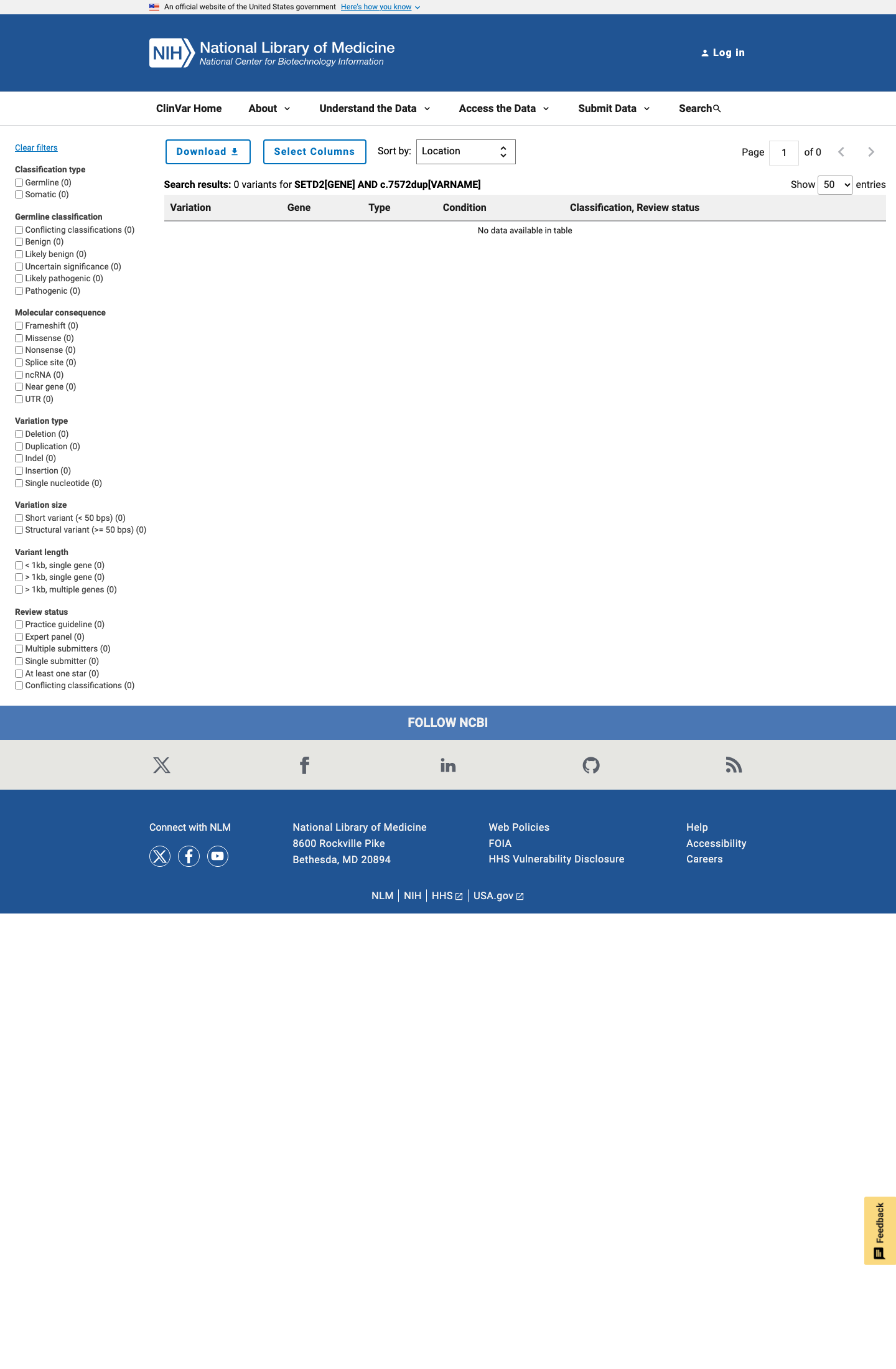
NM_014159.6:c.7572dup (p.Lys2525Ter) in SETD2 is a null variant in a gene for which loss of function is an established germline disease mechanism (SETD2 overgrowth syndrome), applied at PVS1_Moderate after downgrade for location in the last exon with predicted NMD escape and truncation of a non-critical C-terminal region.1 This variant is absent from gnomAD v2.1, v4.1, and gnomAD-Canada, and absent from ClinVar, satisfying PM2_Moderate for a rare variant at extremely low population frequency.2 No additional pathogenic, benign, or functional criteria are met. The three somatic-cancer publications reviewed (PMID:23417712, PMID:24509477, PMID:25728682) discuss SETD2 at the gene level but do not mention or characterize this specific variant. Overall classification: VUS (Variant of Uncertain Significance). Two moderate pathogenic criteria (PVS1_Moderate, PM2_Moderate) fall short of the Likely Pathogenic threshold under the ACMG/AMP 2015 combination rules, which require three moderate criteria or one strong plus one moderate for Likely Pathogenic. No benign criteria are met. The evidence is insufficient to classify this variant as either likely pathogenic or likely benign.3
Final classification
VUS
PVS1PM2
SETD2
c.7572dup
p.Lys2525Ter
This variant
NM_014159.6:c.7572dup (p.Lys2525Ter) in SETD2 is a null variant in a gene for which loss of function is an established germline disease mechanism (SETD2 overgrowth syndrome), applied at PVS1_Moderate after downgrade for location in the last exon with predicted NMD escape and truncation of a non-critical C-terminal region.
gene-specific framework lacked a usable explicit final combination framework, so generic ACMG/AMP 2015 final-combination rules were applied as fallback; applied criteria: PVS1 moderate, PM2 moderate; combination = 2 moderate, which maps to VUS.
Classification rationale
PVS1PM2
VUS
SETD2 c.7572dup
PVS1 + PM2
→
VUS
1
pvs1_generic_framework ↗pvs1_gene_contextpvs1_variant_assessment
3
generic_acmg_combination_rules
LYFE Sciences is an AI system, and it can make mistakes. Criteria
may be applied incorrectly, sources may be misread, and a confident-looking
classification can still be wrong. Double-check every criterion and
its underlying evidence before relying on any call.
Gene diagram
· NM_014159.6 · variants mapped to exon structure
SETD2
NM_014159.6
Fetching transcript structure from UCSC…
Applied criteria · 2 applied · 20 assessed
MetEvidence satisfies this criterion.
Not metEvaluated against available evidence; threshold not reached.
Not assessedApplies in principle, but no evidence was found to evaluate it.
N/ADoesn't apply to this variant type.
Applied · 2
Strength
Supporting
Moderate
Strong
Very strong
PVS1
moderate
Pathogenic
This duplication (NM_014159.6:c.7572dup) creates a premature termination codon at p.Lys2525Ter in SETD2, a gene for which loss of function is an established germline disease mechanism (SETD2 overgrowth syndrome; PMID:24852293). However, the variant resides in exon 21 of 21 (the last exon) and is predicted to escape nonsense-mediated decay, producing a truncated protein lacking only the C-terminal ~40 amino acids of 2,565 total residues. The removed region is not a well-characterized functional domain. Per PMC6185798, this warrants downgrade from full PVS1 to PVS1_Moderate.
SETD2 germline loss-of-function mechanism established (PMID:24852293PMID:31643139)Variant creates premature stop codon p.Lys2525Ter in last exon (21/21)
PM2
moderate
Pathogenic
This variant is absent from gnomAD v2.1, gnomAD v4.1, and gnomAD-Canada v1.0, and absent from ClinVar, satisfying PM2 for a rare variant at extremely low population frequency.
Absent from gnomAD v2.1 (exomes)Absent from gnomAD v4.1 (exomes)Absent from gnomAD-Canada v1.0 (genomes)
Assessed · not applied
· 20 not met · 0 not assessed
Pathogenic
PS1
No pathogenic variant at the same amino acid residue (p.Lys2525) has been reported in ClinVar for comparison.
PS2
No de novo observation has been reported for this variant; absence of parental data precludes PS2 application.
PS3
No variant-specific functional data exists for NM_014159.6:c.7572dup.
PS4
This variant is absent from ClinVar and gnomAD population databases.
PM1
The variant truncates the C-terminal ~40 amino acids of SETD2.
PM5
No pathogenic missense variant at the same residue (p.Lys2525) was identified in ClinVar as a comparator.
PM6
No de novo observation has been reported for this variant; assumed de novo not applicable without at least one report.
PP1
No segregation data are available for this variant.
PP3
This is a truncating variant whose primary effect is premature protein termination, already accounted for under PVS1.
PP4
No patient phenotype or family history is available for assessment against the disease-specific presentation of SETD2 overgrowth syndrome.
PP5
This variant is absent from ClinVar.
Benign
BA1
The variant is absent from all population databases, with an allele frequency far below the BA1 threshold of >1%.
BS1
The variant is absent from population databases; allele frequency does not exceed the BS1 threshold of >0.3%.
BS2
The variant has not been observed in any healthy adult individual; absent from gnomAD.
BS3
No well-established in vitro or in vivo functional studies demonstrate a benign effect for this variant.
BS4
No family segregation data are available to demonstrate lack of cosegregation with disease.
BP2
No co-occurrence data are available; the variant has not been observed in trans with a pathogenic SETD2 variant or in any individual.
BP4
This variant creates a premature termination codon, which is predicted to alter the protein product.
BP5
No data on an alternate molecular basis for disease in a case harboring this variant are available.
BP6
This variant is absent from ClinVar.
N/A · 6
PM3 · PM4 · PP2 · BP1 · BP3 · BP7
Research & evidence
Population frequency
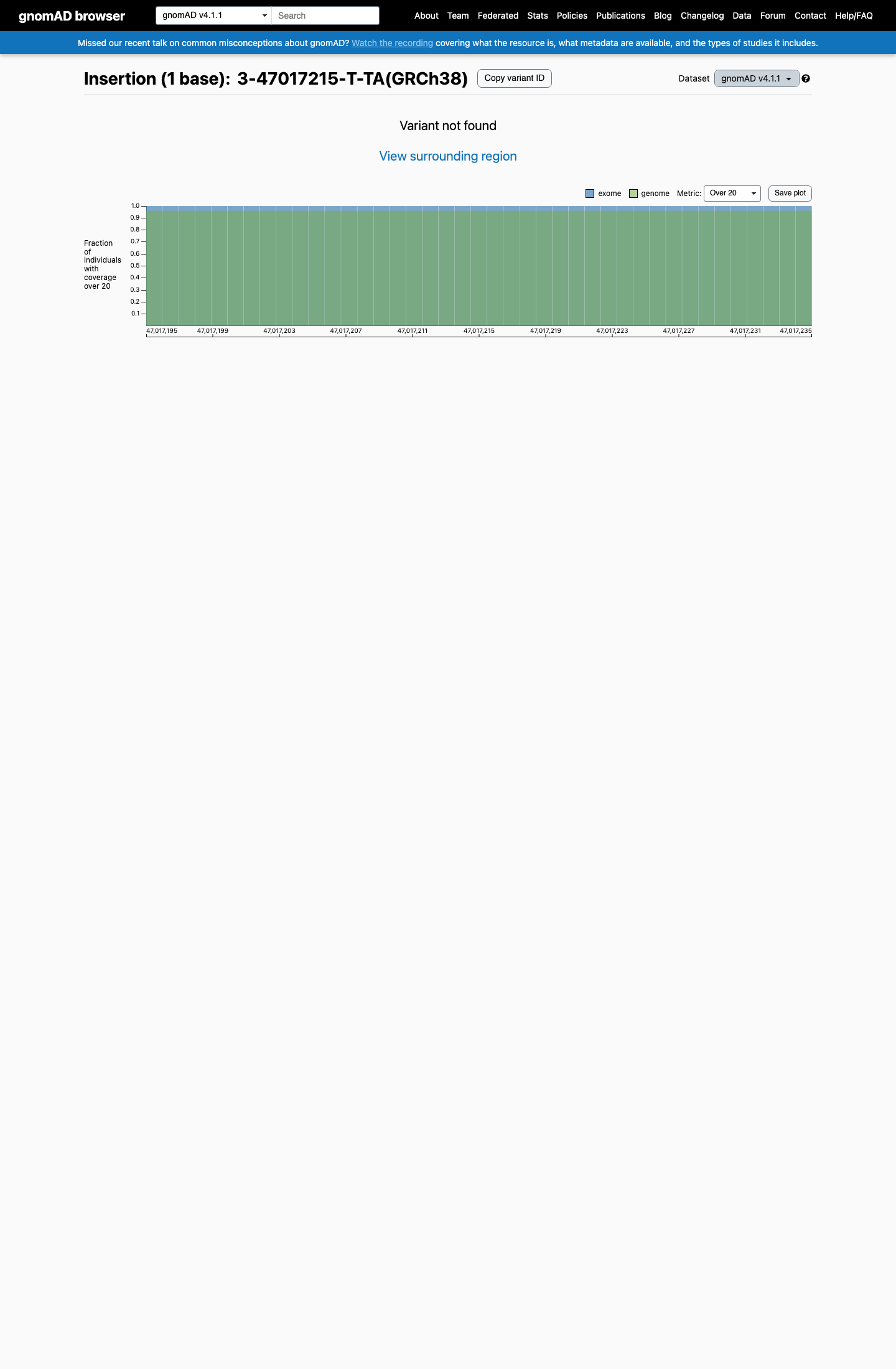
gnomAD v4.1
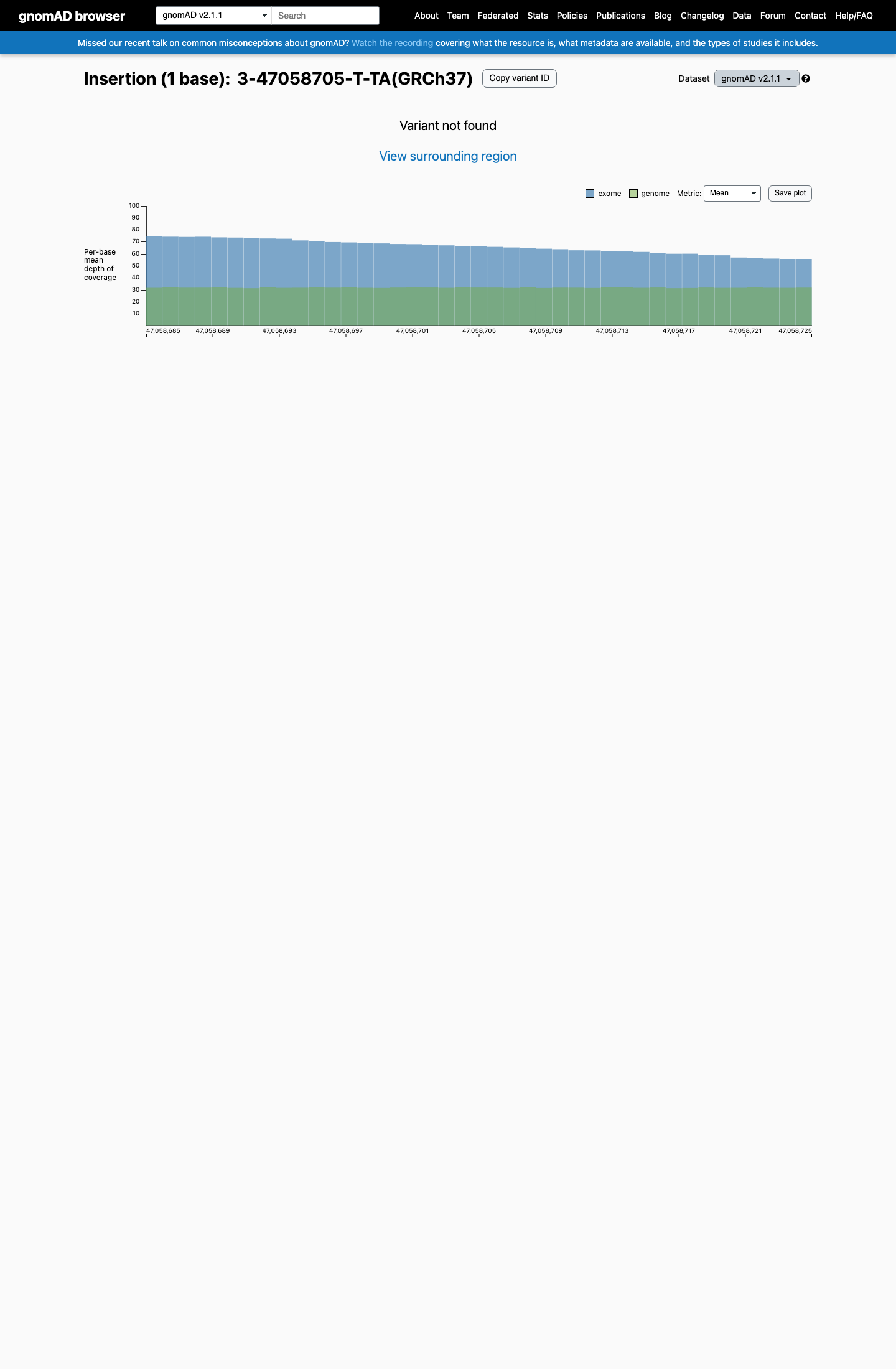
gnomAD v2.1
v4.1
Absent from gnomAD v4.1.
v2.1
Absent from gnomAD v2.1.
🇨🇦 CA
Absent from gnomAD-Canada v1.0.
Allele frequency by ancestry
three datasets · side by side
gnomAD v4.1
Absent
· 0 / ?
0 hom
0 hom
Not observed in any ancestry group.
gnomAD v2.1
Absent
· 0 / ?
0 hom
0 hom
Not observed in any ancestry group.
gnomAD Canada 🇨🇦
Absent
· 0 / ?
0 hom
0 hom
Not observed in any ancestry group.

In silico
SpliceAI predicts possible splice impact for this variant (max delta score = 0.38).
Functional
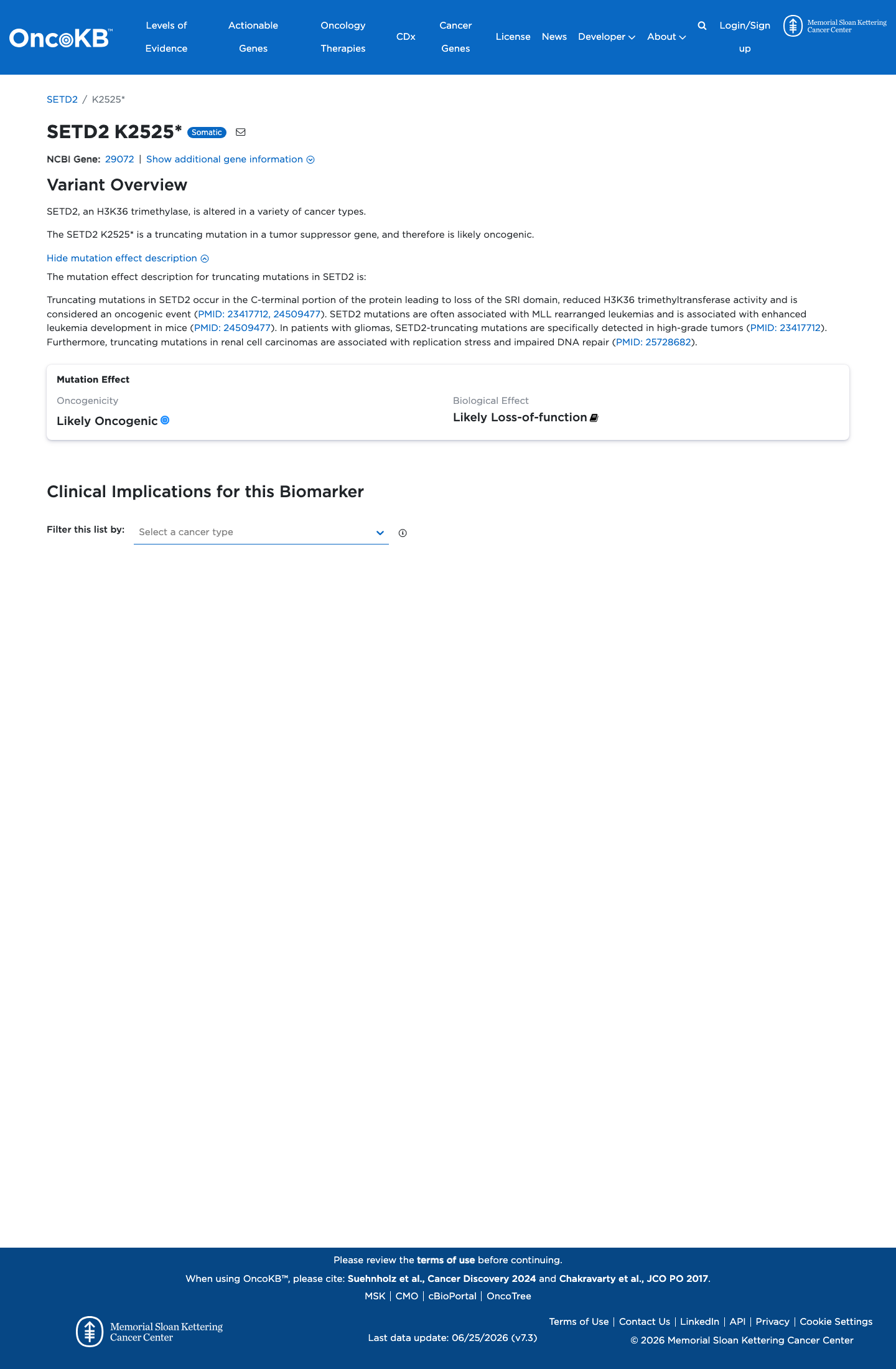
Likely Oncogenic
OncoKB identified variant-specific curated literature and context relevant to functional review; biological-effect context: Likely Loss-of-function; curated oncogenicity label: Likely Oncogenic.
COSMIC

Cancer hotspots
Somatic evidence
Not in COSMIC / hotspots
COSMIC
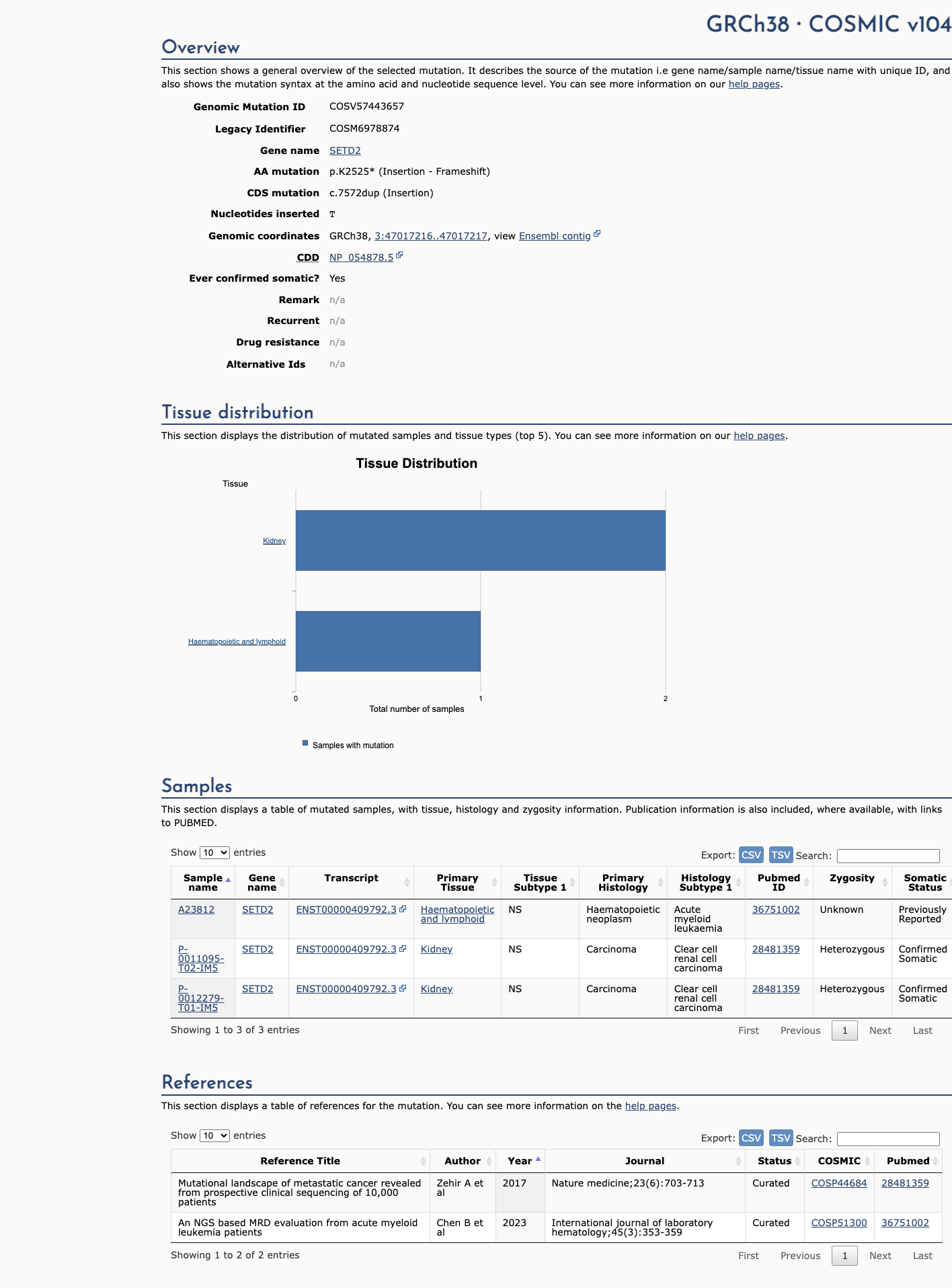
This variant does not lie in a statistically significant hotspot. This variant has previously been reported in somatic cancers (COSMIC; COSV57443657, n = 3 times).
Hotspots
This variant does not lie in a statistically significant hotspot.
Sources & reference links
Triaged references · 3 PMIDs not cited in assessment
23417712 ↗
Mutations in SETD2 and genes affecting histone H3K36 methylation target hemispheric high-grade gliomas.
ONCOKB
24509477 ↗
Identification of functional cooperative mutations of SETD2 in human acute leukemia.
ONCOKB
25728682 ↗
SETD2 loss-of-function promotes renal cancer branched evolution through replication stress and impaired DNA repair.
ONCOKB