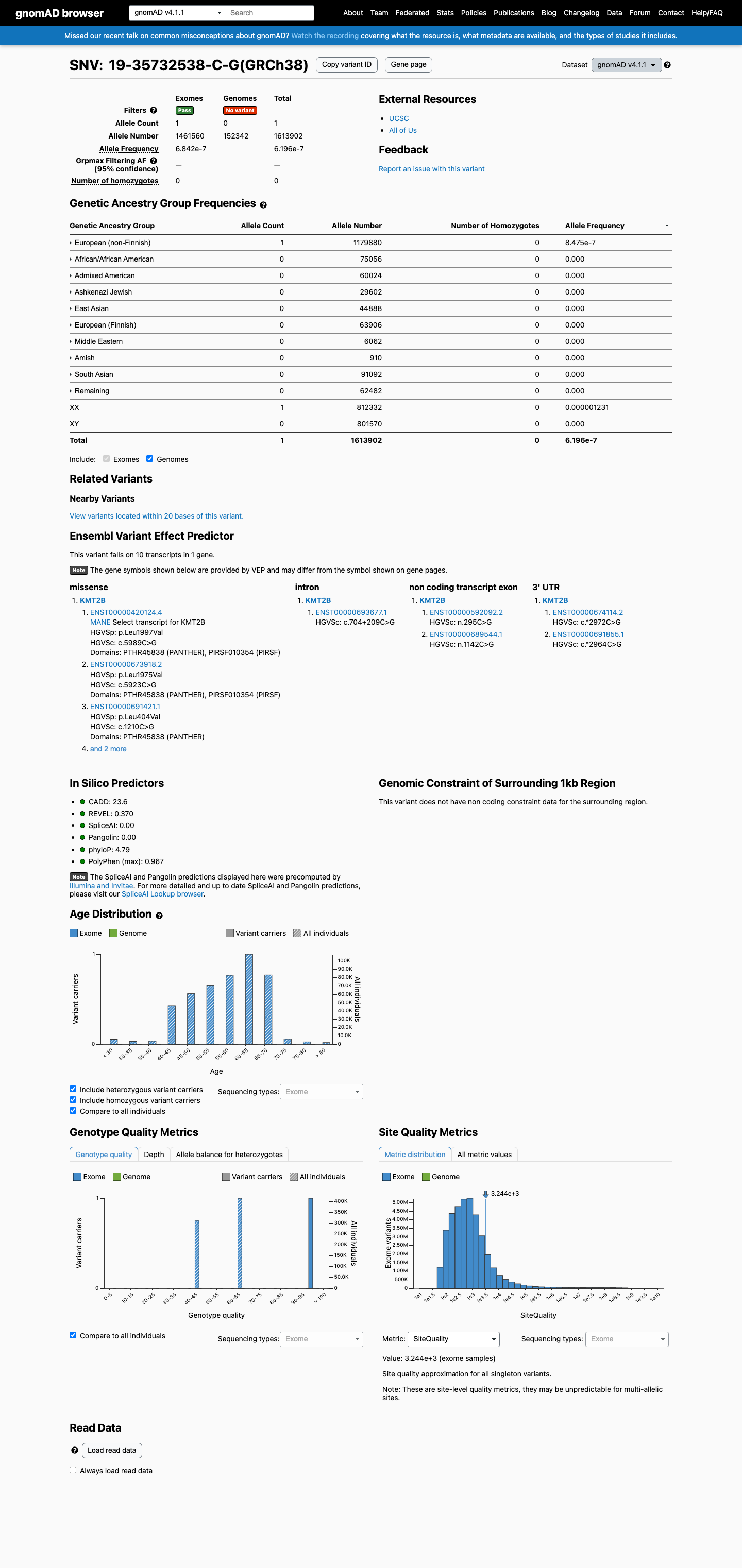
NM_014727.2:c.5989C>G (p.Leu1997Val) in KMT2B is extremely rare in population databases, observed in only 1 of 1,613,902 alleles (AF=0.00006%) in gnomAD v4.1 and absent from gnomAD v2.1 and gnomAD-Canada, meeting PM2 at supporting strength.1 This variant is a missense substitution and does not qualify for PVS1; no pathogenic variants have been reported at the same residue (PS1 not met); no functional studies exist (PS3 not assessed); and no de novo or segregation data are available. Multiple in silico prediction tools do not support a deleterious effect: REVEL score is 0.37 (intermediate), BayesDel score is -0.166 (benign range), and SpliceAI predicts no splicing impact (max delta=0.00). However, this evidence is mixed and does not confidently meet PP3 or BP4.2 The only criterion met is PM2 (supporting). Per ACMG/AMP 2015 classification rules (PMID:25741868), a single supporting pathogenic criterion without any benign criteria is insufficient for a likely pathogenic or benign classification.3 Overall classification: Variant of Uncertain Significance (VUS). Additional evidence including functional studies, segregation analysis, case-control data, or clinical correlation is required to resolve the significance of this variant.
Final classification
VUS
PM2
KMT2B
c.5989C>G
p.Leu1997Val
This variant
NM_014727.2:c.5989C>G (p.Leu1997Val) in KMT2B is extremely rare in population databases, observed in only 1 of 1,613,902 alleles (AF=0.00006%) in gnomAD v4.1 and absent from gnomAD v2.1 and gnomAD-Canada, meeting PM2 at supporting strength.
gene-specific framework lacked a usable explicit final combination framework, so generic ACMG/AMP 2015 final-combination rules were applied as fallback; applied criteria: PM2 supporting; combination = 1 supporting, which maps to VUS.
Classification rationale
PM2
VUS
KMT2B c.5989C>G
PM2
→
VUS
LYFE Sciences is an AI system, and it can make mistakes. Criteria
may be applied incorrectly, sources may be misread, and a confident-looking
classification can still be wrong. Double-check every criterion and
its underlying evidence before relying on any call.
Gene diagram
· NM_014727.2 · variants mapped to exon structure
KMT2B
NM_014727.2
Fetching transcript structure from UCSC…
Applied criteria · 1 applied · 20 assessed
MetEvidence satisfies this criterion.
Not metEvaluated against available evidence; threshold not reached.
Not assessedApplies in principle, but no evidence was found to evaluate it.
N/ADoesn't apply to this variant type.
Applied · 1
Strength
Supporting
Moderate
Strong
Very strong
PM2
supporting
Pathogenic
NM_014727.2:c.5989C>G is extremely rare in population databases: absent from gnomAD v2.1 and gnomAD-Canada; observed in only 1/1,613,902 alleles (AF=0.00006%) in gnomAD v4.1 with zero homozygotes. This is well below the 0.1% PM2 threshold for a rare variant in a dominant disease gene.
gnomAD v2.1: absentgnomAD v4.1: 1/1613
Assessed · not applied
· 9 not met · 11 not assessed
Pathogenic
PS1
No known pathogenic variant at KMT2B residue Leu1997 has been reported in ClinVar or the literature; PS1 requires a different amino acid change at the same residue that is established as pathogenic.
PS2
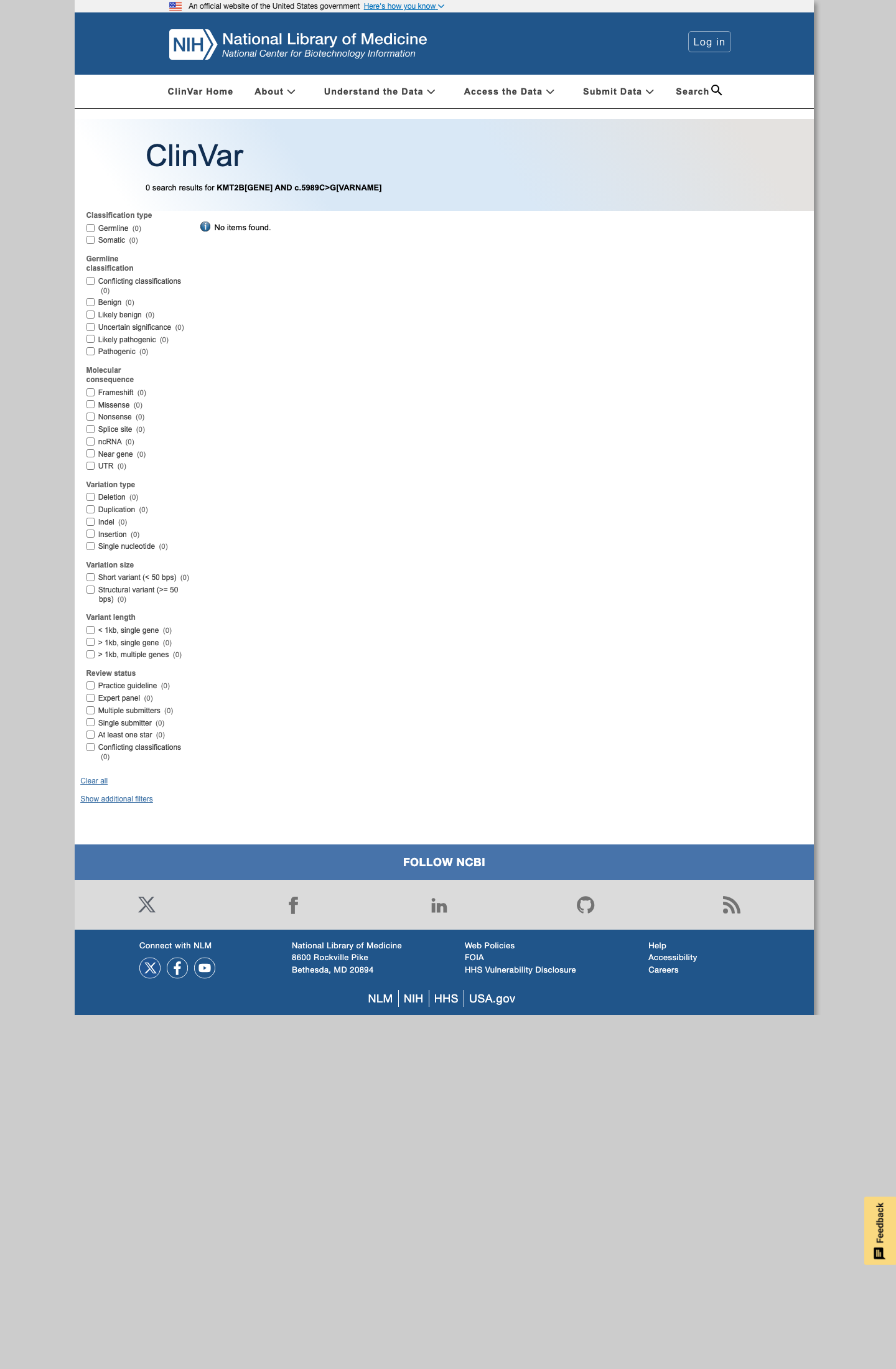
No de novo data are available for NM_014727.2:c.5989C>G; the variant is absent from ClinVar and no publications report this variant.
PS3
No variant-specific functional studies have been reported for NM_014727.2:c.5989C>G.
PS4
No case-control or cohort data are available for this variant.
PM1
This variant does not lie within a statistically significant mutational hotspot, nor within a well-characterized functional domain where pathogenic missense variants cluster and benign variation is absent.
PP1
No segregation data are available for this variant; the variant has not been reported in any family studies.
PP2
KMT2B constraint metrics (gnomAD missense Z-score, o/e ratio) were not retrieved in this case; PP2 assessment requires gene-level constraint data to determine whether the gene has a low rate of benign missense variation.
PP3
Multiple in silico prediction tools do not support a deleterious effect: REVEL score is 0.37 (below typical pathogenic threshold of >0.5), BayesDel score is -0.166 (benign range), and SpliceAI predicts no splicing impact (max delta=0.00).
PP4
No patient-specific phenotype or clinical data are available for this variant; PP4 requires that the patient's phenotype or family history is highly specific for KMT2B-related disease.
PP5
No reputable source has reported NM_014727.2:c.5989C>G as pathogenic; the variant is absent from ClinVar.
Benign
BA1
The allele frequency of NM_014727.2:c.5989C>G in gnomAD v4.1 is 0.00006% (6.20e-7), far below the 1% BA1 threshold for a stand-alone benign classification.
BS1
The allele frequency of NM_014727.2:c.5989C>G is 0.00006%, far below the 0.3% BS1 threshold.
BS2
One heterozygous carrier is observed in gnomAD v4.1 (European non-Finnish), but the phenotype/health status of this individual is unknown.
BS3
No variant-specific functional studies demonstrating no deleterious effect have been reported for NM_014727.2:c.5989C>G.
BS4
No segregation data are available to assess lack of cosegregation with disease; the variant has not been reported in any family studies.
BP1
BP1 applies when a missense variant occurs in a gene where only truncating variants cause disease.
BP2
No data are available regarding a second pathogenic variant in trans or a homozygous state; BP2 requires observation in trans with a pathogenic variant or as homozygous for a recessive disorder.
BP4
While SpliceAI predicts no splicing impact (max delta=0.00) and BayesDel falls in the benign range (-0.166), the REVEL score of 0.37 is intermediate and does not confidently exclude pathogenicity.
BP5
KMT2B has an established disease association with autosomal dominant dystonia-28 (DYT28, OMIM:617284).
BP6
No reputable source has classified NM_014727.2:c.5989C>G as benign; the variant is absent from ClinVar entirely.
N/A · 7
PVS1 · PM3 · PM4 · PM5 · PM6 · BP3 · BP7
Research & evidence
Population frequency
gnomAD v4.1
gnomAD v2.1
v4.1
This variant is present in gnomAD v4.1 (AF= 6.19616e-07; MAF= 0.00006%, 1/1613902 alleles, homozygotes = 0) and has highest observed frequency in the European (non-Finnish) population (AF= 8.47544e-07; MAF= 0.00008%, 1/1179880 alleles, homozygotes = 0).
v2.1
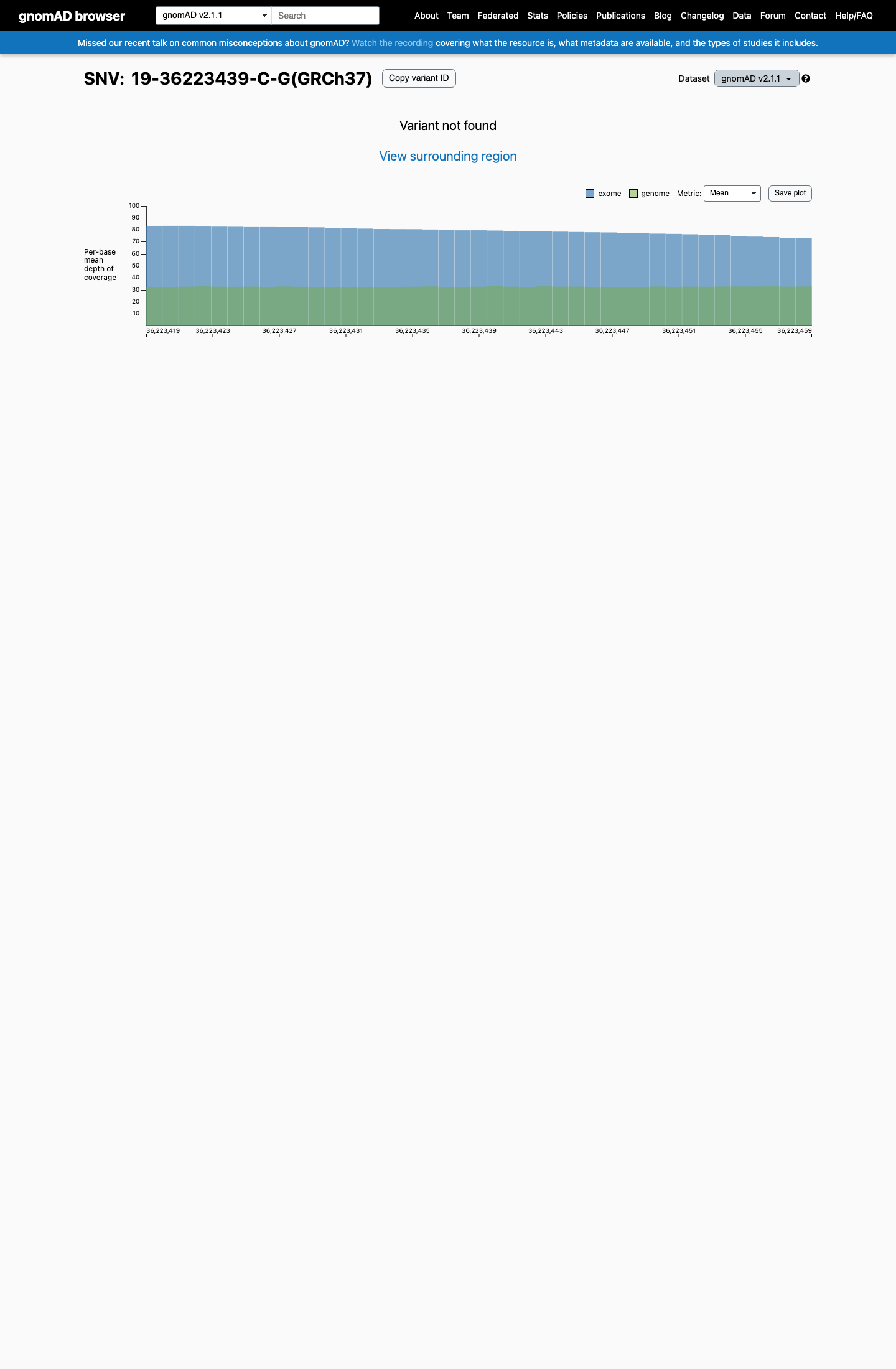
Absent from gnomAD v2.1.
🇨🇦 CA
Absent from gnomAD-Canada v1.0.
Allele frequency by ancestry
three datasets · side by side
gnomAD v4.1
6.2e-05%
· 1 / 1,613,902
0 hom
0 hom
European (non-Finnish) 1 / 1,179,880 |
8.5e-05% |
+ 9 not observed (Remaining individuals, Admixed American, European (Finnish), Amish, East Asian, Middle Eastern, South Asian, Ashkenazi Jewish, African/African American)
gnomAD v2.1
Absent
· 0 / ?
0 hom
0 hom
Not observed in any ancestry group.
gnomAD Canada 🇨🇦
Absent
· 0 / ?
0 hom
0 hom
Not observed in any ancestry group.

In silico
SpliceAI predicts no significant splice impact for this variant (max delta score = 0.00). REVEL score = 0.37. BayesDel score = -0.166046.

Functional
Unknown Oncogenic Effect
OncoKB did not identify variant-specific reviewed functional evidence for this variant; gene-level curated context is available for reviewer follow-up. KMT2B, a histone methyltransferase, is mutated at low frequencies in various cancer types.

COSMIC

Cancer hotspots
Somatic evidence
Not in COSMIC / hotspots
COSMIC
This variant does not lie in a statistically significant hotspot. This variant has not previously been reported in somatic cancers (COSMIC).
Hotspots
This variant does not lie in a statistically significant hotspot.
Sources & reference links