Analysis in progress
Initialising…
0%
complete
This report is still being assembled — sections appear as each stage finishes. It isn't final yet.
ASXL1
Final classification
VUS
PVS1PM2BP4
ASXL1
c.2148dup
p.Arg717Ter
nonsense · exon 13

ASXL1 encodes a chromatin-binding protein of the Polycomb group that helps regulate gene expression by recruiting repressive complexes (such as PRC2) to chromatin and modifying histone marks. Germline mutations in ASXL1 cause Bohring-Opitz syndrome, a developmental disorder with distinctive craniofacial abnormalities. Somatic loss-of-function mutations in ASXL1 are common in blood cancers, including myelodysplastic syndromes, chronic myelomonocytic leukemia, myelofibrosis, and acute myeloid leukemia, where the gene acts as a tumor suppressor. Loss of ASXL1 function disrupts normal repression of target genes, contributing to leukemogenesis.

This variant

ASXL1 truncating mutations are established drivers in myeloid malignancies, and germline loss-of-function variants cause Bohring-Opitz syndrome, giving this last-exon truncation a plausible disease mechanism. The VUS classification reflects that this specific allele lacks the functional, familial, or population evidence needed to confirm or refute pathogenicity.

Transcript
NM_015338.5
HGVS · transcript:coding
NM_015338.5:c.2148dup
GRCh38
chr20:32434859 C>CT
GRCh37
chr20:31022662 C>CT
Basis VUS: PVS1 (Moderate, last-exon NMD-escape truncation) plus PM2 and BP4 (Supporting, gnomAD absence and negative SpliceAI) match no pathogenic or benign ACMG/AMP 2015 rule.
VUS: PVS1 (Moderate, last-exon NMD-escape truncation) plus PM2 and BP4 (Supporting, gnomAD absence and negative SpliceAI) match no pathogenic or benign ACMG/AMP 2015 rule.
Classification rationale
PVS1PM2 BP4 VUS
ASXL1 c.2148dup nonsense · exon 13

PVS1 (Moderate): last-exon nonsense escapes nonsense-mediated decay but truncates ~54% of the protein, exceeding the >10% consequential-truncation threshold. PM2 (Supporting): variant is absent from gnomAD v2.1, v4.1, and gnomAD-Canada v1.0. BP4 (Supporting): SpliceAI max delta 0.018, below the 0.2 splice-altering threshold. Overall: VUS - met criteria (PVS1 Moderate, PM2 Supporting, BP4 Supporting) combine under no ACMG/AMP 2015 rule.

PVS1 + PM2 + BP4 VUS
Gene diagram · NM_015338.5 · variants mapped to exon structure
ASXL1 NM_015338.5
Fetching transcript structure from UCSC…
Applied criteria · 3 applied · 17 assessed
MetEvidence satisfies this criterion.
Not metEvaluated against available evidence; threshold not reached.
Not assessedApplies in principle, but no evidence was found to evaluate it.
N/ADoesn't apply to this variant type.
Applied · 3
Strength Supporting Moderate Strong Very strong
PVS1 moderate review Pathogenic
Met (Moderate): last-exon stop codon escapes nonsense-mediated decay but removes 54% of the protein, exceeding the >10% truncation threshold.
mutalyzer/VariantValidator normalization confirms NM_015338.5:c.2148dup produces NP_056153.2:p.(Arg717Ter), a nonsense/premature-termination-codon variant.VariantValidator variant_exonic_positions places the variant in exon 13 of 13 (start_exon=end_exon='13'), the final exon of the ASXL1 transcript, meaning NMD is not predicted to occur per the ClinGen SVI PVS1 decision tree (PMC6185798).Mutalyzer predicted protein data show the truncated protein length is 716 aa versus a full-length 1542 aa protein, a loss of approximately 54% of the protein, exceeding the 10% threshold used in the SVI framework's NMD-escape branch to justify at least PVS1_Moderate.
PM2 supporting Pathogenic
Met (Supporting): absent from gnomAD v2.1, gnomAD v4.1, and gnomAD-Canada v1.0.
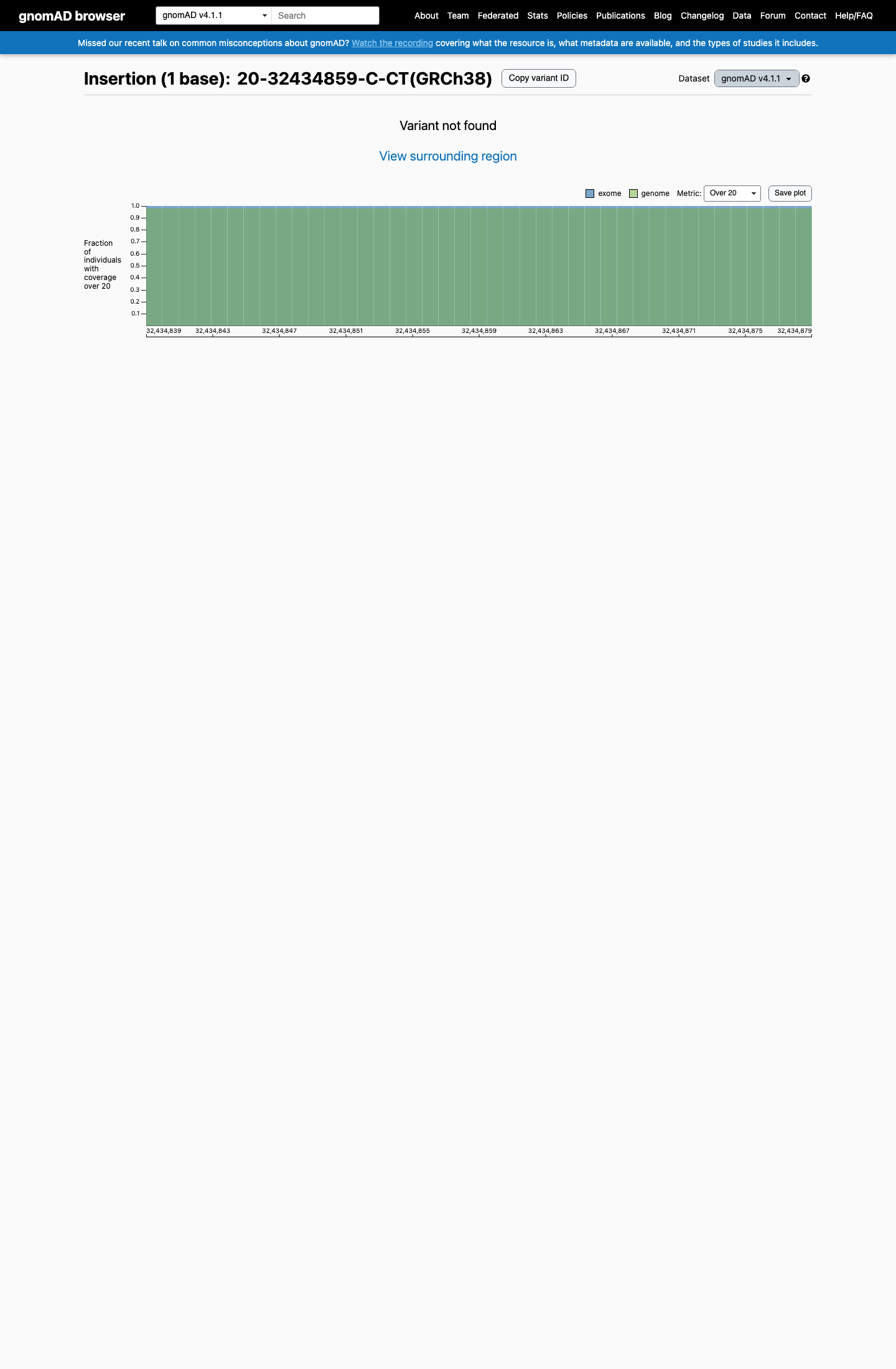
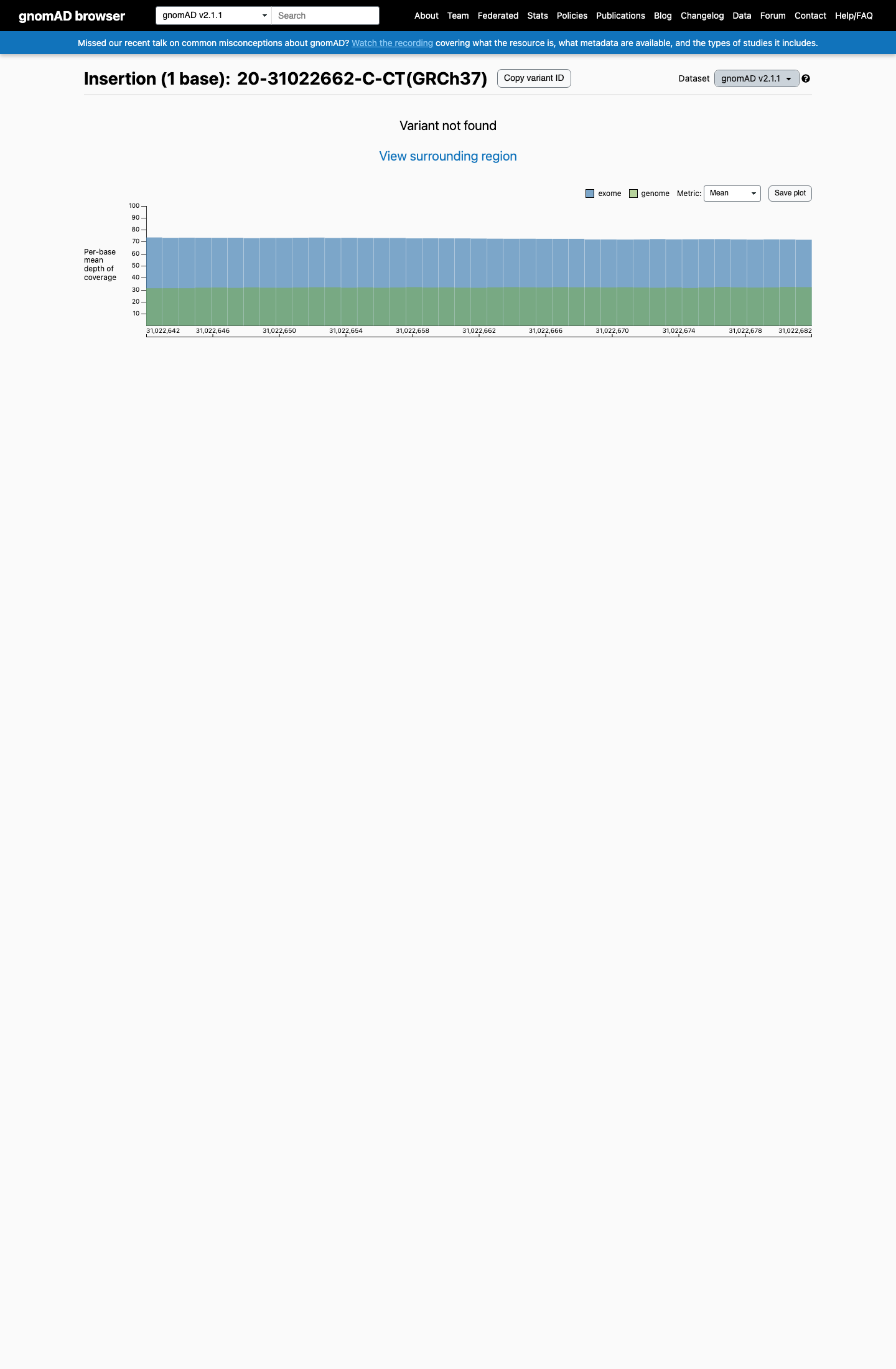
gnomAD v2.1 queried 20-31022662-C-CT and reported the variant absent.gnomAD v4.1 queried chr20-32434859-C-CT and reported the variant absent.gnomAD-Canada v1.0 queried 20-32434859-C-CT and reported the variant absent.
BP4 supporting Benign
Met (Supporting): SpliceAI max delta 0.018, far below the 0.2 splice-altering cutoff.
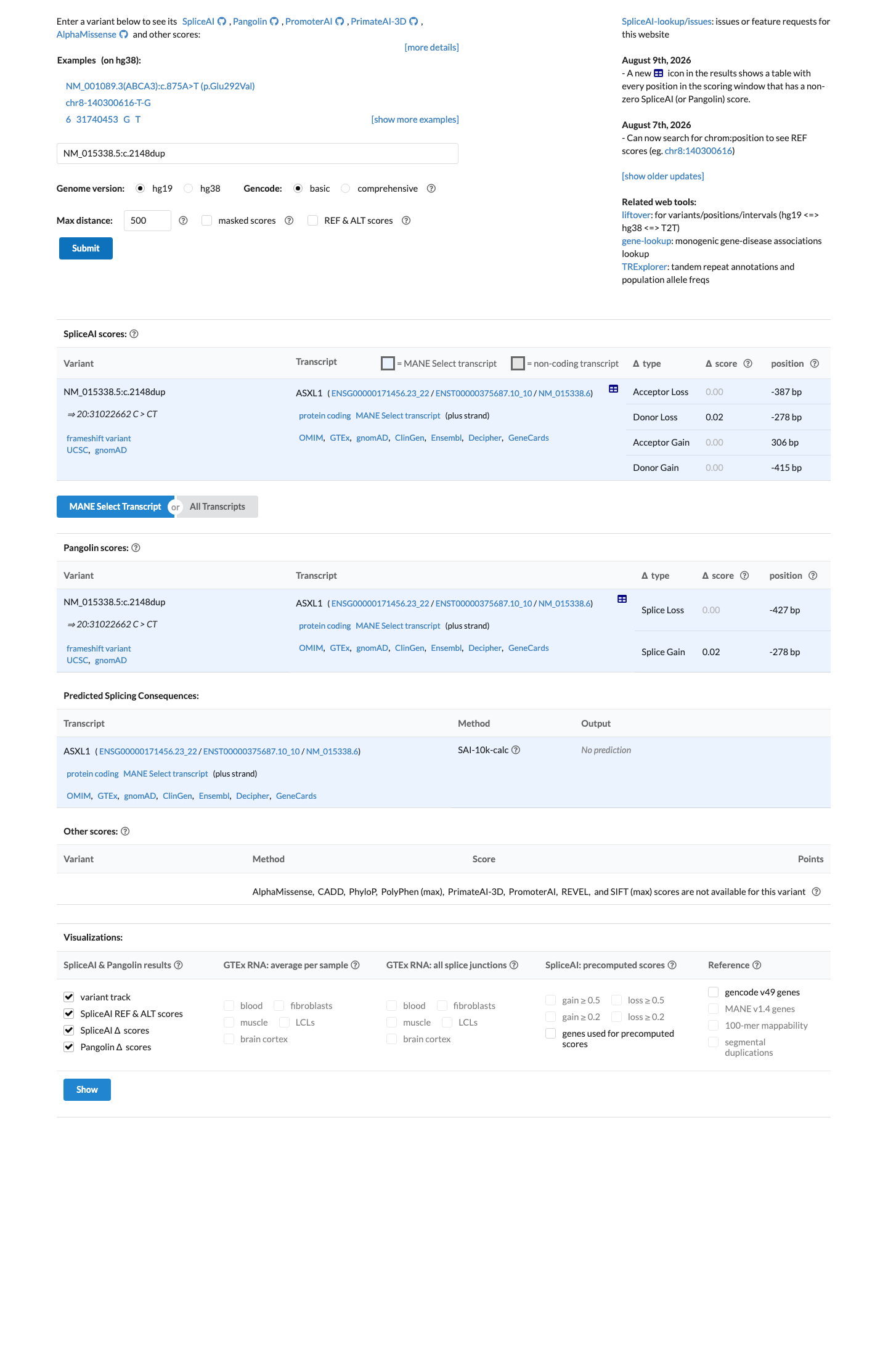
case_summary.json compact_evidence.spliceai: SpliceAI predicts no significant splice impact for this variant (max delta score = 0.018); scores DS_AG=0.001, DS_AL=0.0, DS_DG=0.0, DS_DL=0.018.SpliceAI delta scores well below the 0.2 threshold established in the original SpliceAI validation publication (Jaganathan KM et al., Cell 2019, PMID 30661751) support a benign/no-effect prediction for splicing, satisfying BP4 at supporting strength.
Assessed · not applied · 3 not met · 14 not assessed
Pathogenic
PS2 Not assessed: no parental genotypes or de novo occurrence data were available.
PS3 Not assessed: no validated functional assay of this exact variant was available.
PS4 Not assessed: no case-control or cohort enrichment data for this variant were available.
PM3 Not assessed: no affected proband with this variant in trans with a pathogenic ASXL1 variant was identified.
PM6 Not assessed: no parental testing data were available to confirm an assumed de novo occurrence.
PP1 Not assessed: no family pedigree or segregation data were available.
PP3 Not met: SpliceAI max delta 0.018, far below the 0.2 splice-altering threshold.
PP4 Not assessed: no phenotype or diagnostic context for the tested individual was provided.
PP5 Not assessed: no ClinVar expert-panel pathogenic assertion for this variant was identified.
Benign
BA1 Not met: variant absent from gnomAD, so no allele frequency approaches the stand-alone benign threshold.
BS1 Not met: absent from population datasets, with no allele frequency exceeding that expected for an ASXL1-related disorder.
BS2 Not assessed: population data show absence only, with no healthy-carrier observations available.
BS3 Not assessed: no functional assay of this exact variant was available to show lack of damaging effect.
BS4 Not assessed: no genotype-phenotype data for relatives were available.
BP2 Not assessed: no observation of the variant in cis or trans with an independent pathogenic ASXL1 variant was provided.
BP5 Not assessed: no alternate molecular diagnosis or phenotype attribution was provided.
BP6 Not assessed: no ClinVar expert-panel benign assertion for this variant was identified.
N/A · 8 PS1 · PM1 · PM4 · PM5 · PP2 · BP1 · BP3 · BP7
Research & evidence
Population frequency
gnomAD v4.1 screenshot
gnomAD v4.1
gnomAD v2.1 screenshot
gnomAD v2.1
v4.1
Absent from gnomAD v4.1.
v2.1
Absent from gnomAD v2.1.
🇨🇦 CA
Absent from gnomAD-Canada v1.0.
Allele frequency by ancestry
three datasets · side by side
gnomAD v4.1
Absent · 0 / ?
0 hom
Not observed in any ancestry group.
gnomAD v2.1
Absent · 0 / ?
0 hom
Not observed in any ancestry group.
gnomAD Canada 🇨🇦
Absent · 0 / ?
0 hom
Not observed in any ancestry group.
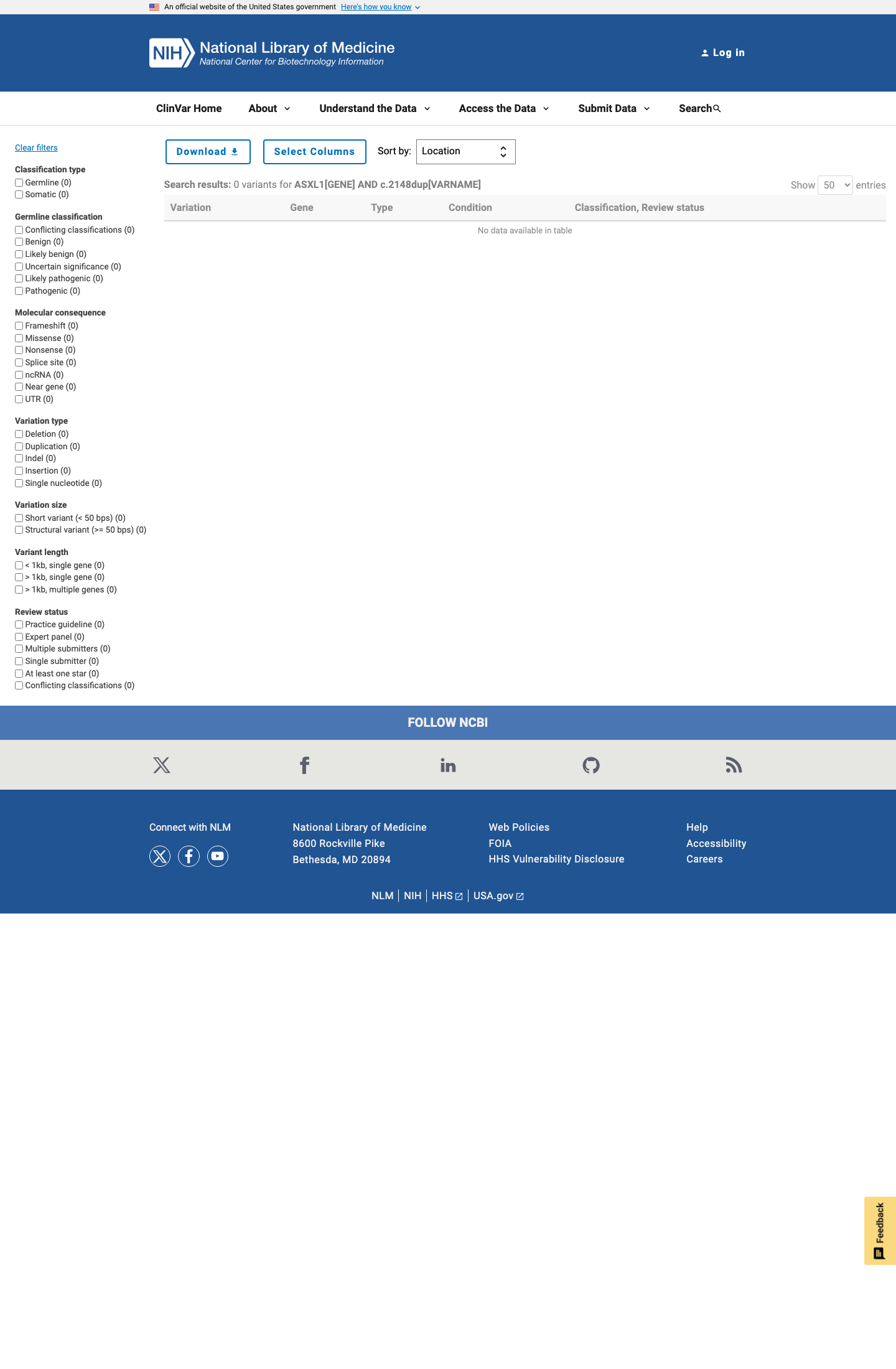
ClinVar screenshot
ClinVar
This variant is absent from ClinVar.
SpliceAI screenshot
In silico
SpliceAI predicts no significant splice impact for this variant (max delta score = 0.02).
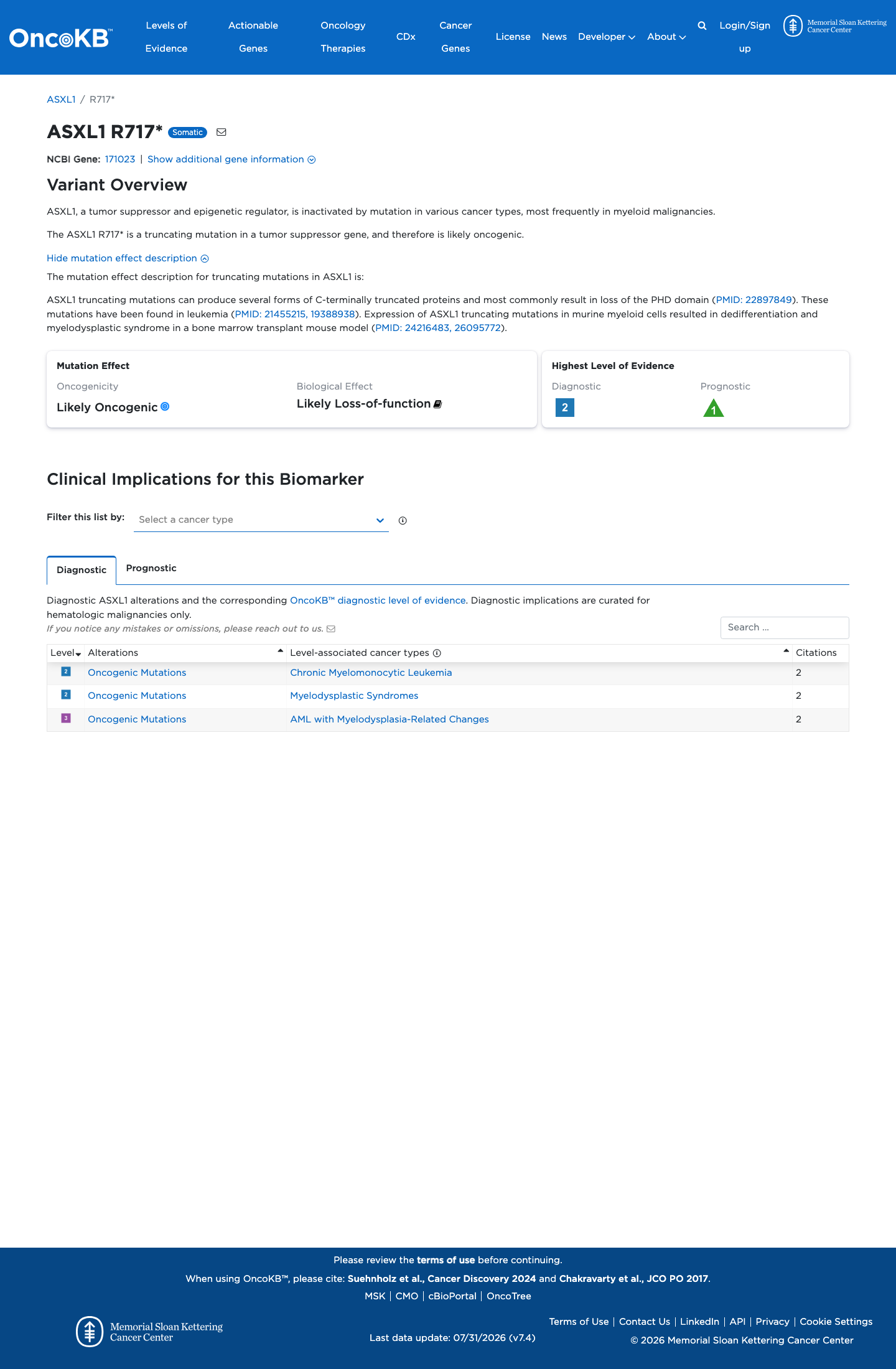
Functional / OncoKB screenshot
Functional Likely Oncogenic
OncoKB identified variant-specific curated literature and context relevant to functional review; biological-effect context: Likely Loss-of-function; curated oncogenicity label: Likely Oncogenic.
OncoKB ↗
COSMIC screenshot
COSMIC
Cancer hotspots screenshot
Cancer hotspots
Somatic evidence Not in COSMIC / hotspots
COSMIC
This variant does not lie in a statistically significant hotspot. This variant has not previously been reported in somatic cancers (COSMIC).
Hotspots
This variant does not lie in a statistically significant hotspot.
Sources & reference links
8Sources
ClinVar
gnomAD v2.1
gnomAD v4.1
gnomAD-Canada
SpliceAI
OncoKB
COSMIC
Cancer hotspots
Triaged references · 5 PMIDs not cited in assessment
19388938 ↗ Mutations of polycomb-associated gene ASXL1 in myelodysplastic syndromes and chronic myelomonocytic leukaemia. ONCOKB
21455215 ↗ Concomitant analysis of EZH2 and ASXL1 mutations in myelofibrosis, chronic myelomonocytic leukemia and blast-phase myeloproliferative neoplasms. ONCOKB
22897849 ↗ ASXL1 mutations promote myeloid transformation through loss of PRC2-mediated gene repression. ONCOKB
24216483 ↗ Myelodysplastic syndromes are induced by histone methylation–altering ASXL1 mutations. ONCOKB
26095772 ↗ Cancer-associated ASXL1 mutations may act as gain-of-function mutations of the ASXL1-BAP1 complex. ONCOKB