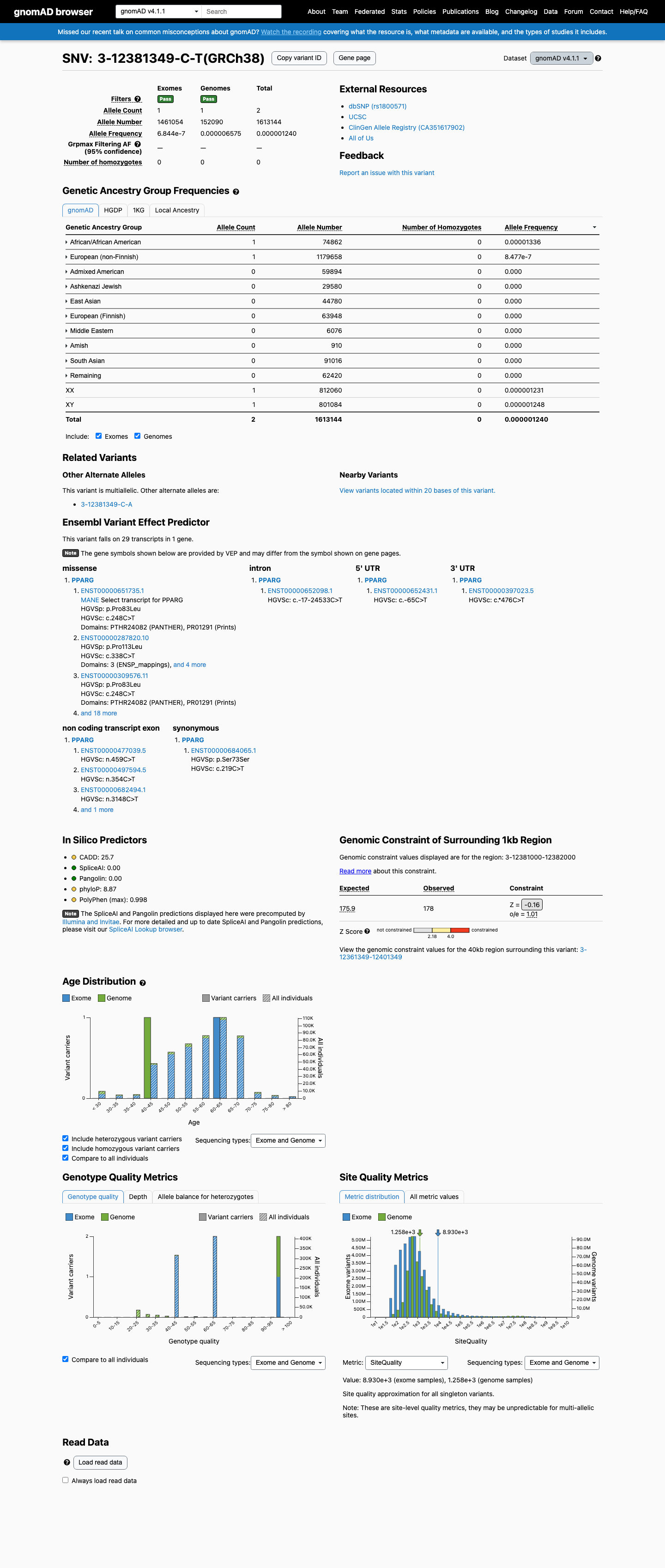
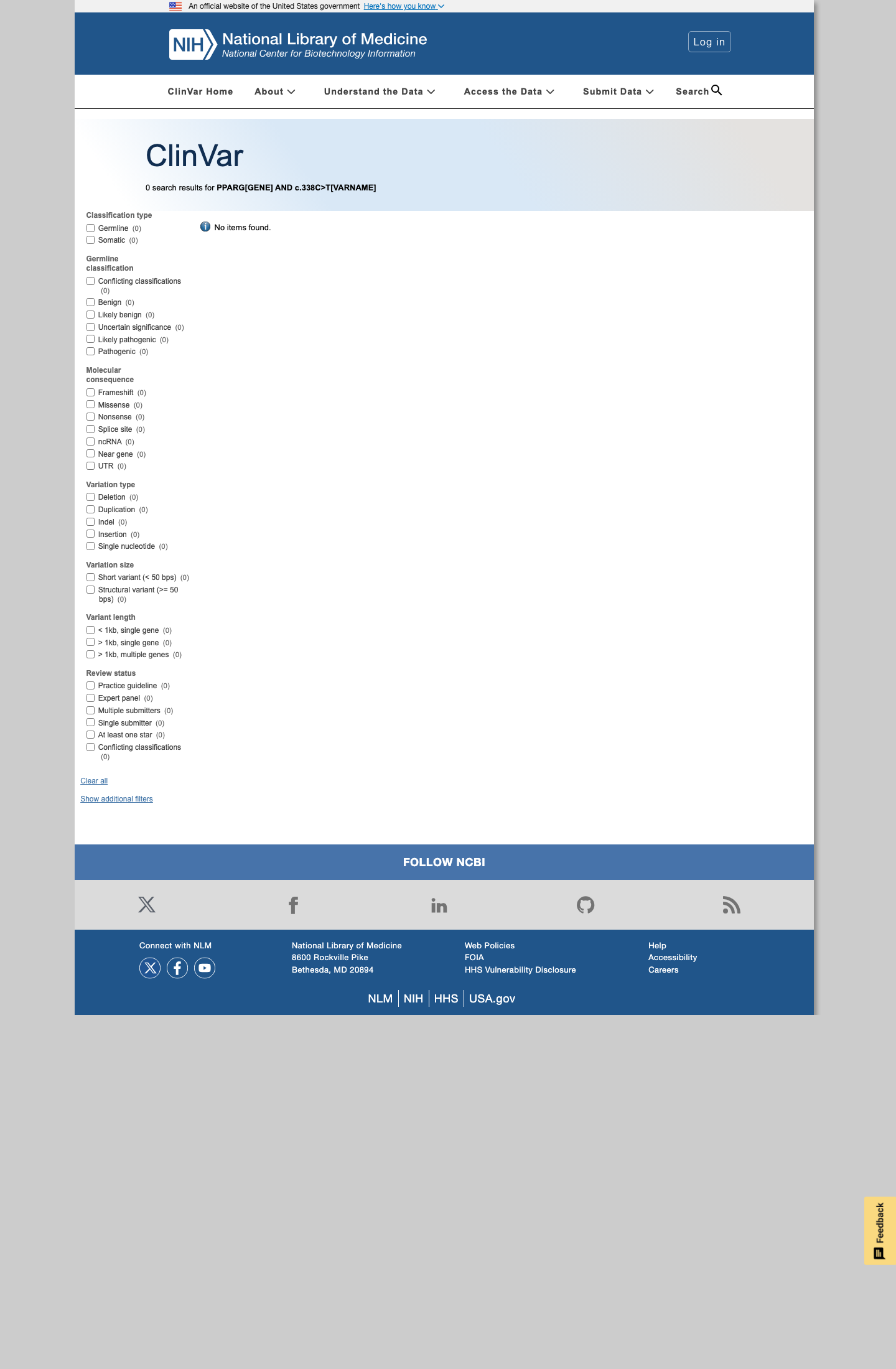
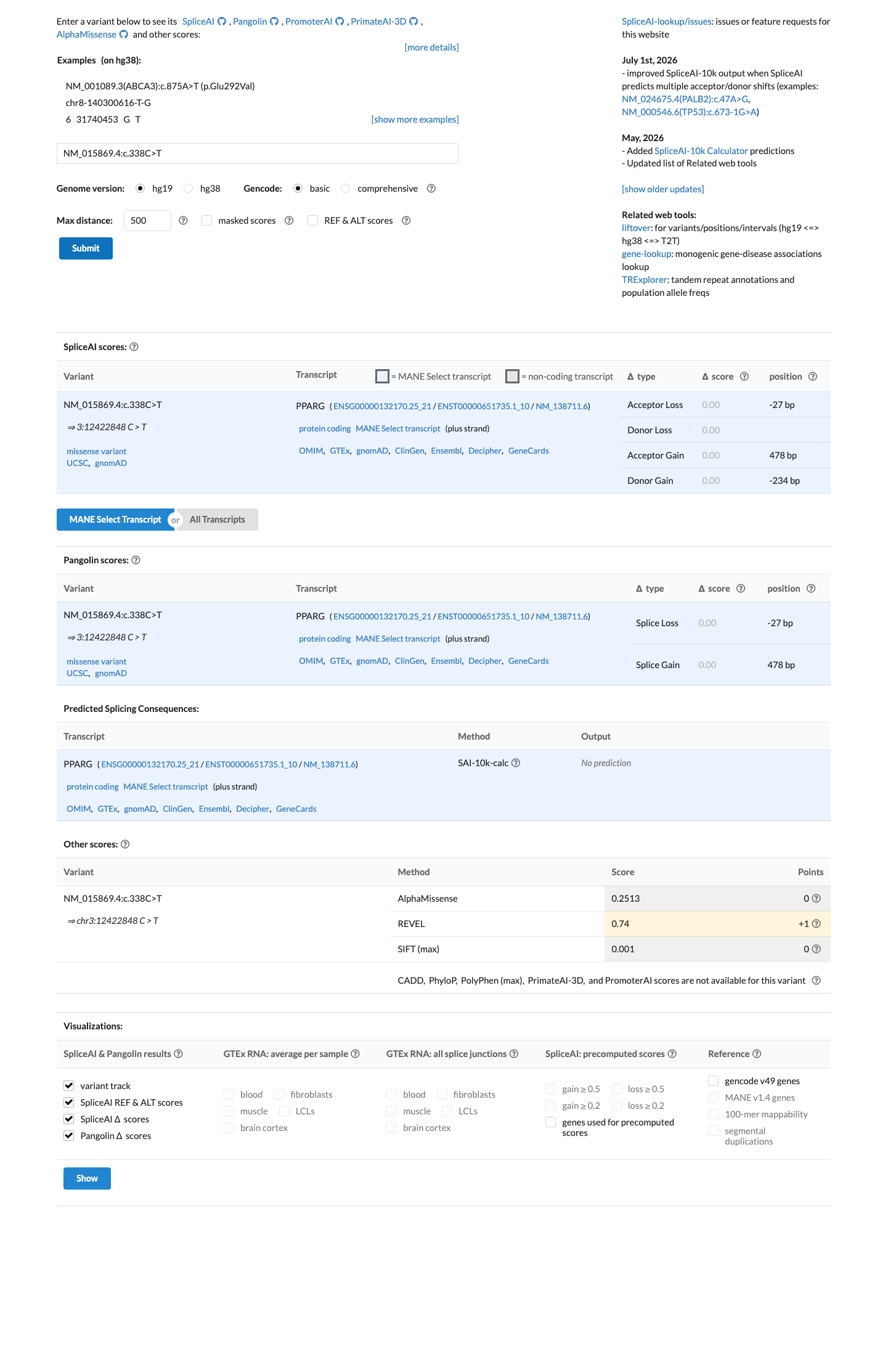
NM_015869.4:c.338C>T (p.Pro113Leu) in PPARG is a missense variant absent from ClinVar and present at an extremely low allele frequency of 1.24×10⁻⁶ (2/1,613,144 alleles, 0 homozygotes) in gnomAD v4.1, meeting PM2 at supporting strength (well below 0.1% threshold).1 REVEL in silico prediction yields a score of 0.74, exceeding the 0.5 threshold for a deleterious call, meeting PP3 at supporting strength. SpliceAI predicts no splicing impact (max delta score 0.00) and BayesDel (0.293) is borderline.2 No functional studies, de novo reports, segregation data, or disease-specific cohort data were identified for this variant. PVS1 is not applicable as this is a missense variant (ClinGen SVI PVS1 framework, PMC6185798). All remaining assessed pathogenic and benign criteria were not met.3 With only PM2 (supporting) and PP3 (supporting) met, the evidence is insufficient to reach a Likely Pathogenic or Likely Benign classification under generic ACMG/AMP 2015 combination rules (PMID:25741868). This variant is classified as a Variant of Uncertain Significance (VUS).4
Final classification
VUS
PM2PP3
PPARG
c.338C>T
p.Pro113Leu
This variant
NM_015869.4:c.338C>T (p.Pro113Leu) in PPARG is a missense variant absent from ClinVar and present at an extremely low allele frequency of 1.24×10⁻⁶ (2/1,613,144 alleles, 0 homozygotes) in gnomAD v4.1, meeting PM2 at supporting strength (well below 0.1% threshold).
gene-specific framework lacked a usable explicit final combination framework, so generic ACMG/AMP 2015 final-combination rules were applied as fallback; applied criteria: PM2 supporting, PP3 supporting; combination = 2 supporting, which maps to VUS.
Classification rationale
PM2PP3
VUS
PPARG c.338C>T
PM2 + PP3
→
VUS
2
revelbayesdelspliceai ↗
3
pvs1_generic_framework ↗pvs1_variant_assessmentoncokb ↗
4
generic_acmg_combination_rules
LYFE Sciences is an AI system, and it can make mistakes. Criteria
may be applied incorrectly, sources may be misread, and a confident-looking
classification can still be wrong. Double-check every criterion and
its underlying evidence before relying on any call.
Gene diagram
· NM_015869.4 · variants mapped to exon structure
PPARG
NM_015869.4
Fetching transcript structure from UCSC…
Applied criteria · 2 applied · 20 assessed
MetEvidence satisfies this criterion.
Not metEvaluated against available evidence; threshold not reached.
Not assessedApplies in principle, but no evidence was found to evaluate it.
N/ADoesn't apply to this variant type.
Applied · 2
Strength
Supporting
Moderate
Strong
Very strong
PM2
supporting
Pathogenic
NM_015869.4:c.338C>T is extremely rare in population databases: absent from gnomAD v2.1 and gnomAD-Canada, and present at an allele frequency of 1.24×10⁻⁶ (0.00012%, 2/1,613,144 alleles) in gnomAD v4.1 with no homozygotes. This frequency is well below the 0.1% threshold for PM2.
gnomAD v2.1: absentgnomAD v4.1: AF=1.24×10⁻⁶ (2/1613
PP3
supporting
Pathogenic
REVEL in silico predictor assigns a score of 0.74, which is above the commonly accepted threshold for deleterious prediction (>0.5). BayesDel score of 0.293 is borderline. SpliceAI predicts no splicing impact (max delta=0.00). Taken together, the REVEL score provides a single line of computational evidence supporting a deleterious effect.
REVEL score: 0.74 (deleteriousabove 0.5 threshold)BayesDel score: 0.293 (borderline
Assessed · not applied
· 18 not met · 2 not assessed
Pathogenic
PS1
No prior report of the same amino acid change (p.Pro113Leu) as a pathogenic variant exists in ClinVar or the literature; this variant is absent from all ClinVar records.
PS2
No de novo occurrence data are available for this variant in any database or published literature.
PS3
No well-established in vitro or in vivo functional studies were identified for NM_015869.4:c.338C>T (p.Pro113Leu).
PS4
No case-control or cohort data are available to assess whether the prevalence of this variant is significantly increased in affected individuals; the variant is absent from ClinVar.
PM1
This variant does not lie in a statistically significant mutational hotspot per cancerhotspots.org.
PM6
No assumed or confirmed de novo occurrence has been reported for this variant.
PP1
No cosegregation data are available for this variant; no family studies have been reported.
PP2
PPARG missense constraint metrics are not available in the evidence packet (HCI prior score not available for PPARG).
PP4
No patient phenotype or family history data were provided for this case; the specificity of the patient's presentation cannot be assessed.
PP5
No reputable source has reported this variant as pathogenic.
Benign
BA1
The population allele frequency of 1.24×10⁻⁶ (0.00012%) in gnomAD v4.1 is far below the 1% threshold for BA1.
BS1
The population allele frequency of 1.24×10⁻⁶ (0.00012%) in gnomAD v4.1 is far below the 0.3% threshold for BS1.
BS2
Although 2 alleles are observed in gnomAD v4.1, the phenotype of those individuals is unknown.
BS3
No well-established in vitro or in vivo functional studies demonstrating no damaging effect were identified for this variant.
BS4
No segregation data are available to assess lack of segregation in affected family members.
BP1
PPARG is known to harbor disease-causing missense variants (e.g., familial partial lipodystrophy type 3 is caused by PPARG missense mutations such as p.Arg212Trp).
BP2
No observation of this variant in trans with a pathogenic variant has been reported for a fully penetrant dominant disorder.
BP4
REVEL in silico predictor assigns a score of 0.74, which predicts a deleterious effect.
BP5
No data are available indicating this variant was observed in a case with an alternate molecular basis for disease.
BP6
No reputable source has reported this variant as benign.
N/A · 6
PVS1 · PM3 · PM4 · PM5 · BP3 · BP7
Research & evidence
Population frequency
gnomAD v4.1
gnomAD v2.1
v4.1
This variant is present in gnomAD v4.1 (AF= 1.23981e-06; MAF= 0.00012%, 2/1613144 alleles, homozygotes = 0) and has highest observed frequency in the African/African American population (AF= 1.33579e-05; MAF= 0.00134%, 1/74862 alleles, homozygotes = 0).
v2.1
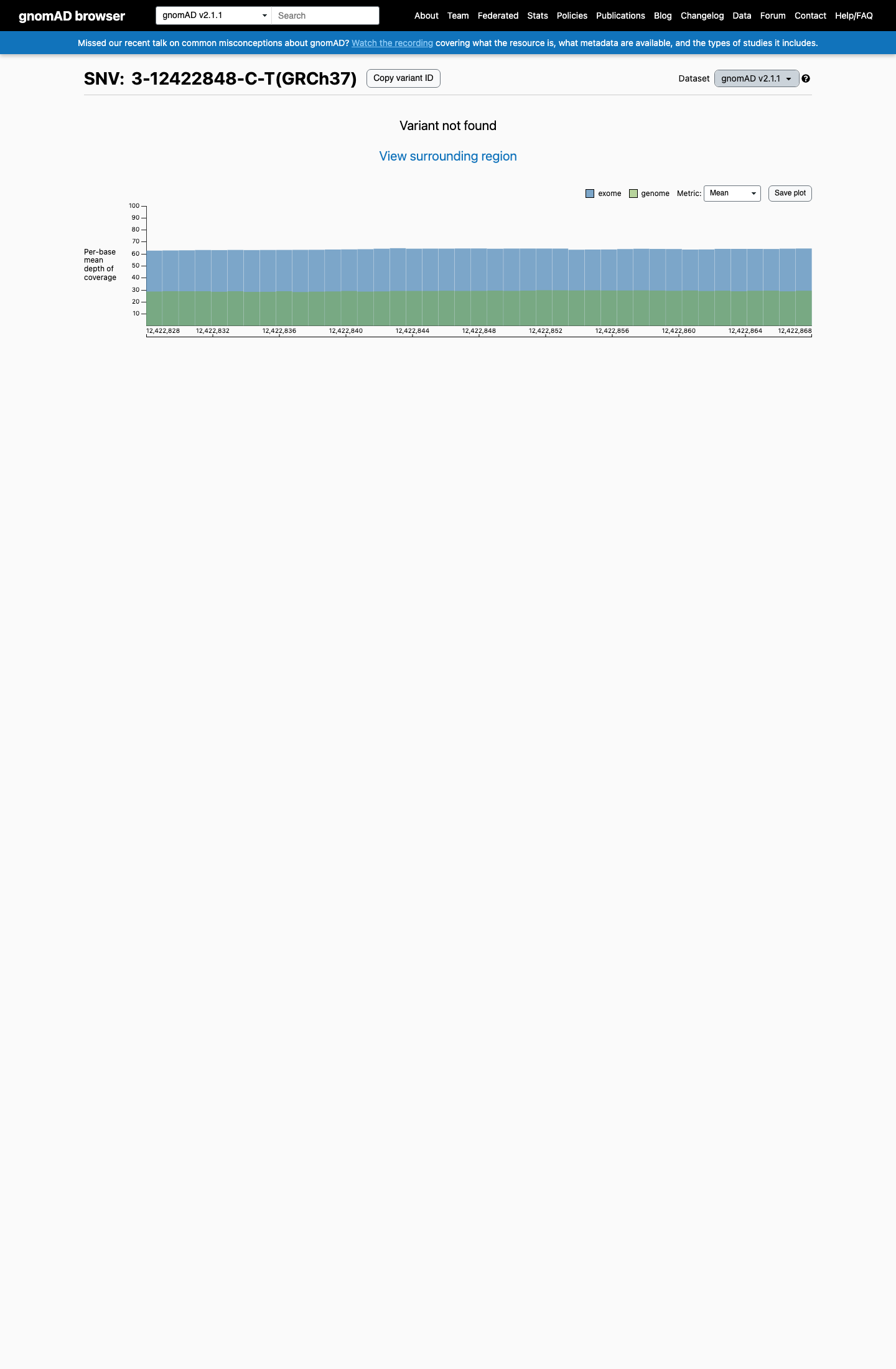
Absent from gnomAD v2.1.
🇨🇦 CA
Absent from gnomAD-Canada v1.0.
Allele frequency by ancestry
three datasets · side by side
gnomAD v4.1
0.00012%
· 2 / 1,613,144
0 hom
0 hom
African/African American 1 / 74,862 |
0.0013% |
European (non-Finnish) 1 / 1,179,658 |
8.5e-05% |
+ 8 not observed (Remaining individuals, Admixed American, European (Finnish), Amish, East Asian, Middle Eastern, South Asian, Ashkenazi Jewish)
gnomAD v2.1
Absent
· 0 / ?
0 hom
0 hom
Not observed in any ancestry group.
gnomAD Canada 🇨🇦
Absent
· 0 / ?
0 hom
0 hom
Not observed in any ancestry group.
In silico
SpliceAI predicts no significant splice impact for this variant (max delta score = 0.00). REVEL score = 0.74. BayesDel score = 0.293355.
Functional
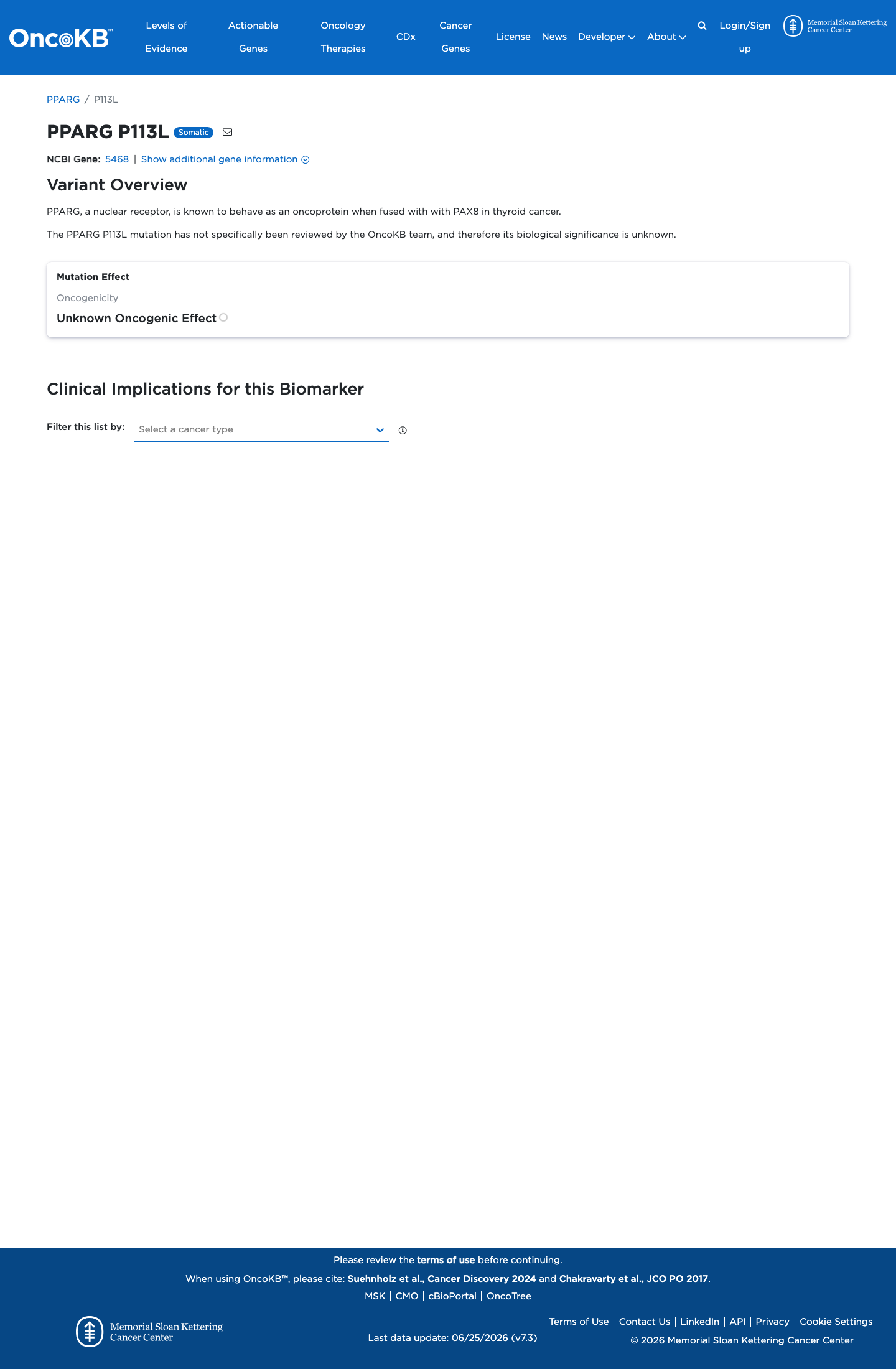
Unknown Oncogenic Effect
OncoKB did not identify variant-specific reviewed functional evidence for this variant; gene-level curated context is available for reviewer follow-up. PPARG, a nuclear receptor, is known to behave as an oncoprotein when fused with with PAX8 in thyroid cancer.

COSMIC

Cancer hotspots
Somatic evidence
Not in COSMIC / hotspots
COSMIC
This variant does not lie in a statistically significant hotspot. This variant has not previously been reported in somatic cancers (COSMIC).
Hotspots
This variant does not lie in a statistically significant hotspot.
Sources & reference links