This variant was interpreted by pipeline
7.1.0.
The current version is
8.0.0.
Re-running queues a fresh interpretation; the result replaces this page when complete.
Re-runs are not free. Blank = draws on today's public interpretation allowance.
With a code = uses 1 of that code's uses.
RET encodes a receptor tyrosine kinase that, when activated by GDNF-family ligands, triggers signaling pathways involved in cell growth, differentiation, migration, and survival, and is essential for development of the nervous system and neural crest-derived tissues. Germline changes in RET cause Hirschsprung disease, congenital central hypoventilation syndrome, and the inherited cancer syndromes multiple endocrine neoplasia type 2A and 2B and familial medullary thyroid carcinoma. In cancer, RET is a proto-oncogene that can be turned on by point mutations or gene rearrangements, driving malignancies such as medullary and papillary thyroid carcinoma, lung adenocarcinoma, and chronic myelomonocytic leukemia, and abnormal RET activity has also been linked to invasion and metastasis in pancreatic cancer and to endocrine therapy resistance in breast cancer.
This variant
RET is a receptor tyrosine kinase whose germline missense changes can drive MEN2A/MEN2B and familial medullary thyroid carcinoma, while loss-of-function changes cause Hirschsprung disease. p.Pro613Thr is a missense substitution with no functional, segregation, or case evidence linking it to either mechanism, and its absence from population databases and lack of splice impact do not resolve its effect. It therefore remains a variant of uncertain significance.
Transcript
NM_020975.5
HGVS · transcript:coding
NM_020975.5:c.1837C>A
GRCh38
chr10:43113633 C>A
GRCh37
chr10:43609081 C>A
VUS under generic ACMG/AMP 2015 rules (no RET-specific ClinGen framework available): only PM2 and BP4 were met, each at supporting strength, and they offset.
Classification rationale
PM2BP4VUS
RET c.1837C>Amissense · exon 10
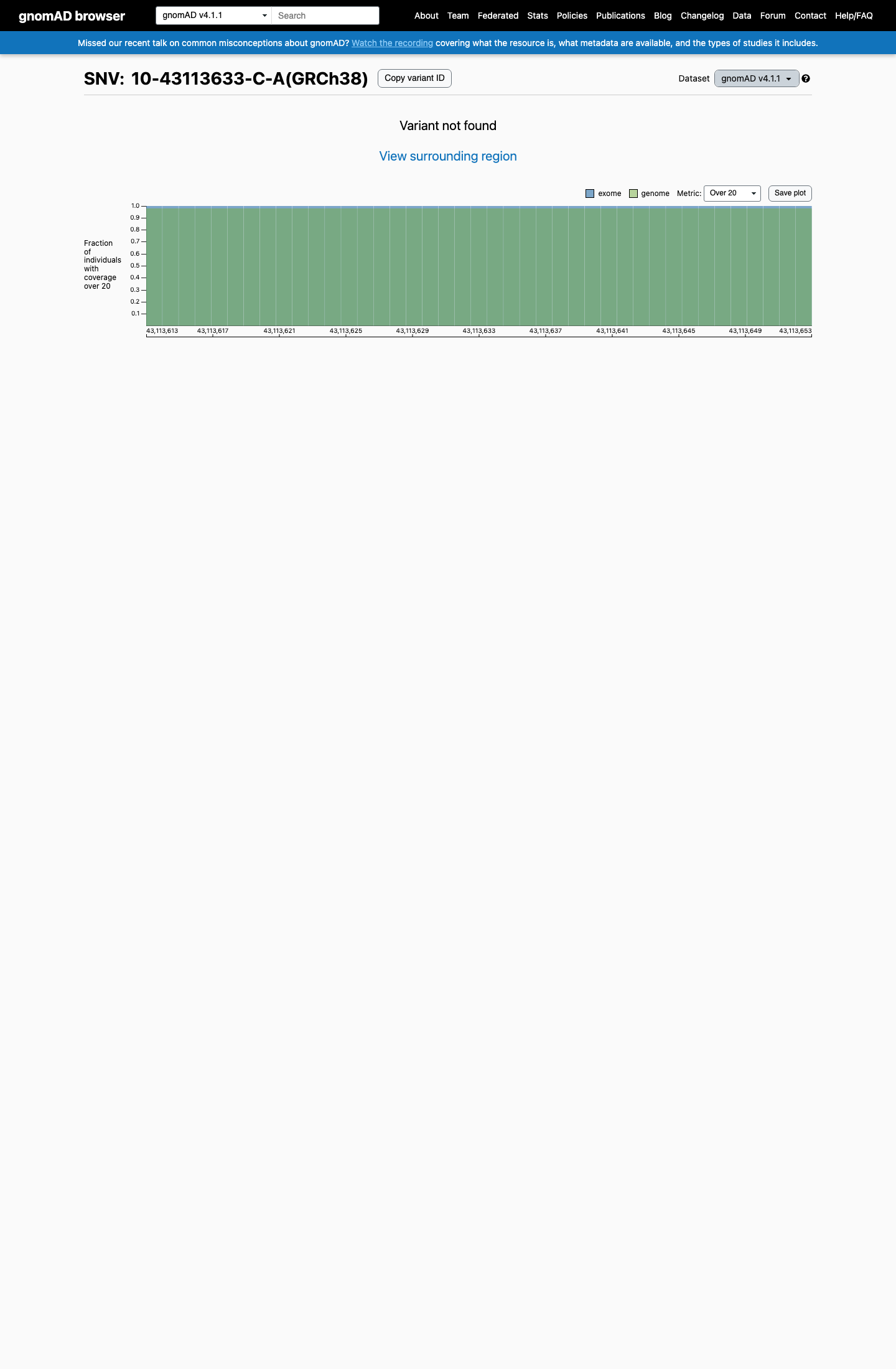
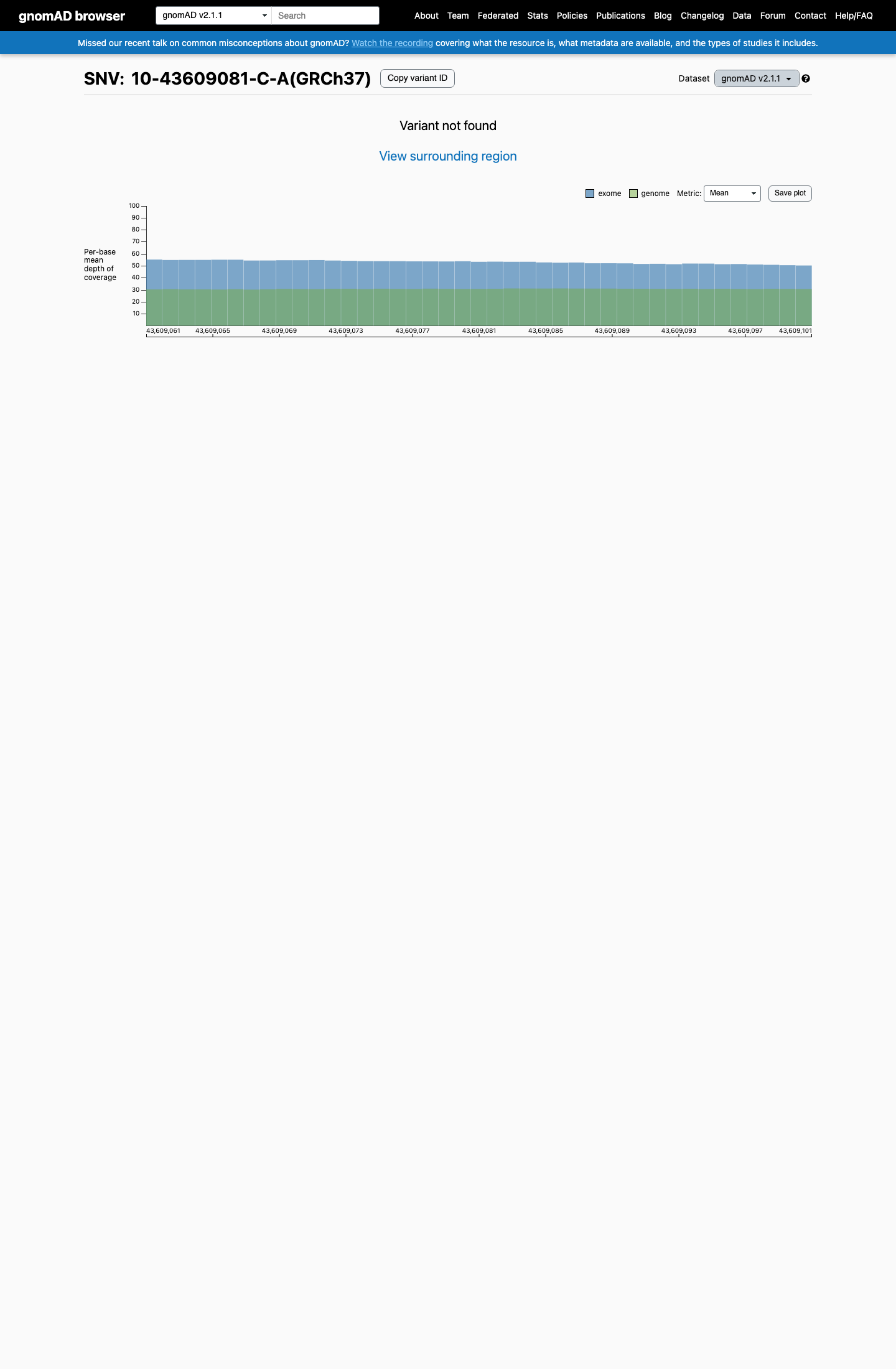
PM2 (Supporting): absent from gnomAD v2.1, v4.1, and gnomAD-Canada. BP4 (Supporting): SpliceAI max delta 0.013 predicts no splice impact, below the 0.2 threshold. Synthesis: with one supporting pathogenic (PM2) and one supporting benign (BP4) signal offsetting, the generic ACMG/AMP 2015 combination rules yield VUS.
PM2 + BP4→VUS
LYFE Sciences is an AI system, and it can make mistakes. Criteria
may be applied incorrectly, sources may be misread, and a confident-looking
classification can still be wrong. Double-check every criterion and
its underlying evidence before relying on any call.
Gene diagram
· NM_020975.5 · variants mapped to exon structure
RETNM_020975.5
Fetching transcript structure from UCSC…
Exons
—
Transcript span
—
Strand
—
Variants mapped
—
Source
UCSC ncbiRefSeqCurated
All variants in RET—click a row to locate it on the plot · use the link column to open its page
Protein
Location
Classification
Link
Applied criteria · 2 applied · 21 assessed
MetEvidence satisfies this criterion.
Not metEvaluated against available evidence; threshold not reached.
Not assessedApplies in principle, but no evidence was found to evaluate it.
N/ADoesn't apply to this variant type.
Applied · 2
Strength Supporting Moderate Strong Very strong
✓
PM2supportingPathogenic
Met (supporting): absent from gnomAD v2.1, v4.1, and gnomAD-Canada.
gnomAD v2.1 reports the variant as absent.gnomAD v4.1 reports the variant as absent.gnomAD-Canada v1.0 reports the variant as absent.
Met (supporting): SpliceAI max delta 0.013 vs the 0.2 splice-impact threshold.
SpliceAI (source_registry key 'spliceai') predicts max delta score 0.013, well below the 0.2 high-precision no-impact/impact threshold established in Jaganathan et al. 2019 (PMID 30661751), and Pangolin splice-gain/loss scores (SG 0.007, SL -0.01) concur, supporting BP4 at supporting strength via the splicing route.REVEL score 0.319 (source_registry key 'revel') is in the indeterminate zone of the ClinGen SVI-calibrated thresholds (Pejaver et al. 2022, PMID 36413997) and does not itself reach the benign-supporting cutoff (<0.290), so it is not counted as an additional corroborating line for BP4.BayesDel score -0.0482401 (source_registry key 'bayesdel') has no verified published calibration threshold/table available to this pipeline and is treated as not_available, so it is not used to support BP4.
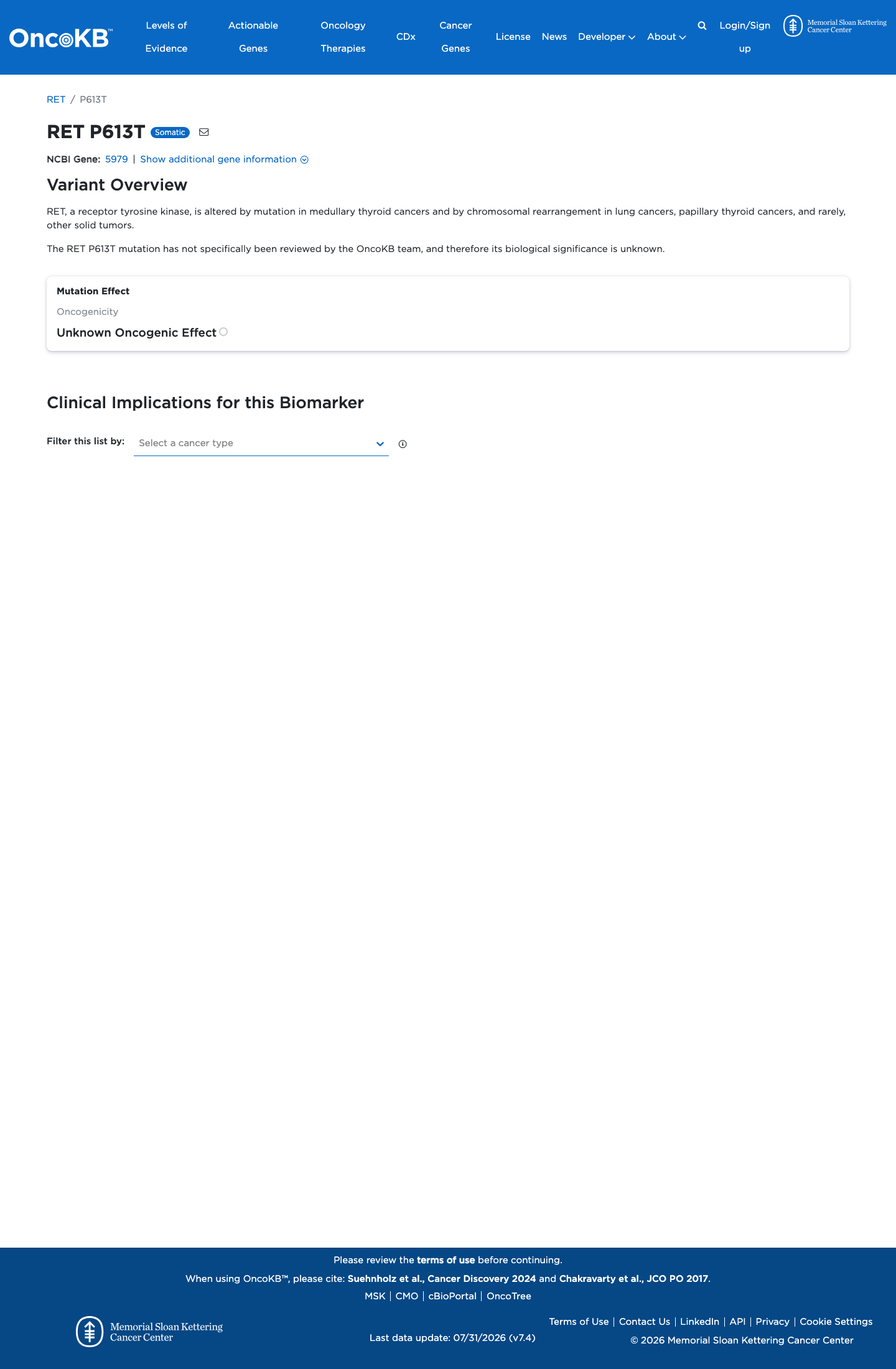
OncoKB did not identify variant-specific reviewed functional evidence for this variant; gene-level curated context is available for reviewer follow-up. RET, a receptor tyrosine kinase, is altered by mutation in medullary thyroid cancers and by chromosomal rearrangement in lung cancers, papillary thyro
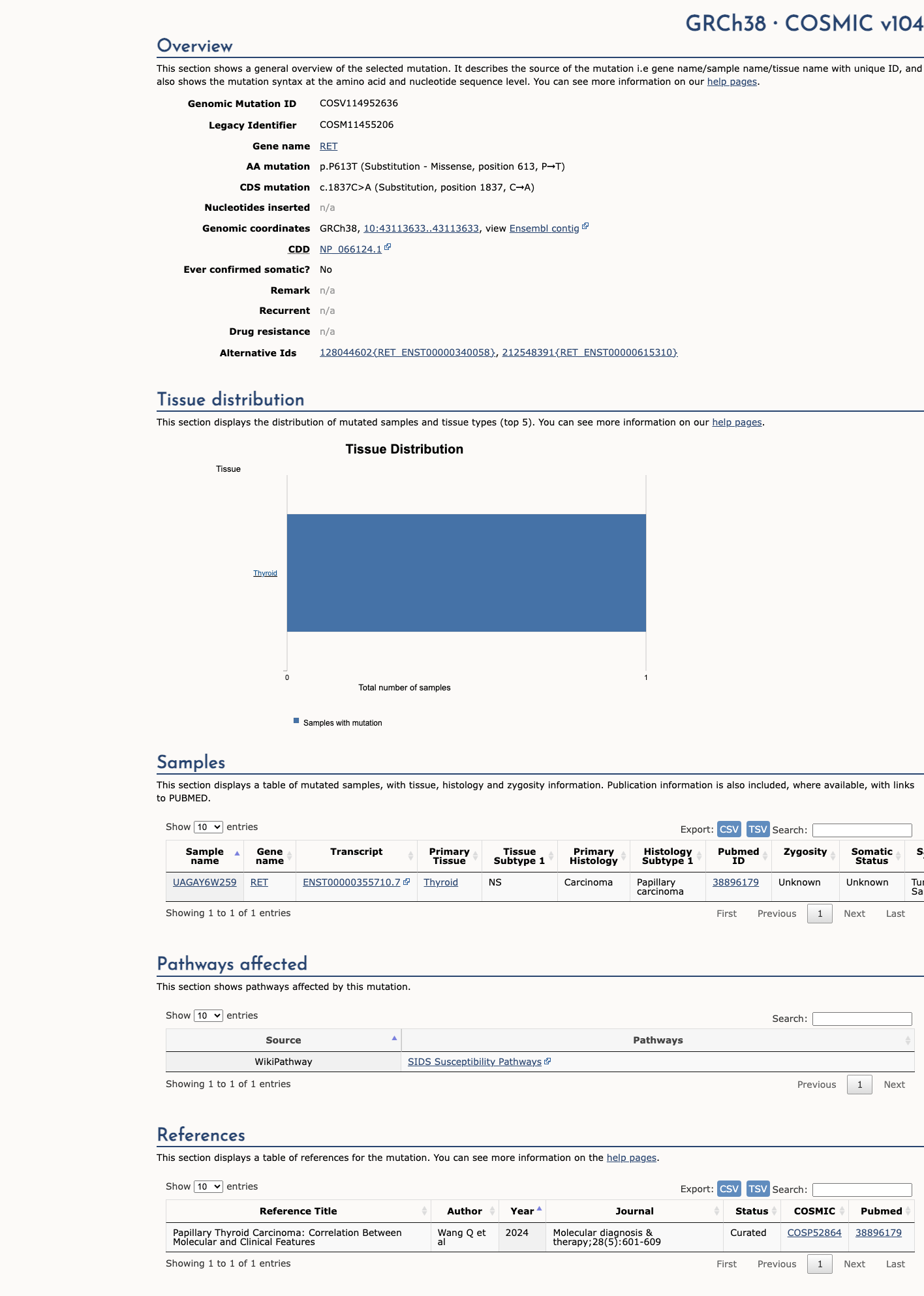
This variant does not lie in a statistically significant hotspot. This variant has previously been reported in somatic cancers (COSMIC; COSV114952636, n = 1 times).
Hotspots
This variant does not lie in a statistically significant hotspot.
Triaged references · 1 PMID not cited in assessment
25394175 ↗A practice guideline from the American College of Medical Genetics and Genomics and the National Society of Genetic Counselors: referral indications for cancer predisposition assessment.CLINVAR