NM_020975.6:c.2410G>T (p.Val804Leu) in RET is classified as Likely Pathogenic using generic ACMG/AMP 2015 framework (Richards et al., PMID:25741868).1 PM1 (moderate): Val804 is in the RET tyrosine kinase domain, a critical functional domain where MEN2/FMTC-associated missense mutations cluster. Multiple publications identify codon 804 as a disease-associated residue.2 PS3 (supporting): Functional studies directly characterized RET V804L among seven kinase domain mutations; the variant was introduced and biologically assessed (Iwashita et al., 1999).3 PM2 (supporting): Extremely low allele frequency in population databases. gnomAD v2.1 AF=4.3×10⁻⁶ (1/232,600); gnomAD v4.1 AF=1.3×10⁻⁵ (21/1,605,504); absent from gnomAD-Canada.4 PM5 (supporting): V804M (c.2410G>A) is a well-established pathogenic variant at the same residue, reported as FMTC-causing in PMID:10876191. Per ACMG/AMP PM5, a novel missense at a residue with a known pathogenic missense change provides supporting evidence.5 PP1 (supporting): Co-segregation of V804L with familial medullary thyroid cancer in an extended kindred is reported in PMID:12694233.6 Overall: 1 moderate (PM1) + 4 supporting (PS3, PM2, PM5, PP1) criteria met. This satisfies the '1 Moderate and 4 Supporting' Likely Pathogenic combination under generic ACMG/AMP 2015 rules.7 No benign criteria were met. BA1 (AF>1%): not met. BS1 (AF>0.3%): not met. BS3 (functional evidence of no damage): not met — available functional evidence supports damaging effect.8 ClinVar consensus supports pathogenicity: 18 clinical laboratories classify as Pathogenic (ClinVar Variation ID: 13946), though most submissions are single-submitter review status without expert panel review.9 Several criteria require human review: PS3 strength may be upgradable with full-text review of PMID:10445857 and PMID:15184865; PP1 strength may be upgradable with full-text segregation data; PM1 should be confirmed against germline-specific hotspot methodology.10
Final classification
Likely Pathogenic
PS3PM1PM2PM5PP1
RET
c.2410G>T
p.Val804Leu
This variant
NM_020975.6:c.2410G>T (p.Val804Leu) in RET is classified as Likely Pathogenic using generic ACMG/AMP 2015 framework (Richards et al., PMID:25741868).
gene-specific framework lacked a usable explicit final combination framework, so generic ACMG/AMP 2015 final-combination rules were applied as fallback; applied criteria: PS3 supporting, PM1 moderate, PM2 supporting, PM5 supporting, PP1 supporting; combination = 1 moderate + 4 supporting, which maps to Likely Pathogenic.
Classification rationale
PS3PM1PM2PM5PP1
Likely Pathogenic
RET c.2410G>T
PS3 + PM1 + PM2 + PM5 + PP1
→
Likely Pathogenic
1
generic_acmg_combination_rules
7
generic_acmg_combination_rules
LYFE Sciences is an AI system, and it can make mistakes. Criteria
may be applied incorrectly, sources may be misread, and a confident-looking
classification can still be wrong. Double-check every criterion and
its underlying evidence before relying on any call.
Gene diagram
· NM_020975.6 · variants mapped to exon structure
RET
NM_020975.6
Fetching transcript structure from UCSC…
Applied criteria · 5 applied · 17 assessed
MetEvidence satisfies this criterion.
Not metEvaluated against available evidence; threshold not reached.
Not assessedApplies in principle, but no evidence was found to evaluate it.
N/ADoesn't apply to this variant type.
Applied · 5
Strength
Supporting
Moderate
Strong
Very strong
PS3
supporting
review
Pathogenic
Functional characterization of V804L was performed in PMID:10445857 (Iwashita et al., 1999). The study introduced seven RET kinase domain mutations including V804L and assessed their biological and biochemical properties. The abstract confirms V804L was directly studied. This provides variant-specific functional evidence supporting a deleterious effect, consistent with the known gain-of-function mechanism of RET kinase domain mutations in MEN2/FMTC.
PMID:10445857 (Iwashita et al.1999): Direct functional study of RET V804L among seven kinase domain mutationsvariant introduced and biologically characterized. Abstract confirms 'valine 804→leucine (V804L)' was one of the mutations introduced into Ret.
PM1
moderate
review
Pathogenic
Val804 is located in the RET tyrosine kinase domain (codons 724–1010), a critical and well-established functional domain. Multiple independent publications identify codon 804 as a disease-associated residue in MEN2 and FMTC (PMID:15184865, PMID:9242375, PMID:10445857, PMID:10235148, PMID:12694233). The automated hotspot analysis flagged this residue as not statistically significant in somatic cancer, but this does not diminish the established role of RET kinase domain residues in germline MEN2/FMTC predisposition. No benign missense variation is observed at this specific residue in gnomAD.
V804 is in the RET tyrosine kinase domain (critical functional domain for kinase activity).PMID:15184865: Title explicitly references 'disease associated mutations at valine 804 in the RET receptor tyrosine kinase.'PMID:9242375: Studies FMTC mutations affecting the tyrosine kinase domain.
PM2
supporting
Pathogenic
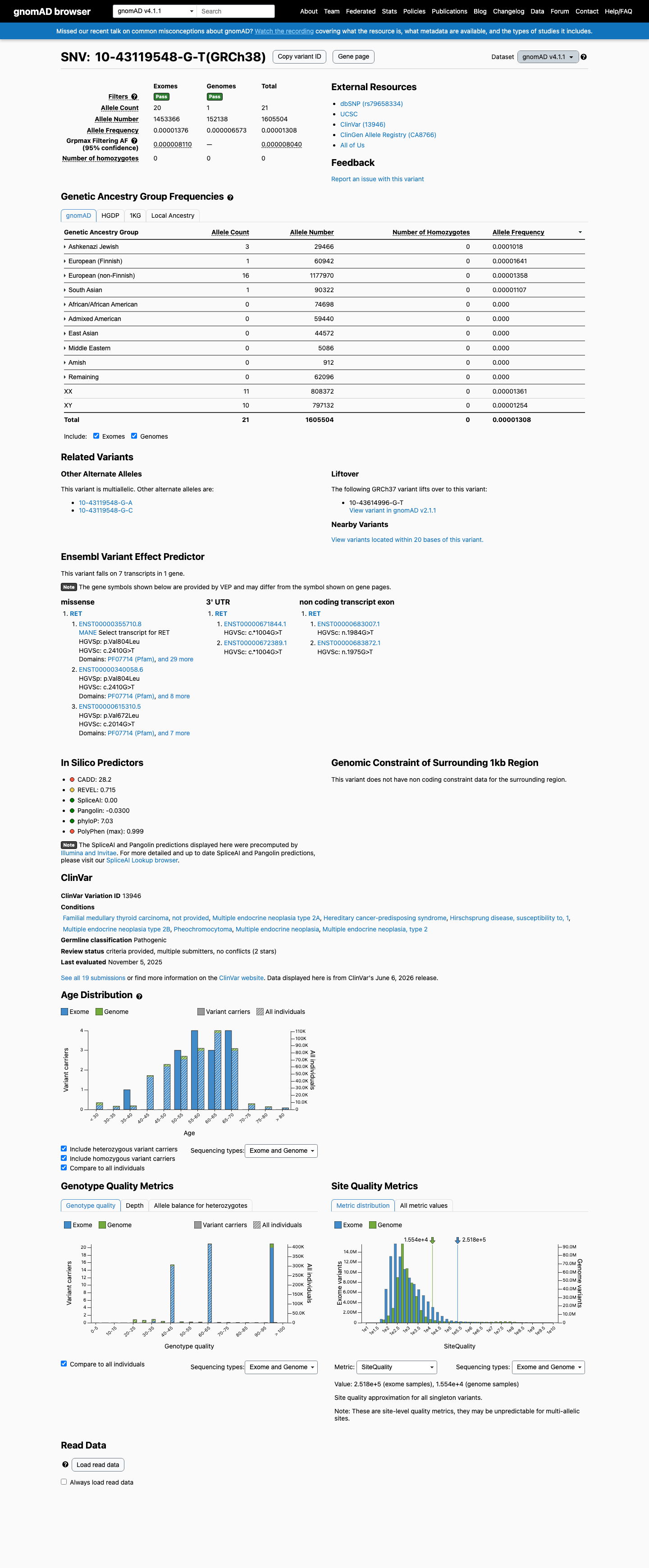
The variant is extremely rare in population databases. gnomAD v2.1: 1/232,600 alleles (AF=4.3×10⁻⁶). gnomAD v4.1: 21/1,605,504 alleles (AF=1.3×10⁻⁵; grpmax FAF=8.04×10⁻⁶). Both are well below the 0.1% PM2 threshold for non-VCEP frameworks. Absent from gnomAD-Canada v1.0. No homozygotes observed.
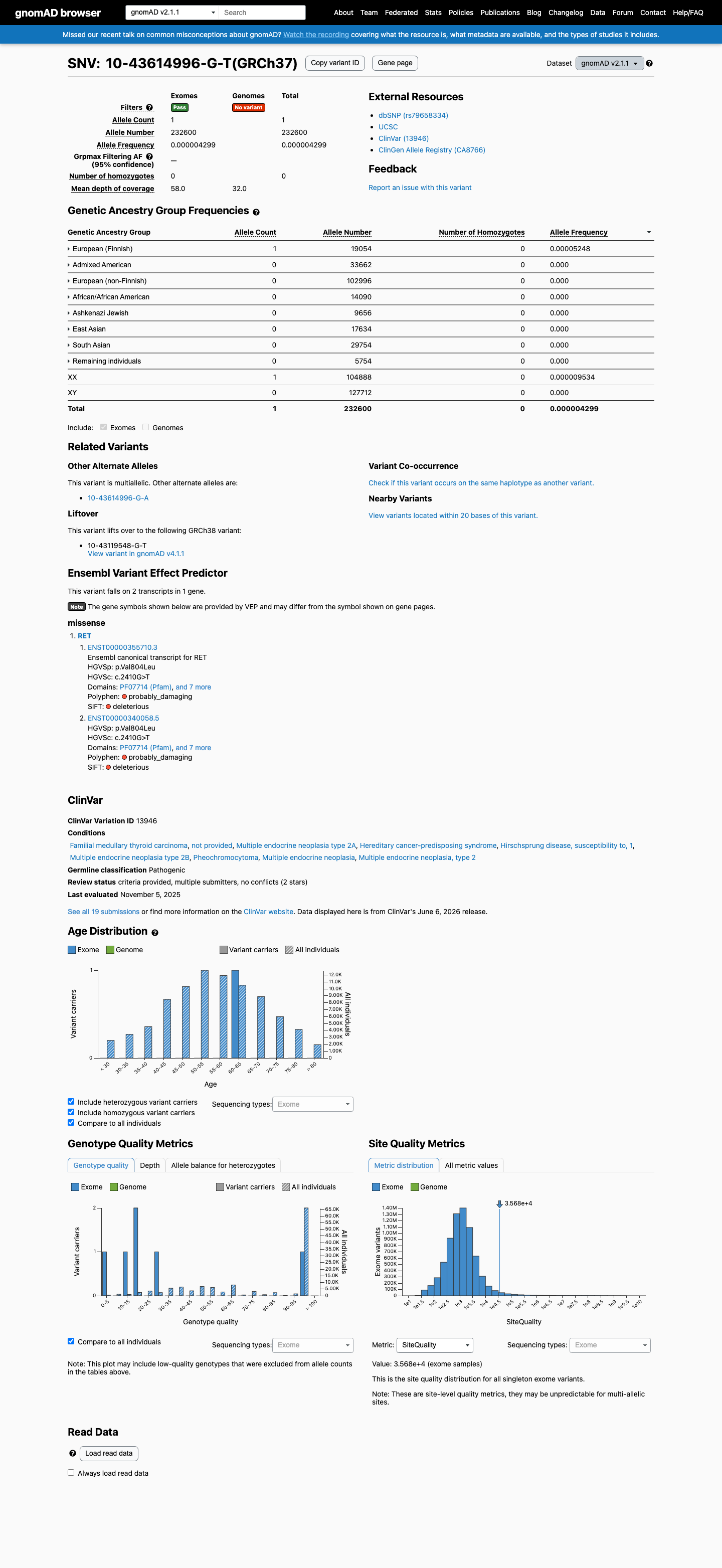
gnomAD v2.1: AF=4.299×10⁻⁶ (1/232600 exomes0 homozygotes).
PM5
supporting
review
Pathogenic
NM_020975.6:c.2410G>A (p.Val804Met, V804M) is a well-established pathogenic variant at the same amino acid residue. PMID:10876191 (Feldman et al., 2000) reports a family with FMTC due to the RET V804M mutation. V804M is classified as Pathogenic in ClinVar. Per ACMG/AMP PM5, a novel missense change at an amino acid residue where a different missense change has been determined to be pathogenic can be applied as supporting evidence.
V804M (c.2410G>A) is a known pathogenic variant at the same codon 804.PMID:10876191 confirms V804M as FMTC-causing (title: 'Variable expressivity of familial medullary thyroid carcinoma (FMTC) due to a RET V804M (GTG→ATG) mutation').
PP1
supporting
review
Pathogenic
Co-segregation of the V804L mutation with familial medullary thyroid cancer (FMTC) was demonstrated in an extended kindred as reported in PMID:12694233. The title and abstract confirm 'Segregation of the V804L mutation... in an extended kindred with familial medullary thyroid cancer.' This provides evidence of co-segregation with disease in a gene definitively known to cause MEN2/FMTC.
PMID:12694233 (Borrego et al.): Co-segregation of RET V804L with FMTC in an extended kindred confirmed by abstract.
Assessed · not applied
· 10 not met · 7 not assessed
Pathogenic
PS1
No evidence of a different nucleotide change at the same position (c.2410) with independently established pathogenicity was identified.
PS2
No de novo report for NM_020975.6:c.2410G>T was identified in the literature reviewed.
PS4
Insufficient statistical case-control data to meet PS4 threshold.
PM6
No de novo observation for NM_020975.6:c.2410G>T with confirmed maternity and paternity was identified in the reviewed literature.
PP2
While RET missense variants are a well-established mechanism of disease in MEN2/FMTC (gain-of-function), PP2 also requires a low rate of benign missense variation in the gene.
PP3
In silico evidence is mixed and does not meet the threshold for multiple lines of computational support for a deleterious effect.
PP4
Insufficient patient-specific phenotype data available in the evidence sources to determine whether the patient's phenotype or family history is highly specific for MEN2/FMTC with a single genetic etiology.
Benign
BA1
The variant has an allele frequency of ~4.3×10⁻⁶ in gnomAD v2.1 and 1.3×10⁻⁵ in gnomAD v4.1, far below the 1% BA1 threshold.
BS1
Maximum subpopulation allele frequency is 5.2×10⁻⁵ in European (Finnish) in gnomAD v2.1 and 1.0×10⁻⁴ in Ashkenazi Jewish in gnomAD v4.1, both well below the 0.3% BS1 threshold.
BS2
RET-MEN2/FMTC is an autosomal dominant disorder with high penetrance.
BS3
Available functional evidence supports a damaging effect, not a benign effect.
BS4
Available segregation evidence supports co-segregation with disease, not lack of segregation.
BP1
RET disease mechanism in MEN2/FMTC is primarily gain-of-function missense variants, not truncating variants.
BP2
No phase information is available to determine whether this variant has been observed in trans with a pathogenic RET variant (relevant for fully penetrant dominant disorders) or in cis with a pathogenic variant in any inheritance pattern.
BP4
Multiple lines of computational evidence do not consistently support a benign effect.
BP5
No evidence that this variant was observed in a case with a definitive alternate molecular basis for disease was identified in the reviewed materials.
BP6
ClinVar reports this variant as Pathogenic by 18 clinical laboratories.
N/A · 3
PVS1 · PP5 · BP7
Research & evidence
Population frequency · supports pathogenic
gnomAD v4.1
gnomAD v2.1
v4.1
This variant is present in gnomAD v4.1 (AF= 1.308e-05; MAF= 0.00131%, 21/1605504 alleles, homozygotes = 0) and has highest observed frequency in the Ashkenazi Jewish population (AF= 0.000101812; MAF= 0.01018%, 3/29466 alleles, homozygotes = 0); grpmax FAF= 8.04e-06.
v2.1
This variant is present in gnomAD v2.1 (AF= 4.29923e-06; MAF= 0.00043%, 1/232600 alleles, homozygotes = 0) and has highest observed frequency in the European (Finnish) population (AF= 5.24824e-05; MAF= 0.00525%, 1/19054 alleles, homozygotes = 0).
🇨🇦 CA
Absent from gnomAD-Canada v1.0.
Allele frequency by ancestry
three datasets · side by side
gnomAD v4.1
0.0013%
· 21 / 1,605,504
0 hom · FAF 0.0008%
0 hom · FAF 0.0008%
Ashkenazi Jewish 3 / 29,466 |
0.01% |
European (Finnish) 1 / 60,942 |
0.0016% |
European (non-Finnish) 16 / 1,177,970 |
0.0014% |
South Asian 1 / 90,322 |
0.0011% |
+ 6 not observed (Remaining individuals, Admixed American, Amish, East Asian, Middle Eastern, African/African American)
gnomAD v2.1
0.00043%
· 1 / 232,600
0 hom
0 hom
European (Finnish) 1 / 19,054 |
0.0052% |
+ 7 not observed (African/African American, Admixed American, Ashkenazi Jewish, East Asian, European (non-Finnish), Remaining individuals, South Asian)
gnomAD Canada 🇨🇦
Absent
· 0 / ?
0 hom
0 hom
Not observed in any ancestry group.

ClinVar
This variant has been reported in ClinVar as Pathogenic (18 clinical laboratories). (ClinVarID = 13946)
In silico
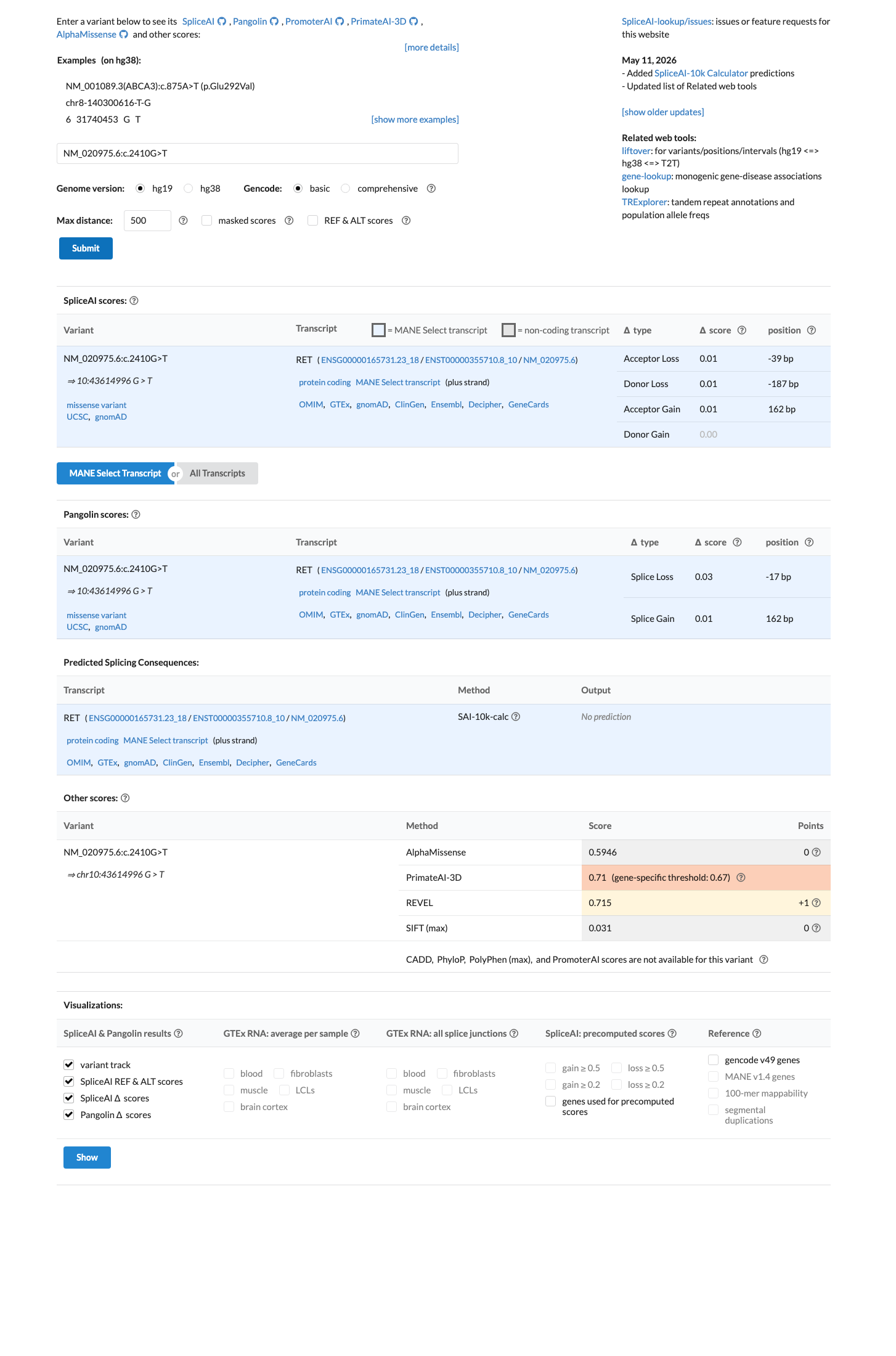
SpliceAI predicts no significant splice impact for this variant (max delta score = 0.01). REVEL score = 0.715. BayesDel score = 0.337965.
Functional
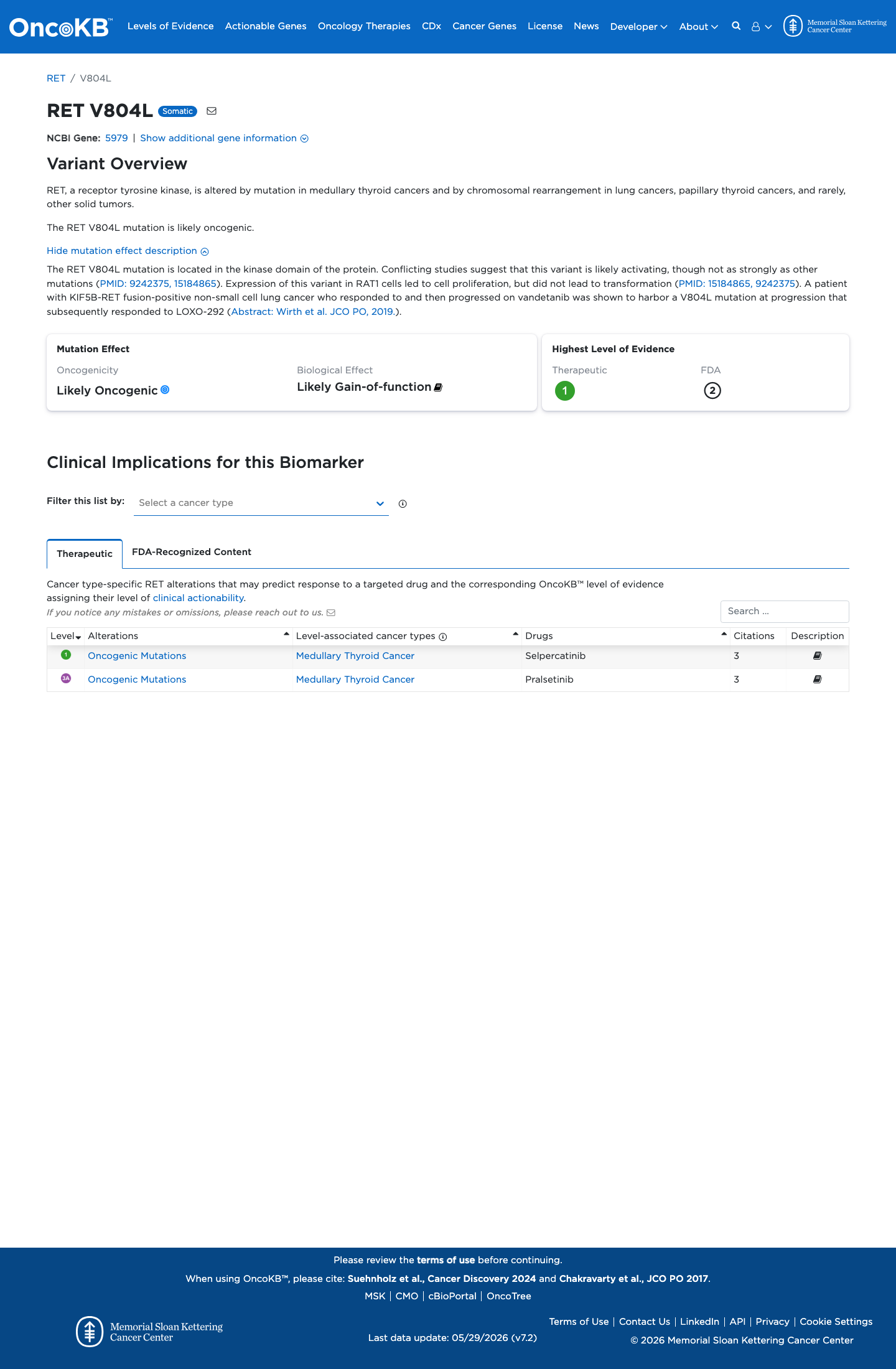
Likely Oncogenic
OncoKB identified variant-specific curated literature and context relevant to functional review; biological-effect context: Likely Gain-of-function; curated oncogenicity label: Likely Oncogenic.

COSMIC

Cancer hotspots
Somatic evidence
Not in COSMIC / hotspots
COSMIC
This variant does not lie in a statistically significant hotspot. This variant has not previously been reported in somatic cancers (COSMIC).
Hotspots
This variant does not lie in a statistically significant hotspot.
Literature · how each cited paper was used
5papers cited
Each card is an audit: what was searched, what was found, whether it names the variant, which criteria it fed, and why. 2 further PMIDs triaged but not cited — see Sources & references.
Biological and biochemical properties of Ret with kinase domain mutations identified in multiple endocrine neoplasia type 2B and familial medullary thyroid carcinoma.
Searched
c.2410G>Tp.Val804LeuV804Lvaline 804
Found
Seven RET kinase domain mutations including V804L were introduced into Ret and biologically characterized. The study assessed the biological and biochemical properties of RET kinase domain mutants, confirming that V804L was among the directly studied variants.
Variant
✓ Names this variant
Applied to
→PS3
met
→PM1
met
Why
Variant-specific functional data confirmed. Referenced in PS3 assessment at supporting strength; full-text review recommended for possible PS3 upgrade.
We introduced seven mutations (glutamic acid 768→aspartic acid (E768D), valine 804→leucine (V804L), alanine 883→phenylalanine (A883F), serine 891→alanine (S891A), methionine 918→threonine (M918T), glutamic acid 921→lysine (E921K), and asparagine 922→lysine (N922K)) into Ret.
Location Abstract: 'We introduced seven mutations (glutamic acid 768→aspartic acid (E768D), valine 804→leucine (V804L), alanine 883→phenylalanine (A883F)...).' · Context In vitro mutagenesis and functional characterization of RET kinase domain mutants; specific assay types not detailed in abstract.
Segregation of the V804L mutation and S836S polymorphism of exon 14 of the RET gene in an extended kindred with familial medullary thyroid cancer.
Searched
c.2410G>Tp.Val804LeuV804Lsegregation V804L
Found
Co-segregation of the V804L mutation with familial medullary thyroid cancer demonstrated in an extended kindred. The paper also analyzes the S836S polymorphism in the same family. This provides segregation evidence for V804L in FMTC.
Variant
✓ Names this variant
Applied to
→PM1
met
→PP1
met
Why
Variant-specific segregation confirmed in extended kindred. Referenced in PP1 assessment at supporting strength; full-text review recommended for upgrade assessment.
Segregation of the V804L mutation and S836S polymorphism of exon 14 of the RET gene in an extended kindred with familial medullary thyroid cancer.
Location Title: 'Segregation of the V804L mutation and S836S polymorphism of exon 14 of the RET gene in an extended kindred with familial medullary thyroid cancer.'
Disease associated mutations at valine 804 in the RET receptor tyrosine kinase confer resistance to selective kinase inhibitors.
Searched
c.2410G>Tp.Val804LeuV804Lvaline 804
Found
Disease-associated mutations at RET valine 804 (including V804L and V804M) were found to confer resistance to selective kinase inhibitors (PP1, PP2, ZD6474). The paper demonstrates that V804 mutations alter drug sensitivity, confirming functional significance of this residue.
Variant
✓ Names this variant
Applied to
→PS3
met
→PM1
met
Why
V804 residue functional significance confirmed. Referenced in PM1 assessment; could support PS3 upgrade if full text confirms direct V804L functional data.
Disease associated mutations at valine 804 in the RET receptor tyrosine kinase confer resistance to selective kinase inhibitors.
Location Title and abstract: 'Disease associated mutations at valine 804 in the RET receptor tyrosine kinase confer resistance to selective kinase inhibitors.' Abstract snippet confirms V804 mutations studied. · Context Kinase inhibitor sensitivity assays (PP1, PP2, ZD6474) against oncogenic RET kinase mutants.
Rule & framework references · cited for criterion definitions, not variant evidence
10876191 ↗
Variable expressivity of familial medullary thyroid carcinoma (FMTC) due to a RET V804M (GTG-->ATG) mutation.
9242375 ↗
Oncogenic activation of RET by two distinct FMTC mutations affecting the tyrosine kinase domain.
Sources & reference links
Triaged references · 2 PMIDs not cited in assessment
11589684 ↗
Germline sequence variant S836S in the RET proto-oncogene is associated with low level predisposition to sporadic medullary thyroid carcinoma in the Spanish population.
CLINVAR
28492532 ↗
Sherloc: a comprehensive refinement of the ACMG-AMP variant classification criteria.
CLINVAR