NM_020975.6:c.2711C>T (p.Ser904Phe) is a missense variant in exon 15 of the RET gene, located in the activation loop of the tyrosine kinase domain.1 This variant is absent from gnomAD v2.1 and gnomAD-Canada, and is present in gnomAD v4.1 at an extremely low allele frequency of 6.2e-7 (1/1,613,158 alleles), meeting PM2_supporting.2 The variant is located in the activation loop of the RET kinase domain (codon 904, between autophosphorylation residues Y900 and Y905), a critical functional domain and known mutational hotspot for MEN2-associated variants, meeting PM1_moderate.3 In vitro functional studies demonstrate that S904F increases RET kinase ATP affinity, accelerates autophosphorylation, and confers gain-of-function transforming activity, consistent with the established pathogenic mechanism of RET in MEN2, meeting PS3_supporting.4 The variant cosegregates with medullary thyroid carcinoma in multiple affected family members across at least two families; in the largest reported family, 7 of 10 carriers developed MTC across multiple generations, meeting PP1_moderate.5 REVEL in silico prediction score of 0.821 supports a deleterious effect on protein function, meeting PP3_supporting.6 The variant has been observed in multiple individuals with medullary thyroid carcinoma, a phenotype highly specific for RET-related hereditary cancer syndromes, meeting PP4_supporting.7 Two moderate criteria (PM1, PP1) and four supporting criteria (PS3, PM2, PP3, PP4) are met. Per ACMG/AMP 2015 combination rules (PMID:25741868), this combination is consistent with a classification of Likely Pathogenic.8
Final classification
Likely Pathogenic
PS3PM1PM2PP1PP3PP4
RET
c.2711C>T
p.Ser904Phe
This variant
NM_020975.6:c.2711C>T (p.Ser904Phe) is a missense variant in exon 15 of the RET gene, located in the activation loop of the tyrosine kinase domain.
gene-specific framework lacked a usable explicit final combination framework, so generic ACMG/AMP 2015 final-combination rules were applied as fallback; applied criteria: PS3 supporting, PM1 moderate, PM2 supporting, PP1 moderate, PP3 supporting, PP4 supporting; combination = 2 moderate + 4 supporting, which maps to Likely Pathogenic.
Classification rationale
PS3PM1PM2PP1PP3PP4
Likely Pathogenic
RET c.2711C>T
PS3 + PM1 + PM2 + PP1 + PP3 + PP4
→
Likely Pathogenic
6
revel
8
generic_acmg_combination_rules
LYFE Sciences is an AI system, and it can make mistakes. Criteria
may be applied incorrectly, sources may be misread, and a confident-looking
classification can still be wrong. Double-check every criterion and
its underlying evidence before relying on any call.
Gene diagram
· NM_020975.6 · variants mapped to exon structure
RET
NM_020975.6
Fetching transcript structure from UCSC…
Applied criteria · 6 applied · 16 assessed
MetEvidence satisfies this criterion.
Not metEvaluated against available evidence; threshold not reached.
Not assessedApplies in principle, but no evidence was found to evaluate it.
N/ADoesn't apply to this variant type.
Applied · 6
Strength
Supporting
Moderate
Strong
Very strong
PS3
supporting
Pathogenic
In vitro functional studies demonstrate that the S904F substitution increases RET kinase ATP affinity, accelerates autophosphorylation, and confers gain-of-function transforming activity. These functional defects are consistent with the established gain-of-function mechanism of RET in MEN2 and medullary thyroid carcinoma.
PMID:29434222: S904F mutant CCDC6-RET showed increased ATP affinity (Km[ATP])accelerated autophosphorylation kineticsand higher catalytic efficiency vs wild-type in in vitro kinase assays using purified RET kinase domains
PM1
moderate
Pathogenic
The variant is located in the activation loop of the RET tyrosine kinase domain (codon 904, situated between autophosphorylation residues Y900 and Y905), a critical and well-established functional domain. The RET kinase domain is a known mutational hotspot for pathogenic MEN2-associated variants, and no benign variation has been established at this residue within the activation loop.
PMID:29434222: 'The serine 904 residue is located in between two autophosphorylation tyrosines Y900 and Y905 within the canonical activation loop (AL) of RET kinase.'The RET kinase domain activation loop is a well-established critical functional domainknown pathogenic MEN2 variants cluster in the kinase domain.
PM2
supporting
Pathogenic
This variant is absent from gnomAD v2.1 and gnomAD-Canada and is present in gnomAD v4.1 at an extremely low allele frequency (1/1,613,158 alleles, AF = 6.2e-7), well below the PM2 threshold of 0.1%. No homozygotes have been observed.
gnomAD v2.1: absent (0 alleles).gnomAD v4.1: 1/1613
PP1
moderate
Pathogenic
The variant cosegregates with medullary thyroid carcinoma in multiple affected family members across at least two families. In the largest reported family (PMID:33167350), 7 of 10 carriers developed MTC across multiple generations (average age at diagnosis 46.3 years). A prior report describes a father and son both affected with adult-onset MTC. RET is a gene definitively known to cause MEN2/FMTC.
PMID:33167350: family 91-O-03: 8 tested carriers + 2 obligate carriers across multiple generations7/10 developed MTC at average age 46.3 years. Highly penetrant but late-onsetslowly progressing MTC. Prior published family with father and son affected by adult-onset MTC cited as reference [25].
PP3
supporting
Pathogenic
REVEL score of 0.821 exceeds the 0.7 threshold for pathogenic prediction, supporting a deleterious effect on protein function. BayesDel score of 0.3192 provides borderline additional support. SpliceAI predicts no splicing impact (max delta = 0.0). Multiple in silico algorithms support a deleterious prediction.
REVEL: 0.821 (>0.7 pathogenic threshold).BayesDel: 0.3192 (borderlinebelow typical strong pathogenic threshold).
PP4
supporting
Pathogenic
The variant has been observed in multiple individuals with medullary thyroid carcinoma, a phenotype that is highly specific for RET-related hereditary cancer syndromes (MEN2A, MEN2B, FMTC). MTC is a hallmark feature of RET-associated disease with high positive predictive value.
PMID:33167350: 7 carriers with MTC in one familyadditional family with MTC reported. MTC is the sentinel feature of RET-related MEN2/FMTC.ClinVar VariationID 24963: classified as LP by 2 clinical laboratories in the context of MEN2/FMTC.
Assessed · not applied
· 15 not met · 1 not assessed
Pathogenic
PS1
No evidence is available that a different nucleotide change at codon 904 producing the same amino acid substitution (p.Ser904Phe) has been established as pathogenic; PS1 cannot be applied without a known pathogenic comparator arising from an alternative nucleotide change at the same residue.
PS2
No de novo observation with confirmed paternity and maternity has been reported for this variant; the variant has been observed as inherited in multiple family members (PMID:33167350).
PS4
The variant has been observed in affected families but there are insufficient case-control data to demonstrate a statistically significant increased prevalence in affected individuals compared to population controls.
PM5
No same-residue comparator missense variants with an established pathogenic classification were identified in ClinVar or the literature; classic PM5 semantics (different amino acid change at the same residue already established as pathogenic) cannot be applied.
PM6
No de novo observation (even without confirmed paternity/maternity) has been reported for this variant; the variant segregates as inherited in multiple families with MTC.
PP2
Insufficient gene-level missense constraint data (e.g., gnomAD Z-score, missense depletion metrics) were available to determine whether RET has a low rate of benign missense variation.
PP5
ClinVar classification is split between Likely pathogenic (2 labs) and Uncertain significance (1 lab) with review status of 'criteria provided, single submitter.' No expert panel or multi-submitter consensus exists.
Benign
BA1
The maximum population allele frequency in gnomAD (1.6e-5 in Remaining individuals) is far below the BA1 threshold of 1%.
BS1
The maximum population allele frequency in gnomAD (1.6e-5) is far below the BS1 threshold of 0.3%.
BS2
Only 1 allele observed in gnomAD v4.1 across 1.6 million alleles; insufficient observation in healthy adults to apply BS2, which requires observation in healthy adults for a disorder expected to have full penetrance at an early age.
BS3
Available functional studies demonstrate gain-of-function effects (increased ATP affinity, accelerated autophosphorylation, transforming activity) consistent with a pathogenic mechanism, not a benign effect.
BS4
The variant does segregate with disease in reported families.
BP2
No evidence was identified that this variant has been observed in trans with a known pathogenic RET variant in a fully penetrant dominant disorder.
BP4
REVEL score of 0.821 supports a deleterious effect, contradicting BP4 which requires multiple lines of computational evidence suggesting no impact on gene product.
BP5
No evidence was identified that this variant has been found in a case with an alternate molecular basis for disease that would explain the phenotype independently.
BP6
No reputable source reports this variant as benign or likely benign.
N/A · 3
PVS1 · BP1 · BP7
Research & evidence
Population frequency · supports pathogenic
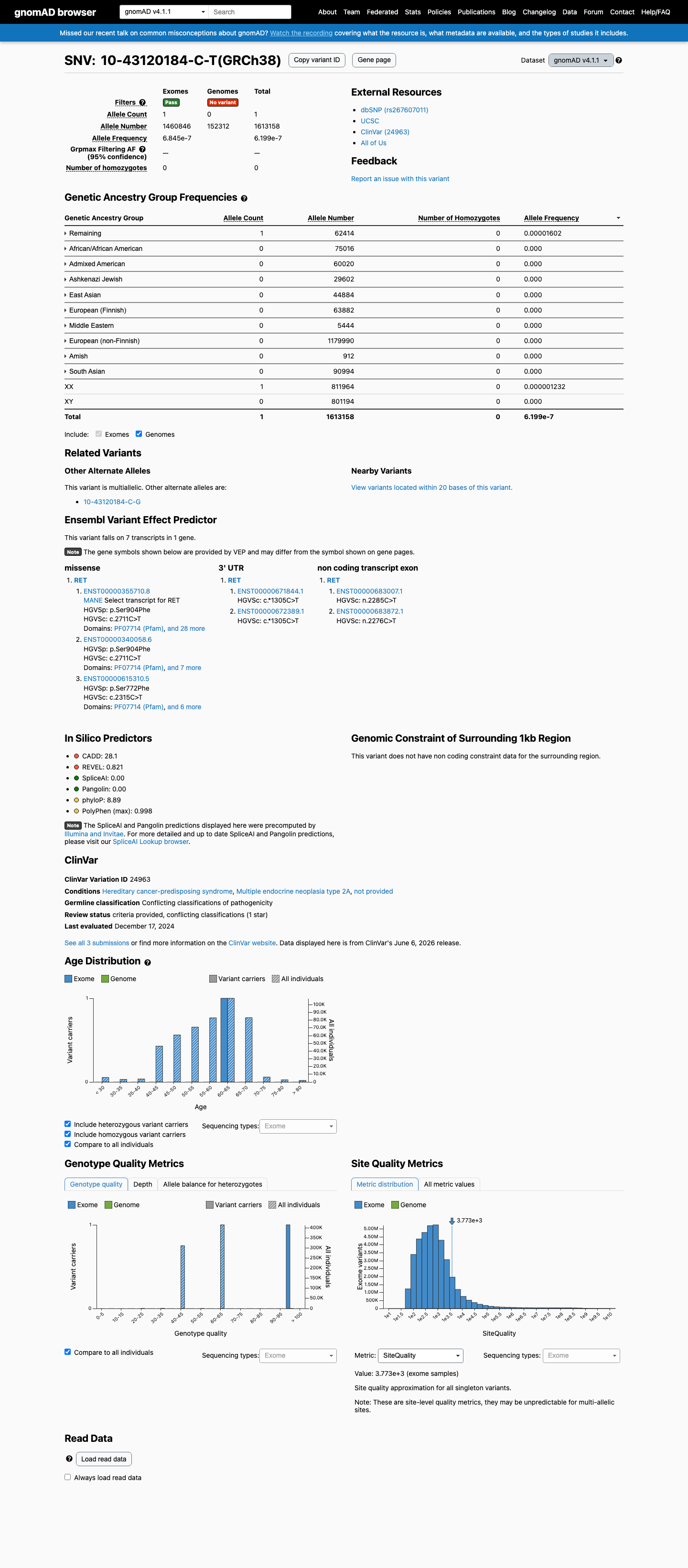
gnomAD v4.1
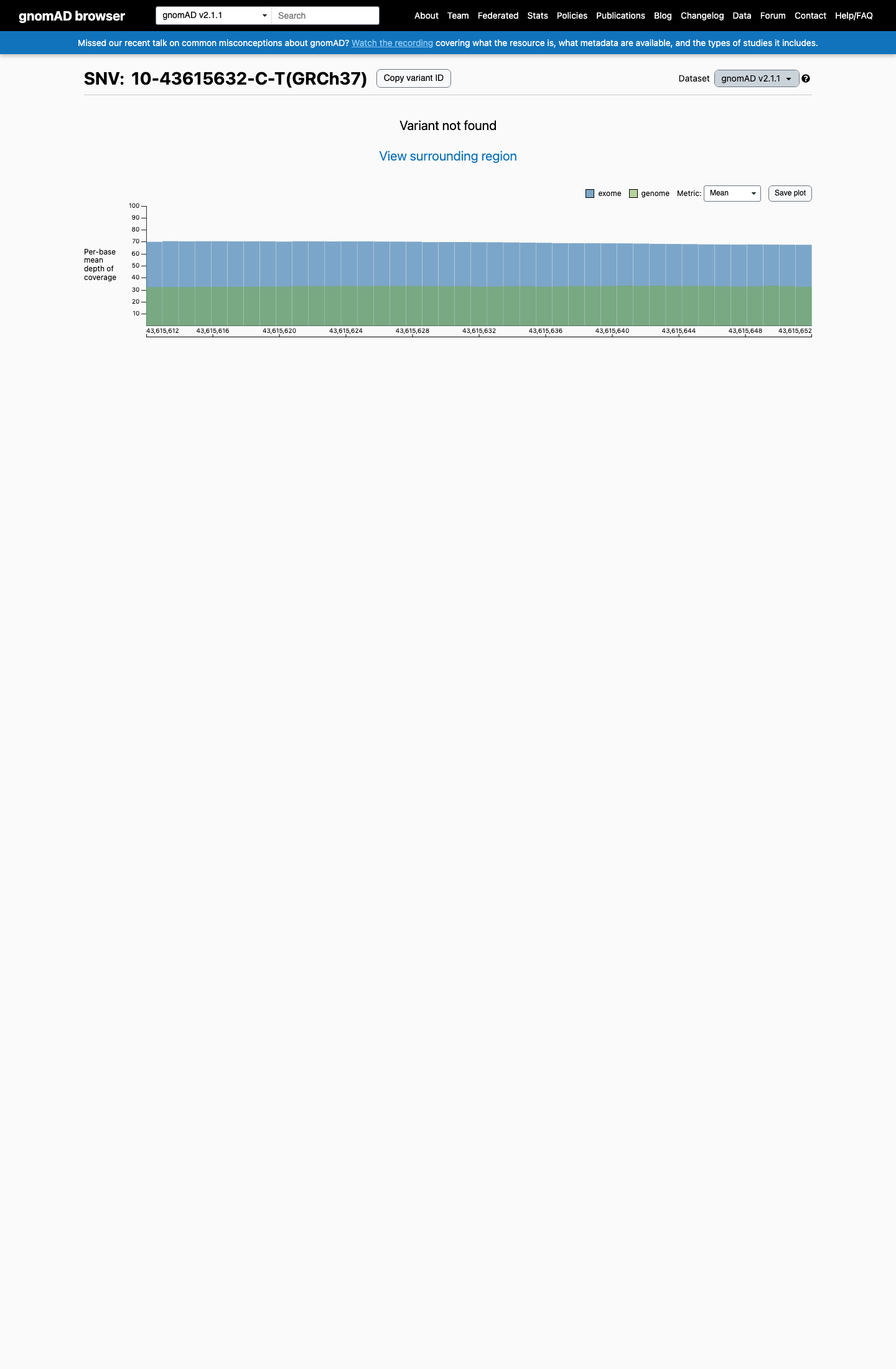
gnomAD v2.1
v4.1
This variant is present in gnomAD v4.1 (AF= 6.19902e-07; MAF= 0.00006%, 1/1613158 alleles, homozygotes = 0) and has highest observed frequency in the Remaining individuals population (AF= 1.6022e-05; MAF= 0.00160%, 1/62414 alleles, homozygotes = 0).
v2.1
Absent from gnomAD v2.1.
🇨🇦 CA
Absent from gnomAD-Canada v1.0.
Allele frequency by ancestry
three datasets · side by side
gnomAD v4.1
6.2e-05%
· 1 / 1,613,158
0 hom
0 hom
Remaining individuals 1 / 62,414 |
0.0016% |
+ 9 not observed (Admixed American, European (Finnish), Amish, East Asian, Middle Eastern, South Asian, Ashkenazi Jewish, African/African American, European (non-Finnish))
gnomAD v2.1
Absent
· 0 / ?
0 hom
0 hom
Not observed in any ancestry group.
gnomAD Canada 🇨🇦
Absent
· 0 / ?
0 hom
0 hom
Not observed in any ancestry group.
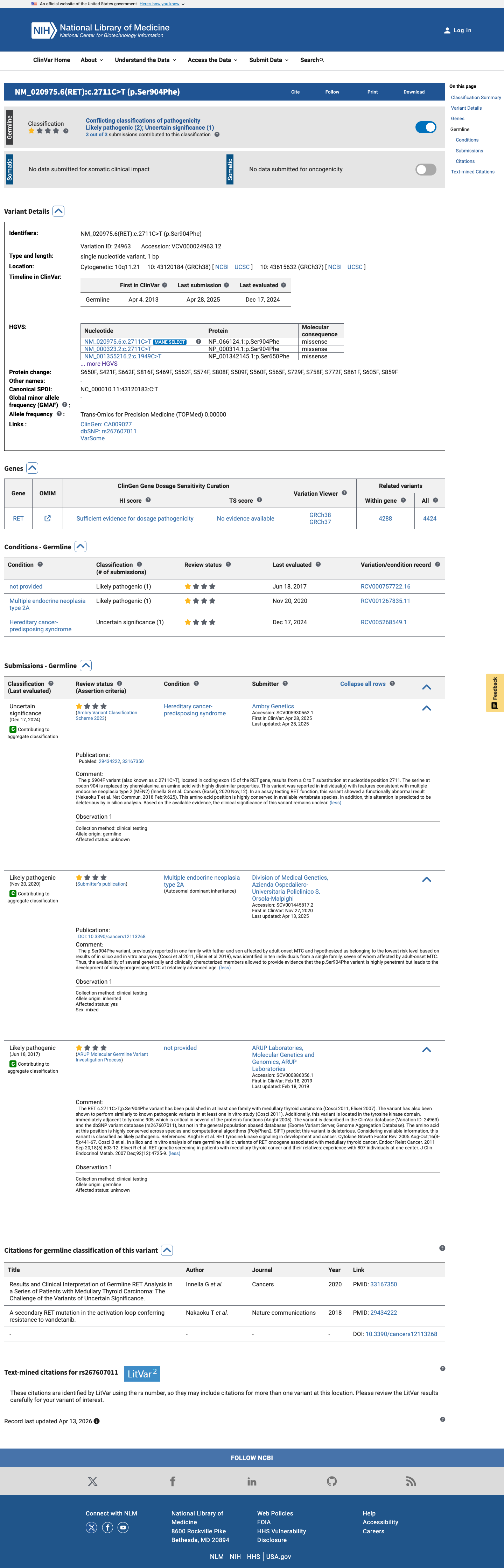
ClinVar
This variant has been reported in ClinVar as Likely pathogenic (2 clinical laboratories) and as Uncertain significance (1 clinical laboratory). (ClinVarID = 24963)
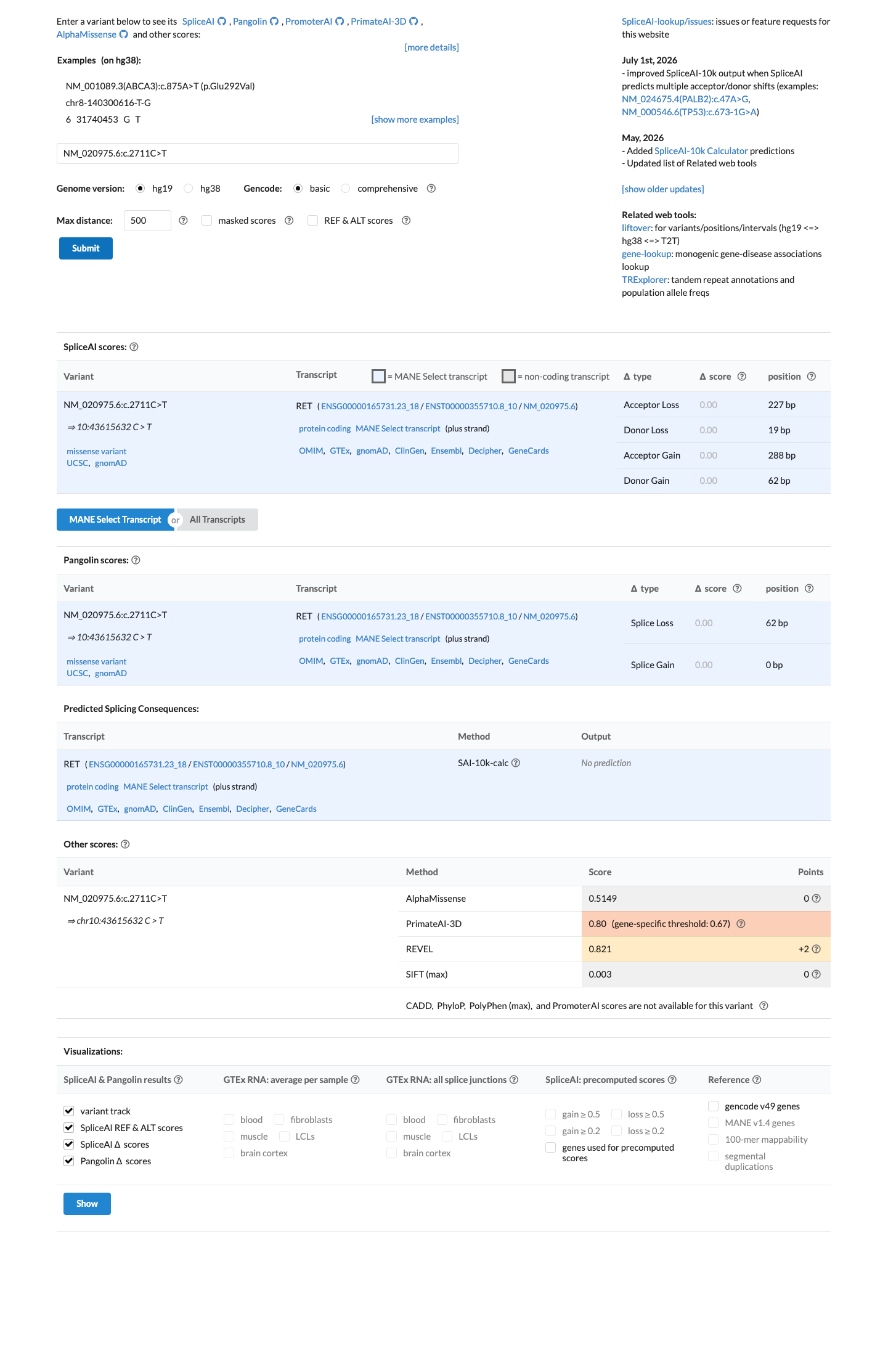
In silico
SpliceAI predicts no significant splice impact for this variant (max delta score = 0.00). REVEL score = 0.821. BayesDel score = 0.3192.
Functional
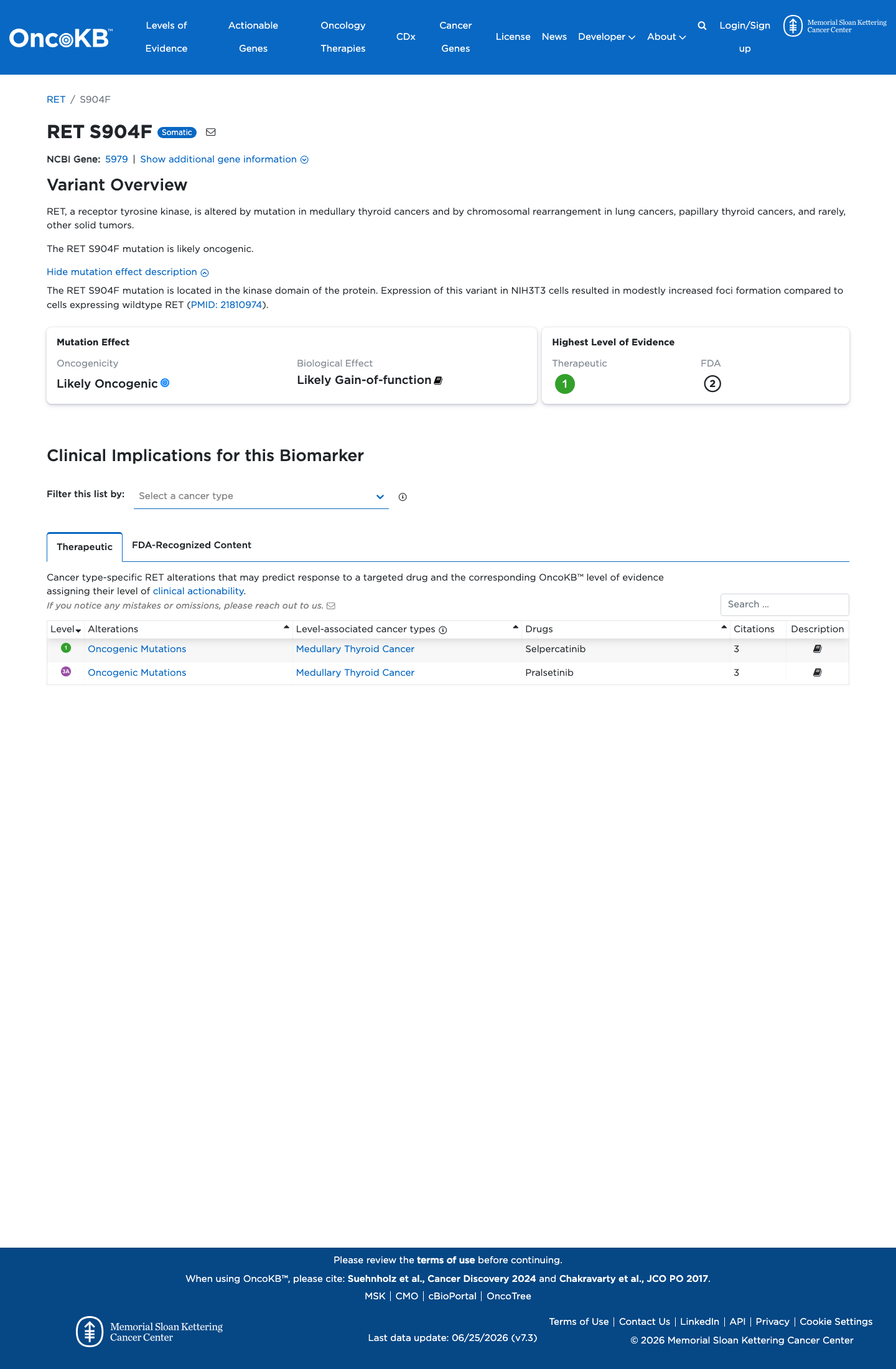
Likely Oncogenic
OncoKB identified variant-specific curated literature and context relevant to functional review; biological-effect context: Likely Gain-of-function; curated oncogenicity label: Likely Oncogenic.
COSMIC

Cancer hotspots
Somatic evidence
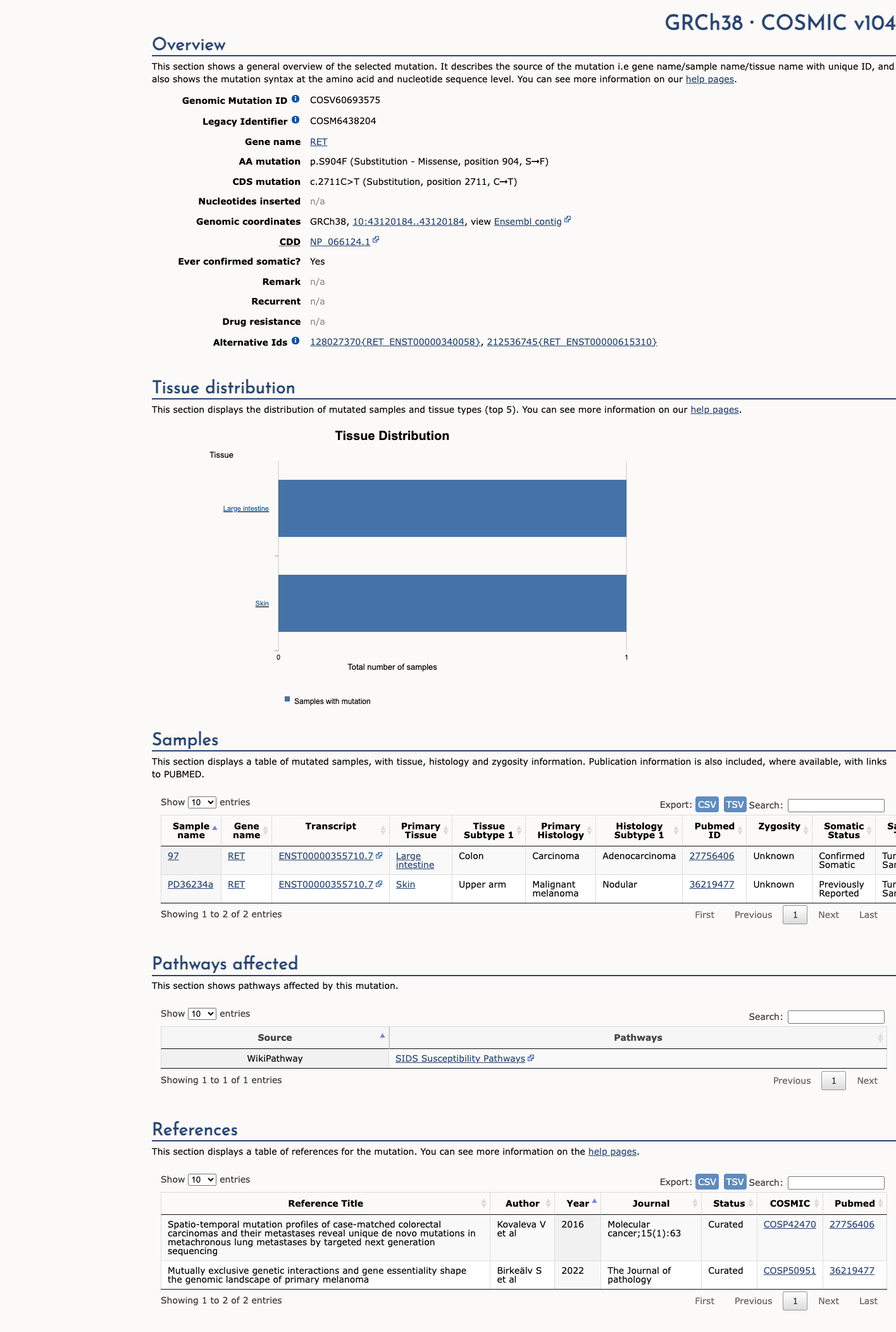
Not in COSMIC / hotspots
COSMIC
This variant does not lie in a statistically significant hotspot. This variant has previously been reported in somatic cancers (COSMIC; COSV60693575, n = 2 times).
Hotspots
This variant does not lie in a statistically significant hotspot.
Literature · how each cited paper was used
3papers cited
Each card is an audit: what was searched, what was found, whether it names the variant, which criteria it fed, and why. 5 further PMIDs triaged but not cited — see Sources & references.
In silico and in vitro analysis of rare germline allelic variants of RET oncogene associated with medullary thyroid cancer.
Searched
S904FSer904Phec.2711
Found
S904F was one of six rare germline RET mutations analyzed by in silico and in vitro assays for transforming activity. S904F received the highest in silico score (65) among the six variants tested and demonstrated transforming activity in NIH3T3 fibroblast focus formation assays, consistent with a gain-of-function pathogenic mechanism. The authors suggested assigning S904F to the lowest ATA risk level based on relatively high transforming activity but low clinical aggressiveness.
Variant
✓ Names this variant
Applied to
→PS3
met
Why
Variant-specific functional data (transforming activity) confirmed via abstract; cited as supporting evidence for PS3_supporting. Full text not available for detailed review.
Germline and somatic RET oncogene mutations are found in 98% hereditary and 40% sporadic medullary thyroid carcinomas. Our aim was to analyse by in silico and in vitro assays the transforming activity of six rare RET mutations (T338I, V648I, M918V, A883T, S904F and M848T). [...] The in silico analysis showed the highest score value (i.e. 65) for S904F
Location Abstract; cited by PMID:33167350 as reference [26] (Cosci et al. 2011) · Context In silico prediction tools; NIH3T3 fibroblast focus formation assay for transforming activity
A secondary RET mutation in the activation loop conferring resistance to vandetanib.
Searched
S904Fc.2711C>TSer904PheS904
Found
S904F secondary mutation identified in the RET kinase domain activation loop of a CCDC6-RET fusion-positive lung adenocarcinoma that developed resistance to vandetanib. In vitro kinase assays demonstrated that S904F increases ATP affinity, accelerates autophosphorylation, and enhances catalytic efficiency compared to wild-type RET. Ba/F3 cells expressing S904F showed IL3-independent growth. The authors note that the same mutation is a known germline oncogenic mutation responsible for familial medullary thyroid carcinoma.
Variant
✓ Names this variant — characterised directly
Applied to
→PS3
met
Why
Variant-specific functional data confirmed gain-of-function effects in vitro; cited as PS3_supporting evidence. Study is primarily a somatic resistance context but explicitly references germline oncogenic role.
Discovery of a S904F secondary mutation in the RET kinase domain [...] Targeted deep sequencing of cancer-related genes from genomic DNA identified a serine-to-phenylalanine substitution at codon 904 (S904F) in RET as the only non-synonymous mutation in the resistant tumor
Location Abstract; Results (Discovery of a S904F secondary mutation); Results (Vandetanib resistance is related to increased ATP affinity); Figure 1d; Figure 2a-c; Figure 3a-d; Discussion para 2 · Context In vitro kinase assay using purified recombinant RET kinase domain (aa 658-1072) expressed in Sf9 insect cells; H1299 lung cancer cells transiently expressing CCDC6-RET; Ba/F3 cells with lentiviral CCDC6-RET transduction; X-ray crystallography of S904F RET kinase domain at 2.3A; thermal shift assay; molecular dynamics simulation · full text
Results and Clinical Interpretation of Germline RET Analysis in a Series of Patients with Medullary Thyroid Carcinoma: The Challenge of the Variants of Uncertain Significance.
Searched
Ser904p.Ser904PheS904Fc.2711
Found
p.Ser904Phe identified as a variant of uncertain significance in a family (91-O-03) with multiple members affected by medullary thyroid carcinoma. Eight individuals were tested and found to carry the variant, with two additional obligate carriers. Seven of ten carriers developed slowly progressing MTC at an average age of 46.3 years; none manifested pheochromocytoma or hyperparathyroidism. The authors conclude that the variant is highly penetrant but causes late-onset, low-aggressiveness MTC, suggesting that screening recommended for carriers of lowest-risk ATA mutations is appropriate.
Variant
✓ Names this variant — characterised directly
Applied to
→PP1
met
→PP4
met
Why
Variant-specific cosegregation and phenotype data confirmed; cited for PP1_moderate (cosegregation) and PP4_supporting (phenotype specificity). Does not independently meet PS4 statistical threshold.
The p.Ser904Phe variant was found in a family with several members affected by MTC (Figure 1): eight individuals were tested and found to carry the variant, while two other relatives were obligate carriers. Out of 10 carriers, seven developed slowly progressing MTC at an average age of 46.3 years and none manifested other RET-related problems.
Location Section 2.3 (Families with Unclassified Variants), para 1; Table 3; Figure 1; Discussion para 5; Section 4.4 · Context Clinical cohort study of 163 subjects undergoing RET genetic testing at a cancer genetics clinic; segregation analysis and genotype-phenotype correlation. · full text
Sources & reference links
Triaged references · 5 PMIDs not cited in assessment
25356965 ↗
ACMG policy statement: updated recommendations regarding analysis and reporting of secondary findings in clinical genome-scale sequencing.
CLINVAR
25394175 ↗
A practice guideline from the American College of Medical Genetics and Genomics and the National Society of Genetic Counselors: referral indications for cancer predisposition assessment.
CLINVAR
27854360 ↗
Recommendations for reporting of secondary findings in clinical exome and genome sequencing, 2016 update (ACMG SF v2.0): a policy statement of the American College of Medical Genetics and Genomics.
CLINVAR