NM_023067.4:c.402C>G (p.Cys134Trp) in FOXL2 is absent from all population databases including gnomAD v2.1, v4.1, and gnomAD-Canada v1.0.1 The variant alters codon 134 in the forkhead DNA-binding domain wing 2 region, a statistically significant mutational hotspot with 901 somatic occurrences in COSMIC (COSV57725321). Functional studies in KGN granulosa cell tumor cells demonstrate that C134W mutant FOXL2 fails to upregulate GnRH receptor expression and fails to enhance GnRH-induced apoptosis, whereas wild-type FOXL2 performs both functions, consistent with a loss-of-function effect (PMID:23372819).2 REVEL in silico prediction score of 0.884 supports a deleterious effect on protein function.3 Applying generic ACMG/AMP 2015 final classification combination rules (PMID:25741868): two moderate criteria (PM1, PM2) and two supporting criteria (PS3, PP3) are met, consistent with a Likely Pathogenic classification.4
Final classification
Likely Pathogenic
PS3PM1PM2PP3
FOXL2
c.402C>G
p.Cys134Trp
This variant
NM_023067.4:c.402C>G (p.Cys134Trp) in FOXL2 is absent from all population databases including gnomAD v2.1, v4.1, and gnomAD-Canada v1.0.
gene-specific framework lacked a usable explicit final combination framework, so generic ACMG/AMP 2015 final-combination rules were applied as fallback; applied criteria: PS3 supporting, PM1 moderate, PM2 moderate, PP3 supporting; combination = 2 moderate + 2 supporting, which maps to Likely Pathogenic.
Classification rationale
PS3PM1PM2PP3
Likely Pathogenic
FOXL2 c.402C>G
PS3 + PM1 + PM2 + PP3
→
Likely Pathogenic
LYFE Sciences is an AI system, and it can make mistakes. Criteria
may be applied incorrectly, sources may be misread, and a confident-looking
classification can still be wrong. Double-check every criterion and
its underlying evidence before relying on any call.
Gene diagram
· NM_023067.4 · variants mapped to exon structure
FOXL2
NM_023067.4
Fetching transcript structure from UCSC…
Applied criteria · 4 applied · 17 assessed
MetEvidence satisfies this criterion.
Not metEvaluated against available evidence; threshold not reached.
Not assessedApplies in principle, but no evidence was found to evaluate it.
N/ADoesn't apply to this variant type.
Applied · 4
Strength
Supporting
Moderate
Strong
Very strong
PS3
supporting
Pathogenic
Functional studies in KGN granulosa cell tumor cells (PMID:23372819) demonstrate that wild-type FOXL2 upregulates GnRH receptor expression and enhances GnRH-induced apoptosis, whereas C134W mutant FOXL2 does not, consistent with a loss-of-function effect. This is a single well-controlled in vitro study in a somatic cell context; applied at supporting strength for germline interpretation.
Overexpression of wild-type FOXL2 increased GnRHR mRNA and protein levelsC134W mutant did not.Wild-type FOXL2 enhanced GnRH-induced apoptosis (MTT assay
PM1
moderate
Pathogenic
The p.Cys134Trp alteration lies within the forkhead DNA-binding domain wing 2 region, a statistically significant mutational hotspot (cancerhotspots.org) with 901 somatic occurrences in COSMIC (COSV57725321). The C134 residue is critical for FOXL2 protein-protein interactions and transcriptional regulatory function.
Located in forkhead DNA-binding domain wing 2 region (residue 134).Statistically significant hotspot per cancerhotspots.org.COSMIC COSV57725321 with 901 somatic occurrences across adult granulosa cell tumors.
PM2
moderate
Pathogenic
This variant is absent from all population databases: gnomAD v2.1, gnomAD v4.1, and gnomAD-Canada v1.0 (allele frequency 0.0%). This absence from large population cohorts is consistent with a rare pathogenic variant.
Absent from gnomAD v2.1 (exomes).Absent from gnomAD v4.1 (exomes).Absent from gnomAD-Canada v1.0 (HostSeq genomes).
PP3
supporting
Pathogenic
REVEL score of 0.884 predicts a deleterious effect on protein function. BayesDel score of 0.353 is below typical pathogenicity thresholds, and SpliceAI delta score is 0.00 (no splicing impact). The high REVEL score provides one line of in silico evidence supporting a deleterious effect.
REVEL score: 0.884 (deleterious prediction).BayesDel score: 0.353 (below typical pathogenicity threshold).SpliceAI max delta: 0.00 (no splicing impact predicted).
Assessed · not applied
· 15 not met · 2 not assessed
Pathogenic
PS2
No de novo observation of NM_023067.4:c.402C>G with confirmed paternity and maternity was identified in any reviewed publication.
PS4
No case-control data comparing variant prevalence in germline-affected individuals versus unaffected controls is available.
PM6
No de novo observation of this variant has been reported, with or without confirmation of paternity and maternity.
PP1
No co-segregation data is available for this variant in any family.
PP2
HCI prior score is not available for FOXL2, and a formal assessment of the gene's rate of benign missense variation versus pathogenic missense variation cannot be made per the generic ACMG/AMP framework without this data.
PP4
No patient phenotype or clinical data were provided for this assessment.
PP5
No reputable source (e.g., clinical diagnostic laboratory) has reported this variant as pathogenic with evidence that is unavailable for independent review.
Benign
BA1
This variant is absent from all population databases (gnomAD v2.1, v4.1, gnomAD-Canada v1.0; allele frequency 0.0%).
BS1
This variant is absent from population databases (allele frequency 0.0%).
BS2
No observation of this variant in a healthy adult individual has been reported for a disorder expected to be fully penetrant.
BS3
The available functional study (PMID:23372819) demonstrates a damaging effect for the C134W mutant (loss of GnRHR upregulation and failure to enhance GnRH-induced apoptosis), which is inconsistent with a benign functional assessment.
BS4
No segregation data is available to assess lack of co-segregation with disease.
BP1
FOXL2 is associated with blepharophimosis, ptosis, and epicanthus inversus syndrome (BPES) via both truncating and missense germline variants, with over 100 germline variants described.
BP2
No observation of this variant in trans with a fully penetrant dominant pathogenic variant has been reported.
BP4
REVEL score of 0.884 predicts a deleterious effect, contradicting the BP4 requirement that multiple lines of computational evidence suggest no impact.
BP5
No observation of this variant in a case with an alternate molecular cause for disease has been reported.
BP6
No reputable source reports this variant as benign.
N/A · 7
PVS1 · PS1 · PM3 · PM4 · PM5 · BP3 · BP7
Research & evidence
Population frequency · supports pathogenic
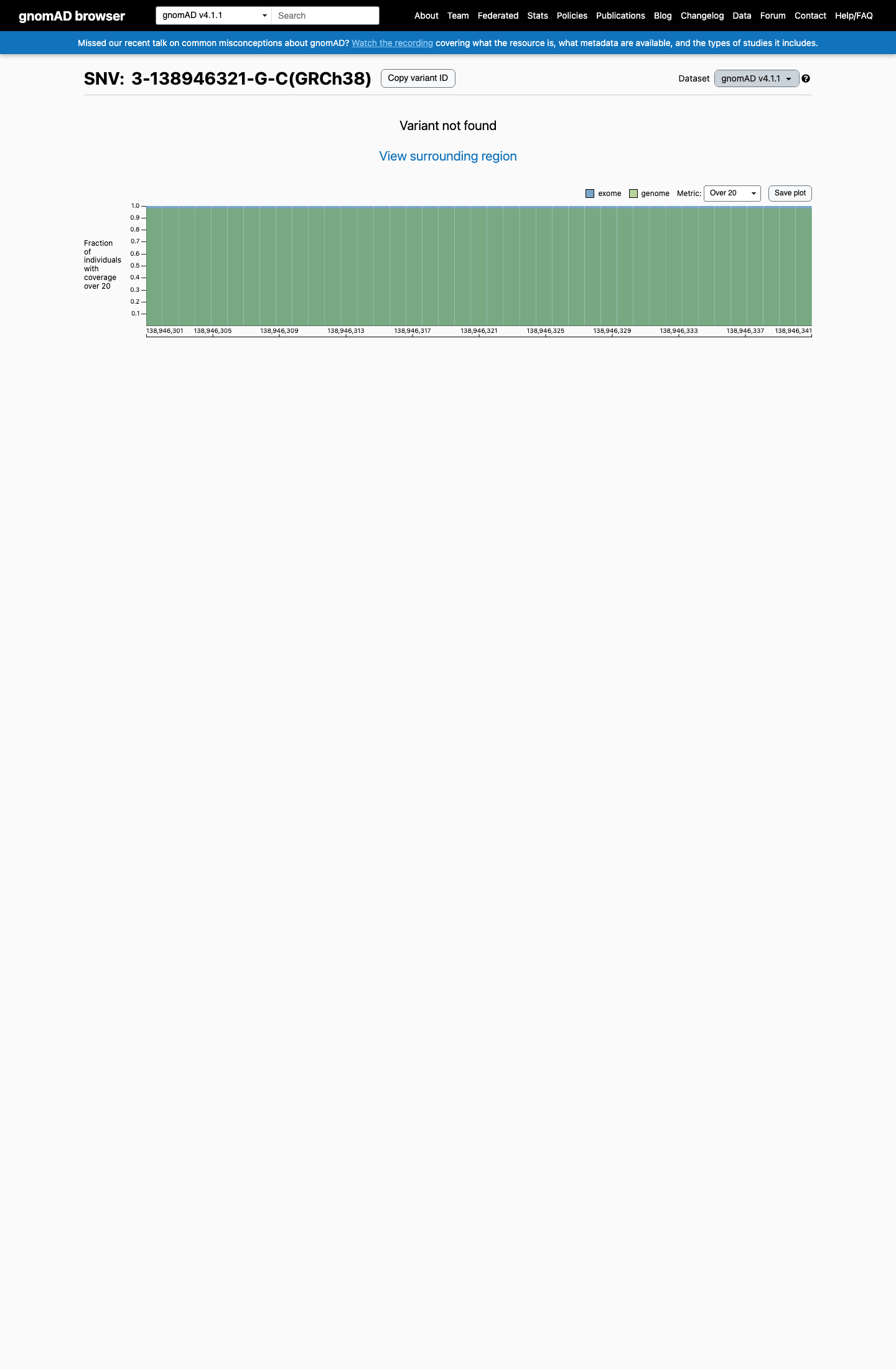
gnomAD v4.1
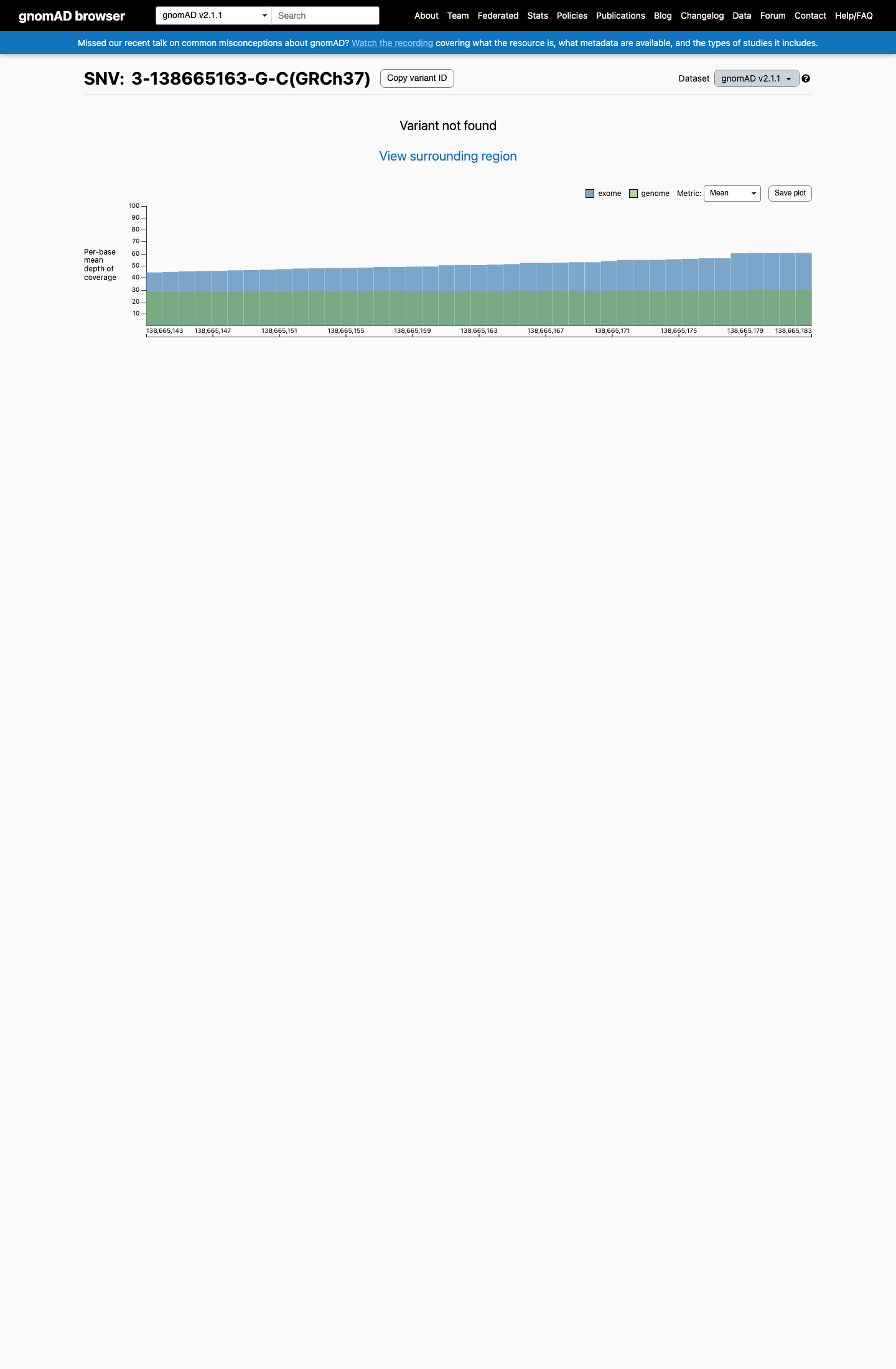
gnomAD v2.1
v4.1
Absent from gnomAD v4.1.
v2.1
Absent from gnomAD v2.1.
🇨🇦 CA
Absent from gnomAD-Canada v1.0.
Allele frequency by ancestry
three datasets · side by side
gnomAD v4.1
Absent
· 0 / ?
0 hom
0 hom
Not observed in any ancestry group.
gnomAD v2.1
Absent
· 0 / ?
0 hom
0 hom
Not observed in any ancestry group.
gnomAD Canada 🇨🇦
Absent
· 0 / ?
0 hom
0 hom
Not observed in any ancestry group.
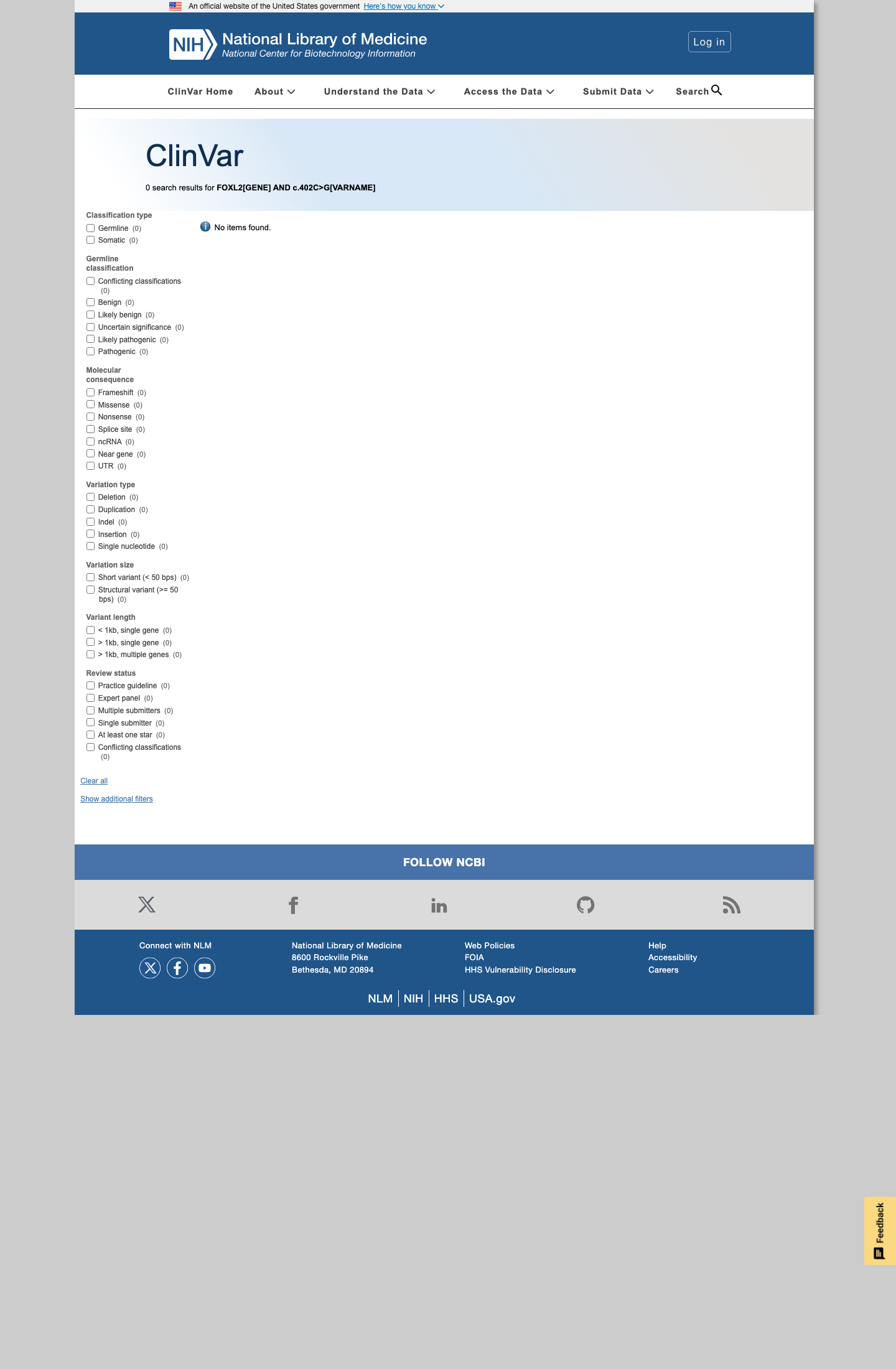
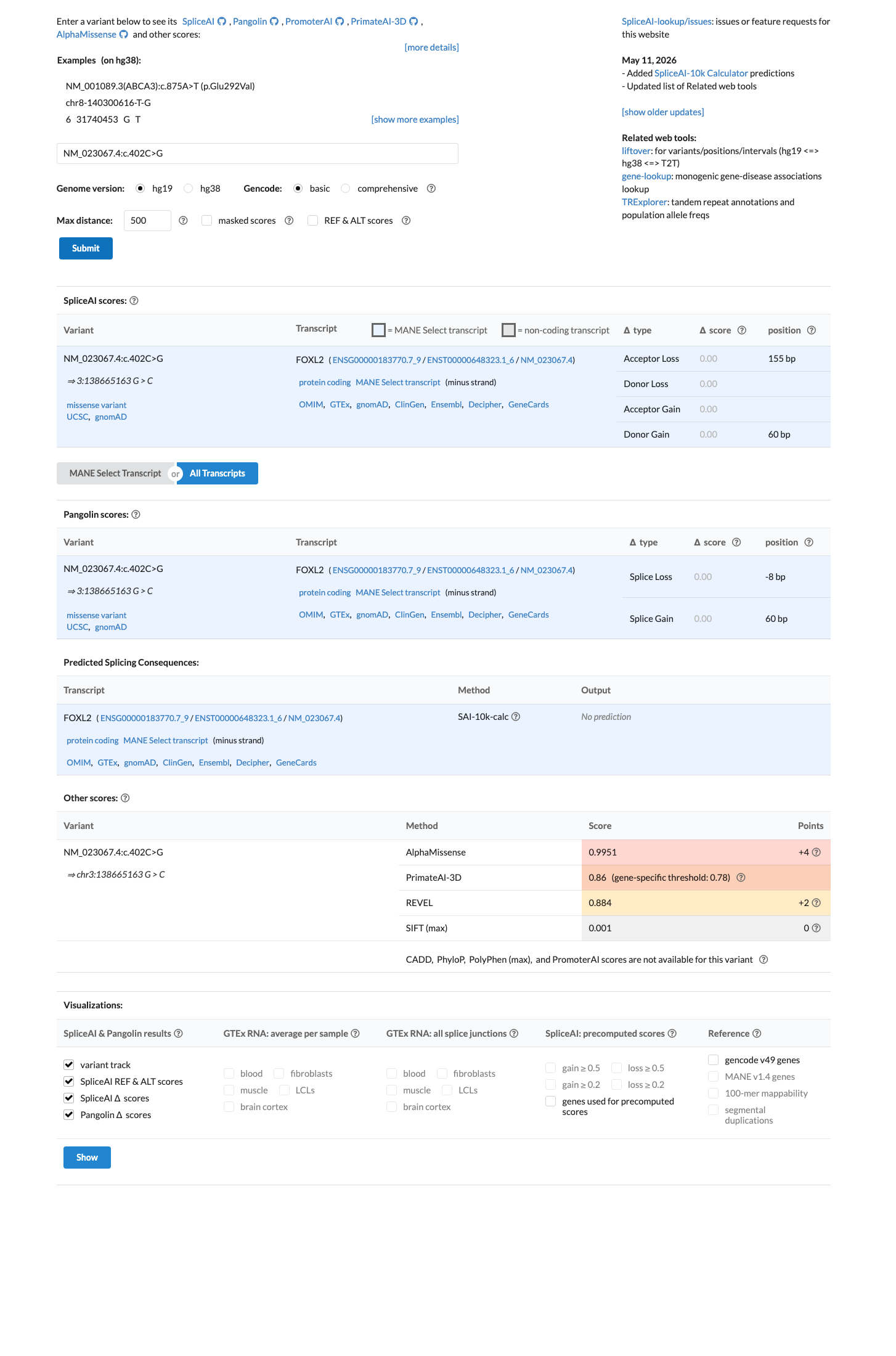
In silico
SpliceAI predicts no significant splice impact for this variant (max delta score = 0.00). REVEL score = 0.884. BayesDel score = 0.353418.
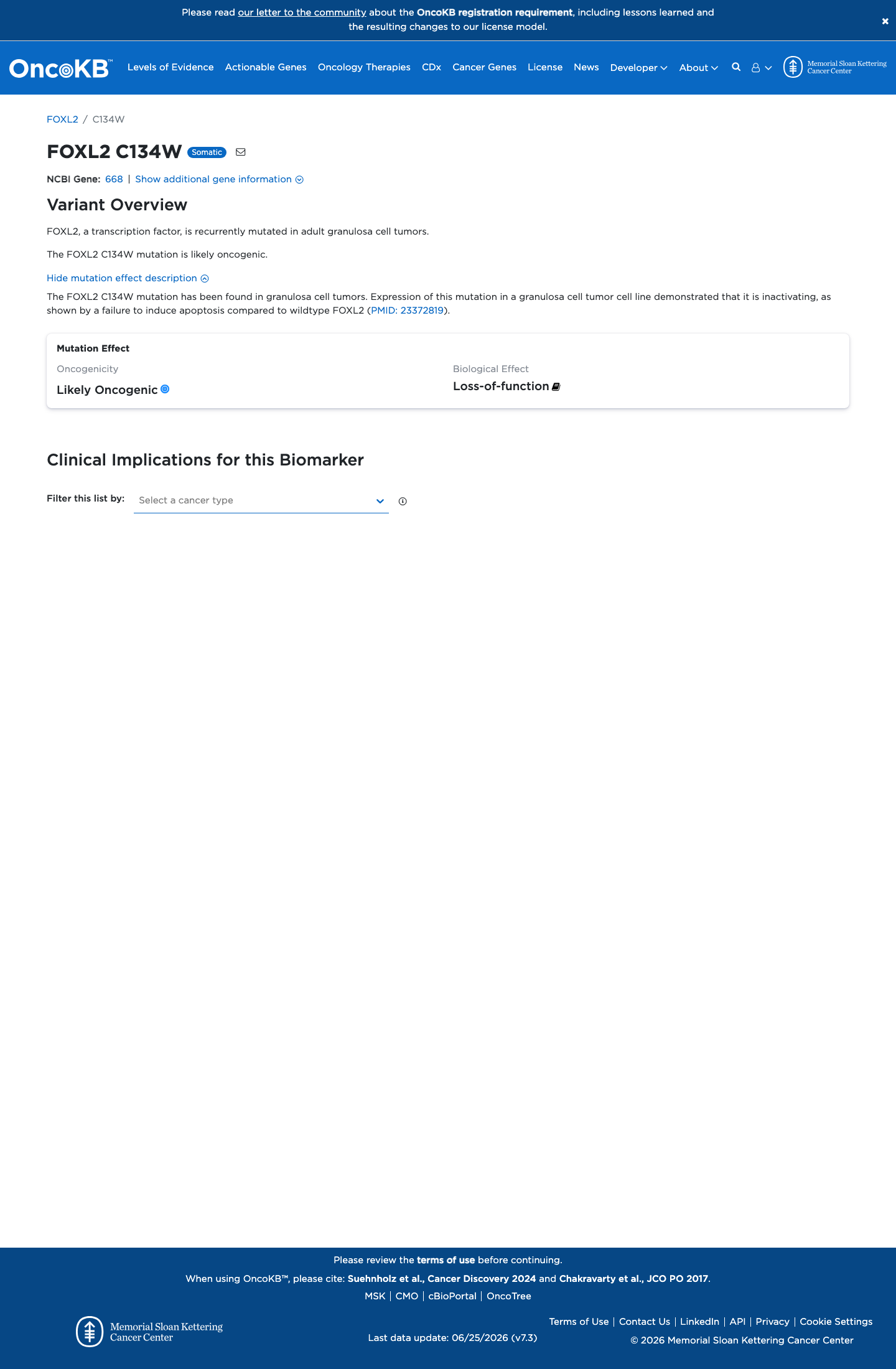
Functional
Likely Oncogenic
OncoKB identified variant-specific curated literature and context relevant to functional review; biological-effect context: Loss-of-function; curated oncogenicity label: Likely Oncogenic.
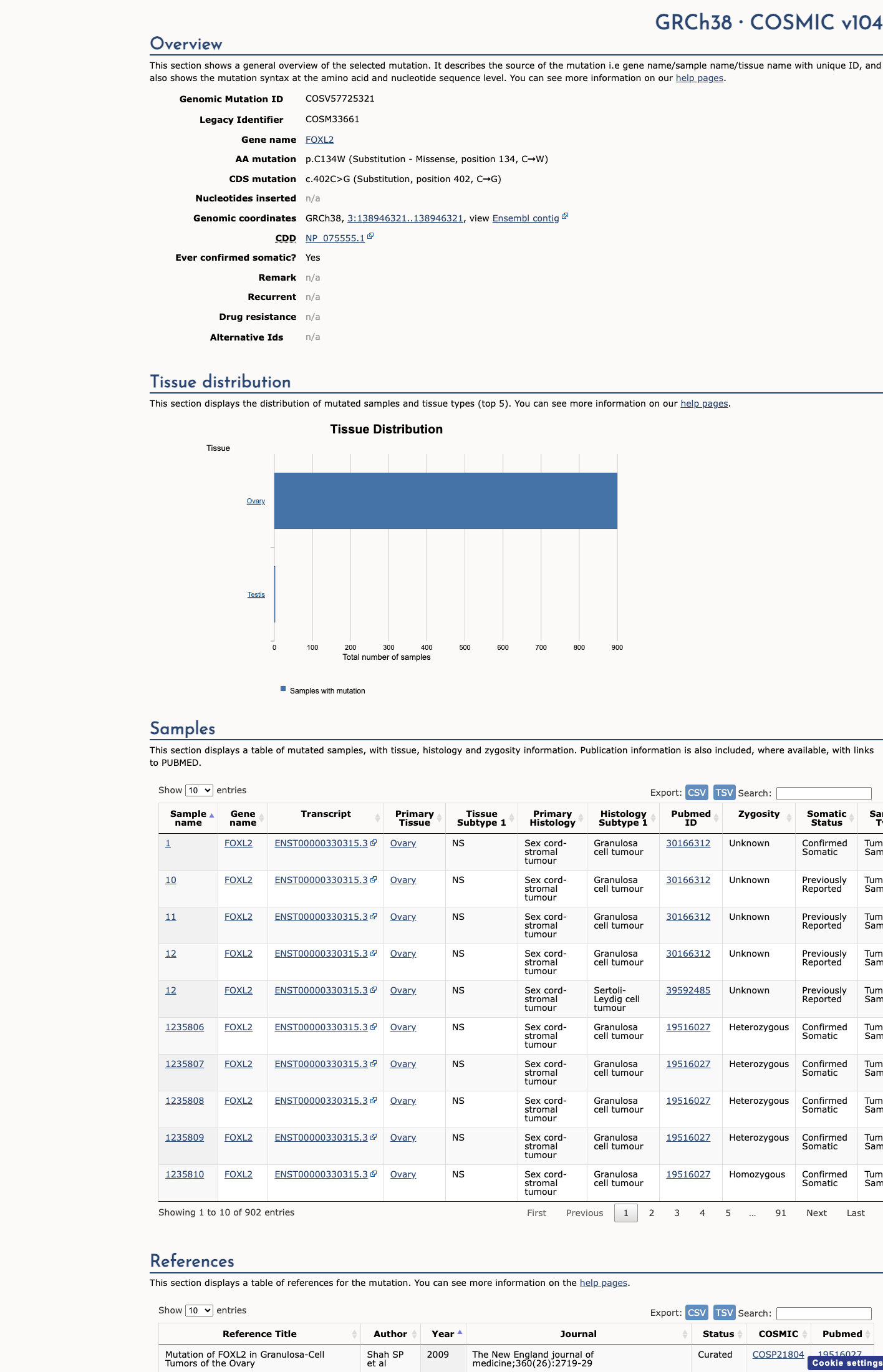
COSMIC

Cancer hotspots
Somatic evidence
Hotspot
COSMIC
This variant lies in a statistically significant hotspot. This variant has previously been reported in somatic cancers (COSMIC; COSV57725321, n = 901 times).
Hotspots
This variant lies in a statistically significant hotspot.
Literature · how each cited paper was used
1papers cited
Each card is an audit: what was searched, what was found, whether it names the variant, which criteria it fed, and why.
Overexpression of wild-type but not C134W mutant FOXL2 enhances GnRH-induced cell apoptosis by increasing GnRH receptor expression in human granulosa cell tumors.
Searched
c.402C>GC134W402C>Gp.Cys134Trp
Found
C134W mutant FOXL2 (c.402C>G) fails to upregulate GnRH receptor mRNA and protein expression in human KGN granulosa cell tumor cells, whereas wild-type FOXL2 increases GnRHR levels and enhances GnRH-induced apoptosis. siRNA knockdown of FOXL2 reduces GnRHR in normal granulosa cells but not in heterozygous mutant KGN cells, indicating the C134W mutation impairs FOXL2-mediated transcriptional regulation of GnRHR.
Variant
✓ Names this variant — characterised directly
Applied to
→PS3
met
→PM1
met
Why
Variant-specific functional data confirmed loss-of-function effect in somatic context; referenced in PS3 (supporting), PM1, and BS3 assessments.
Overexpression of wild-type FOXL2 increases both mRNA and protein levels of GnRH receptor and consequently enhances GnRH-induced apoptosis. Importantly, neither the expression levels of GnRH receptor nor GnRH-induced apoptosis were affected by overexpression of the C134W mutant FOXL2.
Location Abstract; Results paragraphs 1-5; Figures 3, 4, 5; Discussion paragraphs 1-5 · Context KGN human granulosa cell tumor-derived cell line (heterozygous FOXL2 c.402C>G); immortalized human granulosa-luteal cells (wild-type FOXL2); Western blot, RT-qPCR, MTT assay, cleaved caspase-3 detection · full text
Sources & reference links