Analysis in progress
Initialising…
0%
complete
This report is still being assembled — sections appear as each stage finishes. It isn't final yet.
GALNT12
Final classification
Likely Pathogenic
GALNT12 c.5G>A · p.Trp2Ter
GALNT12

PVS1 (very_strong) met: NM_024642.5:c.5G>A is a nonsense variant (p.Trp2Ter) in exon 1 of the MANE Select transcript of GALNT12, a gene with an established loss-of-function mechanism for germline cancer predisposition. The premature stop at codon 2 is predicted to trigger nonsense-mediated decay.

Gene
GALNT12
Transcript
NM_024642.5
HGVS · transcript:coding
NM_024642.5:c.5G>A
Consequence
N/A
GRCh38
chr9:98807703 G>A
GRCh37
chr9:101569985 G>A
Basis gene-specific framework lacked a usable explicit final combination framework, so generic ACMG/AMP 2015 final-combination rules were applied as fallback; applied criteria: PVS1 very strong, PM2 moderate; combination = 1 very strong + 1 moderate, which maps to Likely Pathogenic.
gene-specific framework lacked a usable explicit final combination framework, so generic ACMG/AMP 2015 final-combination rules were applied as fallback; applied criteria: PVS1 very strong, PM2 moderate; combination = 1 very strong + 1 moderate, which maps to Likely Pathogenic.
Classification rationale
PVS1PM2 Likely Pathogenic
GALNT12 c.5G>A

PVS1 (very_strong) met: NM_024642.5:c.5G>A is a nonsense variant (p.Trp2Ter) in exon 1 of the MANE Select transcript of GALNT12, a gene with an established loss-of-function mechanism for germline cancer predisposition. The premature stop at codon 2 is predicted to trigger nonsense-mediated decay.1 PM2 (moderate) met: This variant is present at extremely low frequency in population databases (gnomAD v2.1 AF=0.00341%, v4.1 AF=0.00052%), well below the 0.1% threshold. No homozygotes observed in gnomAD.2 The combination of PVS1 (very strong) and PM2 (moderate) results in a classification of Likely Pathogenic per generic ACMG/AMP 2015 criteria (Richards et al. 2015, PMID:25741868).3

PVS1 + PM2 Likely Pathogenic
1 pvs1_generic_framework ↗pvs1_gene_contextpvs1_variant_assessment
3 generic_acmg_combination_rules
Gene diagram · NM_024642.5 · variants mapped to exon structure
GALNT12 NM_024642.5
Fetching transcript structure from UCSC…
Applied criteria · 2 applied · 18 assessed
Applied · 2
Strength Supporting Moderate Strong Very strong
PVS1 very strong Pathogenic
Nonsense variant NM_024642.5:c.5G>A (p.Trp2Ter) in exon 1 of 10, the MANE Select transcript of GALNT12, a gene with an established loss-of-function mechanism for germline cancer predisposition. The premature termination codon at amino acid position 2 is predicted to trigger nonsense-mediated decay, resulting in absence of functional protein. No evidence of alternative start codon rescue or non-critical exon involvement.
Null variant (nonsense) in gene where loss of function is a known mechanism of diseaseVariant located in exon 1/10premature stop at codon 2 predicted to trigger NMD
PM2 moderate Pathogenic
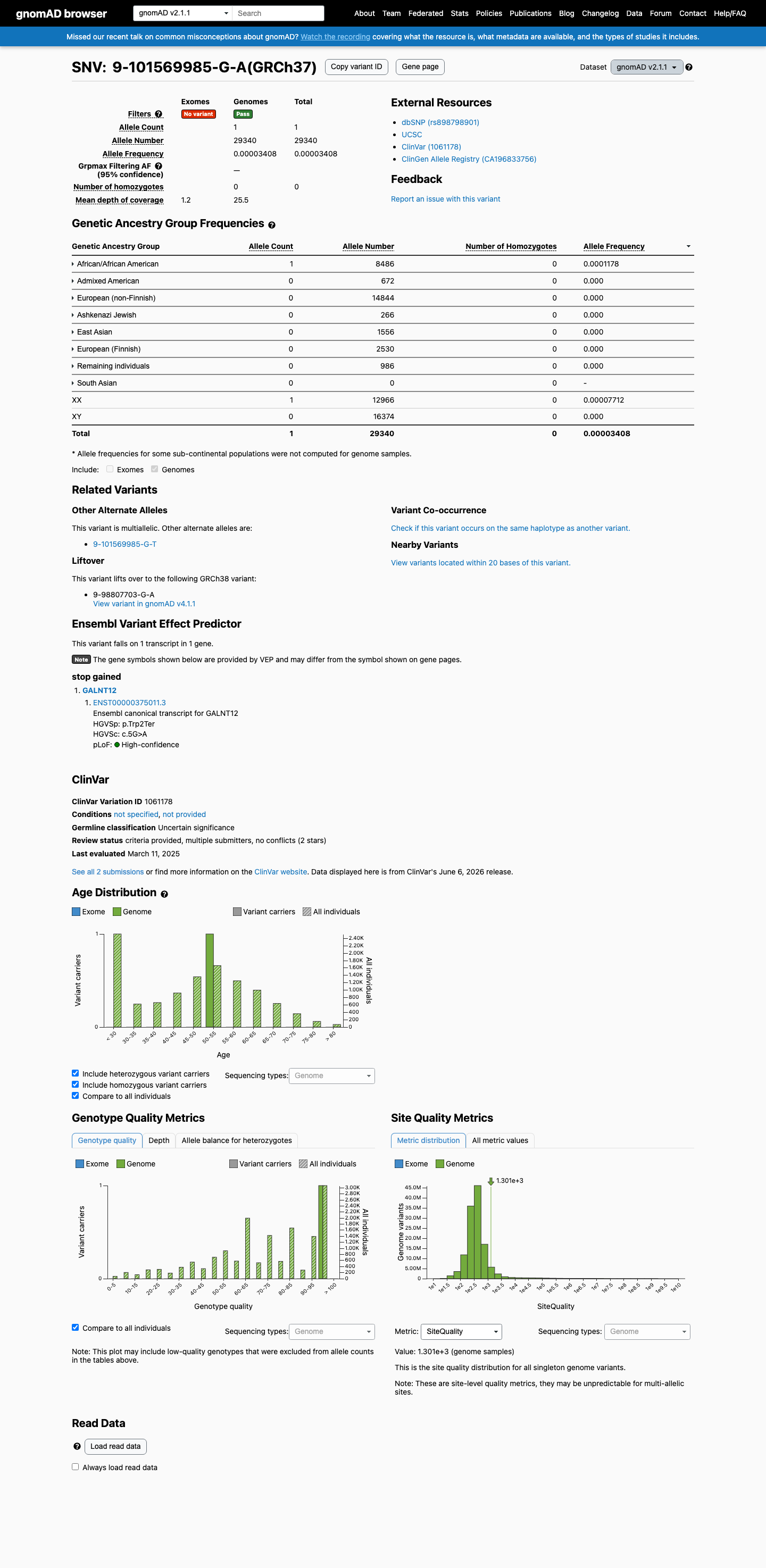
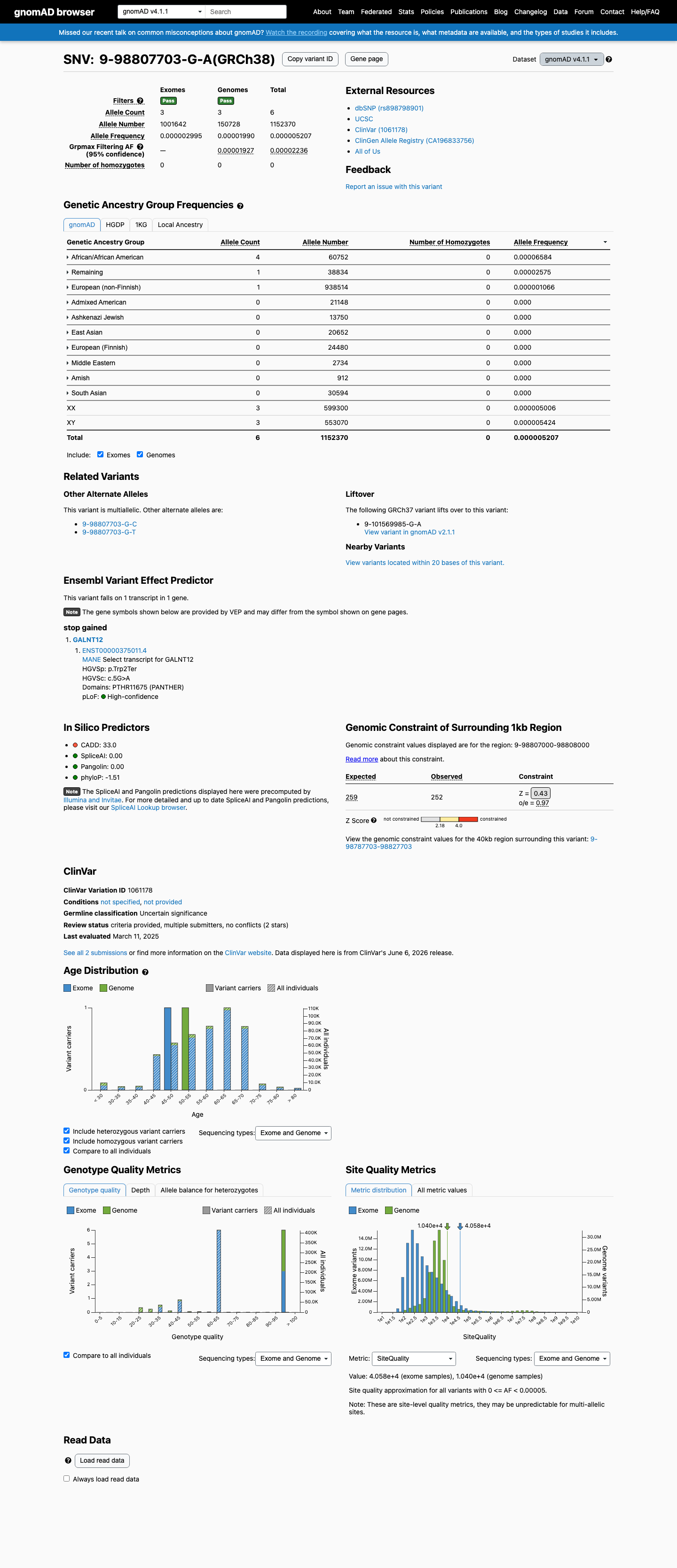
The variant is present at extremely low frequency in population databases: gnomAD v2.1 overall AF=0.00341% (1/29,340 alleles, 0 homozygotes), maximum subpopulation AF=0.01178% (African/African American); gnomAD v4.1 overall AF=0.00052% (6/1,152,370 alleles, 0 homozygotes), maximum subpopulation AF=0.00658% (African/African American). All observed frequencies are well below the 0.1% PM2 threshold. Absent from gnomAD-Canada v1.0.
gnomAD v2.1: AF=0.00341%1/29340 alleles
Assessed · not applied
Pathogenic
PS2 No de novo occurrence with confirmed maternity and paternity was identified for this variant in any reviewed source.
PS3 No well-established in vitro or in vivo functional studies demonstrating a damaging effect specific to NM_024642.5:c.5G>A were identified in the reviewed literature.
PS4 The variant has been observed in one homozygous case (26-year-old female with grade 1 endometrioid endometrial carcinoma, PMID:30886832) and reported in one gastric adenocarcinoma case (PMID:32963463, per ClinVar submission SCV002655098).
PM1 Variant does not lie within a statistically significant mutational hotspot (cancerhotspots.org negative), and no well-established critical or well-characterized functional domain has been defined at amino acid position 2 of GALNT12.
PM6 No de novo observation (without confirmation of maternity and paternity) was identified for this variant in any reviewed source.
PP1 No cosegregation data with disease in multiple affected family members are available for this variant.
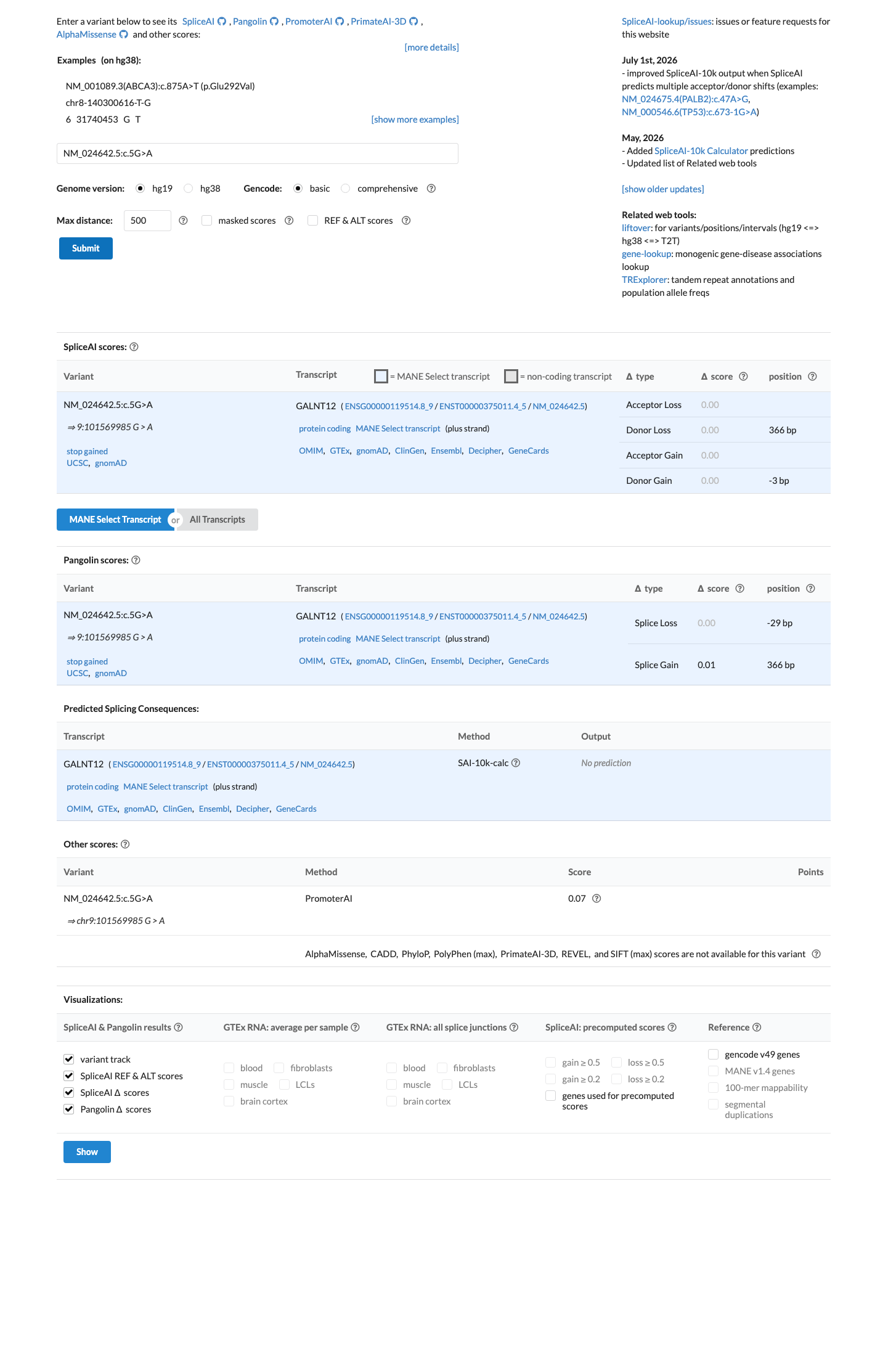
PP3 SpliceAI predicts no splicing impact (max delta score = 0.00).
PP4 Although the variant has been observed in a 26-year-old homozygous patient with grade 1 endometrioid endometrial carcinoma (PMID:30886832) and in a gastric adenocarcinoma patient (PMID:32963463), these cancer phenotypes are not highly specific for GALNT12-related disease.
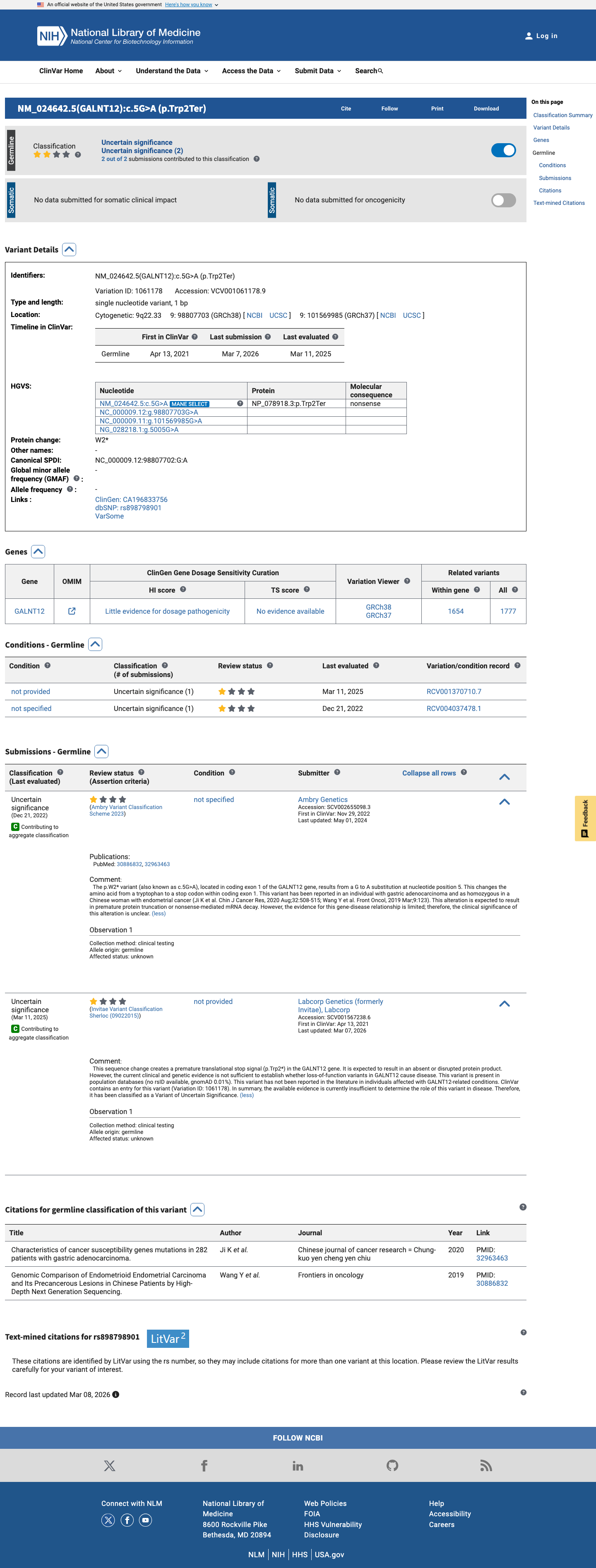
PP5 The variant is classified as Uncertain Significance in ClinVar (VariationID: 1061178) by two clinical laboratories (Ambry Genetics, Labcorp/Invitae).
Benign
BA1 The maximum population allele frequency is 0.01178% (African/African American, gnomAD v2.1), well below the 1% BA1 threshold.
BS1 The maximum population allele frequency is 0.01178% (African/African American, gnomAD v2.1), well below the 0.3% BS1 threshold.
BS2 No homozygous healthy adult carriers have been observed in population databases (gnomAD v2.1: 0 homozygotes; gnomAD v4.1: 0 homozygotes).
BS3 No well-established in vitro or in vivo functional studies demonstrating no damaging effect on protein function or splicing were identified for this variant.
BS4 No segregation data in affected families are available for this variant; BS4 requires lack of segregation in multiple affected family members.
BP2 No evidence of this variant observed in trans with a known pathogenic variant in GALNT12.
BP4 While SpliceAI predicts no splice impact (max delta score = 0.00), BP4 requires multiple lines of computational evidence suggesting no impact on gene product.
BP5 No cases have been identified where an alternate molecular basis for disease was found in an individual carrying this variant.
BP6 No reputable source has classified this variant as benign or likely benign.
N/A · 5 PS1 · PM5 · PP2 · BP1 · BP7
Research & evidence
Population frequency · supports pathogenic
gnomAD v4.1 screenshot
gnomAD v4.1
gnomAD v2.1 screenshot
gnomAD v2.1
v4.1
This variant is present in gnomAD v4.1 (AF= 5.20666e-06; MAF= 0.00052%, 6/1152370 alleles, homozygotes = 0) and has highest observed frequency in the African/African American population (AF= 6.58415e-05; MAF= 0.00658%, 4/60752 alleles, homozygotes = 0); grpmax FAF= 2.236e-05.
v2.1
This variant is present in gnomAD v2.1 (AF= 3.40832e-05; MAF= 0.00341%, 1/29340 alleles, homozygotes = 0) and has highest observed frequency in the African/African American population (AF= 0.000117841; MAF= 0.01178%, 1/8486 alleles, homozygotes = 0).
🇨🇦 CA
Absent from gnomAD-Canada v1.0.
Allele frequency by ancestry
three datasets · side by side
gnomAD v4.1
0.00052% · 6 / 1,152,370
0 hom · FAF 0.0022%
African/African American
4 / 60,752
0.0066%
Remaining individuals
1 / 38,834
0.0026%
European (non-Finnish)
1 / 938,514
0.00011%
+ 7 not observed (Admixed American, European (Finnish), Amish, East Asian, Middle Eastern, South Asian, Ashkenazi Jewish)
gnomAD v2.1
0.0034% · 1 / 29,340
0 hom
African/African American
1 / 8,486
0.012%
+ 7 not observed (Admixed American, Ashkenazi Jewish, East Asian, European (Finnish), European (non-Finnish), Remaining individuals, South Asian)
gnomAD Canada 🇨🇦
Absent · 0 / ?
0 hom
Not observed in any ancestry group.
ClinVar screenshot
ClinVar
This variant has been reported in ClinVar as Uncertain significance (2 clinical laboratories). (ClinVarID = 1061178)
SpliceAI screenshot
In silico
SpliceAI predicts no significant splice impact for this variant (max delta score = 0.00). BayesDel score = 0.22007.
Functional No data
No calibrated functional assay or RNA evidence was identified for this variant.
OncoKB ↗
COSMIC screenshot
COSMIC
Cancer hotspots screenshot
Cancer hotspots
Somatic evidence Not in COSMIC / hotspots
COSMIC
This variant does not lie in a statistically significant hotspot. This variant has not previously been reported in somatic cancers (COSMIC).
Hotspots
This variant does not lie in a statistically significant hotspot.
Literature · how each cited paper was used
1papers cited
Each card is an audit: what was searched, what was found, whether it names the variant, which criteria it fed, and why. 1 further PMID triaged but not cited — see Sources & References.
Genomic Comparison of Endometrioid Endometrial Carcinoma and Its Precancerous Lesions in Chinese Patients by High-Depth Next Generation Sequencing.
Searched
c.5G>Ac.G5Ap.W2Xp.Trp2TerW2*GALNT12
Found
NM_024642.5:c.5G>A (p.Trp2Ter) identified as a homozygous germline likely pathogenic variant in a 26-year-old Chinese female with grade 1 endometrioid endometrial carcinoma. No family history of cancer. Identified among 10 patients with pathogenic or likely pathogenic germline mutations in a cohort of 115 paired tumor-blood samples from patients with endometrial intraepithelial neoplasia and endometrioid endometrial carcinoma.
Variant
✓ Names this variant — characterised directly
Applied to
PM2 supports · met PVS1 supports · met
Why
Variant-specific observation confirmed in full text. Homozygous germline finding in 26-year-old with endometrial carcinoma supports PVS1 (gene-disease validity) and context for PM2/PS4 assessment, but single case does not independently meet PS4 statistical threshold.
GALNT12 c.G5A (p.W2X) hom Likely pathogenic 26 G1 EEC None
Location Table 4 (Germline mutations); Results section 'Germline Mutations'; Discussion paragraph on germline findings  ·  Context Targeted NGS panel of 363 cancer-related genes on paired fresh-frozen tumor and matched blood samples from 79 EEC and 36 EIN patients; tertiary hospital cohort (Peking Union Medical College Hospital, Beijing, China)  ·  full text
Sources & reference links
8Sources
ClinVar
gnomAD v2.1
gnomAD v4.1
gnomAD-Canada
SpliceAI
OncoKB
COSMIC
Cancer hotspots
Triaged references · 1 PMID not cited in assessment
32963463 ↗ Characteristics of cancer susceptibility genes mutations in 282 patients with gastric adenocarcinoma. CLINVAR