NM_024675.3:c.1684+1G>A is a canonical +1 donor splice site variant in intron 4 of PALB2, a gene for which loss of function is an established mechanism for hereditary breast, ovarian, and pancreatic cancer predisposition (ClinGen PALB2 VCEP v1.2.0).1 This variant is absent from gnomAD v2.1 and v4.1 population databases, satisfying the PALB2 VCEP PM2_Supporting threshold of ≤0.000333% allele frequency (PM2_Supporting).2 RNA analysis performed by Lopez-Perolio et al. (2019, PMID:30890586) confirmed aberrant splicing for c.1684+1G>A, supporting classification as a null variant under the PALB2 VCEP PVS1 decision tree at Very Strong strength (PVS1).3 The variant introduces a premature termination codon upstream of p.Tyr1183 and is predicted to be NMD-prone; combined with RNA-confirmed splice defect, PM5_Supporting is applied per PALB2 VCEP rules (PM5_Supporting).4 No benign criteria are met: the variant is not present at significant population frequency (BA1/BS1 not met), SpliceAI predicts a strong splice impact (BP4 not met), the variant is not at a position eligible for BP7, and no evidence of normal splicing or lack of segregation is available.5 Applying the ACMG/AMP combination rules (Richards et al. 2015) as adopted by the PALB2 VCEP: 1 Pathogenic Very Strong (PVS1) + ≥2 Pathogenic Supporting (PM2_Supporting, PM5_Supporting) yields a classification of Pathogenic under Rule 4.6 Note: The ClinGen Hereditary Breast, Ovarian and Pancreatic Cancer VCEP classifies this variant as Uncertain Significance (ClinVar ID 482029). The discrepancy between the automated adjudication (Pathogenic) and the expert panel classification (VUS) may reflect additional VCEP-specific PVS1 decision tree nuances, PS1 splicing table consultation, or clinical judgment not fully captured in the available evidence materials. Human review by a PALB2 VCEP curator is recommended.7
Final classification
Pathogenic
PVS1PM2PM5
PALB2
c.1684+1G>A
p.?
This variant
NM_024675.3:c.1684+1G>A is a canonical +1 donor splice site variant in intron 4 of PALB2, a gene for which loss of function is an established mechanism for hereditary breast, ovarian, and pancreatic cancer predisposition (ClinGen PALB2 VCEP v1.2.0).
Richards et.al., 2015 - Combining rules v1.2.0 criteria-combination framework: matched Rule4 (1 Pathogenic.Very Strong + Pathogenic.Supporting >=2) with applied criteria: PVS1 very strong, PM2 supporting, PM5 supporting; maps to Pathogenic.
Classification rationale
PVS1PM2PM5
Pathogenic
PALB2 c.1684+1G>A
PVS1 + PM2 + PM5
→
Pathogenic
LYFE Sciences is an AI system, and it can make mistakes. Criteria
may be applied incorrectly, sources may be misread, and a confident-looking
classification can still be wrong. Double-check every criterion and
its underlying evidence before relying on any call.
Gene diagram
· NM_024675.3 · variants mapped to exon structure
PALB2
NM_024675.3
Fetching transcript structure from UCSC…
Applied criteria · 3 applied · 11 assessed
MetEvidence satisfies this criterion.
Not metEvaluated against available evidence; threshold not reached.
Not assessedApplies in principle, but no evidence was found to evaluate it.
N/ADoesn't apply to this variant type.
Applied · 3
Strength
Supporting
Moderate
Strong
Very strong
PVS1
very strong
review
Pathogenic
NM_024675.3:c.1684+1G>A is a canonical +1 donor splice site variant in PALB2, a gene for which loss of function is an established mechanism for hereditary breast, ovarian, and pancreatic cancer predisposition (monoallelic) and Fanconi anemia subtype FA-N (biallelic). The ClinGen PALB2 VCEP v1.2.0 PVS1 decision tree applies. RNA analysis of this variant has been performed and reported (Lopez-Perolio et al., 2019, PMID:30890586), confirming aberrant splicing. Under the PALB2 VCEP framework, PVS1_VeryStrong is assigned for a canonical splice site variant with observed RNA-level splice defect in a gene where LOF is a known disease mechanism.
Canonical +1 donor splice site (intron 4) in PALB2PALB2 loss-of-function is established disease mechanism for breast/ovarian/pancreatic cancer and Fanconi anemiaClinGen PALB2 VCEP v1.2.0 includes PVS1 guidance with decision tree
PM2
supporting
Pathogenic
NM_024675.3:c.1684+1G>A is absent from gnomAD v2.1 and v4.1. Under the PALB2 VCEP v1.2.0, PM2 is applied at Supporting strength (not Moderate) when the variant frequency is ≤0.000333% (1/300,000) in gnomAD v4. The variant meets this threshold as it is completely absent from both gnomAD datasets.
Absent from gnomAD v2.1 (0 alleles)Absent from gnomAD v4.1 (0 alleles)Variant frequency ≤0.000333% threshold met (VCEP PM2_Supporting rule)
PM5
supporting
review
Pathogenic
Under the PALB2 VCEP v1.2.0, PM5_Supporting is applied to splice variants with premature termination codons upstream of p.Tyr1183 when PVS1_VS(RNA) is applied based on high-quality observed splicing impact and the variant is NMD-prone. NM_024675.3:c.1684+1G>A is a canonical +1 splice site variant in intron 4 that has been shown to cause aberrant splicing by RNA analysis (PMID:30890586). The resulting transcript is predicted to introduce a premature termination codon far upstream of the p.Tyr1183 boundary and is expected to be NMD-prone, satisfying the VCEP PM5_Supporting conditions.
PALB2 VCEP PM5 rule: PTC upstream of p.Tyr1183c.1684+1G>A is in exon 4 intron boundarywell upstream of codon 1183
Assessed · not applied
· 10 not met · 1 not assessed
Pathogenic
PS1
The PALB2 VCEP v1.2.0 PS1 criterion for splicing variants requires use of the PALB2 PS1 Splicing table (referenced to PMID:37352859).
PS4
The PALB2 VCEP v1.2.0 requires case-control data with p≤0.05 and OR≥3 (or lower 95% CI≥1.5) for PS4.
PP1
No co-segregation data in affected family members was identified for NM_024675.3:c.1684+1G>A.
PP3
The PALB2 VCEP v1.2.0 PP3 rule for splicing variants is: 'Predicted impact via splicing (SpliceAI ≥0.2) for intronic variants OUTSIDE of donor and acceptor 1,2 sites.' NM_024675.3:c.1684+1G>A is a +1 donor site variant, which is AT a donor 1,2 site, not outside it.
Benign
BA1
Under the PALB2 VCEP v1.2.0, BA1 requires Grpmax Filtering AF >0.1% in gnomAD v4.
BS1
Under the PALB2 VCEP v1.2.0, BS1 requires Grpmax Filtering AF >0.01% in gnomAD v4.
BS2
The PALB2 VCEP v1.2.0 applies BS2 in the context of Fanconi anemia (recessive condition) using a points-per-proband system.
BS4
The PALB2 VCEP v1.2.0 applies BS4 based on quantitative co-segregation analysis showing lack of segregation (LOD ≤-1.28 for Strong, ≤-0.64 for Moderate, ≤-0.32 for Supporting).
BP1
The PALB2 VCEP v1.2.0 BP1 criterion applies specifically to missense variants in PALB2, based on the low rate of functional missense variants.
BP4
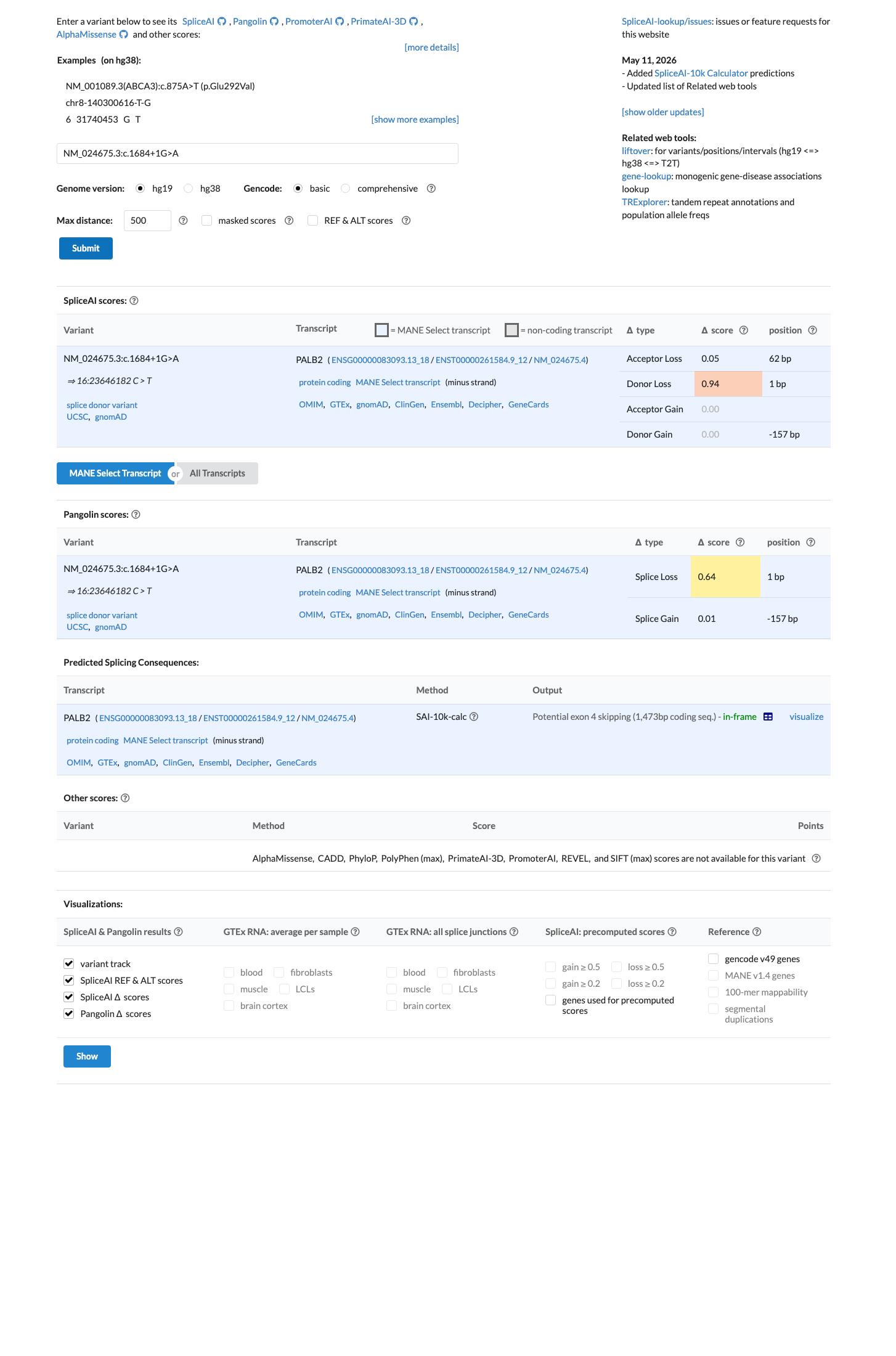
The PALB2 VCEP v1.2.0 BP4 rule for splicing variants requires 'No predicted impact via splicing (SpliceAI ≤0.1).' NM_024675.3:c.1684+1G>A has a SpliceAI max delta score of 0.94 (donor loss = 0.94), well above the 0.1 threshold.
BP7
The PALB2 VCEP v1.2.0 BP7 (in silico) is limited to synonymous and deep intronic variants beyond +7 (donor) and -21 (acceptor).
N/A · 14
PS2 · PS3 · PM1 · PM3 · PM4 · PM6 · PP2 · PP4 · PP5 · BS3 · BP2 · BP3 · BP5 · BP6
Research & evidence
Population frequency · supports pathogenic
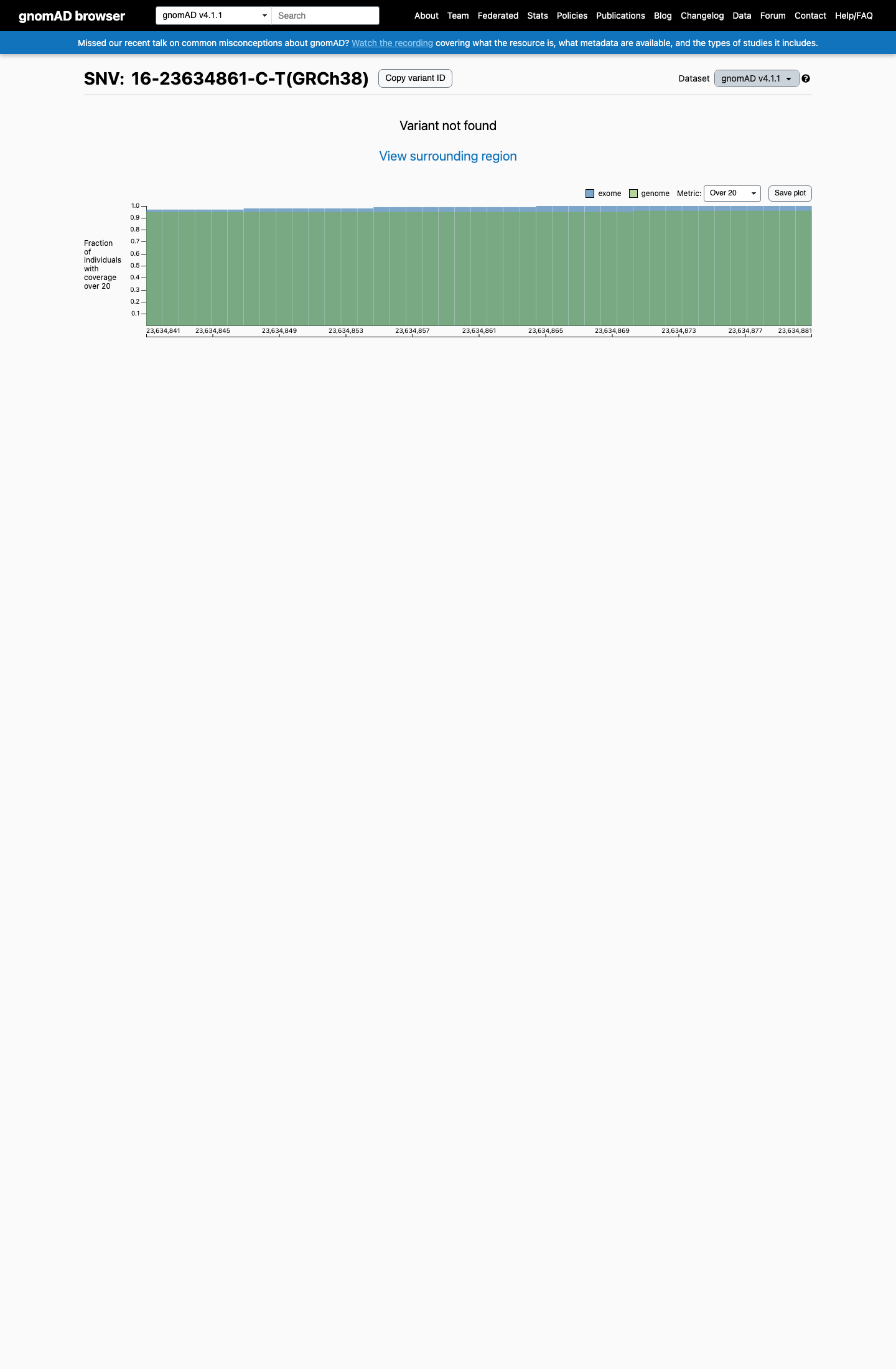
gnomAD v4.1
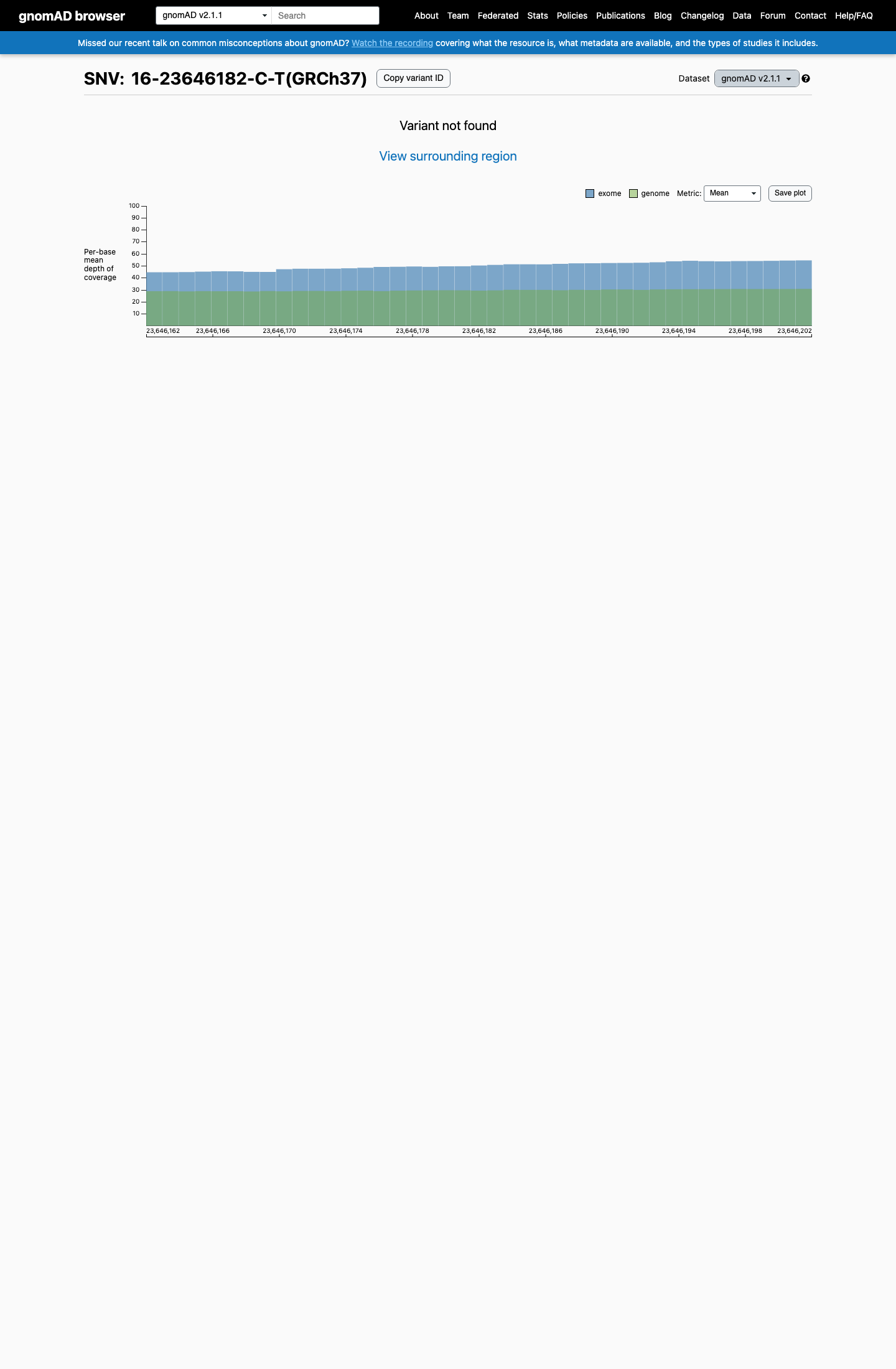
gnomAD v2.1
v4.1
Absent from gnomAD v4.1.
v2.1
Absent from gnomAD v2.1.
🇨🇦 CA
This variant is absent from gnomAD-Canada.
Allele frequency by ancestry
three datasets · side by side
gnomAD v4.1
Absent
· 0 / ?
0 hom
0 hom
Not observed in any ancestry group.
gnomAD v2.1
Absent
· 0 / ?
0 hom
0 hom
Not observed in any ancestry group.
gnomAD Canada 🇨🇦
Absent
· 0 / ?
0 hom
0 hom
Not observed in any ancestry group.
ClinVar
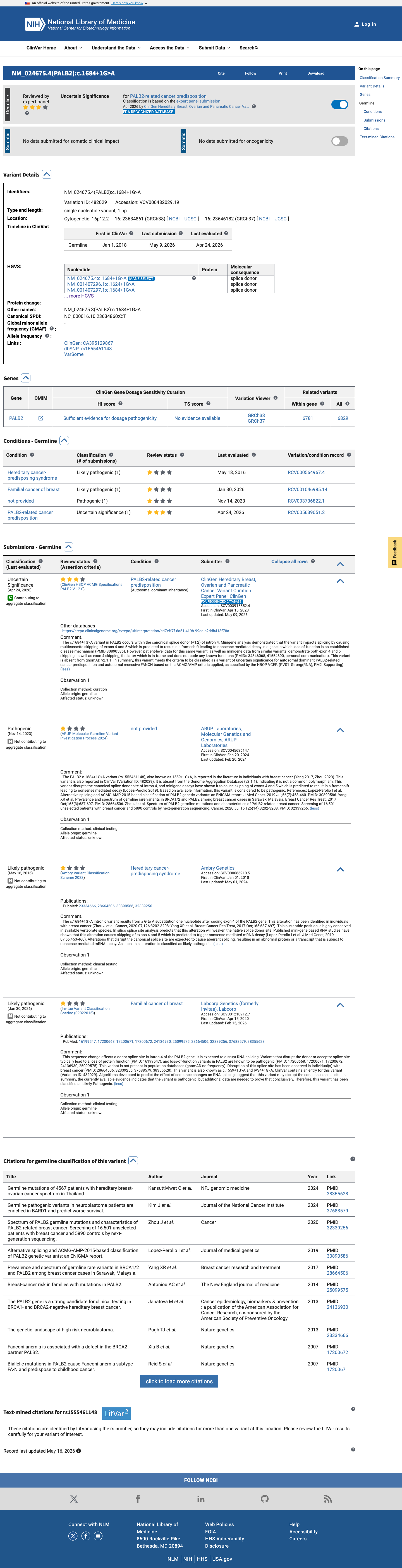
This variant has been reported in ClinVar as Likely pathogenic (2 clinical laboratories) and as Pathogenic (1 clinical laboratory) and as Uncertain Significance by ClinGen Hereditary Breast, Ovarian and Pancreatic Cancer Variant Curation Expert Panel, ClinGen (expert panel). (ClinVarID = 482029)
In silico
SpliceAI predicts possible splice impact for this variant (max delta score = 0.94). BayesDel score = 0.63.
Functional
No data
No calibrated functional assay or RNA evidence was identified for this variant.

COSMIC
Somatic evidence
COSMIC
This variant has not previously been reported in somatic cancers (COSMIC).
Hotspots
This variant does not lie in a statistically significant cancer hotspot.
Literature · how each cited paper was used
1papers cited
Each card is an audit: what was searched, what was found, whether it names the variant, which criteria it fed, and why. 8 further PMIDs triaged but not cited — see Sources & references.
Alternative splicing and ACMG-AMP-2015-based classification of PALB2 genetic variants: an ENIGMA report.
Found
Canonical +1 donor splice site (intron 4) in PALB2 PALB2 loss-of-function is established disease mechanism for breast/ovarian/pancreatic cancer and Fanconi anemia ClinGen PALB2 VCEP v1.2.0 includes PVS1 guidance with decision tree RNA splicing assay confirms aberrant splicing for c.1684+1G>A (PMID:30890586) Variant is at a canonical ±1 2 position satisfying the generic ClinGen SVI PVS1 framework (PMC6185798)
Applied to
→PVS1
very strong
→PM5
supporting
Sources & reference links
Triaged references · 8 PMIDs not cited in assessment
17200671 ↗
Biallelic mutations in PALB2 cause Fanconi anemia subtype FA-N and predispose to childhood cancer.
CLINVAR
28664506 ↗
Prevalence and spectrum of germline rare variants in BRCA1/2 and PALB2 among breast cancer cases in Sarawak, Malaysia.
CLINVAR
15604628 ↗
Genetic cancer risk assessment and counseling: recommendations of the national society of genetic counselors.
CLINVAR
17200668 ↗
PALB2, which encodes a BRCA2-interacting protein, is a breast cancer susceptibility gene.
CLINVAR
28492532 ↗
Sherloc: a comprehensive refinement of the ACMG-AMP variant classification criteria.
CLINVAR