The PALB2 c.7G>T (p.Glu3Ter, p.E3*) variant has not been observed in somatic cancers in COSMIC and has been reported in ClinVar as pathogenic, including review by the ClinGen Hereditary Breast, Ovarian and Pancreatic Cancer expert panel.1 This variant is absent from gnomAD v2.1 and gnomAD v4.1, placing it below the PALB2 PM2_Supporting population threshold of 0.000333%.2 This variant introduces a premature stop codon at amino acid 3, and the active PALB2 expert specification supports loss of function as an established disease mechanism, consistent with application of PVS1 and the PALB2 truncation-based PM5 rule.3 SpliceAI predicts a limited splice effect with a maximum delta score of 0.15, which is below the PALB2 PP3 threshold of 0.2 and above the BP4 threshold of 0.1, so computational splice evidence is indeterminate; a BayesDel score of 0.63 is available but is not the governing PP3/BP4 rule in this gene-specific framework.4
PALB2
Final classification
Pathogenic
PALB2 c.7G>T · p.Glu3Ter
PALB2
The PALB2 c.7G>T (p.Glu3Ter, p.E3*) variant has not been observed in somatic cancers in COSMIC and has been reported in ClinVar as pathogenic, including review by the ClinGen Hereditary Breast, Ovarian and Pancreatic Cancer expert panel.
Richards et.al., 2015 - Combining rules v1.2.0 criteria-combination framework: matched Rule4 (1 Pathogenic.Very Strong + Pathogenic.Supporting >=2) with applied criteria: PVS1 very strong, PM2 supporting, PM5 supporting, PP5 supporting; maps to Pathogenic.
Classification rationale
PVS1PM2PM5PP5
Pathogenic
PALB2 c.7G>T
PVS1 + PM2 + PM5 + PP5
→
Pathogenic
3
cspec ↗pvs1_gene_contextpvs1_variant_assessmentpm5_candidates
4
spliceai ↗bayesdelcspec ↗
Gene diagram
· NM_024675.3 · variants mapped to exon structure
PALB2
NM_024675.3
Fetching transcript structure from UCSC…
Applied criteria · 4 met · select any tile
Met
Not met
Not assessed
N/A
Strength
very strong
supporting
Pathogenic evidence
PVS
PS
PM
PP
Benign evidence
BA
BS
BP
—
—
—
Rationale
Select a criterion.
Sources
Evidence used
Gaps remaining
Rule
—
Research & evidence
Population frequency · supports pathogenic

gnomAD v4.1
gnomAD v2.1
v4.1
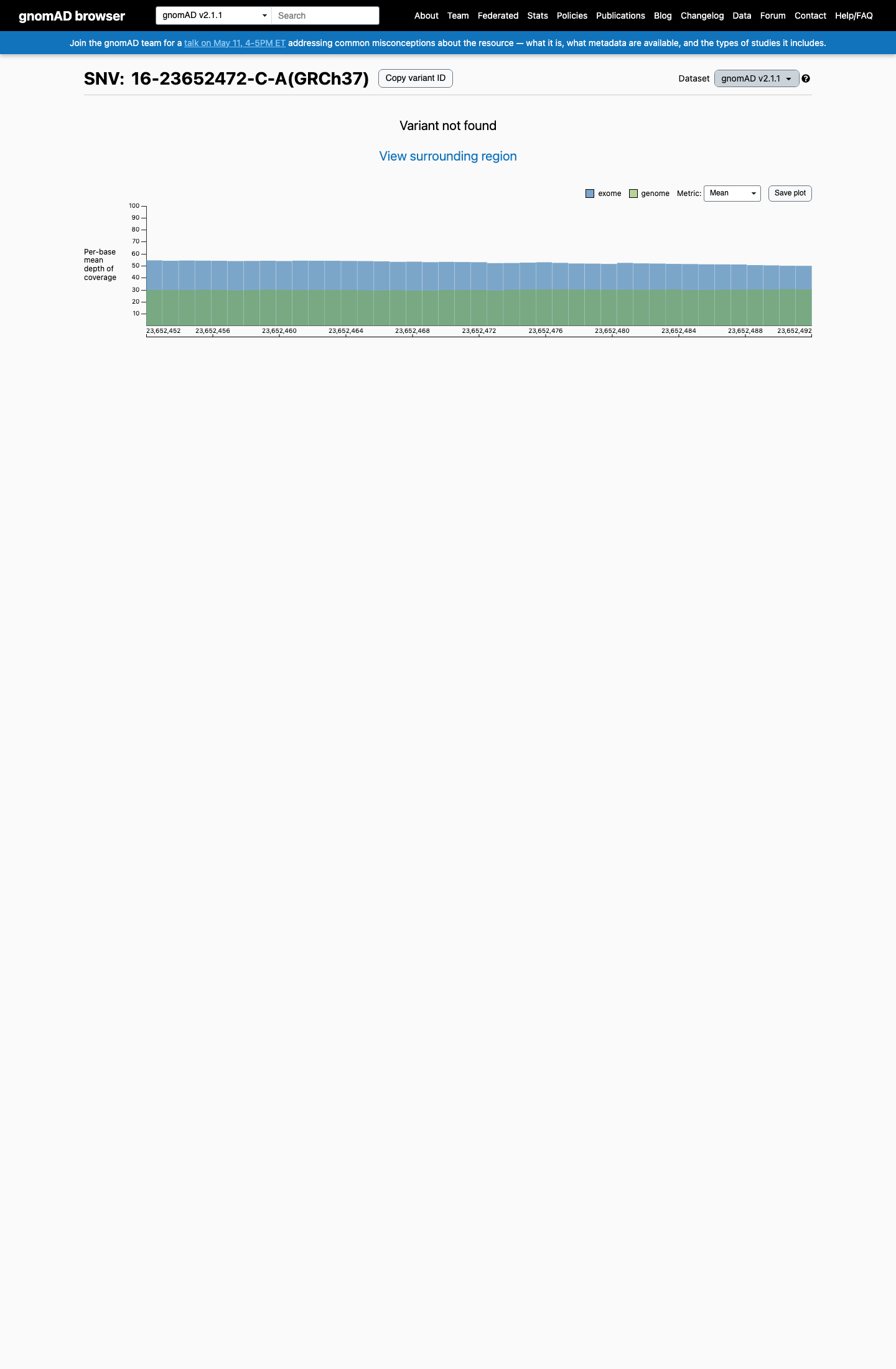
Absent from gnomAD v4.1.
v2.1
Absent from gnomAD v2.1.
Allele frequency by ancestry
three datasets · side by side
gnomAD v4.1
Absent
· 0 / ?
0 hom
0 hom
Not observed in any ancestry group.
gnomAD v2.1
Absent
· 0 / ?
0 hom
0 hom
Not observed in any ancestry group.

ClinVar
This variant has been reported in ClinVar as Pathogenic (8 clinical laboratories) and as Pathogenic by ClinGen Hereditary Breast, Ovarian and Pancreatic Cancer Variant Curation Expert Panel, ClinGen (expert panel). (ClinVarID = 241571)
In silico
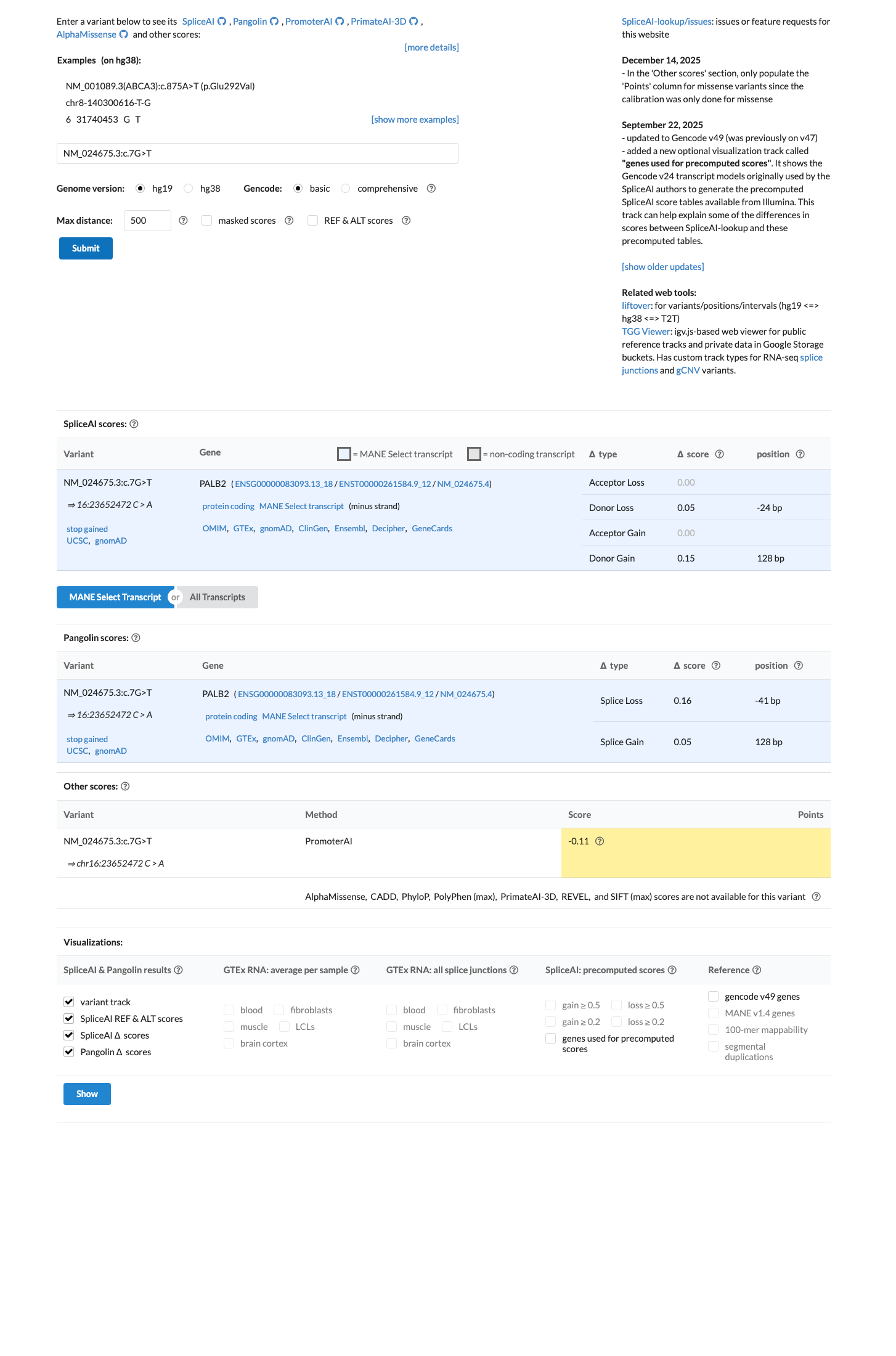
SpliceAI predicts no significant splice impact for this variant (max delta score = 0.15). BayesDel score = 0.63.
Functional
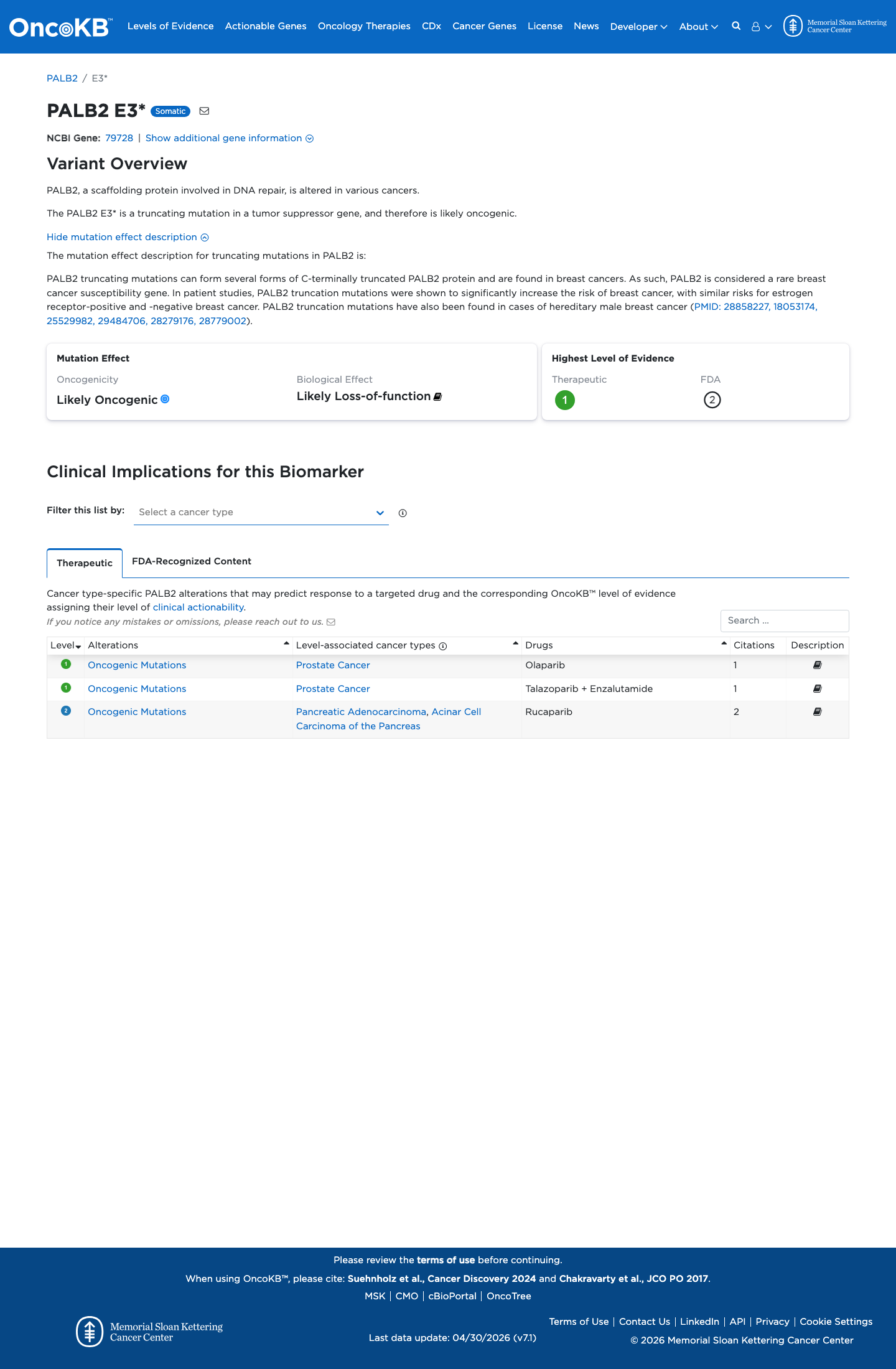
Likely Oncogenic
OncoKB identified variant-specific curated literature and context relevant to functional review; biological-effect context: Likely Loss-of-function; curated oncogenicity label: Likely Oncogenic.

COSMIC

Cancer hotspots
Somatic evidence
Not in COSMIC / hotspots
COSMIC
This variant does not lie in a statistically significant hotspot. This variant has not previously been reported in somatic cancers (COSMIC).
Hotspots
This variant does not lie in a statistically significant hotspot.
Sources & reference links