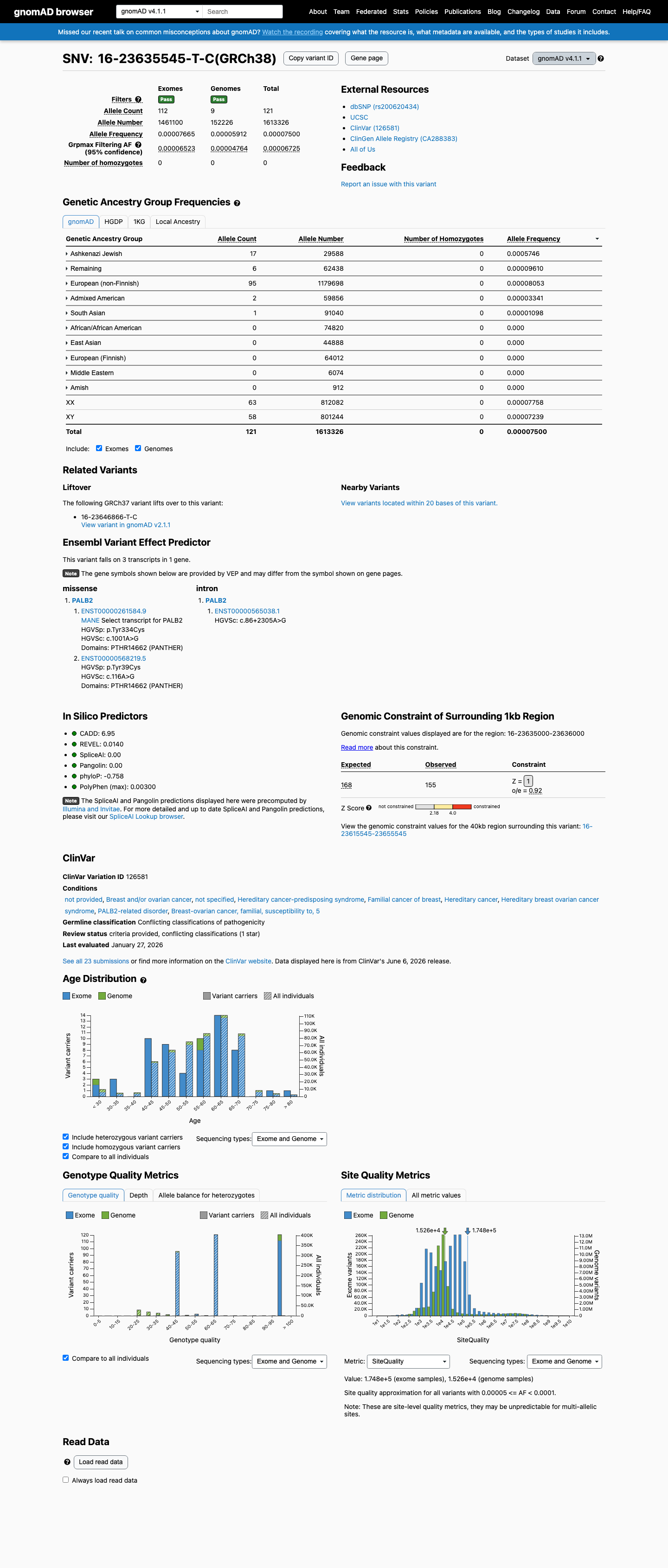
PALB2 VCEP BP1_Supporting is applied as this is a missense variant; true pathogenic missense variants in PALB2 are thought to be exceedingly rare.1 This variant is present in gnomAD v4.1 at an allele frequency of 0.000075 (121/1,613,326 alleles), which exceeds the VCEP PM2 threshold of 0.00000333 but does not meet BS1 (>0.01%) or BA1 (>0.1%) benign population thresholds.2 The variant has been observed in multiple cohorts at frequencies comparable to population controls (Balia 2010: 1/95 cases and 1/50 controls; Catucci 2012: 1/96 cases; Hellebrand 2011: 1/818 cases classified as polymorphism).3 In silico predictors REVEL (0.014) and BayesDel (-0.648) are consistent with a benign interpretation, though PALB2 VCEP does not apply PP3/BP4 for missense variants as published predictors have not achieved functional outcome prediction.4 No pathogenic criteria are met. With only BP1_Supporting (benign supporting) applied, the overall classification under PALB2 VCEP v1.2.0 is Uncertain Significance (VUS).5
Final classification
VUS
BP1
PALB2
c.1001A>G
p.Tyr334Cys
This variant
PALB2 VCEP BP1_Supporting is applied as this is a missense variant; true pathogenic missense variants in PALB2 are thought to be exceedingly rare.
Richards et.al., 2015 - Combining rules v1.2.0 criteria-combination framework was evaluated deterministically with applied criteria: BP1 supporting; no rule matched the adjudicated criteria.
Classification rationale
BP1
VUS
PALB2 c.1001A>G
BP1
→
VUS
LYFE Sciences is an AI system, and it can make mistakes. Criteria
may be applied incorrectly, sources may be misread, and a confident-looking
classification can still be wrong. Double-check every criterion and
its underlying evidence before relying on any call.
Gene diagram
· NM_024675.4 · variants mapped to exon structure
PALB2
NM_024675.4
Fetching transcript structure from UCSC…
Applied criteria · 1 applied · 7 assessed
MetEvidence satisfies this criterion.
Not metEvaluated against available evidence; threshold not reached.
Not assessedApplies in principle, but no evidence was found to evaluate it.
N/ADoesn't apply to this variant type.
Applied · 1
Strength
Supporting
Moderate
Strong
Very strong
BP1
supporting
Benign
PALB2 VCEP BP1 applies to all missense variants. Based on published and unpublished functional studies, PALB2 has a low rate of missense variants that are non-functional, and true pathogenic missense variants are thought to be exceedingly rare.
PALB2 VCEP BP1 rule: Apply to all missense variantsp.Tyr334Cys is a missense substitution
Assessed · not applied
· 5 not met · 2 not assessed
Pathogenic
PS4
No case-control study demonstrates significant statistical enrichment of this variant in affected individuals.
PM2
gnomAD v4.1 allele frequency (7.50e-05, 0.0075%) exceeds the PALB2 VCEP PM2_Supporting threshold of ≤1/300,000 (0.000333%).
PP1
No co-segregation data available meeting VCEP thresholds (LOD≥0.3 or LR≥2:1 for AD).
Benign
BA1
gnomAD v4.1 grpmax filtering allele frequency (6.725e-05, 0.006725%) does not exceed the PALB2 VCEP BA1 threshold of >0.1%.
BS1
gnomAD v4.1 grpmax filtering allele frequency (6.725e-05, 0.006725%) does not exceed the PALB2 VCEP BS1 threshold of >0.01%.
BS2
VCEP BS2 requires Fanconi Anemia proband point-table assessment (≥4 points for Strong, 2 for Moderate, 1 for Supporting).
BS4
VCEP BS4 requires quantitative co-segregation analysis with LOD or Bayes Factor values.
N/A · 18
PVS1 · PS1 · PS2 · PS3 · PM1 · PM5 · PM6 · PP2 · PP3 · PP4 · PP5 · BS3 · BP2 · BP3 · BP4 · BP5 · BP6 · BP7
Research & evidence
Population frequency
gnomAD v4.1
gnomAD v2.1
v4.1
This variant is present in gnomAD v4.1 (AF= 7.50003e-05; MAF= 0.00750%, 121/1613326 alleles, homozygotes = 0) and has highest observed frequency in the Ashkenazi Jewish population (AF= 0.000574557; MAF= 0.05746%, 17/29588 alleles, homozygotes = 0); grpmax FAF= 6.725e-05.
v2.1
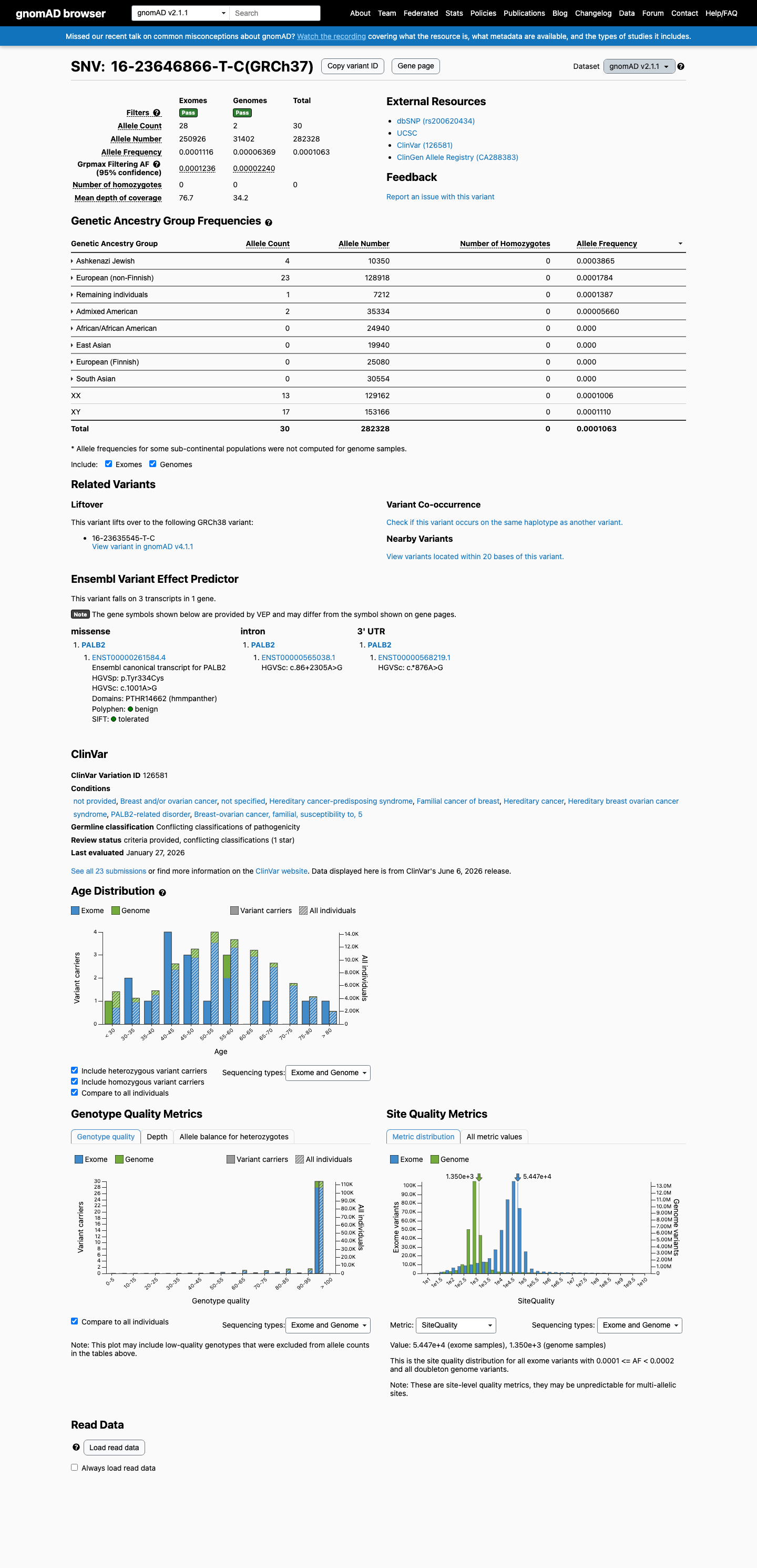
This variant is present in gnomAD v2.1 (AF= 0.000106259; MAF= 0.01063%, 30/282328 alleles, homozygotes = 0) and has highest observed frequency in the Ashkenazi Jewish population (AF= 0.000386473; MAF= 0.03865%, 4/10350 alleles, homozygotes = 0); grpmax FAF= 0.00012362.
🇨🇦 CA
Not available in gnomAD-Canada v1.0.
Allele frequency by ancestry
three datasets · side by side
gnomAD v4.1
0.0075%
· 121 / 1,613,326
0 hom · FAF 0.0067%
0 hom · FAF 0.0067%
Ashkenazi Jewish 17 / 29,588 |
0.057% |
Remaining individuals 6 / 62,438 |
0.0096% |
European (non-Finnish) 95 / 1,179,698 |
0.0081% |
Admixed American 2 / 59,856 |
0.0033% |
South Asian 1 / 91,040 |
0.0011% |
+ 5 not observed (European (Finnish), Amish, East Asian, Middle Eastern, African/African American)
gnomAD v2.1
0.011%
· 30 / 282,328
0 hom · FAF 0.012%
0 hom · FAF 0.012%
Ashkenazi Jewish 4 / 10,350 |
0.039% |
European (non-Finnish) 23 / 128,918 |
0.018% |
Remaining individuals 1 / 7,212 |
0.014% |
Admixed American 2 / 35,334 |
0.0057% |
+ 4 not observed (African/African American, East Asian, European (Finnish), South Asian)
gnomAD Canada 🇨🇦
Absent
· 0 / ?
0 hom
0 hom
Not observed in any ancestry group.

ClinVar
This variant has been reported in ClinVar as Uncertain significance (9 clinical laboratories) and as Likely benign (9 clinical laboratories) and as Benign (1 clinical laboratory). (ClinVarID = 126581)
In silico
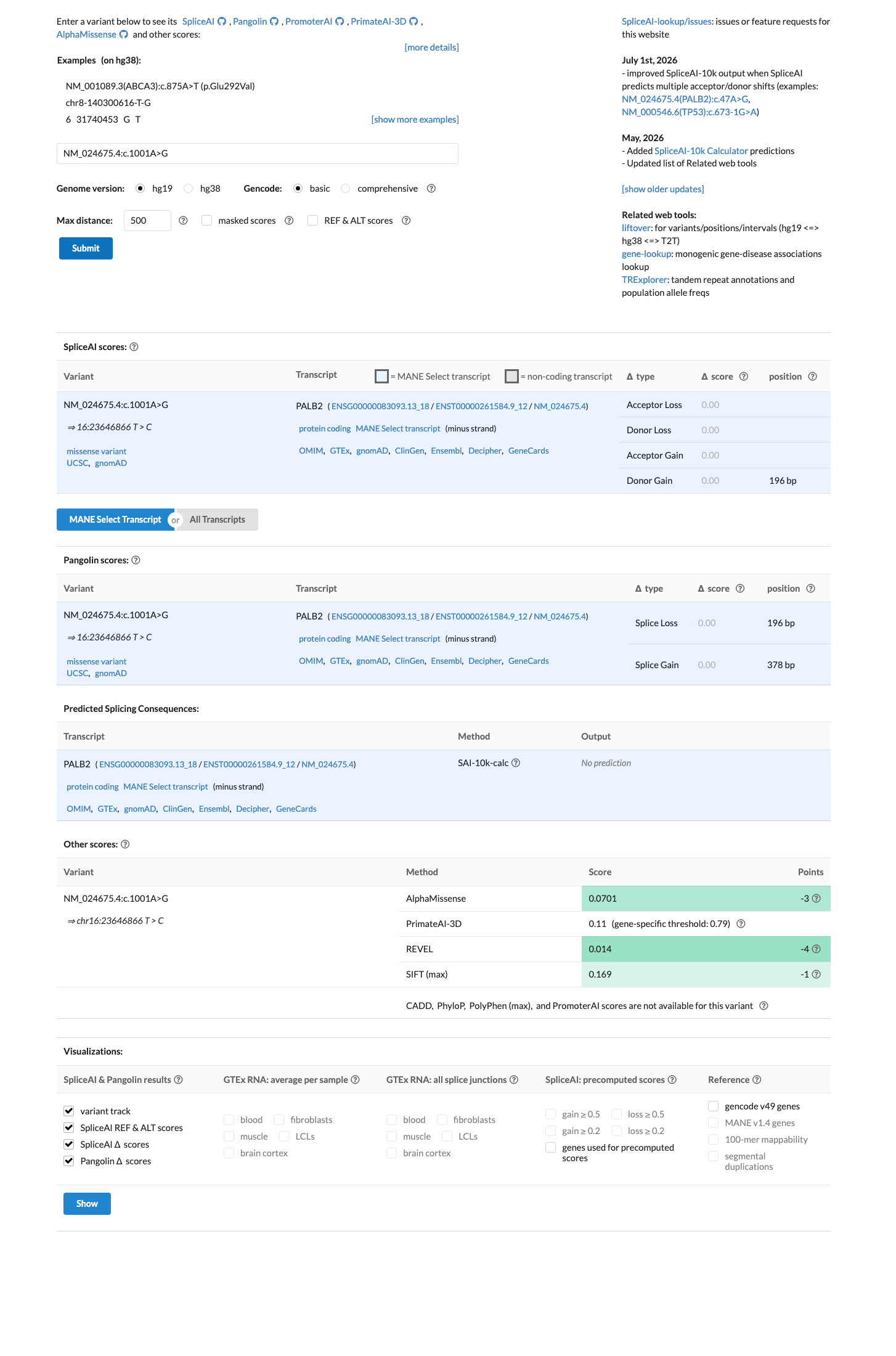
SpliceAI predicts no significant splice impact for this variant (max delta score = 0.00). REVEL score = 0.014. BayesDel score = -0.648329.
Functional
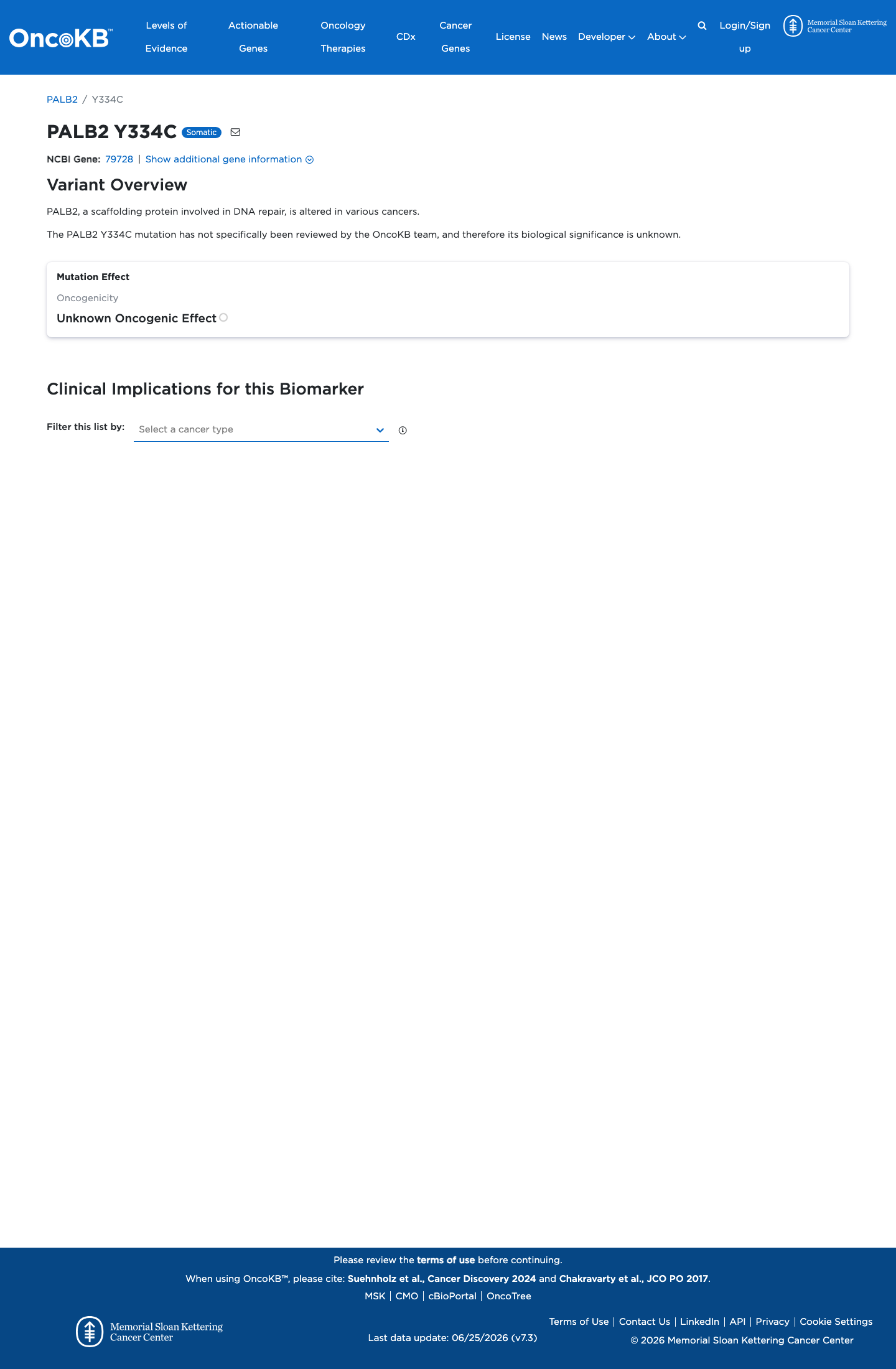
Unknown Oncogenic Effect
OncoKB did not identify variant-specific reviewed functional evidence for this variant; gene-level curated context is available for reviewer follow-up. PALB2, a scaffolding protein involved in DNA repair, is altered in various cancers.

COSMIC

Cancer hotspots
Somatic evidence
Not in COSMIC / hotspots
COSMIC
This variant does not lie in a statistically significant hotspot. This variant has not previously been reported in somatic cancers (COSMIC).
Hotspots
This variant does not lie in a statistically significant hotspot.
Sources & reference links
9Sources
Triaged references · 9 PMIDs not cited in assessment
25741868 ↗
Standards and guidelines for the interpretation of sequence variants: a joint consensus recommendation of the American College of Medical Genetics and Genomics and the Association for Molecular Pathology.
CLINVAR
28779002 ↗
Rare, protein-truncating variants in ATM, CHEK2 and PALB2, but not XRCC2, are associated with increased breast cancer risks.
CLINVAR
33134171 ↗
Using Co-segregation and Loss of Heterozygosity Analysis to Define the Pathogenicity of Unclassified Variants in Hereditary Breast Cancer Patients.
CLINVAR
21618343 ↗
Germline mutations in the PALB2 gene are population specific and occur with low frequencies in familial breast cancer.
CLINVAR
22241545 ↗
Rare germline mutations in PALB2 and breast cancer risk: a population-based study.
CLINVAR
28492532 ↗
Sherloc: a comprehensive refinement of the ACMG-AMP variant classification criteria.
CLINVAR