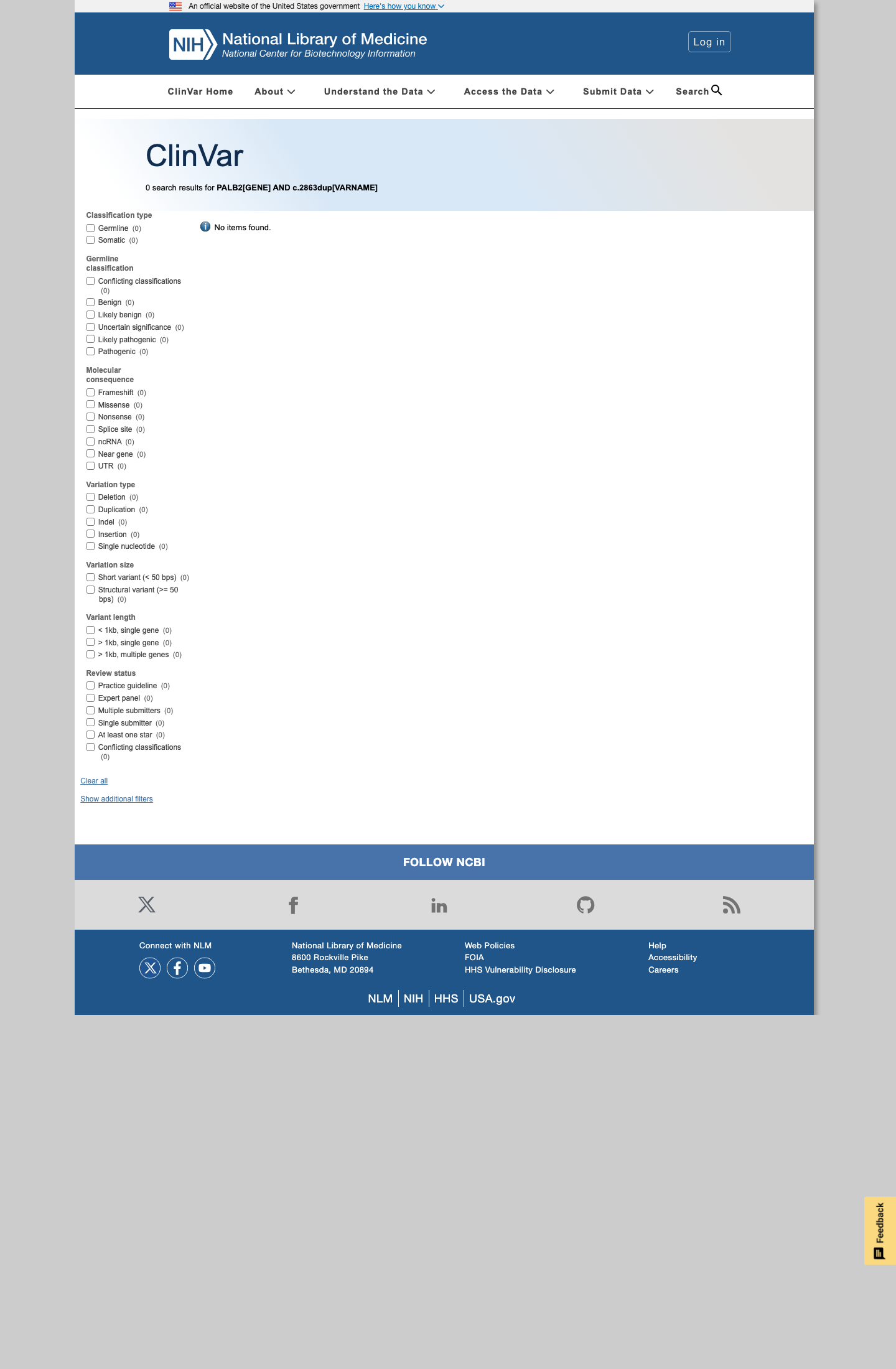
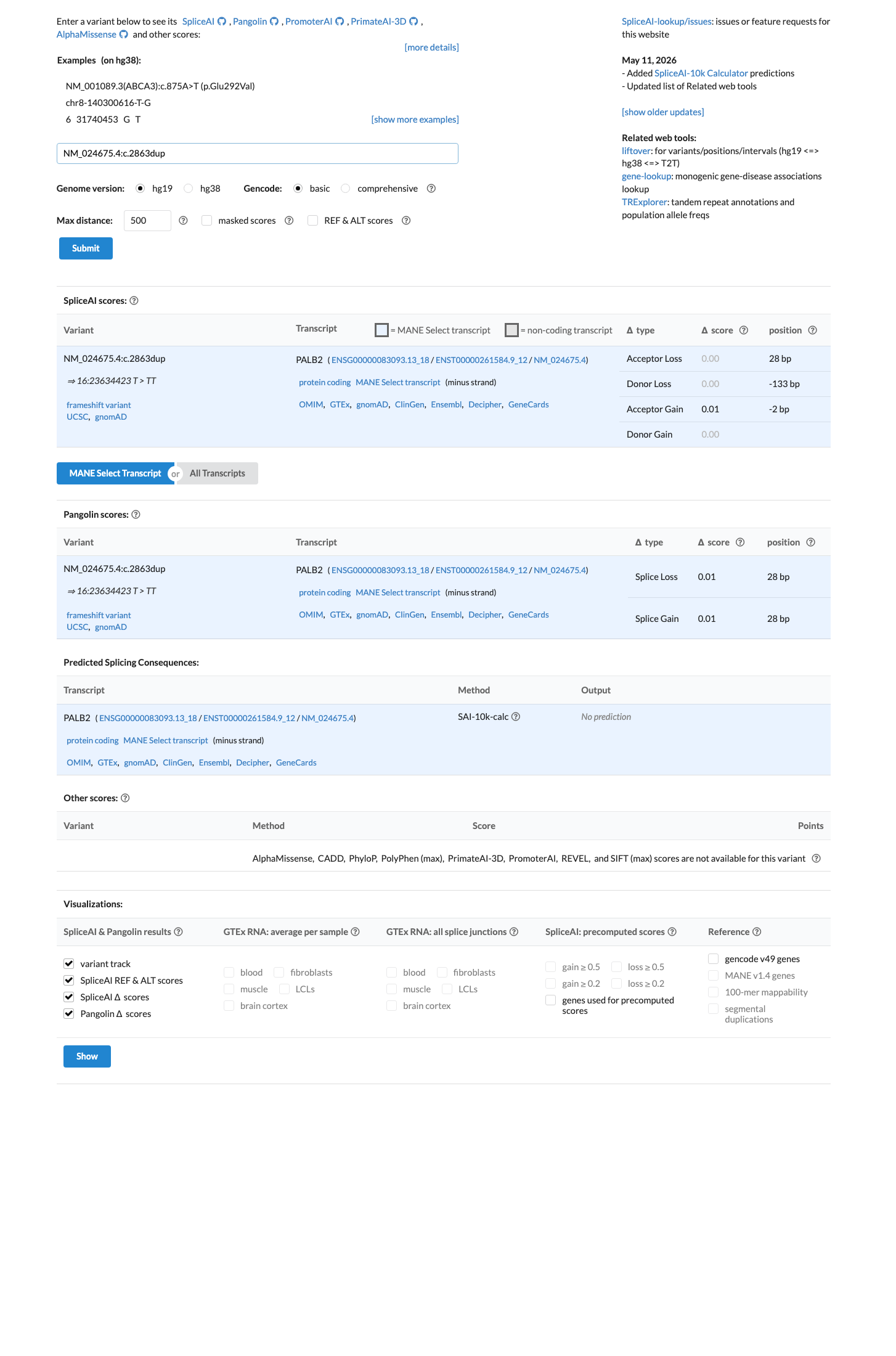
The PALB2 c.2863dup (p.(Ser955LysfsTer2)) variant has not been observed in somatic cancers in COSMIC and is absent from ClinVar.1 This variant is absent from gnomAD v2.1, gnomAD v4.1, and gnomAD-Canada, placing the observed population frequency at 0%, below the PALB2 PM2_Supporting threshold of 0.000333% in gnomAD v4.2 Published PALB2 studies and the expert-panel specification support loss of function as an established disease mechanism for PALB2-related cancer predisposition, and this duplication is predicted to cause an early truncating frameshift, p.(Ser955LysfsTer2).3 SpliceAI predicts no significant splice impact for this variant, with a maximum delta score of 0.01, supporting interpretation of the primary effect as a truncating frameshift rather than an alternative splice-driven event.4
Final classification
Pathogenic
PVS1PM2PM5
PALB2
c.2863dup
p.Ser955LysfsTer2
This variant
The PALB2 c.2863dup (p.(Ser955LysfsTer2)) variant has not been observed in somatic cancers in COSMIC and is absent from ClinVar.
Richards et.al., 2015 - Combining rules v1.2.0 criteria-combination framework: matched Rule4 (1 Pathogenic.Very Strong + Pathogenic.Supporting >=2) with applied criteria: PVS1 very strong, PM2 supporting, PM5 supporting; maps to Pathogenic.
Classification rationale
PVS1PM2PM5
Pathogenic
PALB2 c.2863dup
PVS1 + PM2 + PM5
→
Pathogenic
3
cspec ↗pvs1_gene_contextpvs1_variant_assessmentPMID:18053174 ↗PMID:28779002 ↗PMID:28858227 ↗
LYFE Sciences is an AI system, and it can make mistakes. Criteria
may be applied incorrectly, sources may be misread, and a confident-looking
classification can still be wrong. Double-check every criterion and
its underlying evidence before relying on any call.
Gene diagram
· NM_024675.4 · variants mapped to exon structure
PALB2
NM_024675.4
Fetching transcript structure from UCSC…
Applied criteria · 3 applied · 9 assessed
MetEvidence satisfies this criterion.
Not metEvaluated against available evidence; threshold not reached.
Not assessedApplies in principle, but no evidence was found to evaluate it.
N/ADoesn't apply to this variant type.
Applied · 3
Strength
Supporting
Moderate
Strong
Very strong
PVS1
very strong
Pathogenic
This variant is a frameshift duplication predicted to create an early premature termination codon, p.(Ser955LysfsTer2), in PALB2. The PALB2 expert panel uses a gene-specific PVS1 framework, and loss of function is an established disease mechanism for PALB2-related cancer predisposition, supporting PVS1 at very strong strength for this truncating event.
Frameshift duplication NM_024675.4:c.2863dup with predicted protein consequence p.(Ser955LysfsTer2).PALB2 loss of function is an established disease mechanism in the expert-panel framework.
PM2
supporting
Pathogenic
This variant is absent from gnomAD v4.1, absent from gnomAD v2.1, and absent from gnomAD-Canada. The observed population frequency is therefore 0%, which is below the PALB2 PM2_Supporting threshold of 0.000333% (1/300,000) in gnomAD v4.
Absent from gnomAD v4.1.Absent from gnomAD v2.1.Absent from gnomAD-Canada v1.0.
PM5
supporting
Pathogenic
The PALB2 expert panel repurposes PM5 for truncating variants with premature termination codons upstream of p.Tyr1183. This frameshift variant, p.(Ser955LysfsTer2), is upstream of p.Tyr1183 and therefore meets PM5 at supporting strength under the PALB2-specific rule.
PALB2 uses a truncation-cutoff PM5 framework rather than classic same-residue missense PM5.Predicted truncation p.(Ser955LysfsTer2) occurs upstream of p.Tyr1183.
Assessed · not applied
· 4 not met · 5 not assessed
Pathogenic
PS4
No variant-specific case-control data were identified showing a statistically increased prevalence of this variant in affected individuals compared with controls, so PS4 cannot currently be assessed.
PM3
No evidence was identified showing this variant in trans with another pathogenic PALB2 variant in an individual with Fanconi anemia, so PM3 cannot currently be assessed.
PP1
No segregation data were identified that would allow calculation of a PALB2-specific LOD score or Bayes factor, so PP1 cannot currently be assessed.
PP3
SpliceAI predicts no significant splice impact for this variant, with a maximum delta score of 0.01, which is below the PALB2 PP3 threshold of 0.2.
Benign
BA1
This variant is absent from gnomAD v4.1.
BS1
This variant is absent from gnomAD v4.1.
BS2
No well-documented observations of this variant in unaffected individuals meeting the PALB2/Fanconi anemia BS2 framework were identified, so BS2 cannot currently be assessed.
BS4
No non-segregation data were identified that would allow calculation of a PALB2-specific LOD score or Bayes factor, so BS4 cannot currently be assessed.
BP4
SpliceAI predicts no significant splice impact for this variant, with a maximum delta score of 0.01, which is below the BP4 splicing threshold of 0.1.
N/A · 16
PS1 · PS2 · PS3 · PM1 · PM4 · PM6 · PP2 · PP4 · PP5 · BS3 · BP1 · BP2 · BP3 · BP5 · BP6 · BP7
Research & evidence
Population frequency · supports pathogenic
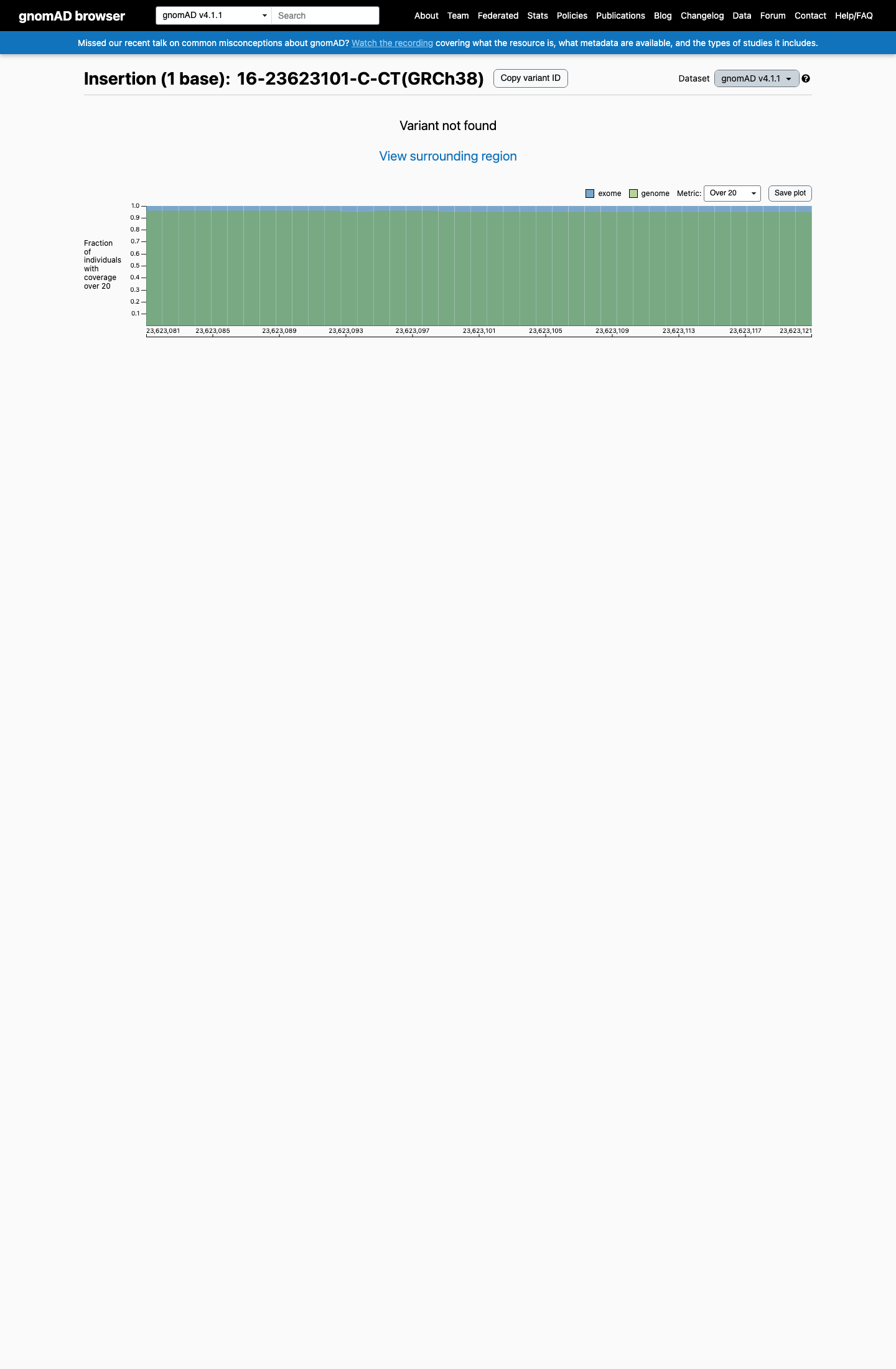
gnomAD v4.1
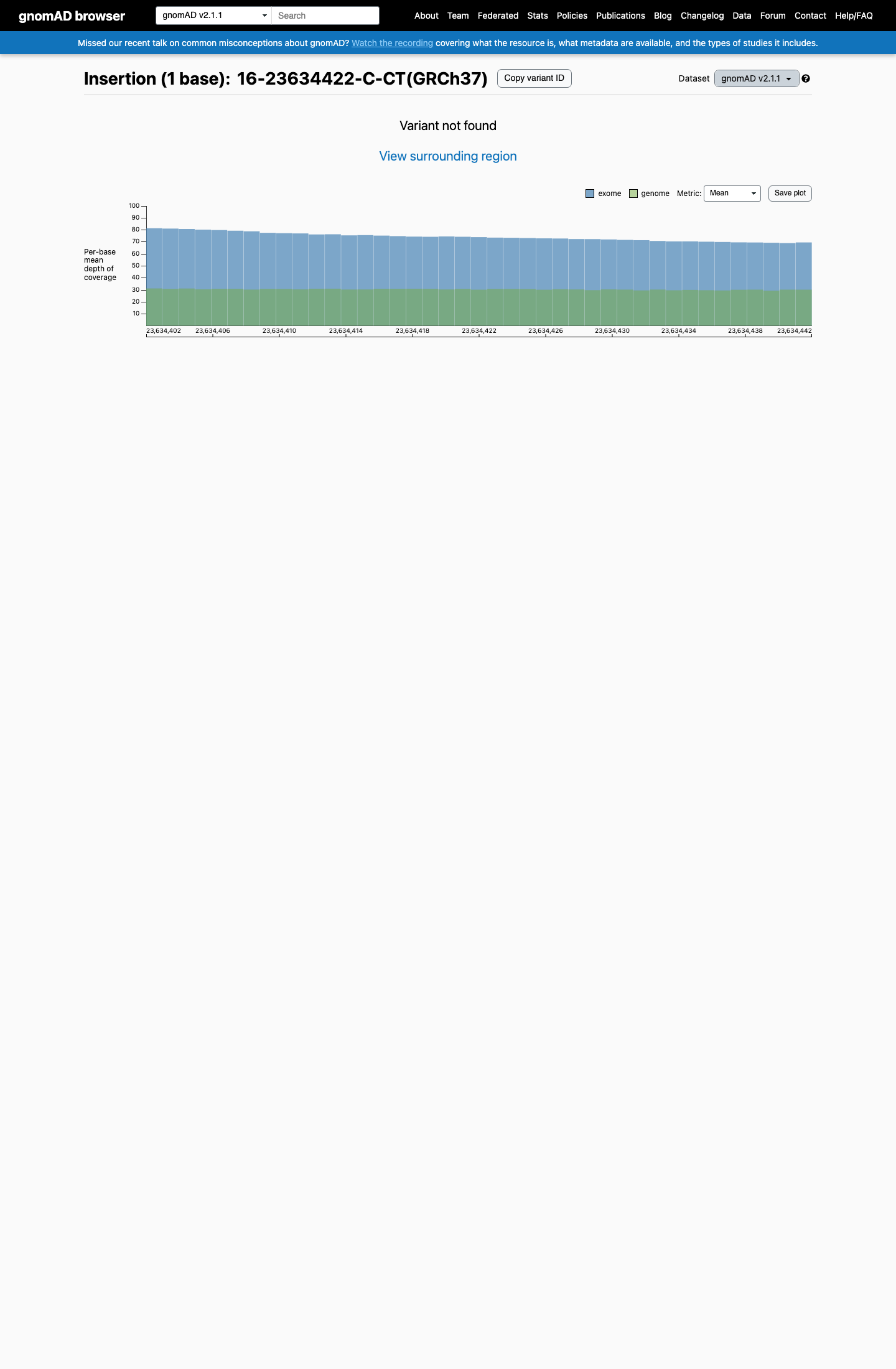
gnomAD v2.1
v4.1
Absent from gnomAD v4.1.
v2.1
Absent from gnomAD v2.1.
🇨🇦 CA
Absent from gnomAD-Canada v1.0.
Allele frequency by ancestry
three datasets · side by side
gnomAD v4.1
Absent
· 0 / ?
0 hom
0 hom
Not observed in any ancestry group.
gnomAD v2.1
Absent
· 0 / ?
0 hom
0 hom
Not observed in any ancestry group.
gnomAD Canada 🇨🇦
Absent
· 0 / ?
0 hom
0 hom
Not observed in any ancestry group.
In silico
SpliceAI predicts no significant splice impact for this variant (max delta score = 0.01).
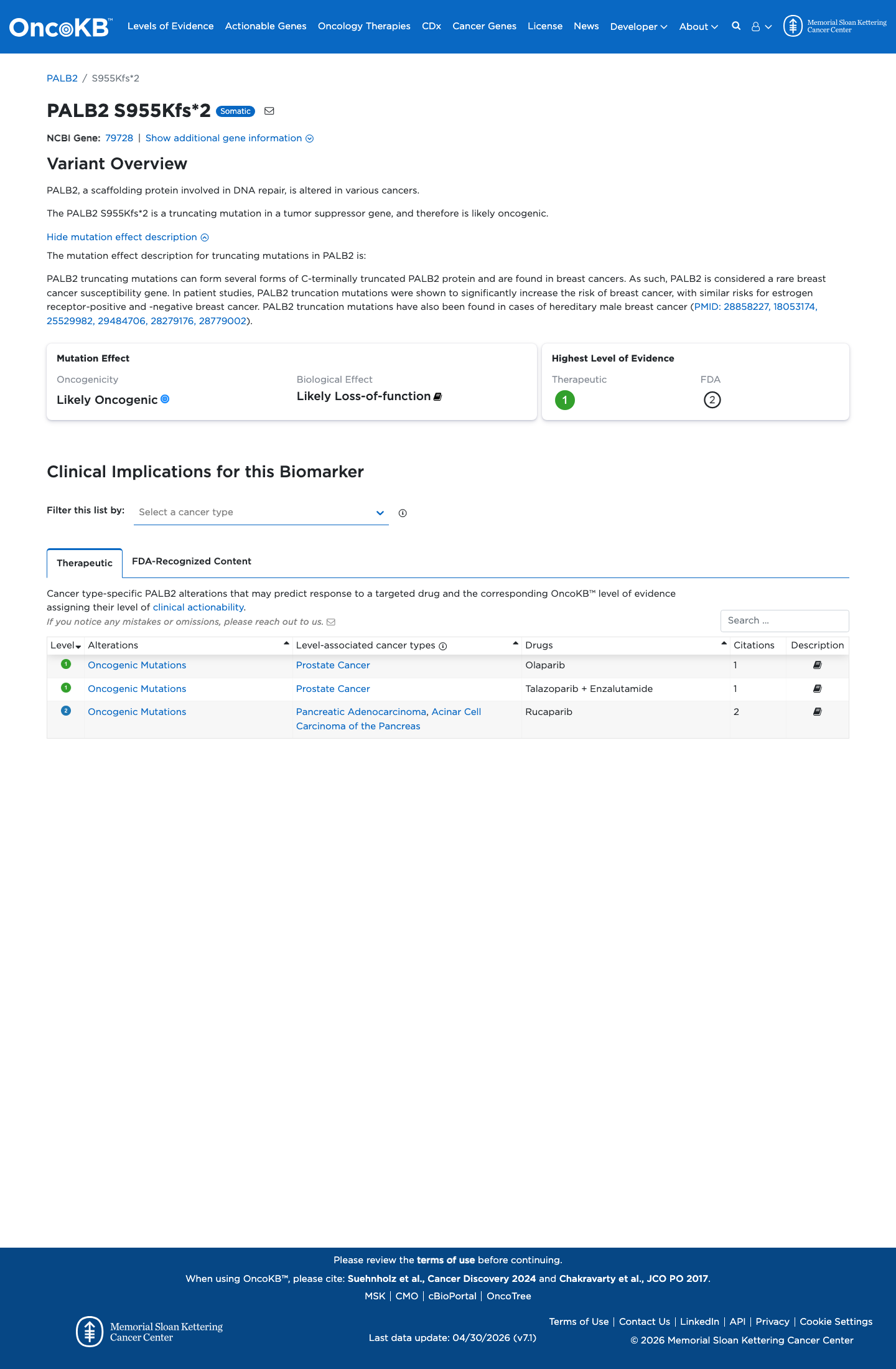
Functional
Likely Oncogenic
OncoKB identified variant-specific curated literature and context relevant to functional review; biological-effect context: Likely Loss-of-function; curated oncogenicity label: Likely Oncogenic.

COSMIC

Cancer hotspots
Somatic evidence
Not in COSMIC / hotspots
COSMIC
This variant does not lie in a statistically significant hotspot. This variant has not previously been reported in somatic cancers (COSMIC).
Hotspots
This variant does not lie in a statistically significant hotspot.
Sources & reference links
9Sources
Triaged references · 6 PMIDs not cited in assessment
18053174 ↗
Identification of a novel truncating PALB2 mutation and analysis of its contribution to early-onset breast cancer in French-Canadian women.
ONCOKB
28279176 ↗
PALB2 mutations in BRCA1/2-mutation negative breast and ovarian cancer patients from Poland.
ONCOKB
28779002 ↗
Rare, protein-truncating variants in ATM, CHEK2 and PALB2, but not XRCC2, are associated with increased breast cancer risks.
ONCOKB
29484706 ↗
Identification of a novel truncating mutation in PALB2 gene by a multigene sequencing panel for mutational screening of breast cancer risk-associated and related genes.
ONCOKB