0%
complete
Final classification
Pathogenic
PVS1PM2PM5
PALB2
c.886del
p.Met296Ter
nonsense · exon 4

PALB2 encodes a tumor suppressor protein that partners with BRCA2 (and also interacts with BRCA1) to repair double-stranded DNA breaks through the homologous recombination pathway. It acts as a scaffold that stabilizes BRCA2 in the cell nucleus and helps recruit DNA-repair machinery to sites of damage. Inherited mutations in PALB2 increase susceptibility to breast cancer, with smaller associated risks for ovarian, pancreatic, and prostate cancer and melanoma, and inheriting two mutated copies causes Fanconi anemia complementation group N. Rare somatic alterations in PALB2 are also found across various tumor types.

This variant

This exon 4 frameshift truncates PALB2 before its C-terminal WD40 beta-propeller, the region through which PALB2 stabilizes BRCA2 in the nucleus to repair double-stranded DNA breaks by homologous recombination, the tumor-suppressor function whose monoallelic loss drives inherited PALB2 breast-cancer susceptibility.

Transcript
NM_024675.4
HGVS · transcript:coding
NM_024675.4:c.886del
GRCh38
chr16:23635659 AT>A
GRCh37
chr16:23646980 AT>A
Pathogenic: PVS1 (very strong) plus PM2 and PM5 (both supporting) satisfy Rule 4 of the ClinGen HBOC PALB2 expert panel specification.
Classification rationale
PVS1PM2PM5 Pathogenic
PALB2 c.886del nonsense · exon 4

PVS1 very strong: c.886del shifts the reading frame and creates a premature stop p.(Met296Ter) in exon 4 of 13 with predicted NMD, upstream of the p.Tyr1183 truncation boundary, in a gene where loss of function is an established disease mechanism. PM2 supporting: gnomAD v4.1 total allele frequency of 0.000248% (4/1,613,998 alleles) is below the VCEP 1/300,000 (0.000333%) rarity threshold. PM5 supporting: the premature stop at codon 296 lies upstream of p.Tyr1183*, the most C-terminal known pathogenic PALB2 truncation, satisfying the VCEP truncation-cutoff rule.

PVS1 + PM2 + PM5 Pathogenic
Gene diagram · NM_024675.4 · variants mapped to exon structure
PALB2 NM_024675.4
Fetching transcript structure from UCSC…
Applied criteria · 3 applied · 7 assessed
MetEvidence satisfies this criterion.
Not metEvaluated against available evidence; threshold not reached.
Not assessedApplies in principle, but no evidence was found to evaluate it.
N/ADoesn't apply to this variant type.
Applied · 3
Strength Supporting Moderate Strong Very strong
PVS1 very strong Pathogenic
Met at Very Strong: c.886del creates a premature stop p.(Met296Ter) in exon 4 of 13, upstream of p.Tyr1183 with predicted NMD, per the PALB2 VCEP PVS1 decision tree.
ClinGen Hereditary Breast, Ovarian and Pancreatic Cancer Expert Panel PALB2 specification v1.2 (cspec): PVS1 is applied through the 'PALB2 PVS1 Decision Tree' with strengths Very Strong/Strong/Moderate/Supporting; truncation-boundary text applies to frameshifting or truncating variants with premature termination codons upstream of p.Tyr1183; the WD40 beta-propeller and coiled-coil domains are considered indispensable; no alternate splice isoform is a candidate rescue transcript; LoF variants are rare in gnomAD in all exons.Mutalyzer normalization of NM_024675.4:c.886del predicts p.(Met296Ter): the translated ORF terminates at residue 295, a premature stop at codon 296 of NP_078951.2 (full-length 1186 aa); transcript selector data place the variant in exon 4 (cDNA positions 212-1684) of 13 exons, so the PTC is ~0.8 kb upstream of the exon 4/5 junction and ~2.5 kb upstream of the final exon-exon junction.ClinGen SVI PVS1 recommendations (PMC6185798; PMID 30192042): for a null variant in a gene with established LoF mechanism, PVS1 (Very Strong) applies when the premature termination codon is predicted to undergo NMD, practically defined as a stop located more than 50-55 nt upstream of the final exon-exon junction; a PTC in exon 4 of 13 meets this.
PM2 supporting Pathogenic
Met (supporting): gnomAD v4.1 total AF of 0.000248% (4/1,613,998 alleles) falls below the PALB2 VCEP PM2 threshold of 1/300,000 (0.000333%).
PALB2 ClinGen HBOP VCEP v1.2 PM2 rule: Supporting when frequency <=1/300,000 (0.000333%) in the gnomAD v4 dataset (cspec).gnomAD v4.1: total AF = 2.478e-06 (0.000248%, 4/1,613,998 alleles), grpmax FAF = 7.9e-07 (0.000079%) - both below the 0.000333% threshold.gnomAD v4.1 NFE subpopulation AF = 3.39e-06 (0.000339%, 4/1,179,946 alleles) marginally exceeds 0.000333% on 4 alleles; treated as sampling noise given total AF and grpmax FAF both pass.
PM5 supporting Pathogenic
Met (supporting): frameshift c.886del creates a premature stop at codon 296, upstream of p.Tyr1183*, satisfying the PALB2 VCEP PM5_Supporting truncation-cutoff rule.
PALB2 HBOP VCEP v1.2 (cspec) PM5 card: 'Based on location of the most C-terminal known pathogenic variant, p.Tyr1183*. Use as PM5_Supporting (not moderate). Do not use for missense changes'; Supporting rule: 'Apply to frameshifting or truncating variants with premature termination codons upstream of p.Tyr1183.'c.886del is a frameshifting 1-bp deletion; its premature termination codon at position 296 (codon 296 < Tyr1183, i.e., upstream of the p.Tyr1183* cutoff) qualifies the allele for the PM5_Supporting truncation-cutoff rule.PMID:30089731 documents the exact allele as NM_024675:exon4:c.886delA (p.M296X) in Table 2, confirming the frameshift/truncating class and exon-4 location used to place the premature stop well upstream of p.Tyr1183* and of the final exon.
Assessed · not applied · 3 not met · 4 not assessed
Pathogenic
PS4 Not assessed: no case-control study reports c.886del individually; PALB2 truncating-variant class-level OR 4.69 (p=6.9e-6) cannot be attributed to this exact variant.
PM3 Not assessed: no affected proband is documented with c.886del in trans with a second PALB2 pathogenic variant, and no phase or Fanconi-phenotype data exists.
PP1 Not assessed: no segregation or LOD data for c.886del; the PALB2 specification requires LOD >=0.3 or Bayes factor >=2:1 for supporting PP1.
Benign
BA1 Not met: gnomAD v4.1 grpmax filtering AF of 0.000079% is over 1,000-fold below the PALB2 VCEP BA1 threshold of >0.1%.
BS1 Not met: gnomAD v4.1 grpmax filtering AF of 0.000079% is ~127-fold below the PALB2 VCEP BS1 threshold of >0.01%.
BS2 Not met: gnomAD v4.1 and v2.1 report zero homozygotes (0/1,613,998 and 0/251,348 alleles) and no unaffected-carrier observations, scoring 0 BS2 points.
BS4 Not assessed: no non-segregation or LOD data for c.886del; the PALB2 specification requires LOD <= -0.32 or Bayes factor <=0.48 for supporting BS4.
N/A · 18 PS1 · PS2 · PS3 · PM1 · PM4 · PM6 · PP2 · PP3 · PP4 · PP5 · BS3 · BP1 · BP2 · BP3 · BP4 · BP5 · BP6 · BP7
Research & evidence
Population frequency · supports pathogenic
gnomAD v4.1 screenshot
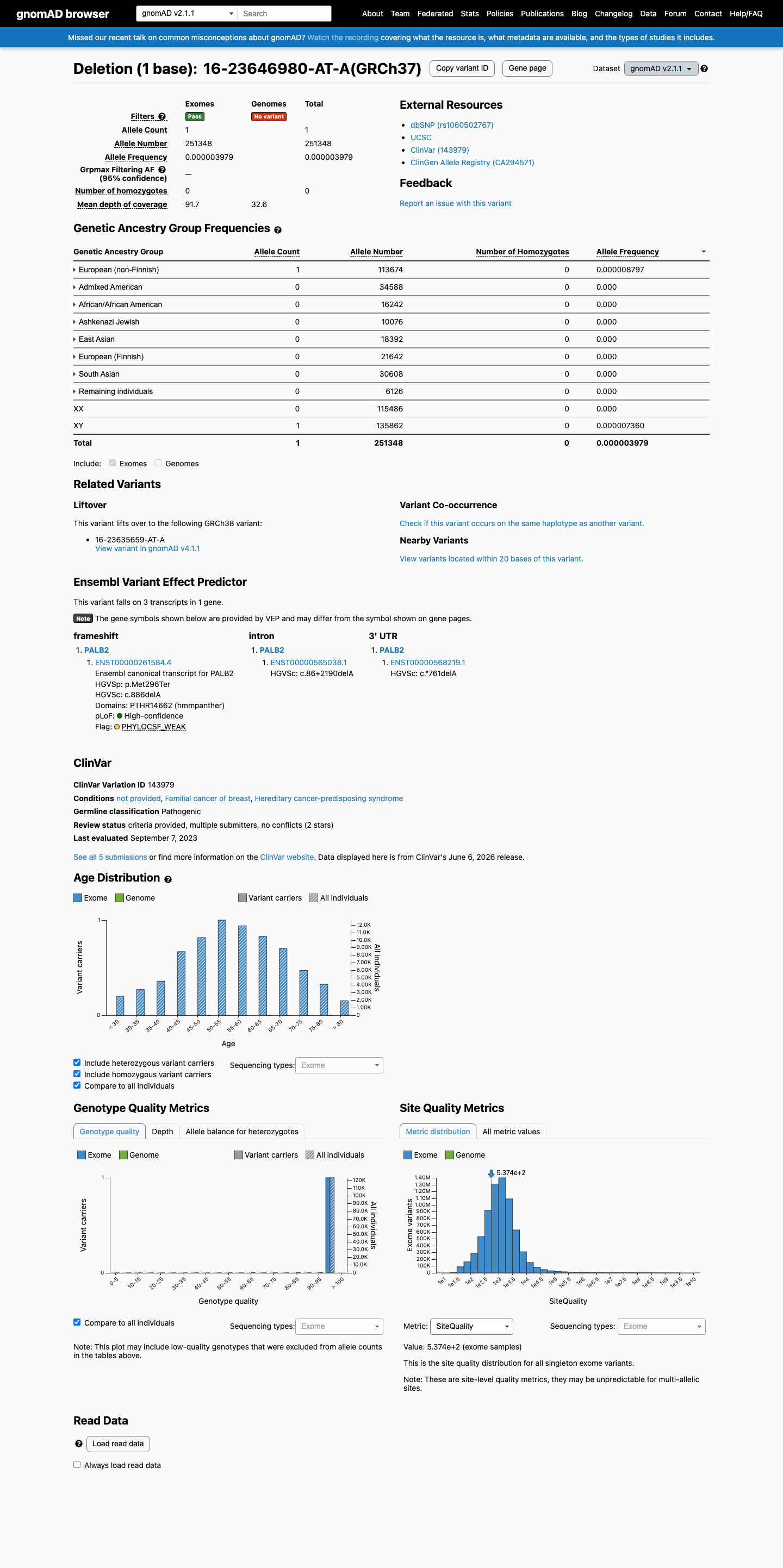
gnomAD v4.1
gnomAD v2.1 screenshot
gnomAD v2.1
v4.1
This variant is present in gnomAD v4.1 (AF= 2.47832e-06; MAF= 0.00025%, 4/1613998 alleles, homozygotes = 0) and has highest observed frequency in the European (non-Finnish) population (AF= 3.38999e-06; MAF= 0.00034%, 4/1179946 alleles, homozygotes = 0); grpmax FAF= 7.9e-07.
v2.1
This variant is present in gnomAD v2.1 (AF= 3.97855e-06; MAF= 0.00040%, 1/251348 alleles, homozygotes = 0) and has highest observed frequency in the European (non-Finnish) population (AF= 8.79709e-06; MAF= 0.00088%, 1/113674 alleles, homozygotes = 0).
🇨🇦 CA
Absent from gnomAD-Canada v1.0.
Allele frequency by ancestry
three datasets · side by side
gnomAD v4.1
0.00025% · 4 / 1,613,998
0 hom · FAF 7.9e-05%
European (non-Finnish)
4 / 1,179,946
0.00034%
+ 9 not observed (Remaining individuals, Admixed American, European (Finnish), Amish, East Asian, Middle Eastern, South Asian, Ashkenazi Jewish, African/African American)
gnomAD v2.1
0.0004% · 1 / 251,348
0 hom
European (non-Finnish)
1 / 113,674
0.00088%
+ 7 not observed (African/African American, Admixed American, Ashkenazi Jewish, East Asian, European (Finnish), Remaining individuals, South Asian)
gnomAD Canada 🇨🇦
Absent · 0 / ?
0 hom
Not observed in any ancestry group.
ClinVar screenshot
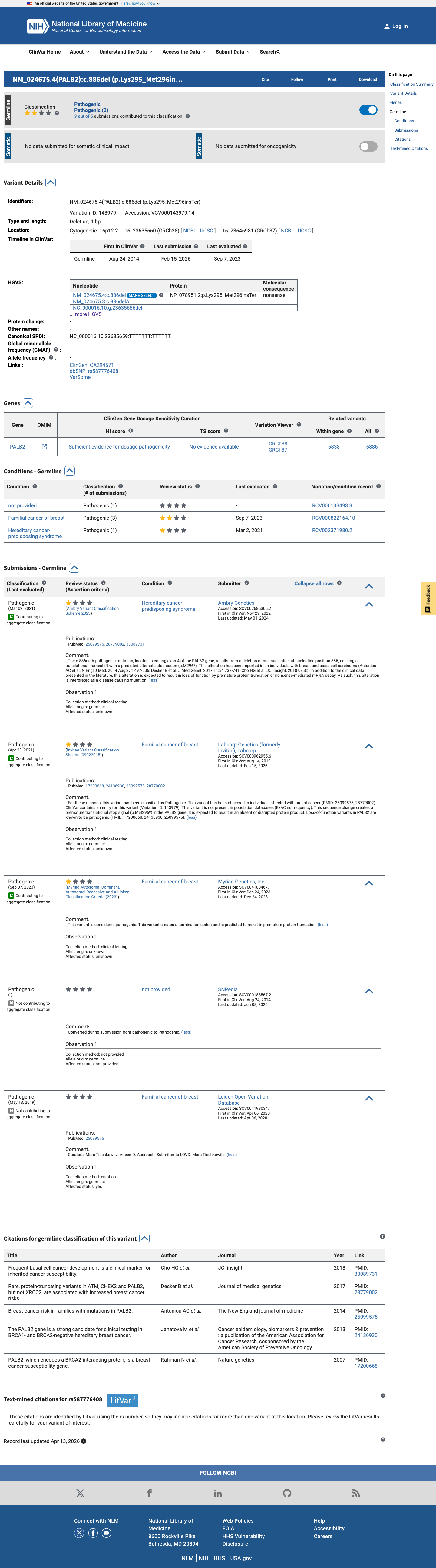
ClinVar
This variant has been reported in ClinVar as Pathogenic (3 clinical laboratories). (ClinVarID = 143979)
SpliceAI screenshot
In silico
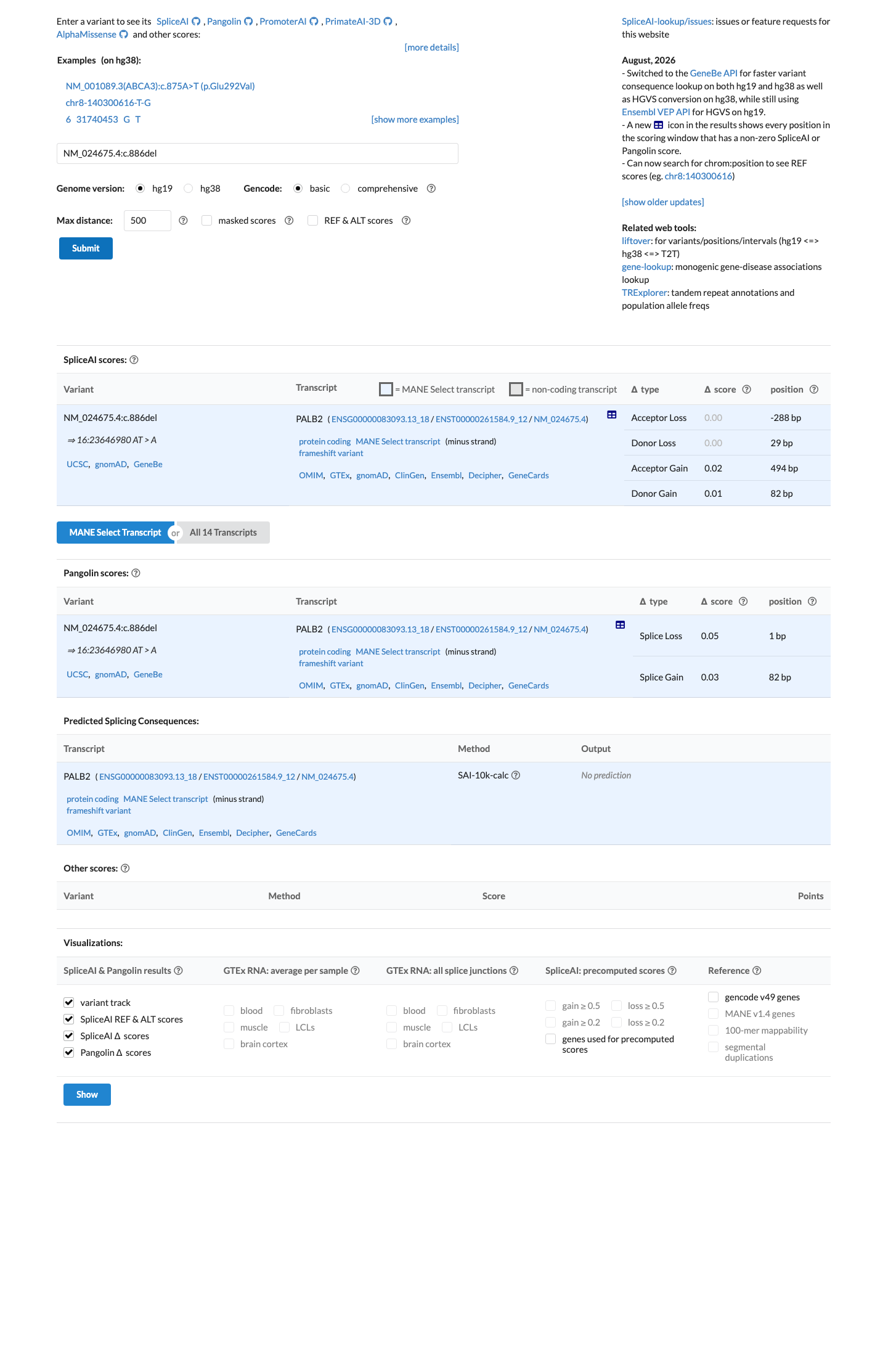
SpliceAI predicts no significant splice impact for this variant (max delta score = 0.02).
Functional / OncoKB screenshot
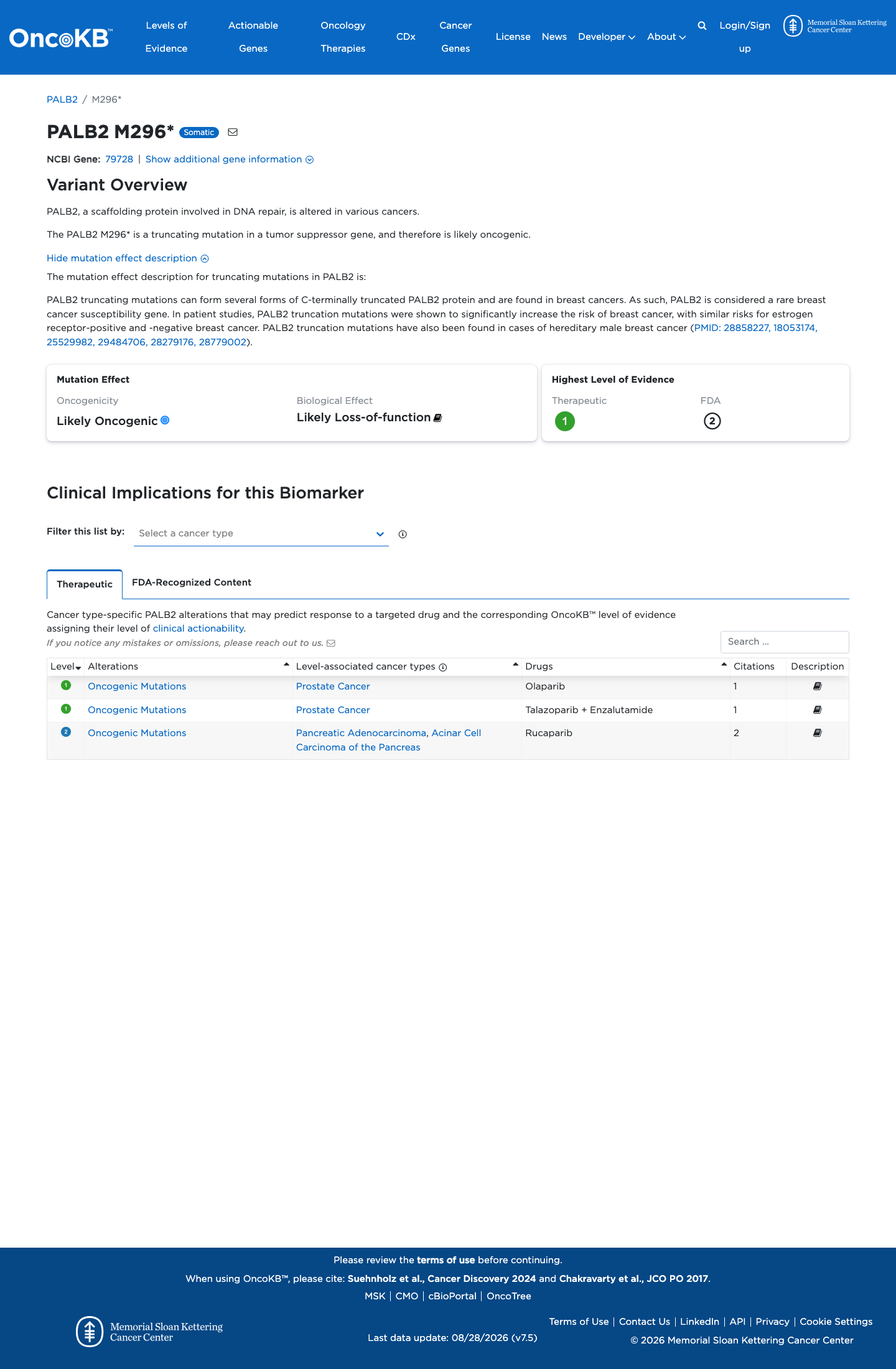
Functional Likely Oncogenic
OncoKB identified variant-specific curated literature and context relevant to functional review; biological-effect context: Likely Loss-of-function; curated oncogenicity label: Likely Oncogenic.
OncoKB ↗
COSMIC screenshot
COSMIC
Cancer hotspots screenshot
Cancer hotspots
Somatic evidence Not in COSMIC / hotspots
COSMIC
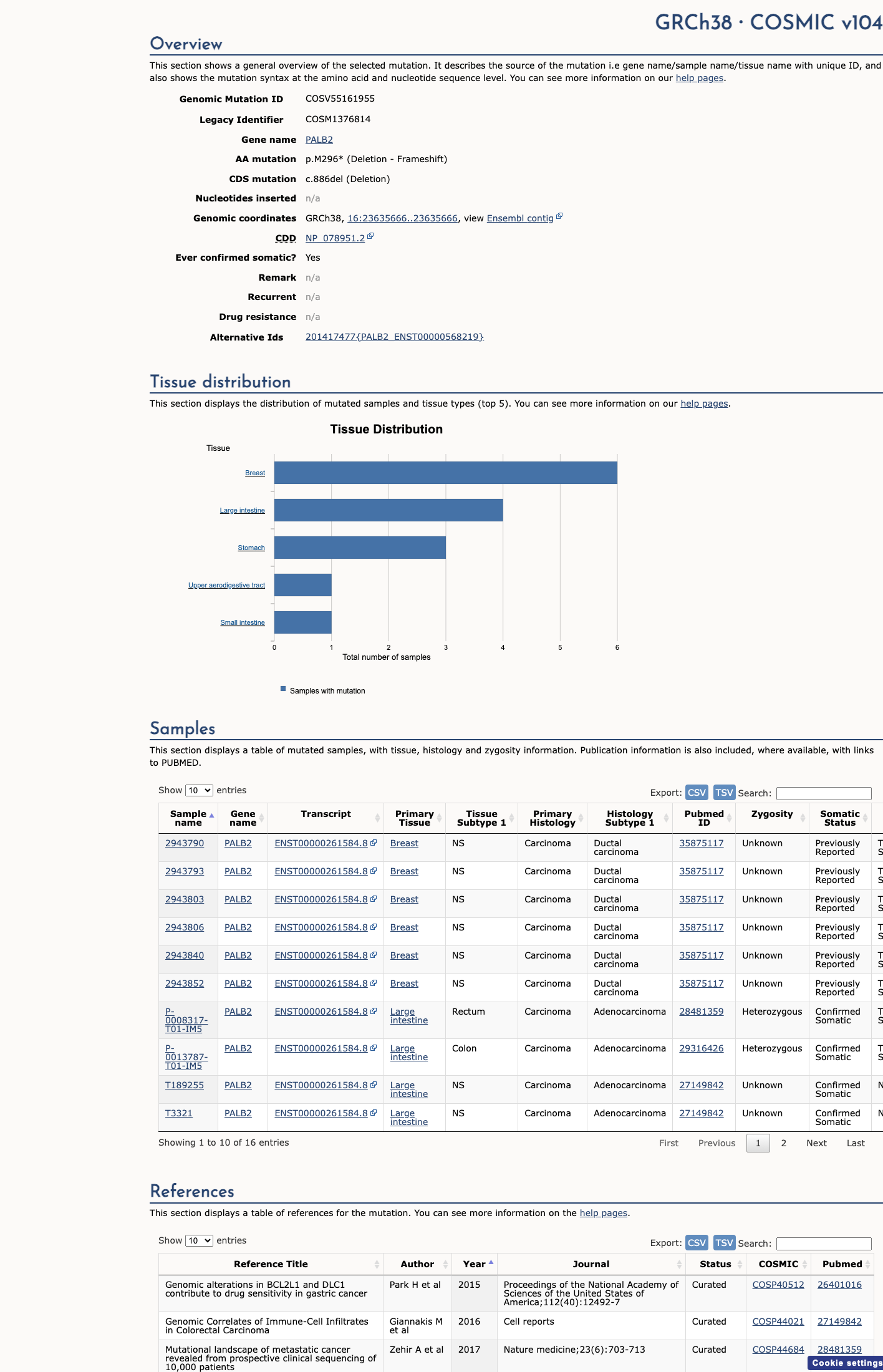
This variant does not lie in a statistically significant hotspot. This variant has previously been reported in somatic cancers (COSMIC; COSV55161955, n = 16 times).
Hotspots
This variant does not lie in a statistically significant hotspot.
Literature · how each cited paper was used
3papers cited
Each card is an audit: what was searched, what was found, whether it names the variant, which criteria it fed, and why. 4 further PMIDs triaged but not cited — see Sources & references.
Breast-cancer risk in families with mutations in PALB2.
Searched
c.886delp.(M296*)M296886del
Found
This paper is a multicenter segregation analysis of breast-cancer risk in 154 families (362 members) carrying deleterious germline PALB2 loss-of-function mutations. The exact variant c.886del is explicitly listed in Figure 1A among the 48 different loss-of-function mutations reported in the study (frameshift/deletion class); no family count is shown in parentheses after c.886del, indicating it was present in only a single family. No variant-specific clinical, segregation, or frequency data are reported for c.886del individually; the paper's risk estimates (cumulative breast-cancer risk 35% by age 70 for female carriers; ~8-9x relative risk) apply to the pooled loss-of-function mutation cohort. Families with PALB2 missense or VUS variants were excluded, so inclusion of c.886del implies it was classified as a deleterious loss-of-function allele.
Variant
✓ Names this variant — characterised directly
Applied to
PVS1 very strong
Lists c.886del among 48 distinct PALB2 loss-of-function mutations (frameshift/deletion class) in breast-cancer families, supporting that this allele is a bona fide LoF/truncating variant in the biologically relevant transcript.
PM5 supporting
Confirms c.886del is classified and treated as a truncating PALB2 loss-of-function (frameshift/deletion-class) mutation in a clinical family cohort, consistent with the truncation-cutoff PM5 rule premise that this allele lies in the established pathogenic truncation region upstream of p.Tyr1183*.
Among the 154 families, there were 48 different loss-of-function mutations in PALB2 (Fig. 1A, and Table S3 in the Supplementary Appendix).
Location Results, Families paragraph (page 499); variant listed in Figure 1A (PALB2 gene structure and mutations schematic)  ·  Context Multicenter (14 centers) family study; 154 families with 362 PALB2 loss-of-function mutation carriers (311 women, 51 men); modified complex segregation analysis using Mendel v3.3 to estimate age-specific breast-cancer risk; ascertainment-adjusted likelihoods  ·  full text
Frequent basal cell cancer development is a clinical marker for inherited cancer susceptibility.
Searched
c.886delc.886delAp.(M296*)p.M296XNM_024675
Found
The paper reports a germline PALB2 nonsense/frameshift variant, NM_024675:exon4:c.886delA (p.M296X, here given as p.M296*), identified in one subject within a 61-patient 'high-frequency BCC' cohort (individuals with 6+ biopsy-confirmed basal cell carcinomas in a 10-year period, top 5% of BCC patients at Stanford). The variant was one of 13 pathogenic mutations found in 12 of 61 (19.7%) subjects across 12 DNA repair/cancer-susceptibility genes (APC, BARD1, BRCA1, BRCA2, CDH1, CHEK2, MLH1, MSH2, MSH6, MUTYH, NBN, PALB2), classified as pathogenic per ACMG/AMP criteria via ClinVar and HGMD, and confirmed by Sanger sequencing. PALB2 is noted as participating in homologous recombination DNA repair. No individual-level clinical data (cancer history, segregation, or functional assay) specific to this PALB2 variant carrier is provided beyond its listing in Table 2.
Variant
✓ Names this variant — characterised directly
Applied to
PVS1 very strong
Confirms the identical variant as a germline, Sanger-confirmed PALB2 truncating allele in canonical-transcript exon 4 (c.886delA, p.M296X), supporting transcript relevance and the protein-truncating consequence used for PVS1.
PM5 supporting
Documents the exact allele as exon-4 c.886delA (p.M296X), confirming the frameshift/truncating class and location used to place its premature termination codon (residue 296) upstream of the p.Tyr1183* PM5 truncation-cutoff boundary.
PALB2 p.M296X NM_024675:exon4:c.886delA
Location Table 2 (Pathogenic mutations identified in the high-frequency BCC cohort), with cohort description in Results, paragraph 2  ·  Context 61-subject retrospective cohort with frequent BCC (6+ BCCs over 10 years, top 5% of BCC patients at Stanford 2005-2015); germline DNA from saliva, targeted capture sequencing of 29 genes (Fulgent Genetics Focus Cancer panel, mean coverage 53.8x), pathogenic calls per ACMG/AMP criteria using ClinVar (June 2015) and HGMD Professional (2016.4), confirmed by Sanger sequencing  ·  full text
Rule & framework references · cited for criterion definitions, not variant evidence
28779002 ↗ Rare, protein-truncating variants in ATM, CHEK2 and PALB2, but not XRCC2, are associated with increased breast cancer risks.
Sources & reference links
9Sources
CSpec VCEP
ClinVar
gnomAD v2.1
gnomAD v4.1
gnomAD-Canada
SpliceAI
OncoKB
COSMIC
Cancer hotspots
Triaged references · 4 PMIDs not cited in assessment
18053174 ↗ Identification of a novel truncating PALB2 mutation and analysis of its contribution to early-onset breast cancer in French-Canadian women. ONCOKB
25529982 ↗ A novel PALB2 truncating mutation in an Italian family with male breast cancer. ONCOKB
28279176 ↗ PALB2 mutations in BRCA1/2-mutation negative breast and ovarian cancer patients from Poland. ONCOKB
28858227 ↗ The Role of PALB2 in the DNA Damage Response and Cancer Predisposition. ONCOKB