NM_032444.3:c.5242C>T (p.Gln1748Ter) is a nonsense variant in the terminal exon of SLX4, predicted to produce a truncated protein lacking the C-terminal 87 amino acids within the SLX1-binding domain.1 SLX4 loss of function is an established disease mechanism for Fanconi anemia subtype FA-P, meeting the PVS1 gene-level gate.2 PVS1 is applied at moderate strength: the variant escapes NMD (terminal exon) but truncates a critical functional domain (SBD, residues 1632–1834), consistent with PMC6185798 guidance.3 PM1 is met at moderate strength: the variant is located within the experimentally defined SLX1-binding domain (SBD/CCD, residues 1632–1834), a critical functional domain required for Holliday junction resolvase activity.4 PM2 is met at supporting strength: the variant is extremely rare in population databases (gnomAD v2.1 AF = 0.0032%; v4.1 AF = 0.0019%), well below the 0.1% PM2 threshold, with zero homozygotes observed.5 No variant-specific functional studies, segregation data, de novo observations, or expert panel classifications were identified. ClinVar reports this variant as Uncertain Significance (Variation ID 864196).6 Overall, two moderate criteria (PVS1_moderate + PM1_moderate) and one supporting criterion (PM2_supporting) are met. Under generic ACMG/AMP 2015 combination rules, 2 moderate + 1 supporting criteria do not reach the 'likely pathogenic' threshold, which requires 3 moderate or 2 moderate + 2 supporting. The current evidence profile is consistent with a variant of uncertain significance (VUS), pending additional functional, segregation, or case-control data.7
Final classification
VUS
PVS1PM1PM2
SLX4
c.5242C>T
p.Gln1748Ter
This variant
NM_032444.3:c.5242C>T (p.Gln1748Ter) is a nonsense variant in the terminal exon of SLX4, predicted to produce a truncated protein lacking the C-terminal 87 amino acids within the SLX1-binding domain.
gene-specific framework lacked a usable explicit final combination framework, so generic ACMG/AMP 2015 final-combination rules were applied as fallback; applied criteria: PVS1 moderate, PM1 moderate, PM2 supporting; combination = 2 moderate + 1 supporting, which maps to VUS.
Classification rationale
PVS1PM1PM2
VUS
SLX4 c.5242C>T
PVS1 + PM1 + PM2
→
VUS
7
PMID:25741868 ↗generic_acmg_combination_rules
LYFE Sciences is an AI system, and it can make mistakes. Criteria
may be applied incorrectly, sources may be misread, and a confident-looking
classification can still be wrong. Double-check every criterion and
its underlying evidence before relying on any call.
Gene diagram
· NM_032444.3 · variants mapped to exon structure
SLX4
NM_032444.3
Fetching transcript structure from UCSC…
Applied criteria · 3 applied · 18 assessed
MetEvidence satisfies this criterion.
Not metEvaluated against available evidence; threshold not reached.
Not assessedApplies in principle, but no evidence was found to evaluate it.
N/ADoesn't apply to this variant type.
Applied · 3
Strength
Supporting
Moderate
Strong
Very strong
PVS1
moderate
review
Pathogenic
NM_032444.3:c.5242C>T is a nonsense variant predicted to produce a truncated protein at p.Gln1748Ter (Q1748*). SLX4 loss of function is an established disease mechanism for Fanconi anemia subtype FA-P, and the gene passes the PVS1 gene-level gate. However, the variant is located in the terminal exon (exon 15 of 15), predicting escape from nonsense-mediated decay and production of a protein truncated by only 87 C-terminal amino acids (4.7% of the 1835-residue protein). The truncation removes the C-terminal ~50% of the SLX1-binding domain (SBD, residues 1632–1834), a functionally critical region required for SLX1 interaction and Holliday junction resolvase activity. Under PMC6185798 guidance for last-exon nonsense variants that escape NMD but disrupt a critical functional domain, PVS1 is applied at moderate strength.
Nonsense variant p.Gln1748Ter in the last exon of SLX4 (exon 15/15)SLX4 loss of function is an established disease mechanism (Fanconi anemia FA-P)Truncation removes C-terminal 87 amino acids within the SLX1-binding domain (SBD
PM1
moderate
Pathogenic
The variant p.Gln1748Ter is located within the SLX1-binding domain (SBD) of SLX4, a well-characterized critical functional domain spanning residues 1632–1834. The SBD is the extreme C-terminal conserved domain (CCD) that is both necessary and sufficient for SLX1 interaction, and SLX1 binding is required for Holliday junction resolvase activity. Domain mapping was established by systematic co-immunoprecipitation truncation analysis in PMID:19596235 (Fekairi et al. 2009, Figure 2A,C) and PMID:19596236 (Svendsen et al. 2009, Figure 2B, 4E). The nonsense variant truncates the protein within this domain, removing the C-terminal 87 amino acids and disrupting the conserved SBD. No benign missense variation has been observed in this domain in population databases at appreciable frequency. PM1 is met at moderate strength based on location in an experimentally defined, functionally critical protein domain whose disruption is consistent with the established loss-of-function disease mechanism.
SLX4 SBD/CCD domain mapped to residues 1632-1834 (PMID:19596235PMID:19596236)SBD is necessary and sufficient for SLX1 binding and HJ resolvase activity
PM2
supporting
Pathogenic
NM_032444.3:c.5242C>T is absent from or observed at extremely low frequency in large population databases. In gnomAD v2.1, the allele frequency is 3.20 × 10⁻⁵ (0.0032%, 9/281,628 alleles, 0 homozygotes) with grpmax filtering AF of 2.31 × 10⁻⁵. In gnomAD v4.1, the AF is 1.92 × 10⁻⁵ (0.0019%, 31/1,613,492 alleles, 0 homozygotes) with grpmax FAF of 1.45 × 10⁻⁵. The highest subpopulation frequency is in the Finnish population (AF = 8.09 × 10⁻⁵ in v2.1; 7.89 × 10⁻⁵ in v4.1). All observed frequencies are well below the 0.1% PM2 threshold for non-VCEP generic ACMG adjudication. No homozygotes are observed, consistent with a rare pathogenic variant in a gene where biallelic LoF causes Fanconi anemia.
gnomAD v2.1: AF=0.0032%9/281628 alleles
Assessed · not applied
· 18 not met · 0 not assessed
Pathogenic
PS1
PS1 requires the same amino acid change as an established pathogenic variant.
PS2
PS2 requires a confirmed de novo occurrence with both maternity and paternity confirmed.
PS3
PS3 requires well-established functional studies showing a damaging effect for the variant or a systematically characterized range that includes this position.
PS4
PS4 requires a statistically significant enrichment of the variant in affected individuals compared to controls.
PM6
PM6 requires a de novo observation without confirmation of paternity and maternity.
PP1
PP1 requires cosegregation of the variant with disease in multiple affected family members.
PP3
PP3 requires multiple lines of computational evidence supporting a deleterious effect on the gene or gene product.
PP4
PP4 requires the variant to be identified in a patient whose phenotype or family history is highly specific for a disease with a single genetic etiology.
PP5
PP5 requires a reputable source (e.g., clinical laboratory with recognized expertise) to have recently reported the variant as pathogenic.
Benign
BA1
BA1 requires allele frequency >1% in any population database.
BS1
BS1 requires allele frequency >0.3% (non-VCEP generic ACMG threshold).
BS2
BS2 requires observation of the variant in a healthy adult in the homozygous state, or in trans with a pathogenic variant for a fully penetrant dominant disorder.
BS3
BS3 requires well-established functional studies showing no deleterious effect.
BS4
BS4 requires lack of segregation of the variant with disease in affected family members.
BP2
BP2 requires observation in trans with a pathogenic variant for a fully penetrant dominant disorder, or in cis with a pathogenic variant.
BP4
BP4 requires multiple lines of computational evidence suggesting no impact on the gene or gene product.
BP5
BP5 requires the variant to be found in a case with an alternate molecular basis for disease.
BP6
BP6 requires a reputable source to report the variant as benign.
N/A · 7
PM3 · PM4 · PM5 · PP2 · BP1 · BP3 · BP7
Research & evidence
Population frequency
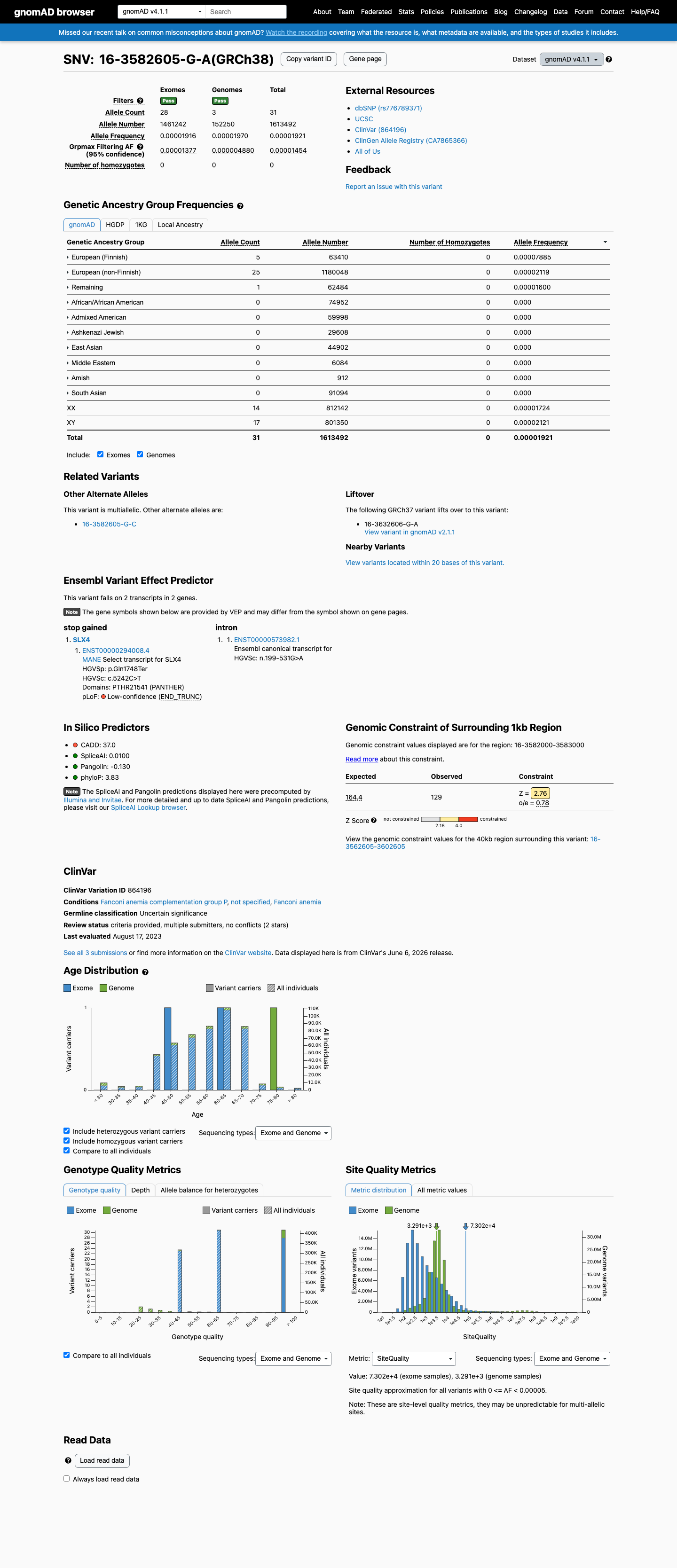
gnomAD v4.1
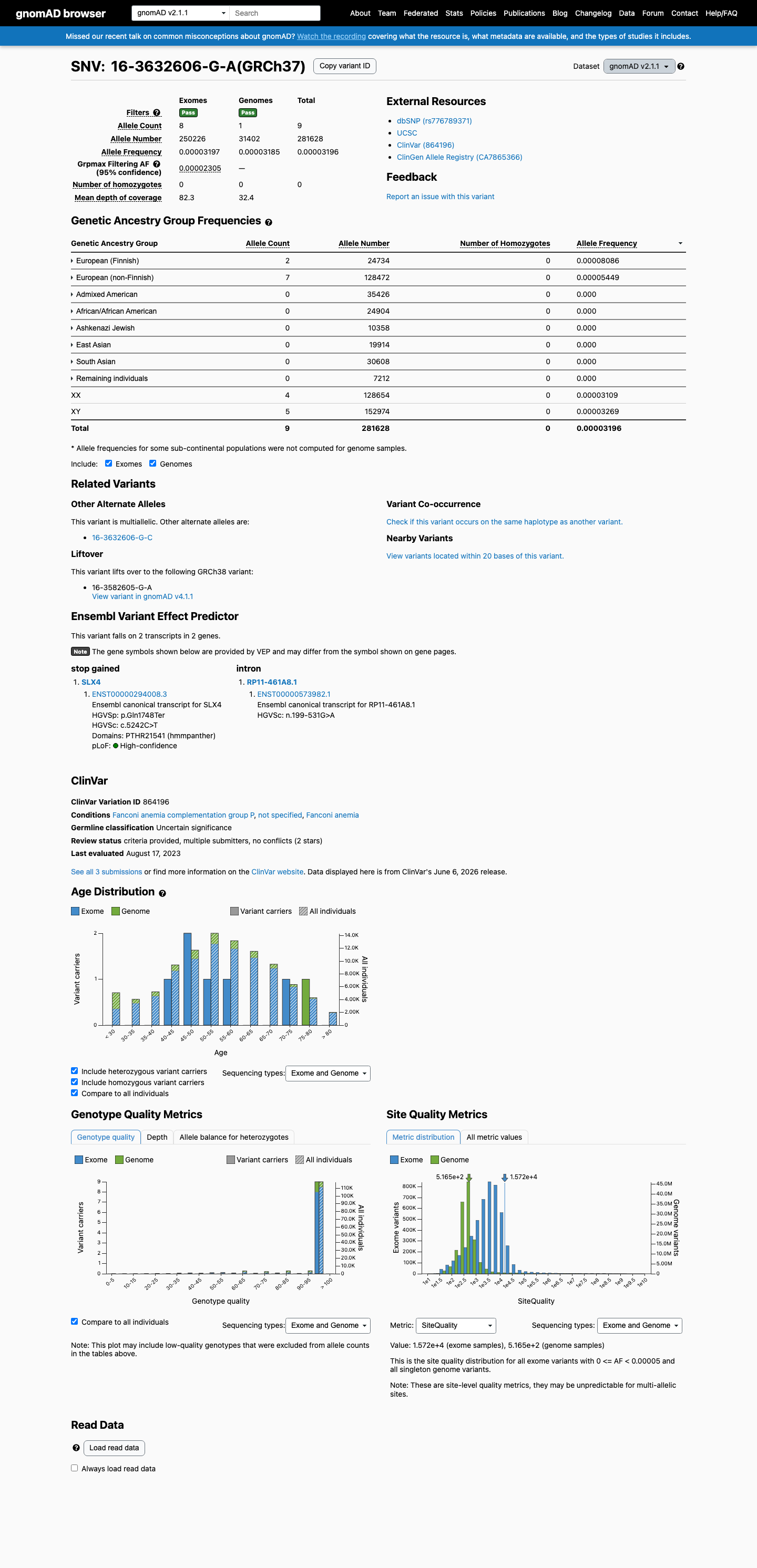
gnomAD v2.1
v4.1
This variant is present in gnomAD v4.1 (AF= 1.9213e-05; MAF= 0.00192%, 31/1613492 alleles, homozygotes = 0) and has highest observed frequency in the European (Finnish) population (AF= 7.88519e-05; MAF= 0.00789%, 5/63410 alleles, homozygotes = 0); grpmax FAF= 1.454e-05.
v2.1
This variant is present in gnomAD v2.1 (AF= 3.1957e-05; MAF= 0.00320%, 9/281628 alleles, homozygotes = 0) and has highest observed frequency in the European (Finnish) population (AF= 8.08604e-05; MAF= 0.00809%, 2/24734 alleles, homozygotes = 0); grpmax FAF= 2.305e-05.
🇨🇦 CA
Absent from gnomAD-Canada v1.0.
Allele frequency by ancestry
three datasets · side by side
gnomAD v4.1
0.0019%
· 31 / 1,613,492
0 hom · FAF 0.0015%
0 hom · FAF 0.0015%
European (Finnish) 5 / 63,410 |
0.0079% |
European (non-Finnish) 25 / 1,180,048 |
0.0021% |
Remaining individuals 1 / 62,484 |
0.0016% |
+ 7 not observed (Admixed American, Amish, East Asian, Middle Eastern, South Asian, Ashkenazi Jewish, African/African American)
gnomAD v2.1
0.0032%
· 9 / 281,628
0 hom · FAF 0.0023%
0 hom · FAF 0.0023%
European (Finnish) 2 / 24,734 |
0.0081% |
European (non-Finnish) 7 / 128,472 |
0.0054% |
+ 6 not observed (African/African American, Admixed American, Ashkenazi Jewish, East Asian, Remaining individuals, South Asian)
gnomAD Canada 🇨🇦
Absent
· 0 / ?
0 hom
0 hom
Not observed in any ancestry group.
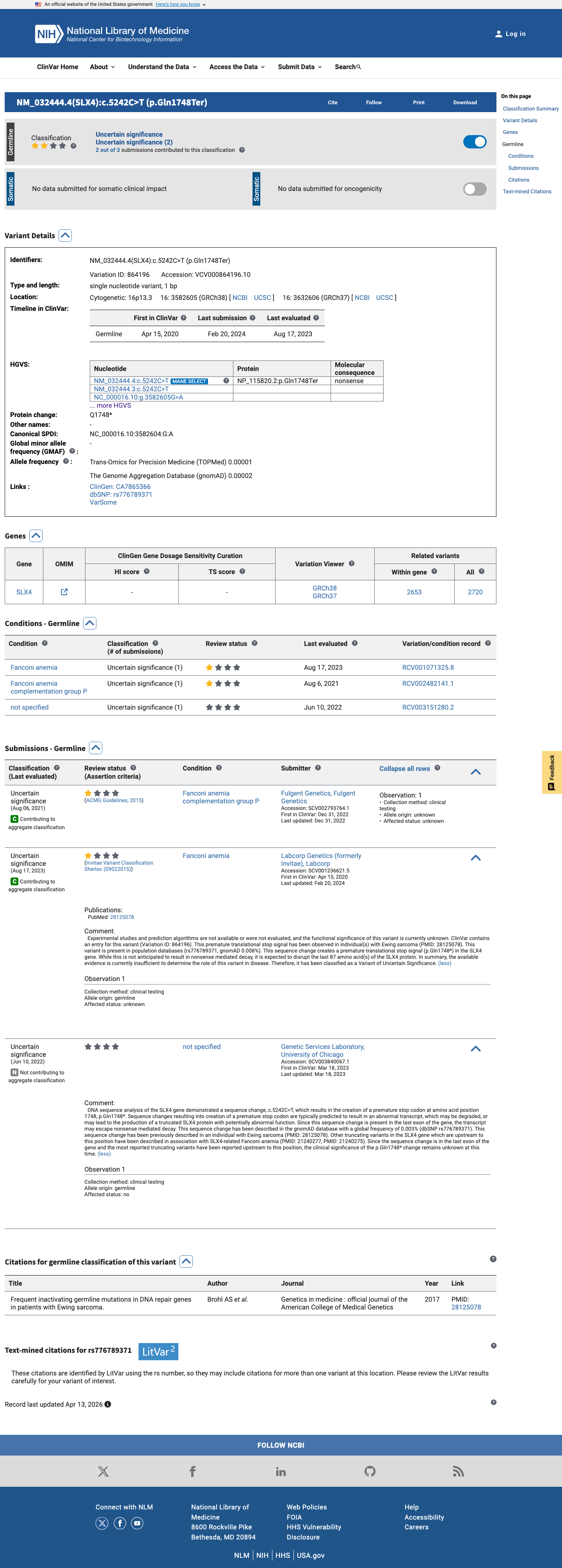
ClinVar
This variant has been reported in ClinVar as Uncertain significance (3 clinical laboratories). (ClinVarID = 864196)

In silico
SpliceAI predicts no significant splice impact for this variant (max delta score = 0.02). BayesDel score = 0.34181.
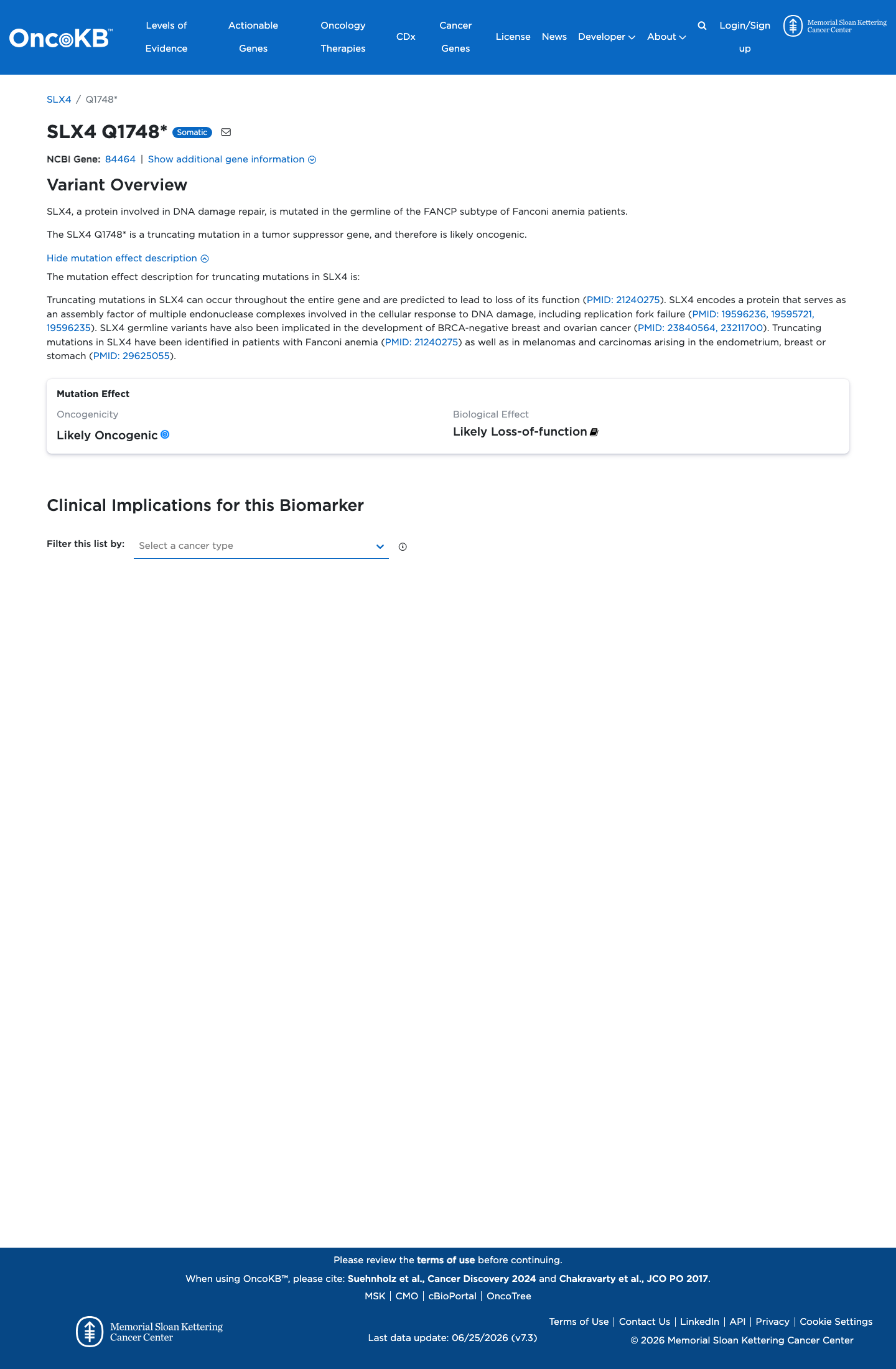
Functional
Likely Oncogenic
OncoKB identified variant-specific curated literature and context relevant to functional review; biological-effect context: Likely Loss-of-function; curated oncogenicity label: Likely Oncogenic.

COSMIC

Cancer hotspots
Somatic evidence
Not in COSMIC / hotspots
COSMIC
This variant does not lie in a statistically significant hotspot. This variant has not previously been reported in somatic cancers (COSMIC).
Hotspots
This variant does not lie in a statistically significant hotspot.
Literature · how each cited paper was used
3papers cited
Each card is an audit: what was searched, what was found, whether it names the variant, which criteria it fed, and why. 5 further PMIDs triaged but not cited — see Sources & references.
Rule & framework references · cited for criterion definitions, not variant evidence
19596235 ↗
Mammalian BTBD12/SLX4 assembles a Holliday junction resolvase and is required for DNA repair.
19596236 ↗
Human SLX4 is a Holliday junction resolvase subunit that binds multiple DNA repair/recombination endonucleases.
21240275 ↗
Mutations of the SLX4 gene in Fanconi anemia.
Sources & reference links
Triaged references · 5 PMIDs not cited in assessment
19595721 ↗
Coordination of structure-specific nucleases by human SLX4/BTBD12 is required for DNA repair.
ONCOKB
23211700 ↗
Low prevalence of SLX4 loss-of-function mutations in non-BRCA1/2 breast and/or ovarian cancer families.
ONCOKB
25741868 ↗
Standards and guidelines for the interpretation of sequence variants: a joint consensus recommendation of the American College of Medical Genetics and Genomics and the Association for Molecular Pathology.
CLINVAR
19888064 ↗
ACOG Committee Opinion No. 442: Preconception and prenatal carrier screening for genetic diseases in individuals of Eastern European Jewish descent.
CLINVAR