NM_033360.4:c.183A>C (p.Gln61His) is a missense variant in KRAS, a gene in which gain-of-function missense variants cause RASopathies including Noonan syndrome and cardio-facio-cutaneous syndrome.1 Multiple different pathogenic missense variants have been established at codon 61 in germline RASopathies (p.Gln61Arg and p.Gln61Lys), satisfying PM5 at Strong strength under the RASopathy VCEP. The Gln61His substitution is concordant with the known pathogenic direction of codon 61 changes which impair GTPase activity.2 PP2 is applied at Supporting strength per VCEP specification, as PP2 is applicable to all RASopathy genes including KRAS.3 PP3 is applied at Supporting strength based on multiple computational lines of evidence: REVEL score 0.644 predicts a deleterious effect, residue 61 is a statistically significant mutational hotspot, and the variant is classified as Oncogenic (gain-of-function) by OncoKB.4 Variant-specific functional evidence from PMID:20147967 demonstrates that KRAS Q61H transforms NIH3T3 cells in focus formation assays and is present in the active GTP-bound conformation. PMID:25705018 shows Q61H produces a 5-6 fold increase in GTP-bound KRAS and promotes anchorage-independent growth in MCF10A isogenic cells. These studies provide strong functional support for a gain-of-function effect but do not meet the strict VCEP requirement for PS3 (must use VCEP-approved functional study publications).5 PM1 could not be applied because residue 61 falls in Switch II (residues 60-76), which is not explicitly listed in the available VCEP PM1 domain supplemental material (only P-loop 10-17 and Switch I 25-40 are listed). Human review is recommended as Switch II is a well-established critical functional domain and residue 61 is a documented mutational hotspot.6 PM2 is not met because the variant is present in gnomAD v2.1 at extremely low frequency (1/251,308 alleles) rather than being completely absent from all population databases as required by the VCEP.7 PVS1 is not applicable per VCEP designation and because this is a missense variant rather than a null variant. PS4, PS2, PM6, PP1, BS2, BS4, BP2, and BP5 could not be assessed due to absence of proband-level clinical data, de novo testing, or segregation analysis.8
Final classification
Likely Pathogenic
PM5PP2PP3
KRAS
c.183A>C
p.Gln61His
This variant
NM_033360.4:c.183A>C (p.Gln61His) is a missense variant in KRAS, a gene in which gain-of-function missense variants cause RASopathies including Noonan syndrome and cardio-facio-cutaneous syndrome.
ClinGen RASopathy Expert Panel Specifications to the ACMG/AMP Variant Interpretation Guidelines Version 1.0 v1.0 lacked a usable explicit final combination framework, so generic ACMG/AMP 2015 final-combination rules were applied as fallback; applied criteria: PM5 strong, PP2 supporting, PP3 supporting; combination = 1 strong + 2 supporting, which maps to Likely Pathogenic.
Classification rationale
PM5PP2PP3
Likely Pathogenic
KRAS c.183A>C
PM5 + PP2 + PP3
→
Likely Pathogenic
LYFE Sciences is an AI system, and it can make mistakes. Criteria
may be applied incorrectly, sources may be misread, and a confident-looking
classification can still be wrong. Double-check every criterion and
its underlying evidence before relying on any call.
Gene diagram
· NM_033360.4 · variants mapped to exon structure
KRAS
NM_033360.4
Fetching transcript structure from UCSC…
Applied criteria · 3 applied · 16 assessed
MetEvidence satisfies this criterion.
Not metEvaluated against available evidence; threshold not reached.
Not assessedApplies in principle, but no evidence was found to evaluate it.
N/ADoesn't apply to this variant type.
Applied · 3
Strength
Supporting
Moderate
Strong
Very strong
PM5
strong
Pathogenic
Multiple different pathogenic missense variants have been previously reported at codon 61 of KRAS in association with germline RASopathies. KRAS c.182A>G (p.Gln61Arg, Q61R) and KRAS c.181C>A (p.Gln61Lys, Q61K) are established pathogenic variants in Noonan syndrome and cardio-facio-cutaneous syndrome. The amino acid change from glutamine (uncharged polar) to histidine (positively charged basic) at position 61 is concordant with the pathogenic direction of known codon 61 substitutions, all of which impair GTPase activity. The VCEP PM5 threshold of ≥2 different pathogenic missense changes at the same residue is satisfied; PM5_Strong also applies to analogous residues in Group 1 genes (HRAS, NRAS, KRAS). Note: the VCEP instructs that PM5 should not be used independently with PM1 if the residue is explicitly designated a mutational hotspot; since residue 61 is not explicitly listed in VCEP PM1 domain material, this co-use restriction does not apply.
Q61R (c.182A>G) and Q61K (c.181C>A) are established pathogenic germline RASopathy variants at codon 61Q61H amino acid change is concordant with known pathogenic substitutions at this residueVCEP Group 1 analog rule (HRAS/NRAS/KRAS) supports cross-gene PM5 application
PP2
supporting
Pathogenic
The RASopathy VCEP explicitly states that PP2 is applicable to all RASopathy genes described and curated in the framework, including KRAS. This is a missense variant in a gene where missense variants are a common mechanism of disease and the gene has a low rate of benign missense variation.
VCEP rule: PP2 applicable to all RASopathy genes including KRASMissense variant in a gain-of-function disease mechanism gene
PP3
supporting
Pathogenic
Multiple lines of computational evidence support a deleterious effect: REVEL score of 0.644 (above typical 0.5 threshold), a statistically significant mutational hotspot at residue 61, and an oncogenic classification by OncoKB. The variant has been recurrently observed in somatic cancers (COSMIC, n=447). SpliceAI predicts no significant splice impact (max delta=0.12). The RASopathy VCEP allows PP3 at Supporting strength when multiple computational lines support a deleterious effect.
REVEL 0.644 supports deleterious effectResidue 61 is a statistically significant hotspot (cancerhotspots.org)OncoKB: Oncogenic
Assessed · not applied
· 15 not met · 1 not assessed
Pathogenic
PS1
No evidence that this exact nucleotide change or the same amino acid change arising from a different nucleotide substitution has been previously established as pathogenic under the RASopathy VCEP criteria.
PS2
No de novo occurrence data reported in the case materials or literature.
PS3
The RASopathy VCEP restricts PS3 to Strong strength using VCEP-approved functional studies (RAS Activation Assay, MEK Activation Assay, ERK Activation Assay).
PS4
Insufficient independent proband count data to meet VCEP thresholds (≥1 supporting, ≥3 moderate, ≥5 strong).
PM1
The RASopathy VCEP PM1 rule references supplemental material for approved functional domains and residues.
PM2
The RASopathy VCEP requires the variant to be completely absent from all population databases for PM2_Moderate.
PM6
No de novo occurrence data reported.
PP1
No segregation data available.
Benign
BA1
The RASopathy VCEP BA1 threshold is an allele frequency ≥0.05%.
BS1
The RASopathy VCEP BS1 threshold is an allele frequency ≥0.025%.
BS2
The RASopathy VCEP states that general population data should not be used for BS2 due to variable expressivity and severity of RASopathies.
BS3
BS3 requires well-established functional studies showing no damaging effect.
BS4
No segregation data available.
BP2
No evidence that this variant has been observed in trans with a pathogenic variant (for dominant disorder) or in cis with a pathogenic variant.
BP4
The RASopathy VCEP requires multiple lines of computational evidence suggesting no impact on gene or gene product.
BP5
No evidence that this variant has been observed in a case with an alternate molecular basis for disease.
N/A · 6
PVS1 · PP4 · PP5 · BP1 · BP6 · BP7
Research & evidence
Population frequency · supports pathogenic
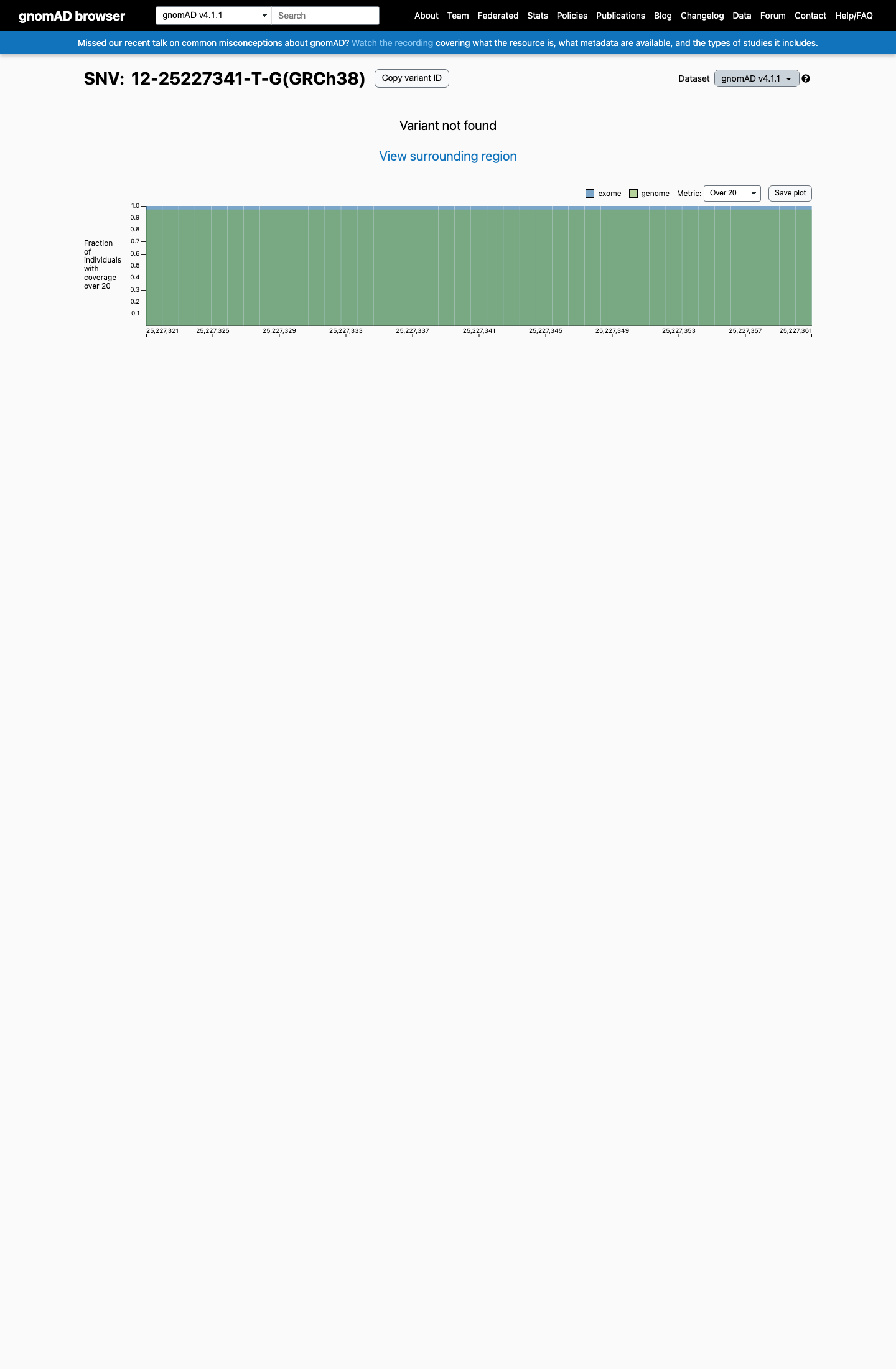
gnomAD v4.1
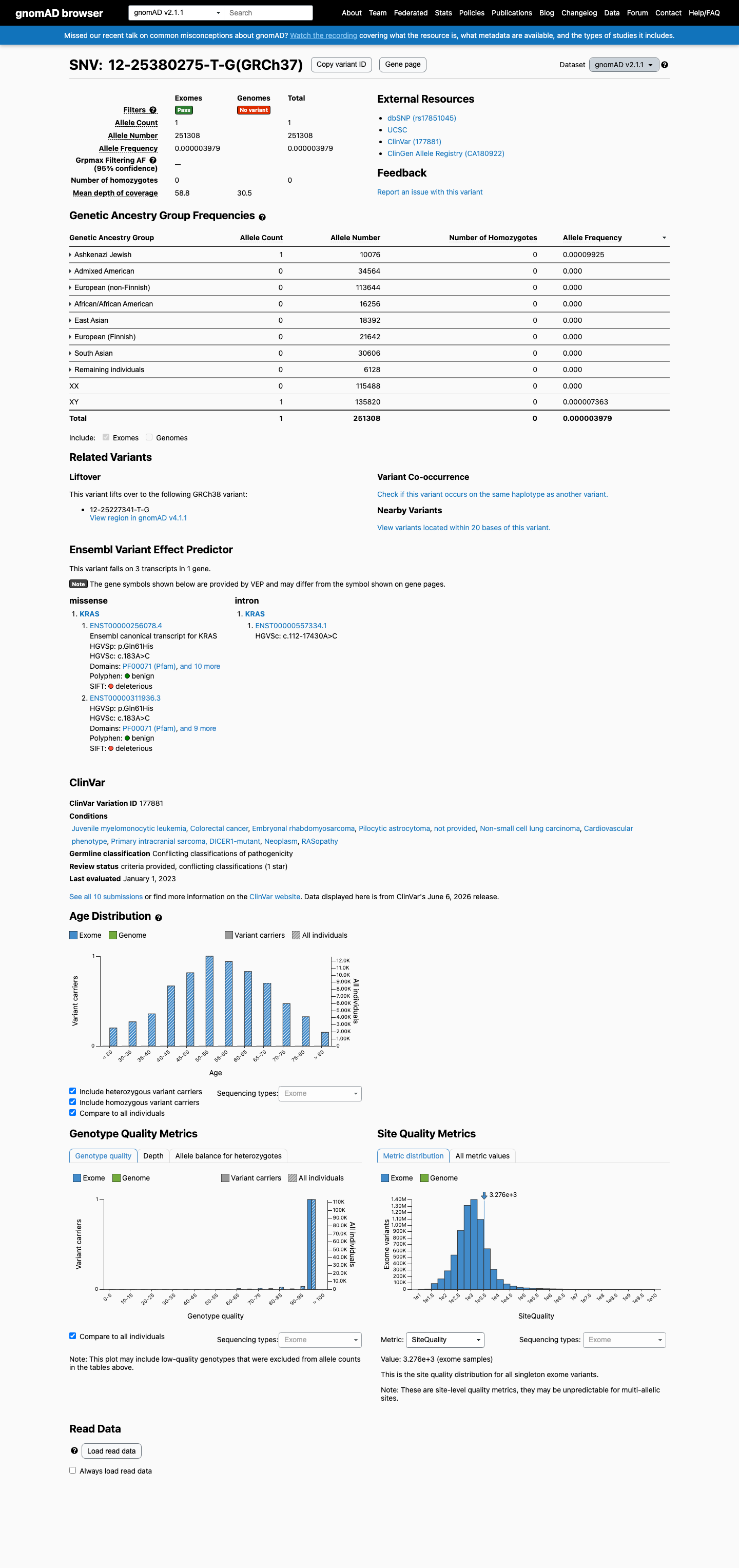
gnomAD v2.1
v4.1
Absent from gnomAD v4.1.
v2.1
This variant is present in gnomAD v2.1 (AF= 3.97918e-06; MAF= 0.00040%, 1/251308 alleles, homozygotes = 0) and has highest observed frequency in the Ashkenazi Jewish population (AF= 9.92457e-05; MAF= 0.00992%, 1/10076 alleles, homozygotes = 0).
🇨🇦 CA
Absent from gnomAD-Canada v1.0.
Allele frequency by ancestry
three datasets · side by side
gnomAD v4.1
Absent
· 0 / ?
0 hom
0 hom
Not observed in any ancestry group.
gnomAD v2.1
0.0004%
· 1 / 251,308
0 hom
0 hom
Ashkenazi Jewish 1 / 10,076 |
0.0099% |
+ 7 not observed (African/African American, Admixed American, East Asian, European (Finnish), European (non-Finnish), Remaining individuals, South Asian)
gnomAD Canada 🇨🇦
Absent
· 0 / ?
0 hom
0 hom
Not observed in any ancestry group.

ClinVar
This variant has been reported in ClinVar as Pathogenic (3 clinical laboratories) and as Uncertain significance (2 clinical laboratories). (ClinVarID = 177881)
In silico
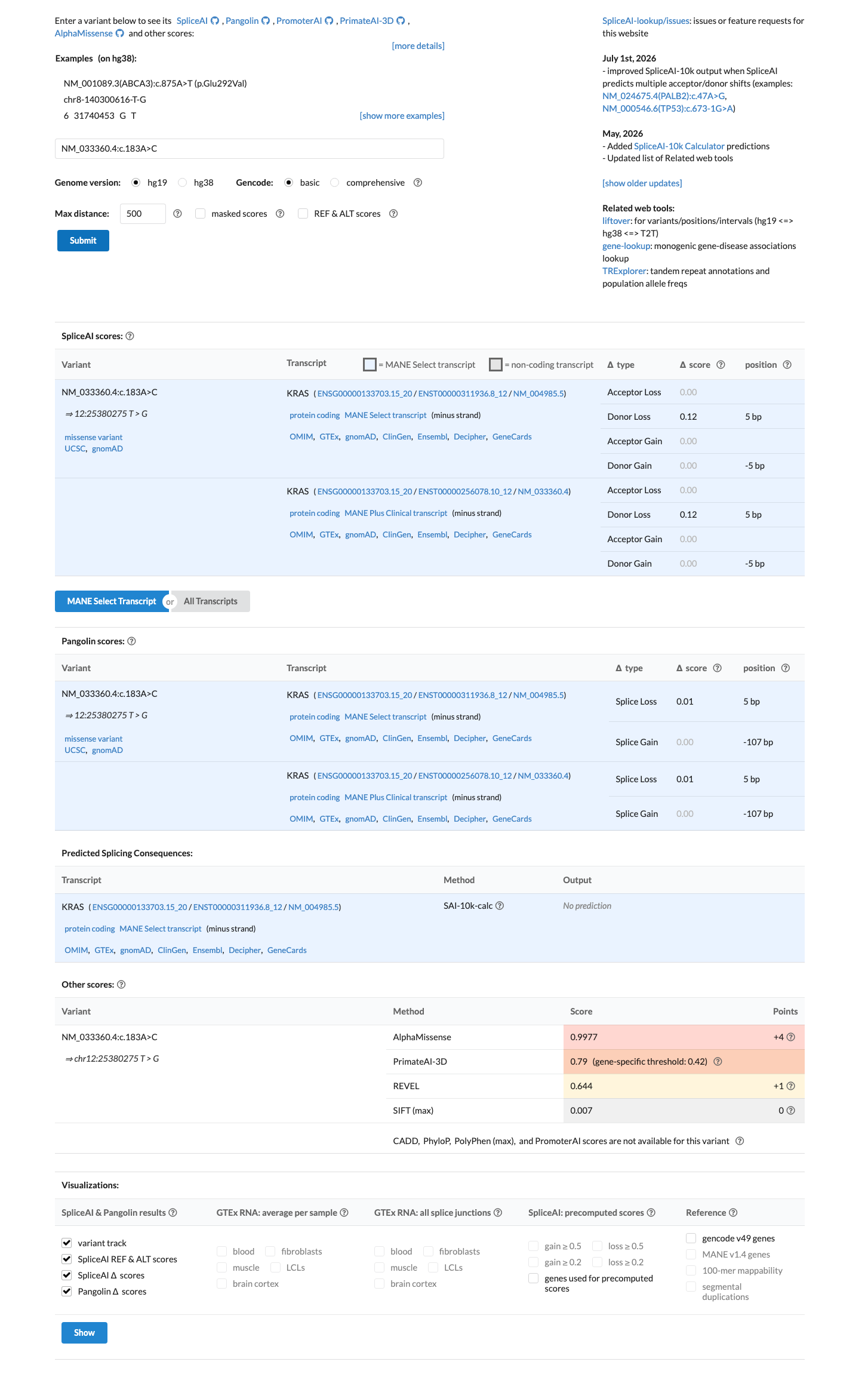
SpliceAI predicts no significant splice impact for this variant (max delta score = 0.12). REVEL score = 0.644. BayesDel score = 0.144965.
Functional
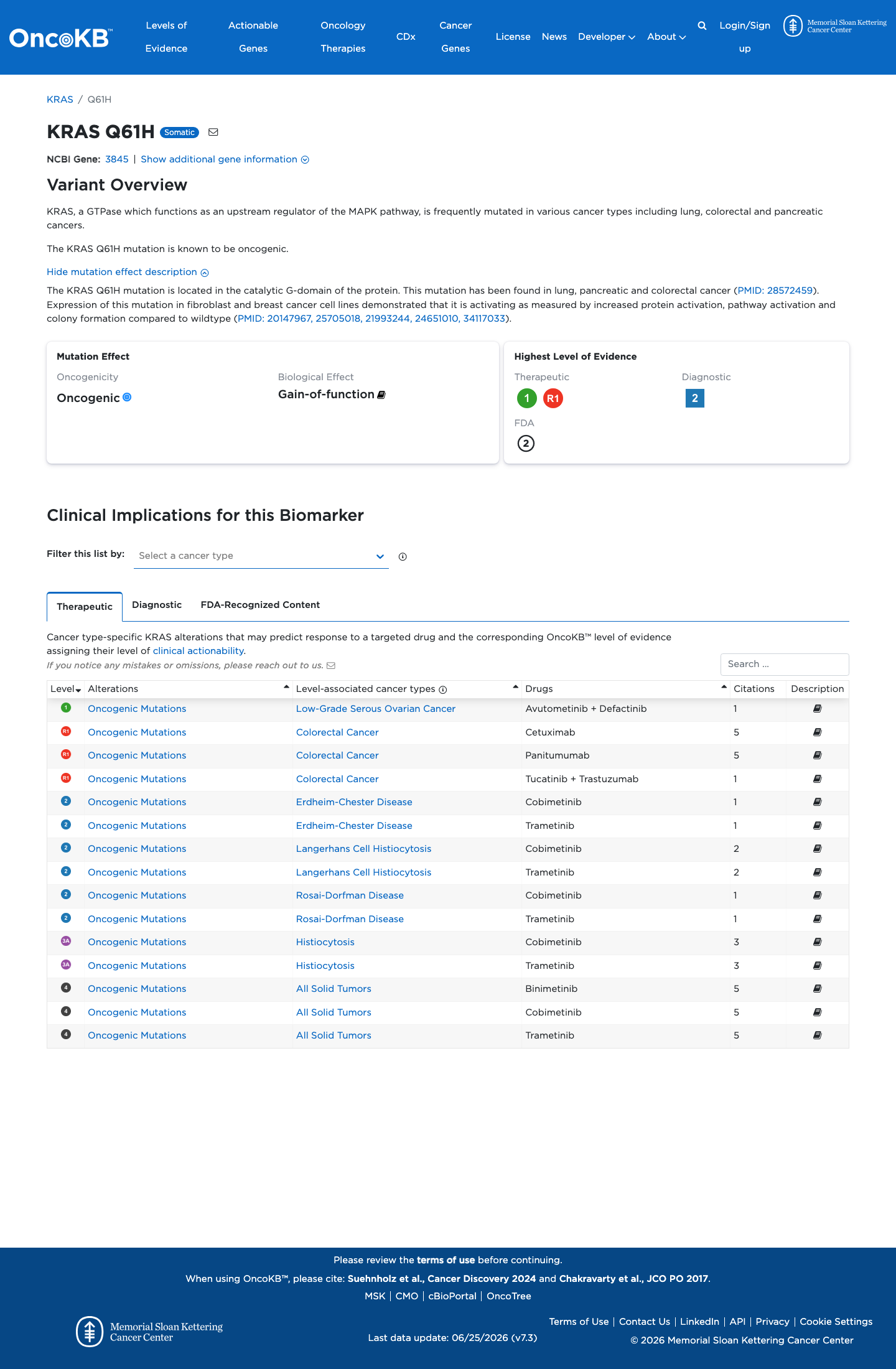
Oncogenic
OncoKB identified variant-specific curated literature and context relevant to functional review; biological-effect context: Gain-of-function; curated oncogenicity label: Oncogenic.
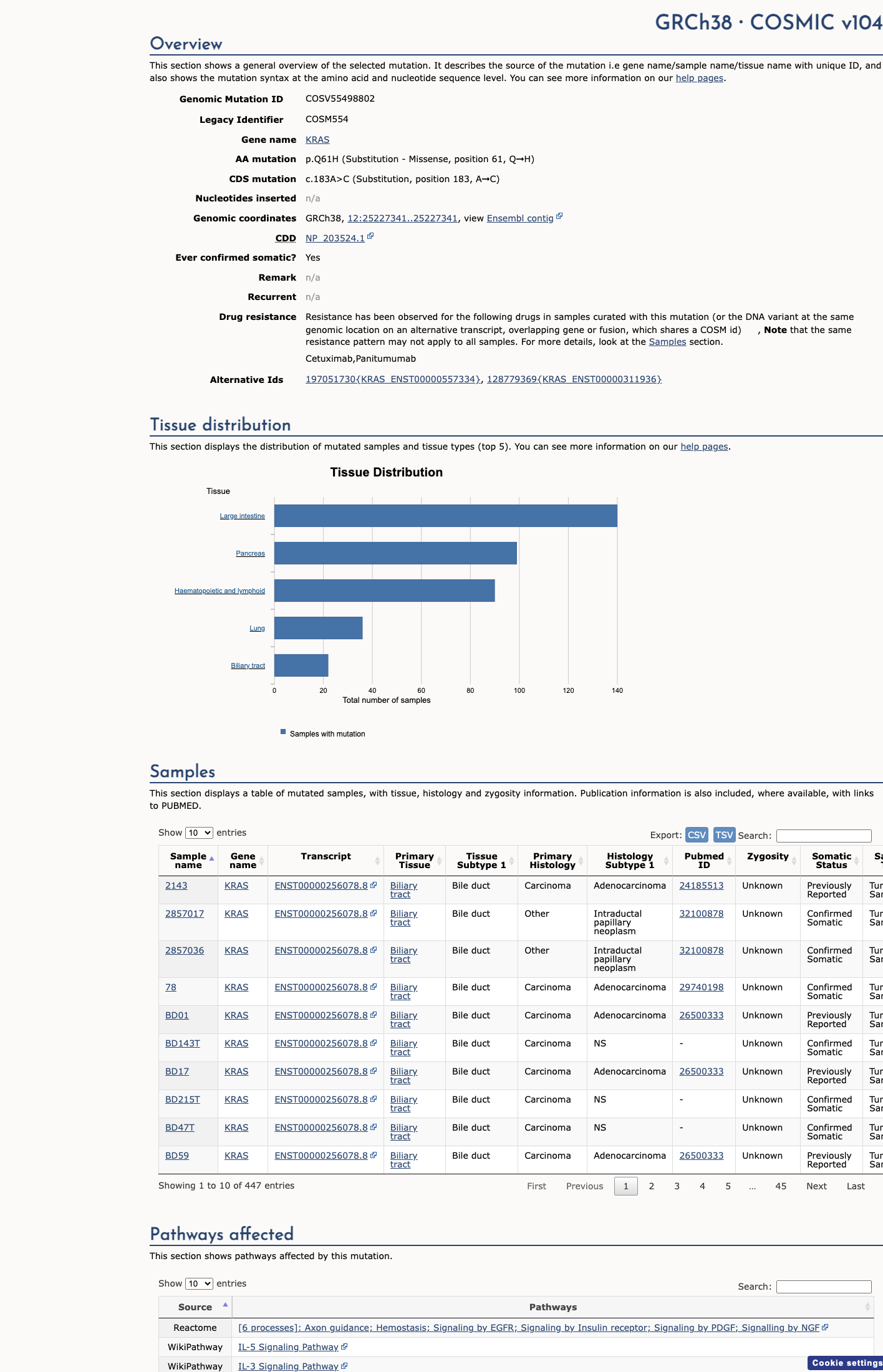
COSMIC
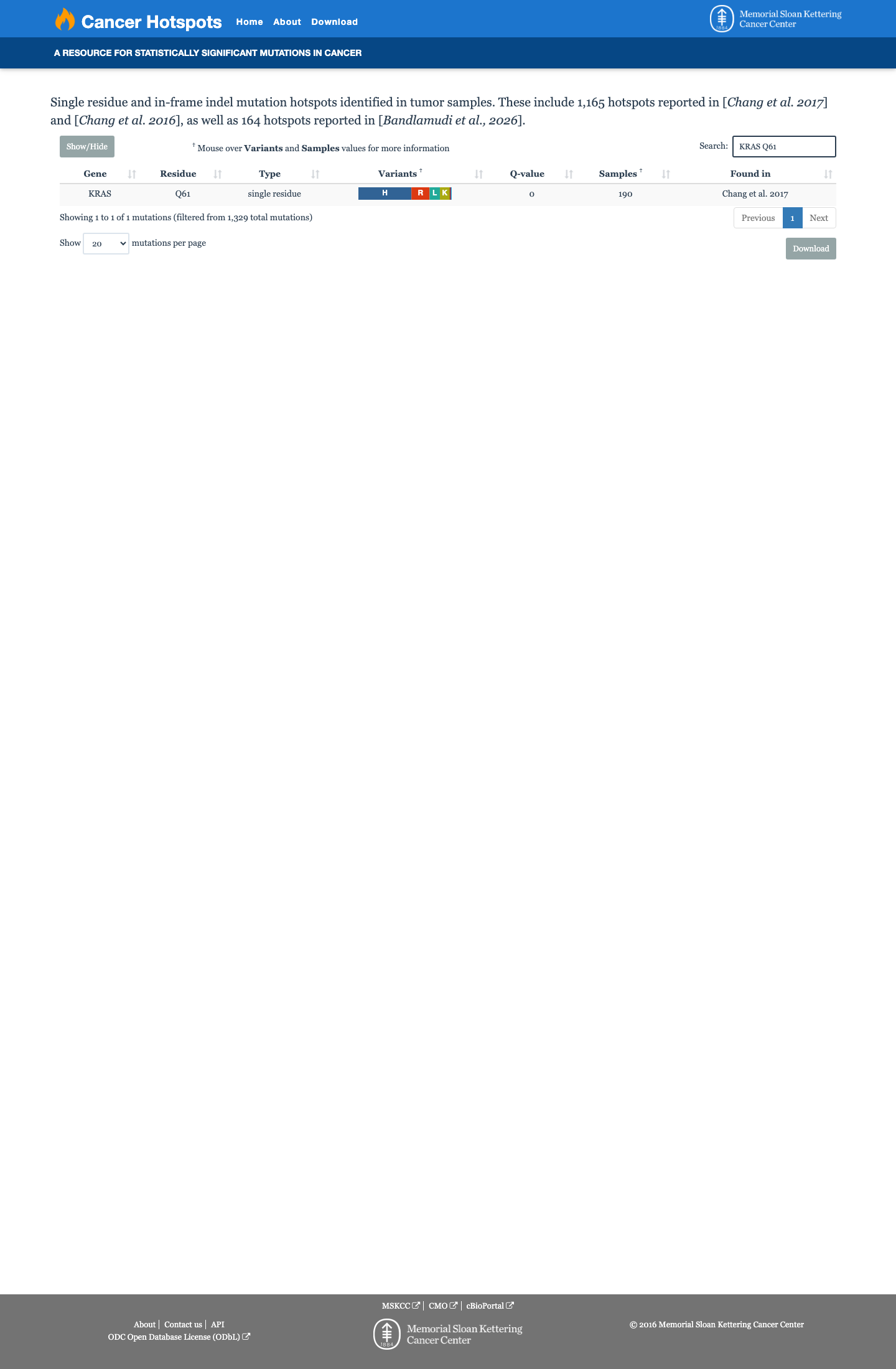
Cancer hotspots
Somatic evidence
Hotspot
COSMIC
This variant lies in a statistically significant hotspot. This variant has previously been reported in somatic cancers (COSMIC; COSV55498802, n = 447 times).
Hotspots
This variant lies in a statistically significant hotspot.
Sources & reference links
9Sources
Triaged references · 8 PMIDs not cited in assessment
20147967 ↗
Activating K-Ras mutations outwith 'hotspot' codons in sporadic colorectal tumours - implications for personalised cancer medicine.
ONCOKB
25705018 ↗
Comparative analysis of KRAS codon 12, 13, 18, 61, and 117 mutations using human MCF10A isogenic cell lines.
ONCOKB
28572459 ↗
AACR Project GENIE: Powering Precision Medicine through an International Consortium.
ONCOKB
25741868 ↗
Standards and guidelines for the interpretation of sequence variants: a joint consensus recommendation of the American College of Medical Genetics and Genomics and the Association for Molecular Pathology.
CLINVAR
32581362 ↗
Whole-genome sequencing of patients with rare diseases in a national health system.
CLINVAR