NM_133487.3:c.235C>T (p.Arg79Cys) is a rare missense variant in RAD51, present at very low frequency in gnomAD (v2.1: 0.018%; v4.1: 0.017%) with no homozygotes observed, meeting PM2 at supporting level.1 Multiple in silico prediction tools (REVEL 0.025, BayesDel -0.556, SpliceAI max delta 0.07) do not support a deleterious effect, meeting BP4 at supporting level.2 The variant is absent from ClinVar and has not been reported in the germline literature. No functional studies, segregation data, case-control comparisons, or de novo observations are available.3 Residue Arg79 is located in the N-terminal domain, outside the functionally critical RecA-like ATPase core (Walker A/B motifs), and is not in a statistically significant mutational hotspot. Applying the generic ACMG/AMP 2015 final combination rules (PMID:25741868), the evidence comprises one supporting pathogenic criterion (PM2) and one supporting benign criterion (BP4). These are insufficient to reach a classification of Likely Pathogenic, Likely Benign, Pathogenic, or Benign. The variant is classified as a Variant of Uncertain Significance (VUS).4
Final classification
VUS
PM2BP4
RAD51
c.235C>T
p.Arg79Cys
This variant
NM_133487.3:c.235C>T (p.Arg79Cys) is a rare missense variant in RAD51, present at very low frequency in gnomAD (v2.1: 0.018%; v4.1: 0.017%) with no homozygotes observed, meeting PM2 at supporting level.
gene-specific framework lacked a usable explicit final combination framework, so generic ACMG/AMP 2015 final-combination rules were applied as fallback; applied criteria: PM2 supporting, BP4 supporting; combination = 1 supporting + 1 supporting benign, which maps to VUS.
Classification rationale
PM2
BP4
VUS
RAD51 c.235C>T
PM2 + BP4
→
VUS
LYFE Sciences is an AI system, and it can make mistakes. Criteria
may be applied incorrectly, sources may be misread, and a confident-looking
classification can still be wrong. Double-check every criterion and
its underlying evidence before relying on any call.
Gene diagram
· NM_133487.3 · variants mapped to exon structure
RAD51
NM_133487.3
Fetching transcript structure from UCSC…
Applied criteria · 2 applied · 19 assessed
MetEvidence satisfies this criterion.
Not metEvaluated against available evidence; threshold not reached.
Not assessedApplies in principle, but no evidence was found to evaluate it.
N/ADoesn't apply to this variant type.
Applied · 2
Strength
Supporting
Moderate
Strong
Very strong
PM2
supporting
Pathogenic
NM_133487.3:c.235C>T is present at very low frequency in gnomAD population databases: v2.1 AF = 0.01847% (9/48,718 alleles) and v4.1 AF = 0.01668% (37/221,888 alleles), both well below the 0.1% PM2 threshold. Absent from gnomAD-Canada in the adjusted call set. No homozygotes observed.
gnomAD v2.1: AF 0.01847% (9/487180 hom)
BP4
supporting
Benign
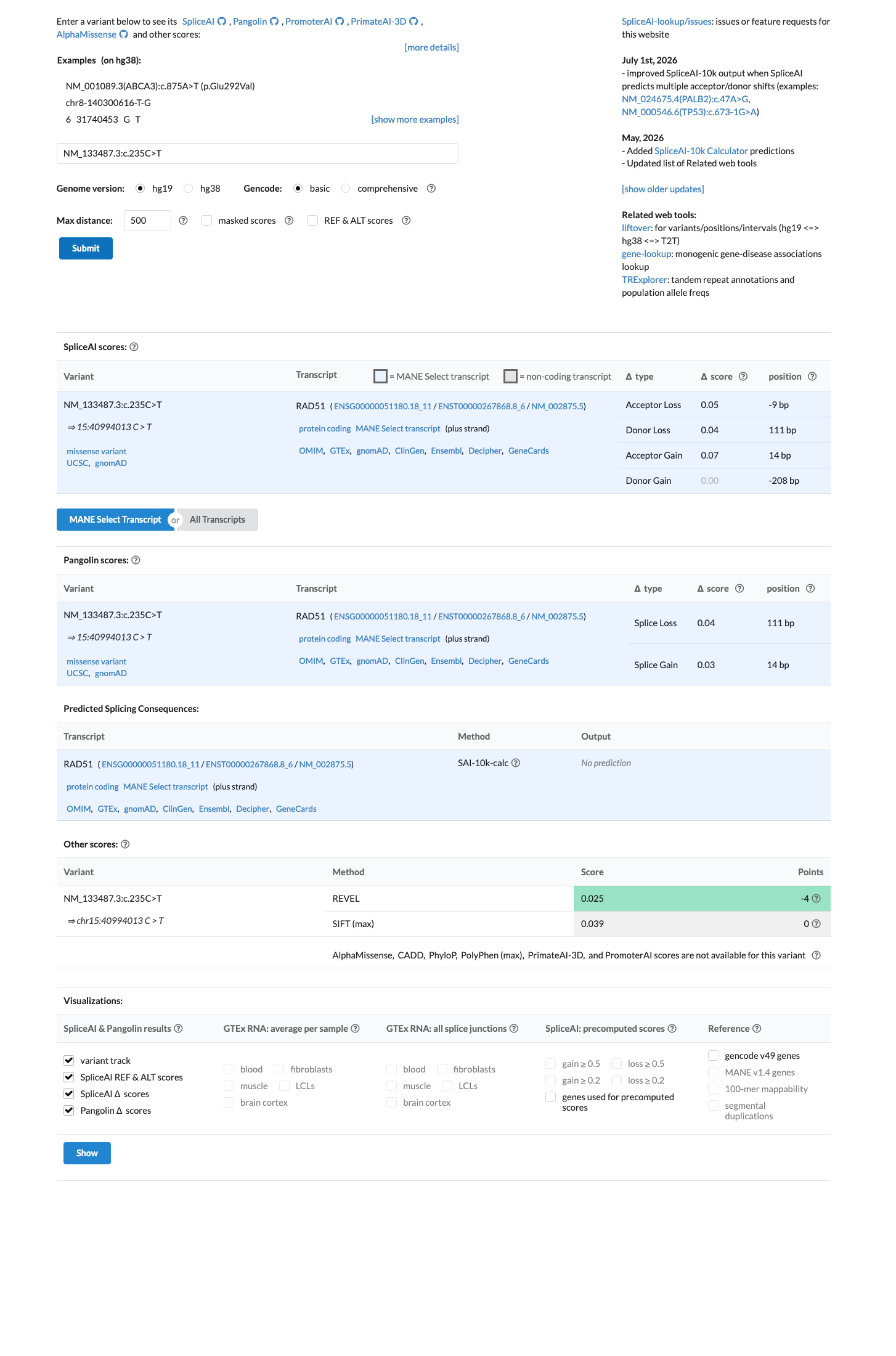
Multiple in silico prediction tools suggest NM_133487.3:c.235C>T (p.Arg79Cys) has no deleterious effect. REVEL score is 0.025 (strongly benign-leaning), BayesDel score is -0.556 (negative; consistent with benign), and SpliceAI predicts no splicing impact (max delta 0.07).
REVEL: 0.025 (non-deleterious)BayesDel: -0.5557 (benign-leaning)SpliceAI max delta: 0.07 (no splice impact).
Assessed · not applied
· 5 not met · 14 not assessed
Pathogenic
PS1
No known pathogenic variant at the same nucleotide position (c.235) was identified for comparison.
PS2
No de novo evidence is available for NM_133487.3:c.235C>T.
PS3
No variant-specific functional studies were identified for NM_133487.3:c.235C>T (p.Arg79Cys).
PS4
No case-control studies or disease-specific cohort data are available for NM_133487.3:c.235C>T.
PM1
Codon 79 (p.Arg79) is located in the N-terminal region of RAD51, outside the RecA-like ATPase domain that contains the functionally critical Walker A and Walker B motifs.
PM5
No known pathogenic missense variant at the same residue (Arg79) was identified.
PM6
No de novo evidence is available for NM_133487.3:c.235C>T.
PP1
No co-segregation data are available for NM_133487.3:c.235C>T.
PP2
Insufficient gene-level constraint data are available to evaluate whether RAD51 has a low rate of benign missense variation.
PP3
Multiple in silico prediction tools do not support a deleterious effect for NM_133487.3:c.235C>T (p.Arg79Cys).
PP4
No patient phenotype or family history information is available for NM_133487.3:c.235C>T.
Benign
BA1
The highest population allele frequency for NM_133487.3:c.235C>T is 0.0939% in the Admixed American population (gnomAD v2.1), which does not exceed the 1% BA1 threshold.
BS1
The highest population allele frequency for NM_133487.3:c.235C>T is 0.0939% in the Admixed American population (gnomAD v2.1), which does not exceed the 0.3% BS1 threshold for non-VCEP adjudication.
BS2
No clinical data on healthy adult carriers of NM_133487.3:c.235C>T are available.
BS3
No variant-specific functional studies were identified for NM_133487.3:c.235C>T (p.Arg79Cys).
BS4
No segregation data are available for NM_133487.3:c.235C>T.
BP1
While loss-of-function is an established disease mechanism for RAD51, missense variants are also reported in RAD51-associated disease.
BP2
No phase information is available for NM_133487.3:c.235C>T.
BP5
No clinical data on alternative molecular diagnoses are available for carriers of NM_133487.3:c.235C>T.
N/A · 7
PVS1 · PM3 · PM4 · PP5 · BP3 · BP6 · BP7
Research & evidence
Population frequency
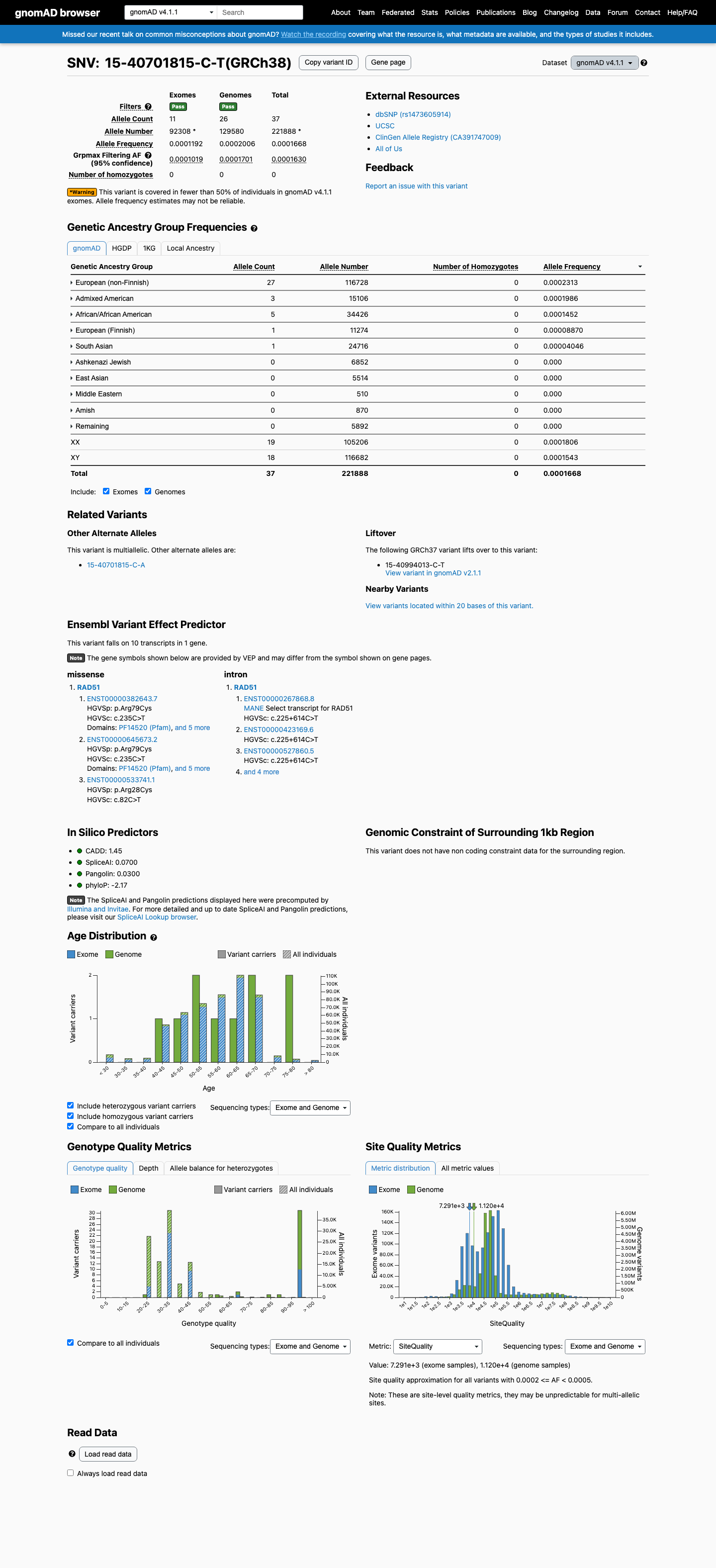
gnomAD v4.1
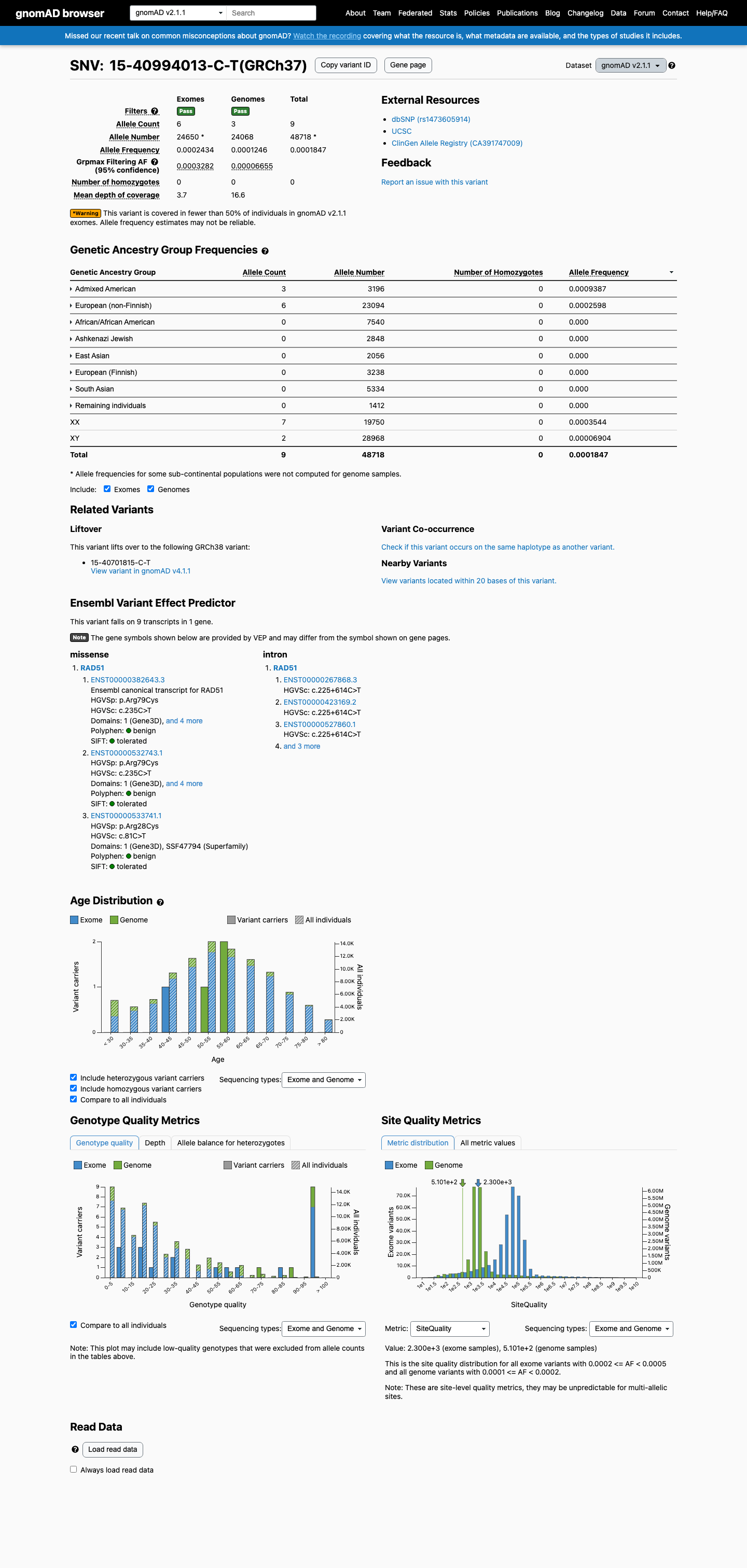
gnomAD v2.1
v4.1
This variant is present in gnomAD v4.1 (AF= 0.000166751; MAF= 0.01668%, 37/221888 alleles, homozygotes = 0) and has highest observed frequency in the European (non-Finnish) population (AF= 0.000231307; MAF= 0.02313%, 27/116728 alleles, homozygotes = 0); grpmax FAF= 0.00016303.
v2.1
This variant is present in gnomAD v2.1 (AF= 0.000184737; MAF= 0.01847%, 9/48718 alleles, homozygotes = 0) and has highest observed frequency in the Admixed American population (AF= 0.000938673; MAF= 0.09387%, 3/3196 alleles, homozygotes = 0); grpmax FAF= 0.00032823.
🇨🇦 CA
This variant is present in gnomAD-Canada v1.0 (AF= 0.00013335111348179759, 2/14998 alleles, homozygotes = 0).
Allele frequency by ancestry
three datasets · side by side
gnomAD v4.1
0.017%
· 37 / 221,888
0 hom · FAF 0.016%
0 hom · FAF 0.016%
European (non-Finnish) 27 / 116,728 |
0.023% |
Admixed American 3 / 15,106 |
0.02% |
African/African American 5 / 34,426 |
0.015% |
European (Finnish) 1 / 11,274 |
0.0089% |
South Asian 1 / 24,716 |
0.004% |
+ 5 not observed (Remaining individuals, Amish, East Asian, Middle Eastern, Ashkenazi Jewish)
gnomAD v2.1
0.018%
· 9 / 48,718
0 hom · FAF 0.033%
0 hom · FAF 0.033%
Admixed American 3 / 3,196 |
0.094% |
European (non-Finnish) 6 / 23,094 |
0.026% |
+ 6 not observed (African/African American, Ashkenazi Jewish, East Asian, European (Finnish), Remaining individuals, South Asian)
gnomAD Canada 🇨🇦
0.013%
· 2 / 14,998
0 hom · FAF 0.0037%
0 hom · FAF 0.0037%
indel · split
European (non-Finnish) 2 / 9,460 |
0.021% |
+ 8 not observed (African/African American, Latino/Admixed American, Ashkenazi Jewish, East Asian, European (Finnish), Middle Eastern, Remaining individuals, South Asian)
In silico
SpliceAI predicts no significant splice impact for this variant (max delta score = 0.07). REVEL score = 0.025. BayesDel score = -0.555735.

Functional
Unknown Oncogenic Effect
OncoKB did not identify variant-specific reviewed functional evidence for this variant; gene-level curated context is available for reviewer follow-up. RAD51, a DNA repair protein, is recurrently altered by mutation or amplification in pancreatic and breast cancers.
COSMIC

Cancer hotspots
Somatic evidence
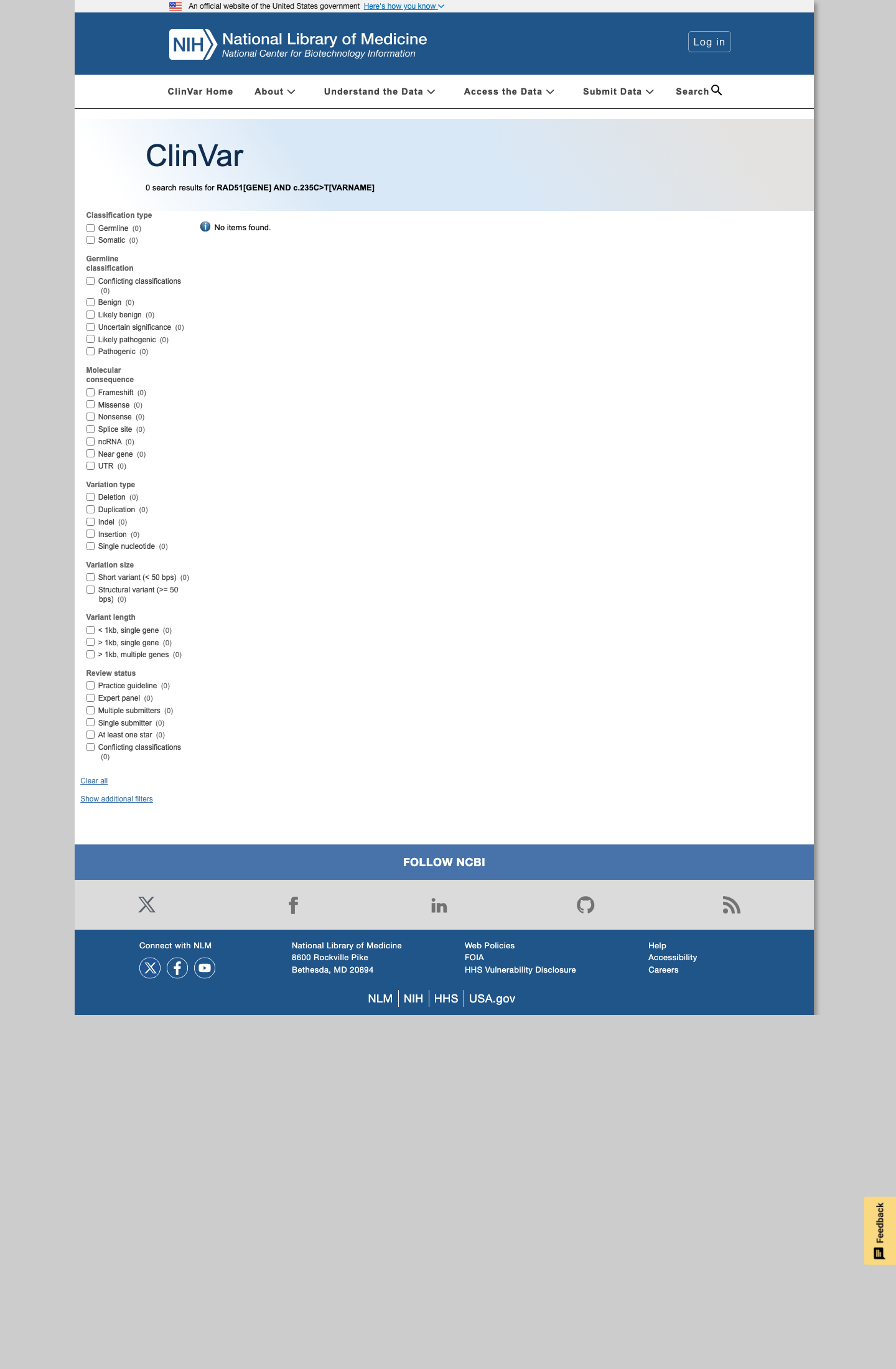
Not in COSMIC / hotspots
COSMIC
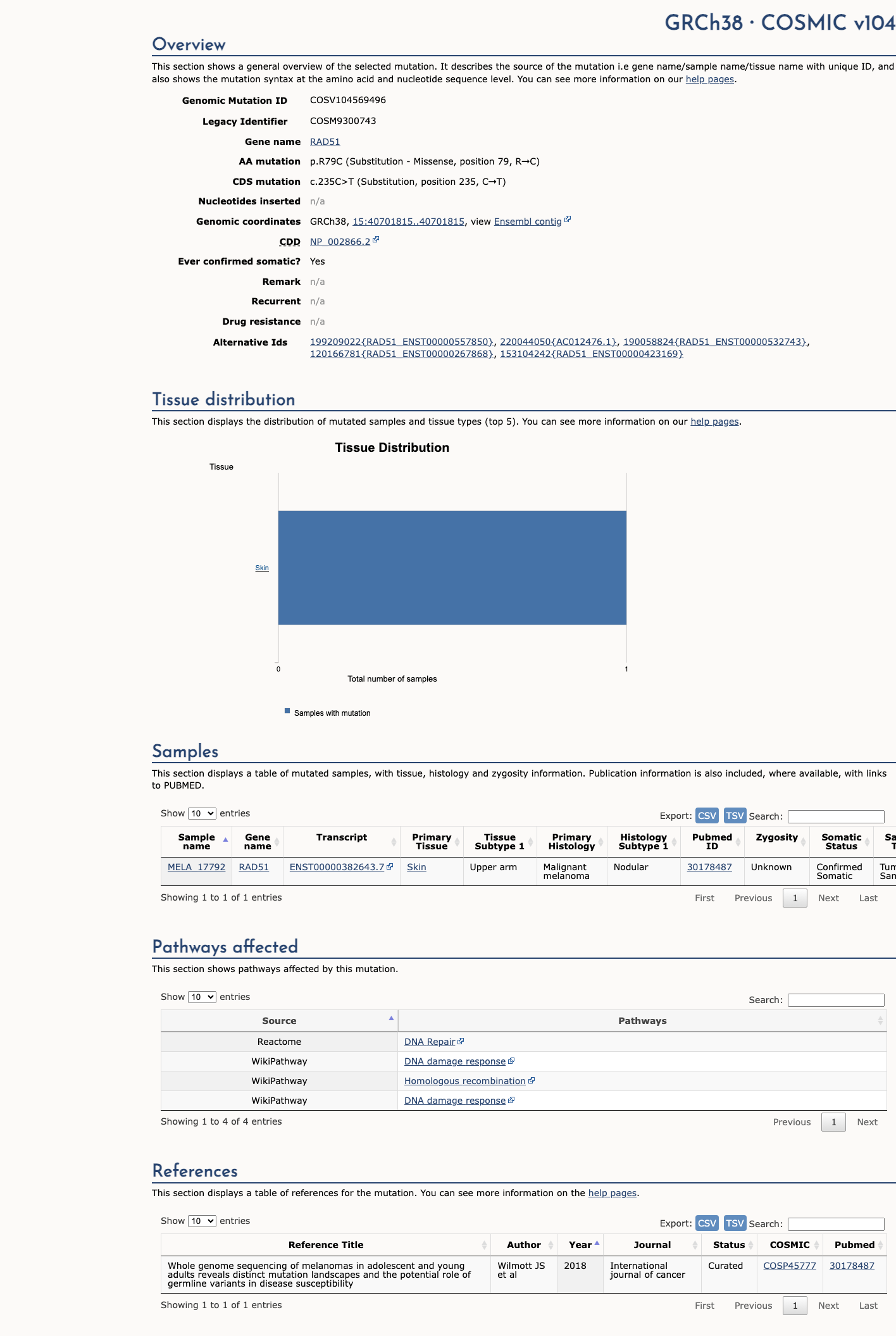
This variant does not lie in a statistically significant hotspot. This variant has previously been reported in somatic cancers (COSMIC; COSV104569496, n = 1 times).
Hotspots
This variant does not lie in a statistically significant hotspot.
Sources & reference links