NM_177438.2:c.4199A>G (p.Asp1400Gly) is a missense variant in exon 22 of DICER1. This variant is present in gnomAD v4.1 at an allele frequency of 4.71e-05 (76/1,612,760 alleles, 0 homozygotes), with a grpmax filtering allele frequency of 4.511e-05. It has been observed across multiple subpopulations, including 7 alleles in the South Asian population (AF=7.69e-05). These frequencies exceed the DICER1 VCEP PM2_Supporting threshold of <5e-06.1 This variant has been reported in ClinVar as Likely Benign following review by the ClinGen DICER1 and miRNA-Processing Gene Variant Curation Expert Panel (ClinVar Variation ID: 412173). Individual clinical laboratory submissions include Uncertain Significance (4 laboratories) and Likely Benign (2 laboratories).2 In silico predictors support a benign interpretation: REVEL score is 0.142, well below the DICER1 VCEP BP4_Supporting threshold of <0.500. SpliceAI predicts no splicing impact (max delta = 0.12). These findings meet BP4_Supporting per DICER1 VCEP criteria.3 The variant has been observed in two siblings with pleuropulmonary blastoma (Leckey et al. 2019, PMID:30665929). However, both siblings also carried a pathogenic DICER1 splice variant (c.2437-2A>G), and the authors explicitly state that c.4199A>G 'has not been associated with DICER1-associated phenotypic features.' In silico algorithms reportedly suggest the variant 'is likely to be tolerated.' No functional studies have been performed.4 Residue Asp1400 lies outside the RNase IIIb domain (p.Y1682–S1846) and is not one of the seven metal ion-binding residues defined by the DICER1 VCEP for PM1. No pathogenic variant at the same residue is known for PS1 or PM5 application. No functional, segregation, de novo, or case-control data support application of any pathogenic criterion.5 Applying the DICER1 VCEP (version 1.4.0) point-based Tavtigian framework: only BP4_Supporting (−1 point) is met. All other applicable criteria are not met. Total point value = −1, which falls within the Uncertain Significance range (Rule 3: ≥−1 and ≤5).6
Final classification
Likely Benign
BP4BP6
DICER1
c.4199A>G
p.Asp1400Gly
This variant
NM_177438.2:c.4199A>G (p.Asp1400Gly) is a missense variant in exon 22 of DICER1.
ClinGen DICER1 and miRNA-Processing Gene Expert Panel Specifications to the ACMG/AMP Variant Interpretation Guidelines for DICER1 Version 1.4.0 v1.4.0 point-based framework: BP4 supporting (-1) + BP6 supporting benign (-1) = -2 points, which maps to Likely Benign.
Classification rationale
BP4BP6
Likely Benign
DICER1 c.4199A>G
BP4 + BP6
→
Likely Benign
LYFE Sciences is an AI system, and it can make mistakes. Criteria
may be applied incorrectly, sources may be misread, and a confident-looking
classification can still be wrong. Double-check every criterion and
its underlying evidence before relying on any call.
Gene diagram
· NM_177438.2 · variants mapped to exon structure
DICER1
NM_177438.2
Fetching transcript structure from UCSC…
Applied criteria · 2 applied · 16 assessed
MetEvidence satisfies this criterion.
Not metEvaluated against available evidence; threshold not reached.
Not assessedApplies in principle, but no evidence was found to evaluate it.
N/ADoesn't apply to this variant type.
Applied · 2
Strength
Supporting
Moderate
Strong
Very strong
BP4
supporting
Benign
The DICER1 VCEP BP4_Supporting requires REVEL score <0.500 and agreement in splicing predictors that no splicing effects are predicted for missense variants. REVEL score is 0.142 (<0.500 threshold satisfied). SpliceAI max delta is 0.12, indicating no predicted splicing impact. Both conditions are met.
REVEL 0.142 (<0.500)SpliceAI max delta 0.12 (no splicing impact predicted)
Assessed · not applied
· 16 not met · 0 not assessed
Pathogenic
PS1
PS1 requires a different nucleotide change producing the same amino acid substitution (p.Asp1400Gly) that has been classified as pathogenic by the ClinGen DICER1 VCEP.
PS2
No de novo occurrence data are available for this variant.
PS3
No functional studies (RNA splicing assay or in vitro cleavage assay) have been performed for this variant.
PS4
The DICER1 VCEP uses a phenotype points system for PS4.
PM1
The variant results in p.Asp1400Gly.
PM2
The DICER1 VCEP PM2_Supporting threshold is allele frequency <0.000005 across gnomAD with no more than one allele in any subpopulation.
PM5
PM5 requires a different missense change at the same residue (D1400) that has been classified as pathogenic by the ClinGen DICER1 VCEP.
PP1
No co-segregation data are available for this variant.
PP3
The DICER1 VCEP requires REVEL score ≥0.750 for PP3_Supporting in missense variants, or agreement in splicing predictors of splicing effects.
PP4
The DICER1 VCEP PP4 requires somatic tumor testing demonstrating a known RNase IIIb hotspot second hit (at residues S1344, E1705, D1709, D1713, G1809, D1810, or E1813) with retention of the germline variant.
Benign
BA1
BA1 requires allele frequency >0.003 (0.3%) in a gnomAD subpopulation with >2,000 alleles tested and ≥5 alleles present.
BS1
BS1 requires allele frequency >0.0003 (0.03%) in a gnomAD subpopulation with >2,000 alleles tested and ≥5 alleles present.
BS2
BS2 requires ≥40 unrelated females tumor-free through age 50 (Strong) or ≥10 (Supporting), or homozygosity in healthy individuals.
BS3
The DICER1 VCEP BS3_Strong requires an RNA assay showing no splicing impact (for intronic/synonymous variants) observed more than once.
BS4
BS4 requires phenotype-positive, genotype-negative 1st–3rd degree relatives.
BP2
BP2 requires ≥1 observation in trans with a P/LP DICER1 variant, or ≥3 observations in cis/phase unknown with 2+ different P/LP DICER1 variants.
N/A · 10
PVS1 · PM3 · PM4 · PM6 · PP2 · PP5 · BP1 · BP3 · BP5 · BP7
Research & evidence
Population frequency · supports benign
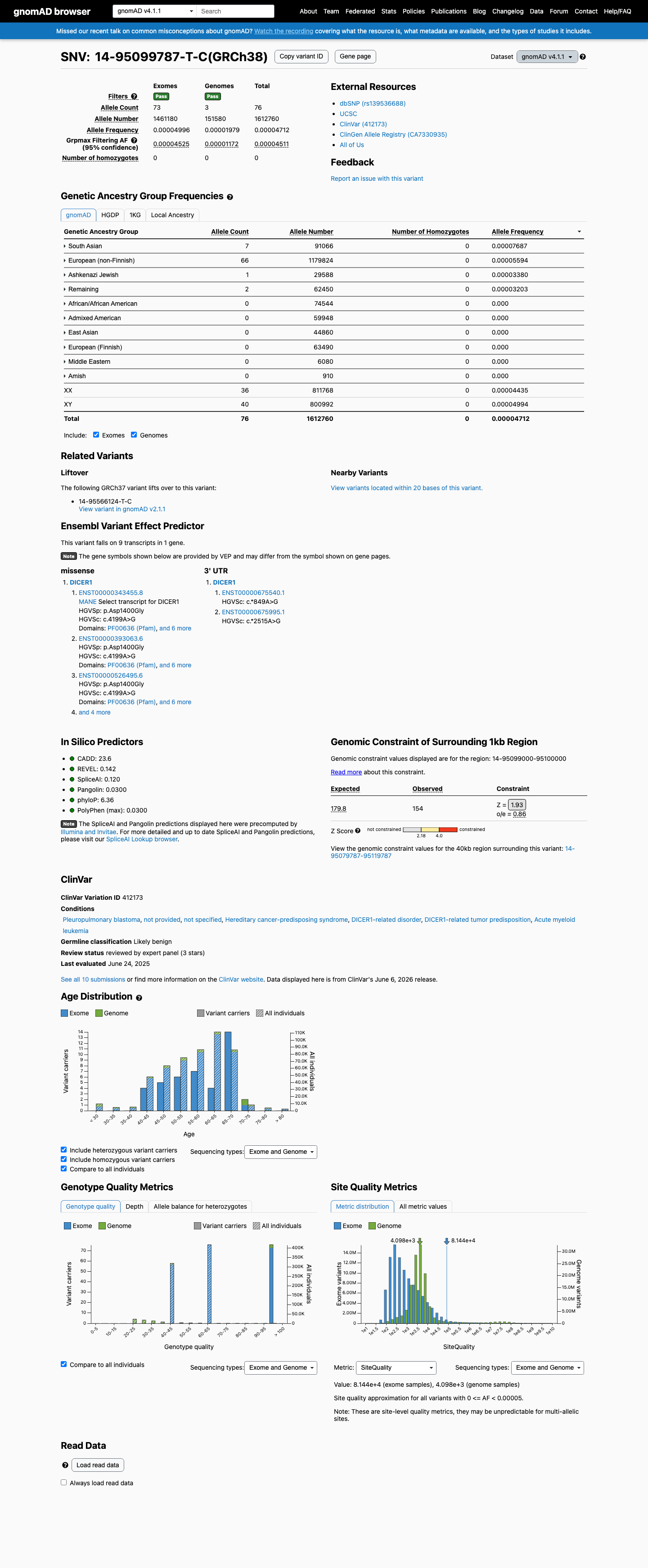
gnomAD v4.1
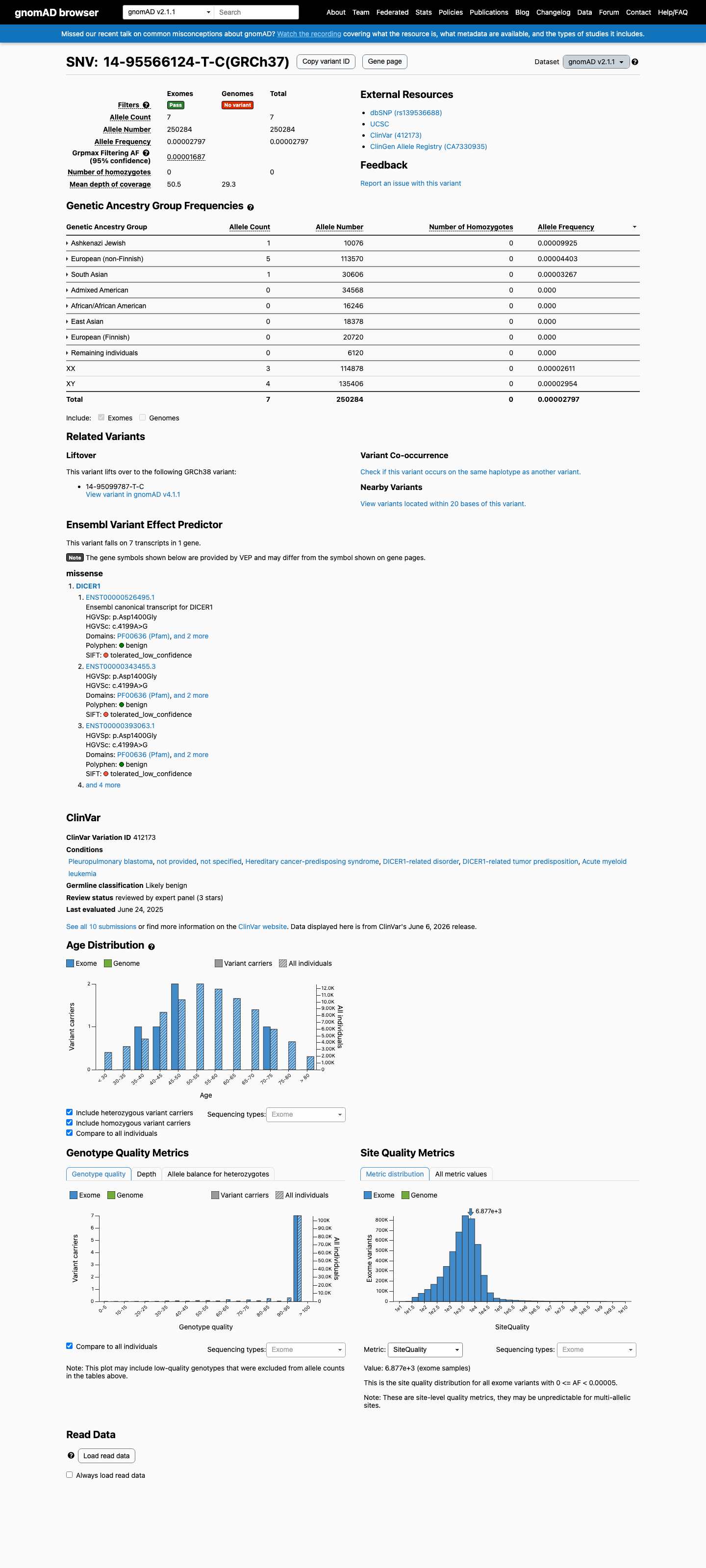
gnomAD v2.1
v4.1
This variant is present in gnomAD v4.1 (AF= 4.71242e-05; MAF= 0.00471%, 76/1612760 alleles, homozygotes = 0) and has highest observed frequency in the South Asian population (AF= 7.68673e-05; MAF= 0.00769%, 7/91066 alleles, homozygotes = 0); grpmax FAF= 4.511e-05.
v2.1
This variant is present in gnomAD v2.1 (AF= 2.79682e-05; MAF= 0.00280%, 7/250284 alleles, homozygotes = 0) and has highest observed frequency in the Ashkenazi Jewish population (AF= 9.92457e-05; MAF= 0.00992%, 1/10076 alleles, homozygotes = 0); grpmax FAF= 1.687e-05.
🇨🇦 CA
Not available in gnomAD-Canada v1.0.
Allele frequency by ancestry
three datasets · side by side
gnomAD v4.1
0.0047%
· 76 / 1,612,760
0 hom · FAF 0.0045%
0 hom · FAF 0.0045%
South Asian 7 / 91,066 |
0.0077% |
European (non-Finnish) 66 / 1,179,824 |
0.0056% |
Ashkenazi Jewish 1 / 29,588 |
0.0034% |
Remaining individuals 2 / 62,450 |
0.0032% |
+ 6 not observed (Admixed American, European (Finnish), Amish, East Asian, Middle Eastern, African/African American)
gnomAD v2.1
0.0028%
· 7 / 250,284
0 hom · FAF 0.0017%
0 hom · FAF 0.0017%
Ashkenazi Jewish 1 / 10,076 |
0.0099% |
European (non-Finnish) 5 / 113,570 |
0.0044% |
South Asian 1 / 30,606 |
0.0033% |
+ 5 not observed (African/African American, Admixed American, East Asian, European (Finnish), Remaining individuals)
gnomAD Canada 🇨🇦
Absent
· 0 / ?
0 hom
0 hom
Not observed in any ancestry group.

ClinVar
This variant has been reported in ClinVar as Uncertain significance (4 clinical laboratories) and as Likely benign (2 clinical laboratories) and as Likely Benign by ClinGen DICER1 and miRNA-Processing Gene Variant Curation Expert Panel, ClinGen (expert panel). (ClinVarID = 412173)
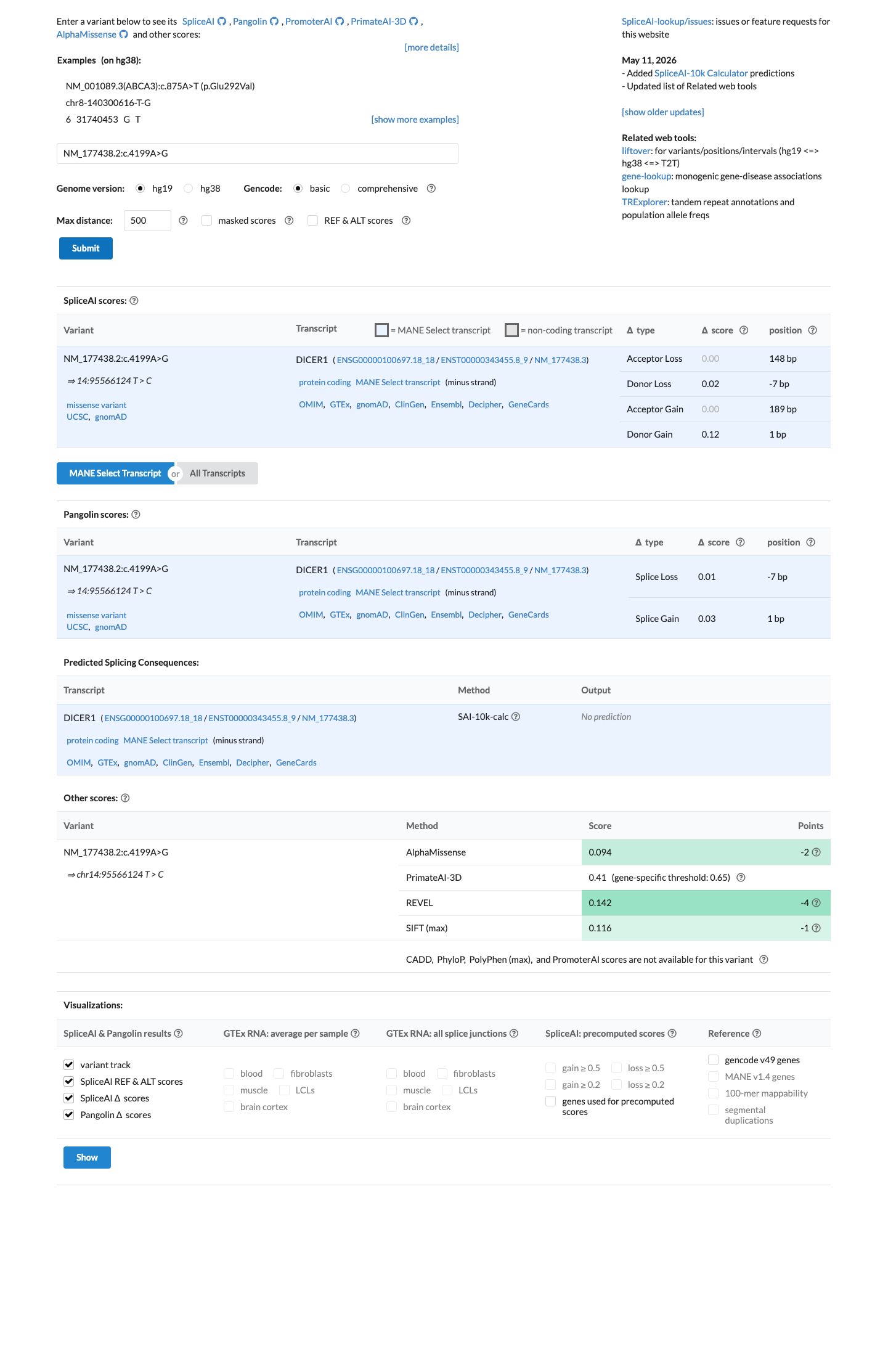
In silico
SpliceAI predicts no significant splice impact for this variant (max delta score = 0.12). REVEL score = 0.142. BayesDel score = -0.0837422.
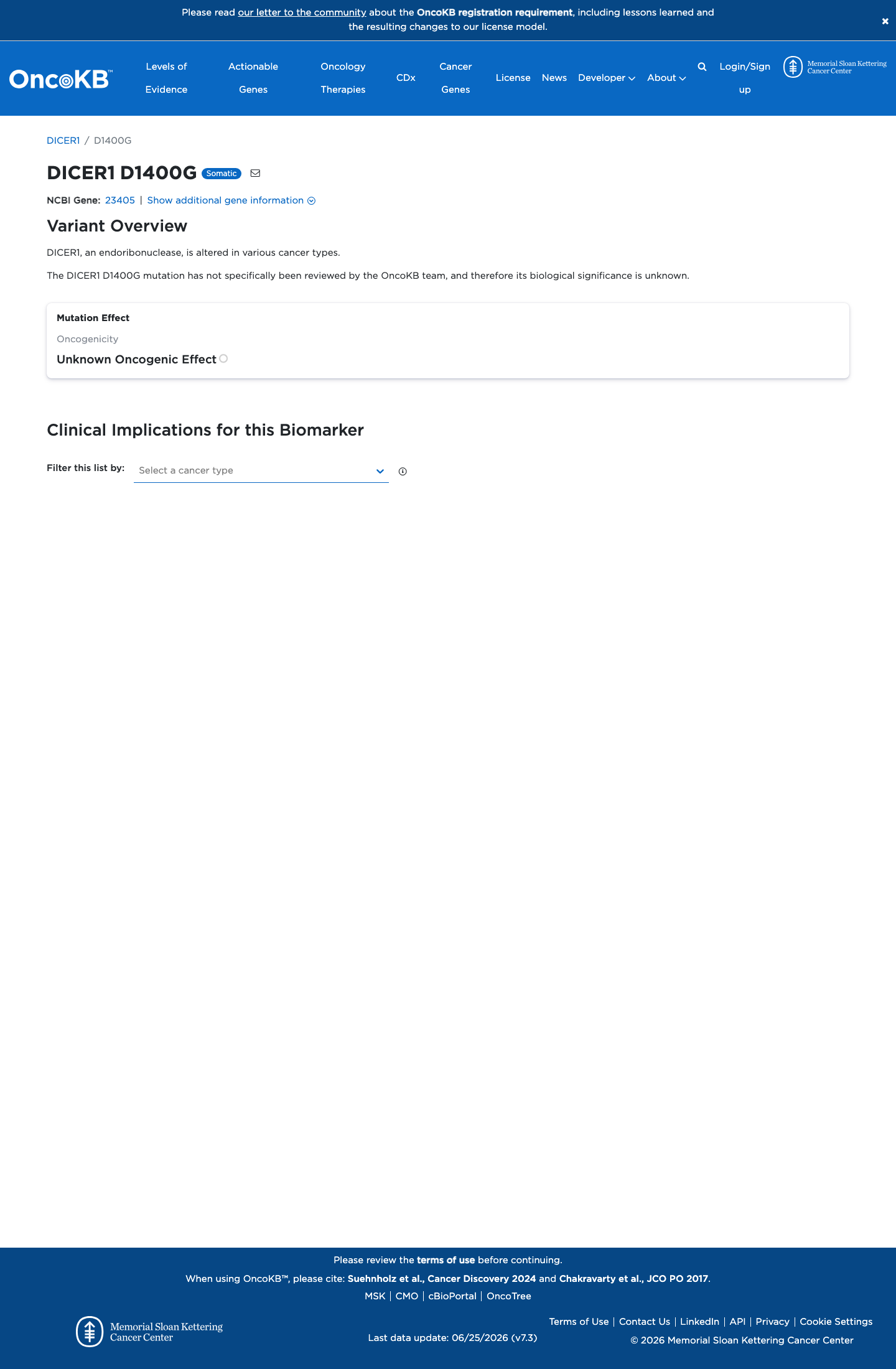
Functional
Unknown Oncogenic Effect
OncoKB did not identify variant-specific reviewed functional evidence for this variant; gene-level curated context is available for reviewer follow-up. DICER1, an endoribonuclease, is altered in various cancer types.

COSMIC

Cancer hotspots
Somatic evidence
Not in COSMIC / hotspots
COSMIC
This variant does not lie in a statistically significant hotspot. This variant has not previously been reported in somatic cancers (COSMIC).
Hotspots
This variant does not lie in a statistically significant hotspot.
Sources & reference links
9Sources
Triaged references · 8 PMIDs not cited in assessment
25741868 ↗
Standards and guidelines for the interpretation of sequence variants: a joint consensus recommendation of the American College of Medical Genetics and Genomics and the Association for Molecular Pathology.
CLINVAR
26467025 ↗
A Standardized DNA Variant Scoring System for Pathogenicity Assessments in Mendelian Disorders.
CLINVAR
30665929 ↗
Novel intronic DICER1 variation associated with pleuropulmonary blastoma in two siblings.
CLINVAR
25394175 ↗
A practice guideline from the American College of Medical Genetics and Genomics and the National Society of Genetic Counselors: referral indications for cancer predisposition assessment.
CLINVAR
29641532 ↗
Germline mutations in candidate predisposition genes in individuals with cutaneous melanoma and at least two independent additional primary cancers.
CLINVAR
28492532 ↗
Sherloc: a comprehensive refinement of the ACMG-AMP variant classification criteria.
CLINVAR