Starting
Initialising…
0%
DICER1
Final classification
Benign
DICER1 c.4680G>A · p.Ala1560=
DICER1

The DICER1 c.4680G>A (p.Ala1560=) variant has been reported in ClinVar with benign classifications from multiple clinical laboratories.

Gene
DICER1
Transcript
NM_177438.3
HGVS · transcript:coding
NM_177438.3:c.4680G>A
Consequence
N/A
GRCh38
chr14:95096240 C>T
GRCh37
chr14:95562577 C>T
Basis ClinGen DICER1 and miRNA-Processing Gene Expert Panel Specifications to the ACMG/AMP Variant Interpretation Guidelines for DICER1 Version 1.4.0 v1.4.0 point-based framework: BA1 stand-alone benign (-8) + BS1 strong (-4) + BS2 supporting (-1) = -13 points, which maps to Benign.
ClinGen DICER1 and miRNA-Processing Gene Expert Panel Specifications to the ACMG/AMP Variant Interpretation Guidelines for DICER1 Version 1.4.0 v1.4.0 point-based framework: BA1 stand-alone benign (-8) + BS1 strong (-4) + BS2 supporting (-1) = -13 points, which maps to Benign.
Classification rationale
BA1BS1BS2 Benign
DICER1 c.4680G>A

The DICER1 c.4680G>A (p.Ala1560=) variant has been reported in ClinVar with benign classifications from multiple clinical laboratories.1 This variant is common in population databases, including gnomAD v4.1 with total allele frequency 0.00631 and African/African American allele frequency 0.11919, which is well above the DICER1 BA1 threshold of 0.003; gnomAD-Canada also shows allele frequency 0.00863 with 11 homozygotes.2 Computational data do not support a splice-disrupting effect, with SpliceAI max delta score 0.01, and the REVEL score is 0.07.3

BA1 + BS1 + BS2 Benign
Gene diagram · NM_177438.3 · variants mapped to exon structure
DICER1 NM_177438.3
Fetching transcript structure from UCSC…
Applied criteria · 3 met · select any tile
Met
Not met
Not assessed
N/A
Strength very strong supporting
Pathogenic evidence
PVS
PS
PM
PP
Benign evidence
BA
BS
BP
Rationale
Select a criterion.
Sources
Evidence used
    Gaps remaining
      Rule
      Research & evidence
      Population frequency · supports benign
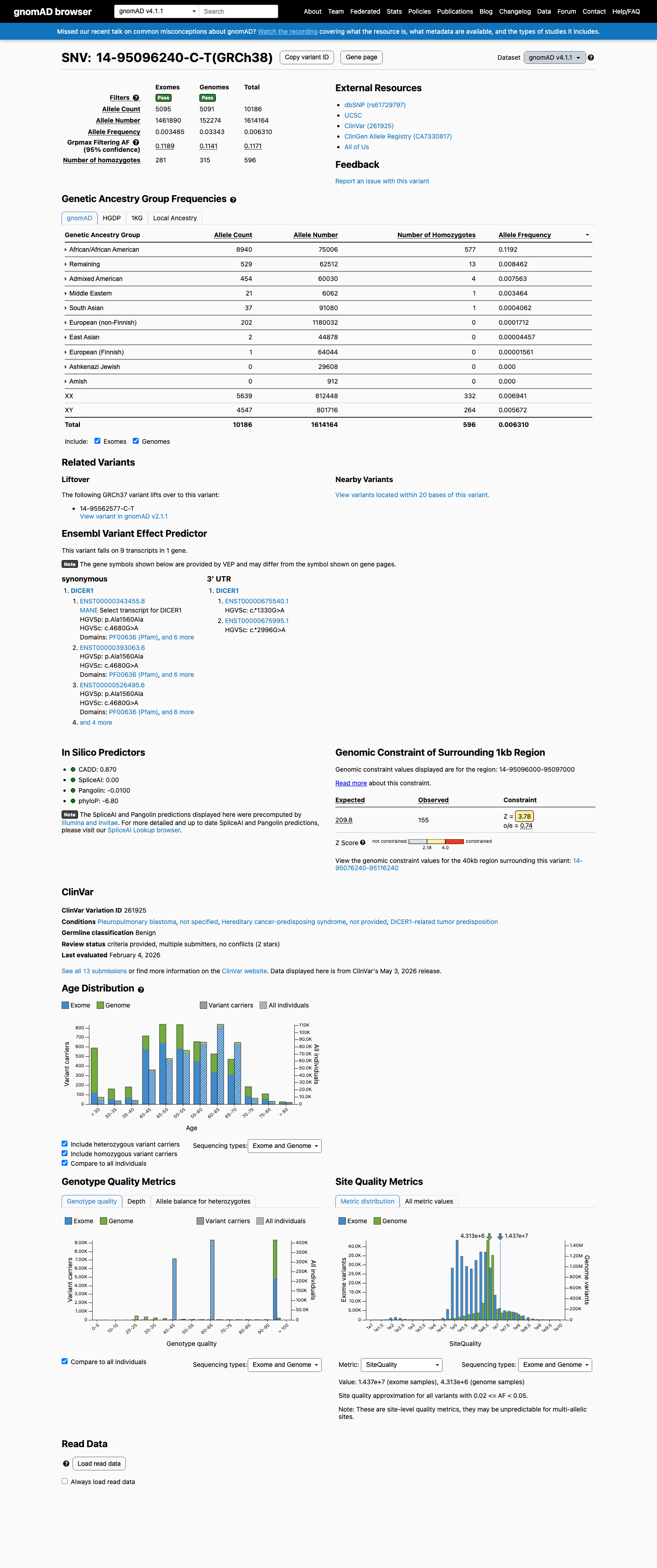
      gnomAD v4.1 screenshot
      gnomAD v4.1
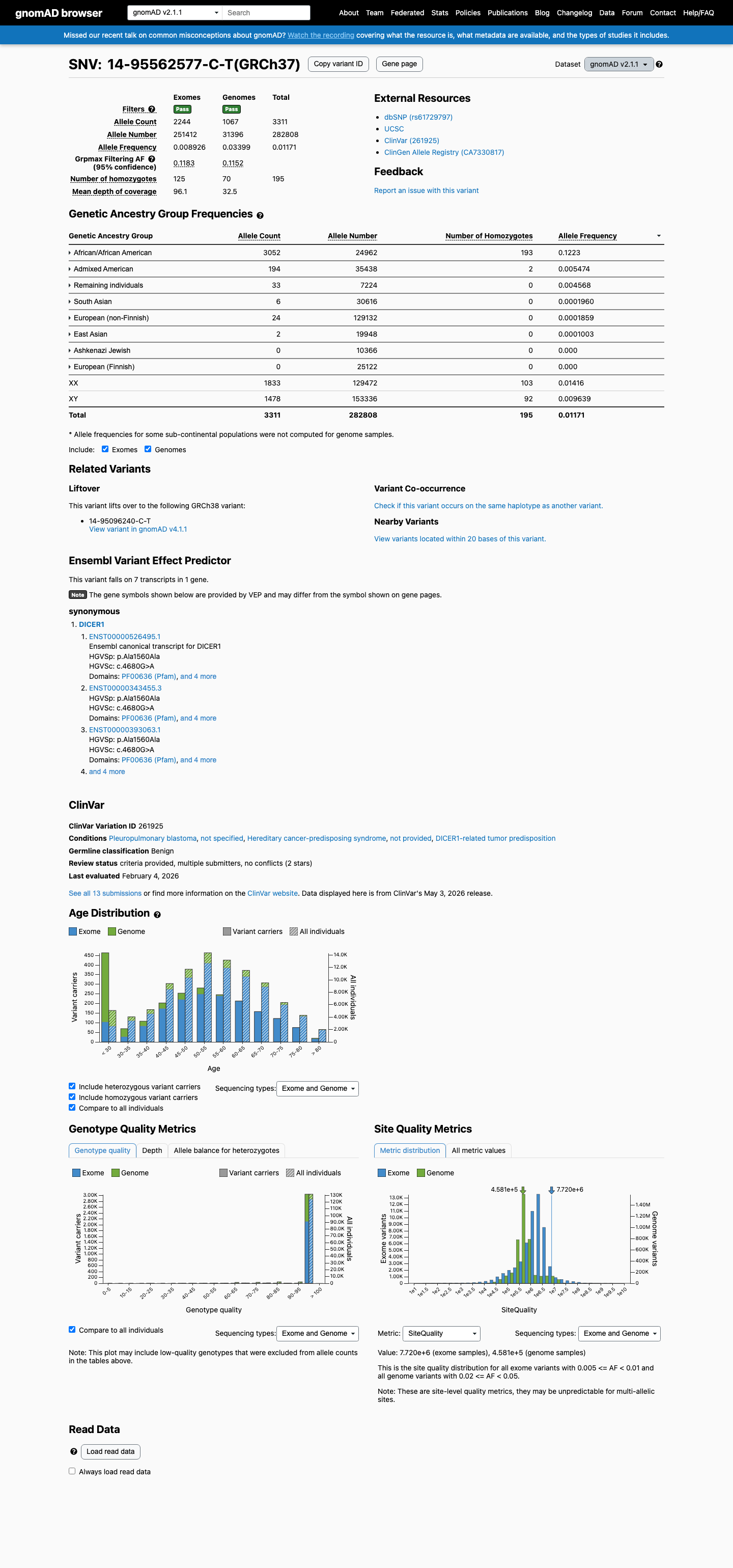
      gnomAD v2.1 screenshot
      gnomAD v2.1
      v4.1
      This variant is present in gnomAD v4.1 (AF= 0.00631039; MAF= 0.63104%, 10186/1614164 alleles, homozygotes = 596) and has highest observed frequency in the African/African American population (AF= 0.11919; MAF= 11.91905%, 8940/75006 alleles, homozygotes = 577); grpmax FAF= 0.117124.
      v2.1
      This variant is present in gnomAD v2.1 (AF= 0.0117076; MAF= 1.17076%, 3311/282808 alleles, homozygotes = 195) and has highest observed frequency in the African/African American population (AF= 0.122266; MAF= 12.22658%, 3052/24962 alleles, homozygotes = 193); grpmax FAF= 0.1183.
      🇨🇦 CA
      This variant is present in gnomAD-Canada v1.0 (AF= 0.00863286; MAF= 0.86329%, 159/18418 alleles, homozygotes = 11) and has highest observed frequency in the afr population (AF= 0.140196; grpmax FAF95= 0.121485).
      Allele frequency by ancestry
      three datasets · side by side
      gnomAD v4.1
      0.63% · 10186 / 1,614,164
      596 hom · FAF 12%
      African/African American
      8940 / 75,006
      12%
      577 hom
      Remaining individuals
      529 / 62,512
      0.85%
      13 hom
      Admixed American
      454 / 60,030
      0.76%
      4 hom
      Middle Eastern
      21 / 6,062
      0.35%
      1 hom
      South Asian
      37 / 91,080
      0.041%
      1 hom
      European (non-Finnish)
      202 / 1,180,032
      0.017%
      East Asian
      2 / 44,878
      0.0045%
      European (Finnish)
      1 / 64,044
      0.0016%
      + 2 not observed (Amish, Ashkenazi Jewish)
      gnomAD v2.1
      1.2% · 3311 / 282,808
      195 hom · FAF 12%
      African/African American
      3052 / 24,962
      12%
      193 hom
      Admixed American
      194 / 35,438
      0.55%
      2 hom
      Remaining individuals
      33 / 7,224
      0.46%
      South Asian
      6 / 30,616
      0.02%
      European (non-Finnish)
      24 / 129,132
      0.019%
      East Asian
      2 / 19,948
      0.01%
      + 2 not observed (Ashkenazi Jewish, European (Finnish))
      gnomAD Canada 🇨🇦
      0.86% · 159 / 18,418
      11 hom · FAF 12%
      African/African American
      143 / 1,020
      14%
      11 hom
      Remaining individuals
      8 / 1,138
      0.7%
      Latino/Admixed American
      5 / 838
      0.6%
      European (non-Finnish)
      3 / 11,740
      0.026%
      + 5 not observed (Ashkenazi Jewish, East Asian, European (Finnish), Middle Eastern, South Asian)
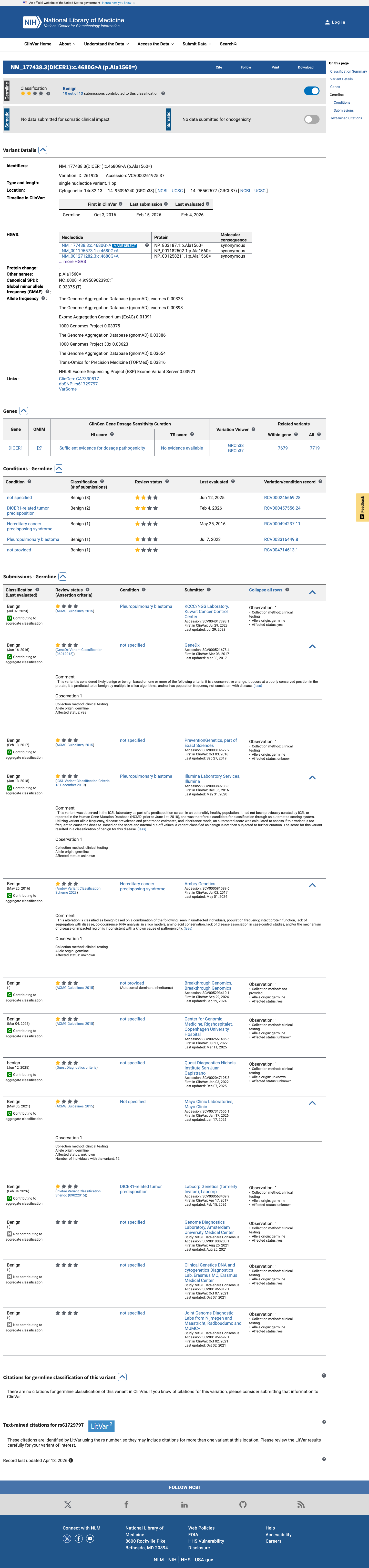
      ClinVar screenshot
      ClinVar
      This variant has been reported in ClinVar as Benign (11 clinical laboratories) and as benign (1 clinical laboratory). (ClinVarID = 261925)
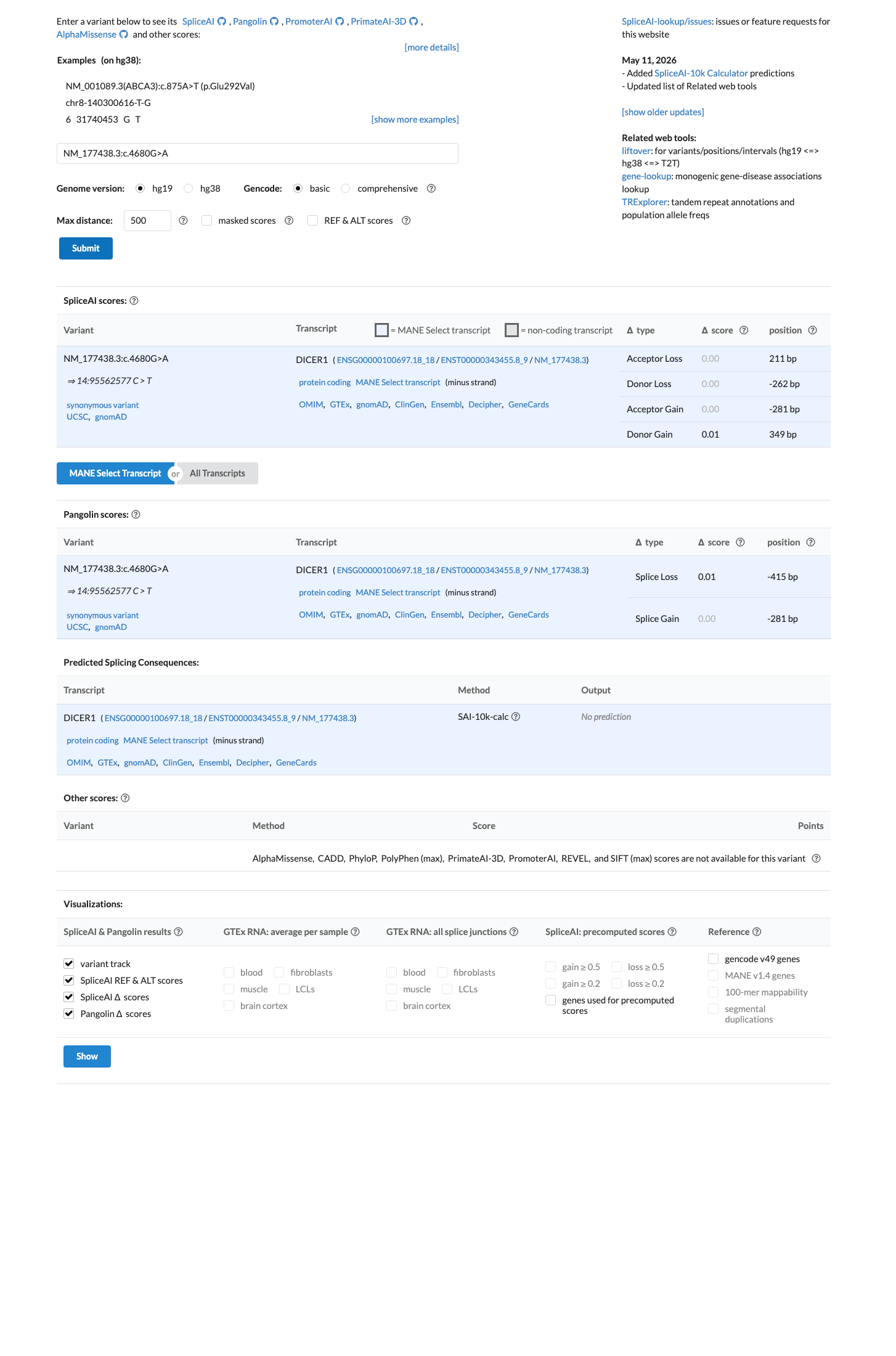
      SpliceAI screenshot
      In silico
      SpliceAI predicts no significant splice impact for this variant (max delta score = 0.01). REVEL score = 0.07.
      Functional / OncoKB screenshot
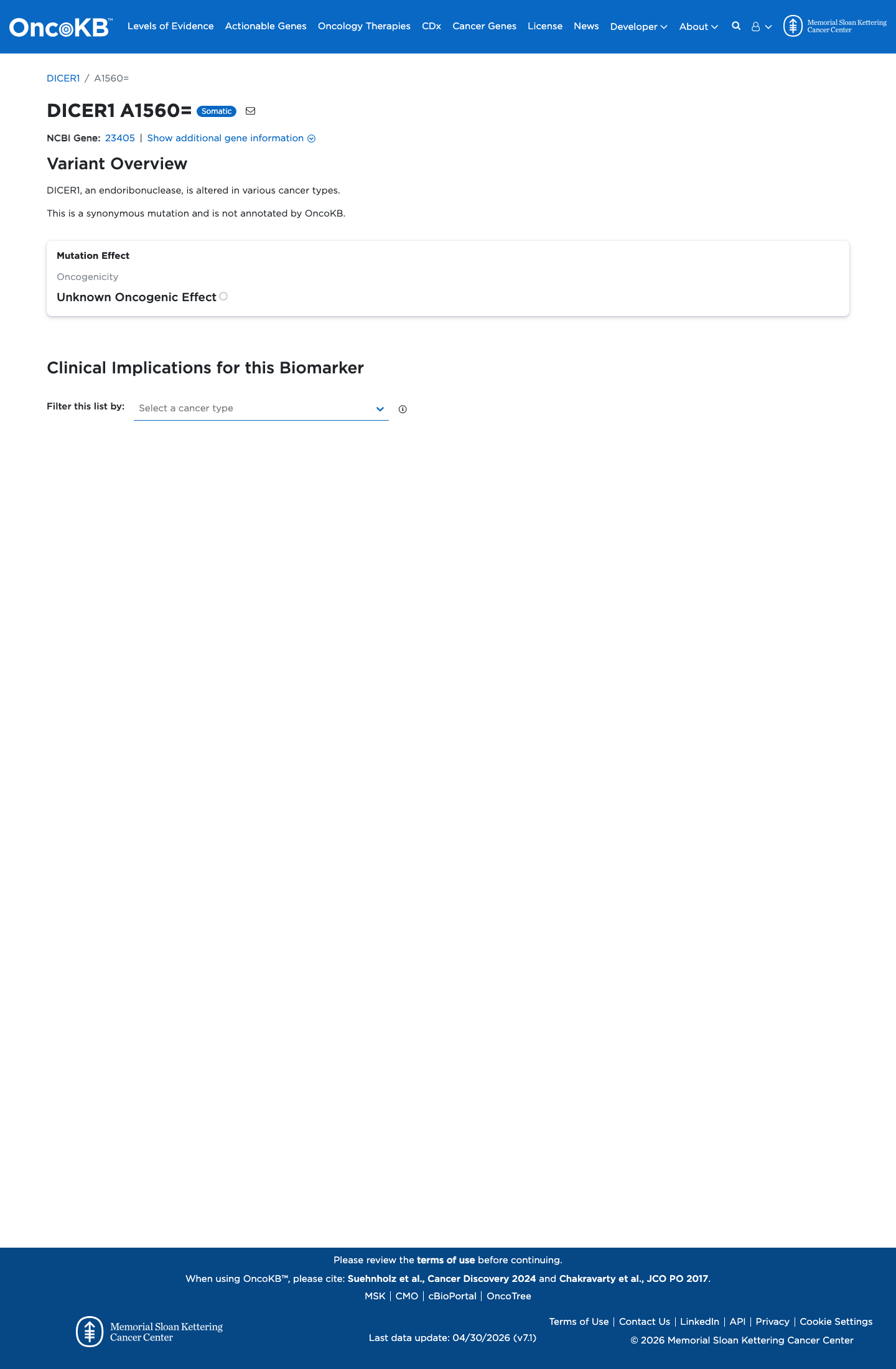
      Functional Unknown Oncogenic Effect
      OncoKB identified curated literature and non-variant-specific oncogenicity context for review; listed oncogenicity label: Unknown Oncogenic Effect.
      OncoKB ↗
      COSMIC screenshot
      COSMIC
      Cancer hotspots screenshot
      Cancer hotspots
      Somatic evidence Not in COSMIC / hotspots
      COSMIC
      This variant does not lie in a statistically significant hotspot. This variant has not previously been reported in somatic cancers (COSMIC).
      Hotspots
      This variant does not lie in a statistically significant hotspot.
      Sources & reference links
      9Sources
      CSpec VCEP
      ClinVar
      gnomAD v2.1
      gnomAD v4.1
      gnomAD-Canada
      SpliceAI
      OncoKB
      COSMIC
      Cancer hotspots
      Triaged references · 6 PMIDs not cited in assessment
      25741868 ↗ Standards and guidelines for the interpretation of sequence variants: a joint consensus recommendation of the American College of Medical Genetics and Genomics and the Association for Molecular Pathology. CLINVAR
      26467025 ↗ A Standardized DNA Variant Scoring System for Pathogenicity Assessments in Mendelian Disorders. CLINVAR
      24493721 ↗ American Society of Clinical Oncology Expert Statement: collection and use of a cancer family history for oncology providers. CLINVAR
      24761742 ↗ DICER1-Related Tumor Predisposition. CLINVAR
      25394175 ↗ A practice guideline from the American College of Medical Genetics and Genomics and the National Society of Genetic Counselors: referral indications for cancer predisposition assessment. CLINVAR
      28492532 ↗ Sherloc: a comprehensive refinement of the ACMG-AMP variant classification criteria. CLINVAR