Starting
Initialising…
0%
TERT
Final classification
Benign
TERT c.2097C>T · p.Ala699=
TERT

The TERT c.2097C>T (p.Ala699=) variant has been reported in ClinVar as benign.

Gene
TERT
Transcript
NM_198253.2
HGVS · transcript:coding
NM_198253.2:c.2097C>T
Consequence
N/A
GRCh38
chr5:1279324 G>A
GRCh37
chr5:1279439 G>A
Basis gene-specific framework lacked a usable explicit final combination framework, so generic ACMG/AMP 2015 final-combination rules were applied as fallback; applied criteria: BA1 stand-alone benign, BS1 strong benign, BP7 supporting benign; combination = 1 stand-alone benign, which maps to Benign.
gene-specific framework lacked a usable explicit final combination framework, so generic ACMG/AMP 2015 final-combination rules were applied as fallback; applied criteria: BA1 stand-alone benign, BS1 strong benign, BP7 supporting benign; combination = 1 stand-alone benign, which maps to Benign.
Classification rationale
BA1BS1BP7 Benign
TERT c.2097C>T

The TERT c.2097C>T (p.Ala699=) variant has been reported in ClinVar as benign.1 This variant is common in population databases, with AF 1.11328% in gnomAD v2.1, AF 0.89897% in gnomAD v4.1, and AF 1.28122% in gnomAD-Canada; the highest observed East Asian frequencies are 8.10613% in gnomAD v2.1 and 5.10623% in gnomAD v4.1, which is above benign frequency thresholds.2 As a synonymous change, available in silico splicing evidence does not support RNA disruption; SpliceAI predicts no significant splice impact with a maximum delta score of 0.00.3

BA1 + BS1 + BP7 Benign
Gene diagram · NM_198253.2 · variants mapped to exon structure
TERT NM_198253.2
Fetching transcript structure from UCSC…
Applied criteria · 3 met · select any tile
Met
Not met
Not assessed
N/A
Strength very strong supporting
Pathogenic evidence
PVS
PS
PM
PP
Benign evidence
BA
BS
BP
Rationale
Select a criterion.
Sources
Evidence used
    Gaps remaining
      Rule
      Research & evidence
      Population frequency · supports benign
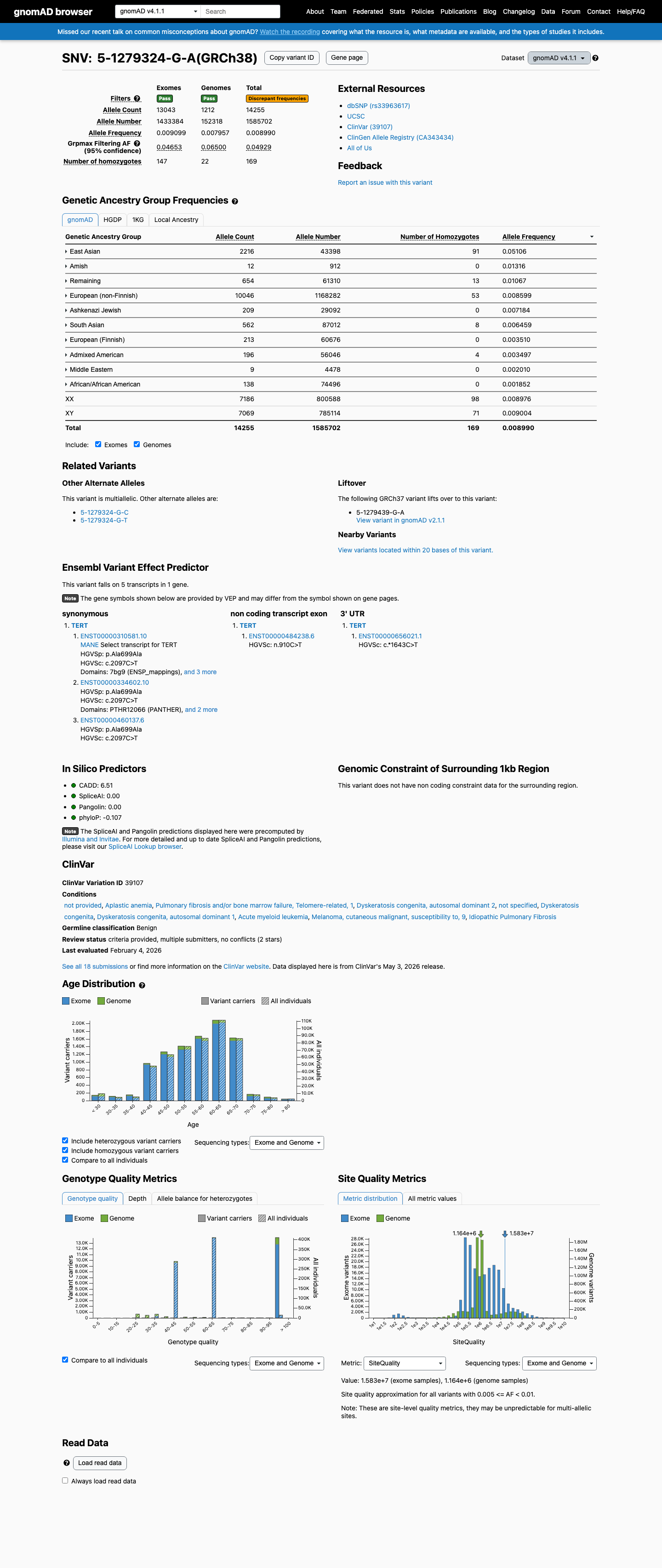
      gnomAD v4.1 screenshot
      gnomAD v4.1
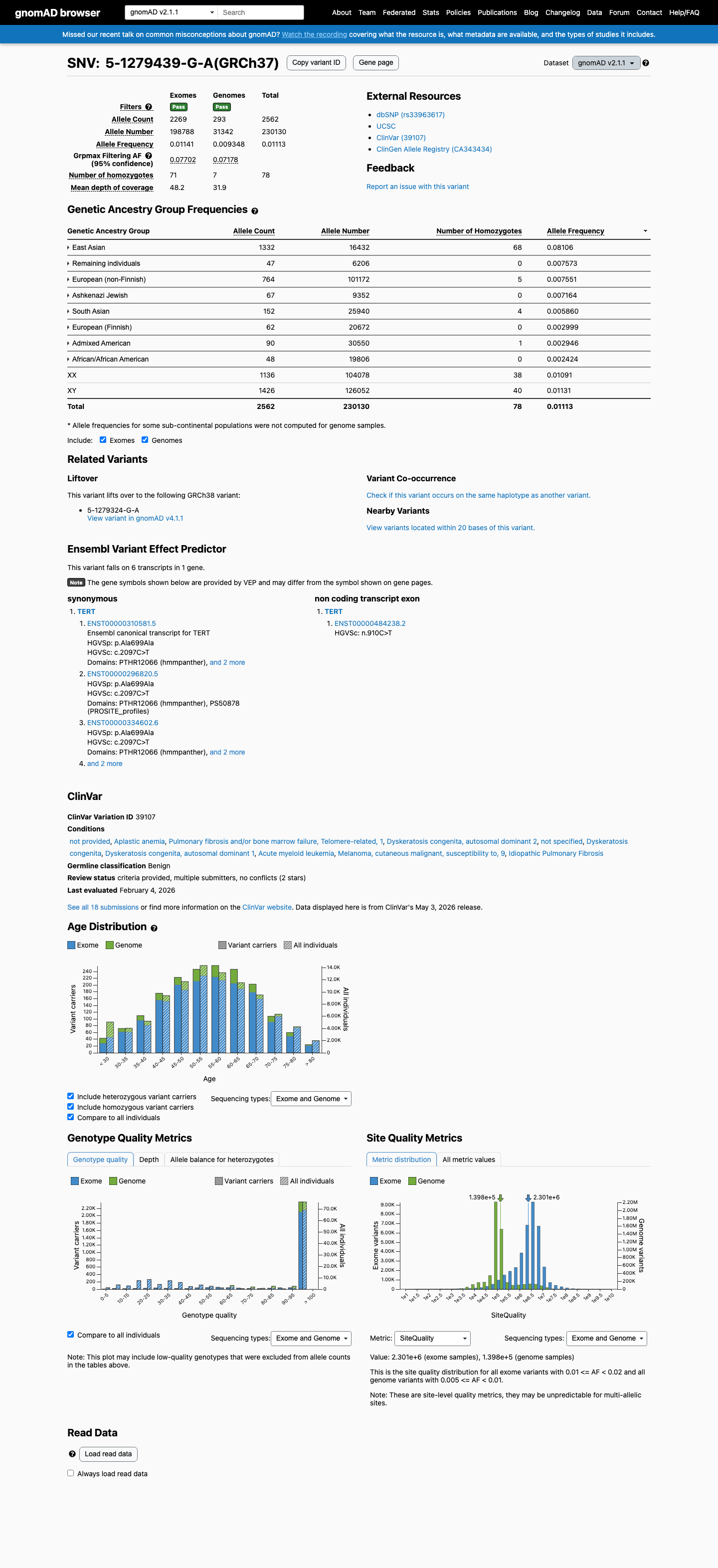
      gnomAD v2.1 screenshot
      gnomAD v2.1
      v4.1
      This variant is present in gnomAD v4.1 (AF= 0.00898971; MAF= 0.89897%, 14255/1585702 alleles, homozygotes = 169) and has highest observed frequency in the East Asian population (AF= 0.0510623; MAF= 5.10623%, 2216/43398 alleles, homozygotes = 91); grpmax FAF= 0.049291.
      v2.1
      This variant is present in gnomAD v2.1 (AF= 0.0111328; MAF= 1.11328%, 2562/230130 alleles, homozygotes = 78) and has highest observed frequency in the East Asian population (AF= 0.0810613; MAF= 8.10613%, 1332/16432 alleles, homozygotes = 68); grpmax FAF= 0.0770165.
      🇨🇦 CA
      This variant is present in gnomAD-Canada v1.0 (AF= 0.0128122; MAF= 1.28122%, 236/18420 alleles, homozygotes = 5) and has highest observed frequency in the eas population (AF= 0.064275; grpmax FAF95= 0.0533145).
      Allele frequency by ancestry
      three datasets · side by side
      gnomAD v4.1
      0.9% · 14255 / 1,585,702
      169 hom · FAF 4.9%
      East Asian
      2216 / 43,398
      5.1%
      91 hom
      Amish
      12 / 912
      1.3%
      Remaining individuals
      654 / 61,310
      1.1%
      13 hom
      European (non-Finnish)
      10046 / 1,168,282
      0.86%
      53 hom
      Ashkenazi Jewish
      209 / 29,092
      0.72%
      South Asian
      562 / 87,012
      0.65%
      8 hom
      European (Finnish)
      213 / 60,676
      0.35%
      Admixed American
      196 / 56,046
      0.35%
      4 hom
      Middle Eastern
      9 / 4,478
      0.2%
      African/African American
      138 / 74,496
      0.19%
      gnomAD v2.1
      1.1% · 2562 / 230,130
      78 hom · FAF 7.7%
      East Asian
      1332 / 16,432
      8.1%
      68 hom
      Remaining individuals
      47 / 6,206
      0.76%
      European (non-Finnish)
      764 / 101,172
      0.76%
      5 hom
      Ashkenazi Jewish
      67 / 9,352
      0.72%
      South Asian
      152 / 25,940
      0.59%
      4 hom
      European (Finnish)
      62 / 20,672
      0.3%
      Admixed American
      90 / 30,550
      0.29%
      1 hom
      African/African American
      48 / 19,806
      0.24%
      gnomAD Canada 🇨🇦
      1.3% · 236 / 18,420
      5 hom · FAF 5.3%
      indel · split
      European (Finnish)
      1 / 8
      12%
      East Asian
      86 / 1,338
      6.4%
      3 hom
      Remaining individuals
      16 / 1,138
      1.4%
      South Asian
      13 / 1,362
      0.95%
      European (non-Finnish)
      111 / 11,742
      0.95%
      2 hom
      Latino/Admixed American
      5 / 838
      0.6%
      Ashkenazi Jewish
      4 / 832
      0.48%
      + 2 not observed (African/African American, Middle Eastern)
      ClinVar screenshot
      ClinVar
      This variant has been reported in ClinVar as Benign (16 clinical laboratories). (ClinVarID = 39107)
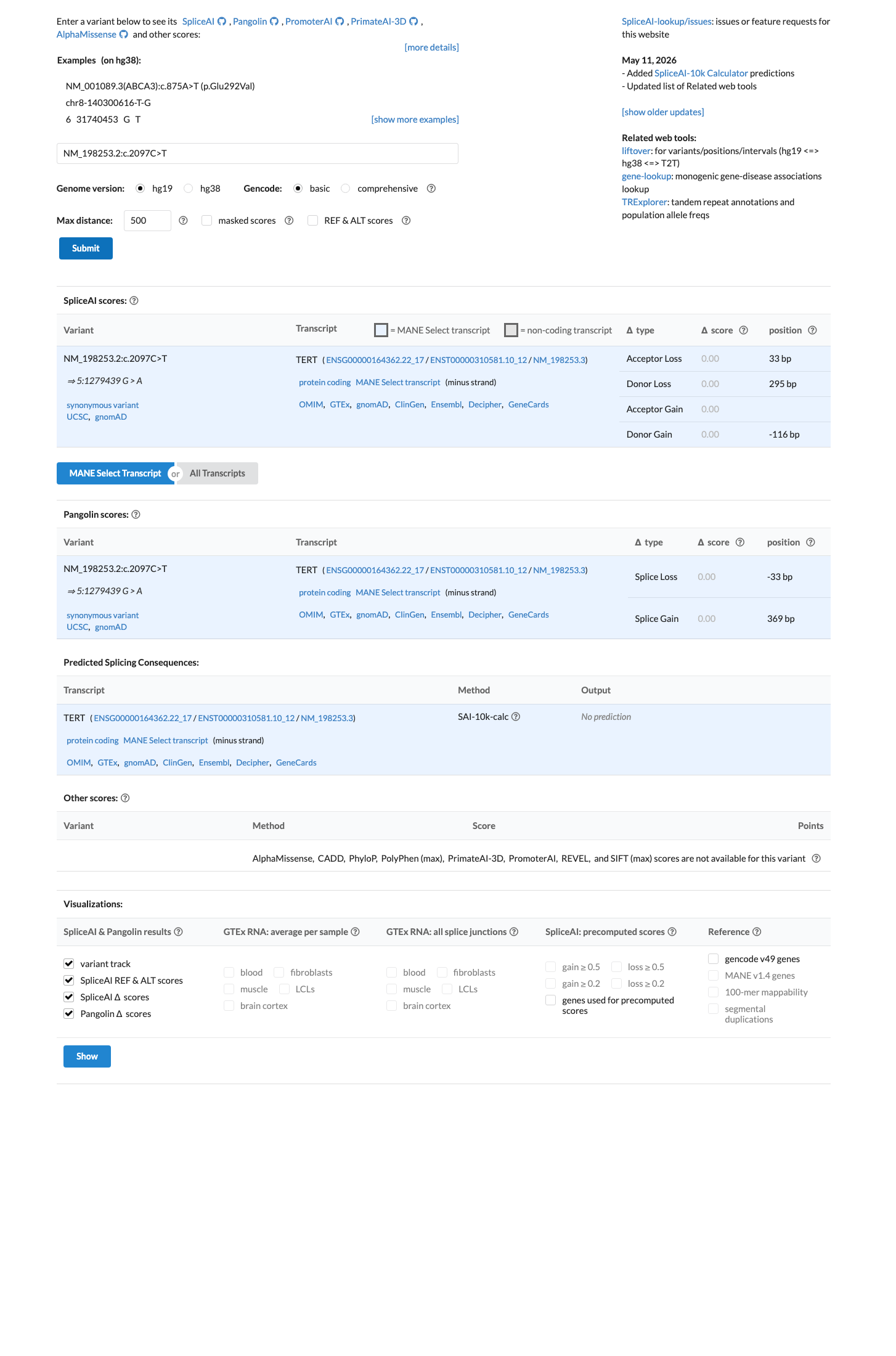
      SpliceAI screenshot
      In silico
      SpliceAI predicts no significant splice impact for this variant (max delta score = 0.00).
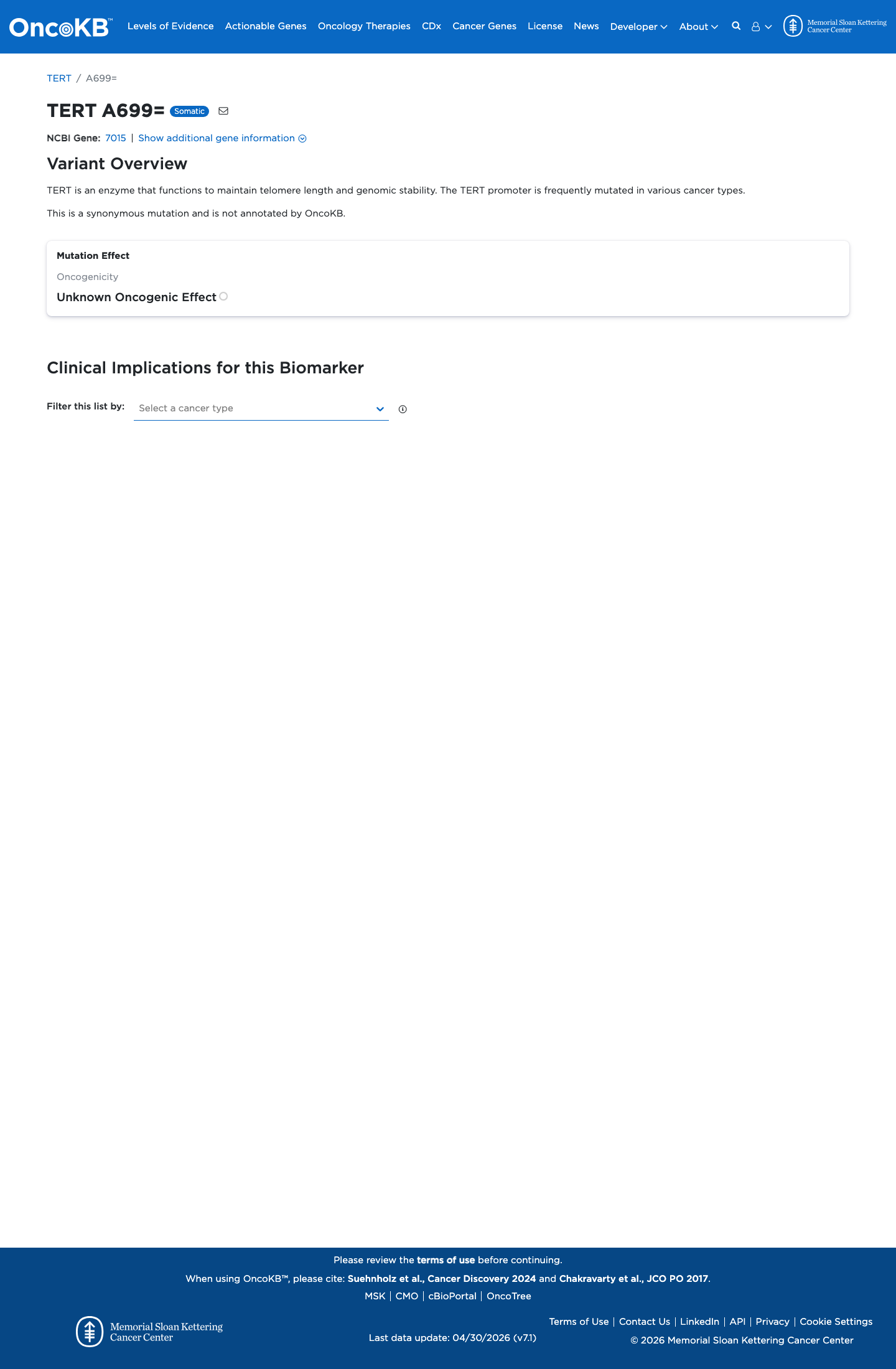
      Functional / OncoKB screenshot
      Functional Unknown Oncogenic Effect
      OncoKB identified curated literature and non-variant-specific oncogenicity context for review; listed oncogenicity label: Unknown Oncogenic Effect.
      OncoKB ↗
      COSMIC screenshot
      COSMIC
      Cancer hotspots screenshot
      Cancer hotspots
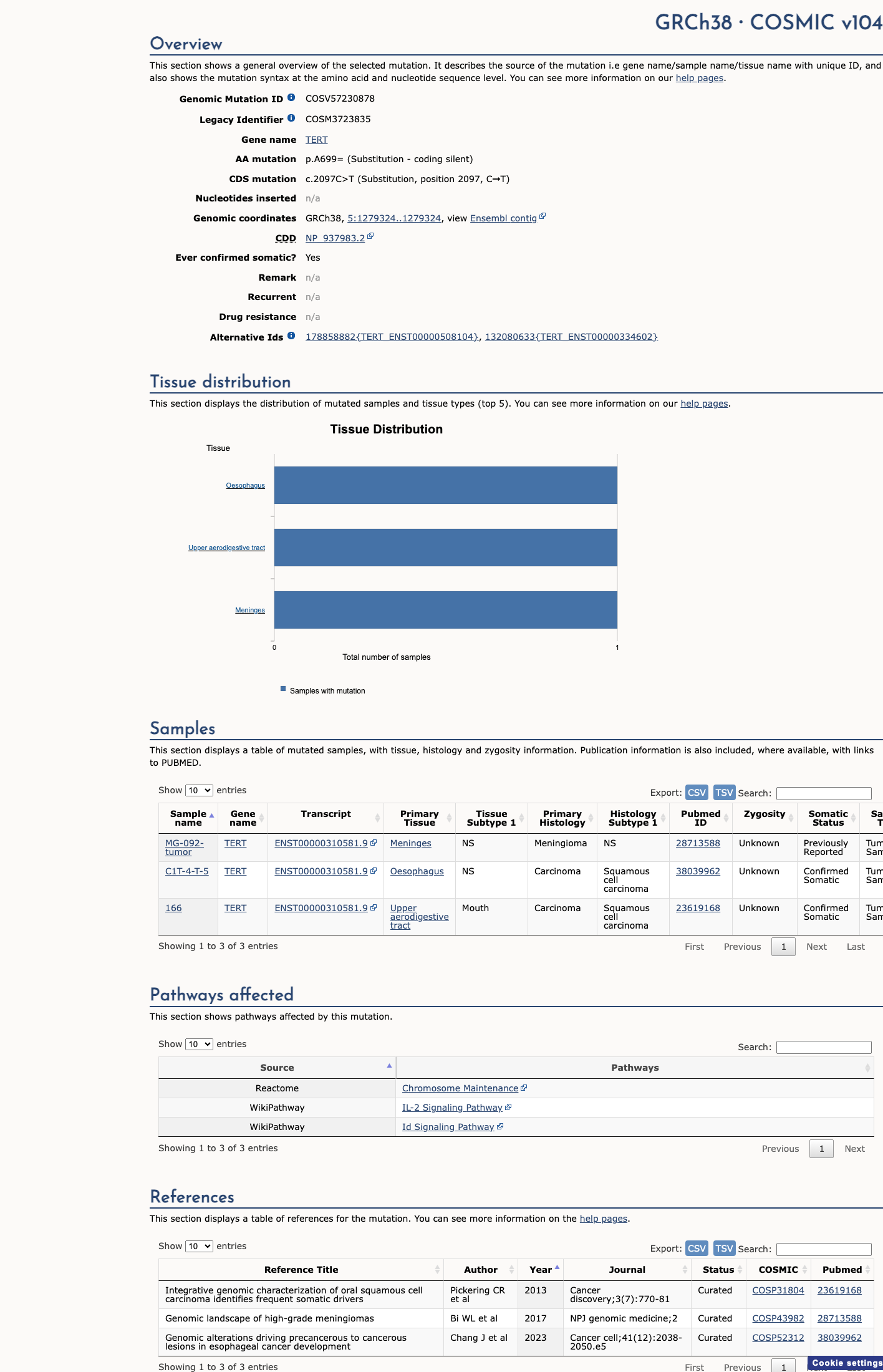
      Somatic evidence Not in COSMIC / hotspots
      COSMIC
      This variant does not lie in a statistically significant hotspot. This variant has previously been reported in somatic cancers (COSMIC; COSV57230878, n = 3 times).
      Hotspots
      This variant does not lie in a statistically significant hotspot.
      Sources & reference links
      8Sources
      ClinVar
      gnomAD v2.1
      gnomAD v4.1
      gnomAD-Canada
      SpliceAI
      OncoKB
      COSMIC
      Cancer hotspots
      Triaged references · 9 PMIDs not cited in assessment
      22138009 ↗ NCCN Task Force report: Evaluating the clinical utility of tumor markers in oncology. CLINVAR
      24033266 ↗ A systematic approach to assessing the clinical significance of genetic variants. CLINVAR
      25741868 ↗ Standards and guidelines for the interpretation of sequence variants: a joint consensus recommendation of the American College of Medical Genetics and Genomics and the Association for Molecular Pathology. CLINVAR
      20301408 ↗ PMID:20301408 CLINVAR
      20301779 ↗ Dyskeratosis Congenita and Related Telomere Biology Disorders. CLINVAR
      20963938 ↗ CEBPA-Associated Familial Acute Myeloid Leukemia (AML). CLINVAR
      21610750 ↗ Clinical utility gene card for: dyskeratosis congenita. CLINVAR
      23970018 ↗ Acute myeloblastic leukaemias in adult patients: ESMO Clinical Practice Guidelines for diagnosis, treatment and follow-up. CLINVAR
      28492532 ↗ Sherloc: a comprehensive refinement of the ACMG-AMP variant classification criteria. CLINVAR