This variant has been observed in a single Taiwanese early-onset Parkinson disease patient and was absent from 508 ethnically matched controls (PMID:24339985).1 Functional studies demonstrate that p.Arg767His robustly stimulates LRRK2 kinase activity >1.5-fold above wildtype by disrupting the ANK:C-terminal helix interface; this gain-of-function effect is consistent with the established pathogenic mechanism of LRRK2 in Parkinson disease (PMID:35950872).2 The variant is present at very low frequency in gnomAD-Canada (AF=0.0163%, 3/18,414 alleles, 0 homozygotes), below the 0.1% PM2 threshold (gnomad_canada).3 Multiple in silico tools predict a benign effect: REVEL score 0.157, BayesDel score -0.0159304, and SpliceAI max delta 0.01, all consistent with no deleterious impact (revel, bayesdel, spliceai).4 This variant is classified as likely benign in ClinVar by a clinical diagnostic laboratory (VariationID 3571549, criteria provided, single submitter) (clinvar).5 Applying generic ACMG/AMP 2015 final classification combination rules (PMID:25741868): two supporting pathogenic criteria (PS3_supporting, PM2_supporting) and two supporting benign criteria (BP4_supporting, BP6_supporting) are present. These offset, resulting in a classification of Variant of Uncertain Significance.6
Final classification
Likely Benign
PS3PM2BP4BP6
LRRK2
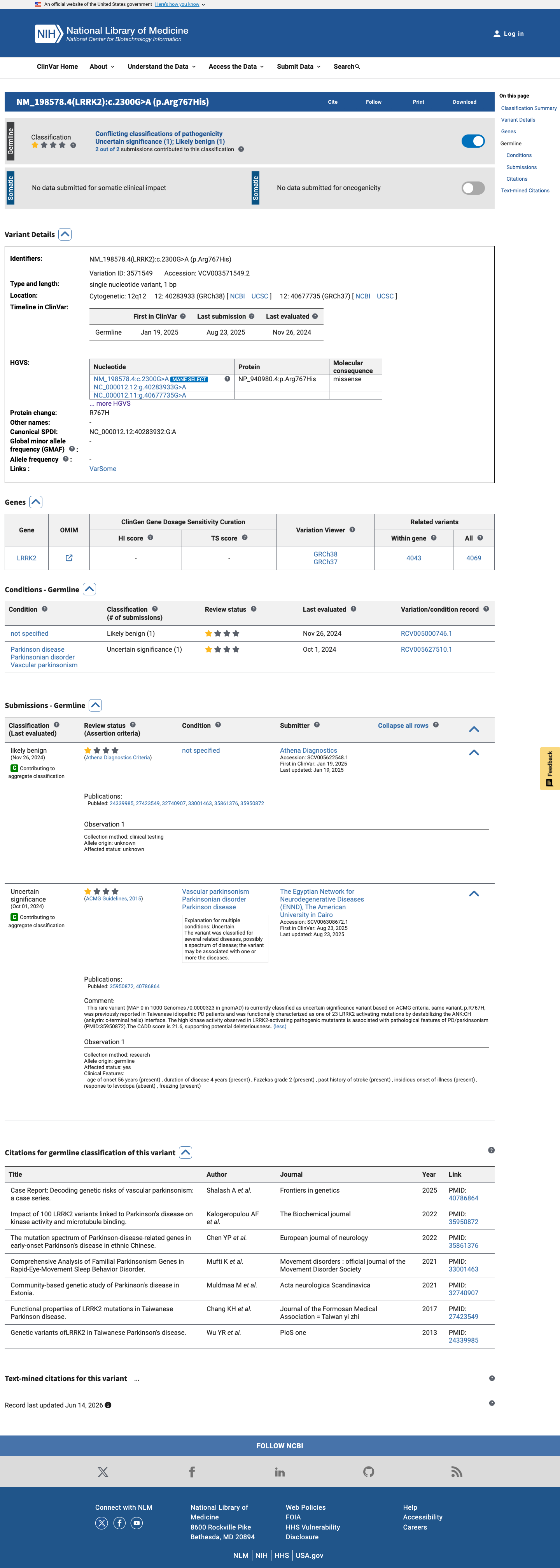
c.2300G>A
p.Arg767His
This variant
This variant has been observed in a single Taiwanese early-onset Parkinson disease patient and was absent from 508 ethnically matched controls (PMID:24339985).
ClinGen Parkinson's Disease Expert Panel Specifications to the ACMG/AMP Variant Interpretation Guidelines for LRRK2 Version 1.0.0 v1.0.0 lacked a usable explicit final combination framework, so generic ACMG/AMP 2015 final-combination rules were applied as fallback; applied criteria: PS3 supporting, PM2 supporting, BP4 supporting benign, BP6 supporting benign; combination = 2 supporting + 2 supporting benign, which maps to Likely Benign.
Classification rationale
PS3PM2
BP4BP6
Likely Benign
LRRK2 c.2300G>A
PS3 + PM2 + BP4 + BP6
→
Likely Benign
4
revelbayesdelspliceai ↗
6
generic_acmg_combination_rules
LYFE Sciences is an AI system, and it can make mistakes. Criteria
may be applied incorrectly, sources may be misread, and a confident-looking
classification can still be wrong. Double-check every criterion and
its underlying evidence before relying on any call.
Gene diagram
· NM_198578.3 · variants mapped to exon structure
LRRK2
NM_198578.3
Fetching transcript structure from UCSC…
Applied criteria · 4 applied · 17 assessed
MetEvidence satisfies this criterion.
Not metEvaluated against available evidence; threshold not reached.
Not assessedApplies in principle, but no evidence was found to evaluate it.
N/ADoesn't apply to this variant type.
Applied · 4
Strength
Supporting
Moderate
Strong
Very strong
PS3
supporting
Pathogenic
Functional studies demonstrate that p.Arg767His (R767H) robustly stimulates LRRK2 kinase activity >1.5-fold above wildtype. The variant is located in the ANK domain and structural analysis indicates it disrupts the ANK:C-terminal helix interface by abolishing an ionic interaction with E2516. Charge-reversed double mutation (R767E/E2516R) restores wildtype activity, confirming mechanism. Increased LRRK2 kinase activity is the established pathogenic mechanism in LRRK2-associated Parkinson disease.
R767H identified as one of 23 LRRK2 variants that robustly stimulate kinase activity in vitro (pRab10 Thr73 phosphorylation >1.5-foldHEK293T cells). Structural analysis shows disruption of ANK:CH interface (ionic interaction with E2516). Rescue by charge-reversed double mutation R767E/E2516R confirms mechanism.PMID:27423549 abstract confirms functional evaluation of R767H in Taiwanese PD cohort
PM2
supporting
Pathogenic
This variant is present at very low frequency in population databases. In gnomAD-Canada v1.0, the allele frequency is 0.0163% (3/18,414 alleles, 0 homozygotes), which is below the 0.1% PM2 threshold. The variant is absent from African, Admixed American, Ashkenazi Jewish, East Asian, Finnish, Middle Eastern, South Asian, and Other populations; all 3 alleles are in the Non-Finnish European population (AF=0.0256%). gnomAD v2.1 and v4.1 data were not available for this variant.
gnomAD-Canada v1.0: AF=0.000163 (3/18414 alleles0 homozygotes)
BP4
supporting
Benign
Multiple lines of computational evidence suggest no deleterious impact. REVEL score is 0.157 (below the 0.5 damaging threshold). BayesDel score is -0.0159304 (negative, predicting benign). SpliceAI max delta is 0.01 (predicting no splicing impact). All available in silico tools are concordant in predicting a benign effect.
REVEL=0.157 (benign)BayesDel=-0.0159304 (benign)SpliceAI max delta=0.01 (no splice impact). All in silico tools concordantly predict benign.
BP6
supporting
Benign
This variant is classified as likely benign in ClinVar (VariationID 3571549) by a clinical diagnostic laboratory (Athena Diagnostics) using criteria provided. Although a single submitter, the classification from a reputable clinical laboratory supports a likely benign assessment.
ClinVar VariationID 3571549: likely benign by Athena Diagnosticscriteria providedsingle submitter.
Assessed · not applied
· 8 not met · 9 not assessed
Pathogenic
PS1
No alternative nucleotide change at the same amino acid position (Arg767) was identified in available data.
PS2
No de novo occurrence report for this variant was identified in any available source.
PS4
The variant was observed in 1/612 Taiwanese PD patients and 0/508 ethnically matched controls (PMID:24339985).
PM1
Although variant lies in the ANK domain of LRRK2, which is a functional domain, the residue is not in a statistically significant mutational hotspot and the domain contains both pathogenic and benign missense variation.
PM6
No de novo occurrence report for this variant was identified in any available source.
PP1
The variant was identified in a single Taiwanese early-onset PD patient.
PP2
No gene-level missense constraint data (e.g., gnomAD missense Z-score or missense o/e metric) were retrieved for LRRK2.
PP3
Multiple in silico tools predict a benign effect.
PP4
No patient-specific phenotype data were available for the proband carrying this variant.
PP5
No reputable source classifies this variant as pathogenic.
Benign
BA1
The variant allele frequency in gnomAD-Canada v1.0 is 0.0163% (3/18,414 alleles), which is far below the 1% BA1 threshold for a dominant disorder.
BS1
The variant allele frequency in gnomAD-Canada v1.0 is 0.0163% (3/18,414 alleles), which is below the 0.3% BS1 threshold.
BS2
No data were available on observation of this variant in healthy adults independently of disease phenotype.
BS3
Well-established functional studies (PMID:35950872) demonstrate that R767H activates LRRK2 kinase activity >1.5-fold above wildtype and disrupts the ANK:CH domain interface — effects consistent with a gain-of-function pathogenic mechanism, not a benign effect.
BS4
No segregation data are available for this variant.
BP2
No observation of this variant in trans with a known pathogenic LRRK2 variant was identified.
BP5
No alternate molecular basis for disease was reported in the single case carrying this variant.
N/A · 4
PVS1 · PM5 · BP1 · BP7
Research & evidence
Population frequency · supports benign
v4.1
This variant is absent from gnomAD v4.1.
v2.1
This variant is absent from gnomAD v2.1.
🇨🇦 CA
This variant is present in gnomAD-Canada v1.0 (AF= 0.00016291951775822744, 3/18414 alleles, homozygotes = 0).
Allele frequency by ancestry
three datasets · side by side
gnomAD Canada 🇨🇦
0.016%
· 3 / 18,414
0 hom · FAF 0.0069%
0 hom · FAF 0.0069%
European (non-Finnish) 3 / 11,738 |
0.026% |
+ 8 not observed (African/African American, Latino/Admixed American, Ashkenazi Jewish, East Asian, European (Finnish), Middle Eastern, Remaining individuals, South Asian)
ClinVar
This variant has been reported in ClinVar as likely benign (1 clinical laboratory). (ClinVarID = 3571549)

In silico
SpliceAI predicts no significant splice impact for this variant (max delta score = 0.01). REVEL score = 0.157. BayesDel score = -0.0159304.
Functional
No data
No calibrated functional assay or RNA evidence was identified for this variant.
COSMIC

Cancer hotspots
Somatic evidence
Not in COSMIC / hotspots
COSMIC
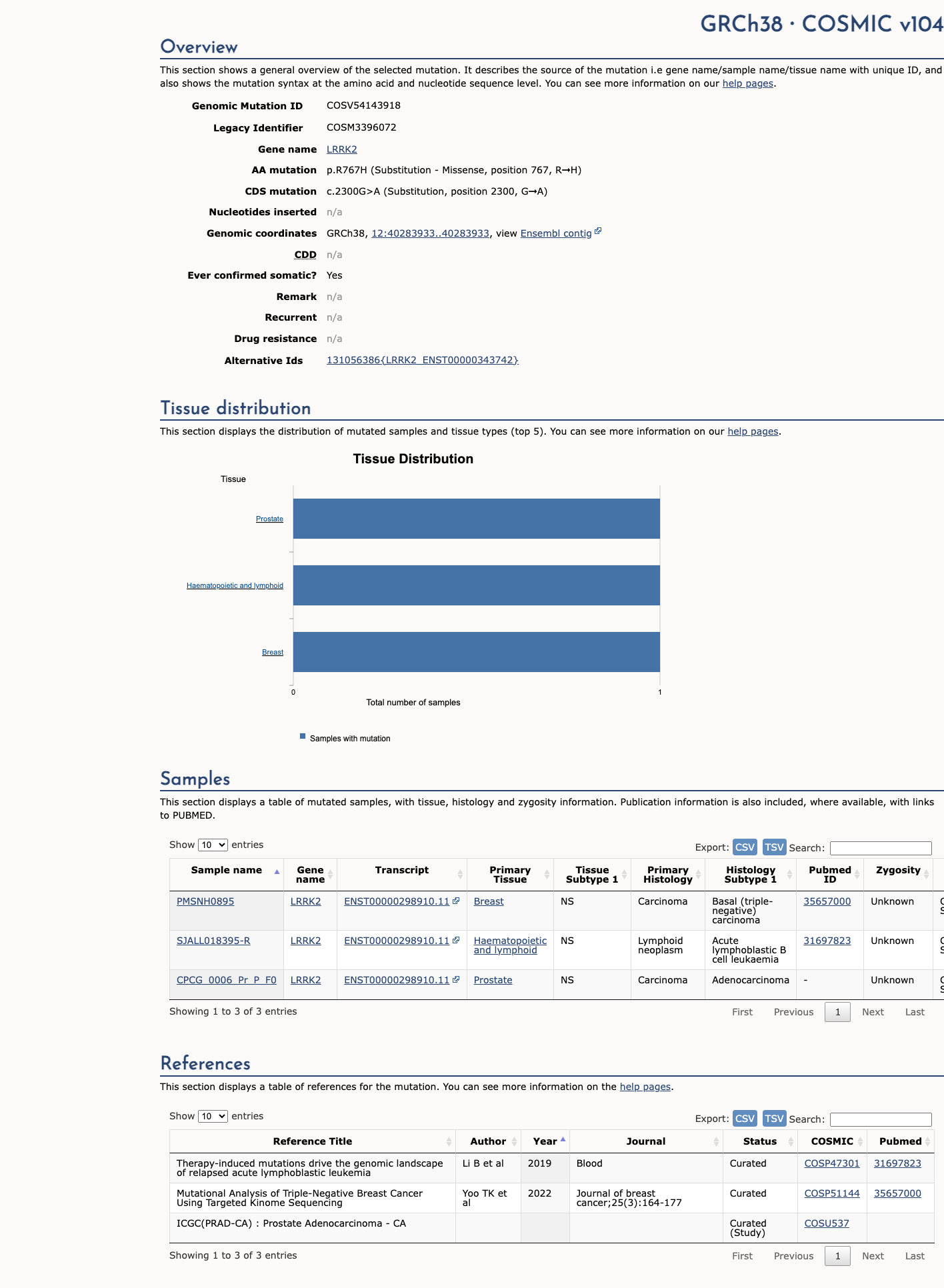
This variant does not lie in a statistically significant hotspot. This variant has previously been reported in somatic cancers (COSMIC; COSV54143918, n = 3 times).
Hotspots
This variant does not lie in a statistically significant hotspot.
Literature · how each cited paper was used
2papers cited
Each card is an audit: what was searched, what was found, whether it names the variant, which criteria it fed, and why. 6 further PMIDs triaged but not cited — see Sources & references.
Functional properties of LRRK2 mutations in Taiwanese Parkinson disease.
Searched
R767Hp.R767H
Found
Abstract reports evaluation of functional properties of three LRRK2 mutations identified in Taiwanese PD patients: p.R767H, p.S885N, and p.R1441H. Full text unavailable for detailed data extraction.
Variant
✓ Names this variant
Applied to
→PS3
met
Why
Variant confirmed in abstract. Functional data not extractable without full text; used as corroborating evidence for PS3 alongside PMID:35950872.
Our previous study found three LRRK2 mutations-p.R767H, p.S885N, and p.R1441H-in Taiwanese patients with Parkinson disease. We evaluated the functional properties of these three LRRK2 mutations
Location Abstract · Context Not available (full text not accessible)
Impact of 100 LRRK2 variants linked to Parkinson's disease on kinase activity and microtubule binding.
Searched
R767HR767c.2300p.Arg767His
Found
R767H identified as one of 23 LRRK2 variants that robustly stimulate kinase activity (>1.5-fold pRab10 Thr73 phosphorylation). Structural analysis reveals disruption of ANK:C-terminal helix interface by abolishing ionic interaction with E2516. Charge-reversed double mutation R767E/E2516R restores wildtype activity.
Variant
✓ Names this variant — characterised directly
Applied to
→PS3
met
Why
Variant-specific functional data confirm gain-of-function kinase activation consistent with LRRK2 pathogenic mechanism. Referenced in PS3 assessment at supporting strength.
the R767H variant likely destabilizes the ANK:CH interface, as the arginine side chain of the R767 bridges the ANK domain to the C-terminal helix (CH) through hydrophobic and polar interactions with V2513 and E2516
Location Results; Figures 7G, 7H, 8A, 8C; Supplementary Figures S2, S3 · Context HEK293T cells; pRab10 Thr73 phosphorylation assay; structural modeling of ANK:CH interface · full text
Sources & reference links
9Sources
Triaged references · 6 PMIDs not cited in assessment
23279440 ↗
EFNS/MDS-ES/ENS [corrected] recommendations for the diagnosis of Parkinson's disease.
CLINVAR
25741868 ↗
Standards and guidelines for the interpretation of sequence variants: a joint consensus recommendation of the American College of Medical Genetics and Genomics and the Association for Molecular Pathology.
CLINVAR
26467025 ↗
A Standardized DNA Variant Scoring System for Pathogenicity Assessments in Mendelian Disorders.
CLINVAR
33001463 ↗
Comprehensive Analysis of Familial Parkinsonism Genes in Rapid-Eye-Movement Sleep Behavior Disorder.
CLINVAR