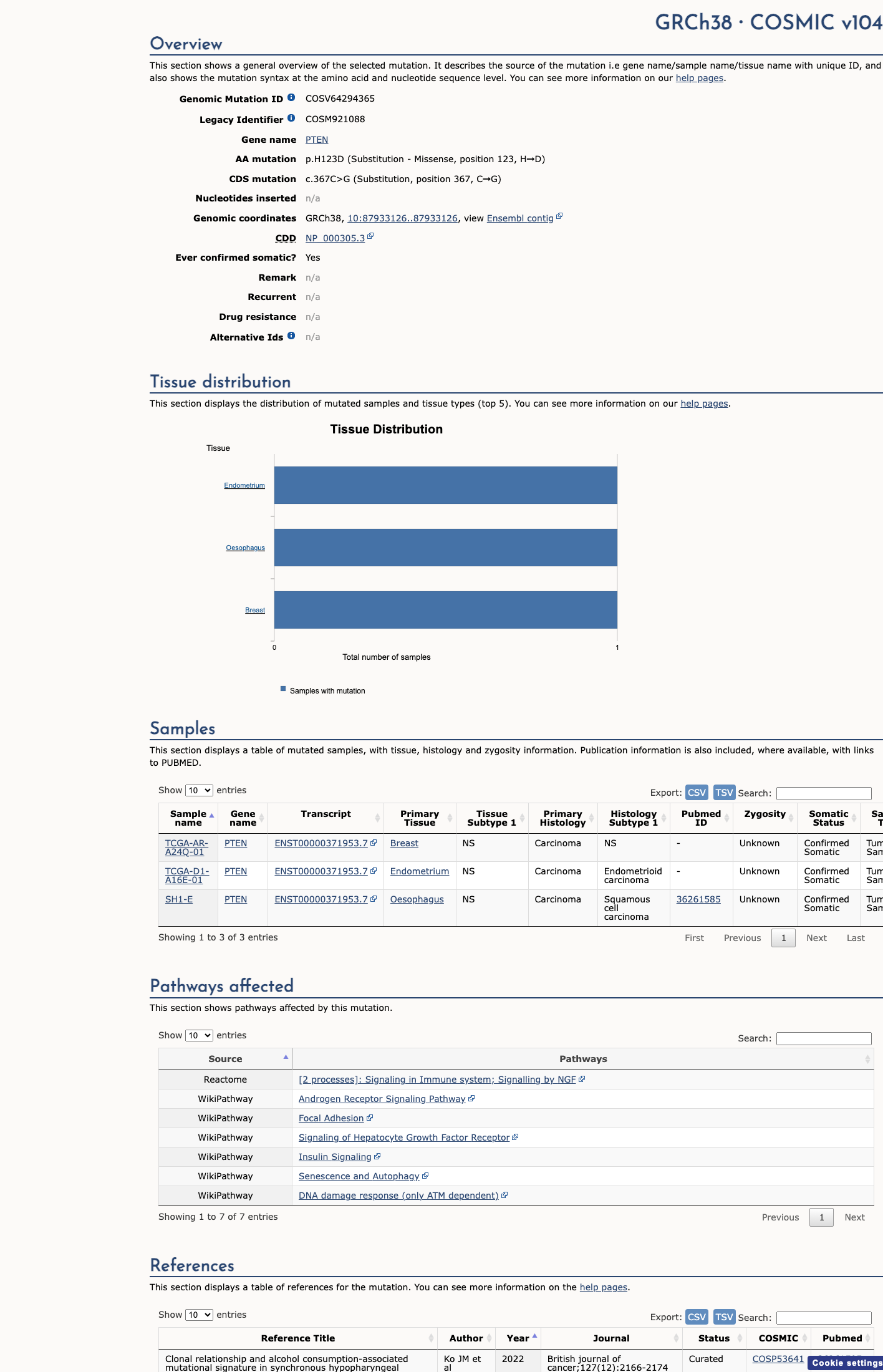
The PTEN c.367C>G (p.His123Asp) variant has been observed in somatic cancers (COSMIC COSV64294365, n=3) and has been reported in ClinVar, including a pathogenic expert-panel classification.1 This variant is absent from gnomAD v2.1, gnomAD v4.1, and gnomAD-Canada, which is below the PTEN Expert Panel PM2 threshold for population rarity.2 In the PTEN saturation mutagenesis phosphatase assay, p.His123Asp showed a high-confidence damaging result with cumulative fitness score -4.3458, which is below the PTEN Expert Panel PS3_Moderate threshold of <= -1.11.3 Computational evidence supports a deleterious effect, with REVEL 0.98 above the PTEN Expert Panel PP3 threshold of >0.7 and BayesDel 0.601229 positive, while SpliceAI max delta 0.01 does not suggest splice disruption.4 This variant also affects a PTEN catalytic motif residue and a different missense change at the same codon has been established as pathogenic, supporting PM1 and PM5 under the PTEN specification.5
Final classification
Likely Pathogenic
PS3PM1PM2PM5PP2PP3PP5
PTEN
c.367C>G
p.His123Asp
This variant
The PTEN c.367C>G (p.His123Asp) variant has been observed in somatic cancers (COSMIC COSV64294365, n=3) and has been reported in ClinVar, including a pathogenic expert-panel classification.
Richards et.al., 2015 - Combining rules v3.2.0 criteria-combination framework: matched Rule13 (Pathogenic.Moderate >=3) with applied criteria: PS3 moderate, PM1 moderate, PM2 supporting, PM5 moderate, PP2 supporting, PP3 supporting, PP5 supporting; maps to Likely Pathogenic.
Classification rationale
PS3PM1PM2PM5PP2PP3PP5
Likely Pathogenic
PTEN c.367C>G
PS3 + PM1 + PM2 + PM5 + PP2 + PP3 + PP5
→
Likely Pathogenic
3
vcep_mmc2cspec ↗
4
revelbayesdelspliceai ↗cspec ↗
LYFE Sciences is an AI system, and it can make mistakes. Criteria
may be applied incorrectly, sources may be misread, and a confident-looking
classification can still be wrong. Double-check every criterion and
its underlying evidence before relying on any call.
Gene diagram
· NM_000314.8 · variants mapped to exon structure
PTEN
NM_000314.8
Fetching transcript structure from UCSC…
Applied criteria · 7 applied · 13 assessed
MetEvidence satisfies this criterion.
Not metEvaluated against available evidence; threshold not reached.
Not assessedApplies in principle, but no evidence was found to evaluate it.
N/ADoesn't apply to this variant type.
Applied · 7
Strength
Supporting
Moderate
Strong
Very strong
PS3
moderate
Pathogenic
In the PTEN saturation mutagenesis phosphatase assay, p.His123Asp had a cumulative fitness score of -4.3458 with a high-confidence result flag, which is below the PTEN Expert Panel PS3_Moderate threshold of <= -1.11 and supports a damaging effect on PTEN function.
mmc2 Table S2: H123DCum_score -4.345802175High_conf true
PM1
moderate
Pathogenic
This missense variant affects codon 123, which lies within the PTEN catalytic motif spanning residues 123-130 defined by the PTEN Expert Panel as a critical functional region for PM1.
PTEN EP catalytic motif includes residues 123-130
PM2
supporting
Pathogenic
This variant is absent from gnomAD v2.1, gnomAD v4.1, and gnomAD-Canada, which is below the PTEN Expert Panel PM2 threshold of <0.00001 (0.001%) and supports rarity in population databases.
Absent from gnomAD v2.1Absent from gnomAD v4.1Absent from gnomAD-Canada v1.0
PM5
moderate
Pathogenic
A different missense change at the same residue, PTEN p.His123Arg, is established as pathogenic by expert panel review in ClinVar. The observed substitution p.His123Asp has a BLOSUM62 score of -1, which is equal to or more deleterious than the comparator p.His123Arg score of 0, meeting the PTEN Expert Panel PM5 rule.
ClinVar VCV000007816 p.His123Arg reviewed by expert panel as pathogenicBLOSUM62 H->D = -1 and H->R = 0
PP2
supporting
Pathogenic
This is a missense variant in PTEN, a gene for which the PTEN Expert Panel permits PP2 because missense variation is a recognized disease mechanism and benign missense variation is comparatively constrained.
PTEN EP PP2 specification
PP3
supporting
Pathogenic
REVEL is 0.98, which is above the PTEN Expert Panel PP3 threshold of >0.7 and supports a deleterious missense effect. BayesDel is also positive at 0.601229, while SpliceAI shows a low maximum delta score of 0.01, which does not suggest a splice effect.
REVEL 0.98BayesDel 0.601229SpliceAI max delta 0.01
Assessed · not applied
· 5 not met · 8 not assessed
Pathogenic
PS1
No evidence was identified that this nucleotide change produces the same amino acid substitution as a previously established pathogenic variant through a different DNA change.
PS2
No confirmed de novo occurrence with documented maternity and paternity confirmation was identified.
PS4
This variant has been reported in ClinVar and in somatic cancer databases, but no case-control enrichment data or PTEN Expert Panel phenotype specificity score was identified to support PS4.
PM6
No assumed de novo occurrence with the required phenotype and family-history context was identified.
PP1
No segregation data were identified to show co-segregation with disease across informative meioses.
Benign
BA1
This variant is absent from population databases and does not meet the PTEN Expert Panel BA1 threshold of >0.00056 (0.056%).
BS1
This variant is absent from population databases and does not meet the PTEN Expert Panel BS1 thresholds of 0.0000043 to 0.00056.
BS2
No homozygous observations in healthy or PTEN hamartoma tumor syndrome-unaffected individuals were identified.
BS3
Available functional evidence does not show preserved PTEN function.
BS4
No data were identified showing lack of segregation in one or more affected families.
BP2
No phase data were identified showing this variant in trans with a pathogenic PTEN variant or recurrently in cis/phase unknown with pathogenic PTEN variants.
BP4
Computational evidence does not support a benign effect.
BP5
No alternate highly penetrant molecular explanation with non-overlapping phenotype was identified to support BP5.
N/A · 8
PVS1 · PM3 · PM4 · PP4 · BP1 · BP3 · BP6 · BP7
Research & evidence
Population frequency · supports pathogenic
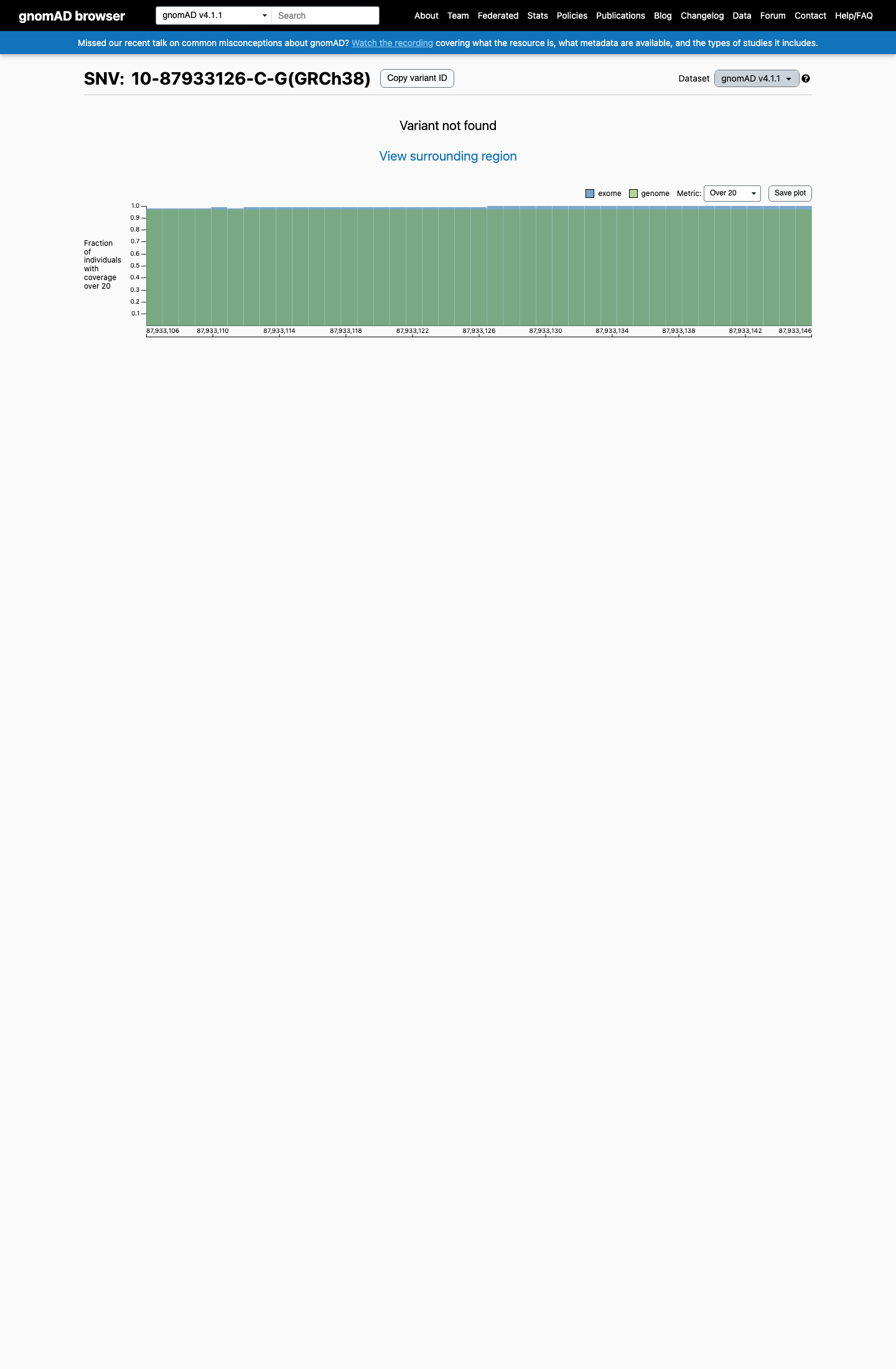
gnomAD v4.1
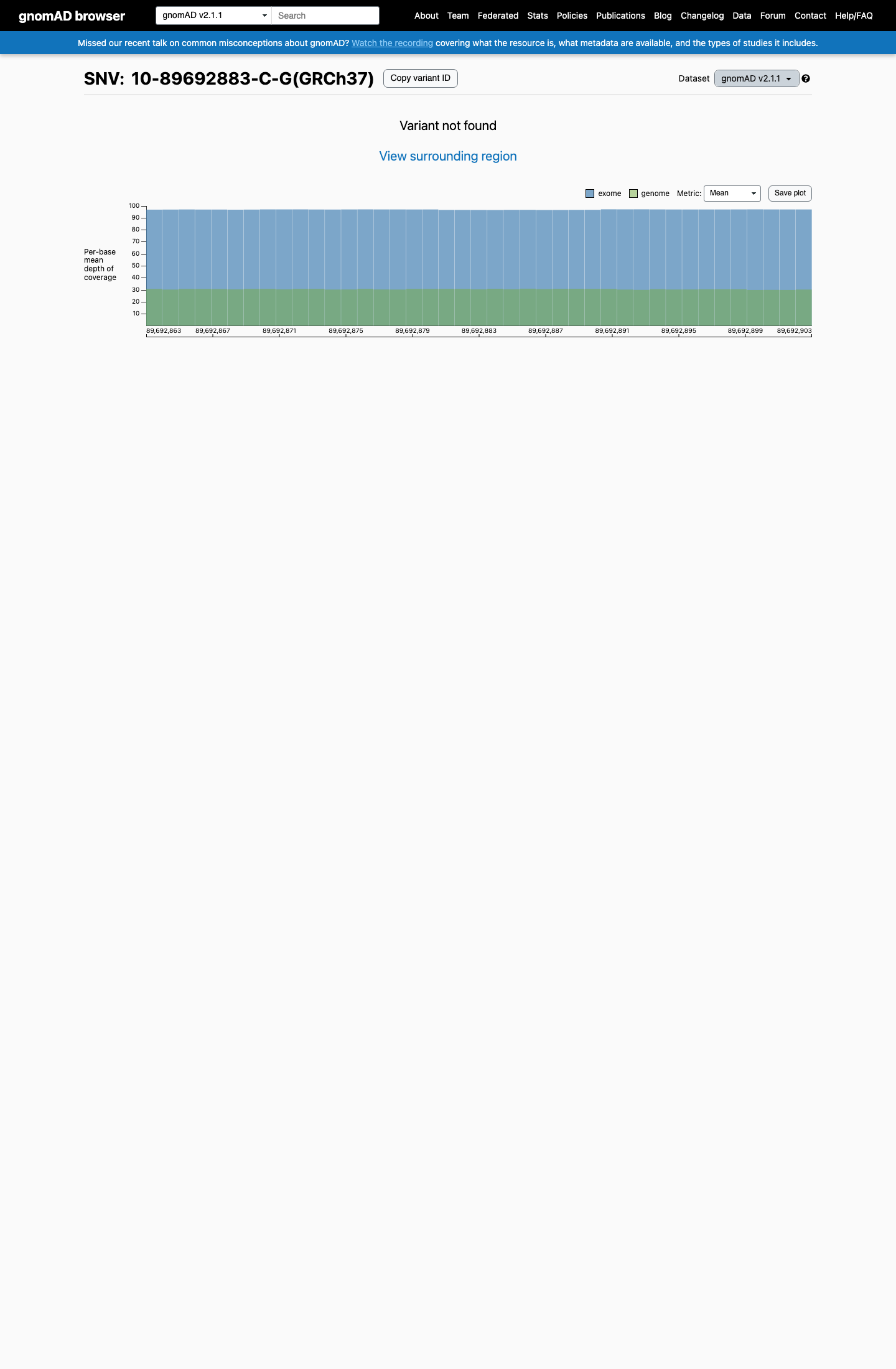
gnomAD v2.1
v4.1
Absent from gnomAD v4.1.
v2.1
Absent from gnomAD v2.1.
🇨🇦 CA
Absent from gnomAD-Canada v1.0.
Allele frequency by ancestry
three datasets · side by side
gnomAD v4.1
Absent
· 0 / ?
0 hom
0 hom
Not observed in any ancestry group.
gnomAD v2.1
Absent
· 0 / ?
0 hom
0 hom
Not observed in any ancestry group.
gnomAD Canada 🇨🇦
Absent
· 0 / ?
0 hom
0 hom
Not observed in any ancestry group.
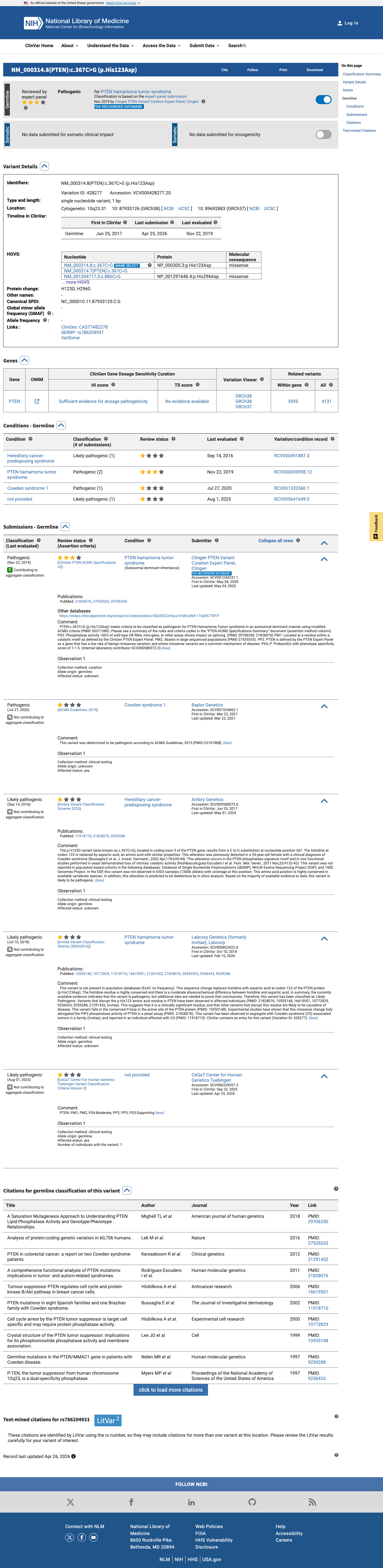
ClinVar
This variant has been reported in ClinVar as Likely pathogenic (3 clinical laboratories) and as Pathogenic (1 clinical laboratory) and as Pathogenic by Clingen PTEN Variant Curation Expert Panel, Clingen (expert panel). (ClinVarID = 428277)
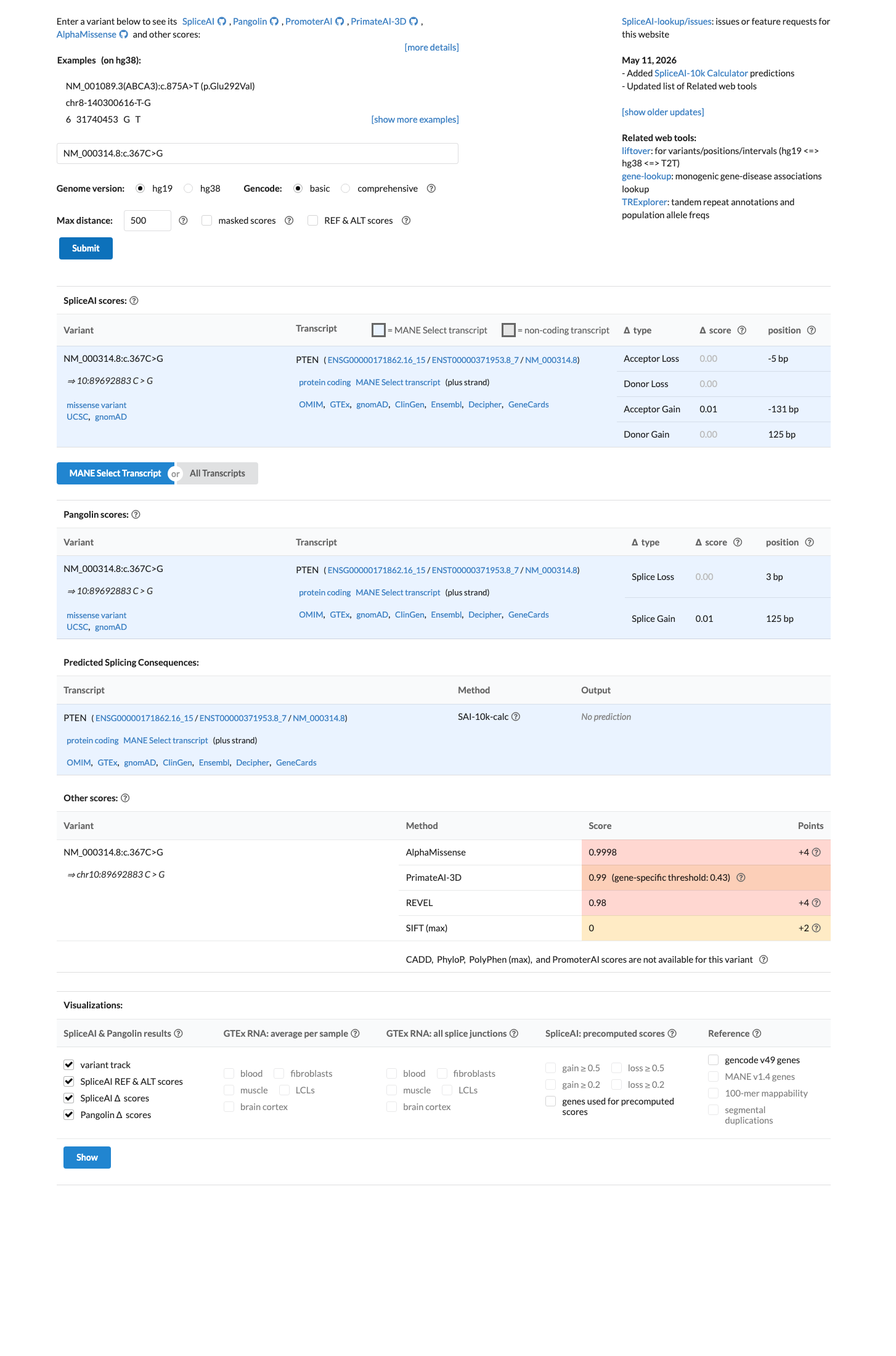
In silico
SpliceAI predicts no significant splice impact for this variant (max delta score = 0.01). REVEL score = 0.98. BayesDel score = 0.601229.
Functional
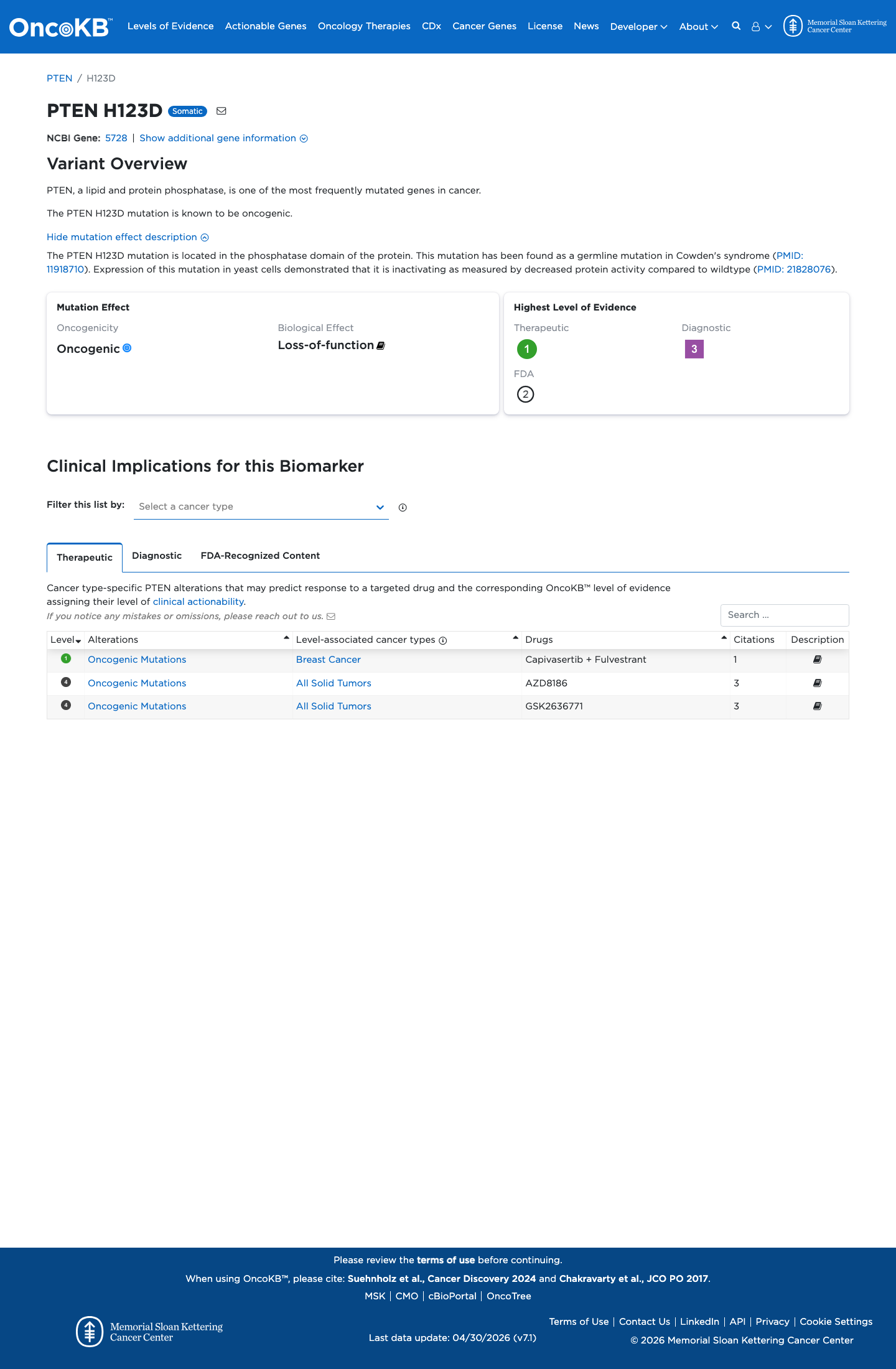
Oncogenic
OncoKB identified variant-specific curated literature and context relevant to functional review; biological-effect context: Loss-of-function; curated oncogenicity label: Oncogenic.
COSMIC

Cancer hotspots
Somatic evidence
Not in COSMIC / hotspots
COSMIC
This variant lies in a statistically significant hotspot. This variant has previously been reported in somatic cancers (COSMIC; COSV64294365, n = 3 times).
Hotspots
This variant lies in a statistically significant hotspot.
Literature · how each cited paper was used
1papers cited
Each card is an audit: what was searched, what was found, whether it names the variant, which criteria it fed, and why. 7 further PMIDs triaged but not cited — see Sources & references.
A Saturation Mutagenesis Approach to Understanding PTEN Lipid Phosphatase Activity and Genotype-Phenotype Relationships.
Found
Structured finding pending for this record — see source link.
Applied to
→PS3
moderate
Sources & reference links
9Sources
Triaged references · 7 PMIDs not cited in assessment
11918710 ↗
PTEN mutations in eight Spanish families and one Brazilian family with Cowden syndrome.
ONCOKB
21828076 ↗
A comprehensive functional analysis of PTEN mutations: implications in tumor- and autism-related syndromes.
ONCOKB
10555148 ↗
Crystal structure of the PTEN tumor suppressor: implications for its phosphoinositide phosphatase activity and membrane association.
CLINVAR
10772829 ↗
Cell cycle arrest by the PTEN tumor suppressor is target cell specific and may require protein phosphatase activity.
CLINVAR
16619501 ↗
Tumour suppressor PTEN regulates cell cycle and protein kinase B/Akt pathway in breast cancer cells.
CLINVAR
25645574 ↗
ACG clinical guideline: Genetic testing and management of hereditary gastrointestinal cancer syndromes.
CLINVAR
28492532 ↗
Sherloc: a comprehensive refinement of the ACMG-AMP variant classification criteria.
CLINVAR