PM1 (moderate): The variant lies within the CEBPA bZIP domain (codons ~278-358), a well-established critical functional domain where pathogenic mutations cluster. No benign variation is observed in this region.1 PM2 (moderate): The variant is absent from gnomAD v2.1, v4.1, and gnomAD-Canada (allele frequency = 0.0), meeting the <0.1% threshold for moderate evidence of rarity.2 PM4 (moderate): The variant is an in-frame duplication (p.Glu309_Thr310insLys) causing protein length change in a non-repeat region, consistent with a disease-causing mechanism. Three moderate criteria (PM1, PM2, PM4) are met with no benign criteria met. Per ACMG/AMP 2015 combination rules (PMID:25741868), ≥3 moderate criteria support classification as Likely Pathogenic.3
Final classification
Likely Pathogenic
PM1PM2PM4
CEBPA
c.926_928dup
p.Glu309_Thr310insLys
This variant
PM1 (moderate): The variant lies within the CEBPA bZIP domain (codons ~278-358), a well-established critical functional domain where pathogenic mutations cluster. No benign variation is observed in this region.
gene-specific framework lacked a usable explicit final combination framework, so generic ACMG/AMP 2015 final-combination rules were applied as fallback; applied criteria: PM1 moderate, PM2 moderate, PM4 moderate; combination = 3 moderate, which maps to Likely Pathogenic.
Classification rationale
PM1PM2PM4
Likely Pathogenic
CEBPA c.926_928dup
PM1 + PM2 + PM4
→
Likely Pathogenic
LYFE Sciences is an AI system, and it can make mistakes. Criteria
may be applied incorrectly, sources may be misread, and a confident-looking
classification can still be wrong. Double-check every criterion and
its underlying evidence before relying on any call.
Gene diagram
· NM_004364.3 · variants mapped to exon structure
CEBPA
NM_004364.3
Fetching transcript structure from UCSC…
Applied criteria · 3 applied · 18 assessed
MetEvidence satisfies this criterion.
Not metEvaluated against available evidence; threshold not reached.
Not assessedApplies in principle, but no evidence was found to evaluate it.
N/ADoesn't apply to this variant type.
Applied · 3
Strength
Supporting
Moderate
Strong
Very strong
PM1
moderate
Pathogenic
The variant is located at codon 309-310 within the CEBPA bZIP domain (approximately codons 278-358), a well-established critical functional domain required for DNA binding and dimerization. Pathogenic CEBPA mutations cluster in the bZIP domain, and no benign variants are reported in this region.
Variant lies within the bZIP domain (codons ~278-358)a critical functional domainabsent from gnomAD suggesting no benign variation in this region.
PM2
moderate
Pathogenic
The variant is absent from gnomAD v2.1, gnomAD v4.1, and gnomAD-Canada v1.0 (allele frequency = 0.0), meeting the <0.1% threshold for PM2 in the absence of a gene-specific CSPEC framework.
Absent from gnomAD v2.1 (AF=0)gnomAD v4.1 (AF=0)gnomAD-Canada v1.0 (AF=0.0).
PM4
moderate
Pathogenic
The variant is an in-frame duplication (c.926_928dup) resulting in insertion of a lysine residue (p.Glu309_Thr310insLys), causing protein length change in a non-repeat region. This meets the PM4 criterion for in-frame insertions in a non-repeat region.
In-frame duplication causing p.Glu309_Thr310insLysprotein length change in a non-repeat region.
Assessed · not applied
· 10 not met · 8 not assessed
Pathogenic
PS2
No de novo observation data are available for this variant in any database or publication reviewed.
PS3
No variant-specific functional studies were identified.
PS4
The variant is absent from ClinVar and absent from gnomAD; no case-control data are available to evaluate whether prevalence is significantly increased in affected individuals versus controls.
PM6
No de novo observation data are available for this variant.
PP1
No cosegregation data are available for this variant in any family.
PP3
Multiple lines of computational evidence supporting pathogenicity are not available.
PP4
No patient-specific phenotype or family history data are available for this variant.
PP5
No germline clinical diagnostic laboratory or expert panel has classified this variant as pathogenic or likely pathogenic.
Benign
BA1
The variant is absent from gnomAD v2.1, v4.1, and gnomAD-Canada (allele frequency = 0.0).
BS1
The variant is absent from gnomAD v2.1, v4.1, and gnomAD-Canada (allele frequency = 0.0).
BS2
The variant is absent from population databases; no observation in healthy adults, either homozygously or in trans with a known pathogenic variant, has been reported.
BS3
No variant-specific functional studies demonstrating no deleterious effect have been identified.
BS4
No cosegregation data are available to assess whether the variant fails to segregate with disease in affected families.
BP2
The variant has not been observed in trans with a known pathogenic variant in any database or publication.
BP3
BP3 applies to in-frame deletions/insertions in repetitive regions without known function.
BP4
Multiple lines of computational evidence suggesting no impact are not available.
BP5
The variant has not been observed in any case with an alternate molecular basis for disease.
BP6
No reputable source has classified this variant as benign or likely benign.
N/A · 7
PVS1 · PS1 · PM3 · PM5 · PP2 · BP1 · BP7
Research & evidence
Population frequency · supports pathogenic
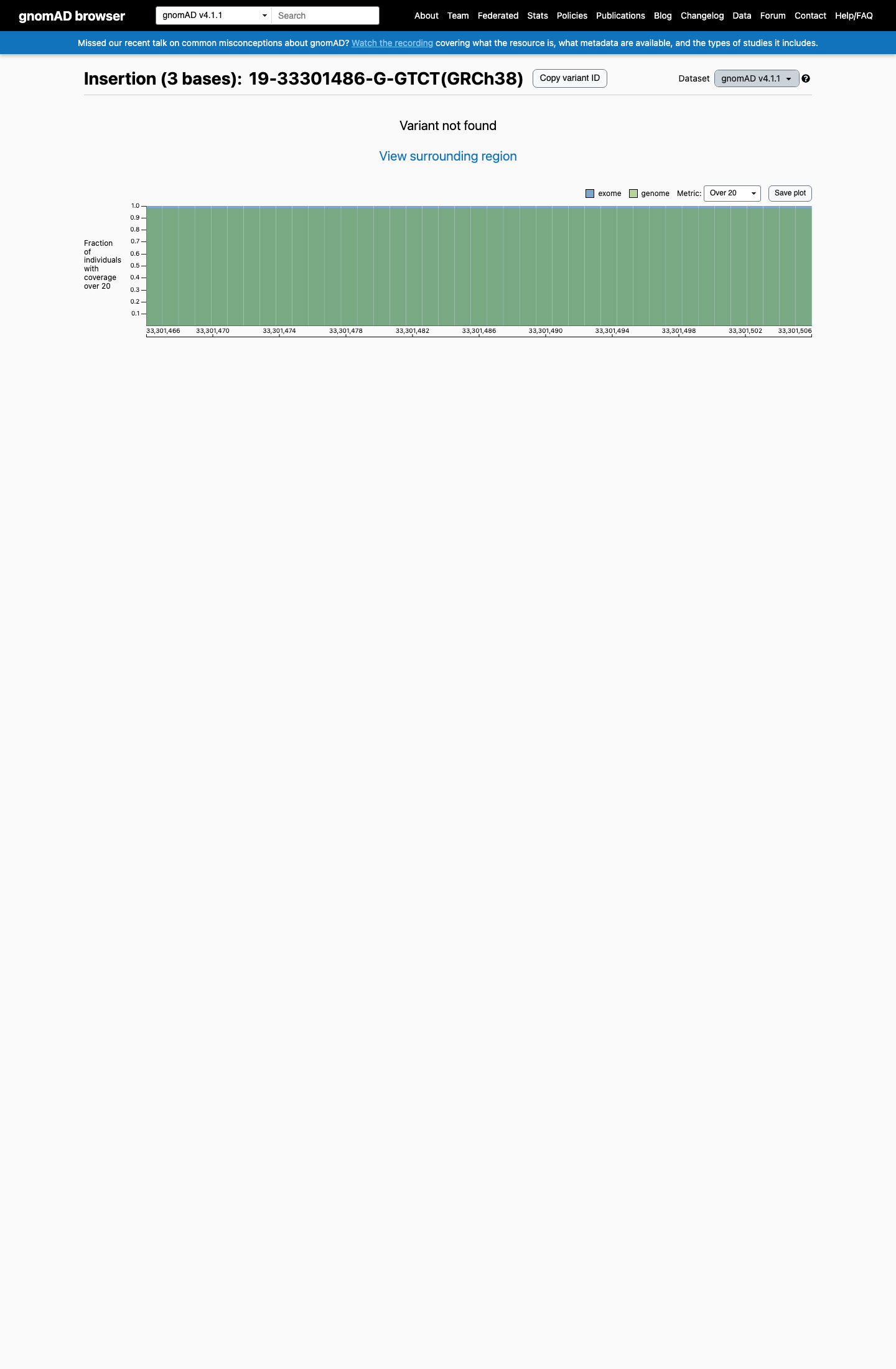
gnomAD v4.1
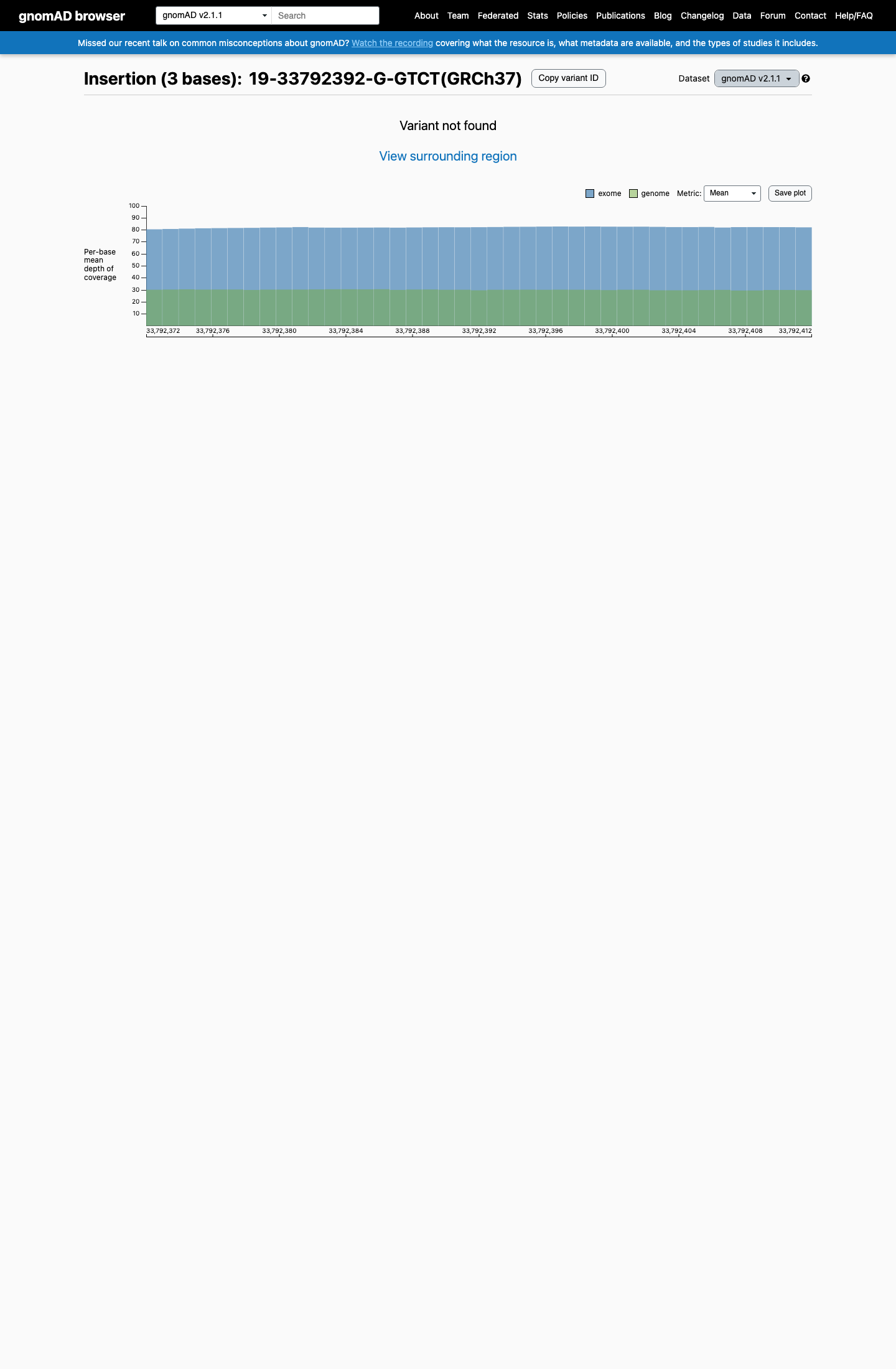
gnomAD v2.1
v4.1
Absent from gnomAD v4.1.
v2.1
Absent from gnomAD v2.1.
🇨🇦 CA
Absent from gnomAD-Canada v1.0.
Allele frequency by ancestry
three datasets · side by side
gnomAD v4.1
Absent
· 0 / ?
0 hom
0 hom
Not observed in any ancestry group.
gnomAD v2.1
Absent
· 0 / ?
0 hom
0 hom
Not observed in any ancestry group.
gnomAD Canada 🇨🇦
Absent
· 0 / ?
0 hom
0 hom
Not observed in any ancestry group.
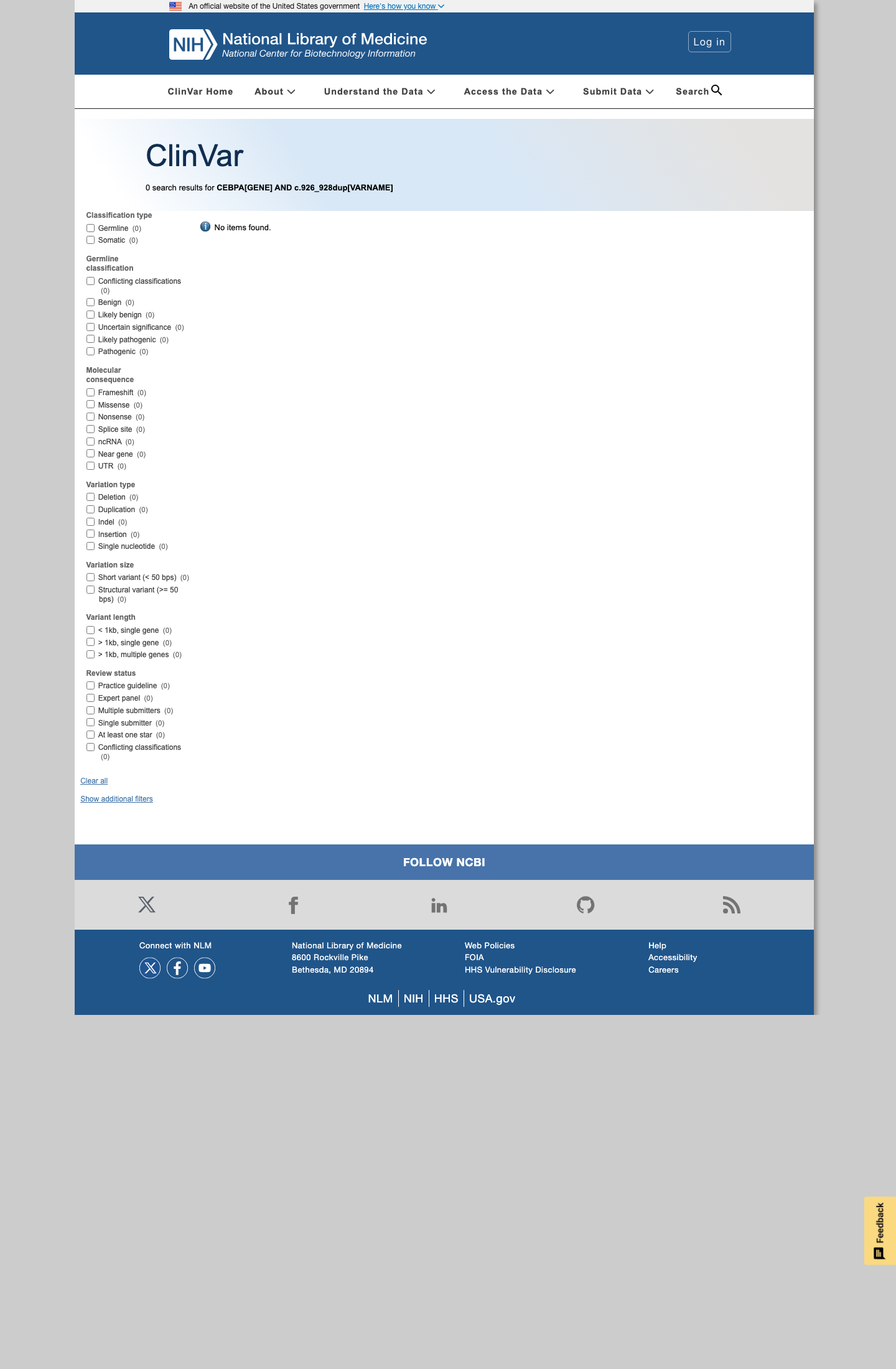
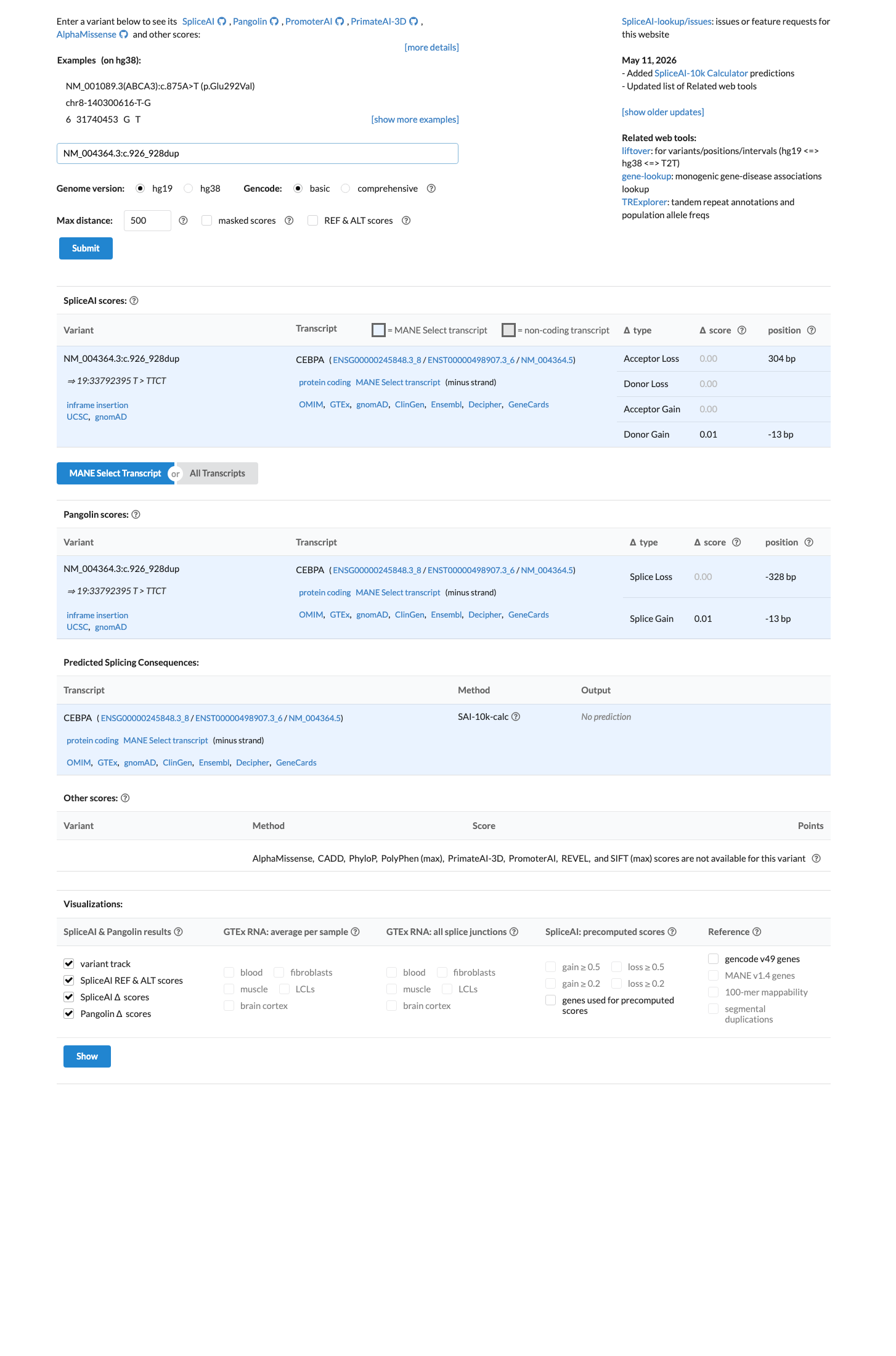
In silico
SpliceAI predicts no significant splice impact for this variant (max delta score = 0.01).
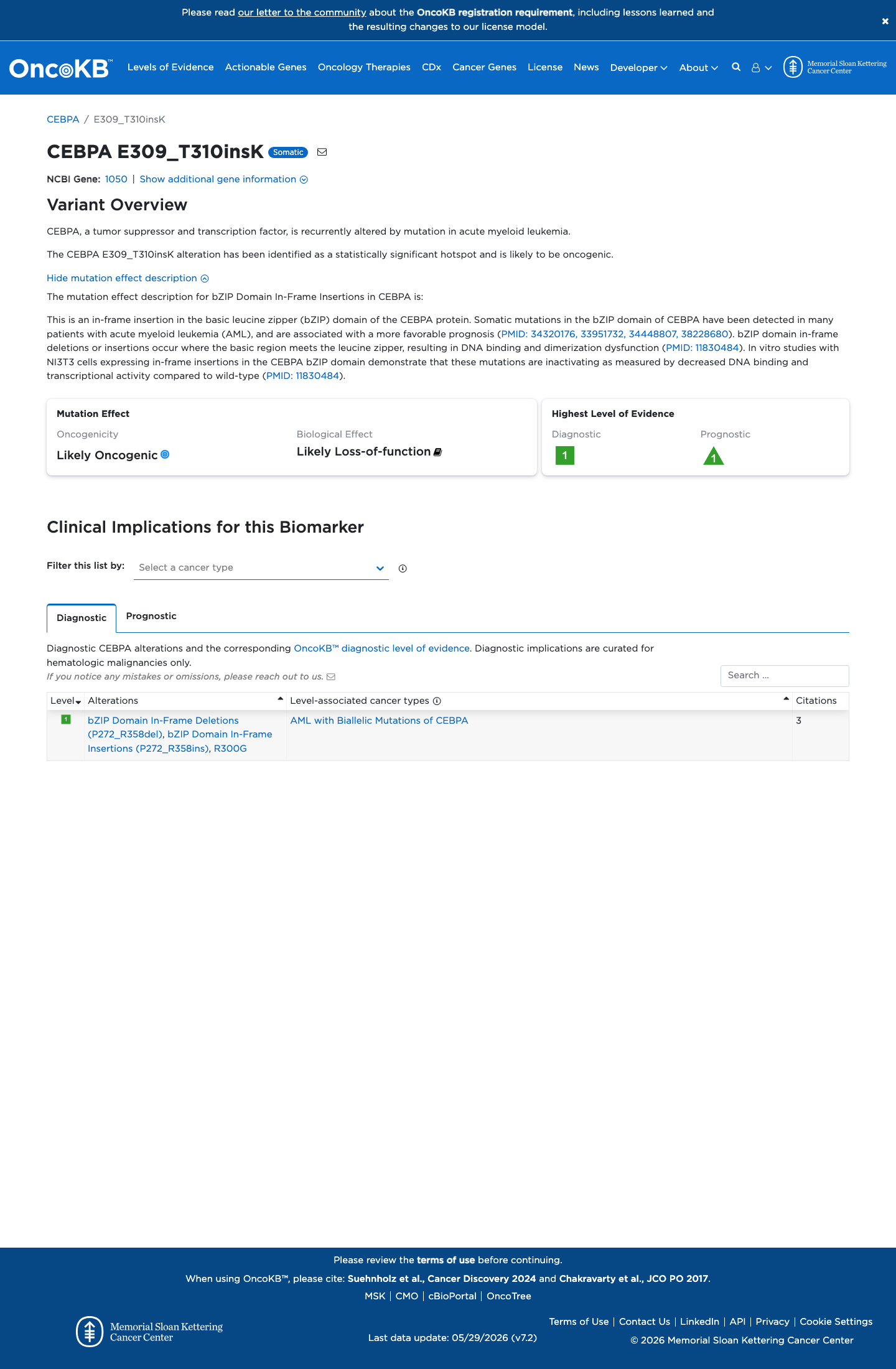
Functional
Likely Oncogenic
OncoKB identified variant-specific curated literature and context relevant to functional review; biological-effect context: Likely Loss-of-function; curated oncogenicity label: Likely Oncogenic.
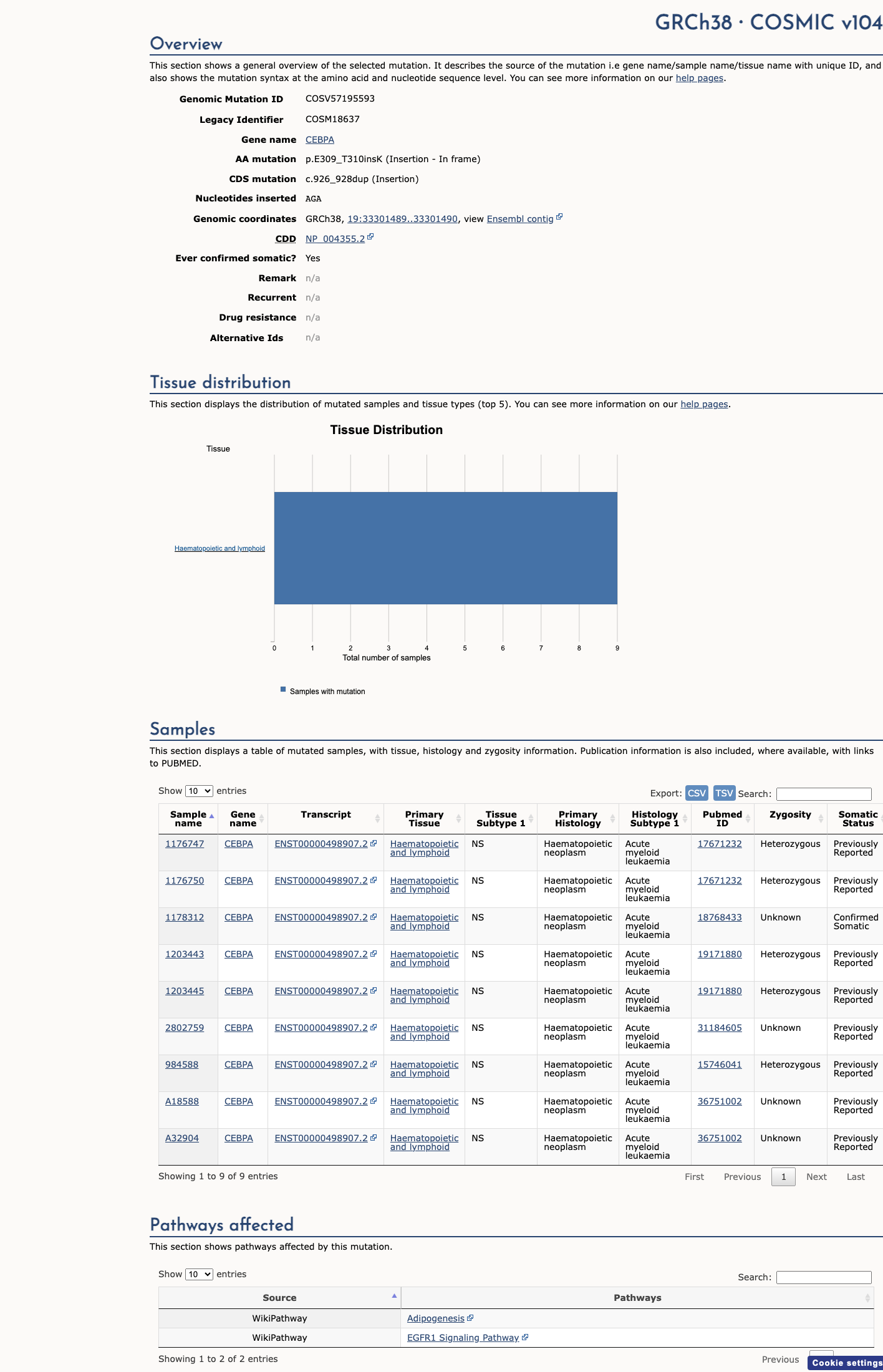
COSMIC

Cancer hotspots
Somatic evidence
Not in COSMIC / hotspots
COSMIC
This variant does not lie in a statistically significant hotspot. This variant has previously been reported in somatic cancers (COSMIC; COSV57195593, n = 9 times).
Hotspots
This variant does not lie in a statistically significant hotspot.
Sources & reference links
Triaged references · 5 PMIDs not cited in assessment
11830484 ↗
Mutations in the gene encoding the transcription factor CCAAT/enhancer binding protein alpha in myelodysplastic syndromes and acute myeloid leukemias.
ONCOKB
33951732 ↗
CEBPA-bZip mutations are associated with favorable prognosis in de novo AML: a report from the Children's Oncology Group.
ONCOKB
34320176 ↗
CEBPA mutations in 4708 patients with acute myeloid leukemia: differential impact of bZIP and TAD mutations on outcome.
ONCOKB