NM_000059.4:c.3417G>A (p.Lys1139=) is a synonymous substitution in BRCA2 exon 11, located outside both clinically important functional domains defined by ENIGMA (aa 10-40 PALB2 binding and aa 2481-3186 DNA binding).1 BP1_Strong is met: silent substitution outside a clinically important functional domain with no predicted splicing impact (SpliceAI max delta = 0.00).2 The variant is present in gnomAD v2.1 (40/250,942 alleles, AF=0.000159) and v4.1 (162/1,613,842 alleles, AF=0.000100), with highest frequency in the Ashkenazi Jewish population (AF=0.00357), consistent with a founder effect. The grpmax filter allele frequency (FAF=2.93e-06 v2.1, FAF=1.88e-05 v4.1) does not meet ENIGMA BS1 thresholds.3 The variant has been classified as Likely benign by the ENIGMA expert panel in ClinVar (Variation ID 135796, 3-star review status), with 8 clinical laboratories reporting Likely benign, 3 reporting Benign, and 1 reporting Likely Benign.4 No variant-specific functional assay data, segregation analysis, case-control data, or clinical-history likelihood ratios were identified for this variant in the ENIGMA curated datasets (Table 9, HUMU, clinical_history_LR, ST7) or in the reviewed literature.5 No publication among the 8 PMIDs reviewed (20104584, 25741868, 23918944, 23788249, 17392385, 18163131, 20301425, 28492532) contained a specific mention of NM_000059.4:c.3417G>A.6
Final classification
Likely Benign
BP1BP6
BRCA2
c.3417G>A
p.Lys1139=
This variant
NM_000059.4:c.3417G>A (p.Lys1139=) is a synonymous substitution in BRCA2 exon 11, located outside both clinically important functional domains defined by ENIGMA (aa 10-40 PALB2 binding and aa 2481-3186 DNA binding).
ENIGMA BRCA1/BRCA2 v1.2 Table 3 rules applied. Zero pathogenic criteria met. BP1_Strong (strong benign) plus BP6 (supporting benign) satisfies the Likely Benign combination rule: Strong (Benign) count=1 + Supporting (Benign) count=1.
Classification rationale
BP1BP6
Likely Benign
BRCA2 c.3417G>A
BP1 + BP6
→
Likely Benign
1
cspec ↗
5
vcep_specifications_table9_v1_2_2024_11_18vcep_humu_40_1557_s001vcep_pmid_31853058_brca2_clinical_history_lrvcep_supplementarytables_v1_2_2024_11_18
LYFE Sciences is an AI system, and it can make mistakes. Criteria
may be applied incorrectly, sources may be misread, and a confident-looking
classification can still be wrong. Double-check every criterion and
its underlying evidence before relying on any call.
Gene diagram
· NM_000059.4 · variants mapped to exon structure
BRCA2
NM_000059.4
Fetching transcript structure from UCSC…
Applied criteria · 2 applied · 13 assessed
MetEvidence satisfies this criterion.
Not metEvaluated against available evidence; threshold not reached.
Not assessedApplies in principle, but no evidence was found to evaluate it.
N/ADoesn't apply to this variant type.
Applied · 2
Strength
Supporting
Moderate
Strong
Very strong
BP1
strong
Benign
BP1_Strong applies under ENIGMA v1.2: c.3417G>A is a silent substitution (p.Lys1139=) located at residue 1139, which is outside both BRCA2 clinically important functional domains (PALB2 binding domain aa 10-40 and DNA binding domain aa 2481-3186). SpliceAI predicts no splicing impact (max delta = 0.00, ≤ 0.1). Both conditions for BP1_Strong are satisfied.
Silent substitution (synonymous) at codon 1139.K1139 is outside clinically important functional domains (PALB2 binding: aa 10-40DNA binding: aa 2481-3186).
Assessed · not applied
· 5 not met · 8 not assessed
Pathogenic
PS3
No variant-specific functional assay data were identified in the ENIGMA curated functional assay table (Specifications Table 9), the HUMU multifactorial dataset, or any reviewed publication.
PS4
No case-control study with variant-specific odds ratio and p-value meeting ENIGMA PS4 thresholds (p ≤ 0.05, OR ≥ 4, lower CI excludes 2.0) was identified.
PM2
PM2_Supporting under ENIGMA requires absence from gnomAD v2.1 (non-cancer, exome only) and gnomAD v3.1 (non-cancer) outbred populations.
PP1
No co-segregation data or LR analysis meeting ENIGMA PP1 thresholds (LR ≥ 2.08) were identified for this variant.
PP3
ENIGMA PP3 requires either (a) missense/in-frame variant inside a clinically important functional domain with BayesDel no-AF score ≥ 0.30, or (b) SpliceAI delta ≥ 0.20 for silent/missense/intronic variants.
PP4
No variant-specific clinical-history likelihood ratio meeting ENIGMA PP4 thresholds (LR ≥ 2.08) was identified.
PP5
The ENIGMA expert panel has classified this variant as Likely benign in ClinVar (Variation ID 135796, review status: reviewed by expert panel).
Benign
BA1
ENIGMA BA1 (Stand Alone benign) requires filter allele frequency (FAF) > 0.001 (0.1%) in gnomAD non-founder populations.
BS1
ENIGMA BS1_Strong requires FAF > 0.0001 and BS1_Supporting requires FAF > 0.00002 in gnomAD non-founder populations.
BS2
ENIGMA BS2 requires assessment of observed homozygotes or compound heterozygotes for absence of Fanconi Anemia phenotype, using a points-based system (Specifications Table 8).
BS3
No variant-specific functional assay data showing no damaging effect on protein function were identified.
BS4
No variant-specific lack-of-segregation LR analysis meeting ENIGMA BS4 thresholds (LR ≤ 0.48) was identified.
BP5
No variant-specific clinical-history likelihood ratio meeting ENIGMA BP5 thresholds (LR ≤ 0.48) was identified.
N/A · 13
PVS1 · PS1 · PS2 · PM1 · PM3 · PM4 · PM5 · PM6 · PP2 · BP2 · BP3 · BP4 · BP7
Research & evidence
Population frequency · supports benign
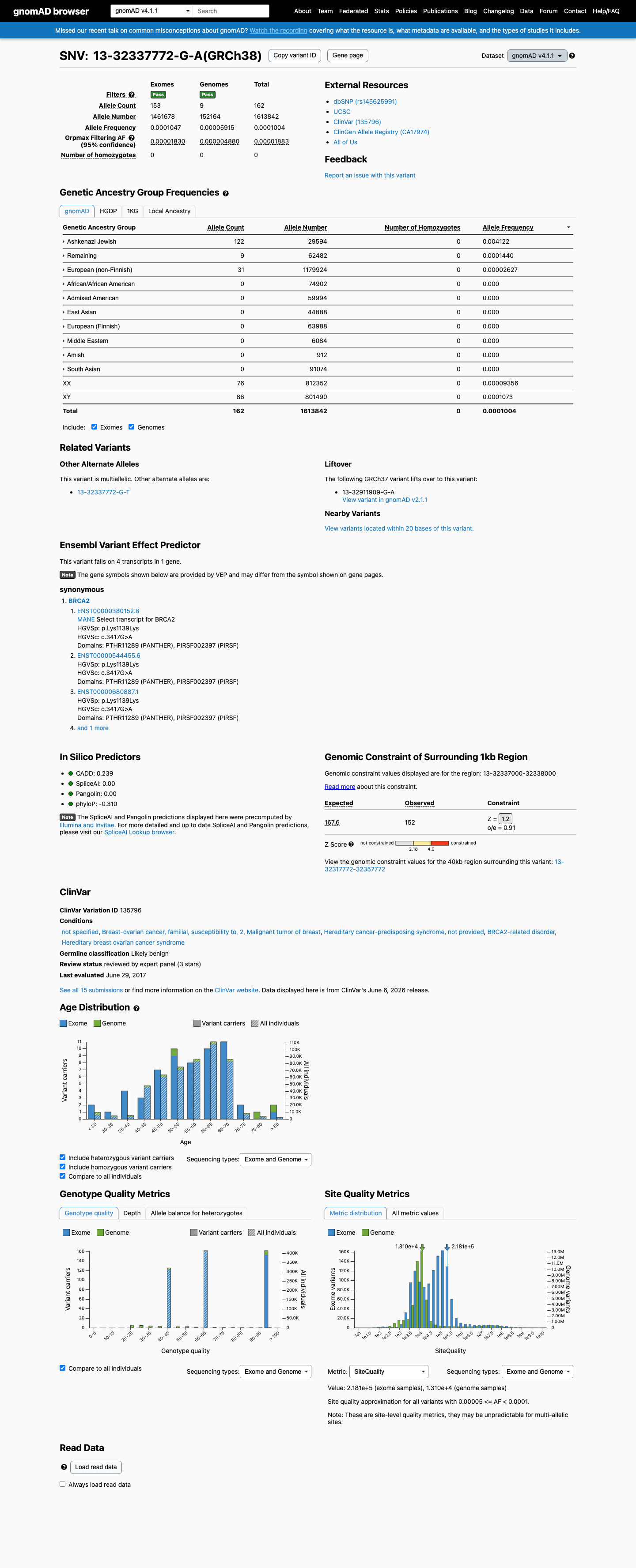
gnomAD v4.1
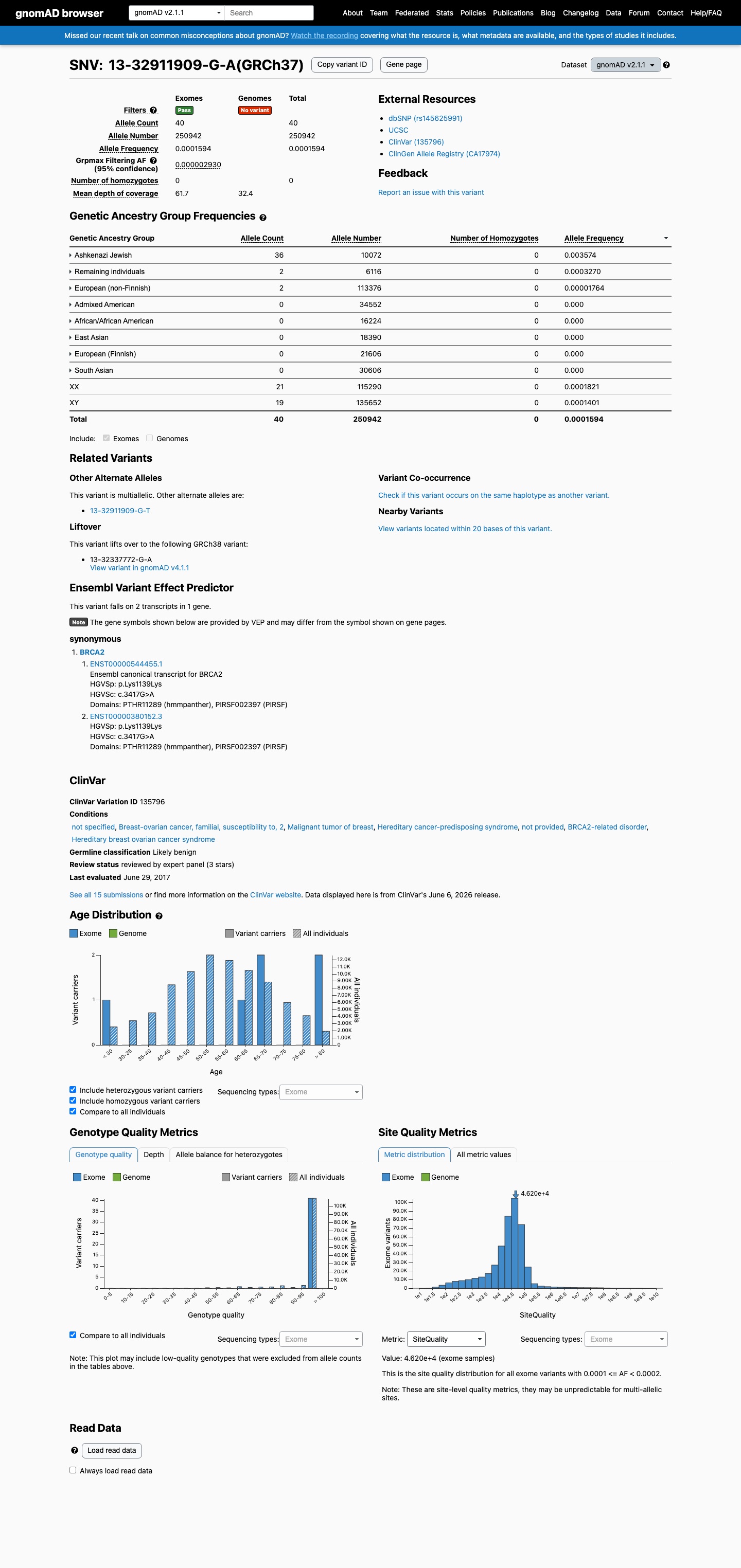
gnomAD v2.1
v4.1
This variant is present in gnomAD v4.1 (AF= 0.000100382; MAF= 0.01004%, 162/1613842 alleles, homozygotes = 0) and has highest observed frequency in the Ashkenazi Jewish population (AF= 0.00412246; MAF= 0.41225%, 122/29594 alleles, homozygotes = 0); grpmax FAF= 1.883e-05.
v2.1
This variant is present in gnomAD v2.1 (AF= 0.000159399; MAF= 0.01594%, 40/250942 alleles, homozygotes = 0) and has highest observed frequency in the Ashkenazi Jewish population (AF= 0.00357427; MAF= 0.35743%, 36/10072 alleles, homozygotes = 0); grpmax FAF= 2.93e-06.
🇨🇦 CA
Not available in gnomAD-Canada v1.0.
Allele frequency by ancestry
three datasets · side by side
gnomAD v4.1
0.01%
· 162 / 1,613,842
0 hom · FAF 0.0019%
0 hom · FAF 0.0019%
Ashkenazi Jewish 122 / 29,594 |
0.41% |
Remaining individuals 9 / 62,482 |
0.014% |
European (non-Finnish) 31 / 1,179,924 |
0.0026% |
+ 7 not observed (Admixed American, European (Finnish), Amish, East Asian, Middle Eastern, South Asian, African/African American)
gnomAD v2.1
0.016%
· 40 / 250,942
0 hom · FAF 0.00029%
0 hom · FAF 0.00029%
Ashkenazi Jewish 36 / 10,072 |
0.36% |
Remaining individuals 2 / 6,116 |
0.033% |
European (non-Finnish) 2 / 113,376 |
0.0018% |
+ 5 not observed (African/African American, Admixed American, East Asian, European (Finnish), South Asian)
gnomAD Canada 🇨🇦
Absent
· 0 / ?
0 hom
0 hom
Not observed in any ancestry group.

ClinVar
This variant has been reported in ClinVar as Likely benign (8 clinical laboratories) and as Benign (3 clinical laboratories) and as Likely Benign (1 clinical laboratory) and as Likely benign by Evidence-based Network for the Interpretation of Germline Mutant Alleles (ENIGMA) (expert panel). (ClinVarID = 135796)
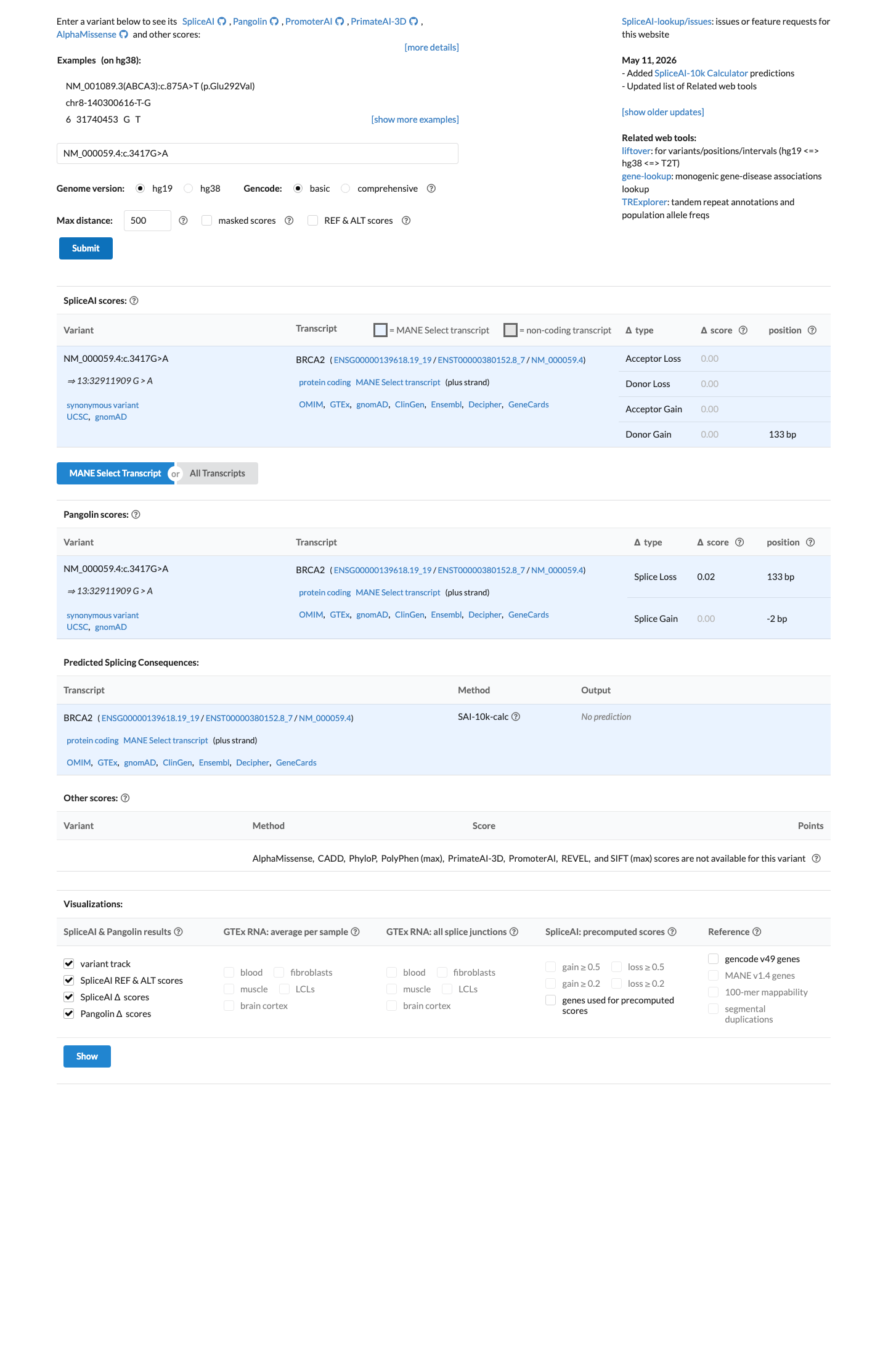
In silico
SpliceAI predicts no significant splice impact for this variant (max delta score = 0.00).
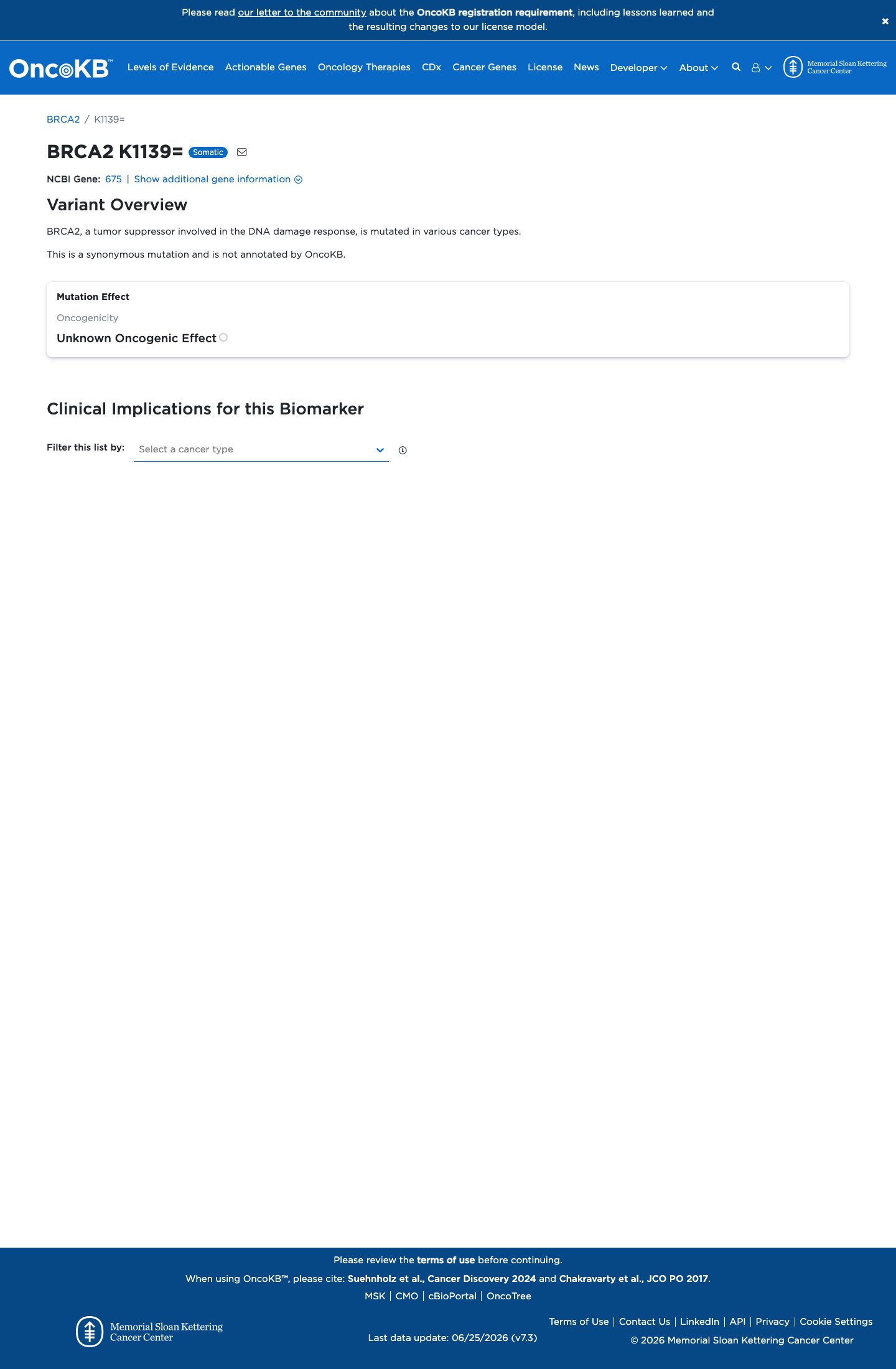
Functional
Unknown Oncogenic Effect
OncoKB identified curated literature and non-variant-specific oncogenicity context for review; listed oncogenicity label: Unknown Oncogenic Effect.

COSMIC

Cancer hotspots
Somatic evidence
Not in COSMIC / hotspots
COSMIC
This variant does not lie in a statistically significant hotspot. This variant has not previously been reported in somatic cancers (COSMIC).
Hotspots
This variant does not lie in a statistically significant hotspot.
Sources & reference links
9Sources
Triaged references · 8 PMIDs not cited in assessment
20104584 ↗
Characterization of BRCA1 and BRCA2 deleterious mutations and variants of unknown clinical significance in unilateral and bilateral breast cancer: the WECARE study.
CLINVAR
23918944 ↗
Tamoxifen and risk of contralateral breast cancer for BRCA1 and BRCA2 mutation carriers.
CLINVAR
25741868 ↗
Standards and guidelines for the interpretation of sequence variants: a joint consensus recommendation of the American College of Medical Genetics and Genomics and the Association for Molecular Pathology.
CLINVAR
17392385 ↗
American Cancer Society guidelines for breast screening with MRI as an adjunct to mammography.
CLINVAR
23788249 ↗
ACMG recommendations for reporting of incidental findings in clinical exome and genome sequencing.
CLINVAR
28492532 ↗
Sherloc: a comprehensive refinement of the ACMG-AMP variant classification criteria.
CLINVAR