PM1 (moderate): p.Asp842 is located in the activation loop (exon 18) of the PDGFRA tyrosine kinase domain, a critical functional domain and statistically significant mutational hotspot.1 PM2 (moderate): The variant is absent from gnomAD v2.1, v4.1, and gnomAD-Canada.2 PS3 (moderate): Multiple independent functional studies demonstrate that PDGFRA D842V is a constitutively activating, gain-of-function mutation with ligand-independent autophosphorylation and transforming activity. Strength is limited to moderate because all functional evidence derives from somatic GIST contexts.3 PP3 (supporting): REVEL predicts a damaging effect (score 0.861). BayesDel is intermediate (0.343) and SpliceAI predicts no splicing impact (0.02), but REVEL provides supporting computational evidence of pathogenicity.4 Classification: Likely Pathogenic. Three moderate criteria (PM1 + PM2 + PS3) and one supporting criterion (PP3) meet the generic ACMG/AMP 2015 threshold for Likely Pathogenic (3 moderate, or 2 moderate + 2 supporting).5 Caveat: All functional and prevalence evidence is derived from somatic (GIST) contexts. This variant has not been observed in any germline case. A definitive germline classification is constrained by this limitation.
Final classification
Likely Pathogenic
PS3PM1PM2PP3
PDGFRA
c.2525A>T
p.Asp842Val
This variant
PM1 (moderate): p.Asp842 is located in the activation loop (exon 18) of the PDGFRA tyrosine kinase domain, a critical functional domain and statistically significant mutational hotspot.
gene-specific framework lacked a usable explicit final combination framework, so generic ACMG/AMP 2015 final-combination rules were applied as fallback; applied criteria: PS3 moderate, PM1 moderate, PM2 moderate, PP3 supporting; combination = 3 moderate + 1 supporting, which maps to Likely Pathogenic.
Classification rationale
PS3PM1PM2PP3
Likely Pathogenic
PDGFRA c.2525A>T
PS3 + PM1 + PM2 + PP3
→
Likely Pathogenic
4
revelbayesdelspliceai ↗
5
generic_acmg_combination_rules
LYFE Sciences is an AI system, and it can make mistakes. Criteria
may be applied incorrectly, sources may be misread, and a confident-looking
classification can still be wrong. Double-check every criterion and
its underlying evidence before relying on any call.
Gene diagram
· NM_006206.6 · variants mapped to exon structure
PDGFRA
NM_006206.6
Fetching transcript structure from UCSC…
Applied criteria · 4 applied · 17 assessed
MetEvidence satisfies this criterion.
Not metEvaluated against available evidence; threshold not reached.
Not assessedApplies in principle, but no evidence was found to evaluate it.
N/ADoesn't apply to this variant type.
Applied · 4
Strength
Supporting
Moderate
Strong
Very strong
PS3
moderate
review
Pathogenic
PDGFRA D842V has been characterized as a gain-of-function, constitutively activating mutation in multiple independent functional studies across several cell line systems (CHO, 293T, Ba/F3), demonstrating ligand-independent autophosphorylation and transforming activity. Five independent publications confirmed constitutive kinase activation. All functional evidence derives from somatic GIST contexts; no germline-specific functional studies are available, which limits the strength applied.
Constitutive ligand-independent PDGFRA autophosphorylation in CHO cells (PMID:12522257)Constitutive activation and autonomous Ba/F3 proliferation confirmedimatinib-resistant (PMID:12949711)
PM1
moderate
Pathogenic
Asp842 is located in the activation loop (exon 18) of the PDGFRA tyrosine kinase domain, a critical functional domain. This residue lies within a statistically significant mutational hotspot and is the most frequently mutated codon in PDGFRA-driven GIST.
Statistically significant hotspot at this residue (hotspots)Asp842 mutations account for the majority of PDGFRA alterations in GISTD842V alone represents 62.6% of published PDGFRA-mutant GISTs (PMID:15928335)
PM2
moderate
Pathogenic
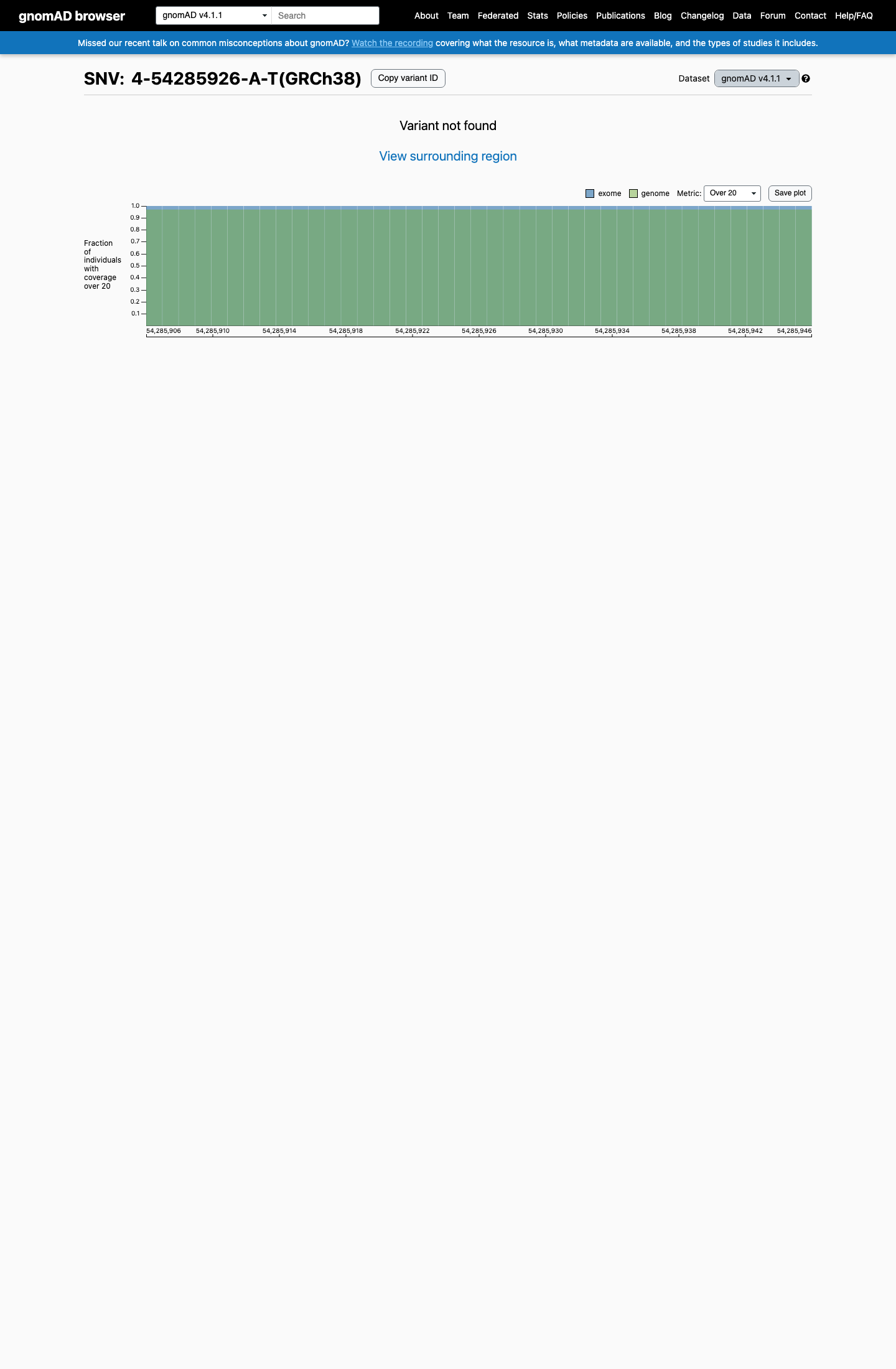
This variant is absent from gnomAD v2.1 (exomes), gnomAD v4.1 (exomes/genomes), and gnomAD-Canada v1.0, meeting the PM2 threshold for absence from population databases (allele frequency <0.1%).
Absent from gnomAD v2.1Absent from gnomAD v4.1Absent from gnomAD-Canada v1.0
PP3
supporting
Pathogenic
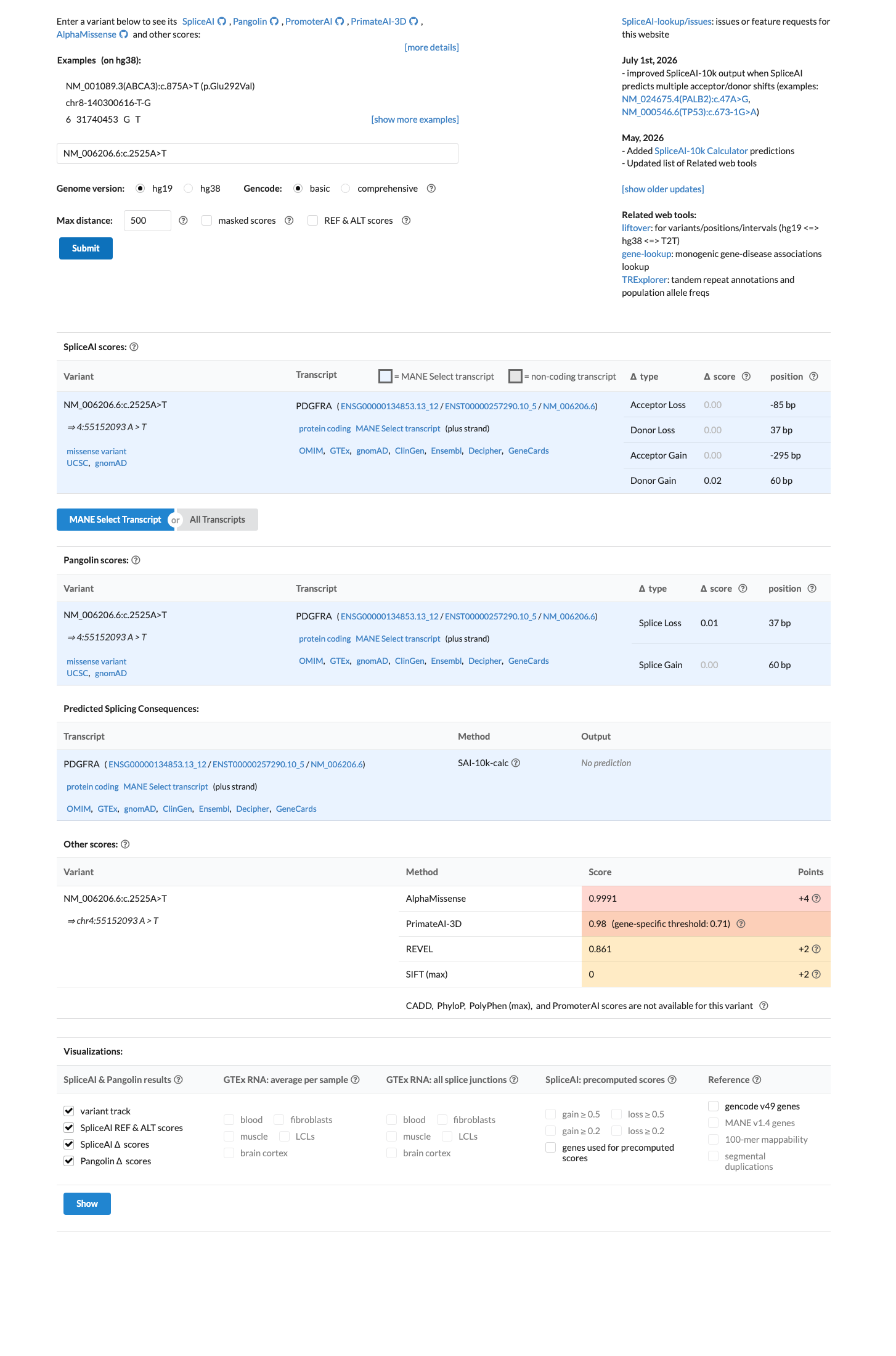
REVEL predicts a damaging effect (score 0.861, well above the 0.5 threshold). BayesDel score is 0.343 (intermediate). SpliceAI predicts no splicing impact (max delta 0.02). Multiple in silico lines are mixed, but REVEL strongly supports pathogenicity, providing supporting-level evidence.
REVEL score: 0.861 (damaging)BayesDel score: 0.342708 (intermediate)SpliceAI max delta: 0.02 (no splicing impact)
Assessed · not applied
· 8 not met · 9 not assessed
Pathogenic
PS2
No de novo data are available for this variant.
PS4
D842V is the most common PDGFRA mutation in sporadic GIST (181/289 published cases) and is reported 211 times in COSMIC.
PM6
No de novo data are available.
PP1
No segregation data are available for this variant.
PP2
HCI prior score is not available for PDGFRA.
PP4
No patient phenotype data or clinical information was provided for this case.
PP5
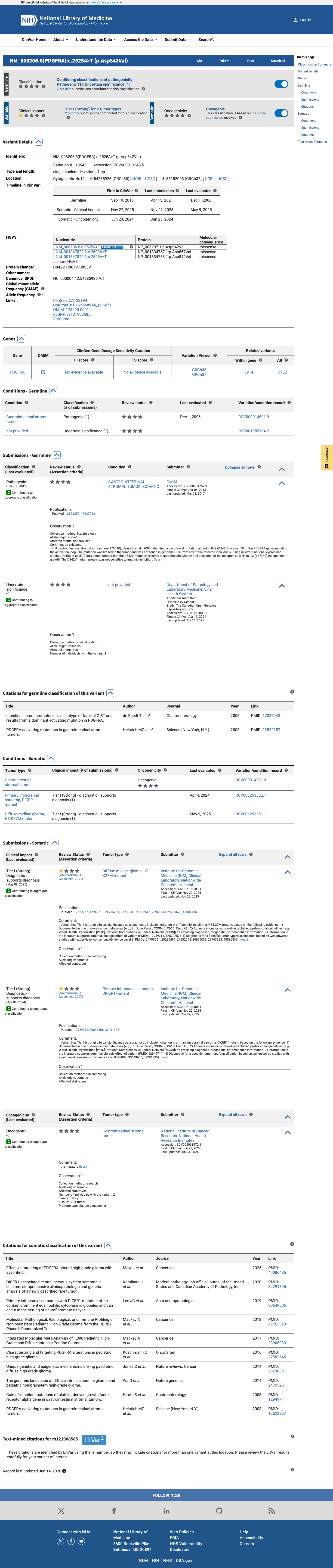
ClinVar aggregate classification for this variant is Uncertain significance (1 clinical laboratory).
Benign
BA1
This variant is absent from all population databases (gnomAD v2.1, v4.1, gnomAD-Canada).
BS1
This variant is absent from all population databases.
BS2
No data on healthy adult carriers are available.
BS3
Well-established functional studies consistently demonstrate a gain-of-function effect: constitutive autophosphorylation, ligand-independent kinase activation, and transforming activity.
BS4
No segregation data are available for this variant.
BP1
PDGFRA germline disease is caused by gain-of-function missense mutations (e.g., Y555C in familial GIST), not solely by truncating variants.
BP2
No data on trans configuration with a known pathogenic variant are available.
BP4
REVEL predicts a damaging effect (0.861).
BP5
No data on an alternate molecular basis for disease in a case harboring this variant are available.
BP6
No reputable source reports this variant as benign.
N/A · 4
PVS1 · PS1 · PM5 · BP7
Research & evidence
Population frequency · supports pathogenic
gnomAD v4.1

gnomAD v2.1
v4.1
Absent from gnomAD v4.1.
v2.1
Absent from gnomAD v2.1.
🇨🇦 CA
Absent from gnomAD-Canada v1.0.
Allele frequency by ancestry
three datasets · side by side
gnomAD v4.1
Absent
· 0 / ?
0 hom
0 hom
Not observed in any ancestry group.
gnomAD v2.1
Absent
· 0 / ?
0 hom
0 hom
Not observed in any ancestry group.
gnomAD Canada 🇨🇦
Absent
· 0 / ?
0 hom
0 hom
Not observed in any ancestry group.
ClinVar
This variant has been reported in ClinVar as Uncertain significance (1 clinical laboratory). (ClinVarID = 13543)
In silico
SpliceAI predicts no significant splice impact for this variant (max delta score = 0.02). REVEL score = 0.861. BayesDel score = 0.342708.
Functional
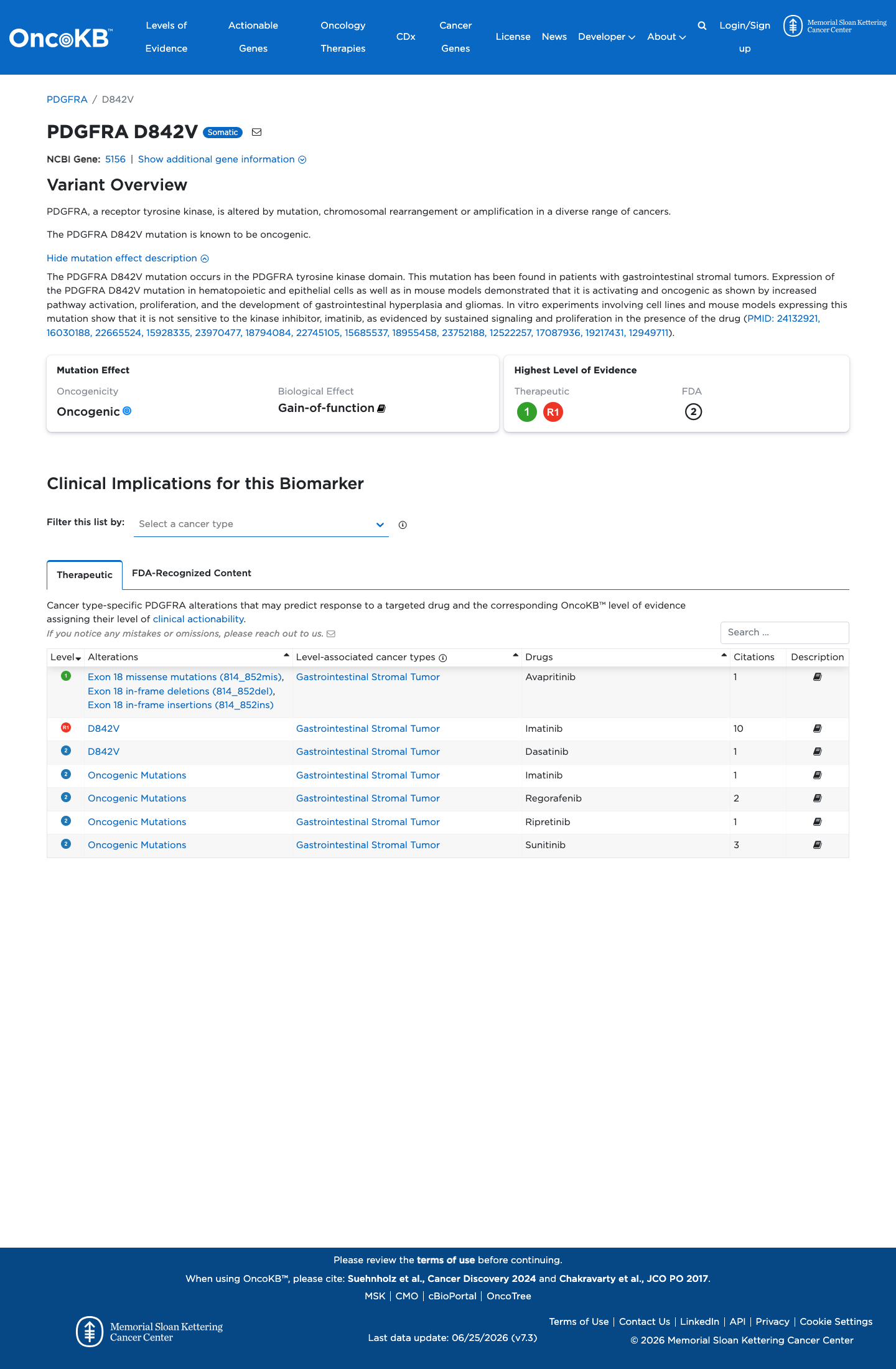
Oncogenic
OncoKB identified variant-specific curated literature and context relevant to functional review; biological-effect context: Gain-of-function; curated oncogenicity label: Oncogenic.
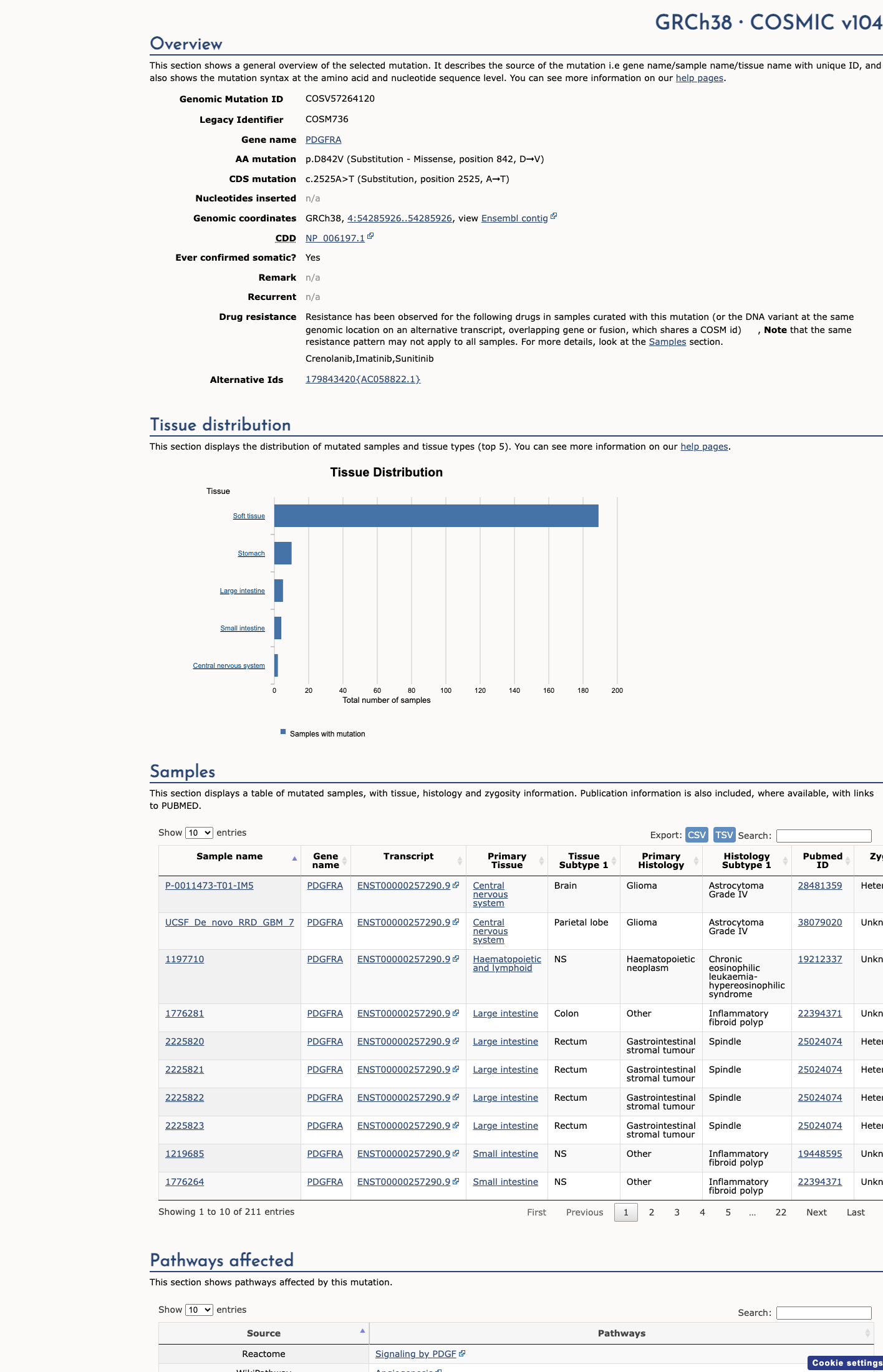
COSMIC

Cancer hotspots
Somatic evidence
Hotspot
COSMIC
This variant lies in a statistically significant hotspot. This variant has previously been reported in somatic cancers (COSMIC; COSV57264120, n = 211 times).
Hotspots
This variant lies in a statistically significant hotspot.
Literature · how each cited paper was used
6papers cited
Each card is an audit: what was searched, what was found, whether it names the variant, which criteria it fed, and why. 1 further PMID triaged but not cited — see Sources & references.
PDGFRA activating mutations in gastrointestinal stromal tumors.
Searched
D842Vc.2525Asp842
Found
PDGFRA D842V identified as a somatic activating mutation in exon 18 of KIT-wildtype GISTs. Constitutive ligand-independent autophosphorylation demonstrated in transiently transfected CHO cells. D842V was the most common PDGFRA mutation found (8 of 14 PDGFRA-mutant GISTs).
Variant
✓ Names this variant — characterised directly
Applied to
→PS3
met
Why
First published identification of D842V as an activating mutation in GIST. Cited as functional evidence for PS3.
Two of the KIT-WT GISTs had an identical PDGFRA missense mutation, leading to substitution of valine for the highly conserved aspartic acid at codon 842 (PDGFRA D842V).
Location Results paragraph 2; Table 1; Figure 2 · Context Transient transfection in CHO cells; immunoblotting for phosphotyrosine and PDGFRA · full text
Gain-of-function mutations of platelet-derived growth factor receptor alpha gene in gastrointestinal stromal tumors.
Searched
D842VAsp842Val842-Asp to Val
Found
PDGFRA Asp842Val identified as a gain-of-function mutation in 3 of 8 GISTs without KIT mutations. Demonstrated strong constitutive tyrosine phosphorylation in 293T cells without ligand stimulation. Ba/F3 cells expressing D842V grew autonomously without IL-3. D842V was resistant to imatinib, showing only partial inhibition at 10 μmol/L.
Variant
✓ Names this variant — characterised directly
Applied to
→PS3
met
Why
Independent confirmation of D842V as a constitutively activating gain-of-function mutation with imatinib resistance. Cited as functional evidence for PS3.
PDGFR α with 842-Asp to Val substitution was phosphorylated strongly on tyrosine without the addition of human PDGF-AA.
Location Results section; Table 1; Figures 3-5 · Context Transient transfection in 293T human embryonic kidney cells; stable transfection in Ba/F3 murine lymphoid cells; tritium thymidine incorporation assay · full text
Mechanisms of resistance to imatinib mesylate in gastrointestinal stromal tumors and activity of the PKC412 inhibitor against imatinib-resistant mutants.
Searched
D842VD842
Found
Investigated mechanisms of imatinib resistance in 26 progressive GIST patients. One patient with an initial KIT G565R mutation acquired a secondary PDGFRA D842V mutation at progression. D842V was confirmed imatinib-resistant in Ba/F3 cells but sensitive to PKC412. The D842V mutant showed the highest cellular IC50 among all tested mutants.
Variant
✓ Names this variant — characterised directly
Applied to
→PS3
met
Why
Demonstrates D842V as an acquired resistance mutation conferring imatinib resistance. Cited as additional functional evidence for PS3.
One patient (case 25) with an original KIT G565R mutation acquired a D842V point mutation in PDGFRA that was not detectable in the primary tumor from this patient.
Location Results; Table 2; Figure 4 · Context Ba/F3 cells stably expressing PDGFRA-D842V; dose-response curves for imatinib and PKC412 · full text
PDGFRA mutations in gastrointestinal stromal tumors: frequency, spectrum and in vitro sensitivity to imatinib.
Searched
D842VD842
Found
Comprehensive catalog of PDGFRA mutations in 1,105 GISTs. D842V was the most common mutation, representing 181 of 289 (62.6%) published PDGFRA-mutant GISTs. D842V confirmed as constitutively activating in CHO cells and imatinib-resistant in vitro (IC50 > 1 μM). Transient expression in CHO cells showed ligand-independent tyrosine phosphorylation for all D842-mutant isoforms.
Variant
✓ Names this variant — characterised directly
Applied to
→PS3
met
→PM1
met
Why
Largest published catalog confirming D842V as the predominant PDGFRA mutation in GIST. Provides prevalence data for PS4 (somatic only) and hotspot evidence for PM1. Cited as additional functional evidence for PS3.
the single most common PDGFRA mutation in GISTs is the substitution D842V (62.6%).
Location Table 1; Results; Discussion · Context Transient transfection in CHO cells; stable Ba/F3 cell lines; XTT proliferation assay; immunoblotting · full text
The small molecule tyrosine kinase inhibitor AMN107 inhibits TEL-PDGFRbeta and FIP1L1-PDGFRalpha in vitro and in vivo.
Searched
D842VD842
Found
Evaluated AMN107 (nilotinib) against PDGFR fusion kinases. PDGFRα D842V was tested as an imatinib-resistant control. Ba/F3 cells expressing PDGFRα D842V were resistant to AMN107 at concentrations up to 1 μM, confirming the drug-resistant nature of this mutation.
Variant
✓ Names this variant — characterised directly
Applied to
→PS3
met
Why
Confirms D842V as a drug-resistant activating mutation. Cited as additional functional evidence for PS3.
Ba/F3 cells expressing PDGFRα D842V were resistant to AMN107, because growth was not inhibited at concentrations up to 1 μM.
Location Table 1; Table 3; Results · Context Ba/F3 murine pro-B-cell line; retroviral transduction; Celltiter96 AqueousOne proliferation assay · full text
Intestinal neurofibromatosis is a subtype of familial GIST and results from a dominant activating mutation in PDGFRA.
Searched
D842VAsp842
Found
Reported a germline PDGFRA Y555C mutation causing familial intestinal neurofibromatosis/GIST. PDGFRA D842V was used as a positive control for activated (phosphorylated) PDGFRα in 293T and Ba/F3 functional assays. D842V showed strong autophosphorylation in both cell lines and conferred IL-3-independent growth in Ba/F3 cells. D842V was confirmed imatinib-resistant, while Y555C was imatinib-sensitive.
Variant
✓ Names this variant — characterised directly
Applied to
→PS3
met
Why
D842V used as a somatic positive control in functional assays of a germline PDGFRA mutation. Confirms activating nature of D842V. Also establishes that germline PDGFRA missense mutations cause familial GIST, supporting BP1 not_met.
A PDGFRα with a known activating somatic mutation (D842V) common in sporadic GIST was used as a positive control for activated (phosphorylated) PDGFRα.
Location Results; Figures 3 and 4 · Context Transient transfection in 293T cells; stable retroviral transduction in Ba/F3 cells; Western blot for phospho-PDGFRα · full text
Sources & reference links
Triaged references · 1 PMID not cited in assessment
23852704 ↗
Tumor markers in colorectal cancer, gastric cancer and gastrointestinal stromal cancers: European group on tumor markers 2014 guidelines update.
CLINVAR