NM_000059.4:c.4284dup is a frameshift duplication in BRCA2 exon 11, predicted to generate a premature termination codon at p.(Gln1429SerfsTer9) with expected NMD.1 PVS1 (very strong) is applied per ENIGMA Specifications Table 4, which assigns PVS1 to BRCA2 exon 11 PTC variants. BRCA2 loss of function is an established mechanism for hereditary breast and ovarian cancer.2 PM5_Strong (PTC) is applied per ENIGMA Table 4, reflecting that exon 11 harbors multiple proven pathogenic PTC variants supporting additional weight beyond PVS1.3 PP4_Supporting is applied based on clinical history likelihood ratio of 2.23 from 21 probands in the Li et al. 2020 cohort, exceeding the ENIGMA PP4 supporting threshold of LR ≥ 2.08.4 PP5_Supporting is applied per standing adjudication rule: ClinVar classifies this variant as Pathogenic with ENIGMA expert panel review (3-star), warranting PP5 at supporting strength.5 Under ENIGMA Table 3 combining rules, 1×PVS1 (very strong) + 1×PM5_Strong (strong) satisfies the pathogenic classification threshold (1×Very Strong + ≥1×Strong). Additionally, 1×Very Strong + ≥2×Supporting (PP4 + PP5) independently meets the pathogenic threshold.6 Final classification: PATHOGENIC, consistent with the ENIGMA expert panel classification in ClinVar (Variation ID 37892).7
Final classification
Pathogenic
PVS1PM5PP4PP5
BRCA2
c.4284dup
p.Gln1429SerfsTer9
This variant
NM_000059.4:c.4284dup is a frameshift duplication in BRCA2 exon 11, predicted to generate a premature termination codon at p.(Gln1429SerfsTer9) with expected NMD.
ENIGMA BRCA1/BRCA2 v1.2 Table 3 criteria combination rules applied to adjudicated criteria from criteria_assessment.json. The variant has PVS1 (very strong), PM5_Strong (strong), PP4_Supporting, and PP5_Supporting. Under Table 3, 1×Very Strong + ≥1×Strong → Pathogenic, and also 1×Very Strong + ≥2×Supporting → Pathogenic. Both independently meet the Pathogenic threshold. No benign criteria are met, so no conflicting-evidence point calculation is required.
Classification rationale
PVS1PM5PP4PP5
Pathogenic
BRCA2 c.4284dup
PVS1 + PM5 + PP4 + PP5
→
Pathogenic
LYFE Sciences is an AI system, and it can make mistakes. Criteria
may be applied incorrectly, sources may be misread, and a confident-looking
classification can still be wrong. Double-check every criterion and
its underlying evidence before relying on any call.
Gene diagram
· NM_000059.4 · variants mapped to exon structure
BRCA2
NM_000059.4
Fetching transcript structure from UCSC…
Applied criteria · 4 applied · 12 assessed
MetEvidence satisfies this criterion.
Not metEvaluated against available evidence; threshold not reached.
Not assessedApplies in principle, but no evidence was found to evaluate it.
N/ADoesn't apply to this variant type.
Applied · 4
Strength
Supporting
Moderate
Strong
Very strong
PVS1
very strong
Pathogenic
NM_000059.4:c.4284dup is a frameshift duplication in BRCA2 exon 11 (c.1910-6841) predicted to cause a premature termination codon at p.(Gln1429SerfsTer9). Per ENIGMA Specifications Table 4, BRCA2 exon 11 PTC variants are assigned PVS1 (very strong). BRCA2 loss of function is an established disease mechanism for hereditary breast and ovarian cancer. NMD is expected given the truncation occurs well upstream of the final exon.
BRCA2 exon 11 PTC assigned PVS1 per ENIGMA Specifications Table 4Frameshift duplication c.4284dup → p.(Gln1429SerfsTer9)stop at codon 1437 of 3418
PM5
strong
Pathogenic
Per ENIGMA Specifications Table 4, BRCA2 exon 11 PTC variants are assigned PM5_Strong (PTC). Exon 11 is not in the PM5_N/A exclusion list (E12, E27, E6). This criterion provides additional weight for PTC variants already annotated as PVS1, reflecting the established pathogenicity of other PTC variants in this exon.
BRCA2 exon 11 PTC assigned PM5_Strong (PTC) per ENIGMA Table 4Exon 11 harbors multiple known pathogenic PTC variants
PP4
supporting
Pathogenic
Per ENIGMA PP4, the clinical history likelihood ratio from Li et al. 2020 (PMID:31853058) for BRCA2 c.4284dup is LR=2.23 based on 21 probands, exceeding the PP4_Supporting threshold of LR≥2.08. This indicates that the personal and family cancer history of carriers is more consistent with a pathogenic variant than with a benign finding.
Clinical history LR = 2.23N=21 probands (Li et al. 2020PMID:31853058)
Assessed · not applied
· 6 not met · 6 not assessed
Pathogenic
PS3
No variant-specific functional studies were identified for NM_000059.4:c.4284dup.
PS4
ENIGMA PS4 requires a formal case-control study with odds ratio ≥4 and lower confidence interval excluding 2.0.
PM2
ENIGMA PM2_Supporting requires the variant to be absent from gnomAD v2.1 (non-cancer, exome only subset) and gnomAD v3.1 (non-cancer).
PP1
ENIGMA PP1 requires quantitative cosegregation analysis with likelihood ratio ≥2.08.
PP3
SpliceAI predicts no splice impact (max delta score = 0.00).
Benign
BA1
ENIGMA BA1 requires filter allele frequency (FAF) > 0.001 (0.1%) in gnomAD non-cancer populations.
BS1
ENIGMA BS1_Supporting requires FAF > 0.00002 (0.002%) and BS1_Strong requires FAF > 0.0001 (0.01%).
BS2
ENIGMA BS2 requires evaluation of Fanconi Anemia phenotype and point-based scoring per Specifications Table 8.
BS3
ENIGMA Table 9 (curated functional assay results for BS3) covers missense and synonymous variants only.
BS4
ENIGMA BS4 requires quantitative lack-of-segregation analysis with likelihood ratio ≤0.48.
BP5
The clinical history LR from Li et al.
BP7
ENIGMA BP7 requires well-established in vitro/in vivo functional studies showing no damaging effect on mRNA transcript profile (mRNA assay only).
N/A · 11
PS1 · PS2 · PM1 · PM4 · PM6 · PP2 · BP1 · BP2 · BP3 · BP4 · BP6
Research & evidence
Population frequency · supports pathogenic
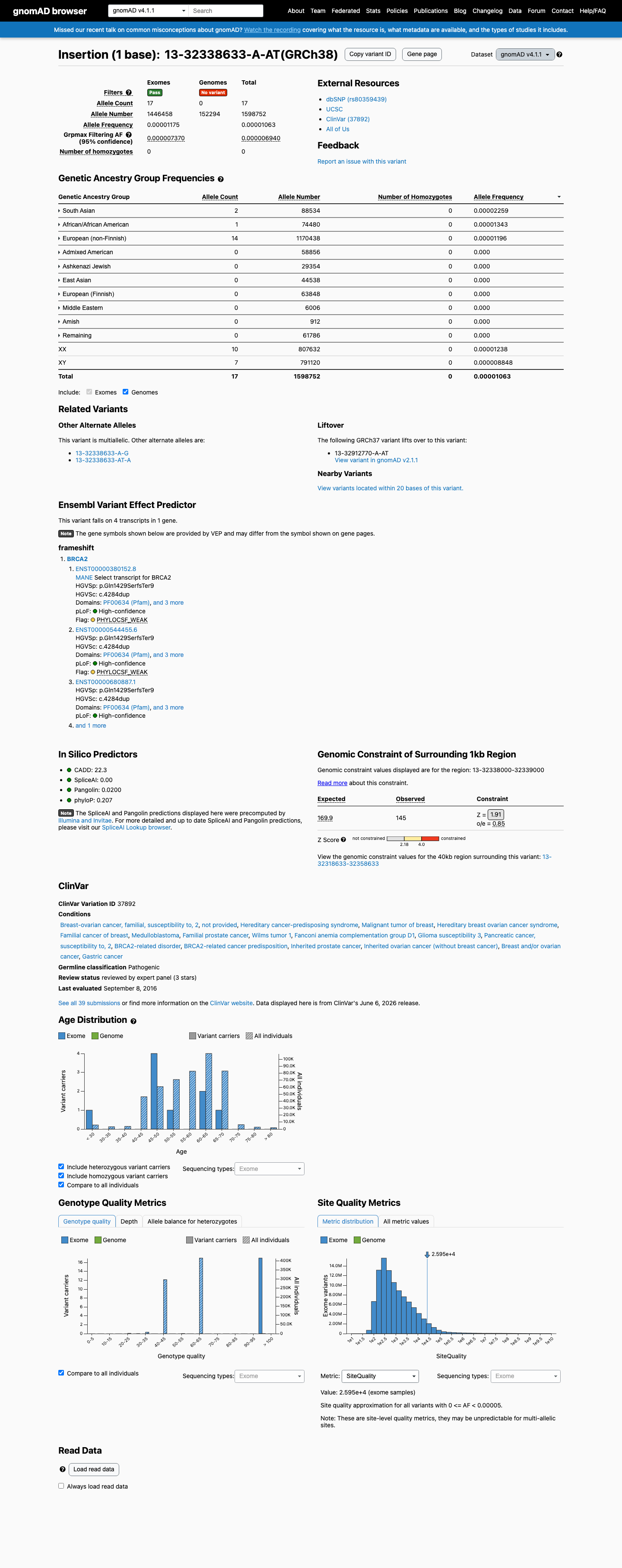
gnomAD v4.1
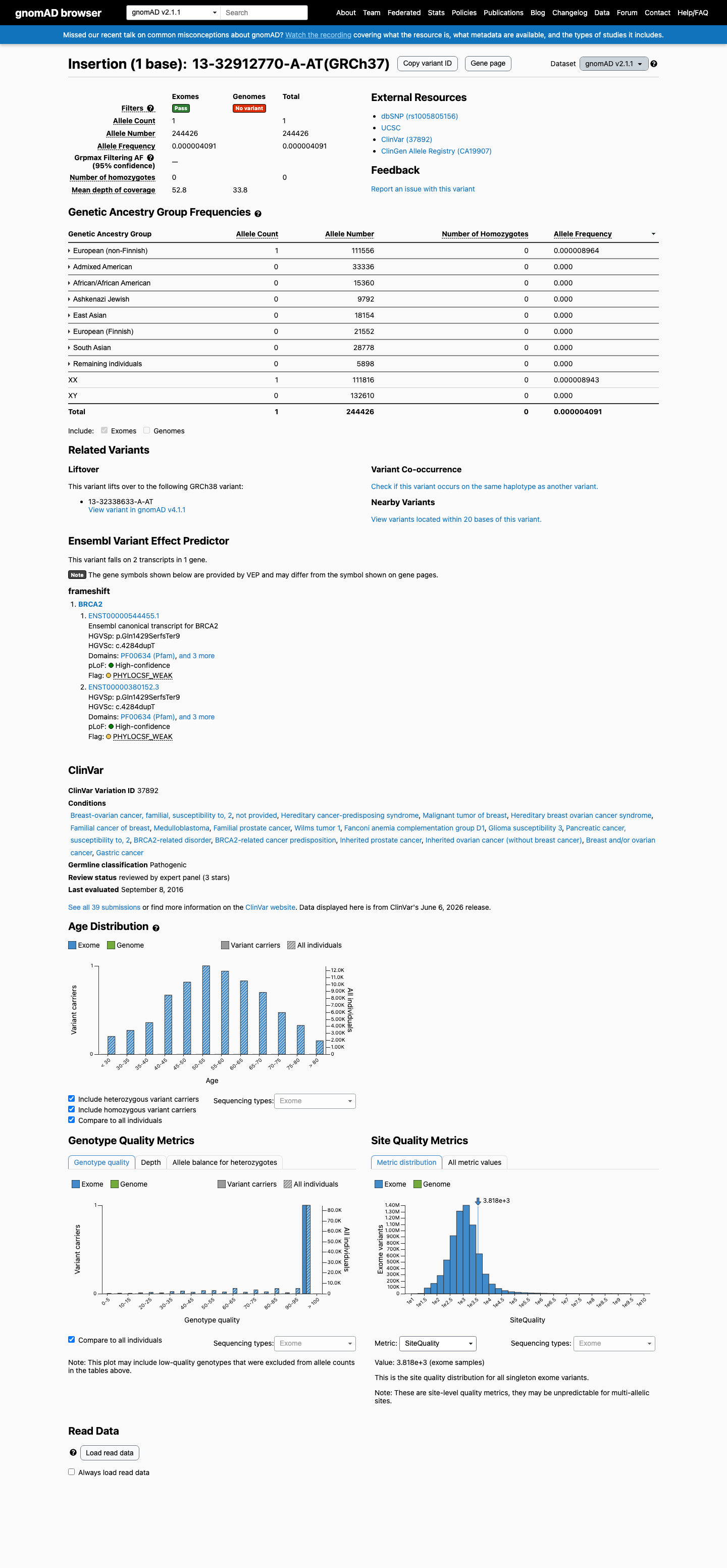
gnomAD v2.1
v4.1
This variant is present in gnomAD v4.1 (AF= 1.06333e-05; MAF= 0.00106%, 17/1598752 alleles, homozygotes = 0) and has highest observed frequency in the South Asian population (AF= 2.25902e-05; MAF= 0.00226%, 2/88534 alleles, homozygotes = 0); grpmax FAF= 6.94e-06.
v2.1
This variant is present in gnomAD v2.1 (AF= 4.09122e-06; MAF= 0.00041%, 1/244426 alleles, homozygotes = 0) and has highest observed frequency in the European (non-Finnish) population (AF= 8.96411e-06; MAF= 0.00090%, 1/111556 alleles, homozygotes = 0).
🇨🇦 CA
Not available in gnomAD-Canada v1.0.
Allele frequency by ancestry
three datasets · side by side
gnomAD v4.1
0.0011%
· 17 / 1,598,752
0 hom · FAF 0.00069%
0 hom · FAF 0.00069%
South Asian 2 / 88,534 |
0.0023% |
African/African American 1 / 74,480 |
0.0013% |
European (non-Finnish) 14 / 1,170,438 |
0.0012% |
+ 7 not observed (Remaining individuals, Admixed American, European (Finnish), Amish, East Asian, Middle Eastern, Ashkenazi Jewish)
gnomAD v2.1
0.00041%
· 1 / 244,426
0 hom
0 hom
European (non-Finnish) 1 / 111,556 |
0.0009% |
+ 7 not observed (African/African American, Admixed American, Ashkenazi Jewish, East Asian, European (Finnish), Remaining individuals, South Asian)
gnomAD Canada 🇨🇦
Absent
· 0 / ?
0 hom
0 hom
Not observed in any ancestry group.

ClinVar
This variant has been reported in ClinVar as Pathogenic (33 clinical laboratories) and as pathogenic (1 clinical laboratory) and as Pathogenic by Evidence-based Network for the Interpretation of Germline Mutant Alleles (ENIGMA) (expert panel). (ClinVarID = 37892)
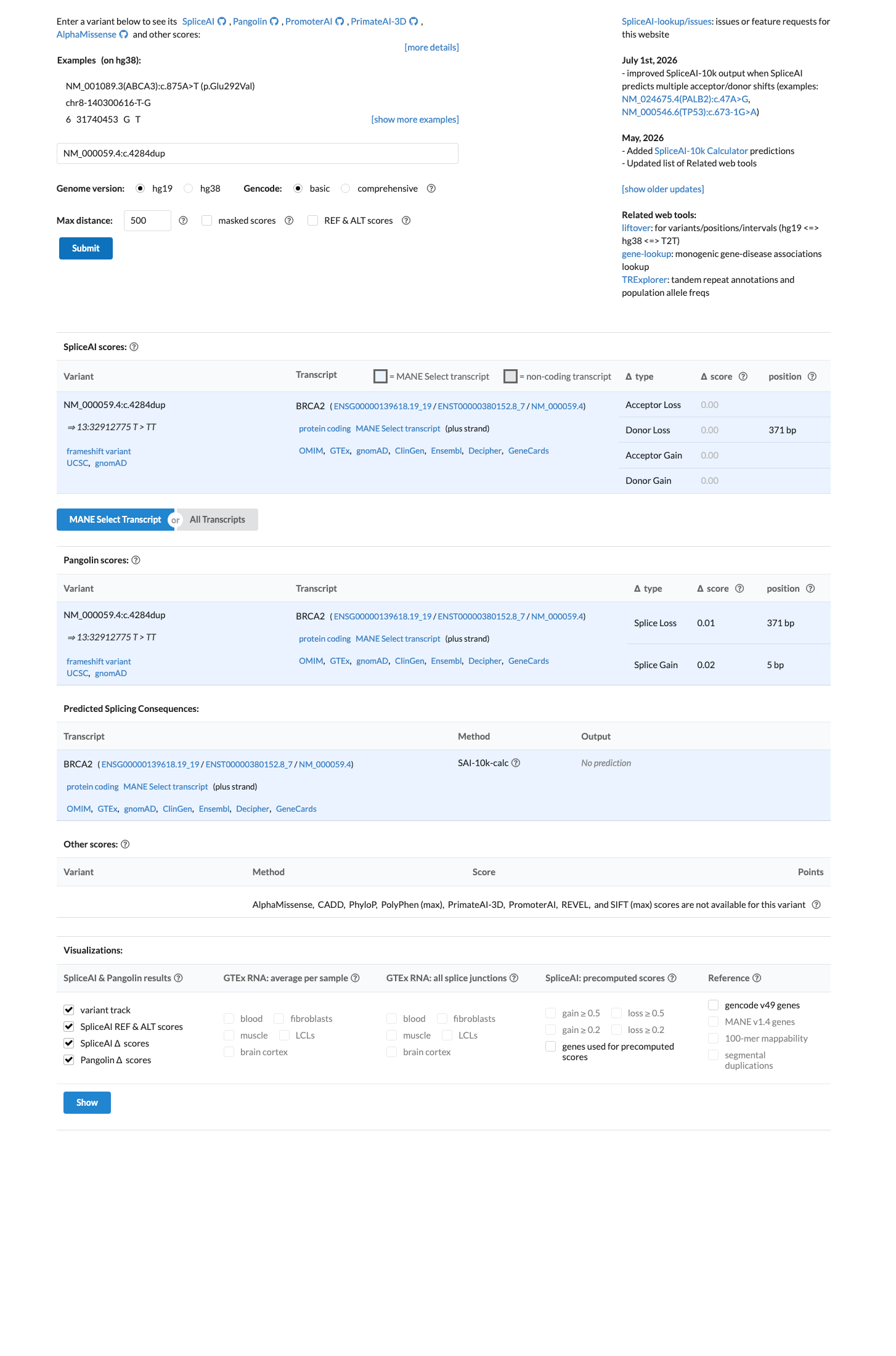
In silico
SpliceAI predicts no significant splice impact for this variant (max delta score = 0.00).
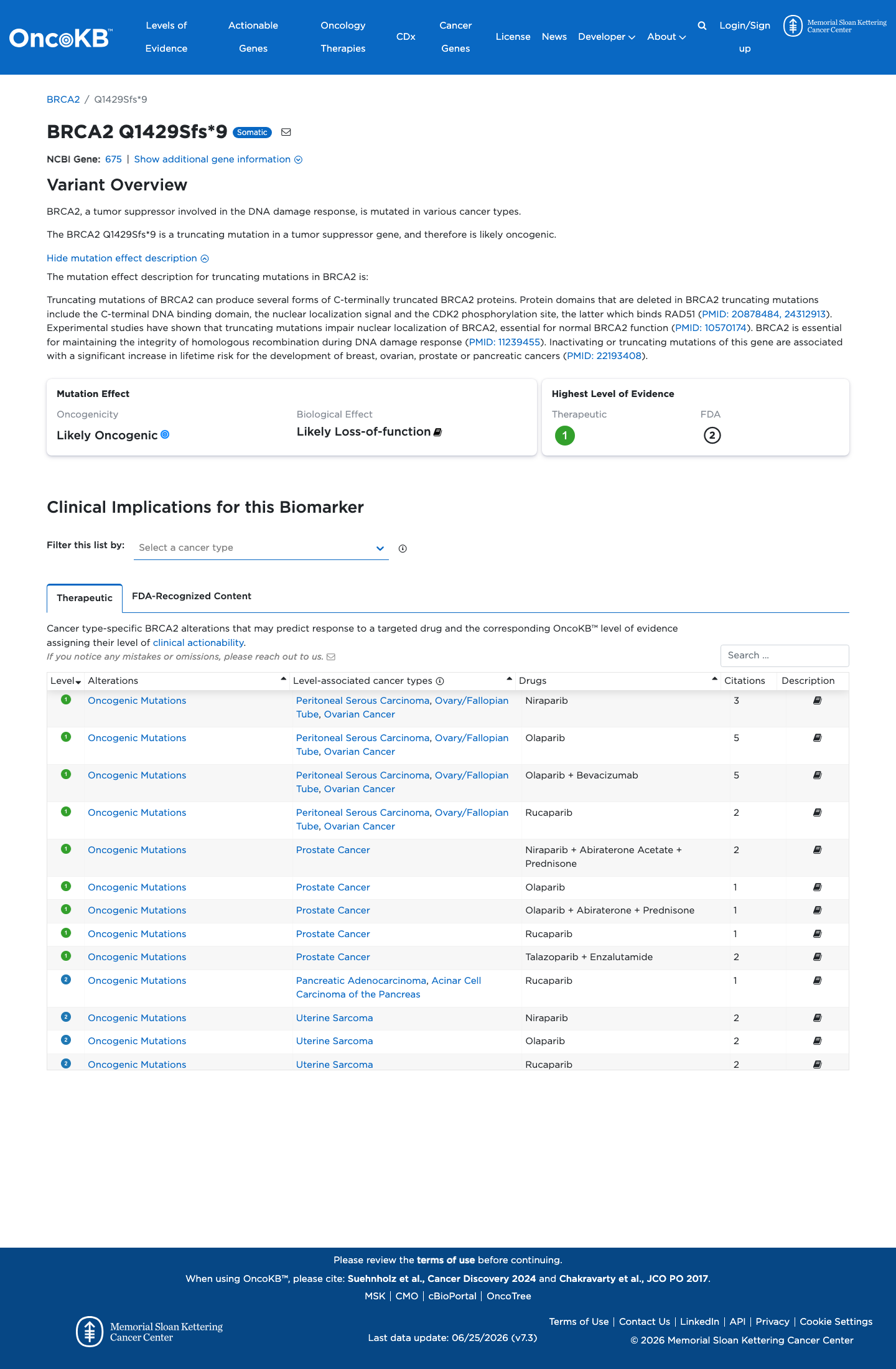
Functional
Likely Oncogenic
OncoKB identified variant-specific curated literature and context relevant to functional review; biological-effect context: Likely Loss-of-function; curated oncogenicity label: Likely Oncogenic.
COSMIC

Cancer hotspots
Somatic evidence
Not in COSMIC / hotspots
COSMIC
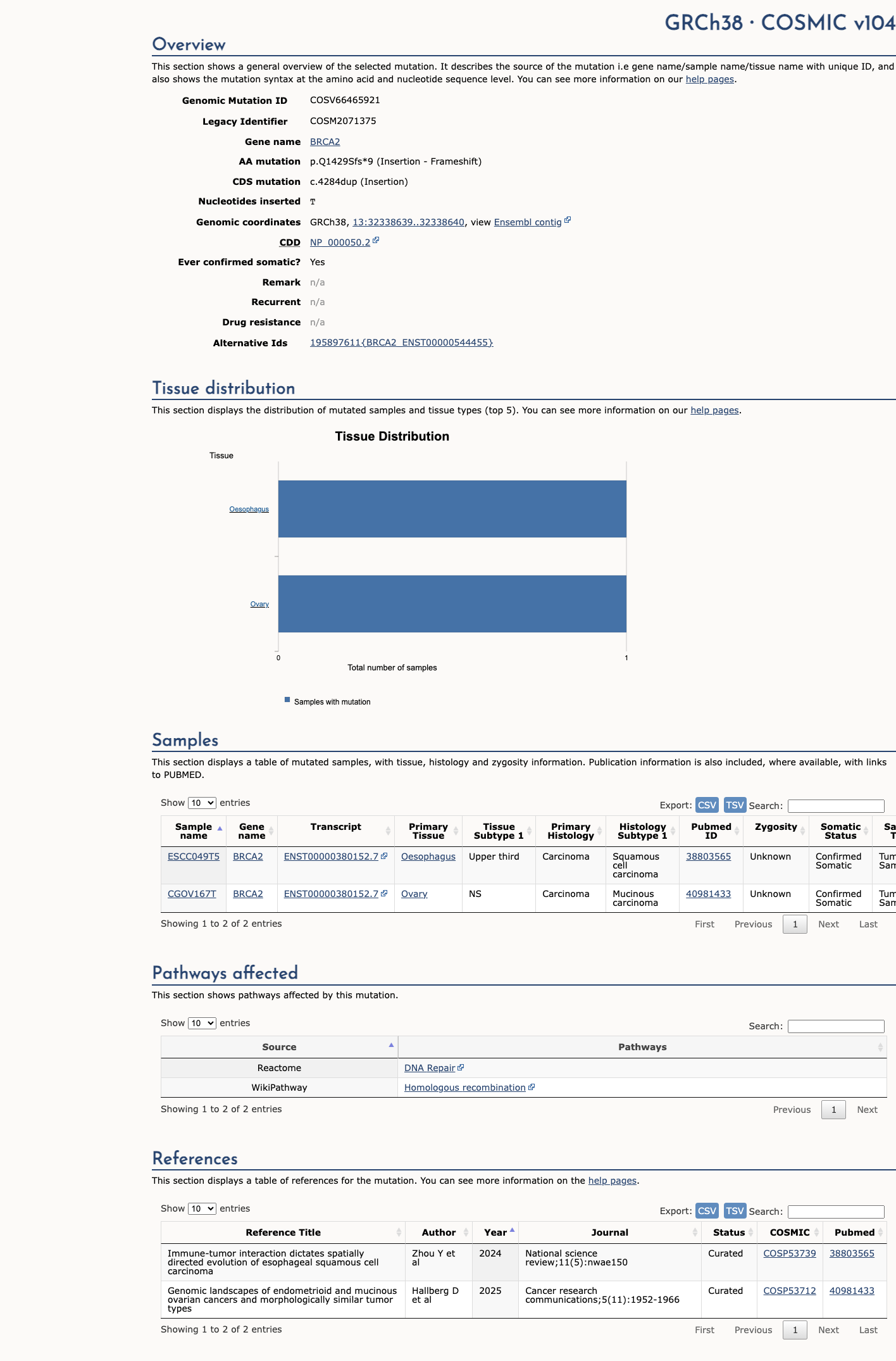
This variant does not lie in a statistically significant hotspot. This variant has previously been reported in somatic cancers (COSMIC; COSV66465921, n = 2 times).
Hotspots
This variant does not lie in a statistically significant hotspot.
Literature · how each cited paper was used
1papers cited
Each card is an audit: what was searched, what was found, whether it names the variant, which criteria it fed, and why. 8 further PMIDs triaged but not cited — see Sources & references.
Li et al. 2020 BRCA1/2 clinical-history likelihood-ratio model
Searched
c.4284dupc.4284dupTQ1429
Found
Li et al. 2020 classified BRCA1/2 VUS using personal and family cancer history from a multigene panel testing cohort. BRCA2 c.4284dupT was evaluated with a clinical history likelihood ratio of 2.23 (LOG(LR)=0.80) based on 21 probands, supporting pathogenicity at the PP4_Supporting level.
Variant
✓ Names this variant — characterised directly
Applied to
→PP4
met
Why
Variant-specific clinical history LR used to apply PP4_Supporting per ENIGMA thresholds (LR≥2.08).
BRCA2 c.4284dupT LOG(LR)=0.8019, N_Probands=21, LR=2.23
Location Clinical history LR spreadsheet (MOESM3): BRCA2 c.4284dupT, LR=2.23, N=21 · full text
Sources & reference links
9Sources
Triaged references · 8 PMIDs not cited in assessment
20878484 ↗
A new mutation of BRCA2 gene in an Italian healthy woman with familial breast cancer history.
ONCOKB
24312913 ↗
A comprehensive focus on global spectrum of BRCA1 and BRCA2 mutations in breast cancer.
ONCOKB
20104584 ↗
Characterization of BRCA1 and BRCA2 deleterious mutations and variants of unknown clinical significance in unilateral and bilateral breast cancer: the WECARE study.
CLINVAR
22085629 ↗
Prevalence of BRCA1 and BRCA2 mutations in unselected breast cancer patients from Greece.
CLINVAR