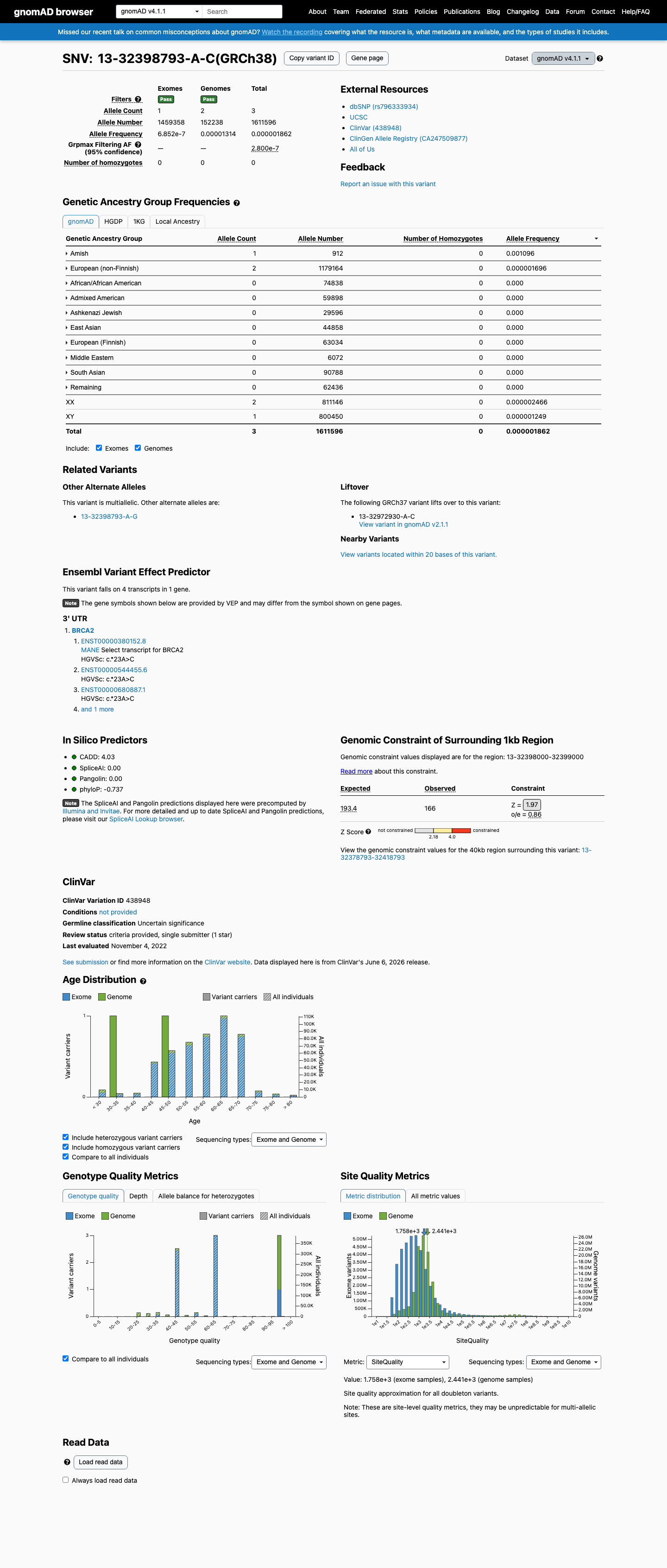
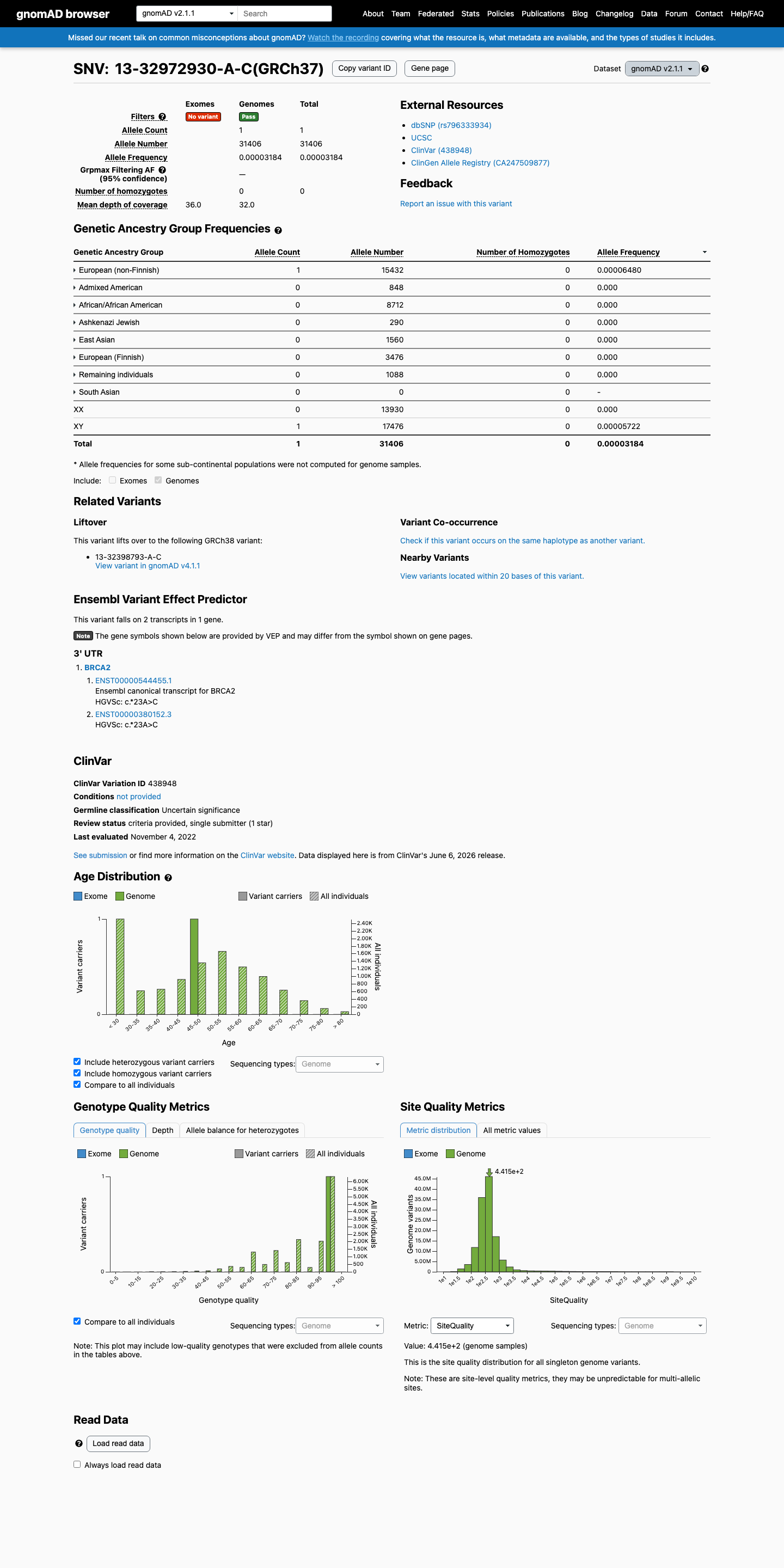
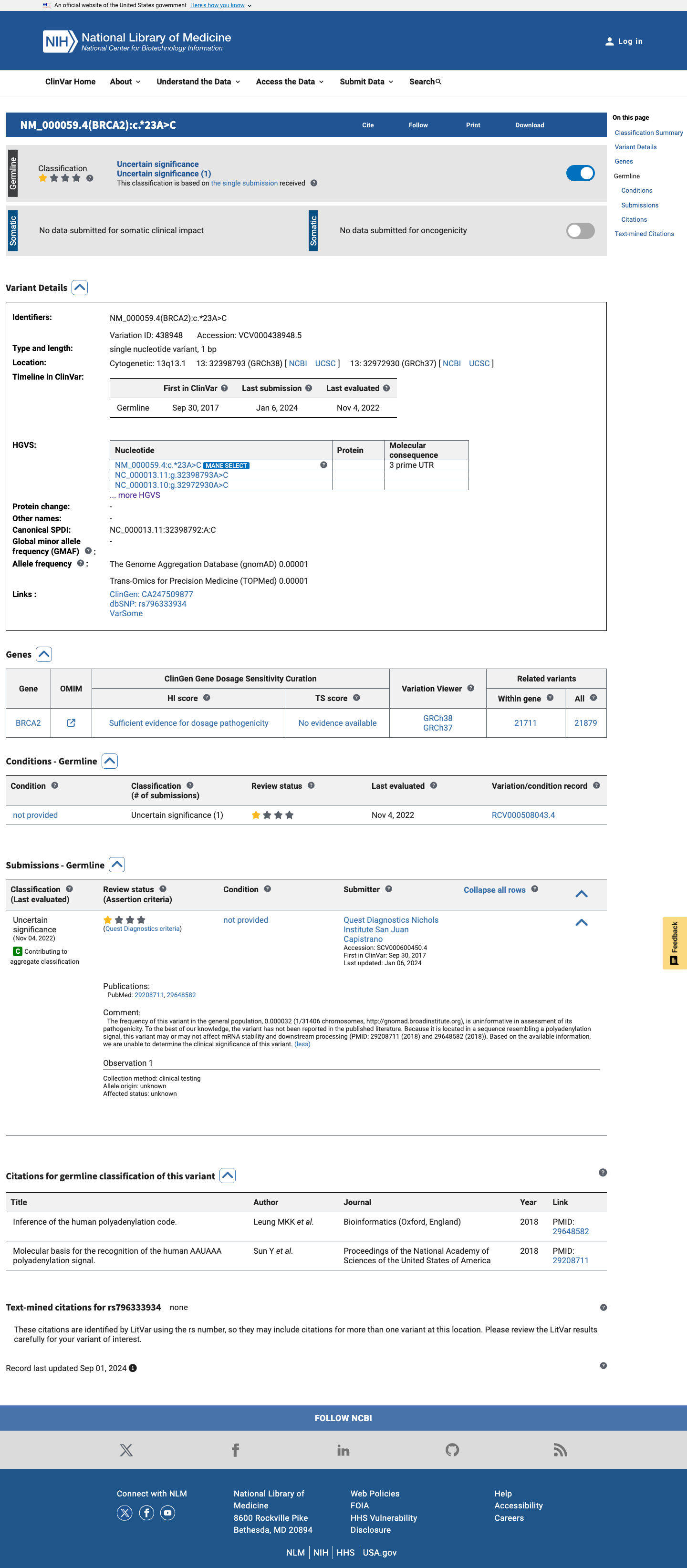
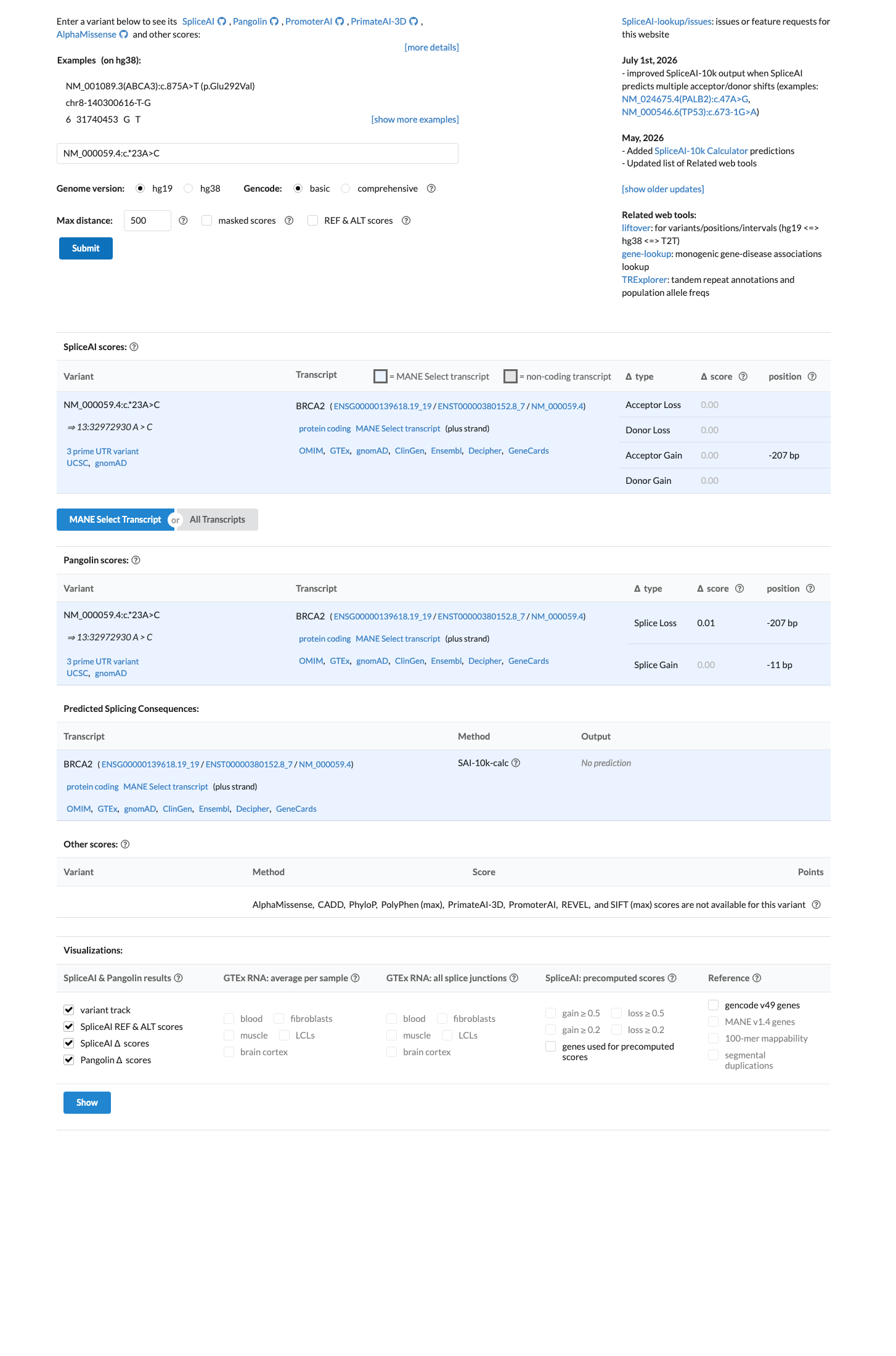
NM_000059.4:c.*23A>C is a 3' UTR substitution in BRCA2 exon 27, downstream of the stop codon. SpliceAI predicts no splicing impact (max delta = 0.00) and the variant is outside the clinically important PALB2-binding and DNA-binding domains.1 The variant is present at very low frequency in gnomAD (v2.1: 1/31406 genome alleles, 0.00318%; v4.1: 3/1611596 alleles, FAF=2.8e-7) and is absent from gnomAD-Canada. These frequencies are below the ENIGMA BA1 and BS1 thresholds.2 This variant has been reported in ClinVar (Variation ID 438948) as Uncertain significance by a single clinical laboratory (1-star review status). Three papers cited in the ClinVar submission (PMID:29208711 on polyadenylation signal recognition, PMID:29648582 on polyadenylation code inference, PMID:26467025 on DNA variant scoring) discuss polyadenylation biology and variant interpretation methodology but do not mention BRCA2 or NM_000059.4:c.*23A>C.3 BP4 (supporting) is met: computational evidence (SpliceAI) predicts no splicing impact. No pathogenic, likely pathogenic, or benign criteria beyond BP4 are met given the absence of functional, clinical, segregation, or case-control data specific to this 3' UTR variant.4
Final classification
VUS
BP4
BRCA2
c.*23A>C
p.?
This variant
NM_000059.4:c.*23A>C is a 3' UTR substitution in BRCA2 exon 27, downstream of the stop codon. SpliceAI predicts no splicing impact (max delta = 0.00) and the variant is outside the clinically important PALB2-binding and DNA-binding domains.
Only BP4 (supporting) is met: SpliceAI predicts no splicing impact (max delta = 0.00) and the variant is outside clinically important functional domains. No pathogenic criteria are met. The ENIGMA BRCA2 v1.2 Table 3 likely benign rules require at least 2 Supporting Benign criteria, or 1 Moderate/Strong Benign plus 1 Supporting Benign. A single supporting benign criterion satisfies no combination rule. Under the ENIGMA points-based scoring (conflicting evidence appendix), BP4 supporting contributes -1 point, falling in the VUS range (-1 to 5).
Classification rationale
BP4
VUS
BRCA2 c.*23A>C
BP4
→
VUS
LYFE Sciences is an AI system, and it can make mistakes. Criteria
may be applied incorrectly, sources may be misread, and a confident-looking
classification can still be wrong. Double-check every criterion and
its underlying evidence before relying on any call.
Gene diagram
· NM_000059.4 · variants mapped to exon structure
BRCA2
NM_000059.4
Fetching transcript structure from UCSC…
Applied criteria · 1 applied · 14 assessed
MetEvidence satisfies this criterion.
Not metEvaluated against available evidence; threshold not reached.
Not assessedApplies in principle, but no evidence was found to evaluate it.
N/ADoesn't apply to this variant type.
Applied · 1
Strength
Supporting
Moderate
Strong
Very strong
BP4
supporting
Benign
This 3' UTR substitution has no predicted impact on mRNA splicing (SpliceAI max delta = 0.00). The variant is located in exon 27, outside the native donor/acceptor splice sites, and outside the ENIGMA-defined clinically important functional domains (PALB2 binding aa 10-40; DNA binding aa 2481-3186). Per ENIGMA Figure 1A, variants with no predicted splicing impact and no protein-level impact receive BP4 at supporting strength.
SpliceAI max delta = 0.00 — no predicted splicing impactVariant outside native donor/acceptor splice sites (c.*23exon 27 3' UTR)
Assessed · not applied
· 14 not met · 0 not assessed
Pathogenic
PVS1
NM_000059.4:c.*23A>C is a 3' UTR substitution, not a null variant (nonsense, frameshift, or canonical ±1,2 splice site).
PS3
No functional studies test NM_000059.4:c.*23A>C or a systematically characterized range that includes this 3' UTR position.
PS4
No case-control data comparing variant prevalence in affected versus unaffected individuals is available for this variant.
PM2
Variant is present in gnomAD v2.1 (1/31406 genome alleles, AF=3.18e-5) and gnomAD v4.1 (3/1611596 alleles, AF=1.86e-6).
PP1
No co-segregation data or likelihood ratio analysis available for this variant.
PP3
SpliceAI predicts no splicing impact (max delta = 0.0).
PP4
Variant not found in the ENIGMA clinical history likelihood ratio table (PMID:31853058 BRCA2 clinical_history_LR.xlsx).
Benign
BA1
Filtering allele frequency (FAF) of 2.8e-7 in gnomAD v4.1 is well below the ENIGMA BA1 threshold of 0.1% (FAF > 0.001).
BS1
Filtering allele frequency (FAF) of 2.8e-7 in gnomAD v4.1 is below both the ENIGMA BS1_Strong threshold (FAF > 0.0001) and BS1_Supporting threshold (FAF > 0.00002).
BS2
No co-occurrence data with pathogenic variants in trans is available.
BS3
Not listed in ENIGMA Specifications Table 9 for curated functional assay results.
BS4
No segregation data demonstrating lack of segregation in affected family members is available.
BP5
Variant not found in the ENIGMA clinical history likelihood ratio table (PMID:31853058 BRCA2 clinical_history_LR.xlsx).
BP7
ENIGMA BP7 requires either mRNA assay data demonstrating no damaging effect on splicing (BP7_Strong RNA), or application to silent/intronic variants at specific positions with BP4 already met.
N/A · 10
PS1 · PS2 · PM1 · PM5 · PM6 · PP2 · PP5 · BP1 · BP2 · BP6
Research & evidence
Population frequency
gnomAD v4.1
gnomAD v2.1
v4.1
This variant is present in gnomAD v4.1 (AF= 1.86151e-06; MAF= 0.00019%, 3/1611596 alleles, homozygotes = 0) and has highest observed frequency in the Amish population (AF= 0.00109649; MAF= 0.10965%, 1/912 alleles, homozygotes = 0); grpmax FAF= 2.8e-07.
v2.1
This variant is present in gnomAD v2.1 (AF= 3.1841e-05; MAF= 0.00318%, 1/31406 alleles, homozygotes = 0) and has highest observed frequency in the European (non-Finnish) population (AF= 6.48004e-05; MAF= 0.00648%, 1/15432 alleles, homozygotes = 0).
🇨🇦 CA
Absent from gnomAD-Canada v1.0.
Allele frequency by ancestry
three datasets · side by side
gnomAD v4.1
0.00019%
· 3 / 1,611,596
0 hom · FAF 2.8e-05%
0 hom · FAF 2.8e-05%
Amish 1 / 912 |
0.11% |
European (non-Finnish) 2 / 1,179,164 |
0.00017% |
+ 8 not observed (Remaining individuals, Admixed American, European (Finnish), East Asian, Middle Eastern, South Asian, Ashkenazi Jewish, African/African American)
gnomAD v2.1
0.0032%
· 1 / 31,406
0 hom
0 hom
European (non-Finnish) 1 / 15,432 |
0.0065% |
+ 7 not observed (African/African American, Admixed American, Ashkenazi Jewish, East Asian, European (Finnish), Remaining individuals, South Asian)
gnomAD Canada 🇨🇦
Absent
· 0 / ?
0 hom
0 hom
Not observed in any ancestry group.
ClinVar
This variant has been reported in ClinVar as Uncertain significance (1 clinical laboratory). (ClinVarID = 438948)
In silico
SpliceAI predicts no significant splice impact for this variant (max delta score = 0.00).
Functional
No data
No calibrated functional assay or RNA evidence was identified for this variant.
Somatic evidence
COSMIC
This variant has not previously been reported in somatic cancers (COSMIC).
Hotspots
This variant does not lie in a statistically significant cancer hotspot.
Sources & reference links
Triaged references · 3 PMIDs not cited in assessment
26467025 ↗
A Standardized DNA Variant Scoring System for Pathogenicity Assessments in Mendelian Disorders.
CLINVAR