PS3_Moderate is met: Y68C has a cumulative fitness score of -2.73 in the Mighell et al. 2018 PTEN saturation mutagenesis phosphatase activity assay (Table S2 of PMID 29706350), meeting the PTEN VCEP threshold of ≤ -1.11 for PS3_Moderate.1 PM2_Supporting is met: NM_000314.8:c.203A>G is absent from gnomAD v2.1, gnomAD v4.1, and gnomAD-Canada v1.0, meeting the PTEN VCEP threshold of < 0.00001 (0.001%) allele frequency.2 PP2_Supporting is met: PTEN has a low rate of benign missense variation and missense variants are a well-established common mechanism of disease in PTEN hamartoma tumor syndrome.3 PP3_Supporting is met: REVEL score of 0.985 exceeds the PTEN VCEP threshold of > 0.7 for missense variants.4 No benign criteria are met. The variant is absent from population databases, functional data demonstrates a damaging effect, and computational predictions support pathogenicity. Classification: VUS (Variant of Uncertain Significance). The variant has 1 moderate criterion (PS3_Moderate) and 3 supporting criteria (PM2_Supporting, PP2_Supporting, PP3_Supporting). This combination (1M + 3Spt) does not meet any PTEN VCEP Likely Pathogenic rule (Rule13 requires ≥3M; Rule14 requires 2M + ≥2Spt; others require ≥1 Strong). Under both the PTEN VCEP and generic ACMG/AMP 2015 classification frameworks, this combination falls into the VUS category.5
Final classification
VUS
PS3PM2PP2PP3
PTEN
c.203A>G
p.Tyr68Cys
This variant
PS3_Moderate is met: Y68C has a cumulative fitness score of -2.73 in the Mighell et al. 2018 PTEN saturation mutagenesis phosphatase activity assay (Table S2 of PMID 29706350), meeting the PTEN VCEP threshold of ≤ -1.11 for PS3_Moderate.
ClinGen PTEN Expert Panel Specifications to the ACMG/AMP Variant Interpretation Guidelines for PTEN Version 3.2 v3.2 criteria-combination framework was evaluated deterministically with applied criteria: PS3 moderate, PM2 supporting, PP2 supporting, PP3 supporting; no rule matched the adjudicated criteria.
Classification rationale
PS3PM2PP2PP3
VUS
PTEN c.203A>G
PS3 + PM2 + PP2 + PP3
→
VUS
LYFE Sciences is an AI system, and it can make mistakes. Criteria
may be applied incorrectly, sources may be misread, and a confident-looking
classification can still be wrong. Double-check every criterion and
its underlying evidence before relying on any call.
Gene diagram
· NM_000314.8 · variants mapped to exon structure
PTEN
NM_000314.8
Fetching transcript structure from UCSC…
Applied criteria · 4 applied · 15 assessed
MetEvidence satisfies this criterion.
Not metEvaluated against available evidence; threshold not reached.
Not assessedApplies in principle, but no evidence was found to evaluate it.
N/ADoesn't apply to this variant type.
Applied · 4
Strength
Supporting
Moderate
Strong
Very strong
PS3
moderate
Pathogenic
Y68C has a cumulative fitness score (Cum_score) of -2.73 in the Mighell et al. 2018 (PMID: 29706350) PTEN saturation mutagenesis phosphatase activity assay (Table S2), meeting the VCEP PS3_Moderate threshold of ≤ -1.11. The measurement is high-confidence (High_conf=True, Pass SE Filter). This represents systematic functional characterization of all possible missense variants at position 68 via massively parallel assay.
Mighell et al. 2018 saturation mutagenesis: Y68C Cum_score = -2.73High_conf=TruePass SE Filter (≤ -1.11 threshold met for PS3_Moderate per PTEN VCEP)
PM2
supporting
Pathogenic
NM_000314.8:c.203A>G is absent from gnomAD v2.1, gnomAD v4.1, and gnomAD-Canada v1.0. This meets the PTEN VCEP PM2_Supporting threshold of allele frequency < 0.00001 (0.001%).
Absent from gnomAD v2.1 (exomes)Absent from gnomAD v4.1 (exomes)Absent from gnomAD-Canada v1.0 (genomes)
PP2
supporting
Pathogenic
PTEN is a gene with a low rate of benign missense variation (high missense constraint) and missense variants are a well-established common mechanism of disease in Cowden syndrome and related PTEN hamartoma tumor syndromes. NM_000314.8:c.203A>G is a missense variant meeting the PTEN VCEP PP2_Supporting criteria.
PTEN: high gnomAD missense constraintmissense variants are common disease mechanism in PHTS
PP3
supporting
Pathogenic
REVEL score of 0.985 exceeds the PTEN VCEP PP3_Supporting threshold of >0.7 for missense variants. BayesDel score of 0.594 provides additional supporting computational evidence, though the VCEP rule specifies REVEL for missense variants.
REVEL score: 0.985 (>0.7 VCEP threshold)BayesDel score: 0.594 (additional support)
Assessed · not applied
· 14 not met · 1 not assessed
Pathogenic
PS1
PS1 requires a different nucleotide change resulting in the same amino acid as a previously established pathogenic variant, or a variant at the same nucleotide position as a known pathogenic splicing variant.
PS2
No de novo observation identified in the reviewed literature.
PS4
Insufficient proband-level data with specificity scores to apply PS4 per PTEN VCEP rules.
PM1
The PTEN VCEP defines PM1 as applicable to residues in the catalytic motifs: 90-94, 123-130, and 166-168 (NP_000305.3).
PM5
PM5 requires a different missense change at the same amino acid residue previously determined to be pathogenic or likely pathogenic.
PM6
No de novo observation identified.
PP1
Insufficient segregation data.
Benign
BA1
The variant is absent from all gnomAD populations.
BS1
The variant is absent from gnomAD.
BS2
No homozygous observations of c.203A>G in any population database or published report.
BS3
Functional data from Mighell et al.
BS4
No segregation data demonstrating lack of segregation in affected family members.
BP2
No evidence of the variant observed in trans with a pathogenic or likely pathogenic PTEN variant, nor ≥3 observations in cis/phase unknown with different P/LP PTEN variants.
BP4
The PTEN VCEP BP4 rule for missense variants requires REVEL score < 0.5.
BP5
No evidence that this variant has been found in a case with an alternate molecular basis for disease meeting the PTEN VCEP BP5 criteria (other gene/disorder must be highly penetrant, and the patient's personal/family history must show no overlap between the other gene disorder and PTEN).
N/A · 9
PVS1 · PM3 · PM4 · PP4 · PP5 · BP1 · BP3 · BP6 · BP7
Research & evidence
Population frequency
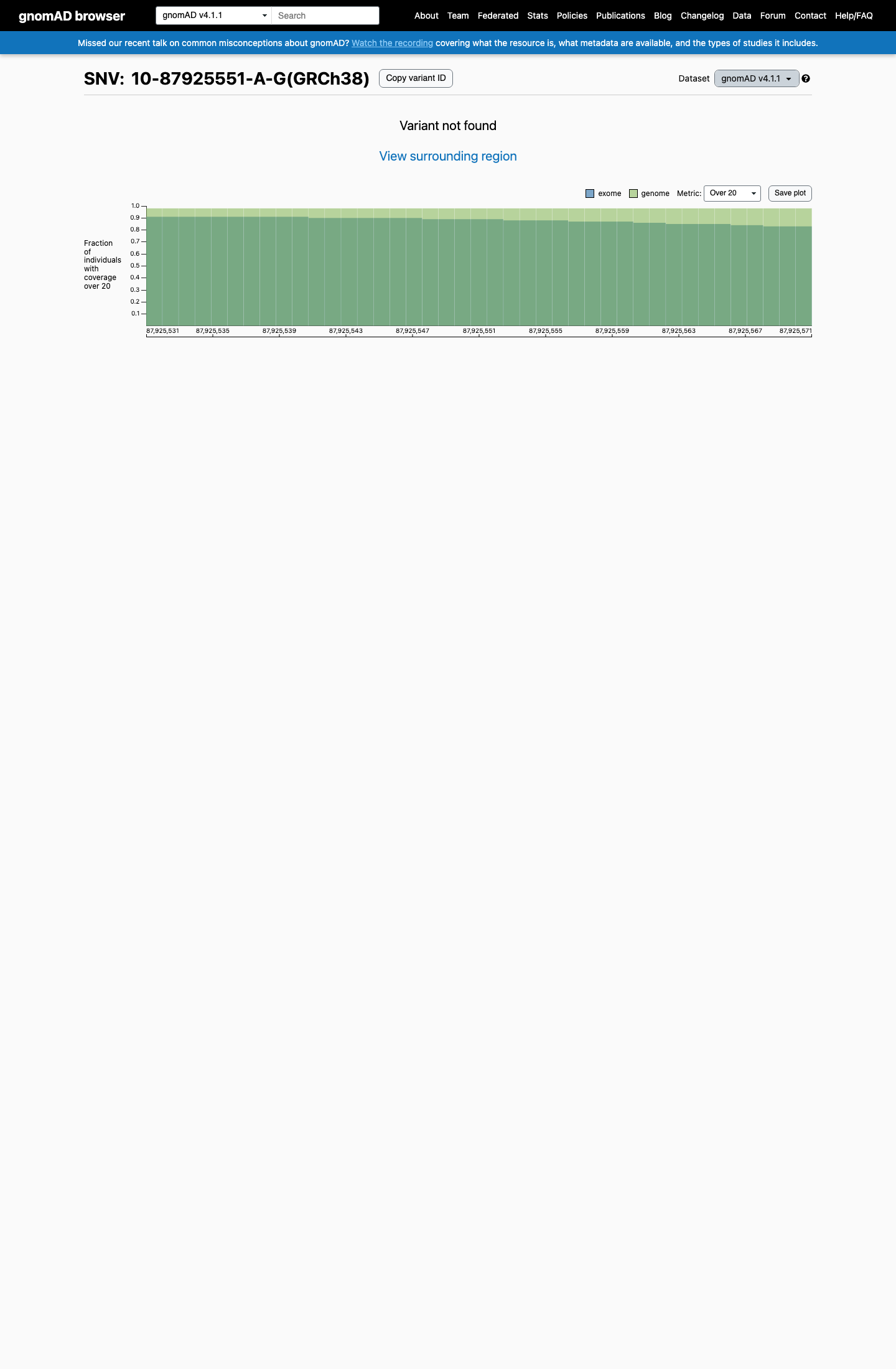
gnomAD v4.1
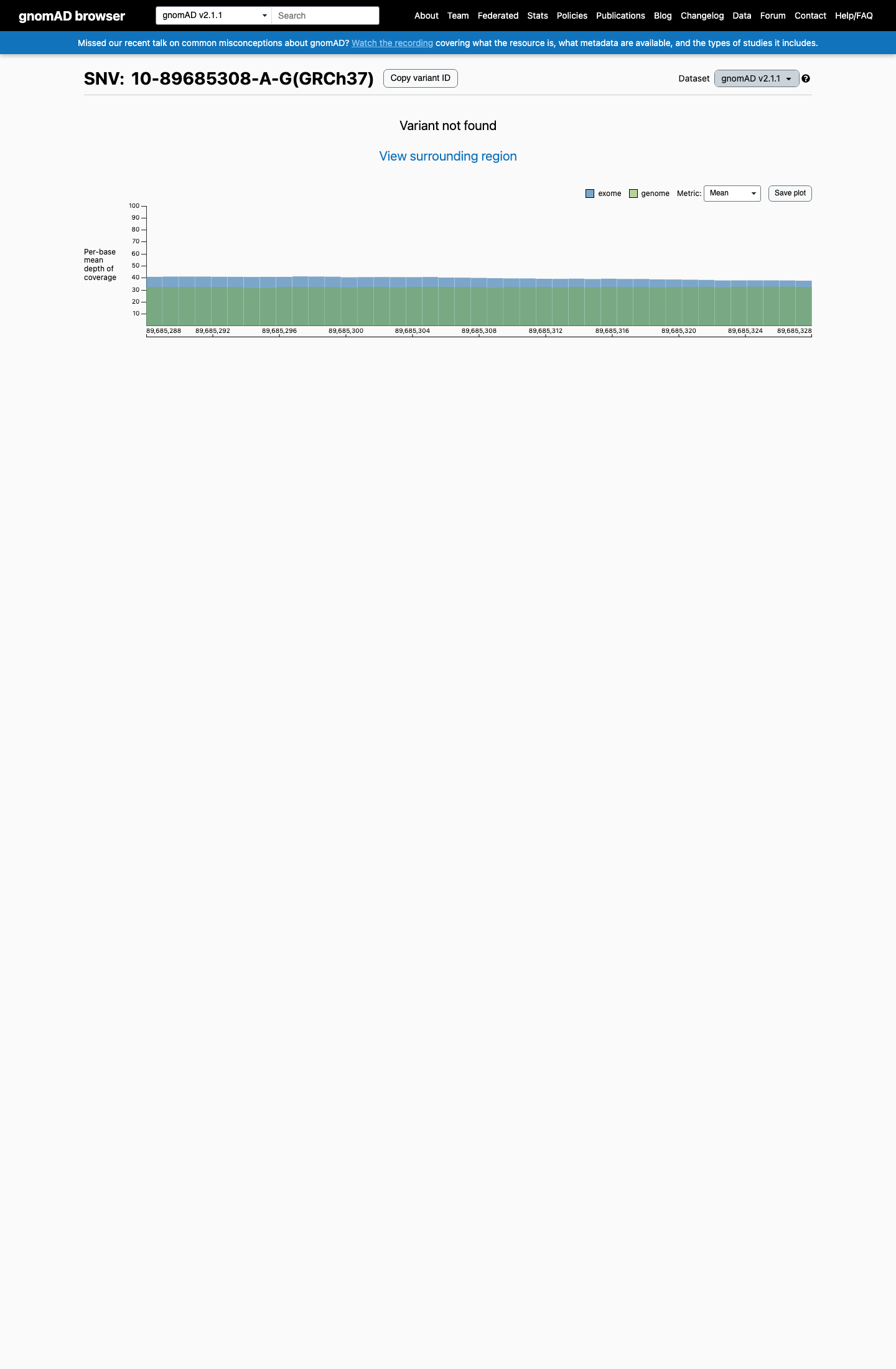
gnomAD v2.1
v4.1
Absent from gnomAD v4.1.
v2.1
Absent from gnomAD v2.1.
🇨🇦 CA
Absent from gnomAD-Canada v1.0.
Allele frequency by ancestry
three datasets · side by side
gnomAD v4.1
Absent
· 0 / ?
0 hom
0 hom
Not observed in any ancestry group.
gnomAD v2.1
Absent
· 0 / ?
0 hom
0 hom
Not observed in any ancestry group.
gnomAD Canada 🇨🇦
Absent
· 0 / ?
0 hom
0 hom
Not observed in any ancestry group.

ClinVar
This variant has been reported in ClinVar as Pathogenic (6 clinical laboratories) and as Likely pathogenic (1 clinical laboratory). (ClinVarID = 233777)
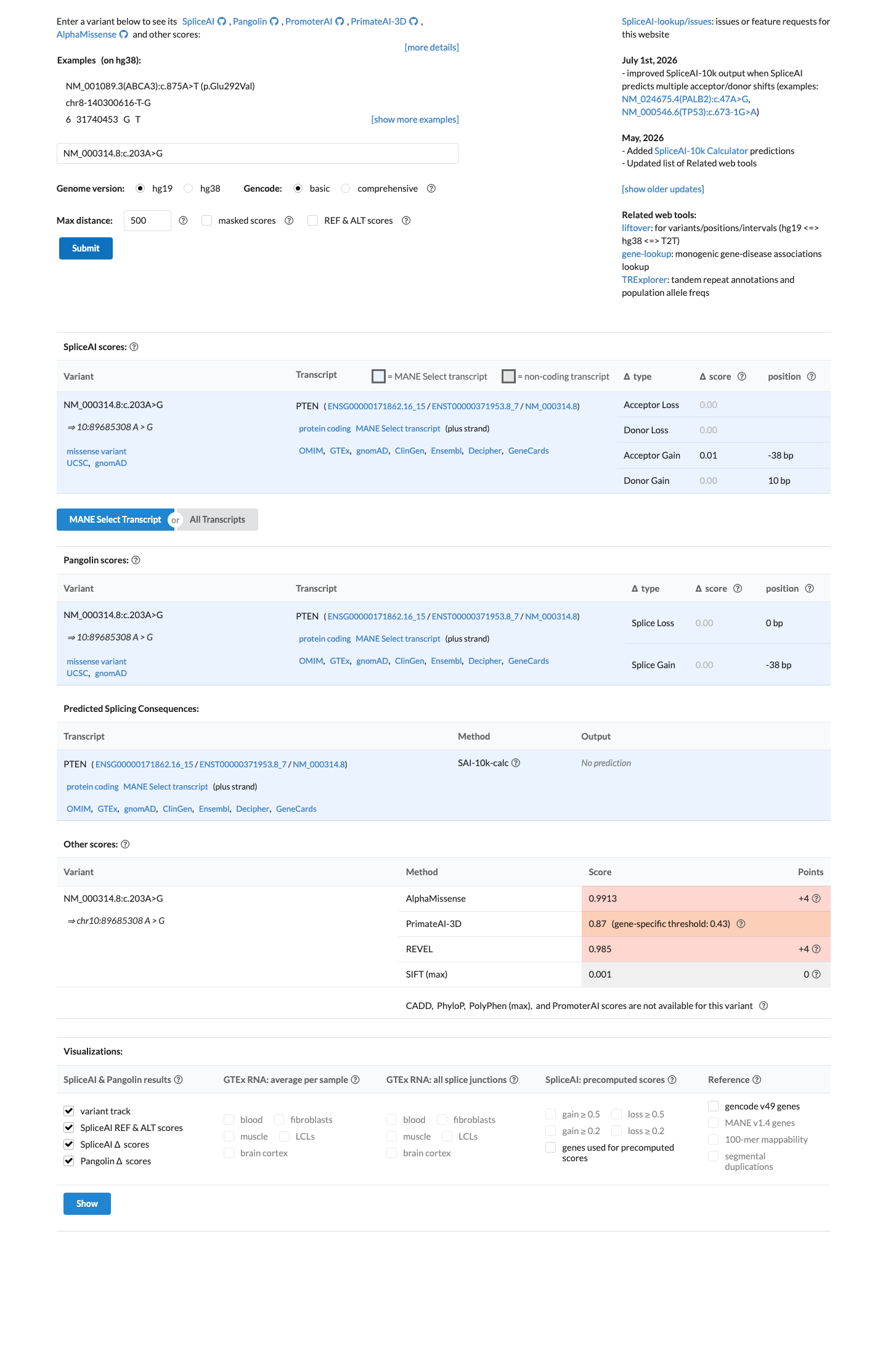
In silico
SpliceAI predicts no significant splice impact for this variant (max delta score = 0.01). REVEL score = 0.985. BayesDel score = 0.59441.
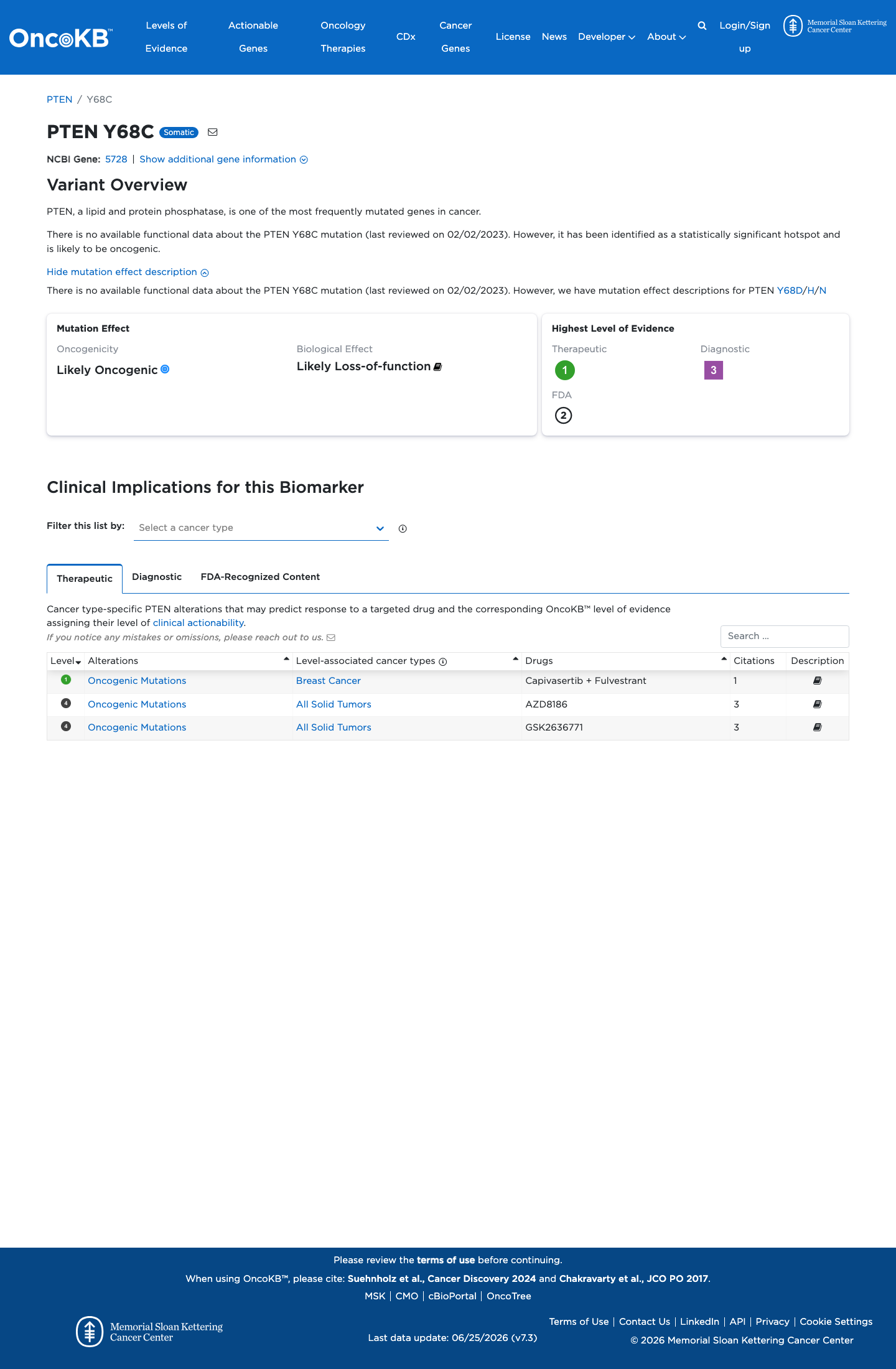
Functional
Likely Oncogenic
OncoKB identified variant-specific curated literature and context relevant to functional review; biological-effect context: Likely Loss-of-function; curated oncogenicity label: Likely Oncogenic.
COSMIC

Cancer hotspots
Somatic evidence
Hotspot
COSMIC
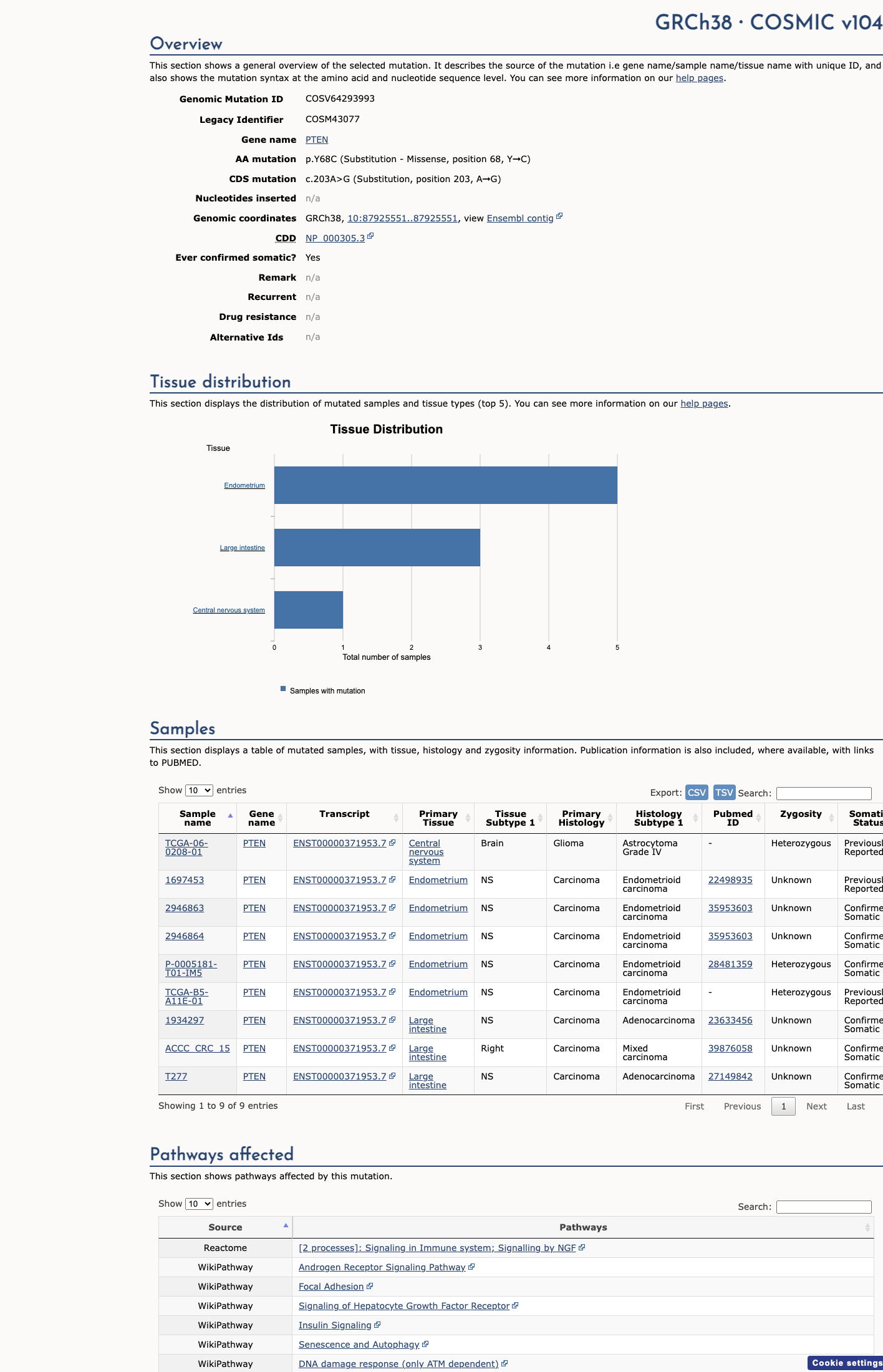
This variant lies in a statistically significant hotspot. This variant has previously been reported in somatic cancers (COSMIC; COSV64293993, n = 9 times).
Hotspots
This variant lies in a statistically significant hotspot.
Sources & reference links
9Sources
Triaged references · 8 PMIDs not cited in assessment
19457929 ↗
Germline and somatic cancer-associated mutations in the ATP-binding motifs of PTEN influence its subcellular localization and tumor suppressive function.
CLINVAR
20926450 ↗
Naturally occurring germline and tumor-associated mutations within the ATP-binding motifs of PTEN lead to oxidative damage of DNA associated with decreased nuclear p53.
CLINVAR
16704655 ↗
Epidermal naevus in Proteus syndrome showing loss of heterozygosity for an inherited PTEN mutation.
CLINVAR
17392385 ↗
American Cancer Society guidelines for breast screening with MRI as an adjunct to mammography.
CLINVAR