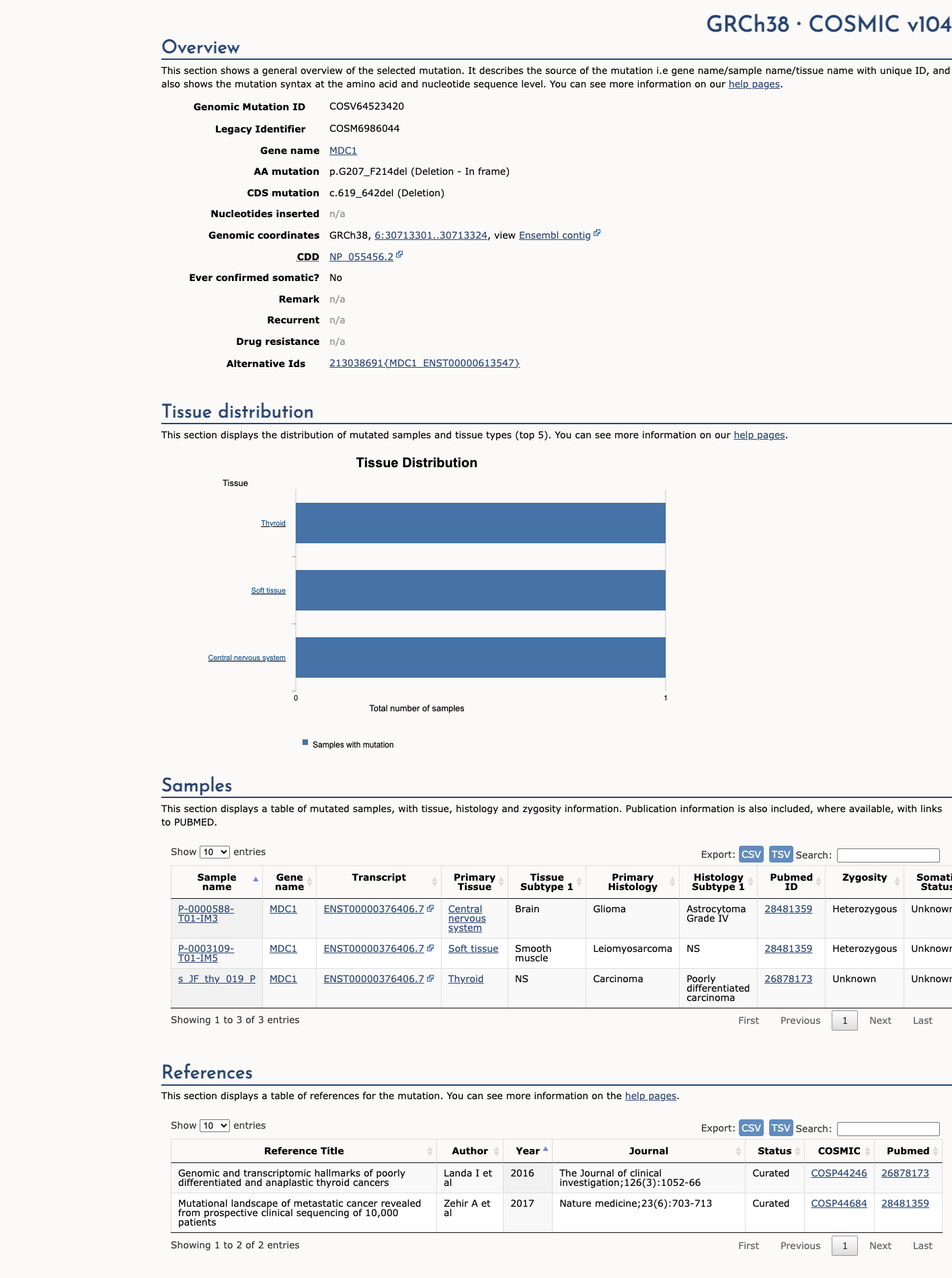
NM_014641.2:c.619_642del (p.Gly207_Phe214del) is an in-frame deletion removing 8 amino acids in MDC1. PM4 (supporting) is met: this is a 24bp in-frame deletion causing a protein length change. The deleted segment does not appear to lie within a repetitive region. BP4 (supporting benign) is met: SpliceAI predicts no splice impact (max delta score = 0.00).1 This variant does not meet PVS1, PS1–PS5, PM1–PM3, PM5–PM6, PP1–PP5, BA1, BS1–BS4, BP1–BP3, or BP5–BP7 due to absence of supporting evidence or inapplicability to this variant type. ClinVar classifies this variant as Benign (1 clinical laboratory, single submitter), but the review status does not meet the 3-star expert panel threshold for BP6.2 This variant has been observed in somatic cancers (COSMIC, n=3), but somatic occurrence does not independently establish germline pathogenicity. Overall classification: Uncertain Significance (VUS). One supporting pathogenic criterion (PM4) is balanced by one supporting benign criterion (BP4), yielding conflicting evidence insufficient for a likely pathogenic or likely benign classification per generic ACMG/AMP 2015 rules.3
MDC1
Final classification
VUS
MDC1 c.619_642del · p.Gly207_Phe214del
MDC1
NM_014641.2:c.619_642del (p.Gly207_Phe214del) is an in-frame deletion removing 8 amino acids in MDC1.
gene-specific framework lacked a usable explicit final combination framework, so generic ACMG/AMP 2015 final-combination rules were applied as fallback; applied criteria: PM4 supporting, BP4 supporting benign; combination = 1 supporting + 1 supporting benign, which maps to VUS.
Classification rationale
PM4
BP4
VUS
MDC1 c.619_642del
PM4 + BP4
→
VUS
Gene diagram
· NM_014641.2 · variants mapped to exon structure
MDC1
NM_014641.2
Fetching transcript structure from UCSC…
Applied criteria · 2 applied · 20 assessed
Applied · 2
Strength
Supporting
Moderate
Strong
Very strong
✓
PM4
supporting
Pathogenic
NM_014641.2:c.619_642del is a 24bp in-frame deletion removing 8 amino acids (p.Gly207_Phe214del), causing a protein length change. The deleted segment does not appear to be a simple tandem repeat region based on available sequence analysis. However, the functional significance of this specific 8-amino-acid deletion in a 2089-amino-acid protein is uncertain, warranting supporting rather than moderate strength.
24bp in-frame deletion removing 8 amino acids (Gly207_Phe214del)Protein length change in a non-repeat-appearing region
✓
BP4
supporting
Benign
SpliceAI predicts no splice impact for this variant (max delta score = 0.00 across all splice categories). Although this is expected for an in-frame exonic deletion and represents a single computational line of evidence, it is consistent with no splicing aberration. REVEL and BayesDel are not applicable to this variant type.
SpliceAI max delta = 0.00 (no predicted splice impact)
Assessed · not applied
Pathogenic
PVS1
NM_014641.2:c.619_642del is an in-frame deletion removing 8 amino acids (Gly207_Phe214del).
PS2
No de novo observations are available for this variant.
PS3
No variant-specific functional data exist for NM_014641.2:c.619_642del.
PS4
No case-control or statistical evidence demonstrating enrichment of this variant in affected individuals versus controls is available.
PM1
The deleted region (aa 207-214) does not lie in a statistically significant mutational hotspot per cancerhotspots.org.
PM2
The variant is absent from gnomAD v2.1, v4.1, and gnomAD-Canada.
PM6
No de novo observations are available for this variant.
PP1
No segregation data are available for this variant.
PP3
No in silico prediction tools support a pathogenic effect.
PP4
No patient phenotype or family history data are available for this case.
PP5
ClinVar classifies this variant as Benign, not Pathogenic.
Benign
BA1
The variant is absent from gnomAD (null allele counts).
BS1
The variant is absent from gnomAD.
BS2
No data are available regarding observation of this variant in healthy individuals, either in the homozygous state or in trans with a pathogenic variant.
BS3
No well-established functional studies demonstrate no deleterious effect for this variant.
BS4
No segregation data are available to demonstrate lack of cosegregation with disease in affected family members.
BP2
No data are available regarding observation of this variant in trans with a pathogenic variant or in cis with a pathogenic variant.
BP3
BP3 applies to in-frame deletions in repetitive regions without known function.
BP5
No data are available documenting this variant in a case with an alternate molecular basis for disease.
BP6
This variant is classified as Benign in ClinVar (ClinVar ID 2656343, 1 clinical laboratory).
N/A · 6
PS1 · PM3 · PM5 · PP2 · BP1 · BP7
Research & evidence
Population frequency
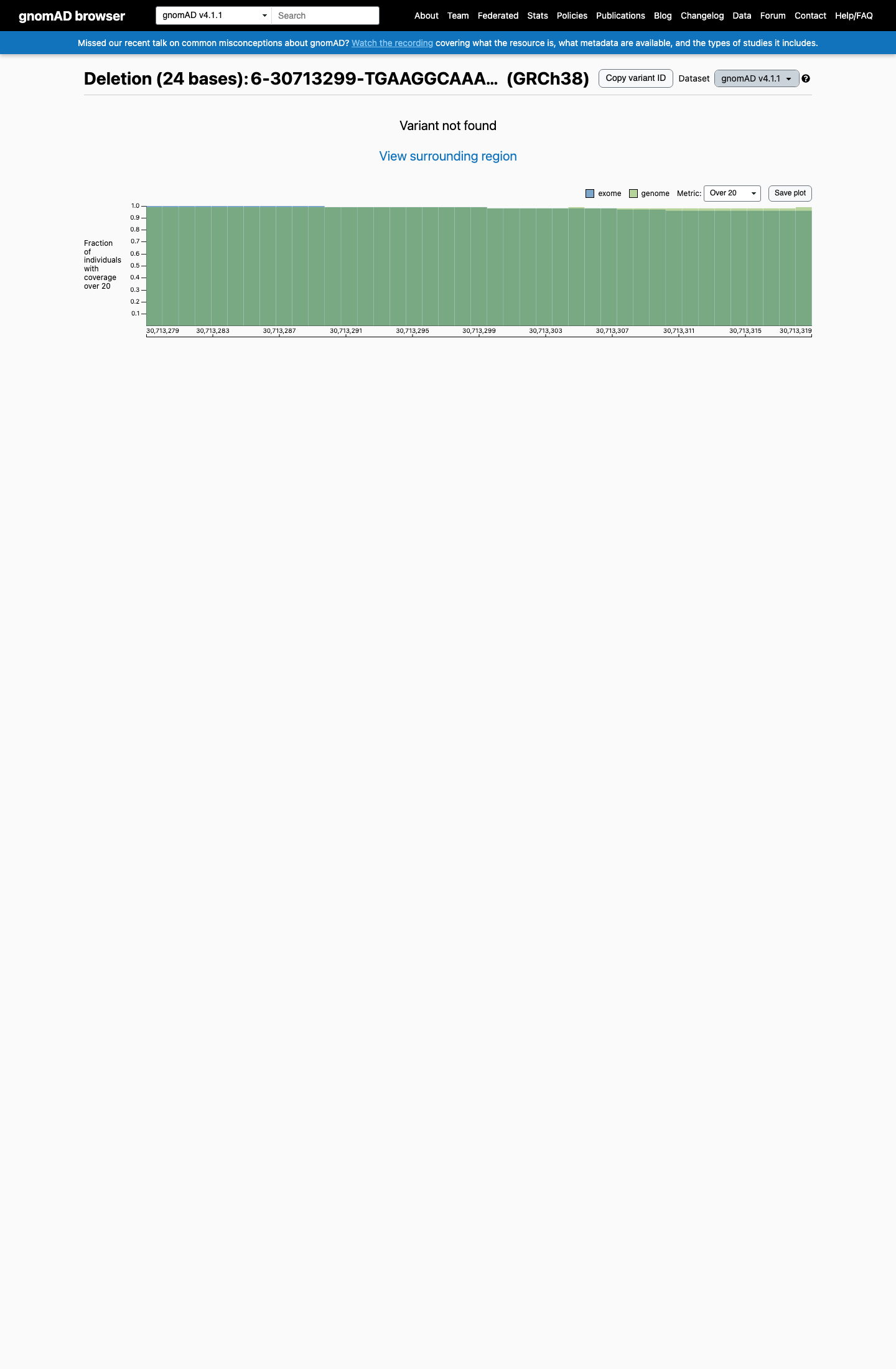
gnomAD v4.1
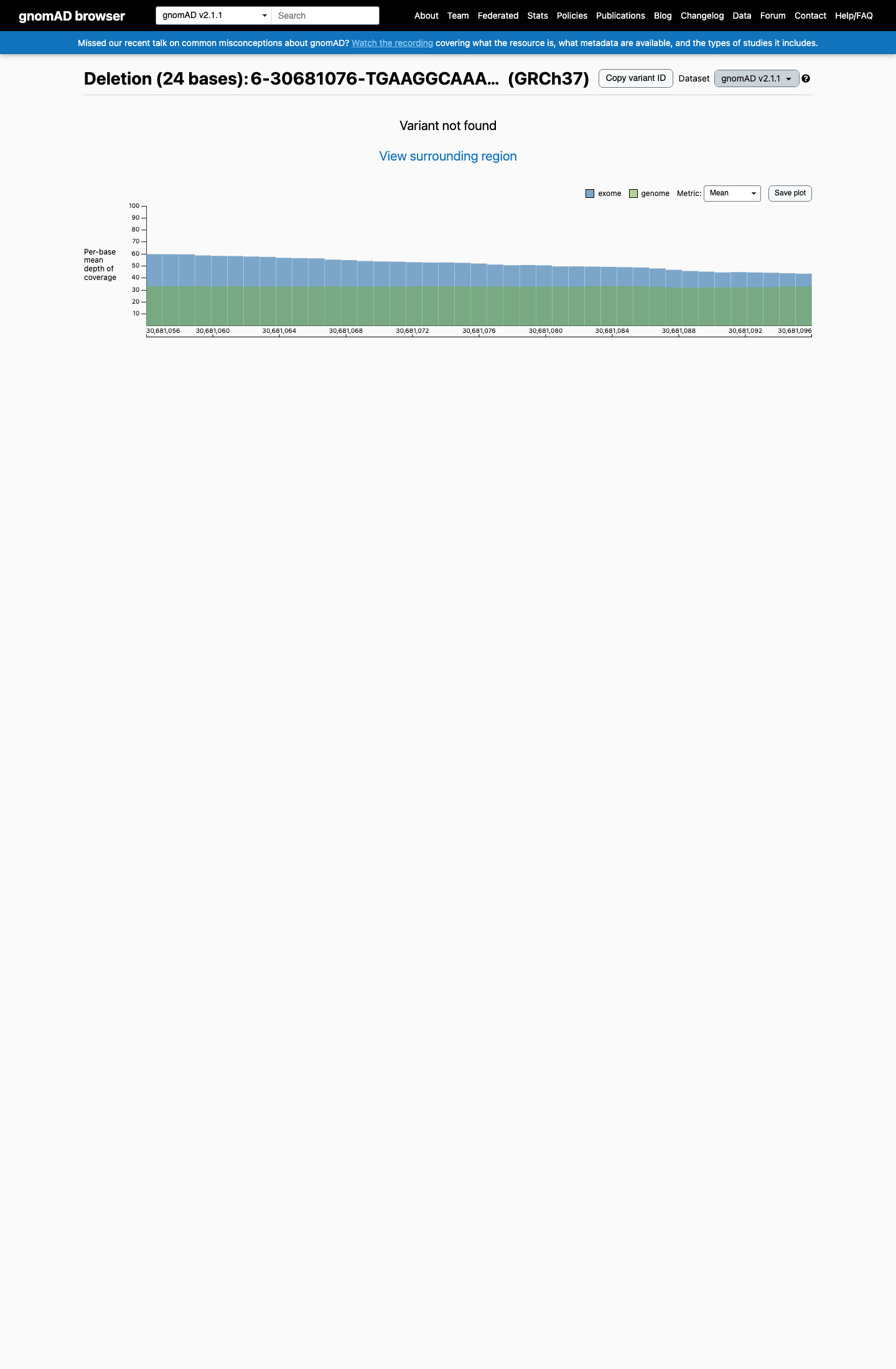
gnomAD v2.1
v4.1
Absent from gnomAD v4.1.
v2.1
Absent from gnomAD v2.1.
🇨🇦 CA
Absent from gnomAD-Canada v1.0.
Allele frequency by ancestry
three datasets · side by side
gnomAD v4.1
Absent
· 0 / ?
0 hom
0 hom
Not observed in any ancestry group.
gnomAD v2.1
Absent
· 0 / ?
0 hom
0 hom
Not observed in any ancestry group.
gnomAD Canada 🇨🇦
Absent
· 0 / ?
0 hom
0 hom
Not observed in any ancestry group.
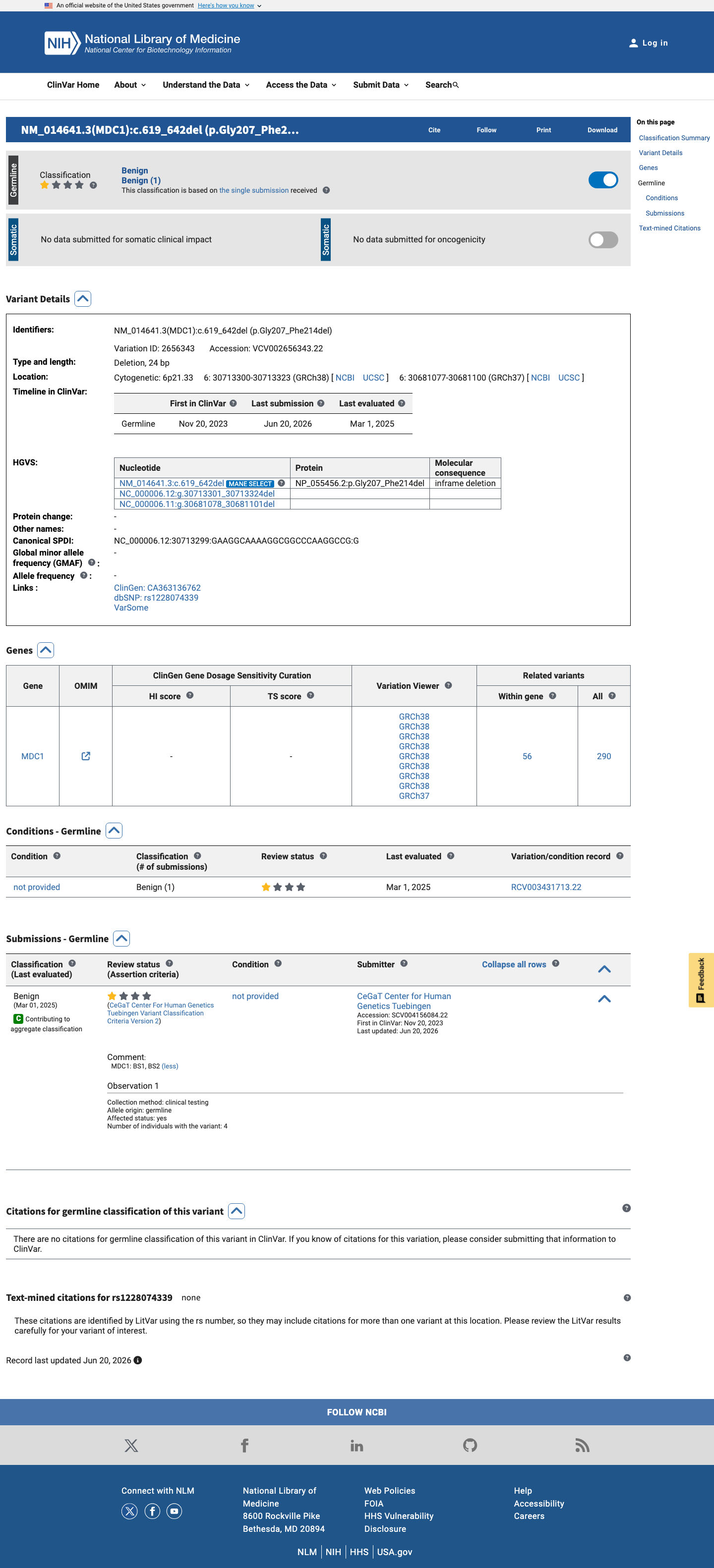
ClinVar
This variant has been reported in ClinVar as Benign (1 clinical laboratory). (ClinVarID = 2656343)

In silico
SpliceAI predicts no significant splice impact for this variant (max delta score = 0.00).
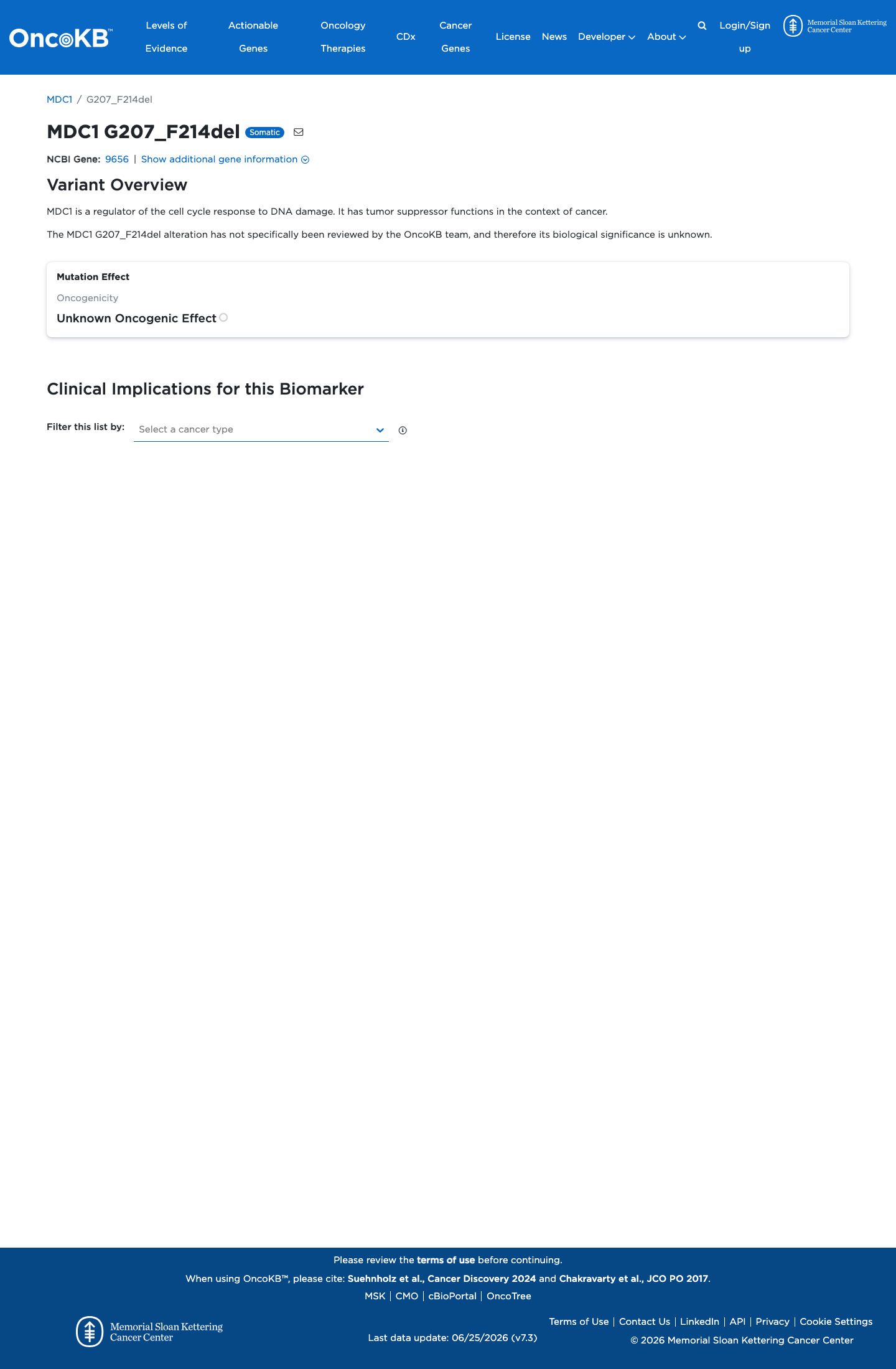
Functional
Unknown Oncogenic Effect
OncoKB did not identify variant-specific reviewed functional evidence for this variant; gene-level curated context is available for reviewer follow-up. MDC1 is a regulator of the cell cycle response to DNA damage. It has tumor suppressor functions in the context of cancer.
COSMIC

Cancer hotspots
Somatic evidence
Not in COSMIC / hotspots
COSMIC
This variant does not lie in a statistically significant hotspot. This variant has previously been reported in somatic cancers (COSMIC; COSV64523420, n = 3 times).
Hotspots
This variant does not lie in a statistically significant hotspot.
Sources & reference links