NM_000548.4:c.4751T>C (p.Leu1584Pro) is a missense variant in exon 37 of TSC2. The variant is located within the Rap-GAP domain (residues 1531-1758), a critical functional domain of TSC2 responsible for GTPase-activating protein activity essential for mTORC1 inhibition. Leucine 1584 resides within an alpha-helical segment (1584-1586), and substitution to proline is predicted to disrupt helical structure (PM1_supporting). The variant is absent from all population databases including gnomAD v2.1, v4.1, and gnomAD-Canada v1.0 (PM2_supporting).1 Multiple in silico tools predict a deleterious effect: REVEL score 0.989 is strongly damaging and BayesDel score 0.569902 supports a deleterious prediction (PP3_supporting).2 SpliceAI predicts no splicing impact (max delta score 0.00), indicating the predicted effect is at the protein level rather than through altered splicing.3 No variant-specific functional studies were confirmed. PMID:22903760 tested 78 TSC2 variants for functional effects on TORC1 inhibition, but L1584P could not be verified among those tested from available evidence.4 ClinVar reports this variant as Uncertain significance (1 star, single submitter from Labcorp/Invitae), which does not contribute to PP5 or BP6.5 No de novo, cosegregation, case-control, or detailed phenotype data are available to support PS2, PS4, PP1, or PP4. With PM1_supporting, PM2_supporting, and PP3_supporting as the only criteria met (3 supporting-level pathogenic criteria), the variant does not reach the threshold for Likely Pathogenic classification under ACMG/AMP 2015 rules. The variant is classified as a Variant of Uncertain Significance (VUS) trending toward pathogenic.6
Final classification
VUS
PM1PM2PP3
TSC2
c.4751T>C
p.Leu1584Pro
missense
This variant
NM_000548.4:c.4751T>C (p.Leu1584Pro) is a missense variant in exon 37 of TSC2.
gene-specific framework lacked a usable explicit final combination framework, so generic ACMG/AMP 2015 final-combination rules were applied as fallback; applied criteria: PM1 supporting, PM2 supporting, PP3 supporting; combination = 3 supporting, which maps to VUS.
Classification rationale
PM1PM2PP3
VUS
TSC2 c.4751T>C
missense
PM1 + PM2 + PP3
→
VUS
2
revelbayesdel
6
generic_acmg_combination_rules
LYFE Sciences is an AI system, and it can make mistakes. Criteria
may be applied incorrectly, sources may be misread, and a confident-looking
classification can still be wrong. Double-check every criterion and
its underlying evidence before relying on any call.
Gene diagram
· NM_000548.4 · variants mapped to exon structure
TSC2
NM_000548.4
Fetching transcript structure from UCSC…
Applied criteria · 3 applied · 20 assessed
MetEvidence satisfies this criterion.
Not metEvaluated against available evidence; threshold not reached.
Not assessedApplies in principle, but no evidence was found to evaluate it.
N/ADoesn't apply to this variant type.
Applied · 3
Strength
Supporting
Moderate
Strong
Very strong
PM1
supporting
Pathogenic
The variant p.Leu1584Pro is located within the Rap-GAP domain (residues 1531-1758) of TSC2, a well-characterized critical functional domain responsible for GTPase-activating protein activity essential for mTORC1 inhibition. UniProt annotates multiple nearby residues as functionally characterized: positions 1643 and 1681 abolish GAP activity, and mutagenesis at 1594 decreases GAP activity. Additionally, leucine to proline substitution at position 1584, which resides within an alpha-helical region (residues 1584-1586), is predicted to disrupt local secondary structure.
UniProt P49815: Rap-GAP domain (1531-1758)residue 1584 is within an alpha-helix (1584-1586)nearby residues functionally characterized (1594 decreased GAP activity
PM2
supporting
Pathogenic
Variant is absent from gnomAD v2.1, gnomAD v4.1, and gnomAD-Canada v1.0 population databases, consistent with a rare variant. Allele frequency <0.1% threshold for PM2 is met (absent).
Absent from gnomAD v2.1 (exomes)gnomAD v4.1 (exomes/genomes)and gnomAD-Canada v1.0.
PP3
supporting
Pathogenic
Multiple in silico tools predict a deleterious effect: REVEL score 0.989 (highly damaging), BayesDel score 0.569902 (deleterious). Additionally, leucine to proline substitution within an alpha-helical segment (residues 1584-1586) of the Rap-GAP domain is mechanistically consistent with structural disruption. SpliceAI predicts no splicing impact (max delta 0.00), indicating the predicted effect is at the protein level.
REVEL: 0.989 (damaging)BayesDel: 0.569902 (deleterious)SpliceAI: max delta 0.00 (no splicing effect). Leu→Pro helix-breaking substitution at a helical position in the GAP domain.
Assessed · not applied
· 17 not met · 3 not assessed
Pathogenic
PS1
No evidence of a different nucleotide change at c.4751 producing the same amino acid change (p.Leu1584Pro) was identified.
PS2
No de novo occurrence data available for this variant.
PS3
No variant-specific functional data confirmed for p.Leu1584Pro.
PS4
Variant reported in ClinVar (VCV001052460) as Uncertain significance by a single clinical laboratory (Invitae); no case-control data or statistically significant enrichment in affected individuals available.
PM6
No de novo occurrence data available for this variant.
PP1
No cosegregation data available for this variant.
PP2
HCI prior score not available for TSC2 (gene_not_supported).
PP4
No detailed phenotype or family history data available.
PP5
ClinVar classification is Uncertain significance with 1-star review status (criteria provided, single submitter).
Benign
BA1
Variant is absent from gnomAD v2.1, v4.1, and gnomAD-Canada v1.0.
BS1
Variant is absent from gnomAD v2.1, v4.1, and gnomAD-Canada v1.0.
BS2
No evidence of observation in healthy adults with expected full penetrance at an early age.
BS3
No functional studies demonstrating no damaging effect on protein function or splicing for this variant.
BS4
No cosegregation data available; cannot evaluate lack of segregation with disease.
BP1
TSC2 missense variants are established causes of tuberous sclerosis complex.
BP2
No evidence of observation in trans with a known pathogenic dominant variant in TSC2.
BP4
REVEL score 0.989 and BayesDel score 0.569902 predict a damaging effect, contradicting BP4 application.
BP5
No evidence of an alternate molecular basis for disease in the affected individual(s).
BP6
ClinVar classification is Uncertain significance (1 star, single submitter).
BP7
NM_000548.4:c.4751T>C is a missense variant (p.Leu1584Pro), not a synonymous variant.
N/A · 5
PVS1 · PM3 · PM4 · PM5 · BP3
Research & evidence
Population frequency
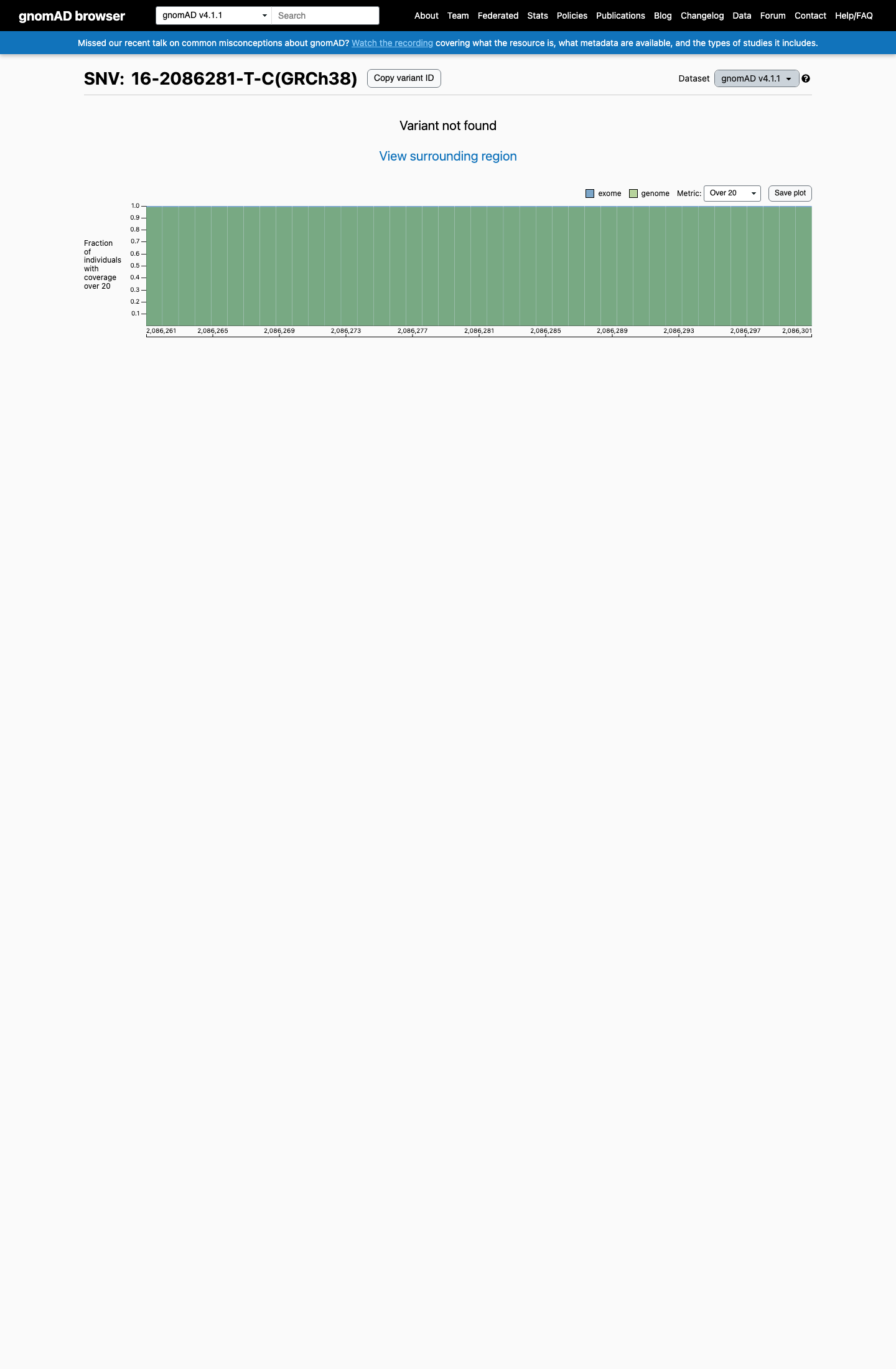
gnomAD v4.1
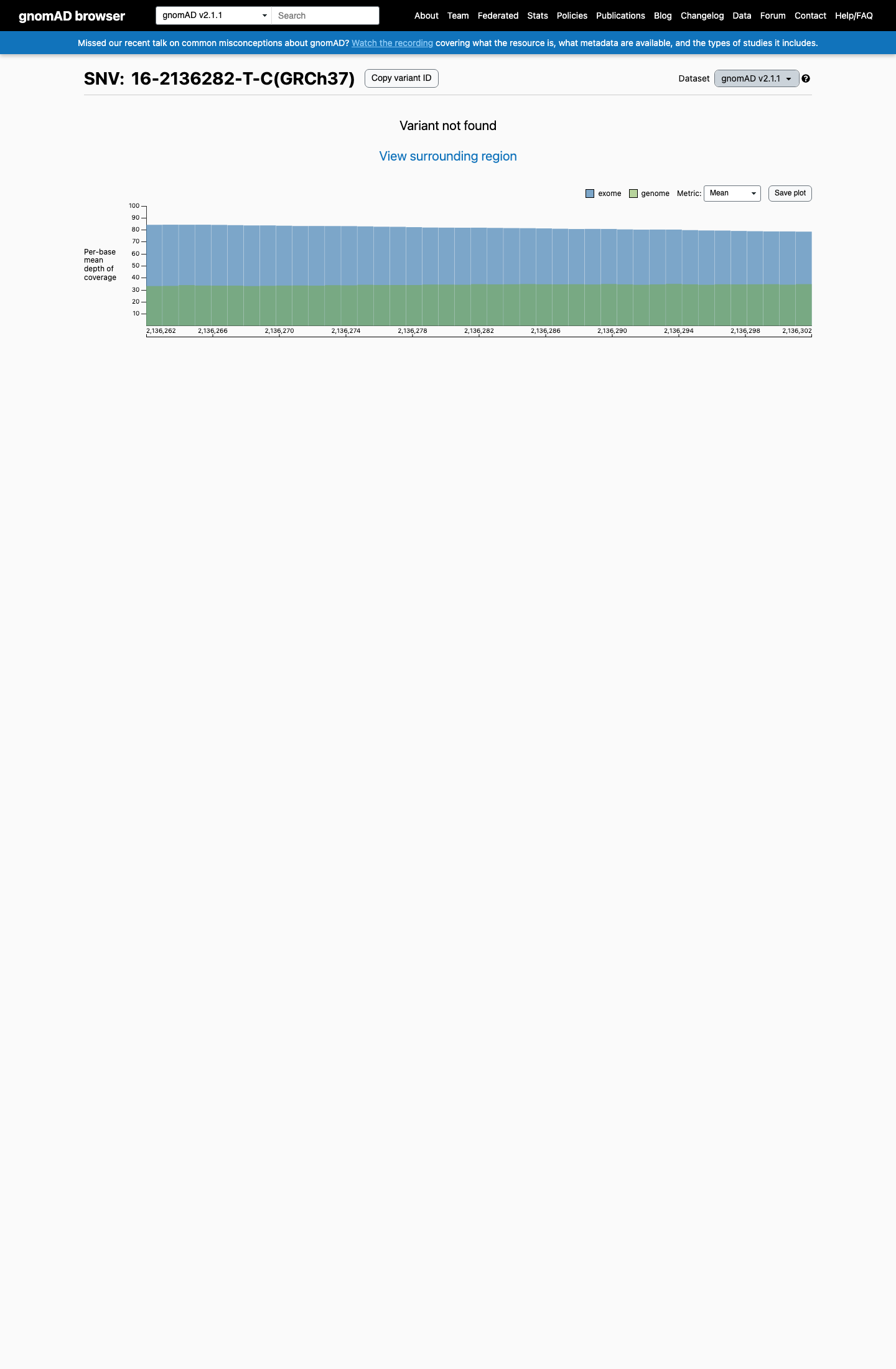
gnomAD v2.1
v4.1
Absent from gnomAD v4.1.
v2.1
Absent from gnomAD v2.1.
🇨🇦 CA
Absent from gnomAD-Canada v1.0.
Allele frequency by ancestry
three datasets · side by side
gnomAD v4.1
Absent
· 0 / ?
0 hom
0 hom
Not observed in any ancestry group.
gnomAD v2.1
Absent
· 0 / ?
0 hom
0 hom
Not observed in any ancestry group.
gnomAD Canada 🇨🇦
Absent
· 0 / ?
0 hom
0 hom
Not observed in any ancestry group.

ClinVar
This variant has been reported in ClinVar as Uncertain significance (1 clinical laboratory). (ClinVarID = 1052460)
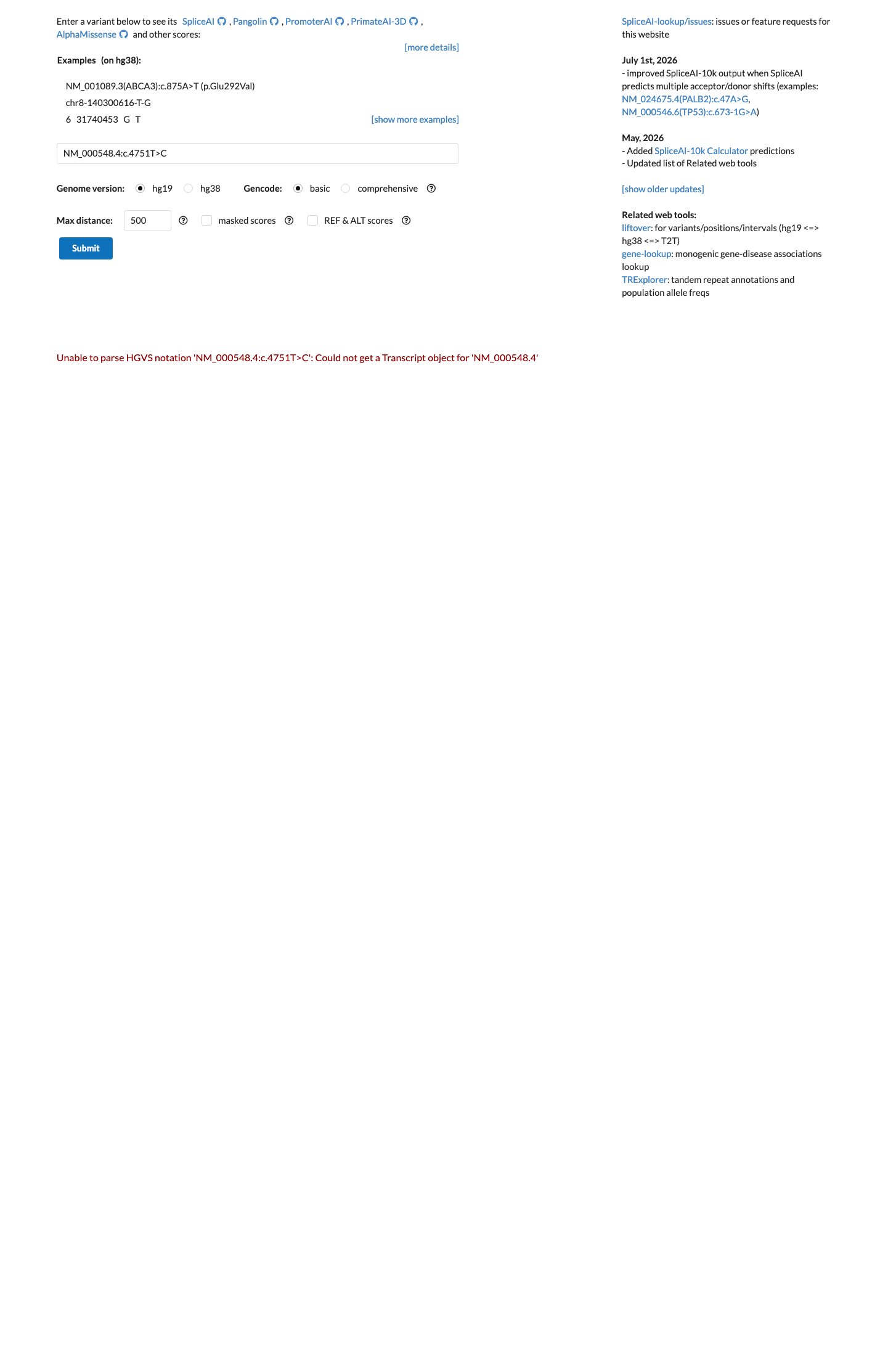
In silico
SpliceAI predicts no significant splice impact for this variant (max delta score = 0.00). REVEL score = 0.989. BayesDel score = 0.569902.
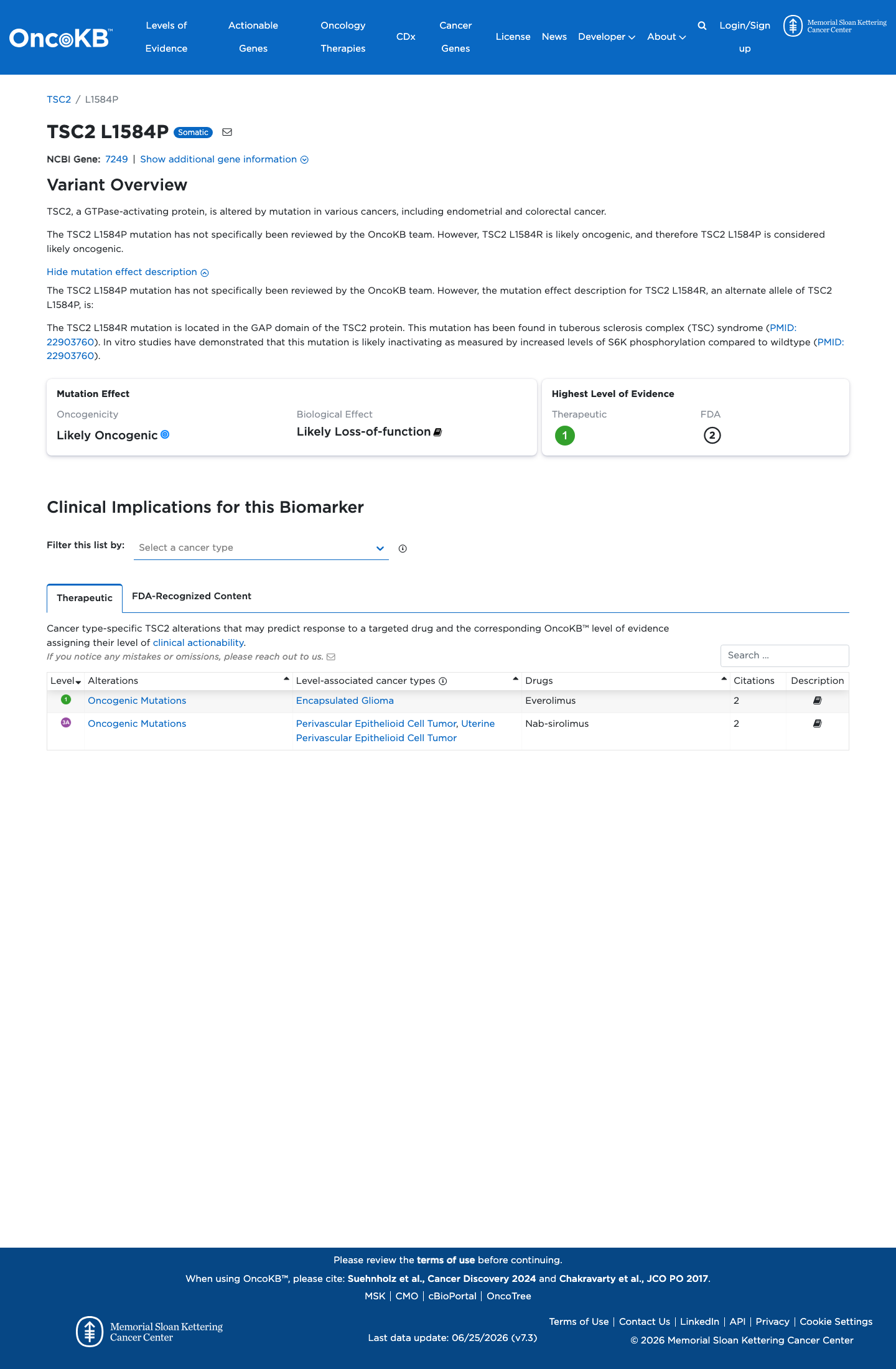
Functional
Likely Oncogenic
OncoKB did not identify variant-specific reviewed functional evidence for this variant; gene-level curated context is available for reviewer follow-up. TSC2, a GTPase-activating protein, is altered by mutation in various cancers, including endometrial and colorectal cancer.

COSMIC
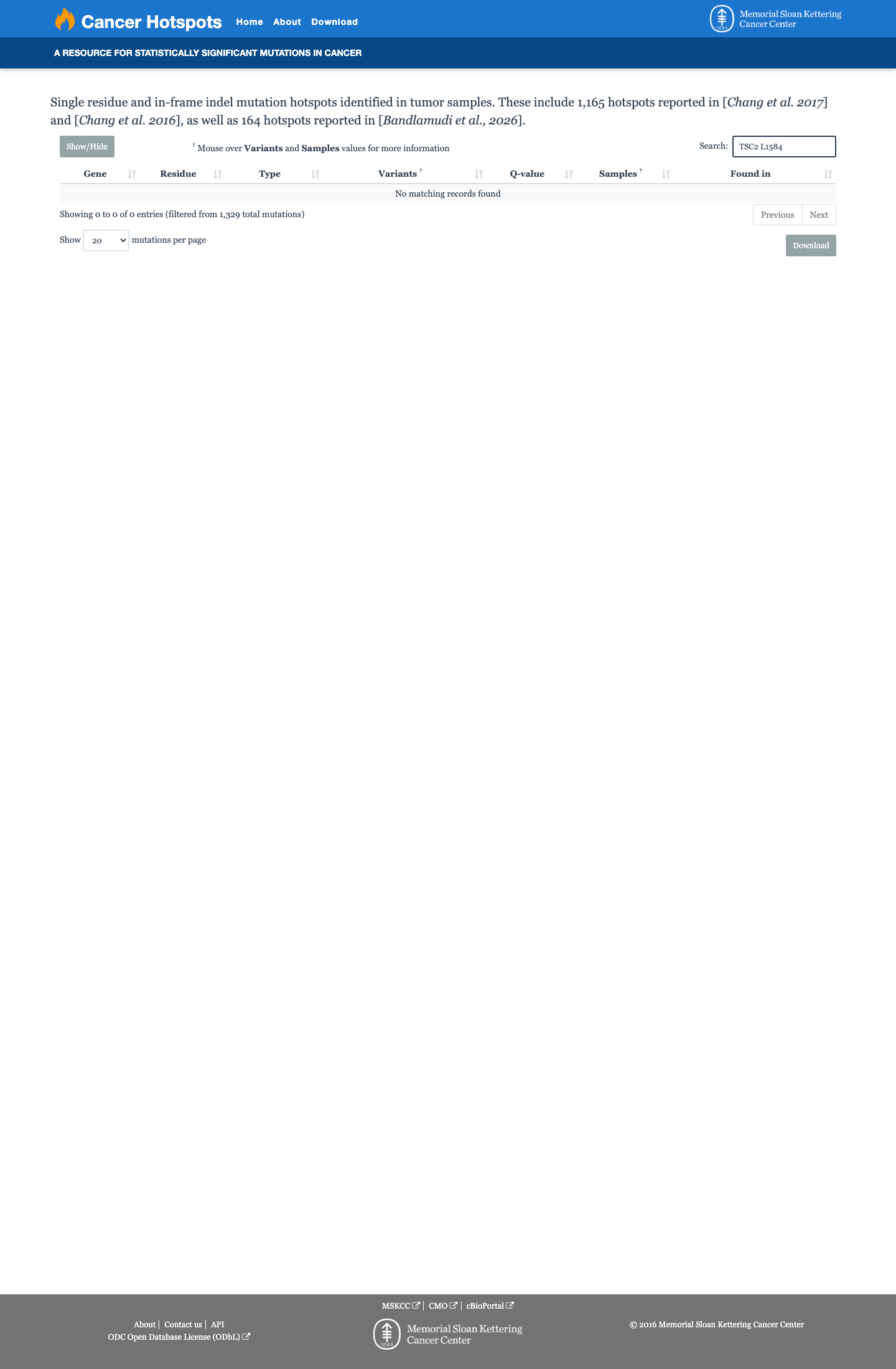
Cancer hotspots
Somatic evidence
Not in COSMIC / hotspots
COSMIC
This variant does not lie in a statistically significant hotspot. This variant has not previously been reported in somatic cancers (COSMIC).
Hotspots
This variant does not lie in a statistically significant hotspot.
Sources & reference links
Triaged references · 2 PMIDs not cited in assessment
22903760 ↗
Functional assessment of TSC2 variants identified in individuals with tuberous sclerosis complex.
ONCOKB
28492532 ↗
Sherloc: a comprehensive refinement of the ACMG-AMP variant classification criteria.
CLINVAR