NM_000179.2:c.1483C>T (p.Arg495Ter) is a nonsense variant in MSH6 that introduces a premature termination codon at position 495, well below the VCEP cutoff of codon 1341, qualifying for PVS1 at Very Strong strength.1 The variant is extremely rare in population databases with an allele frequency of 1.86e-06 in gnomAD v4.1 (3/1,613,890 alleles, 0 homozygotes), meeting the MSH6 VCEP PM2_Supporting threshold of <0.00002.2 This variant has been reported in ClinVar (VariationID 89197) as Pathogenic by the InSiGHT expert panel (3-star review status) and by 22 clinical laboratories, supporting PP5 at Supporting strength.3 The variant was identified in one Brazilian Lynch syndrome proband (PMID:26437257, patient ID-152) with colon cancer at age 59 meeting Bethesda guideline criteria; no MSI, IHC, or co-segregation data were available.4 Applying the ClinGen InSiGHT MSH6 VCEP v2.0 combination rules: PVS1 (Very Strong) + PM2 (Supporting) + PP5 (Supporting) meets Rule 4 (1 Very Strong + ≥2 Supporting) for a classification of Pathogenic.5
MSH6
Final classification
Pathogenic
MSH6 c.1483C>T · p.Arg495Ter
MSH6
NM_000179.2:c.1483C>T (p.Arg495Ter) is a nonsense variant in MSH6 that introduces a premature termination codon at position 495, well below the VCEP cutoff of codon 1341, qualifying for PVS1 at Very Strong strength.
ClinGen InSiGHT Hereditary Colorectal Cancer/Polyposis Expert Panel Specifications to the ACMG/AMP Variant Interpretation Guidelines for MSH6 Version 2.0 v2.0 criteria-combination framework: matched Rule4 (1 Pathogenic.Very Strong + Pathogenic.Supporting >=2) with applied criteria: PVS1 very strong, PM2 supporting, PP5 supporting; maps to Pathogenic.
Classification rationale
PVS1PM2PP5
Pathogenic
MSH6 c.1483C>T
PVS1 + PM2 + PP5
→
Pathogenic
Gene diagram
· NM_000179.2 · variants mapped to exon structure
MSH6
NM_000179.2
Fetching transcript structure from UCSC…
Applied criteria · 3 applied · 13 assessed
Applied · 3
Strength
Supporting
Moderate
Strong
Very strong
✓
PVS1
very strong
Pathogenic
NM_000179.2:c.1483C>T is a nonsense variant that introduces a premature termination codon (p.Arg495Ter) at codon 495, which is well below the VCEP threshold of codon 1341 for MSH6. Under the ClinGen InSiGHT MSH6 VCEP v2.0 PVS1 rule, nonsense variants introducing PTC at or before codon 1341 qualify for PVS1 at Very Strong strength. Loss of function is an established disease mechanism for MSH6 in Lynch syndrome.
Nonsense variant introducing PTC at codon 495well below the VCEP cutoff of codon 1341LoF is established disease mechanism for MSH6 in Lynch syndrome per CSPEC/VCEP
✓
PM2
supporting
Pathogenic
Under MSH6 VCEP v2.0, PM2 at Supporting strength applies when the variant is absent or extremely rare in gnomAD v4 with an allele frequency below 0.00002 (<1 in 50,000 alleles). This variant has an allele frequency of 1.86e-06 in gnomAD v4.1 (3/1,613,890 alleles, 0 homozygotes), which is well below the threshold. It is also extremely rare in gnomAD v2.1 (1/251,182 alleles).
gnomAD v4.1 AF = 1.86e-06 (3/1613890)
✓
PP5
supporting
Pathogenic
Expert panel International Society for Gastrointestinal Hereditary Tumours (InSiGHT) classified as Pathogenic.
ClinVar VariationID 89197: Pathogenicreviewed by expert panel (InSiGHT3-star)
Assessed · not applied
Pathogenic
PS1
PS1 requires a different nucleotide change encoding the same amino acid change (p.Arg495Ter) previously classified as Pathogenic by this VCEP.
PS2
PS2 requires de novo occurrence data with confirmed maternity/paternity.
PS3
PS3 requires variant-specific experimental functional data or systematic characterization of the variant position through calibrated functional assays as defined by the VCEP MMR functional assay documentation.
PP1
PP1 requires co-segregation data with a Bayes Likelihood Ratio meeting VCEP thresholds.
PP3
PP3 under MSH6 VCEP v2.0 requires either: (a) a missense variant with HCI prior probability of pathogenicity >0.68, or (b) a predicted splice defect at a non-canonical splice site with SpliceAI delta score ≥0.2.
PP4
PP4 under MSH6 VCEP v2.0 requires MSI-H colorectal or endometrial tumors and/or loss of MMR protein expression consistent with the variant location.
Benign
BA1
BA1 under MSH6 VCEP v2.0 requires gnomAD v4 Grpmax filtering allele frequency ≥ 0.0022 (0.22%) and exclusion as a founder pathogenic variant.
BS1
BS1 under MSH6 VCEP v2.0 requires gnomAD v4 Grpmax filtering allele frequency ≥ 0.00022 and < 0.0022 (0.022%–0.22%).
BS2
BS2 under MSH6 VCEP v2.0 requires co-occurrence in trans with a known pathogenic variant in a patient with colorectal cancer after age 45 without clinical manifestations of CMMRD.
BS3
BS3 under MSH6 VCEP v2.0 requires calibrated functional assays demonstrating functional odds for pathogenicity ≤ 0.05 (Strong) or between 0.05 and 0.48 (Supporting), or variant-specific proficient function in protein/mRNA-based assays.
BS4
BS4 under MSH6 VCEP v2.0 requires lack of co-segregation with disease in pedigrees with a combined Bayes Likelihood Ratio meeting specified thresholds.
BP5
BP5 under MSH6 VCEP v2.0 requires tumors with MSS and/or no loss of MMR protein expression inconsistent with the gene, or BRAF V600E/MLH1 methylation with MSI-H.
BP6
BP6 applies when a reputable source classifies the variant as benign.
N/A · 12
PS4 · PM1 · PM3 · PM4 · PM5 · PM6 · PP2 · BP1 · BP2 · BP3 · BP4 · BP7
Research & evidence
Population frequency · supports pathogenic
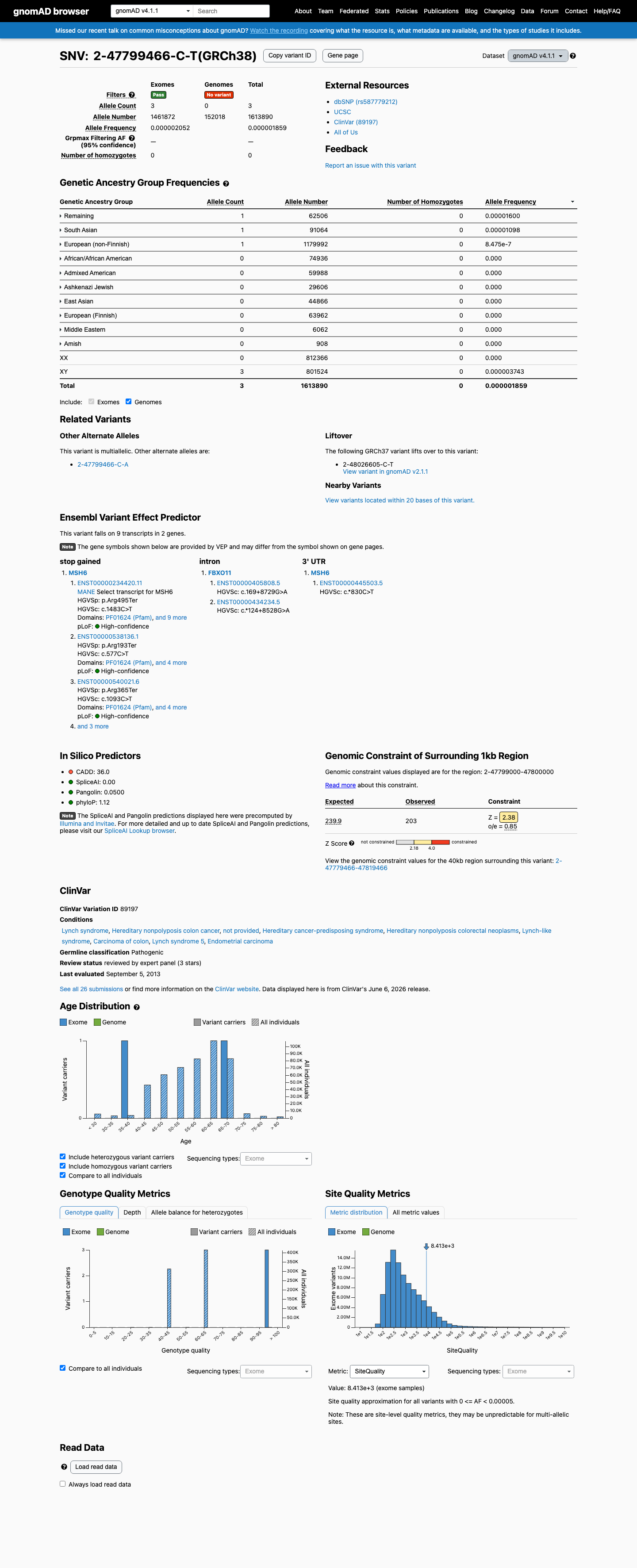
gnomAD v4.1
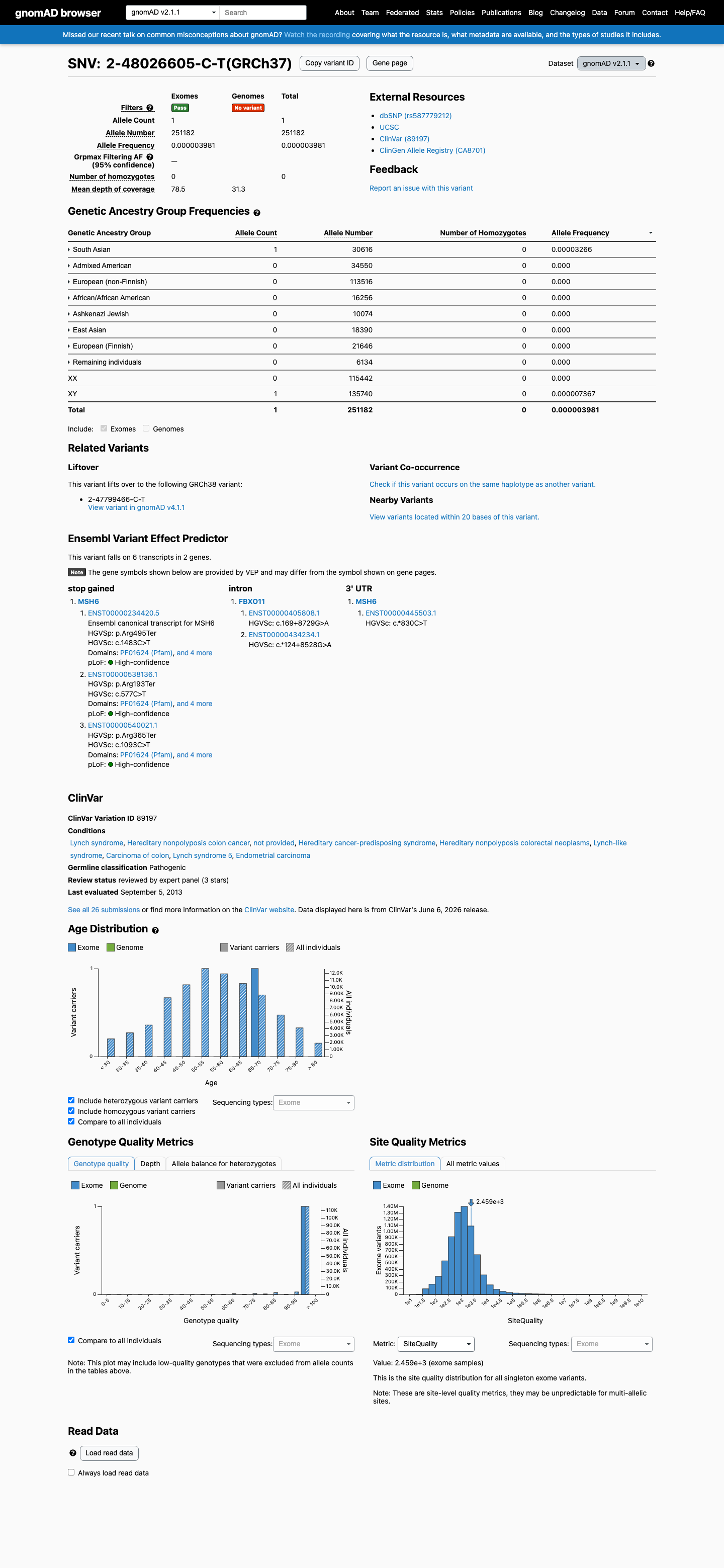
gnomAD v2.1
v4.1
This variant is present in gnomAD v4.1 (AF= 1.85886e-06; MAF= 0.00019%, 3/1613890 alleles, homozygotes = 0) and has highest observed frequency in the Remaining individuals population (AF= 1.59985e-05; MAF= 0.00160%, 1/62506 alleles, homozygotes = 0).
v2.1
This variant is present in gnomAD v2.1 (AF= 3.98118e-06; MAF= 0.00040%, 1/251182 alleles, homozygotes = 0) and has highest observed frequency in the South Asian population (AF= 3.26627e-05; MAF= 0.00327%, 1/30616 alleles, homozygotes = 0).
🇨🇦 CA
Absent from gnomAD-Canada v1.0.
Allele frequency by ancestry
three datasets · side by side
gnomAD v4.1
0.00019%
· 3 / 1,613,890
0 hom
0 hom
Remaining individuals 1 / 62,506 |
0.0016% |
South Asian 1 / 91,064 |
0.0011% |
European (non-Finnish) 1 / 1,179,992 |
8.5e-05% |
+ 7 not observed (Admixed American, European (Finnish), Amish, East Asian, Middle Eastern, Ashkenazi Jewish, African/African American)
gnomAD v2.1
0.0004%
· 1 / 251,182
0 hom
0 hom
South Asian 1 / 30,616 |
0.0033% |
+ 7 not observed (African/African American, Admixed American, Ashkenazi Jewish, East Asian, European (Finnish), European (non-Finnish), Remaining individuals)
gnomAD Canada 🇨🇦
Absent
· 0 / ?
0 hom
0 hom
Not observed in any ancestry group.

ClinVar
This variant has been reported in ClinVar as Pathogenic (22 clinical laboratories) and as Pathogenic by International Society for Gastrointestinal Hereditary Tumours (InSiGHT) (expert panel). (ClinVarID = 89197)
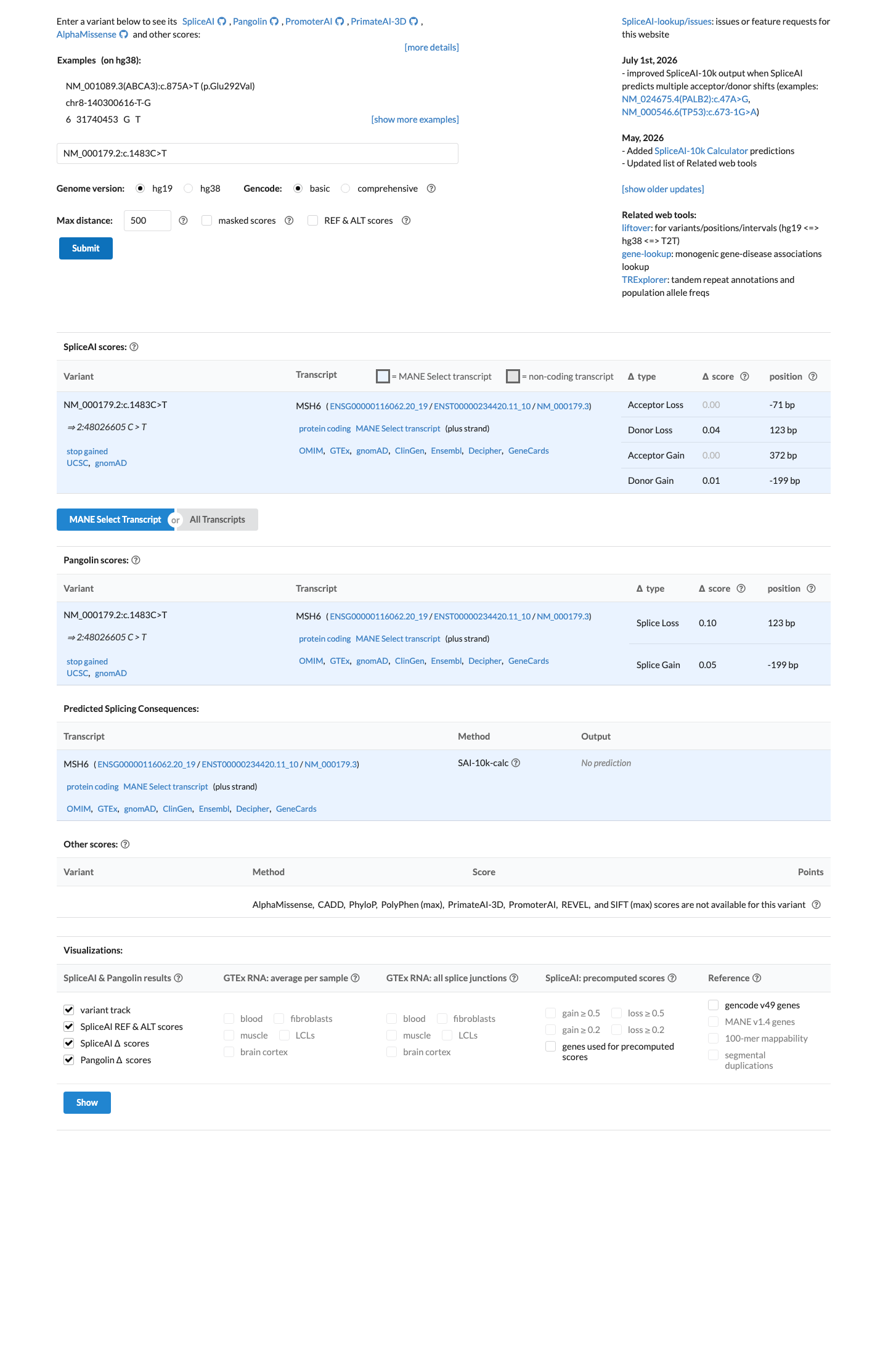
In silico
SpliceAI predicts no significant splice impact for this variant (max delta score = 0.04). BayesDel score = 0.536677.
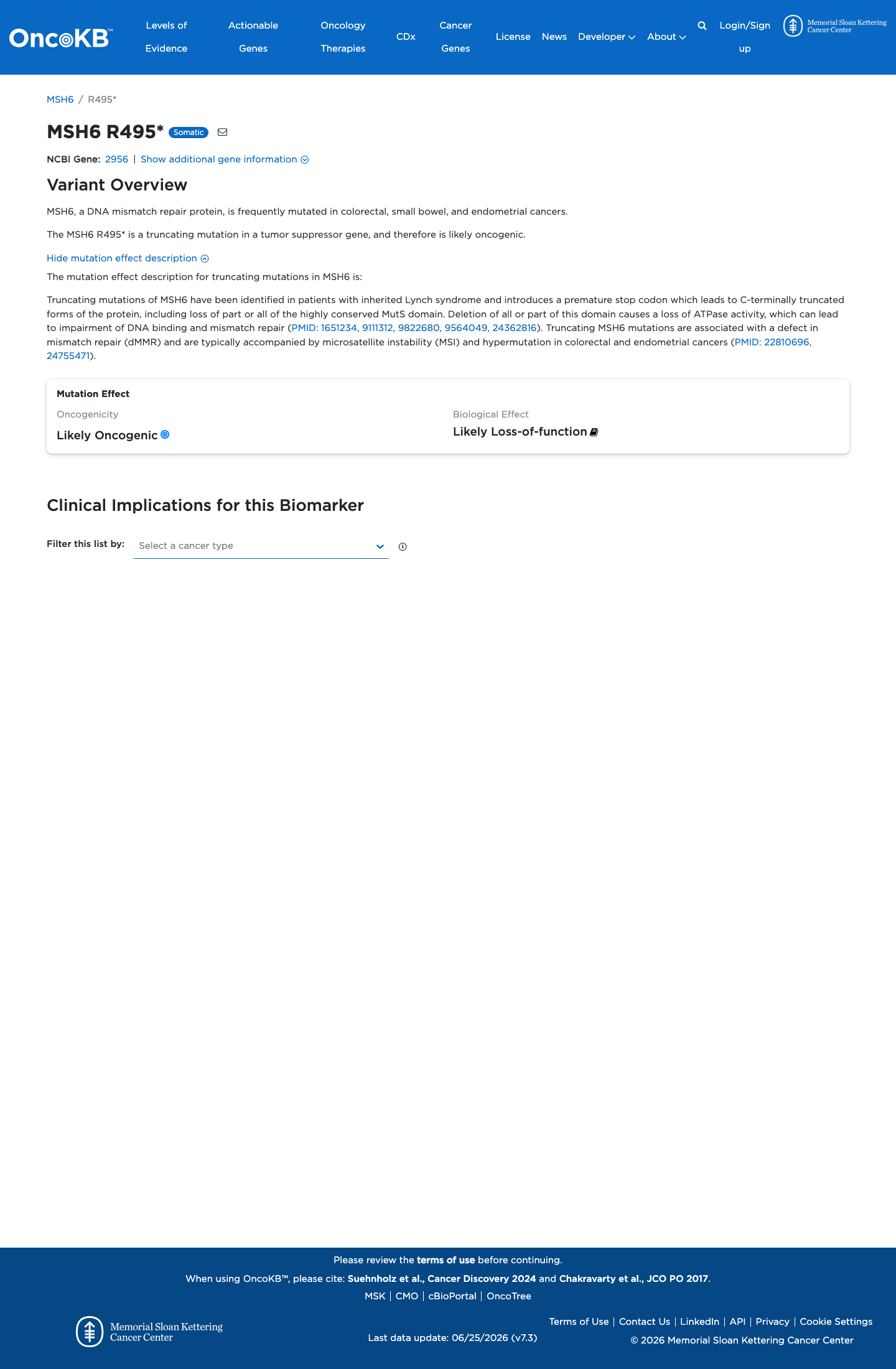
Functional
Likely Oncogenic
OncoKB identified variant-specific curated literature and context relevant to functional review; biological-effect context: Likely Loss-of-function; curated oncogenicity label: Likely Oncogenic.
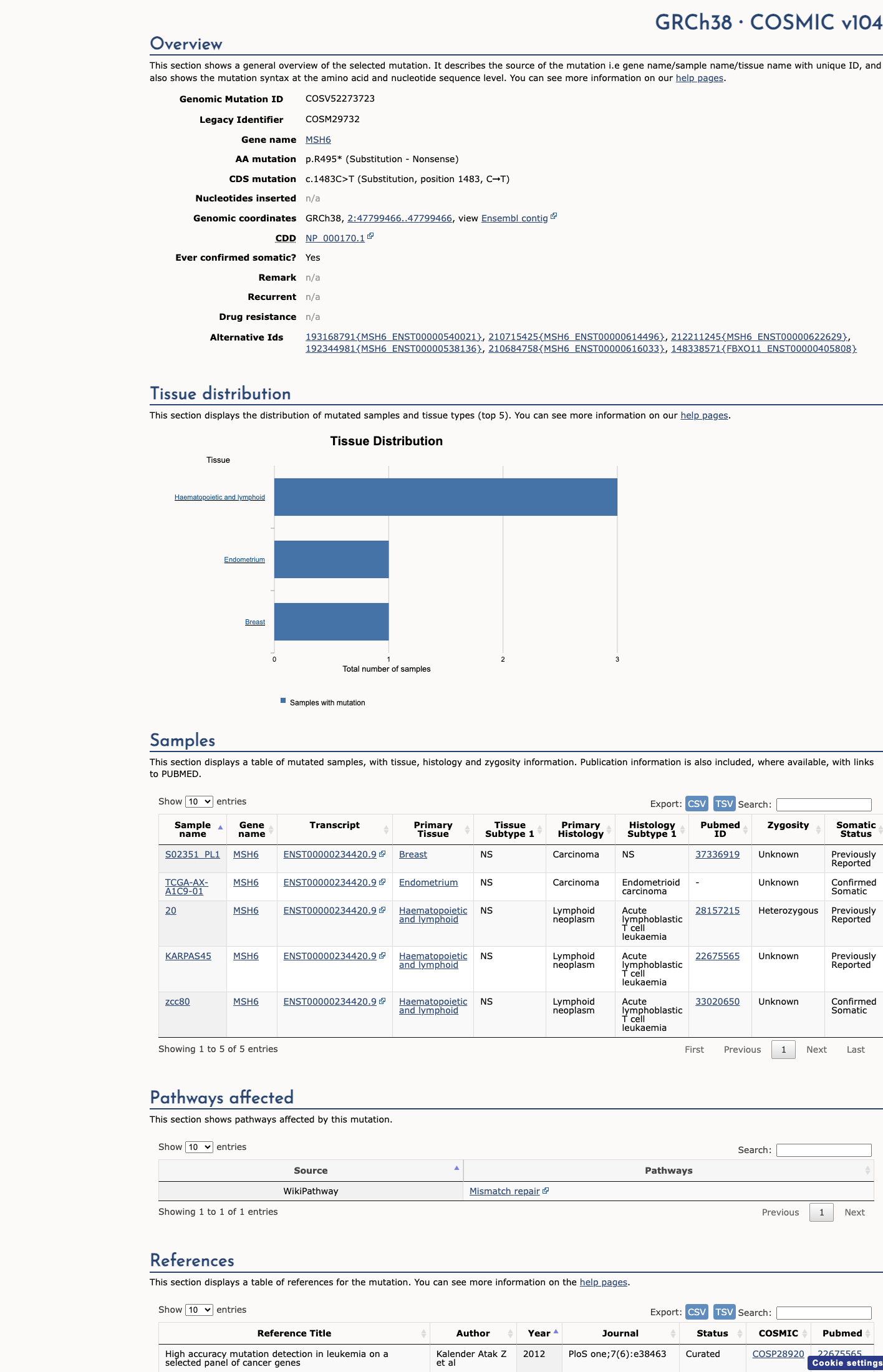
COSMIC

Cancer hotspots
Somatic evidence
Not in COSMIC / hotspots
COSMIC
This variant does not lie in a statistically significant hotspot. This variant has previously been reported in somatic cancers (COSMIC; COSV52273723, n = 5 times).
Hotspots
This variant does not lie in a statistically significant hotspot.
Sources & reference links
9Sources
Triaged references · 7 PMIDs not cited in assessment
24362816 ↗
Application of a 5-tiered scheme for standardized classification of 2,360 unique mismatch repair gene variants in the InSiGHT locus-specific database.
ONCOKB
1651234 ↗
Altering the conserved nucleotide binding motif in the Salmonella typhimurium MutS mismatch repair protein affects both its ATPase and mismatch binding activities.
ONCOKB
24755471 ↗
Colorectal cancer cell lines are representative models of the main molecular subtypes of primary cancer.
ONCOKB
9111312 ↗
Genetic and biochemical analysis of Msh2p-Msh6p: role of ATP hydrolysis and Msh2p-Msh6p subunit interactions in mismatch base pair recognition.
ONCOKB
25741868 ↗
Standards and guidelines for the interpretation of sequence variants: a joint consensus recommendation of the American College of Medical Genetics and Genomics and the Association for Molecular Pathology.
CLINVAR
26437257 ↗
Clinical and Molecular Characterization of Brazilian Patients Suspected to Have Lynch Syndrome.
CLINVAR