NM_000489.5:c.371-1G>A disrupts the canonical splice acceptor site at intron 5 of ATRX, a gene in which germline loss of function is an established mechanism for ATR-X syndrome (MIM #301040). Under the ClinGen SVI PVS1 recommendations (PMC6185798), this qualifies for PVS1 at very strong strength.1 The variant is absent from gnomAD-Canada v1.0 and independently reported as absent from population databases by the submitting clinical laboratory (Labcorp Genetics/Invitae). This rarity, combined with its location on the X chromosome in a gene causing an X-linked disorder, meets PM2 at moderate strength.2 SpliceAI predicts complete acceptor loss (max delta 0.99, DS_AL 0.99), consistent with the predicted loss-of-function effect. Per PMC6185798, PP3 is not stacked with PVS1 for the same splice prediction evidence.3 No variant-specific functional data (PS3), de novo reports (PS2/PM6), segregation data (PP1), or proband phenotype details (PP4) are available in the case materials. ClinVar classification is from a single submitter (1-star) and does not meet PP5 threshold.4 Combined ACMG evidence: PVS1 (very strong) + PM2 (moderate). Under generic ACMG/AMP 2015 combination rules, one very strong and one moderate criterion yields a classification of Likely Pathogenic.5
Final classification
Unclassified
PVS1PM2
ATRX
c.371-1G>A
p.?
· exon NC_000023.10
This variant
NM_000489.5:c.371-1G>A disrupts the canonical splice acceptor site at intron 5 of ATRX, a gene in which germline loss of function is an established mechanism for ATR-X syndrome (MIM #301040). Under the ClinGen SVI PVS1 recommendations (PMC6185798), this qualifies for PVS1 at very strong strength.
Classification rationale
PVS1PM2
Unclassified
ATRX c.371-1G>A
· exon NC_000023.10
PVS1 + PM2
→
Unclassified
1
pvs1_generic_frameworkpvs1_gene_contextpvs1_variant_assessment
3
spliceai ↗pvs1_generic_framework
5
generic_acmg_combination_rules
LYFE Sciences is an AI system, and it can make mistakes. Criteria
may be applied incorrectly, sources may be misread, and a confident-looking
classification can still be wrong. Double-check every criterion and
its underlying evidence before relying on any call.
Gene diagram
· NM_000489.5 · variants mapped to exon structure
ATRX
NM_000489.5
Fetching transcript structure from UCSC…
Applied criteria · 2 applied · 17 assessed
MetEvidence satisfies this criterion.
Not metEvaluated against available evidence; threshold not reached.
Not assessedApplies in principle, but no evidence was found to evaluate it.
N/ADoesn't apply to this variant type.
Applied · 2
Strength
Supporting
Moderate
Strong
Very strong
PVS1
very strong
review
Pathogenic
This variant disrupts the canonical splice acceptor site at intron 5 of ATRX (c.371-1G>A, ±1 position). ATRX loss of function is an established disease mechanism for ATR-X syndrome (alpha-thalassemia/mental retardation syndrome, X-linked, MIM #301040), supported by germline disease literature. Under the ClinGen SVI PVS1 decision tree (PMC6185798), canonical ±1,2 splice site variants in genes with a validated germline loss-of-function mechanism qualify for PVS1 at full strength. SpliceAI predicts near-complete acceptor loss (delta score 0.99), consistent with aberrant splicing and a predicted null effect.
Canonical splice acceptor site (±12 position) disrupted by c.371-1G>AATRX germline loss of function is an established disease mechanism for ATR-X syndrome (PMID:29706636)
PM2
moderate
review
Pathogenic
This variant is absent from gnomAD-Canada v1.0. gnomAD v2.1 and v4.1 population frequency data were unavailable due to query timeout, but the clinical laboratory submission (Invitae) independently confirmed absence from population databases. As a canonical splice site variant on the X chromosome causing a well-established X-linked disorder, standing population variation is expected to be exceedingly low. The combined evidence supports rarity consistent with PM2 at moderate strength under generic ACMG/AMP 2015.
Absent from gnomAD-Canada v1.0 (HostSeq genomes)Invitae clinical submission independently reports absence from gnomADCanonical splice site variant on chromosome X with established disease association
Assessed · not applied
· 6 not met · 11 not assessed
Pathogenic
PS2
No de novo data available for this variant in the case materials.
PS3
No variant-specific functional data identified for NM_000489.5:c.371-1G>A.
PS4
Insufficient proband count data.
PM1
Insufficient information to determine whether this splice site falls within a critical functional domain or established mutational hotspot in ATRX.
PM6
No de novo data available for this variant.
PP1
No segregation data available in the case materials.
PP4
No proband phenotype data available in the case materials for specificity assessment.
PP5
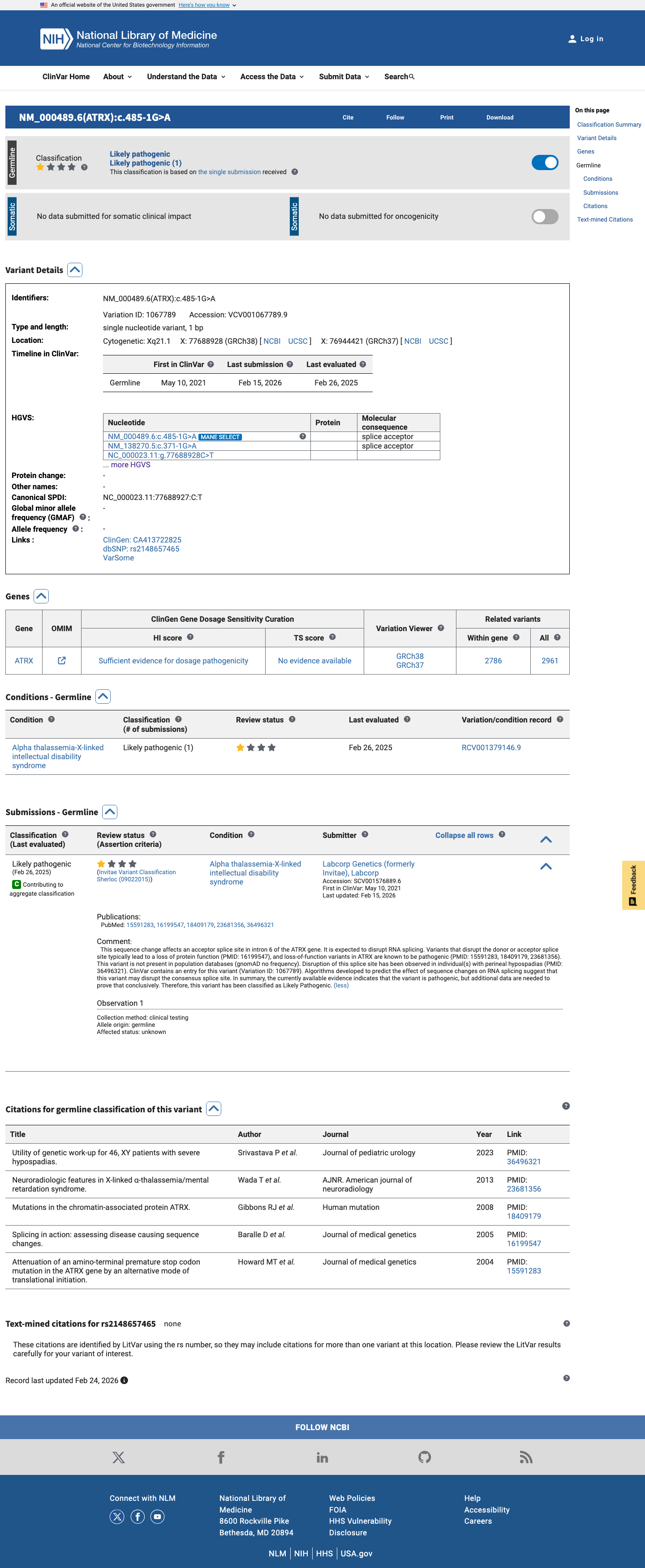
ClinVar entry (variation ID 1067789) classifies this variant as Likely pathogenic under a single submitter (Labcorp Genetics/Invitae) with review status 'criteria provided, single submitter' (1-star).
Benign
BA1
This variant is absent from gnomAD-Canada v1.0.
BS1
This variant is absent from gnomAD-Canada v1.0.
BS2
No data available on observation of this variant in healthy adult controls.
BS3
No functional studies demonstrating a neutral or benign effect for this variant are available.
BS4
No segregation data available demonstrating lack of cosegregation with disease.
BP2
No data available on observation of this variant in trans with a known pathogenic variant.
BP4
Multiple in silico tools predict a deleterious effect rather than a benign effect.
BP5
No data available on a case with this variant where an alternative molecular basis for disease was identified.
BP6
The only ClinVar classification for this variant is Likely pathogenic (not benign or likely benign).
N/A · 9
PS1 · PM3 · PM4 · PM5 · PP2 · PP3 · BP1 · BP3 · BP7
Research & evidence
Population frequency
v4.1
This variant is absent from gnomAD v4.1.
v2.1
This variant is absent from gnomAD v2.1.
🇨🇦 CA
Absent from gnomAD-Canada v1.0.
Allele frequency by ancestry
three datasets · side by side
gnomAD Canada 🇨🇦
Absent
· 0 / ?
0 hom
0 hom
Not observed in any ancestry group.


COSMIC
Somatic evidence
COSMIC
In progress — evidence not uploaded yet.
Hotspots
This variant does not lie in a statistically significant cancer hotspot.
Sources & reference links
Triaged references · 6 PMIDs not cited in assessment
15591283 ↗
Attenuation of an amino-terminal premature stop codon mutation in the ATRX gene by an alternative mode of translational initiation.
CLINVAR
23681356 ↗
Neuroradiologic features in X-linked α-thalassemia/mental retardation syndrome.
CLINVAR
28492532 ↗
Sherloc: a comprehensive refinement of the ACMG-AMP variant classification criteria.
CLINVAR