IDH1 c.394C>T (p.Arg132Cys) is a missense variant at the critical active-site residue R132, the most recurrently mutated amino acid in IDH1 across all cancer types.1 Functional studies directly testing R132C demonstrate a neomorphic gain-of-function: the variant enzyme produces the oncometabolite 2-hydroxyglutarate and promotes leukemogenesis in a mouse transplantation model, with median survival shortened from 167 to 83 days (p<0.001).2 R132C is effectively targeted by the FDA-approved mutant IDH1 inhibitor ivosidenib (AG-120) with nanomolar potency (IC50 13 nM enzyme, 8 nM cellular), and ivosidenib induces differentiation of primary R132C AML blasts ex vivo.3 Multiple different missense changes at the same residue (R132H, R132S, R132G, R132L) are established as pathogenic and share the same gain-of-function mechanism, satisfying PM5.4 The variant is essentially absent from population databases (gnomAD v2.1: 0/251,292 alleles; gnomAD v4.1: 1/1,613,126 alleles, AF=0.00006%), meeting PM2 for rarity in controls.5 In silico predictors support a deleterious effect (REVEL 0.814) and possible splice alteration (SpliceAI max delta 0.51), contributing supporting evidence (PP3).6 The variant has been reported in ClinVar as Pathogenic by multiple clinical laboratories and is recorded in COSMIC with 1,377 somatic observations.7 Applying generic ACMG/AMP 2015 combination rules: PS3 (strong) + PM1 (moderate) + PM2 (moderate) + PM5 (moderate) + PP3 (supporting) → Pathogenic (class 5).8
Final classification
Pathogenic
PS3PM1PM2PM5PP3
IDH1
c.394C>T
p.Arg132Cys
missense
This variant
IDH1 c.394C>T (p.Arg132Cys) is a missense variant at the critical active-site residue R132, the most recurrently mutated amino acid in IDH1 across all cancer types.
gene-specific framework lacked a usable explicit final combination framework, so generic ACMG/AMP 2015 final-combination rules were applied as fallback; applied criteria: PS3 strong, PM1 moderate, PM2 moderate, PM5 moderate, PP3 supporting; combination = 1 strong + 3 moderate + 1 supporting, which maps to Pathogenic.
Classification rationale
PS3PM1PM2PM5PP3
Pathogenic
IDH1 c.394C>T
missense
PS3 + PM1 + PM2 + PM5 + PP3
→
Pathogenic
6
revelspliceai ↗
8
generic_acmg_combination_rules
LYFE Sciences is an AI system, and it can make mistakes. Criteria
may be applied incorrectly, sources may be misread, and a confident-looking
classification can still be wrong. Double-check every criterion and
its underlying evidence before relying on any call.
Gene diagram
· NM_005896.3 · variants mapped to exon structure
IDH1
NM_005896.3
Fetching transcript structure from UCSC…
Applied criteria · 5 applied · 17 assessed
MetEvidence satisfies this criterion.
Not metEvaluated against available evidence; threshold not reached.
Not assessedApplies in principle, but no evidence was found to evaluate it.
N/ADoesn't apply to this variant type.
Applied · 5
Strength
Supporting
Moderate
Strong
Very strong
PS3
strong
Pathogenic
Functional studies demonstrate that the IDH1 R132C variant confers a neomorphic gain-of-function activity, producing the oncometabolite 2-hydroxyglutarate (2-HG). PMID:23954893 directly tested R132C in a mouse bone marrow transplantation model, showing accelerated leukemogenesis with shortened survival (median 83 vs 167 days, p<0.001). PMID:19935646 established the mechanism that R132 mutations (including R132H) produce 2-HG. PMID:29670690 confirmed R132C as a target of the FDA-approved inhibitor ivosidenib (AG-120) with nanomolar IC50 (enzyme 13 nM, cellular 8 nM), providing orthogonal pharmacologic validation of the variant's functional significance.
PMID:23954893: R132C cDNA from MDS patient directly tested in mouse transplantation assaycooperates with HoxA9 to accelerate leukemogenesis (median survival 83 days vs 167 days).PMID:19935646: R132 mutations produce the oncometabolite 2-hydroxyglutarate
PM1
moderate
Pathogenic
Residue R132 lies within the active site of IDH1 (residues 104-136), a well-established critical functional domain. R132 is the single most recurrently mutated amino acid in IDH1 across all cancer types and is flagged as a statistically significant hotspot by cancerhotspots.org. PMID:19935646 demonstrates that mutations at R132 abrogate normal isocitrate-to-αKG conversion and confer neomorphic 2-HG production.
R132 is in the IDH1 active site (isocitrate binding pocket)a critical functional domain.Statistically significant hotspot per cancerhotspots.org.
PM2
moderate
Pathogenic
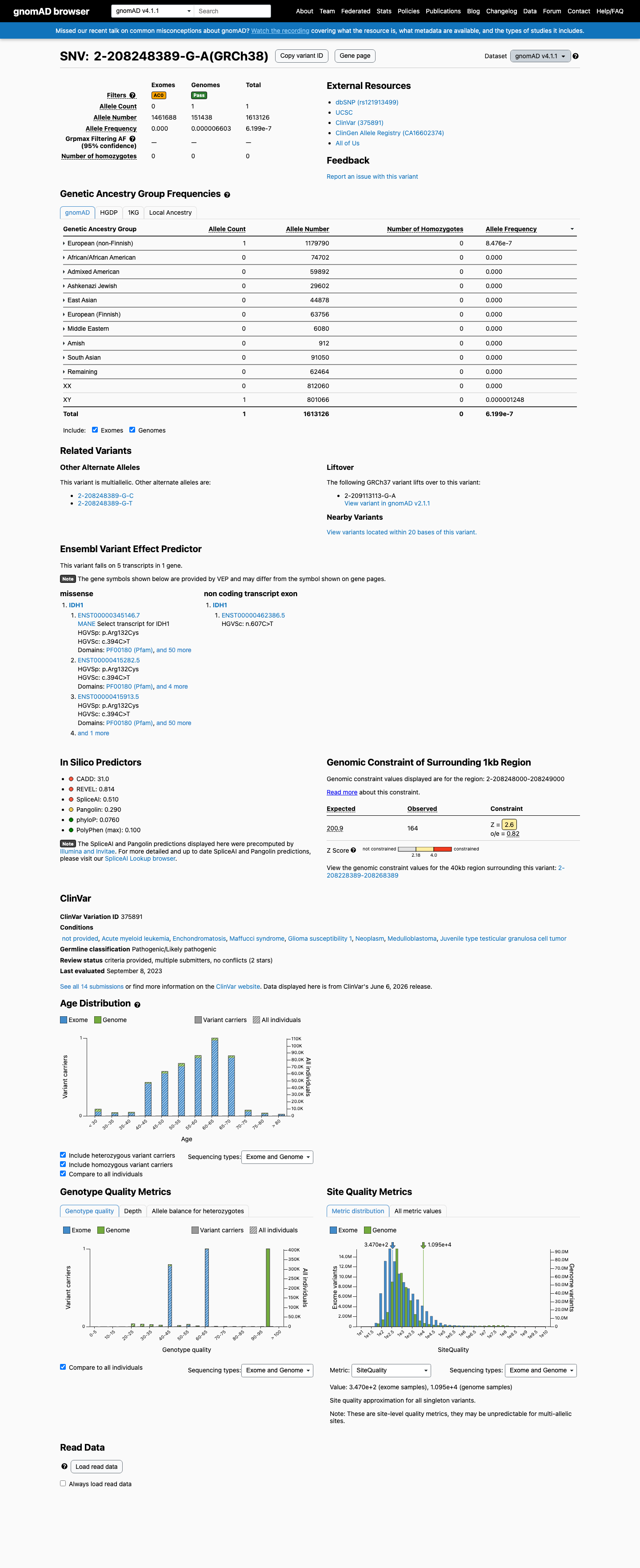
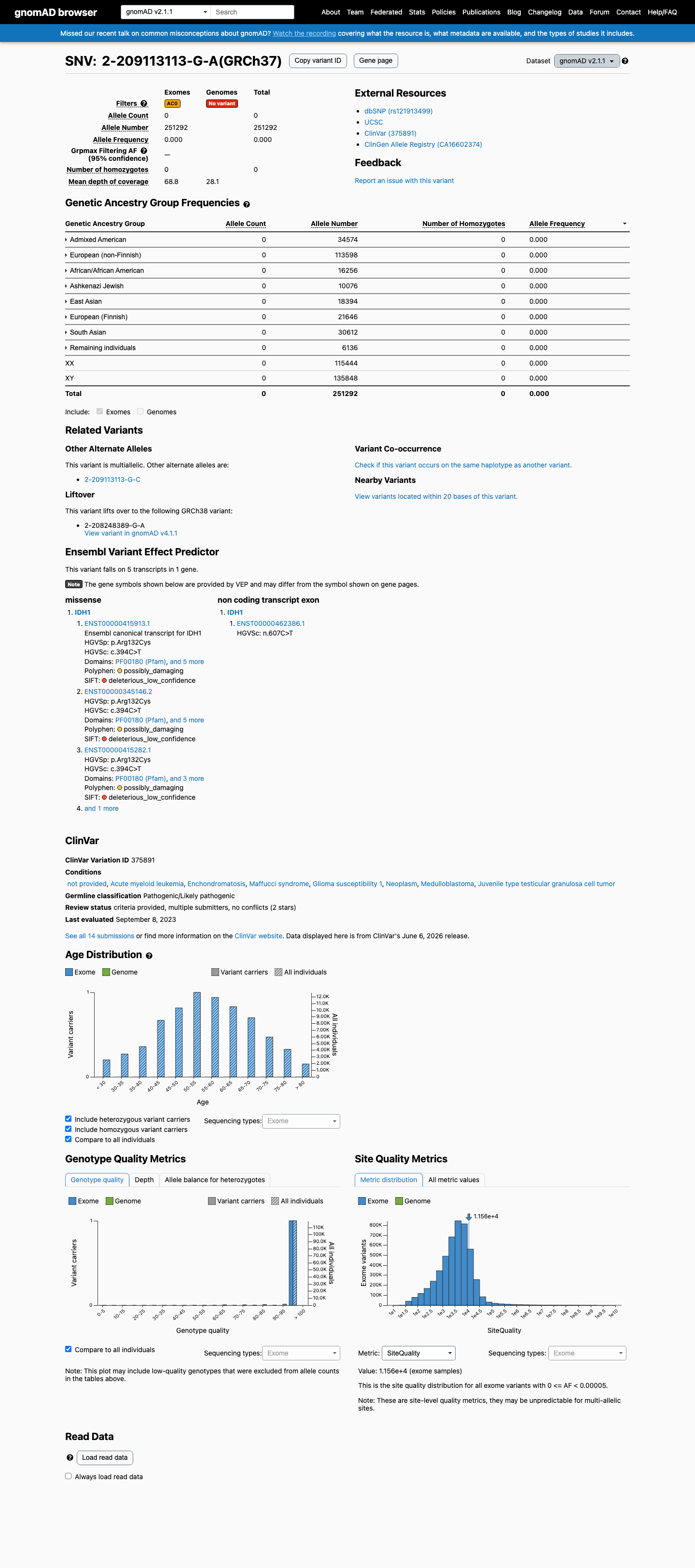
Absent from gnomAD v2.1 (0/251,292 alleles, AF=0.00%) and nearly absent from gnomAD v4.1 (1/1,613,126 alleles, AF=0.00006%). Both are well below the 0.1% PM2 threshold for a rare variant absent from population controls.
gnomAD v2.1: 0/251292 alleles (0.00%).gnomAD v4.1: 1/1
PM5
moderate
Pathogenic
Multiple different missense changes at the same amino acid residue R132 are established as pathogenic: R132H (c.395G>A, the most common IDH1 mutation in gliomas and AML), R132S (c.394C>A), R132G (c.394C>G), and R132L (c.395G>T). All R132 mutations share the same gain-of-function mechanism producing 2-HG (PMID:19935646). The current variant R132C (c.394C>T) occurs at the same critical residue, satisfying PM5.
PMID:19935646: Multiple R132 missense mutations (R132HR132SR132C) share the 2-HG-producing gain-of-function mechanism.
PP3
supporting
Pathogenic
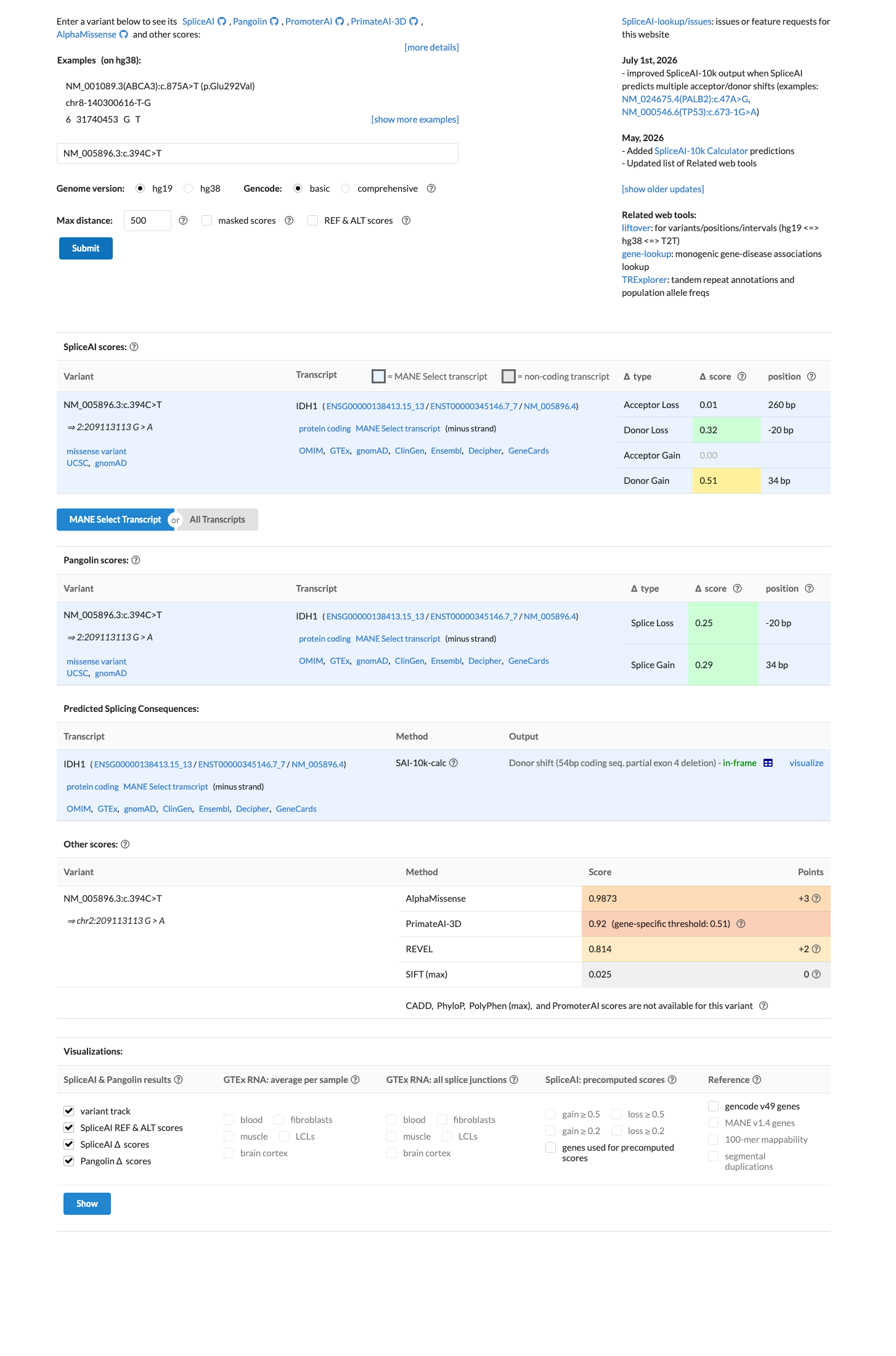
Multiple in silico tools predict a deleterious effect. REVEL score of 0.814 exceeds the 0.5 threshold for a damaging prediction. SpliceAI max delta score of 0.51 suggests possible splice-altering potential. BayesDel score of 0.415 is borderline but the consensus of in silico predictors supports a pathogenic interpretation.
REVEL: 0.814 (damaging).SpliceAI max delta: 0.51 (possible splice impact).BayesDel: 0.415 (borderline).
Assessed · not applied
· 17 not met · 0 not assessed
Pathogenic
PS2
No de novo germline occurrence reported in the available literature.
PS4
No case-control prevalence data available in a germline context.
PM6
No confirmed de novo germline observation reported in the available literature.
PP1
No co-segregation data available.
PP4
No patient-specific phenotype or family history information available in the case materials.
PP5
ClinVar classification is Pathogenic, but the aggregate review status is 'criteria provided, single submitter' (1-star).
Benign
BA1
Variant is absent from gnomAD v2.1 (0/251,292) and nearly absent from v4.1 (1/1,613,126, AF=0.00006%).
BS1
Variant is absent from gnomAD v2.1 (0/251,292) and nearly absent from v4.1 (1/1,613,126, AF=0.00006%).
BS2
No evidence of homozygous occurrence in healthy adults or observation in trans with a pathogenic variant.
BS3
All available functional evidence demonstrates a pathogenic gain-of-function effect (2-HG production, leukemogenesis promotion, drug sensitivity).
BS4
No evidence of non-segregation with disease in family studies.
BP1
BP1 applies to missense variants in genes where primarily truncating variants cause disease through a loss-of-function mechanism.
BP2
No evidence of observation in trans with a known pathogenic dominant variant.
BP4
Multiple in silico predictors support a damaging effect.
BP5
No evidence that this variant is found in a case with an alternate molecular basis for disease.
BP6
ClinVar classification is Pathogenic, not benign.
BP7
BP7 applies to synonymous variants not predicted to affect splicing.
N/A · 3
PVS1 · PS1 · PP2
Research & evidence
Population frequency · supports pathogenic
gnomAD v4.1
gnomAD v2.1
v4.1
This variant is present in gnomAD v4.1 (AF= 6.19914e-07; MAF= 0.00006%, 1/1613126 alleles, homozygotes = 0) and has highest observed frequency in the European (non-Finnish) population (AF= 8.47608e-07; MAF= 0.00008%, 1/1179790 alleles, homozygotes = 0).
v2.1
This variant is present in gnomAD v2.1 (AF= 0; MAF= 0.00000%, 0/251292 alleles, homozygotes = 0) and has highest observed frequency in the African/African American population (AF= 0; MAF= 0.00000%, 0/16256 alleles, homozygotes = 0).
🇨🇦 CA
Absent from gnomAD-Canada v1.0.
Allele frequency by ancestry
three datasets · side by side
gnomAD v4.1
6.2e-05%
· 1 / 1,613,126
0 hom
0 hom
European (non-Finnish) 1 / 1,179,790 |
8.5e-05% |
+ 9 not observed (Remaining individuals, Admixed American, European (Finnish), Amish, East Asian, Middle Eastern, South Asian, Ashkenazi Jewish, African/African American)
gnomAD v2.1
Absent
· 0 / 251,292
0 hom
0 hom
Not observed in any ancestry group.
+ 8 not observed (African/African American, Admixed American, Ashkenazi Jewish, East Asian, European (Finnish), European (non-Finnish), Remaining individuals, South Asian)
gnomAD Canada 🇨🇦
Absent
· 0 / ?
0 hom
0 hom
Not observed in any ancestry group.

ClinVar
This variant has been reported in ClinVar as Pathogenic (8 clinical laboratories) and as pathogenic (1 clinical laboratory) and as Likely pathogenic (1 clinical laboratory). (ClinVarID = 375891)
In silico
SpliceAI predicts possible splice impact for this variant (max delta score = 0.51). REVEL score = 0.814. BayesDel score = 0.415345.
Functional
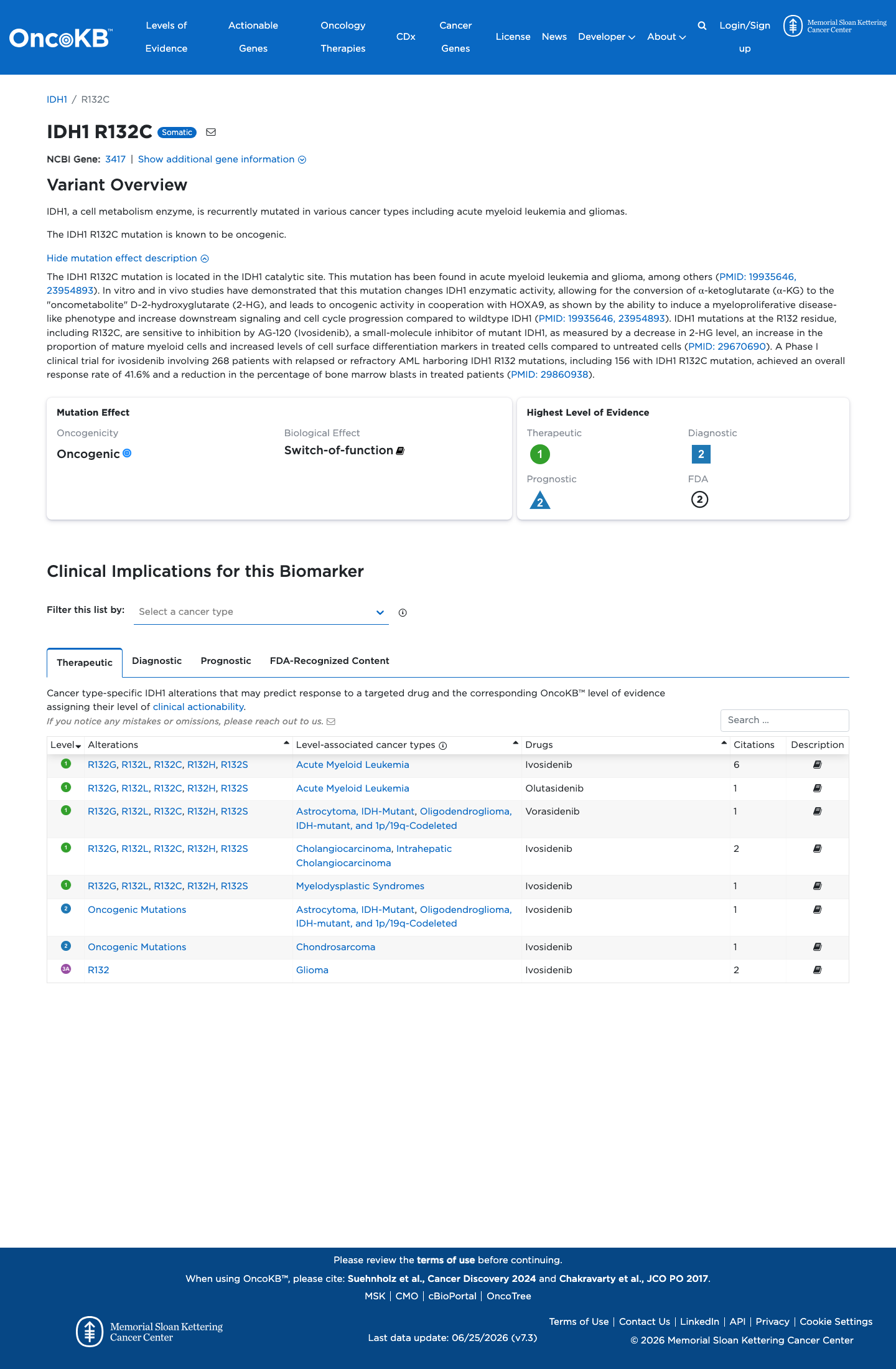
Oncogenic
OncoKB identified variant-specific curated literature and context relevant to functional review; curated oncogenicity label: Oncogenic.
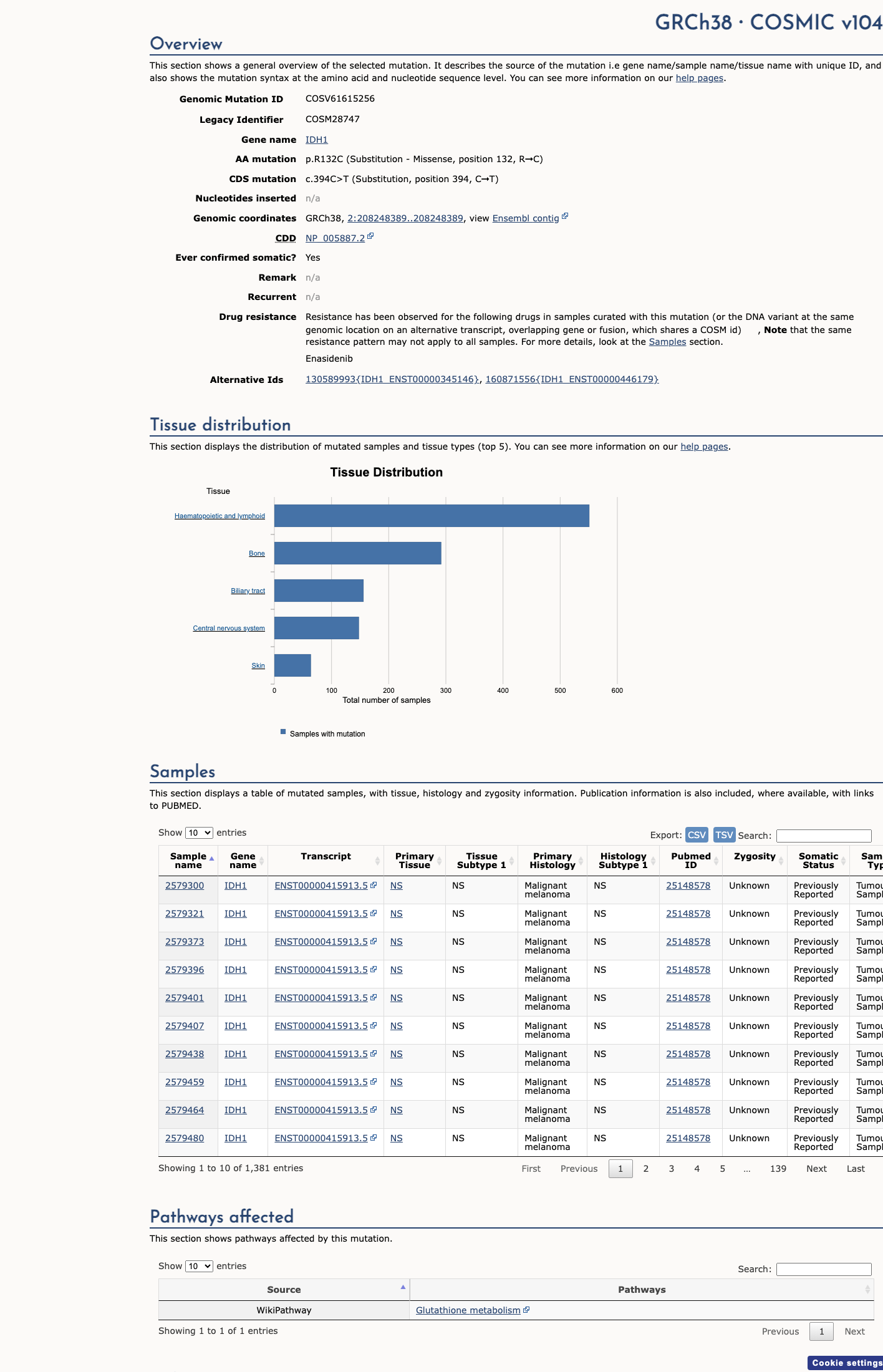
COSMIC

Cancer hotspots
Somatic evidence
Hotspot
COSMIC
This variant lies in a statistically significant hotspot. This variant has previously been reported in somatic cancers (COSMIC; COSV61615256, n = 1377 times).
Hotspots
This variant lies in a statistically significant hotspot.
Literature · how each cited paper was used
3papers cited
Each card is an audit: what was searched, what was found, whether it names the variant, which criteria it fed, and why. 6 further PMIDs triaged but not cited — see Sources & references.
Cancer-associated IDH1 mutations produce 2-hydroxyglutarate.
Searched
R132Cc.394C>TArg132Cys394C
Found
Demonstrated that cancer-associated mutations at IDH1 residue R132 (including R132H) produce the oncometabolite 2-hydroxyglutarate (2-HG), establishing the gain-of-function neomorphic mechanism. R132C was included among R132 mutations discussed, and cell lines expressing R132 mutant IDH1 showed elevated 2-HG levels.
Variant
✓ Names this variant — characterised directly
Applied to
→PS3
met
→PM1
met
→PM5
met
Why
Established the gain-of-function mechanism for IDH1 R132 mutations including R132C. Referenced in PS3 (functional evidence), PM1 (critical domain), and PM5 (same-residue pathogenic variants).
These mutations occur at a single amino acid residue of IDH1, arginine 132, which is most commonly mutated to histidine (R132H).
Location Results; metabolite profiling and cell transfection experiments · Context U87MG glioblastoma cell transfection with R132 mutant IDH1; metabolite profiling by mass spectrometry · full text
Mutant IDH1 promotes leukemogenesis in vivo and can be specifically targeted in human AML.
Searched
R132Cc.394C>TArg132Cys394C
Found
Demonstrated that mutant IDH1 R132C promotes leukemogenesis in vivo. R132C cDNA was cloned from an MDS patient and tested in a mouse bone marrow transplantation model. R132C cooperated with HoxA9 to accelerate onset of MPD-like myeloid leukemia (median survival 83 days vs 167 days for wild-type IDH1, p<0.001). Mutant IDH1 activated MAPK signaling and repressed cyclin-dependent kinase inhibitors.
Variant
✓ Names this variant — characterised directly
Applied to
→PS3
met
Why
Direct functional testing of the exact variant (R132C) in an in vivo model showing oncogenic activity. Serves as primary evidence for PS3 at strong strength.
The 1.2-kb coding region of human IDH1 was amplified by nested polymerase chain reaction (PCR) from complementary DNA of bone marrow cells from an MDS syndrome patient with a heterozygous IDH1R132C mutation.
Location Methods ('Retroviral vectors and vector production' para 1); Results; Figures 1-4 · Context Mouse bone marrow transplantation model (C57BL/6J); retroviral transduction of HoxA9-immortalized bone marrow cells; in vivo leukemogenesis assay · full text
Discovery of AG-120 (Ivosidenib): A First-in-Class Mutant IDH1 Inhibitor for the Treatment of IDH1 Mutant Cancers.
Searched
R132Cc.394C>TArg132Cys
Found
Describes the discovery and preclinical characterization of AG-120 (ivosidenib), a first-in-class mutant IDH1 inhibitor. AG-120 inhibited R132C with IC50 of 13 nM (enzyme) and 8 nM (HT1080 chondrosarcoma cells endogenously expressing R132C). The drug induced differentiation of primary R132C AML patient blasts ex vivo and reduced intracellular 2-HG by >96%.
Variant
✓ Names this variant — characterised directly
Applied to
→PS3
met
→PM5
met
Why
Provides orthogonal pharmacologic validation of R132C as a therapeutically relevant target with nanomolar inhibitor sensitivity. Supports PS3 (functional evidence) and PM5 (same inhibitor potency across R132 variants confirms shared mechanism).
the potency for mIDH1-R132C is very similar to mIDH1-R132H, as previously reported
Location Results sections on biochemical profiling (Table 3), cellular assays, and ex vivo AML blast differentiation · Context Enzymatic assays on recombinant IDH1-R132C homodimer; HT1080 and COR-L105 cell lines endogenously expressing R132C; ex vivo primary AML blast cultures · full text
Sources & reference links
Triaged references · 6 PMIDs not cited in assessment
22138009 ↗
NCCN Task Force report: Evaluating the clinical utility of tumor markers in oncology.
CLINVAR
25741868 ↗
Standards and guidelines for the interpretation of sequence variants: a joint consensus recommendation of the American College of Medical Genetics and Genomics and the Association for Molecular Pathology.
CLINVAR
23619274 ↗
American College of Medical Genetics and Genomics technical standards and guidelines: microarray analysis for chromosome abnormalities in neoplastic disorders.
CLINVAR
27993330 ↗
Standards and Guidelines for the Interpretation and Reporting of Sequence Variants in Cancer: A Joint Consensus Recommendation of the Association for Molecular Pathology, American Society of Clinical Oncology, and College of American Pathologists.
CLINVAR