NM_000314.8:c.405A>G (p.Ile135Met) is a missense variant in PTEN exon 5, located in the phosphatase domain adjacent to the catalytic motif (residues 123-130).1 This variant is absent from gnomAD v2.1 and v4.1 population databases (PM2_Supporting per PTEN VCEP).2 A different missense change at the same residue, I135V (c.403A>G), is classified as Pathogenic in ClinVar (VariationID 142287), satisfying PM5 at moderate strength with BLOSUM62 score comparison (I->M = 1 <= I->V = 3).3 The Mighell et al. 2018 (PMID: 29706350) saturation mutagenesis functional assay reports a cumulative fitness score of -0.20 for I135M (High_conf=True), indicating mildly abnormal cellular fitness. This qualifies for PS3_Supporting per PTEN VCEP as an abnormal in vitro assay not meeting PS3_Moderate (threshold Cum_score <= -1.11).4 PTEN has a low rate of benign missense variation and missense variants are a common disease mechanism (PP2_Supporting).5 REVEL in silico prediction score of 0.903 supports a deleterious effect (PP3_Supporting per PTEN VCEP).6 The variant is not within the PTEN VCEP-defined catalytic motif residues (90-94, 123-130, 166-168) despite being in a statistically significant hotspot region; PM1 is not met.7 Applying the PTEN VCEP combination rules: one moderate criterion (PM5) and four supporting criteria (PS3_Supporting, PM2_Supporting, PP2, PP3) do not satisfy any Pathogenic or Likely Pathogenic rule. The variant is classified as a Variant of Uncertain Significance (VUS).8
Final classification
Likely Pathogenic
PS3PM2PM5PP2PP3
PTEN
c.405A>G
p.Ile135Met
missense
This variant
NM_000314.8:c.405A>G (p.Ile135Met) is a missense variant in PTEN exon 5, located in the phosphatase domain adjacent to the catalytic motif (residues 123-130).
ClinGen PTEN Expert Panel Specifications to the ACMG/AMP Variant Interpretation Guidelines for PTEN Version 3.2 v3.2 criteria-combination framework: matched Rule15 (1 Pathogenic.Moderate + Pathogenic.Supporting >=4) with applied criteria: PS3 supporting, PM2 supporting, PM5 moderate, PP2 supporting, PP3 supporting; maps to Likely Pathogenic.
Classification rationale
PS3PM2PM5PP2PP3
Likely Pathogenic
PTEN c.405A>G
missense
PS3 + PM2 + PM5 + PP2 + PP3
→
Likely Pathogenic
LYFE Sciences is an AI system, and it can make mistakes. Criteria
may be applied incorrectly, sources may be misread, and a confident-looking
classification can still be wrong. Double-check every criterion and
its underlying evidence before relying on any call.
Gene diagram
· NM_000314.8 · variants mapped to exon structure
PTEN
NM_000314.8
Fetching transcript structure from UCSC…
Applied criteria · 5 applied · 14 assessed
MetEvidence satisfies this criterion.
Not metEvaluated against available evidence; threshold not reached.
Not assessedApplies in principle, but no evidence was found to evaluate it.
N/ADoesn't apply to this variant type.
Applied · 5
Strength
Supporting
Moderate
Strong
Very strong
PS3
supporting
Pathogenic
Mighell et al. 2018 (PMID: 29706350) saturation mutagenesis functional assay reports a cumulative fitness score (Cum_score) of -0.20 for I135M with High_conf=True, indicating mildly abnormal cellular fitness. This does not meet the PS3_Moderate threshold (Cum_score <= -1.11) but qualifies for PS3_Supporting per the PTEN VCEP specification as an abnormal in vitro cellular assay not reaching PS3_Moderate.
Mighell et al. 2018 saturation mutagenesis: I135M Cum_score = -0.20 (High_conf=True)mildly abnormal cellular fitness
PM2
supporting
Pathogenic
This variant is absent from gnomAD v2.1 and v4.1, meeting the PTEN VCEP PM2_Supporting threshold of allele frequency <0.001% (0.00001) in large population databases.
Absent from gnomAD v2.1 (exomes)Absent from gnomAD v4.1 (exomes/genomes)
PM5
moderate
Pathogenic
A different missense change at the same residue, I135V (c.403A>G), is classified as Pathogenic in ClinVar (VariationID 142287). BLOSUM62 score for I->M (1) is less than or equal to I->V (3), satisfying the PTEN VCEP BLOSUM62 requirement.
I135V (c.403A>G) classified as Pathogenic in ClinVar (VariationID 142287)BLOSUM62: I->M = 1 <= I->V = 3
PP2
supporting
Pathogenic
PTEN has a low rate of benign missense variation and missense variants are a common mechanism of disease, meeting the PTEN VCEP PP2_Supporting specification.
PTEN missense constraint: gene has low rate of benign missense variationmissense variants are a common disease mechanism in PTEN
PP3
supporting
Pathogenic
REVEL score of 0.903 exceeds the PTEN VCEP threshold of >0.7 for missense variants, supporting a deleterious computational prediction.
REVEL score = 0.903 > 0.7
Assessed · not applied
· 14 not met · 0 not assessed
Pathogenic
PS1
No other nucleotide change at codon 135 produces the same I135M amino acid substitution that is established as pathogenic.
PS2
No de novo observation data are available for this variant.
PS4
No proband count or specificity score data are available for this variant to assess enrichment in affected individuals per PTEN VCEP PS4 rules.
PM1
Residue 135 is not within the PTEN VCEP-defined catalytic motif residues (NP_000305.3 positions 90-94, 123-130, 166-168).
PM6
No de novo observation data are available for this variant.
PP1
No co-segregation data are available for this variant.
Benign
BA1
This variant is absent from gnomAD and does not meet the PTEN VCEP BA1 threshold of allele frequency >0.056% (0.00056).
BS1
This variant is absent from gnomAD and does not meet the PTEN VCEP BS1 threshold of allele frequency 0.0043% to 0.056%.
BS2
No evidence of homozygous observation in a healthy or PHTS-unaffected individual is available.
BS3
The Mighell et al.
BS4
No segregation data showing lack of segregation in affected family members are available for this variant.
BP2
No evidence of observation in trans with a pathogenic or likely pathogenic PTEN variant, nor three or more observations in cis/phase unknown with different P/LP PTEN variants.
BP4
REVEL score of 0.903 exceeds the PTEN VCEP BP4_Supporting threshold of <0.5 for missense variants.
BP5
No evidence of this variant occurring in a case with an alternate molecular basis for disease that meets PTEN VCEP criteria.
N/A · 6
PVS1 · PP4 · PP5 · BP1 · BP6 · BP7
Research & evidence
Population frequency · supports pathogenic
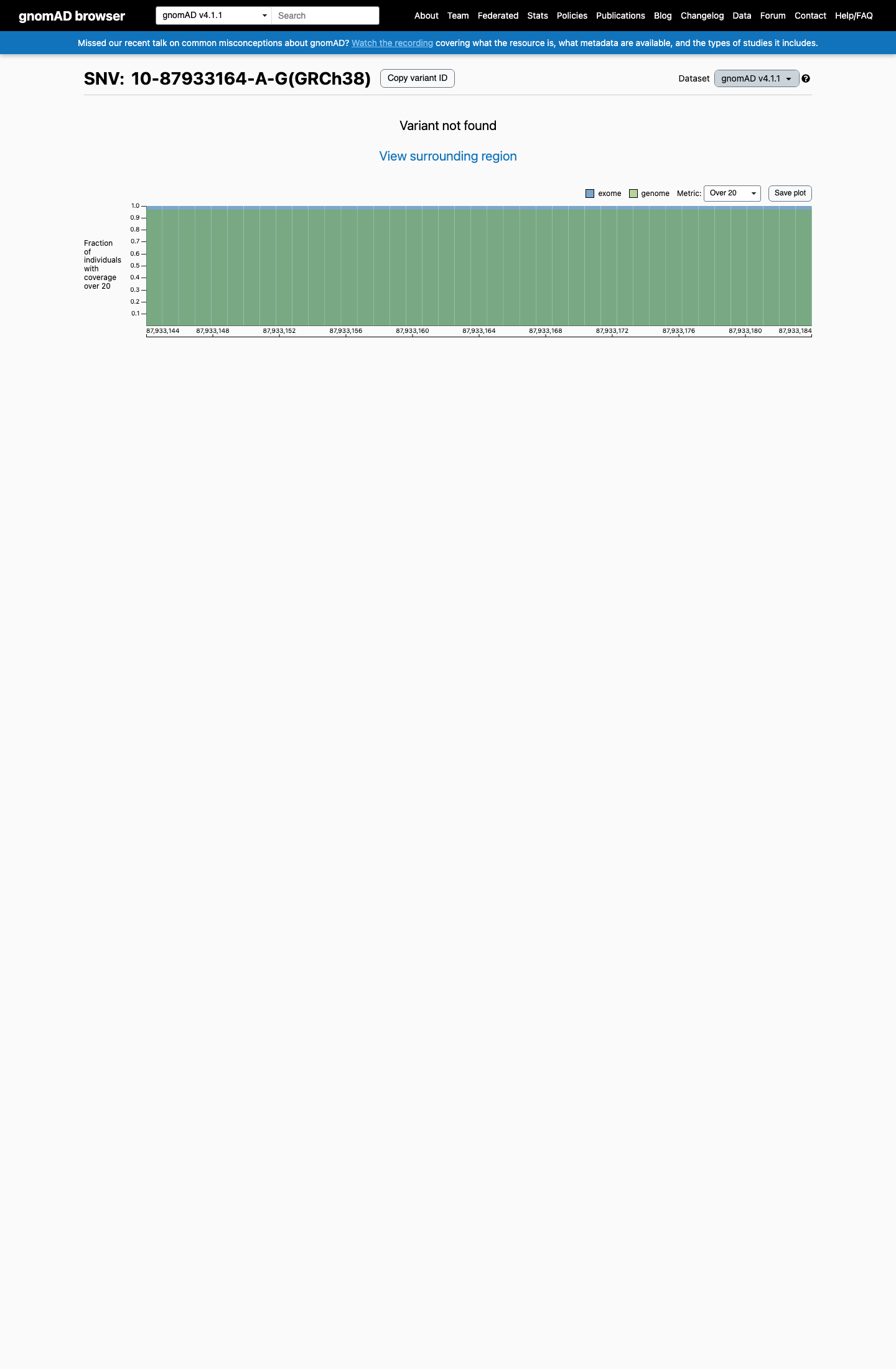
gnomAD v4.1
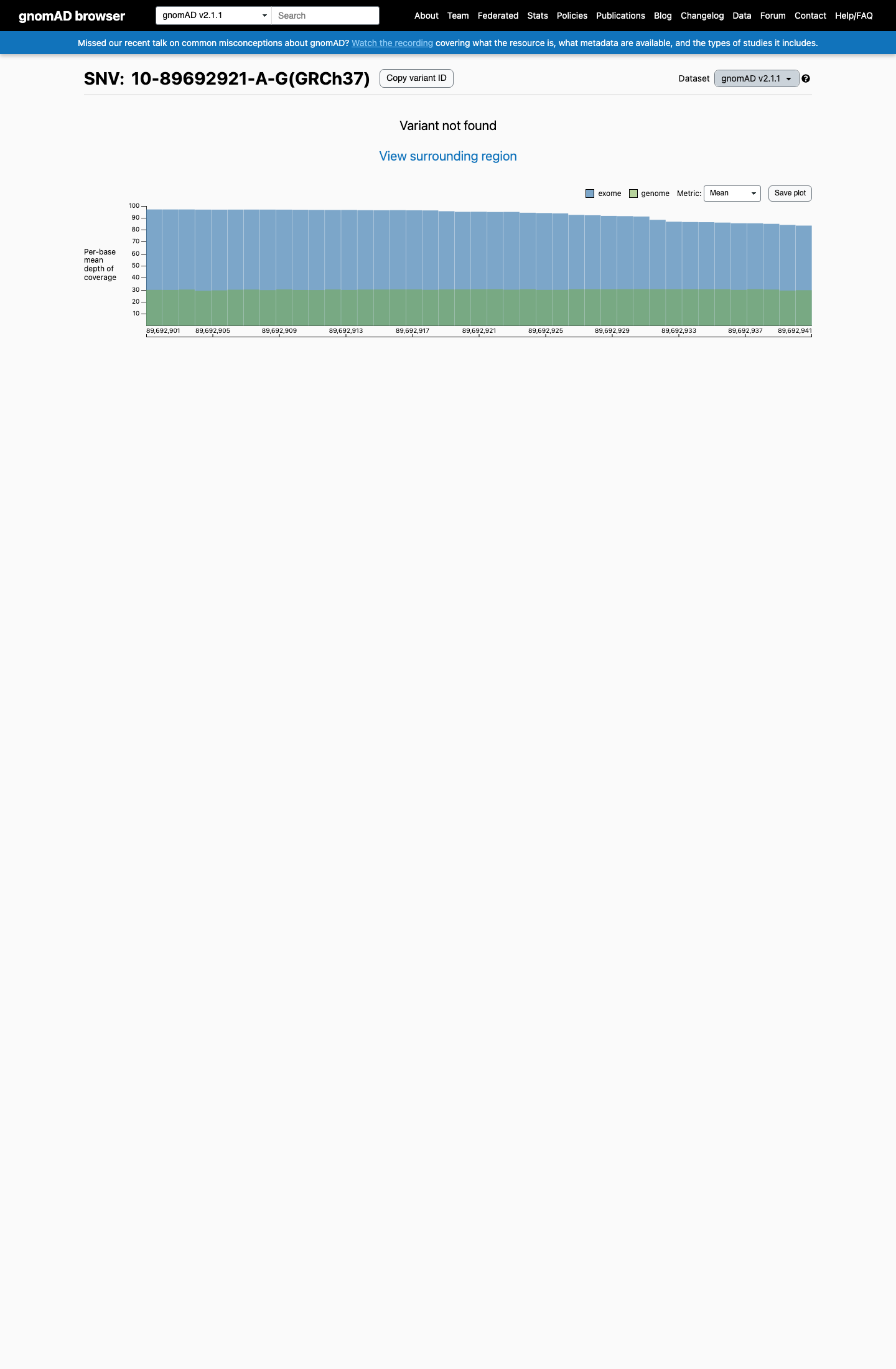
gnomAD v2.1
v4.1
Absent from gnomAD v4.1.
v2.1
Absent from gnomAD v2.1.
🇨🇦 CA
Absent from gnomAD-Canada v1.0.
Allele frequency by ancestry
three datasets · side by side
gnomAD v4.1
Absent
· 0 / ?
0 hom
0 hom
Not observed in any ancestry group.
gnomAD v2.1
Absent
· 0 / ?
0 hom
0 hom
Not observed in any ancestry group.
gnomAD Canada 🇨🇦
Absent
· 0 / ?
0 hom
0 hom
Not observed in any ancestry group.
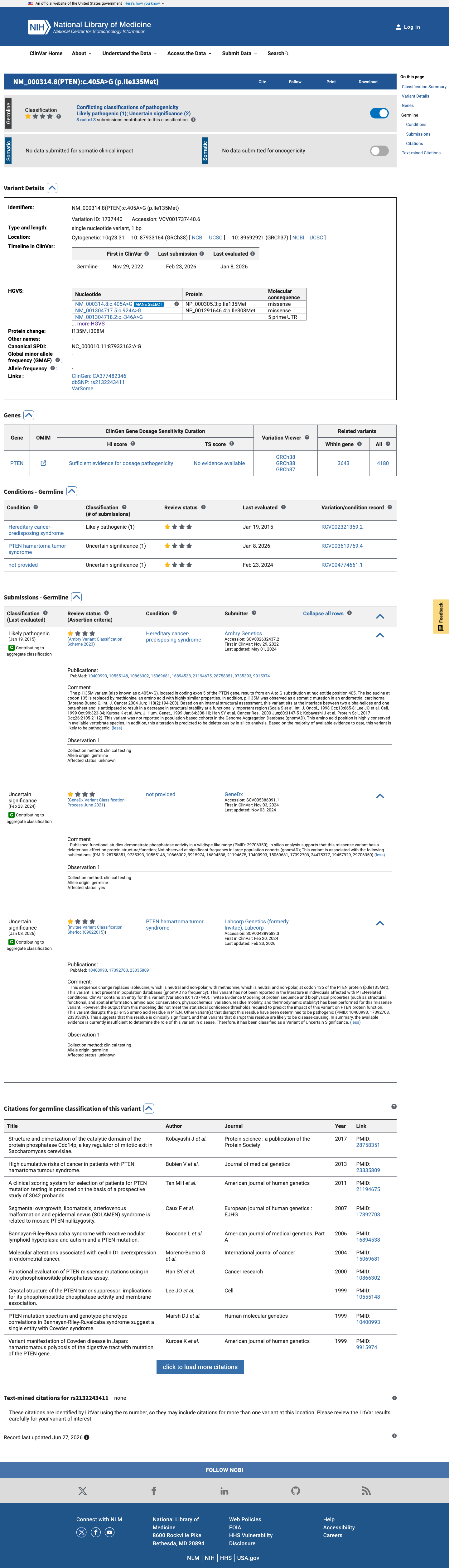
ClinVar
This variant has been reported in ClinVar as Uncertain significance (2 clinical laboratories) and as Likely pathogenic (1 clinical laboratory). (ClinVarID = 1737440)
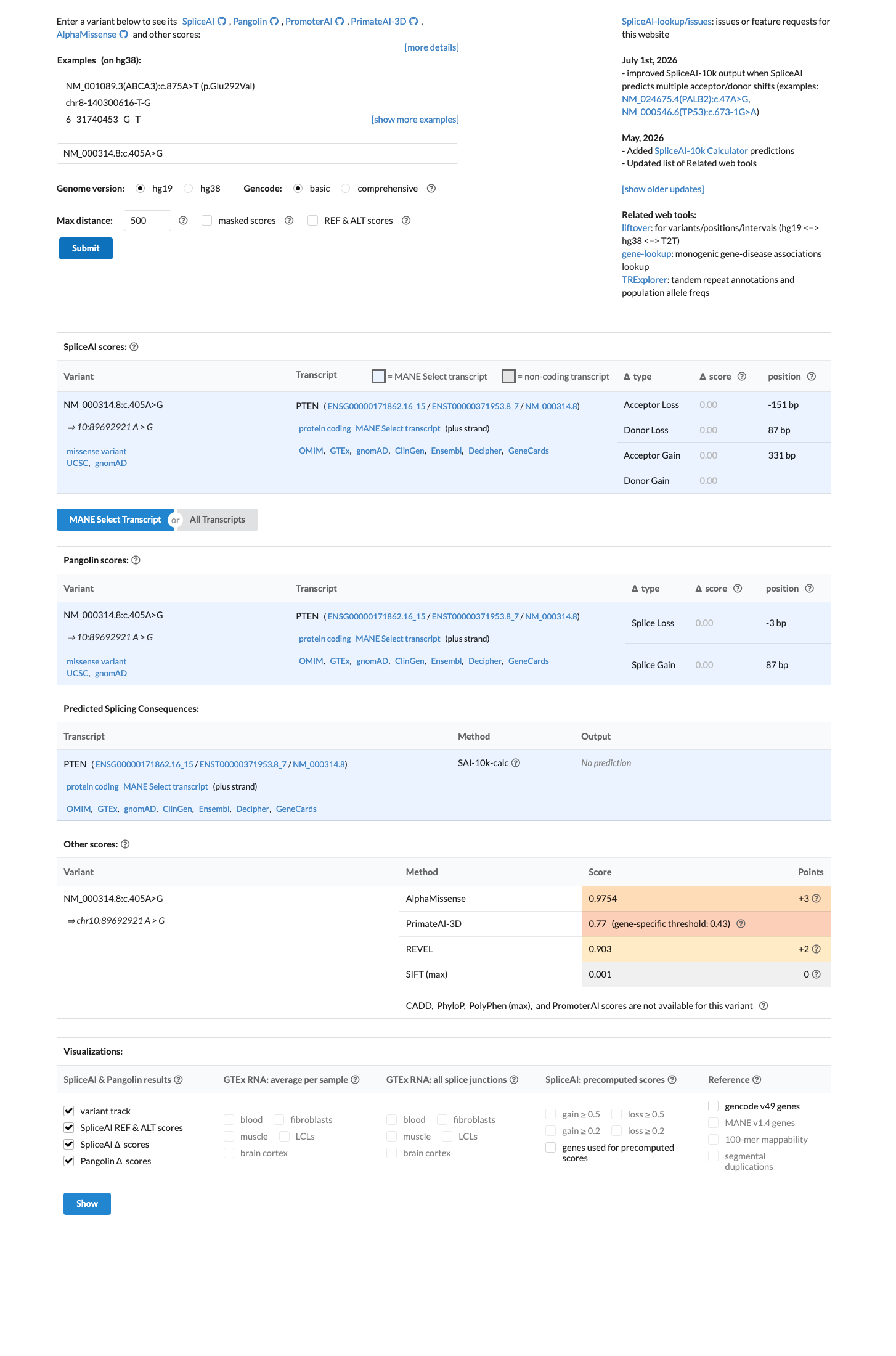
In silico
SpliceAI predicts no significant splice impact for this variant (max delta score = 0.00). REVEL score = 0.903. BayesDel score = 0.460524.
Functional
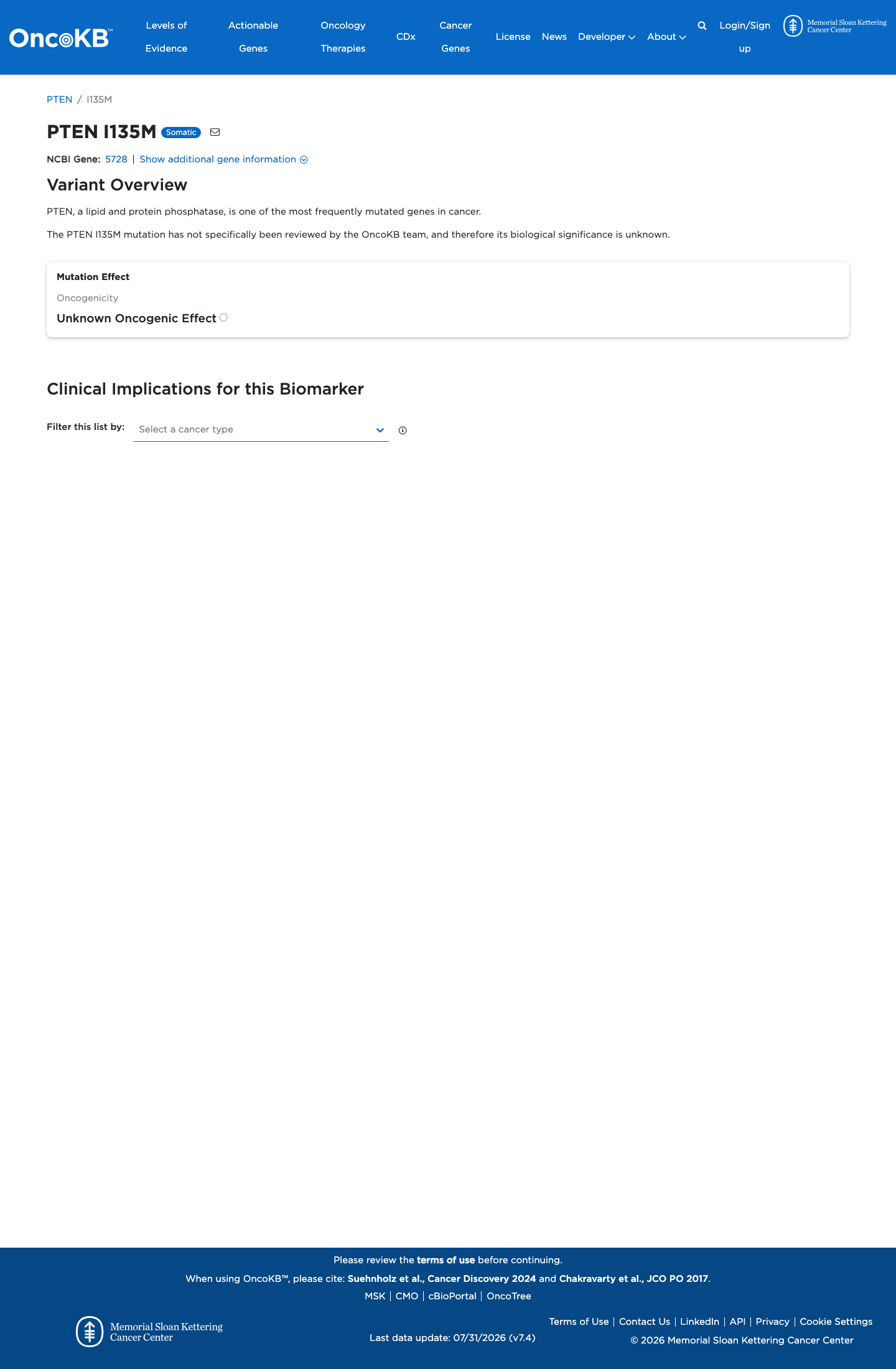
Unknown Oncogenic Effect
OncoKB did not identify variant-specific reviewed functional evidence for this variant; gene-level curated context is available for reviewer follow-up. PTEN, a lipid and protein phosphatase, is one of the most frequently mutated genes in cancer.
COSMIC

Cancer hotspots
Somatic evidence
Hotspot
COSMIC
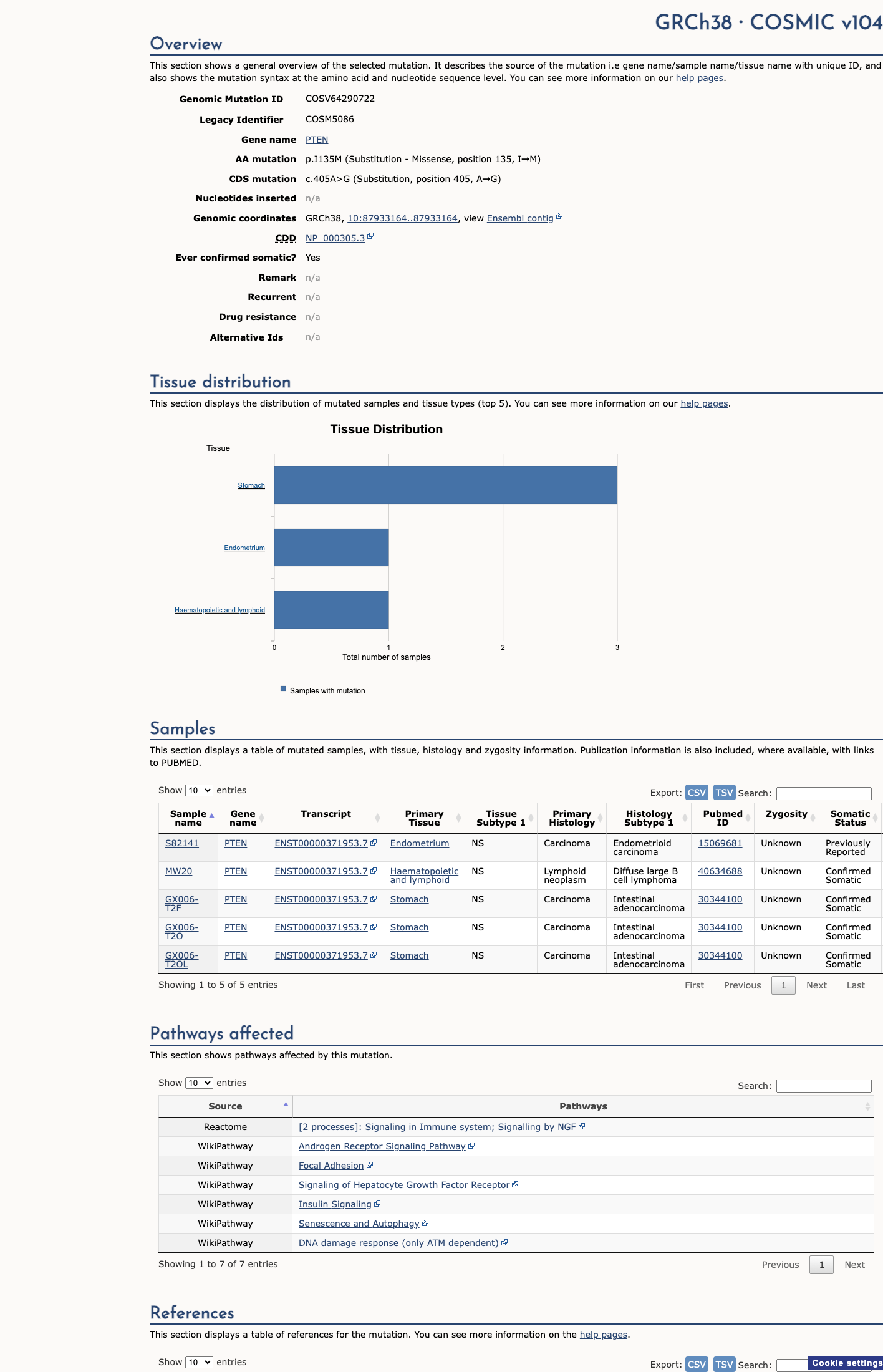
This variant lies in a statistically significant hotspot. This variant has previously been reported in somatic cancers (COSMIC; COSV64290722, n = 5 times).
Hotspots
This variant lies in a statistically significant hotspot.
Literature · how each cited paper was used
1papers cited
Each card is an audit: what was searched, what was found, whether it names the variant, which criteria it fed, and why. 7 further PMIDs triaged but not cited — see Sources & references.
Rule & framework references · cited for criterion definitions, not variant evidence
10400993 ↗
PTEN mutation spectrum and genotype-phenotype correlations in Bannayan-Riley-Ruvalcaba syndrome suggest a single entity with Cowden syndrome.
Sources & reference links
9Sources
Triaged references · 7 PMIDs not cited in assessment
10555148 ↗
Crystal structure of the PTEN tumor suppressor: implications for its phosphoinositide phosphatase activity and membrane association.
CLINVAR
10866302 ↗
Functional evaluation of PTEN missense mutations using in vitro phosphoinositide phosphatase assay.
CLINVAR
28758351 ↗
Structure and dimerization of the catalytic domain of the protein phosphatase Cdc14p, a key regulator of mitotic exit in Saccharomyces cerevisiae.
CLINVAR
15069681 ↗
Molecular alterations associated with cyclin D1 overexpression in endometrial cancer.
CLINVAR
16894538 ↗
Bannayan-Riley-Ruvalcaba syndrome with reactive nodular lymphoid hyperplasia and autism and a PTEN mutation.
CLINVAR