Analysis in progress
Initialising…
0%
complete
This report is still being assembled — sections appear as each stage finishes. It isn't final yet.
NTRK1
Final classification
VUS
NTRK1 c.926C>T · p.Pro309Leu
NTRK1

NM_002529.3:c.926C>T (p.Pro309Leu) in NTRK1 is classified as a Variant of Uncertain Significance (VUS) under the generic ACMG/AMP 2015 framework.

Gene
NTRK1
Transcript
NM_002529.3
HGVS · transcript:coding
NM_002529.3:c.926C>T
Consequence
N/A
GRCh38
chr1:156873708 C>T
GRCh37
chr1:156843500 C>T
Basis gene-specific framework lacked a usable explicit final combination framework, so generic ACMG/AMP 2015 final-combination rules were applied as fallback; applied criteria: PM2 supporting; combination = 1 supporting, which maps to VUS.
gene-specific framework lacked a usable explicit final combination framework, so generic ACMG/AMP 2015 final-combination rules were applied as fallback; applied criteria: PM2 supporting; combination = 1 supporting, which maps to VUS.
Classification rationale
PM2 VUS
NTRK1 c.926C>T

NM_002529.3:c.926C>T (p.Pro309Leu) in NTRK1 is classified as a Variant of Uncertain Significance (VUS) under the generic ACMG/AMP 2015 framework.1 One supporting pathogenic criterion was met: PM2 (absent from gnomAD v2.1 and v4.1 population databases).2 No benign criteria were met. Population absence does not support BA1 (>1%), BS1 (>0.3%), or BS2 (no homozygotes observed). In silico predictions are mixed (REVEL 0.554 damaging; BayesDel 0.172 neutral; SpliceAI 0.00 no splice effect), preventing application of either PP3 or BP4.3 Only one supporting-level criterion (PM2) was met, which is insufficient to reach Likely Pathogenic or Likely Benign under the ACMG/AMP 2015 combination rules. The variant remains as Uncertain Significance.4

PM2 VUS
1 generic_acmg_combination_rules
3 revelbayesdelspliceai ↗
4 generic_acmg_combination_rules
Gene diagram · NM_002529.3 · variants mapped to exon structure
NTRK1 NM_002529.3
Fetching transcript structure from UCSC…
Applied criteria · 1 applied · 16 assessed
Applied · 1
Strength Supporting Moderate Strong Very strong
PM2 supporting Pathogenic
NM_002529.3:c.926C>T is absent from gnomAD v2.1 (0/246,210 alleles) and gnomAD v4.1 (0 alleles). Under generic ACMG/AMP rules, absence from population databases at an allele frequency below 0.1% supports PM2 at supporting strength for a missense variant without additional corroborating evidence.
gnomAD v2.1: 0/246210 alleles (AF=0.000%)gnomAD v4.1: absent
Assessed · not applied
Pathogenic
PS1 PS1 requires the same amino acid change (Pro309Leu) to have been previously established as pathogenic.
PS3 No functional studies have been performed on NM_002529.3:c.926C>T (p.Pro309Leu).
PS4 No case-level evidence was identified for this variant.
PM1 PM1 requires location in a mutational hotspot or well-established critical functional domain without benign variation.
PM5 PM5 requires a different pathogenic missense change at the same amino acid residue (Pro309).
PP2 PP2 requires a low rate of benign missense variation in the gene with missense variants being a common disease mechanism.
PP3 PP3 requires multiple lines of computational evidence supporting a deleterious effect.
PP5 PP5 requires a reputable source to have recently reported the variant as pathogenic, with the evidence not available for independent review.
Benign
BA1 BA1 requires allele frequency >1% in population databases.
BS1 BS1 requires allele frequency >0.3% in population databases.
BS2 BS2 requires observation in a healthy adult in a homozygous or hemizygous state (or in trans with a pathogenic variant for dominant disorders).
BS3 BS3 requires well-established functional studies showing no damaging effect on protein function or splicing.
BP1 BP1 applies when a missense variant occurs in a gene for which only truncating variants are known to cause disease.
BP2 BP2 requires observation in trans with a pathogenic variant for a fully penetrant dominant disorder, or in cis with a pathogenic variant for a recessive disorder.
BP4 BP4 requires multiple lines of computational evidence to suggest no impact on the gene or gene product.
BP6 BP6 requires a reputable source to report the variant as benign with evidence not available for independent review.
N/A · 8 PVS1 · PS2 · PM6 · PP1 · PP4 · BS4 · BP5 · BP7
Research & evidence
Population frequency
gnomAD v4.1 screenshot
gnomAD v4.1
gnomAD v2.1 screenshot
gnomAD v2.1
v4.1
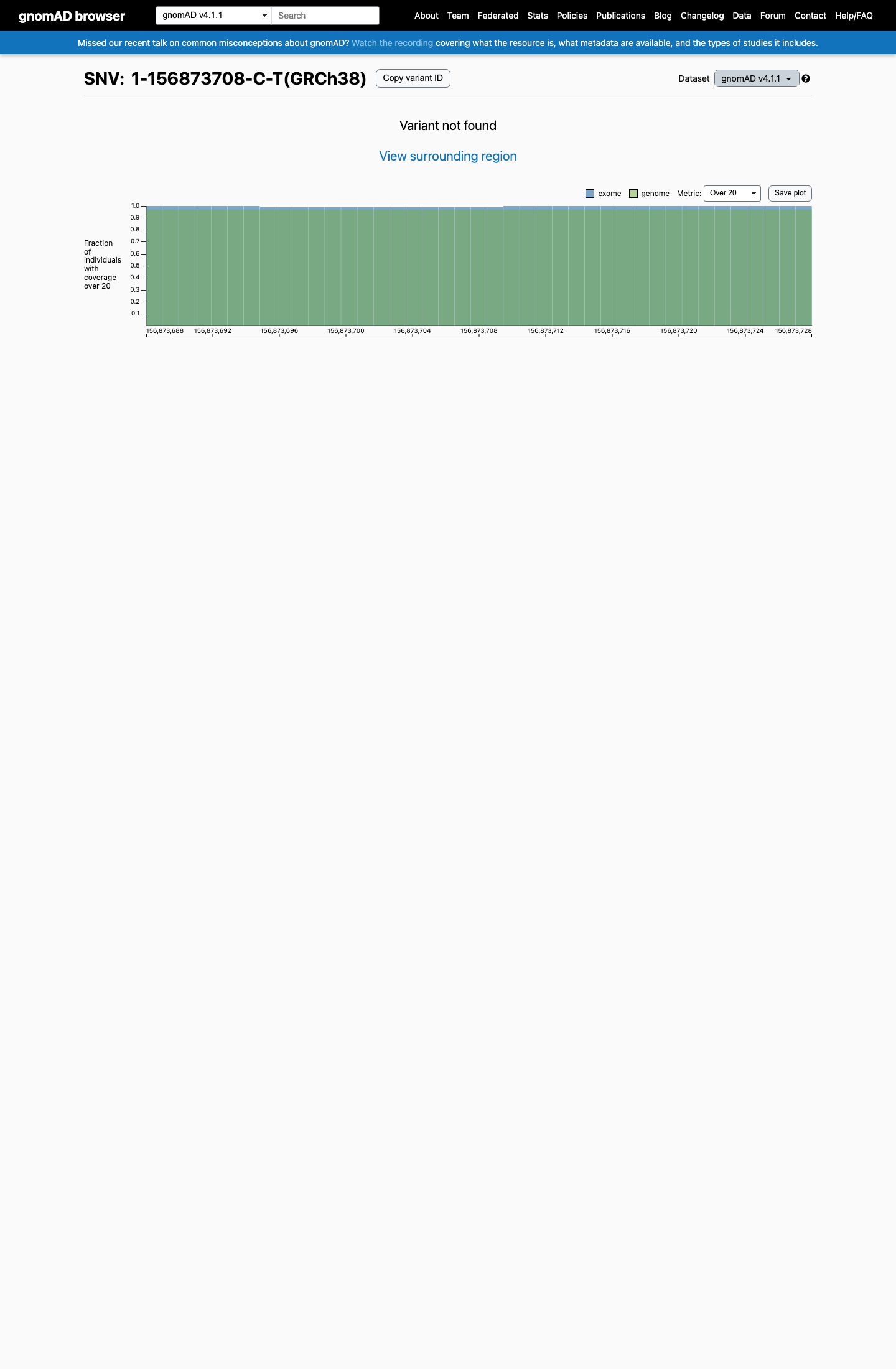
Absent from gnomAD v4.1.
v2.1
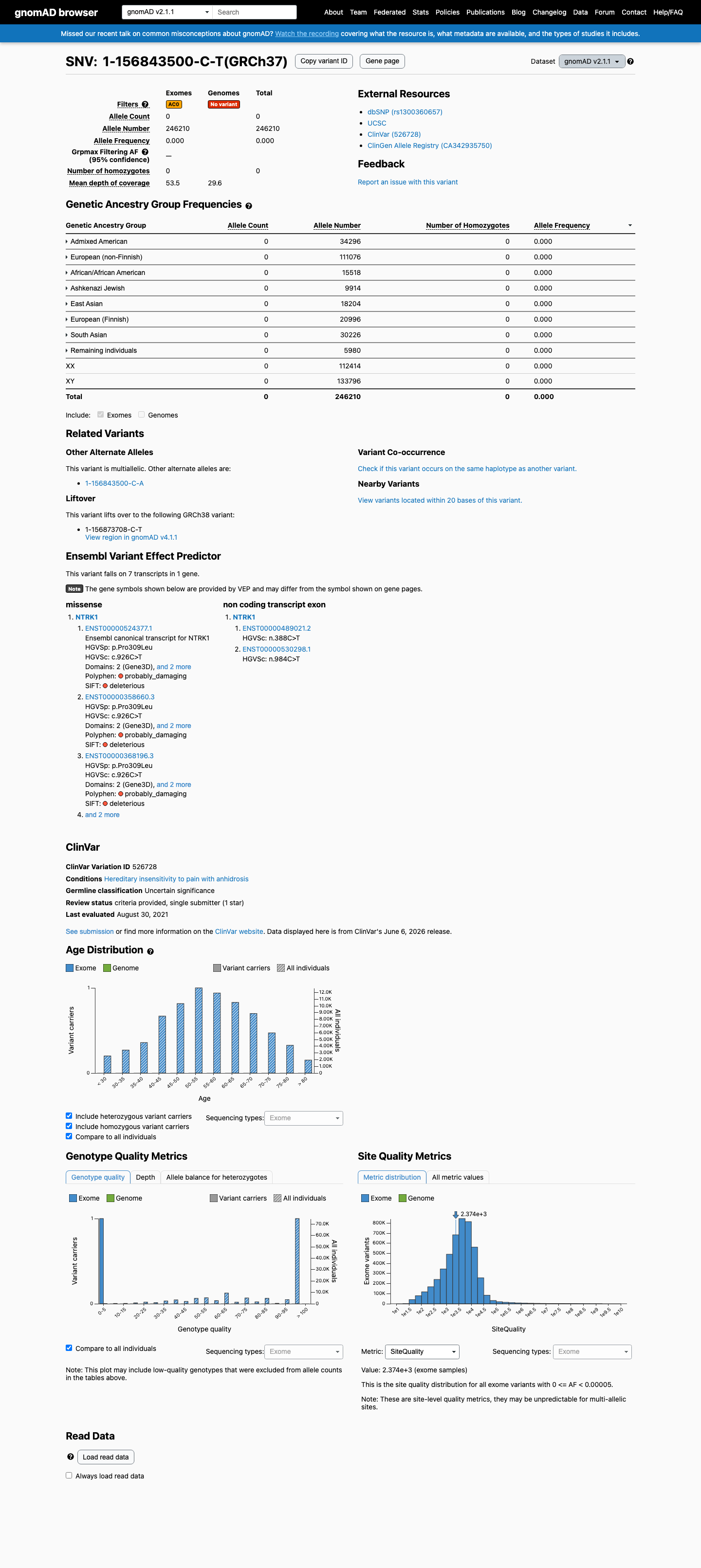
This variant is present in gnomAD v2.1 (AF= 0; MAF= 0.00000%, 0/246210 alleles, homozygotes = 0) and has highest observed frequency in the African/African American population (AF= 0; MAF= 0.00000%, 0/15518 alleles, homozygotes = 0).
🇨🇦 CA
Absent from gnomAD-Canada v1.0.
Allele frequency by ancestry
three datasets · side by side
gnomAD v4.1
Absent · 0 / ?
0 hom
Not observed in any ancestry group.
gnomAD v2.1
Absent · 0 / 246,210
0 hom
Not observed in any ancestry group.
+ 8 not observed (African/African American, Admixed American, Ashkenazi Jewish, East Asian, European (Finnish), European (non-Finnish), Remaining individuals, South Asian)
gnomAD Canada 🇨🇦
Absent · 0 / ?
0 hom
Not observed in any ancestry group.
ClinVar screenshot
ClinVar
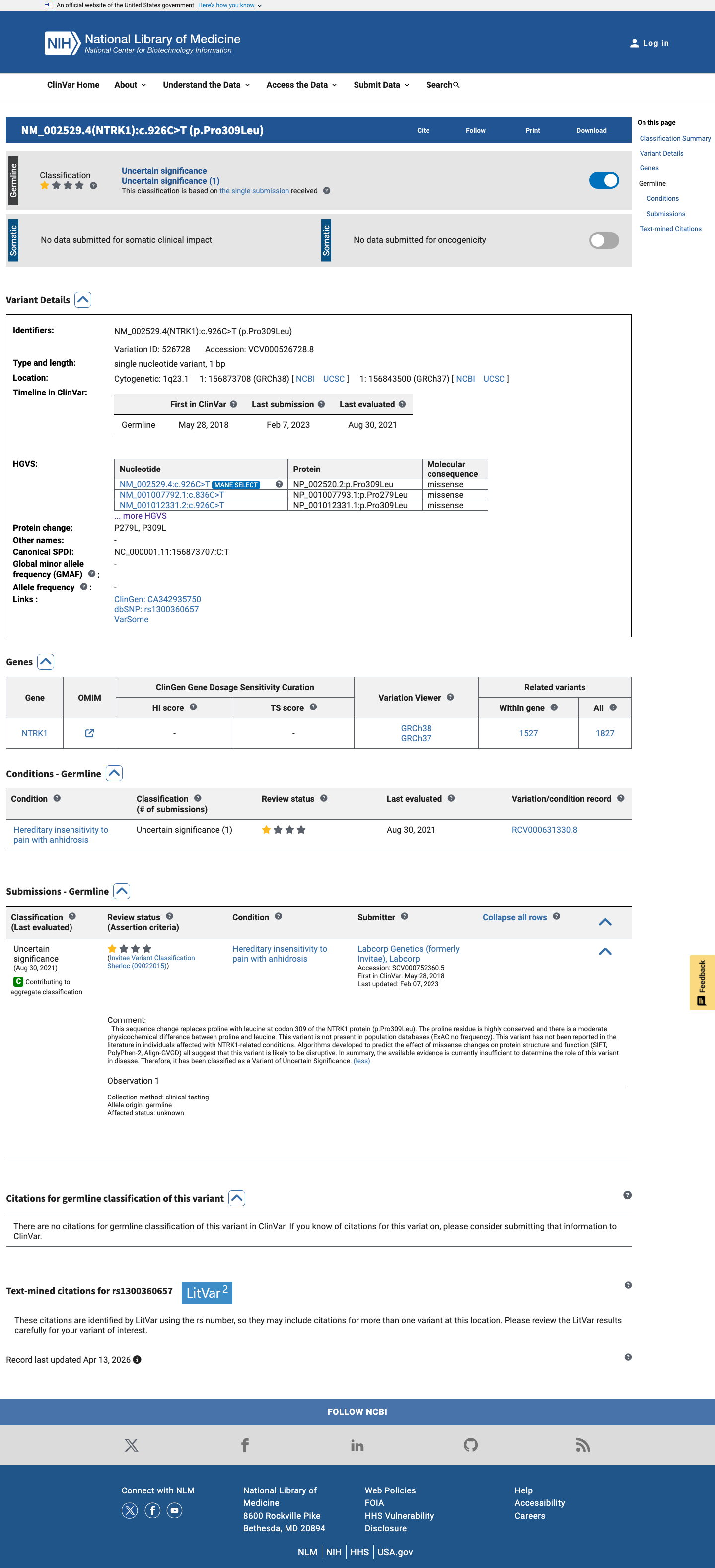
This variant has been reported in ClinVar as Uncertain significance (1 clinical laboratory). (ClinVarID = 526728)
SpliceAI screenshot
In silico
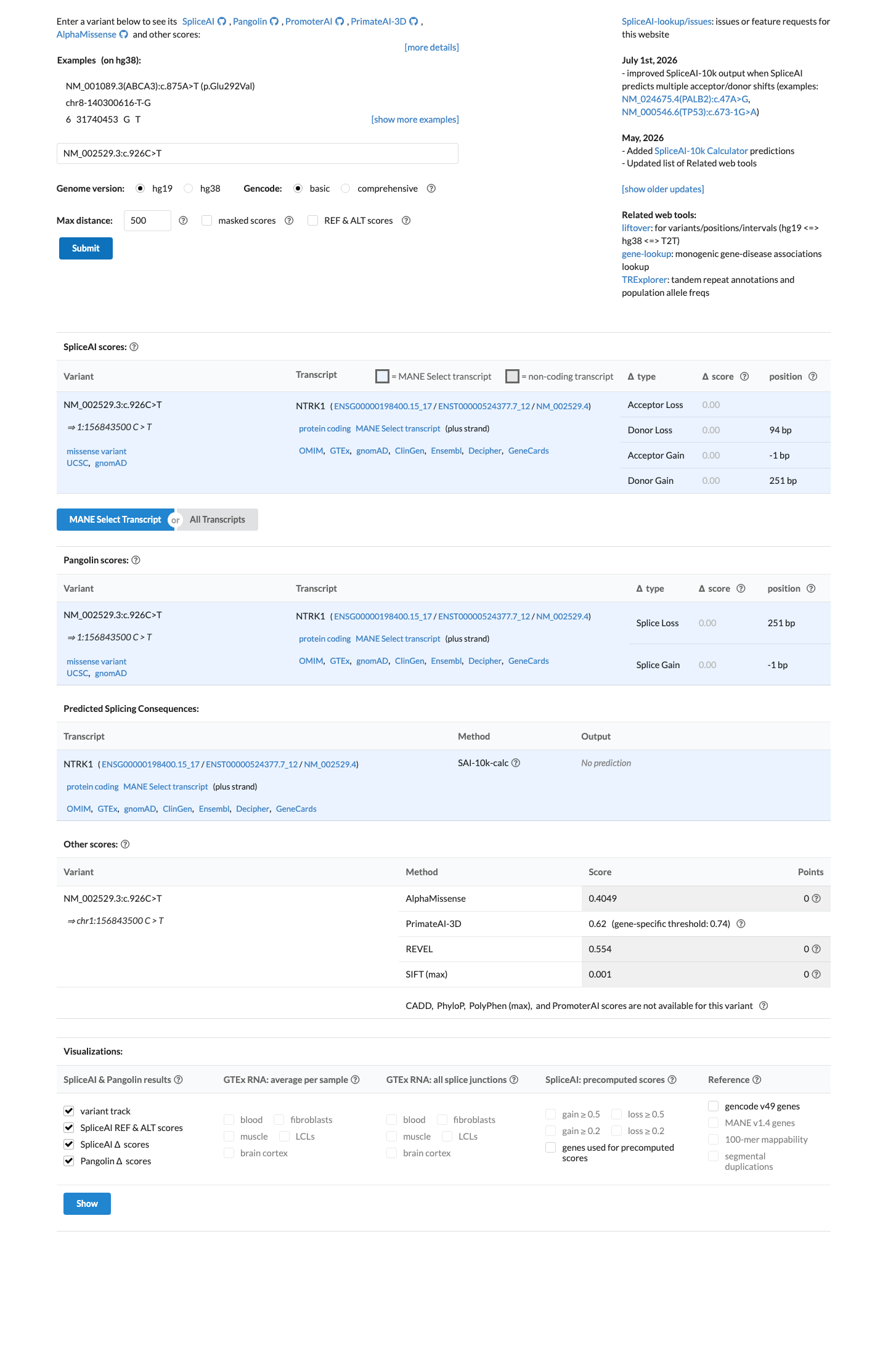
SpliceAI predicts no significant splice impact for this variant (max delta score = 0.00). REVEL score = 0.554. BayesDel score = 0.172357.
Functional / OncoKB screenshot
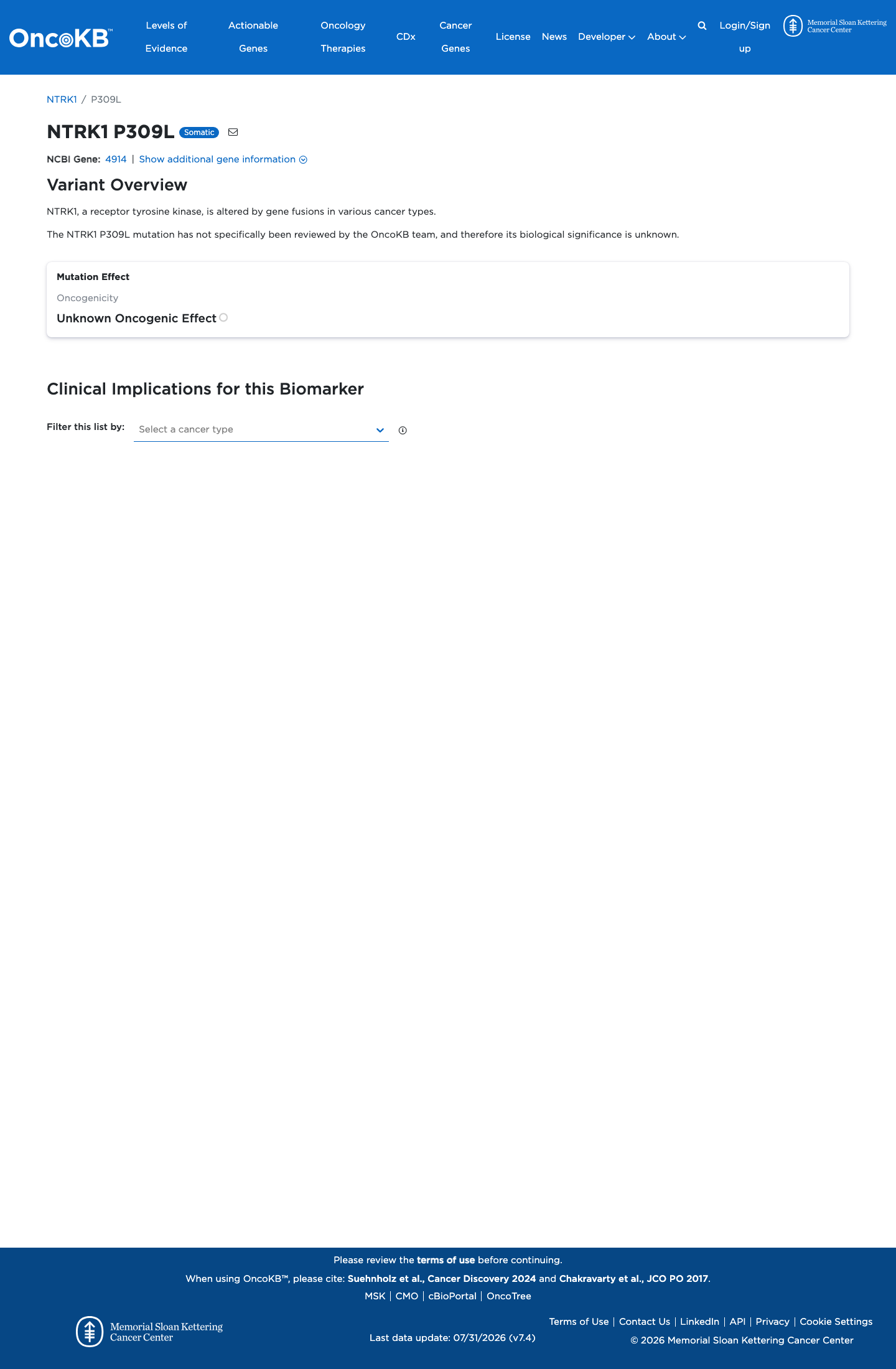
Functional Unknown Oncogenic Effect
OncoKB did not identify variant-specific reviewed functional evidence for this variant; gene-level curated context is available for reviewer follow-up. NTRK1, a receptor tyrosine kinase, is altered by gene fusions in various cancer types.
OncoKB ↗
COSMIC screenshot
COSMIC
Cancer hotspots screenshot
Cancer hotspots
Somatic evidence Not in COSMIC / hotspots
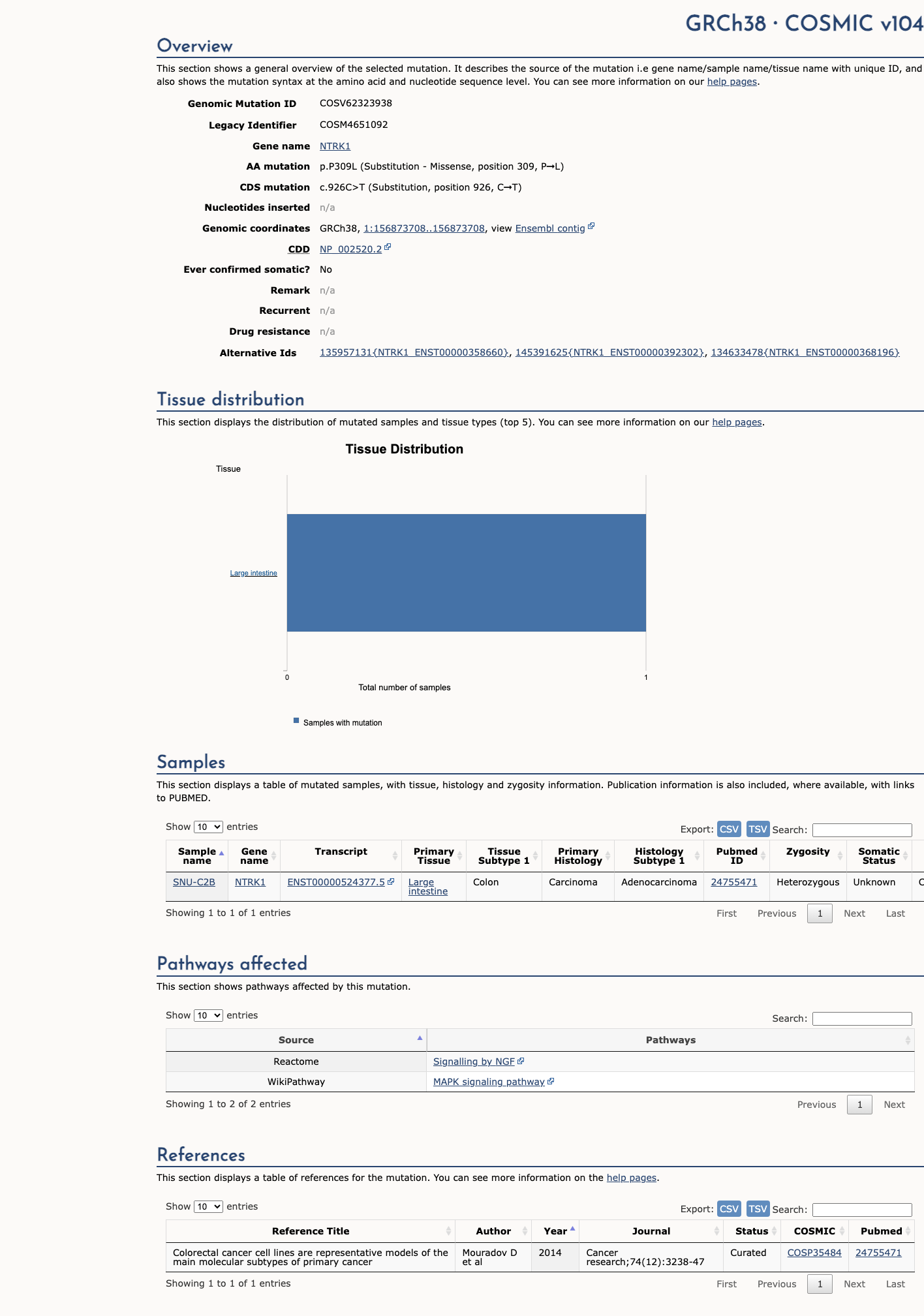
COSMIC
This variant does not lie in a statistically significant hotspot. This variant has previously been reported in somatic cancers (COSMIC; COSV62323938, n = 1 times).
Hotspots
This variant does not lie in a statistically significant hotspot.
Sources & reference links
8Sources
ClinVar
gnomAD v2.1
gnomAD v4.1
gnomAD-Canada
SpliceAI
OncoKB
COSMIC
Cancer hotspots
Triaged references · 2 PMIDs not cited in assessment
20301726 ↗ NTRK1 Congenital Insensitivity to Pain with Anhidrosis. CLINVAR
29419974 ↗ Congenital Insensitivity to Pain Overview. CLINVAR