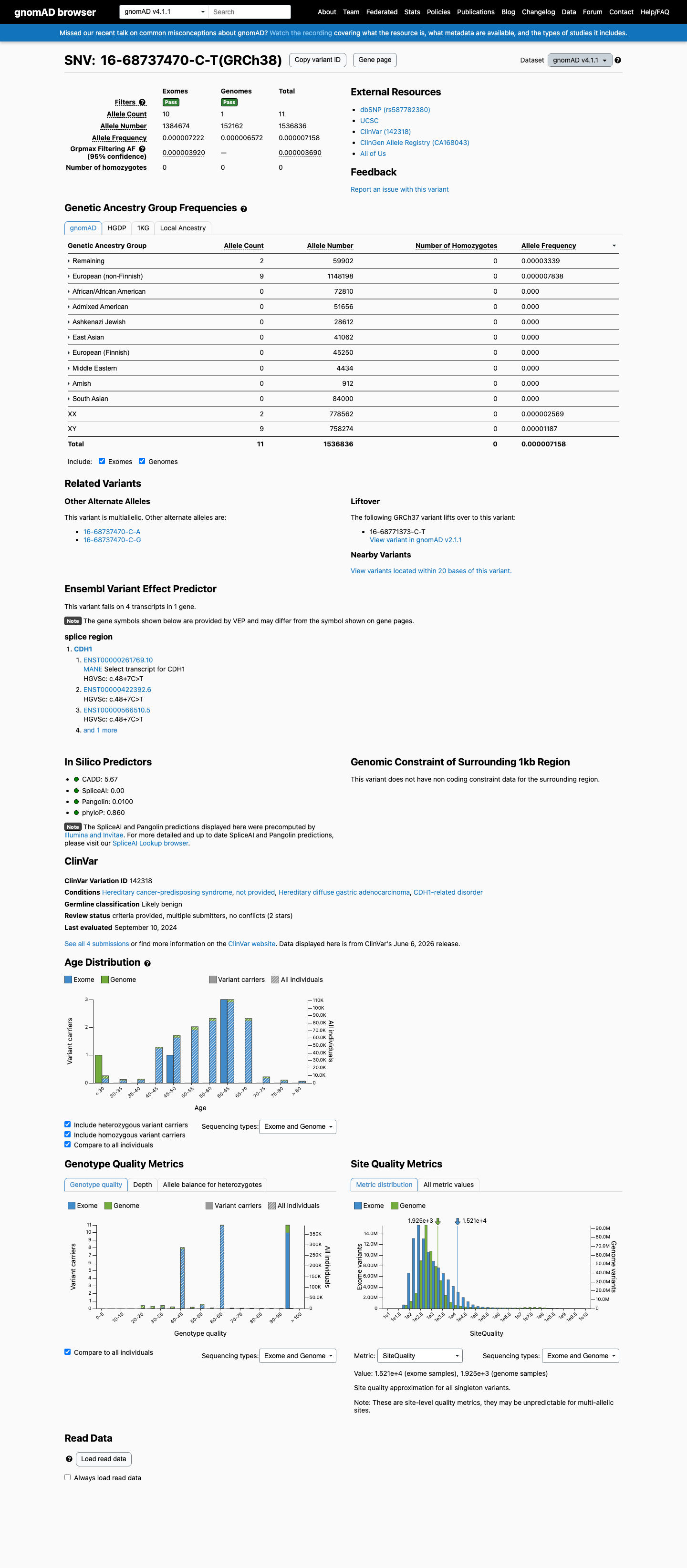
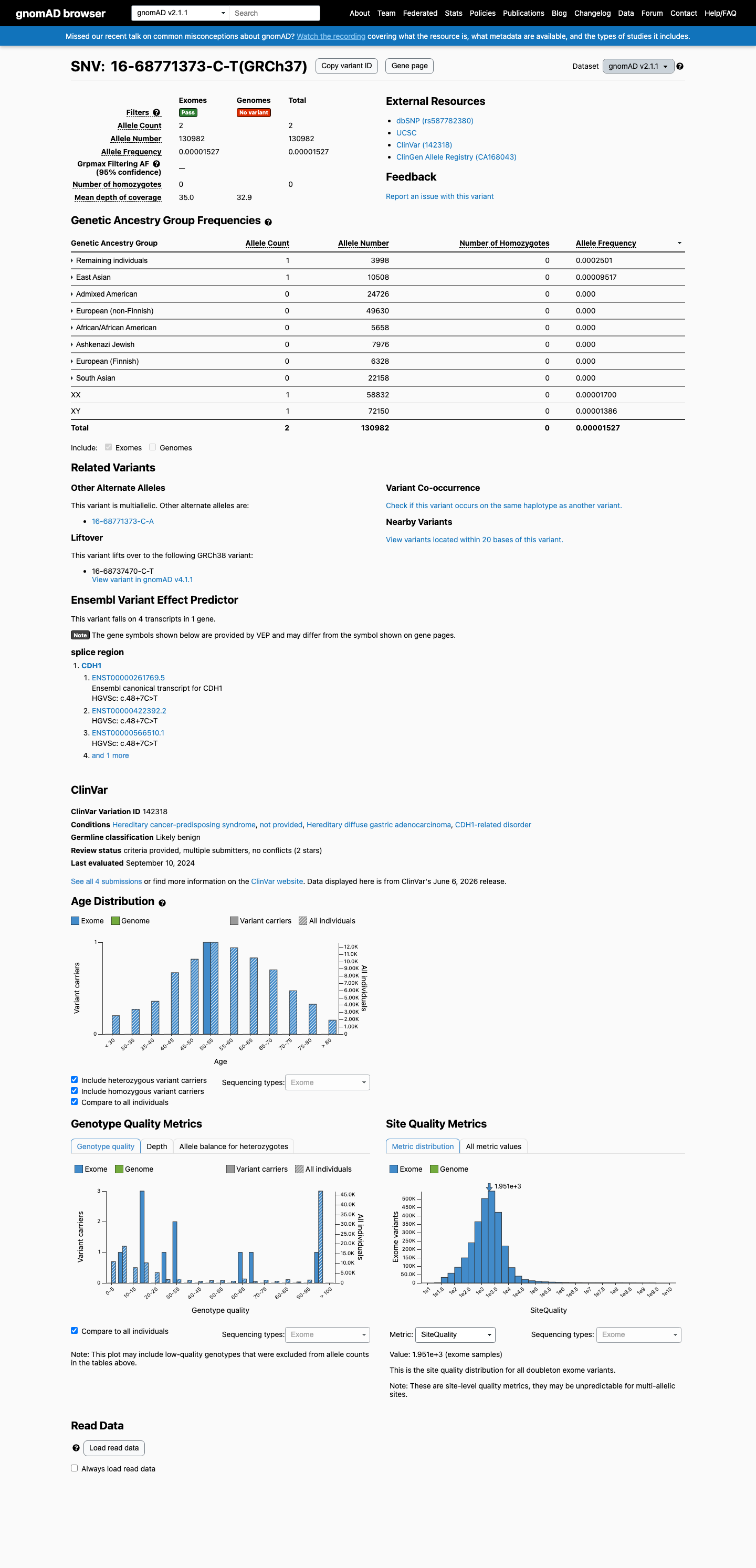
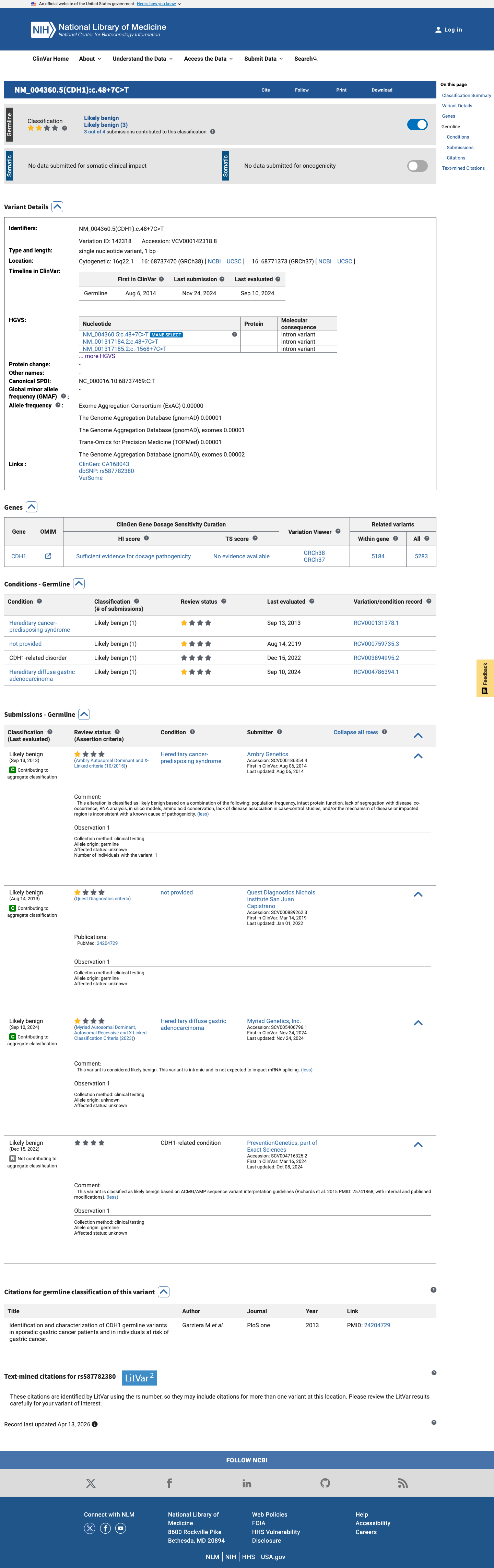
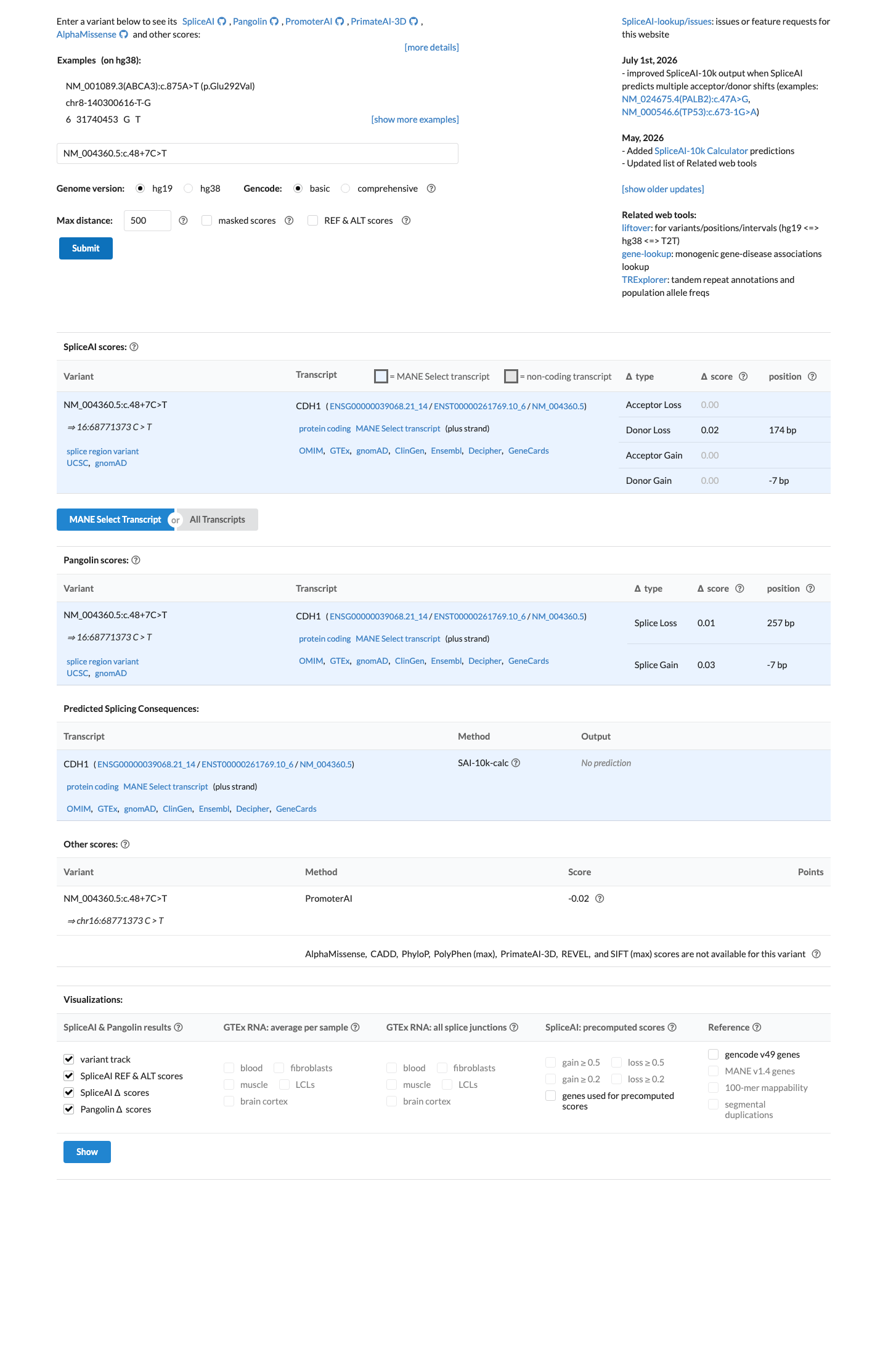
NM_004360.5:c.48+7C>T is an intronic variant at position +7 of intron 1 in CDH1. It has been reported in ClinVar as Likely benign by four clinical laboratories (ClinVar ID 142318, 1-star review status).1 This variant is present at very low frequency in gnomAD population databases: 2 of 130,982 alleles in v2.1 (0.00153%) and 11 of 1,536,836 alleles in v4.1 (0.00072%), with no homozygotes observed.2 Functional RNA studies by Garziera et al. (2013, PMID 24204729) evaluated the splicing impact of c.48+7C>T using RT-PCR on peripheral blood mononuclear cells from a heterozygous carrier. The transcript was normal in size and sequence compared to wild-type controls, with no aberrant splicing products, protein truncations, or frameshifts detected. These findings satisfy BS3 at strong strength per CDH1 VCEP specifications.3 The variant's intronic position at +7 meets the CDH1 VCEP BP7 rule for intronic variants at or beyond the +7 position, providing supporting evidence for a benign interpretation.4 SpliceAI predicts no significant splice impact (max delta score = 0.02), consistent with the normal transcript observed in functional RNA studies.5 PS3 is not met because the functional data demonstrated no abnormal transcripts; the evidence direction is benign rather than pathogenic.6
Final classification
Likely Benign
BS3BP7
CDH1
c.48+7C>T
p.?
missense
This variant
NM_004360.5:c.48+7C>T is an intronic variant at position +7 of intron 1 in CDH1. It has been reported in ClinVar as Likely benign by four clinical laboratories (ClinVar ID 142318, 1-star review status).
ClinGen CDH1 Expert Panel Specifications to the ACMG/AMP Variant Interpretation Guidelines Version 3.1 v3.1 lacked a usable explicit final combination framework, so generic ACMG/AMP 2015 final-combination rules were applied as fallback; applied criteria: BS3 strong benign, BP7 supporting benign; combination = 1 strong benign + 1 supporting benign, which maps to Likely Benign.
Classification rationale
BS3BP7
Likely Benign
CDH1 c.48+7C>T
missense
BS3 + BP7
→
Likely Benign
LYFE Sciences is an AI system, and it can make mistakes. Criteria
may be applied incorrectly, sources may be misread, and a confident-looking
classification can still be wrong. Double-check every criterion and
its underlying evidence before relying on any call.
Gene diagram
· NM_004360.5 · variants mapped to exon structure
CDH1
NM_004360.5
Fetching transcript structure from UCSC…
Applied criteria · 2 applied · 14 assessed
MetEvidence satisfies this criterion.
Not metEvaluated against available evidence; threshold not reached.
Not assessedApplies in principle, but no evidence was found to evaluate it.
N/ADoesn't apply to this variant type.
Applied · 2
Strength
Supporting
Moderate
Strong
Very strong
BS3
strong
Benign
Functional RNA studies (Garziera et al. 2013, PMID 24204729) demonstrated no impact on CDH1 transcript composition for NM_004360.5:c.48+7C>T. RT-PCR of exons 1-5 from peripheral blood mononuclear cells of the variant carrier produced a normal-sized 768 bp fragment identical to wild-type controls. Bidirectional sequencing confirmed the absence of aberrant transcripts. No protein truncations or frameshifts were detected. Per CDH1 VCEP BS3 rule: 'Functional RNA studies demonstrating no impact on transcript composition' applies at Strong strength.
RT-PCR of exons 1-5 from PBMCs of c.48+7C>T carrier showed normal transcript (Figure 3A of PMID 24204729)Bidirectional sequencing confirmed no aberrant splicing productsNo frameshifts or protein truncations detected
BP7
supporting
Benign
NM_004360.5:c.48+7C>T is an intronic variant located at the +7 position of intron 1. Per CDH1 VCEP BP7 rule: 'Synonymous and intronic variants at or beyond +7 to -21 locations.' The variant at +7 falls exactly at the boundary of this rule. The CSPEC instructions note that the CDH1 rule specification does not require a conservation prediction and that BP7 may be used with BP4 to classify variants meeting both criteria as likely benign. Here BP7 is applied independently based on the positional rule.
Variant is intronic at position c.48+7which is at the +7 boundary defined by the CDH1 VCEP BP7 rule: 'intronic variants at or beyond +7 to -21 locations'
Assessed · not applied
· 7 not met · 7 not assessed
Pathogenic
PS2
No de novo data (with confirmed maternity and paternity) available for NM_004360.5:c.48+7C>T.
PS3
The only available functional data for this variant (Garziera et al.
PS4
No case-family data available indicating that individuals or families harboring NM_004360.5:c.48+7C>T meet HDGC criteria.
PM2
Per CDH1 VCEP PM2 rule: variant must be present at ≤1 per 100,000 alleles in gnomAD.
PM6
No assumed de novo (without parental confirmation) data available for NM_004360.5:c.48+7C>T.
PP1
No co-segregation data available for NM_004360.5:c.48+7C>T.
PP3
SpliceAI predicts no significant splice impact (max delta = 0.02).
Benign
BA1
The CDH1 VCEP BA1 threshold is an allele frequency greater than 0.2% (MAF > 0.002).
BS1
The CDH1 VCEP BS1 threshold is an allele frequency greater than 0.1% (MAF > 0.001).
BS2
Insufficient clinical phenotype data to determine whether the 11 individuals in gnomAD v4 (or 2 in gnomAD v2) are free of gastric cancer, diffuse gastric cancer, signet ring cell tumors, or lobular breast cancer, and whether their families lack features suggestive of HDGC.
BS4
No segregation data available for NM_004360.5:c.48+7C>T.
BP2
No evidence of NM_004360.5:c.48+7C>T observed in trans with a known pathogenic CDH1 variant (phase confirmed), nor observed in the homozygous state in an individual without personal/family history of DGC, LBC, or SRC tumors.
BP4
The CDH1 VCEP BP4 rule requires at least three in silico splicing predictors in agreement showing no impact.
BP5
Per CDH1 VCEP, BP5 applies when a pathogenic/likely pathogenic variant is identified in an alternate gene known to cause HDGC (currently only CTNNA1).
N/A · 9
PVS1 · PS1 · PM1 · PM5 · PP2 · PP4 · PP5 · BP1 · BP6
Research & evidence
Population frequency · supports benign
gnomAD v4.1
gnomAD v2.1
v4.1
This variant is present in gnomAD v4.1 (AF= 7.15756e-06; MAF= 0.00072%, 11/1536836 alleles, homozygotes = 0) and has highest observed frequency in the Remaining individuals population (AF= 3.33879e-05; MAF= 0.00334%, 2/59902 alleles, homozygotes = 0); grpmax FAF= 3.69e-06.
v2.1
This variant is present in gnomAD v2.1 (AF= 1.52693e-05; MAF= 0.00153%, 2/130982 alleles, homozygotes = 0) and has highest observed frequency in the Remaining individuals population (AF= 0.000250125; MAF= 0.02501%, 1/3998 alleles, homozygotes = 0).
🇨🇦 CA
Not available in gnomAD-Canada v1.0.
Allele frequency by ancestry
three datasets · side by side
gnomAD v4.1
0.00072%
· 11 / 1,536,836
0 hom · FAF 0.00037%
0 hom · FAF 0.00037%
Remaining individuals 2 / 59,902 |
0.0033% |
European (non-Finnish) 9 / 1,148,198 |
0.00078% |
+ 8 not observed (Admixed American, European (Finnish), Amish, East Asian, Middle Eastern, South Asian, Ashkenazi Jewish, African/African American)
gnomAD v2.1
0.0015%
· 2 / 130,982
0 hom
0 hom
Remaining individuals 1 / 3,998 |
0.025% |
East Asian 1 / 10,508 |
0.0095% |
+ 6 not observed (African/African American, Admixed American, Ashkenazi Jewish, European (Finnish), European (non-Finnish), South Asian)
gnomAD Canada 🇨🇦
Absent
· 0 / ?
0 hom
0 hom
Not observed in any ancestry group.
ClinVar
This variant has been reported in ClinVar as Likely benign (4 clinical laboratories). (ClinVarID = 142318)
In silico
SpliceAI predicts no significant splice impact for this variant (max delta score = 0.02).
Functional
No data
No calibrated functional assay or RNA evidence was identified for this variant.
COSMIC
Somatic evidence
COSMIC
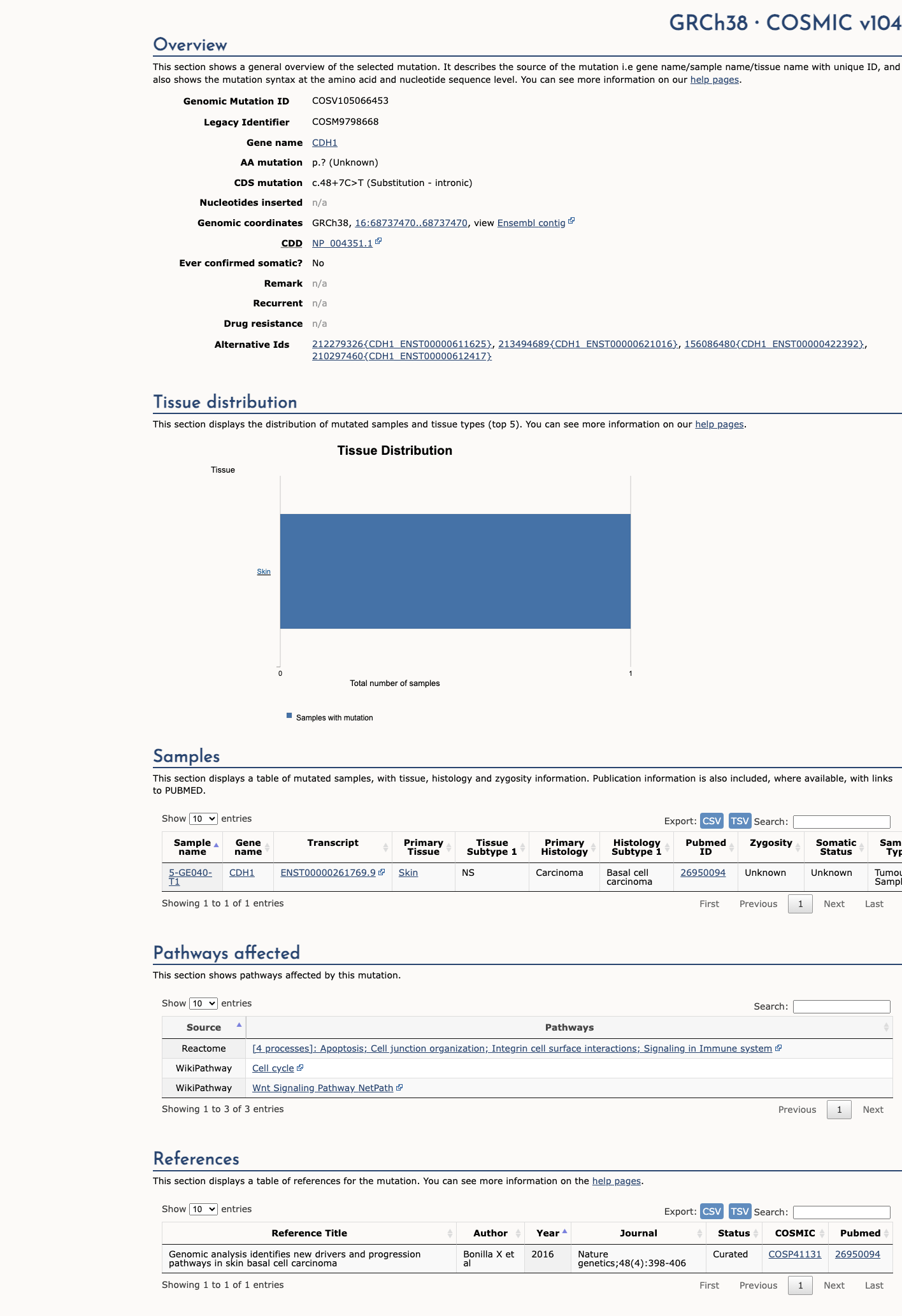
This variant has previously been reported in somatic cancers (COSMIC; COSV105066453, n = 1 times).
Hotspots
This variant does not lie in a statistically significant cancer hotspot.
Literature · how each cited paper was used
1papers cited
Each card is an audit: what was searched, what was found, whether it names the variant, which criteria it fed, and why. 6 further PMIDs triaged but not cited — see Sources & references.
Identification and characterization of CDH1 germline variants in sporadic gastric cancer patients and in individuals at risk of gastric cancer.
Searched
c.48+7C>T48+7IVS1ID 5
Found
Garziera et al. screened CDH1 germline variants in 59 gastric cancer patients, 59 first-degree relatives, 20 autoimmune metaplastic atrophic gastritis patients, and 52 blood donors. The variant c.48+7C>T (designated ID 5) was identified as a novel intronic mutation in one AMAG patient (S121, 51-year-old female with hypergastrinemia) and was absent from all gastric cancer patients and controls. RT-PCR of exons 1-5 from peripheral blood mononuclear cells showed a normal 768 bp transcript identical to wild-type controls on agarose gel. Bidirectional sequencing confirmed no aberrant splicing and no protein truncations or frameshifts. The authors concluded that CDH1 genetic alterations do not appear to play a relevant role in AMAG disease.
Variant
✓ Names this variant — characterised directly
Applied to
→BS3
met
Why
Functional RNA data demonstrated no splicing impact for c.48+7C>T. Referenced in BS3 assessment at strong benign strength.
ID 5, a new intronic mutation close to exon 1 (IVS1 c.48+7C>T). ID 5 was found in a female of 51-year-old with hypergastrinemia. We did not find any truncations or frameshifts in the production of the protein associated to this mutation.
Location Table 3 (variant listing); Results para on intronic mutations; Figure 3A (RT-PCR gel); Discussion para on AMAG findings · Context RT-PCR from peripheral blood mononuclear cells (PBMCs); exons 1-5 amplification (~768 bp); agarose gel electrophoresis; bidirectional Sanger sequencing · full text
Sources & reference links
Triaged references · 6 PMIDs not cited in assessment
22388873 ↗
Familial gastric cancer: guidelines for diagnosis, treatment and periodic surveillance.
CLINVAR
26467025 ↗
A Standardized DNA Variant Scoring System for Pathogenicity Assessments in Mendelian Disorders.
CLINVAR
25394175 ↗
A practice guideline from the American College of Medical Genetics and Genomics and the National Society of Genetic Counselors: referral indications for cancer predisposition assessment.
CLINVAR
26324357 ↗
American Society of Clinical Oncology Policy Statement Update: Genetic and Genomic Testing for Cancer Susceptibility.
CLINVAR
26389258 ↗
Cancer Genetics Risk Assessment and Counseling (PDQ®): Health Professional Version.
CLINVAR