Analysis in progress
Initialising…
0%
complete
This report is still being assembled — sections appear as each stage finishes. It isn't final yet.
MBD4
Final classification
Benign
MBD4 c.1543+14C>T · p.?
MBD4

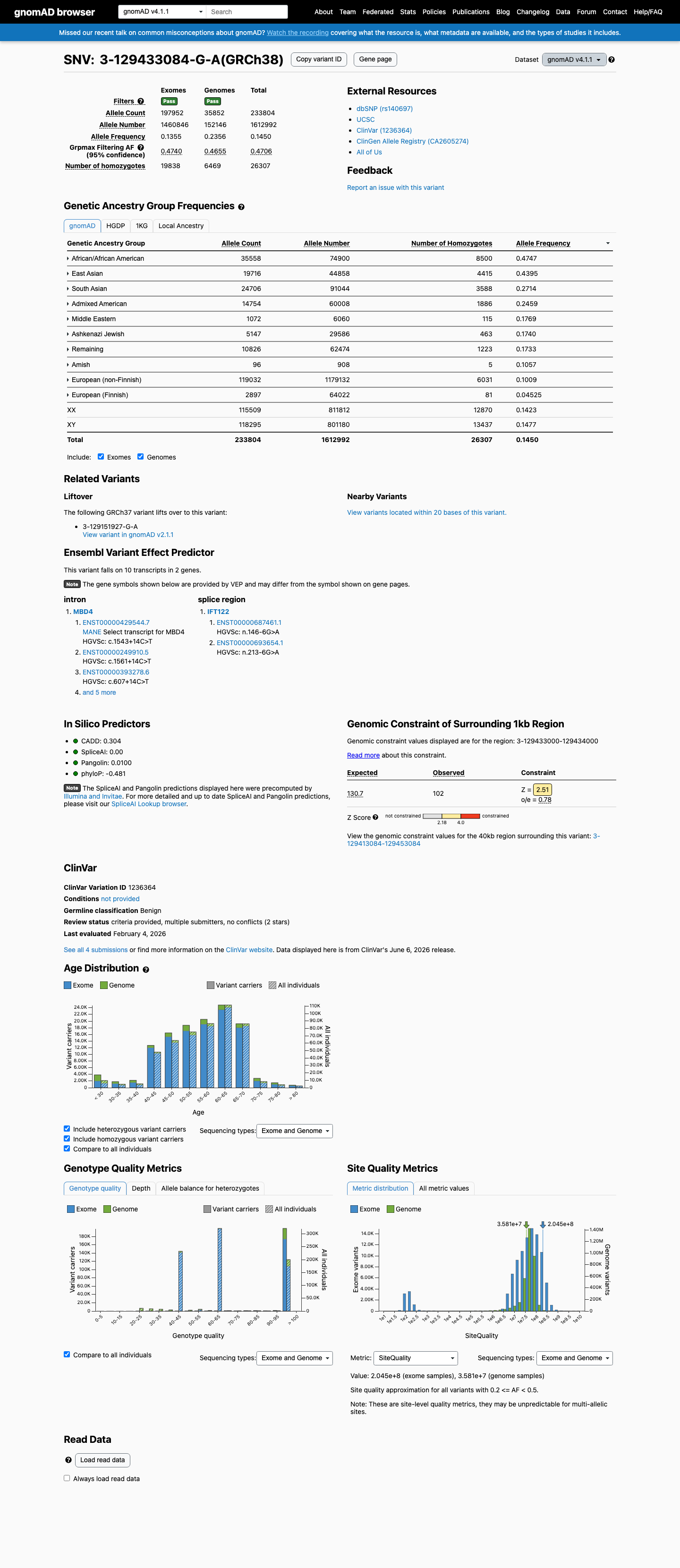
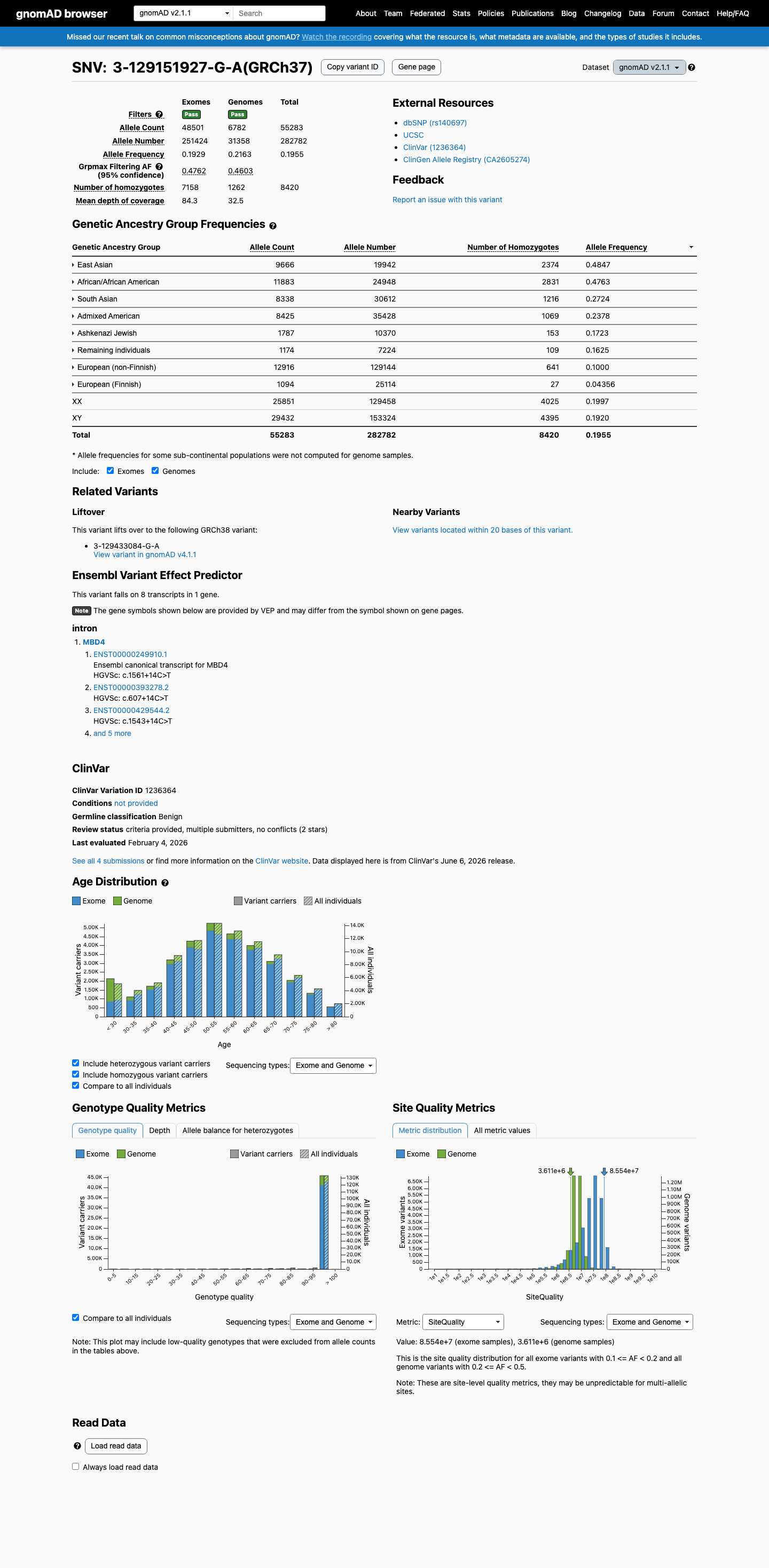
NM_001276270.2:c.1543+14C>T is an intronic variant in MBD4 with an allele frequency of 19.55% in gnomAD v2.1 (55,283/282,782 alleles, 8,420 homozygotes), far exceeding the BA1 stand-alone benign threshold.

Gene
MBD4
Transcript
NM_001276270.2
HGVS · transcript:coding
NM_001276270.2:c.1543+14C>T
Consequence
N/A
GRCh38
chr3:129433084 G>A
GRCh37
chr3:129151927 G>A
Basis gene-specific framework lacked a usable explicit final combination framework, so generic ACMG/AMP 2015 final-combination rules were applied as fallback; applied criteria: BA1 stand-alone benign, BS2 strong benign, BP4 supporting benign, BP6 supporting benign, BP7 supporting benign; combination = 1 stand-alone benign + 1 strong benign + 3 supporting benign, which maps to Benign.
gene-specific framework lacked a usable explicit final combination framework, so generic ACMG/AMP 2015 final-combination rules were applied as fallback; applied criteria: BA1 stand-alone benign, BS2 strong benign, BP4 supporting benign, BP6 supporting benign, BP7 supporting benign; combination = 1 stand-alone benign + 1 strong benign + 3 supporting benign, which maps to Benign.
Classification rationale
BA1BS2BP4BP6BP7 Benign
MBD4 c.1543+14C>T

NM_001276270.2:c.1543+14C>T is an intronic variant in MBD4 with an allele frequency of 19.55% in gnomAD v2.1 (55,283/282,782 alleles, 8,420 homozygotes), far exceeding the BA1 stand-alone benign threshold.1 The variant is present in homozygous state in 8,420 individuals in gnomAD v2.1 and 26,307 in gnomAD v4.1, meeting BS2 at strong benign strength, inconsistent with a pathogenic role in MBD4-associated disease.2 SpliceAI predicts no splicing impact (max delta score = 0.00) for this +14 intronic variant, consistent with BP4 and BP7 at supporting benign strength.3 ClinVar reports this variant as Benign by 3 clinical laboratories (variation ID 1236364), meeting BP6 at supporting benign strength.4

BA1 + BS2 + BP4 + BP6 + BP7 Benign
Gene diagram · NM_001276270.2 · variants mapped to exon structure
MBD4 NM_001276270.2
Fetching transcript structure from UCSC…
Applied criteria · 5 applied · 13 assessed
Applied · 5
Strength Supporting Moderate Strong Very strong
BA1 stand-alone Benign
Allele frequency of 19.55% in gnomAD v2.1 (55,283/282,782 alleles) and 14.50% in gnomAD v4.1 (233,804/1,612,992 alleles) far exceeds the BA1 threshold of >1% for generic ACMG. Highest subpopulation frequency is 48.47% in East Asian (gnomAD v2.1). The variant is observed in 8,420 homozygous individuals in v2.1 and 26,307 in v4.1.
gnomAD v2.1: total AF=19.55% (55283/282782 alleles
BS2 strong Benign
Observed in 8,420 homozygous individuals in gnomAD v2.1 and 26,307 in v4.1, with no reported severe disease phenotype. Homozygous observation in a gene where germline LoF is associated with an autosomal dominant/recessive cancer predisposition syndrome strongly supports a benign interpretation.
8420 homozygotes in gnomAD v2.1.26
BP4 supporting Benign
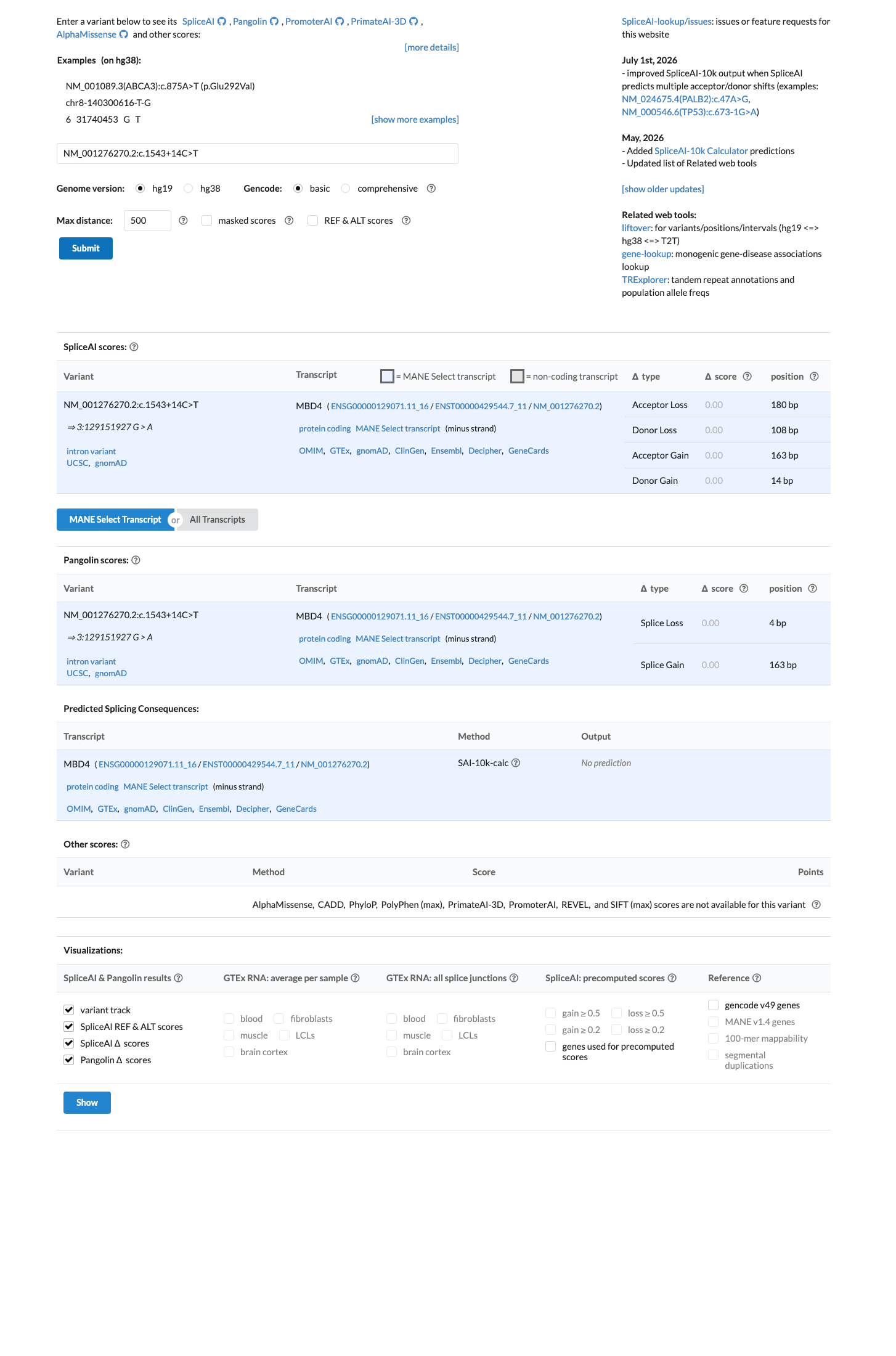
SpliceAI predicts no splicing impact (max delta score = 0.00). REVEL and BayesDel scores are not available for this intronic variant, but the absence of any predicted splicing alteration supports a benign interpretation.
SpliceAI: max delta = 0.00no predicted acceptor gain/loss or donor gain/loss.REVEL and BayesDel not available for intronic variants.
BP6 supporting Benign
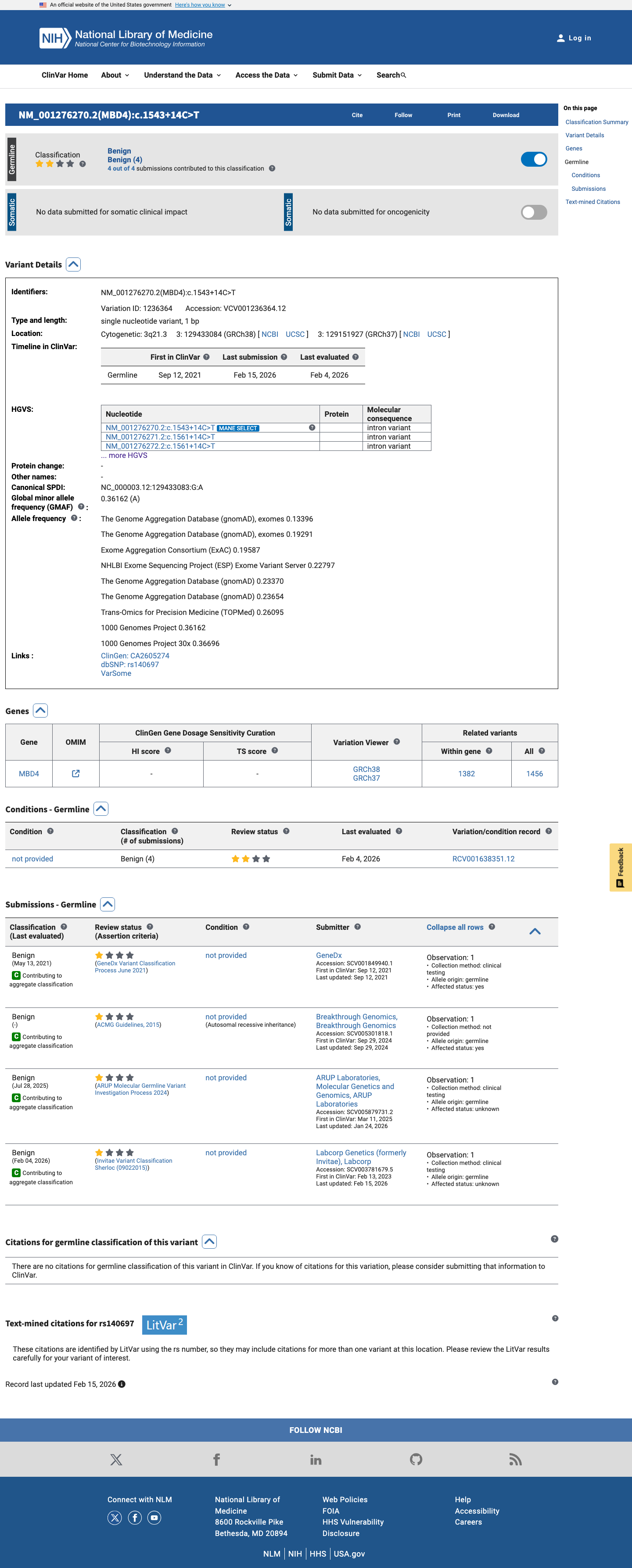
ClinVar reports this variant as Benign by 3 clinical laboratories (GeneDx, ARUP Laboratories, Labcorp Genetics). Although the review status is 1-star (criteria provided, single submitter), three independent clinical laboratories agree on a benign classification, which constitutes a reputable source under generic ACMG BP6.
ClinVar variation ID 1236364: Benign classification.3 clinical laboratories: GeneDxARUP Laboratories
BP7 supporting Benign
This is an intronic variant at position +14 from the exon 6 donor site with SpliceAI delta score of 0.00, indicating no predicted impact on splicing. BP7 applies to synonymous and intronic variants where splicing prediction algorithms predict no impact on the splice consensus sequence.
Intronic variant at c.1543+14 (14 bases downstream of exon 6).SpliceAI max delta = 0.00no predicted alteration of splicing.
Assessed · not applied
Pathogenic
PS2 No de novo observation reported for this variant in the available case materials.
PS3 No functional data exists for this intronic variant.
PS4 Variant is extremely common in population databases (gnomAD AF ~19.5%), precluding a statistically increased prevalence in affected individuals for any rare disease.
PM2 Variant is present at very high frequency in gnomAD (v2.1 AF=19.55%, v4.1 AF=14.50%), far exceeding the PM2 threshold of <0.1%.
PM6 No de novo observation reported for this variant.
PP1 No co-segregation data available.
PP3 SpliceAI predicts no splice impact (max delta score = 0.00).
PP4 Variant is present in ~19.5% of the general population, which is incompatible with a variant causing a rare disease with high specificity.
PP5 ClinVar reports this variant as Benign, not Pathogenic.
Benign
BS3 No functional studies demonstrating no deleterious effect for this variant are available.
BS4 No segregation data available.
BP2 No observation of this variant in trans with a known pathogenic variant is reported in the case materials.
BP5 No alternate molecular basis for disease has been identified in cases with this variant in the available materials.
N/A · 7 PVS1 · PS1 · PM1 · PM5 · PP2 · BS1 · BP1
Research & evidence
Population frequency · supports benign
gnomAD v4.1 screenshot
gnomAD v4.1
gnomAD v2.1 screenshot
gnomAD v2.1
v4.1
This variant is present in gnomAD v4.1 (AF= 0.144951; MAF= 14.49505%, 233804/1612992 alleles, homozygotes = 26307) and has highest observed frequency in the African/African American population (AF= 0.47474; MAF= 47.47397%, 35558/74900 alleles, homozygotes = 8500); grpmax FAF= 0.470605.
v2.1
This variant is present in gnomAD v2.1 (AF= 0.195497; MAF= 19.54969%, 55283/282782 alleles, homozygotes = 8420) and has highest observed frequency in the East Asian population (AF= 0.484706; MAF= 48.47056%, 9666/19942 alleles, homozygotes = 2374); grpmax FAF= 0.476196.
🇨🇦 CA
This variant is present in gnomAD-Canada v1.0 (AF= 0.1828804347826087, 3365/18400 alleles, homozygotes = 464).
Allele frequency by ancestry
three datasets · side by side
gnomAD v4.1
14% · 233804 / 1,612,992
26307 hom · FAF 47%
African/African American
35558 / 74,900
47%
8500 hom
East Asian
19716 / 44,858
44%
4415 hom
South Asian
24706 / 91,044
27%
3588 hom
Admixed American
14754 / 60,008
25%
1886 hom
Middle Eastern
1072 / 6,060
18%
115 hom
Ashkenazi Jewish
5147 / 29,586
17%
463 hom
Remaining individuals
10826 / 62,474
17%
1223 hom
Amish
96 / 908
11%
5 hom
European (non-Finnish)
119032 / 1,179,132
10%
6031 hom
European (Finnish)
2897 / 64,022
4.5%
81 hom
gnomAD v2.1
20% · 55283 / 282,782
8420 hom · FAF 48%
East Asian
9666 / 19,942
48%
2374 hom
African/African American
11883 / 24,948
48%
2831 hom
South Asian
8338 / 30,612
27%
1216 hom
Admixed American
8425 / 35,428
24%
1069 hom
Ashkenazi Jewish
1787 / 10,370
17%
153 hom
Remaining individuals
1174 / 7,224
16%
109 hom
European (non-Finnish)
12916 / 129,144
10%
641 hom
European (Finnish)
1094 / 25,114
4.4%
27 hom
gnomAD Canada 🇨🇦
18% · 3365 / 18,400
464 hom · FAF 46%
indel · split
African/African American
503 / 1,018
49%
130 hom
East Asian
645 / 1,338
48%
157 hom
South Asian
394 / 1,360
29%
49 hom
Latino/Admixed American
191 / 838
23%
18 hom
Remaining individuals
256 / 1,134
23%
30 hom
Middle Eastern
27 / 144
19%
Ashkenazi Jewish
123 / 830
15%
13 hom
European (non-Finnish)
1226 / 11,730
10%
67 hom
+ 1 not observed (European (Finnish))
ClinVar screenshot
ClinVar
This variant has been reported in ClinVar as Benign (3 clinical laboratories). (ClinVarID = 1236364)
SpliceAI screenshot
In silico
SpliceAI predicts no significant splice impact for this variant (max delta score = 0.00).
Functional No data
No calibrated functional assay or RNA evidence was identified for this variant.
OncoKB ↗
COSMIC screenshot
COSMIC
Somatic evidence
COSMIC
This variant has not previously been reported in somatic cancers (COSMIC).
Hotspots
This variant does not lie in a statistically significant cancer hotspot.
COSMIC ↗
Sources & reference links
7Sources
ClinVar
gnomAD v2.1
gnomAD v4.1
gnomAD-Canada
SpliceAI
OncoKB
COSMIC
Triaged references · 2 PMIDs not cited in assessment
25741868 ↗ Standards and guidelines for the interpretation of sequence variants: a joint consensus recommendation of the American College of Medical Genetics and Genomics and the Association for Molecular Pathology. CLINVAR
28492532 ↗ Sherloc: a comprehensive refinement of the ACMG-AMP variant classification criteria. CLINVAR