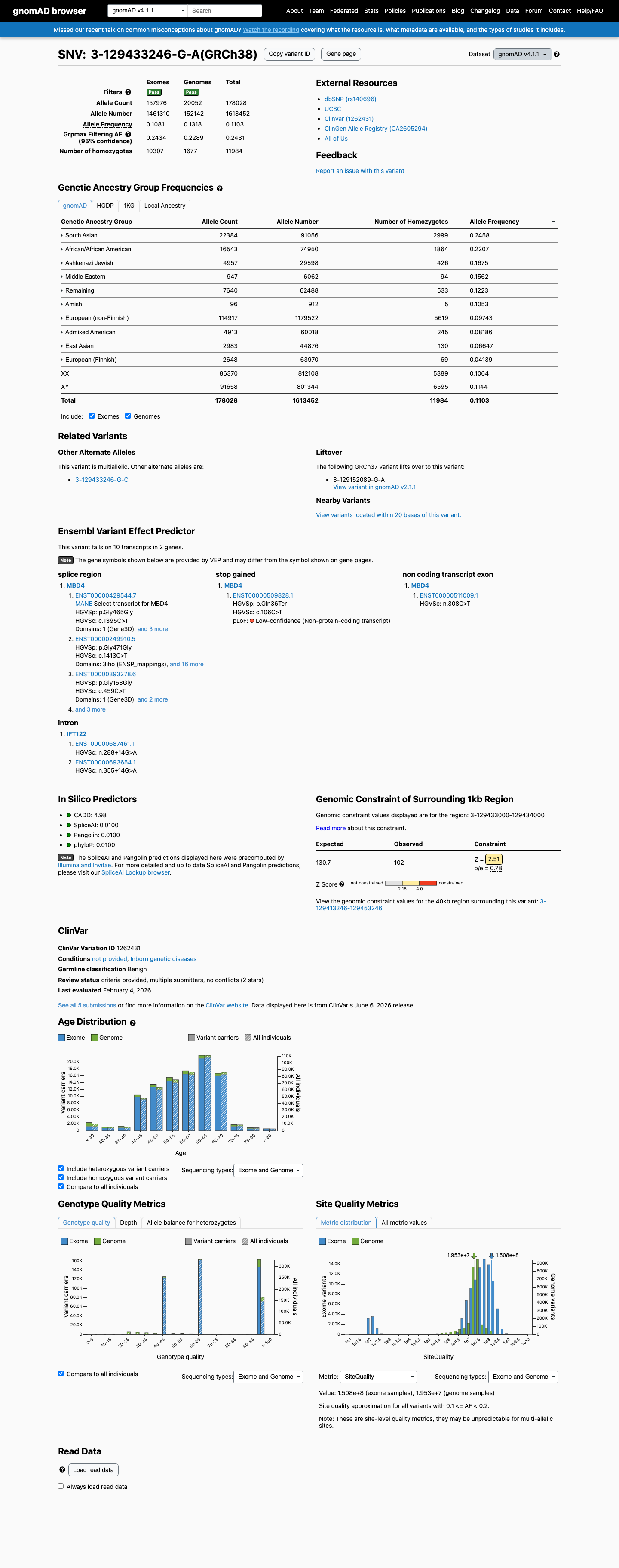
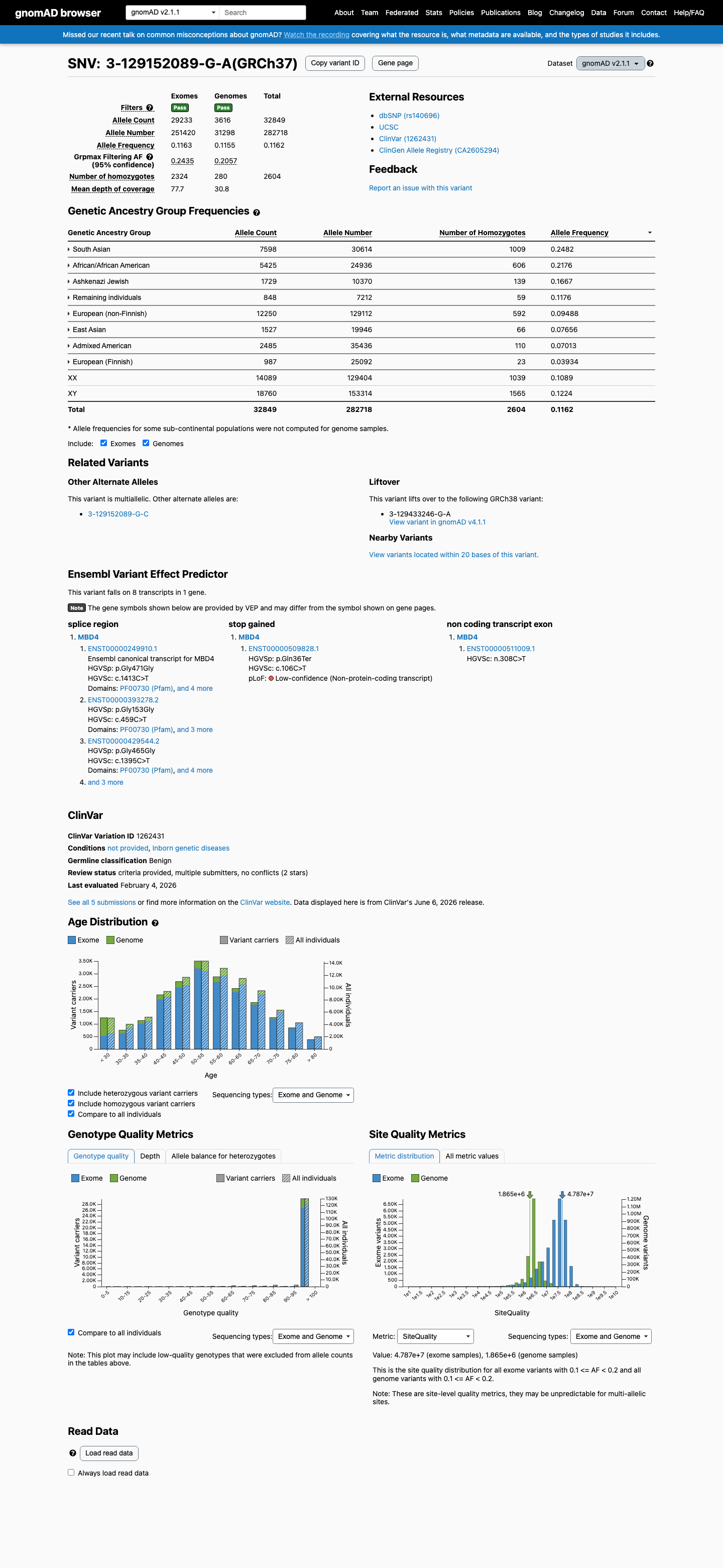
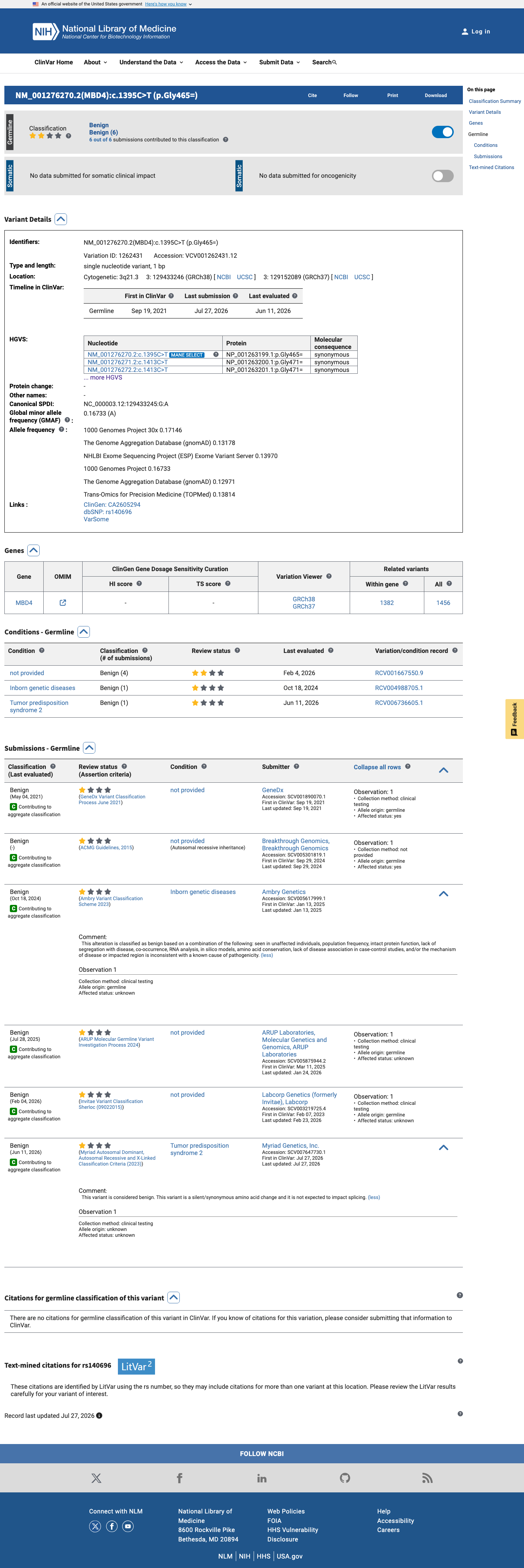
NM_001276270.2:c.1395C>T (p.Gly465=) is a synonymous variant in MBD4 present at extremely high frequency in population databases.1 In gnomAD v2.1, this variant is observed in 32,849 of 282,718 alleles (AF=11.619%) including 2,604 homozygotes, with the highest subpopulation frequency in South Asians (AF=24.819%, 1,009 homozygotes).2 In gnomAD v4.1, this variant is observed in 178,028 of 1,613,452 alleles (AF=11.034%) including 11,984 homozygotes.3 The allele frequency far exceeds the BA1 stand-alone benign threshold of >1% in any general population, establishing this variant as a common polymorphism.4 SpliceAI predicts no splicing impact (max delta score 0.02), consistent with the synonymous nature of this substitution.5 Five clinical laboratories in ClinVar have classified this variant as Benign (ClinVarID 1262431), though review status is single-submitter level without expert panel consensus.6 No functional studies, segregation data, or de novo observations for this variant were identified in the reviewed literature. The very high population frequency (11.6% overall, thousands of homozygotes) alone is sufficient to classify this variant as Benign under generic ACMG/AMP 2015 framework.7
Final classification
Benign
BA1BS1BS2BP4BP7
MBD4
c.1395C>T
p.Gly465=
missense
This variant
NM_001276270.2:c.1395C>T (p.Gly465=) is a synonymous variant in MBD4 present at extremely high frequency in population databases.
gene-specific framework lacked a usable explicit final combination framework, so generic ACMG/AMP 2015 final-combination rules were applied as fallback; applied criteria: BA1 stand-alone benign, BS1 strong benign, BS2 strong benign, BP4 supporting benign, BP7 supporting benign; combination = 1 stand-alone benign + 2 strong benign + 2 supporting benign, which maps to Benign.
Classification rationale
BA1BS1BS2BP4BP7
Benign
MBD4 c.1395C>T
missense
BA1 + BS1 + BS2 + BP4 + BP7
→
Benign
LYFE Sciences is an AI system, and it can make mistakes. Criteria
may be applied incorrectly, sources may be misread, and a confident-looking
classification can still be wrong. Double-check every criterion and
its underlying evidence before relying on any call.
Gene diagram
· NM_001276270.2 · variants mapped to exon structure
MBD4
NM_001276270.2
Fetching transcript structure from UCSC…
Applied criteria · 5 applied · 17 assessed
MetEvidence satisfies this criterion.
Not metEvaluated against available evidence; threshold not reached.
Not assessedApplies in principle, but no evidence was found to evaluate it.
N/ADoesn't apply to this variant type.
Applied · 5
Strength
Supporting
Moderate
Strong
Very strong
BA1
stand-alone
Benign
This variant is present at extremely high frequency in gnomAD v2.1 (AF=11.619%, 32,849/282,718 alleles, 2,604 homozygotes) and gnomAD v4.1 (AF=11.034%, 178,028/1,613,452 alleles, 11,984 homozygotes). Highest subpopulation frequency in South Asian population (v2.1 AF=24.819%, v4.1 AF=24.583%, grpmax FAF=24.313%). Far exceeds the BA1 threshold of >1% allele frequency in any general population. This variant is a common polymorphism.
gnomAD v2.1 overall AF 11.6% with 2604 homozygotesSAS subpopulation AF 24.8% with 1
BS1
strong
Benign
Variant is present at allele frequencies far exceeding the expected frequency for any MBD4-related autosomal dominant disorder. gnomAD v2.1 AF=11.619% overall, with subpopulation frequencies ranging from 3.9% (Finnish) to 24.8% (South Asian). In every subpopulation, the frequency exceeds the BS1 threshold of >0.3%. The variant is observed in 2,604 homozygous individuals in v2.1 alone, incompatible with a highly penetrant Mendelian disease.
gnomAD v2.1 AF 11.6% (all populations >0.3%)2604 homozygotes
BS2
strong
Benign
The variant is observed in homozygous state in 2,604 individuals in gnomAD v2.1 and 11,984 individuals in gnomAD v4.1. For a gene where germline loss-of-function variants are associated with a multi-tumor predisposition syndrome (per PVS1 gene context), observation of this many homozygotes in population databases is incompatible with a pathogenic role. The homozygous count far exceeds what would be expected for a disease-causing variant.
2604 homozygotes in gnomAD v2.111
BP4
supporting
Benign
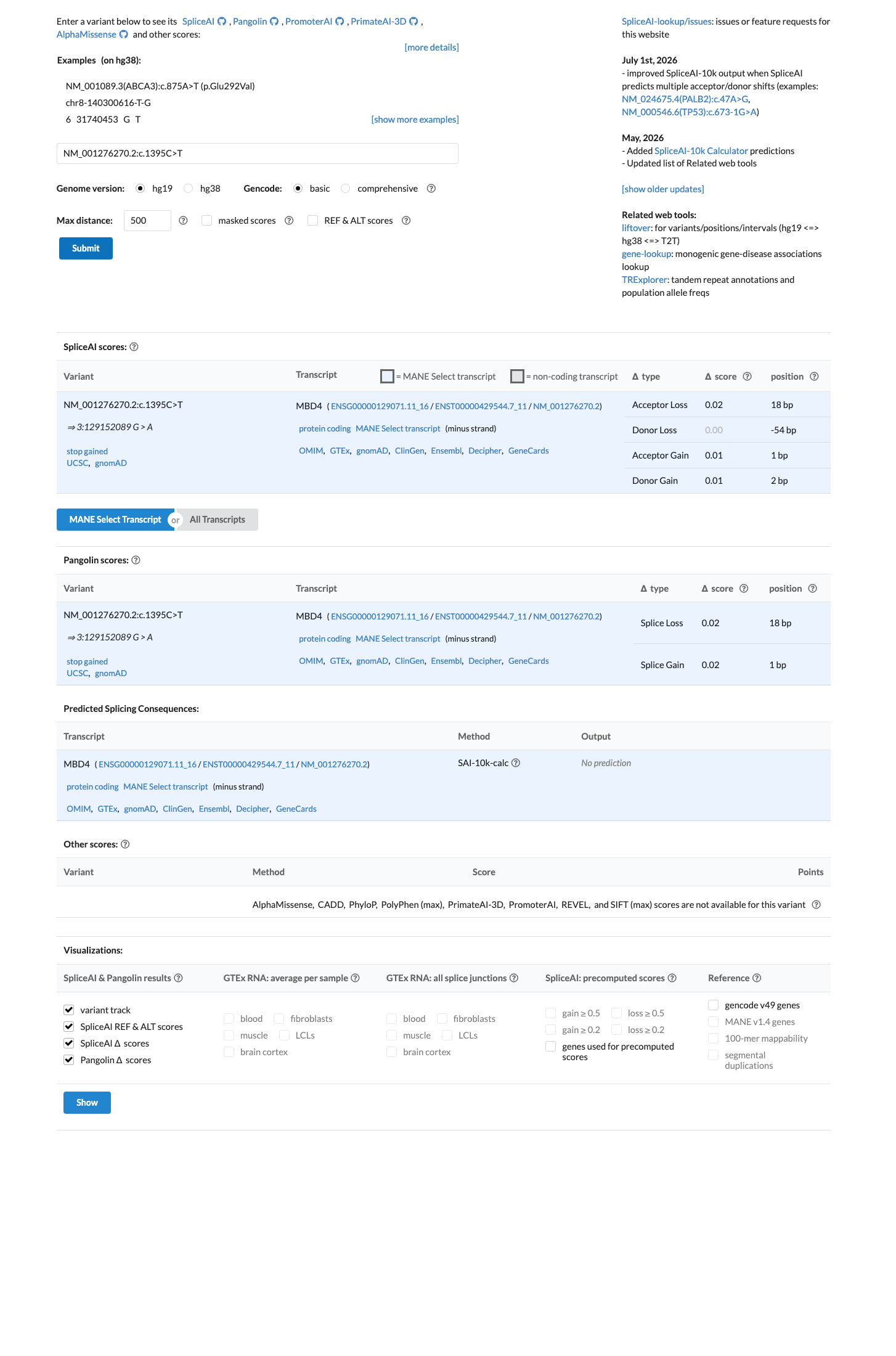
Multiple lines of computational evidence support no impact on splicing or gene product. SpliceAI predicts no splicing alteration (max delta score 0.02, below the 0.1 threshold). The variant is synonymous (p.Gly465=) and produces no amino acid change. No in silico tool predicts a damaging consequence.
SpliceAI max delta 0.02 — no predicted splicing impactsynonymous variant with preserved amino acid sequence
BP7
supporting
Benign
This is a synonymous variant (p.Gly465=) for which splice prediction algorithms predict no impact to the splice consensus sequence or creation of a new splice site (SpliceAI max delta score 0.02). The nucleotide at this position is not highly conserved, as evidenced by the extremely high population frequency (gnomAD AF 11.6%, 2,604 homozygotes), which is incompatible with a position under strong purifying selection.
Synonymous p.Gly465=SpliceAI max delta 0.02 — no predicted splice alterationnucleotide not conserved as shown by high gnomAD AF 11.6% with 2
Assessed · not applied
· 17 not met · 0 not assessed
Pathogenic
PS1
Synonymous variant produces no amino acid change (p.Gly465=).
PS2
No de novo data identified for this variant.
PS3
No functional data identified for this variant.
PS4
Extremely high population frequency (gnomAD AF 11.6%, 2,604 homozygotes) precludes case-control enrichment.
PM1
Synonymous variant (p.Gly465=) produces no amino acid change and therefore does not alter or remove any protein domain.
PM2
Variant is present at very high frequency in gnomAD v2.1 (AF=11.619%, 32,849/282,718 alleles, 2,604 homozygotes) and v4.1 (AF=11.034%, 178,028/1,613,452 alleles, 11,984 homozygotes).
PM6
No confirmed de novo observation for this variant in any publication or ClinVar submission.
PP1
No segregation data available for this variant.
PP2
PP2 applies to missense variants in genes with low rate of benign missense variation and where missense is a common pathogenic mechanism.
PP3
Multiple lines of in silico evidence predict no deleterious effect.
PP4
No patient phenotype data specific to this variant available.
PP5
ClinVar classification is Benign (ClinVarID 1262431) with review status 'criteria provided, single submitter' (1-star).
Benign
BS3
No experimental functional studies demonstrating no deleterious effect were identified in the literature or OncoKB.
BS4
No segregation data demonstrating lack of segregation with disease is available.
BP2
No evidence of this variant observed in trans with a pathogenic variant for a fully penetrant dominant disorder.
BP5
No evidence of an alternative molecular basis for disease in a patient carrying this variant.
BP6
ClinVar classification is Benign with review status 'criteria provided, single submitter' (1-star).
N/A · 3
PVS1 · PM5 · BP1
Research & evidence
Population frequency · supports benign
gnomAD v4.1
gnomAD v2.1
v4.1
This variant is present in gnomAD v4.1 (AF= 0.11034; MAF= 11.03398%, 178028/1613452 alleles, homozygotes = 11984) and has highest observed frequency in the South Asian population (AF= 0.245827; MAF= 24.58267%, 22384/91056 alleles, homozygotes = 2999); grpmax FAF= 0.24313.
v2.1
This variant is present in gnomAD v2.1 (AF= 0.11619; MAF= 11.61900%, 32849/282718 alleles, homozygotes = 2604) and has highest observed frequency in the South Asian population (AF= 0.248187; MAF= 24.81871%, 7598/30614 alleles, homozygotes = 1009); grpmax FAF= 0.243522.
🇨🇦 CA
This variant is present in gnomAD-Canada v1.0 (AF= 0.12491853139257006, 2300/18412 alleles, homozygotes = 167).
Allele frequency by ancestry
three datasets · side by side
gnomAD v4.1
11%
· 178028 / 1,613,452
11984 hom · FAF 24%
11984 hom · FAF 24%
South Asian 22384 / 91,056 |
25% 2999 hom |
African/African American 16543 / 74,950 |
22% 1864 hom |
Ashkenazi Jewish 4957 / 29,598 |
17% 426 hom |
Middle Eastern 947 / 6,062 |
16% 94 hom |
Remaining individuals 7640 / 62,488 |
12% 533 hom |
Amish 96 / 912 |
11% 5 hom |
European (non-Finnish) 114917 / 1,179,522 |
9.7% 5619 hom |
Admixed American 4913 / 60,018 |
8.2% 245 hom |
East Asian 2983 / 44,876 |
6.6% 130 hom |
European (Finnish) 2648 / 63,970 |
4.1% 69 hom |
gnomAD v2.1
12%
· 32849 / 282,718
2604 hom · FAF 24%
2604 hom · FAF 24%
South Asian 7598 / 30,614 |
25% 1009 hom |
African/African American 5425 / 24,936 |
22% 606 hom |
Ashkenazi Jewish 1729 / 10,370 |
17% 139 hom |
Remaining individuals 848 / 7,212 |
12% 59 hom |
European (non-Finnish) 12250 / 129,112 |
9.5% 592 hom |
East Asian 1527 / 19,946 |
7.7% 66 hom |
Admixed American 2485 / 35,436 |
7% 110 hom |
European (Finnish) 987 / 25,092 |
3.9% 23 hom |
gnomAD Canada 🇨🇦
12%
· 2300 / 18,412
167 hom · FAF 24%
167 hom · FAF 24%
South Asian 362 / 1,362 |
27% 40 hom |
African/African American 234 / 1,020 |
23% 30 hom |
Middle Eastern 24 / 144 |
17% |
Remaining individuals 180 / 1,134 |
16% 11 hom |
Ashkenazi Jewish 121 / 830 |
15% 14 hom |
East Asian 138 / 1,338 |
10% 11 hom |
European (non-Finnish) 1160 / 11,738 |
9.9% 58 hom |
Latino/Admixed American 81 / 838 |
9.7% 3 hom |
+ 1 not observed (European (Finnish))
ClinVar
This variant has been reported in ClinVar as Benign (5 clinical laboratories). (ClinVarID = 1262431)
In silico
SpliceAI predicts no significant splice impact for this variant (max delta score = 0.02).
Functional
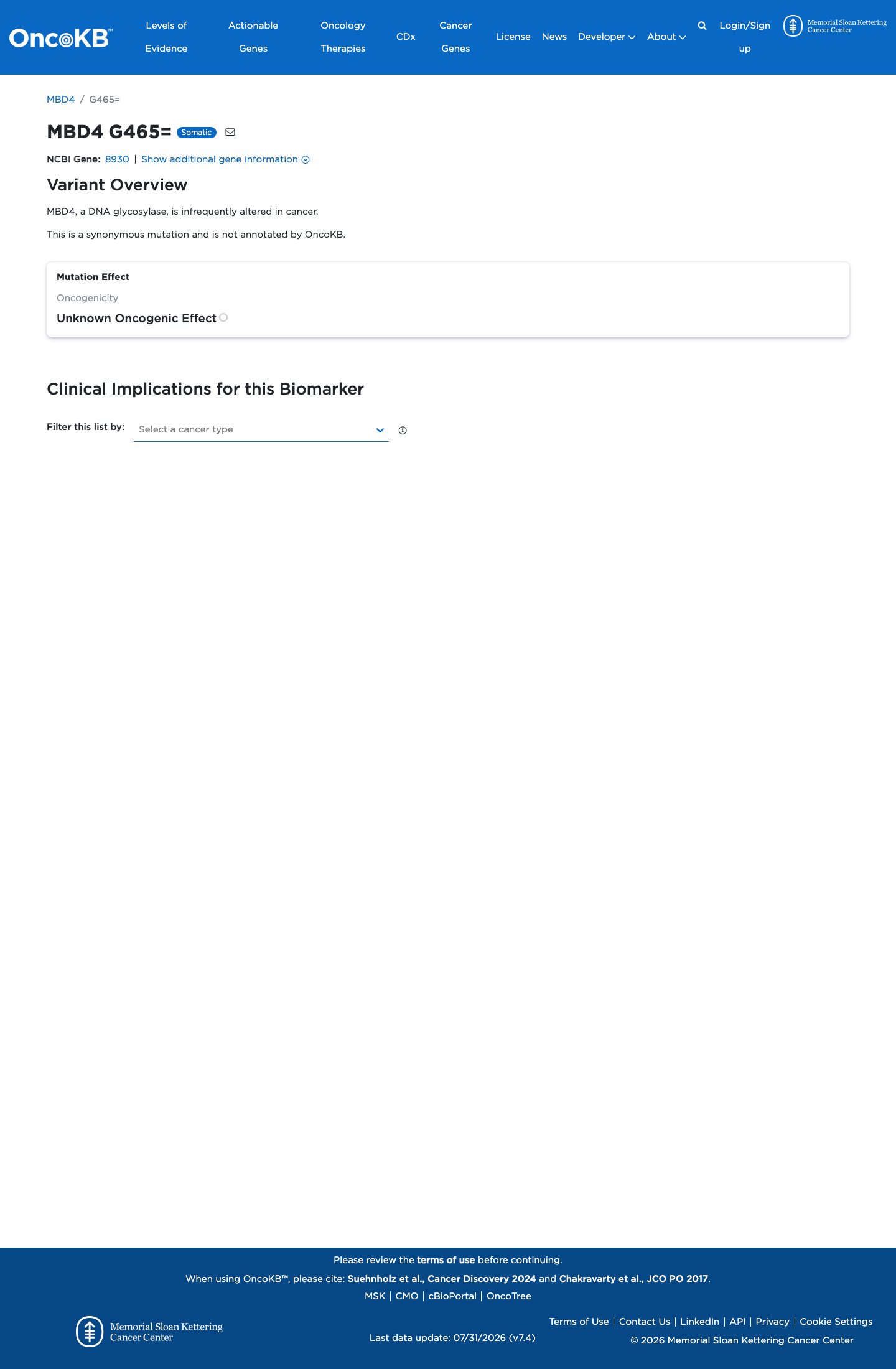
Unknown Oncogenic Effect
OncoKB identified curated literature and non-variant-specific oncogenicity context for review; listed oncogenicity label: Unknown Oncogenic Effect.

COSMIC

Cancer hotspots
Somatic evidence
Not in COSMIC / hotspots
COSMIC
This variant does not lie in a statistically significant hotspot. This variant has not previously been reported in somatic cancers (COSMIC).
Hotspots
This variant does not lie in a statistically significant hotspot.
Sources & reference links
Triaged references · 7 PMIDs not cited in assessment
25730230 ↗
Expanded carrier screening in reproductive medicine-points to consider: a joint statement of the American College of Medical Genetics and Genomics, American College of Obstetricians and Gynecologists, National Society of Genetic Counselors, Perinatal Quality Foundation, and Society for Maternal-Fetal Medicine.
CLINVAR
25741868 ↗
Standards and guidelines for the interpretation of sequence variants: a joint consensus recommendation of the American College of Medical Genetics and Genomics and the Association for Molecular Pathology.
CLINVAR
23169492 ↗
The perspective from EASAC and FEAM on direct-to-consumer genetic testing for health-related purposes.
CLINVAR
22947299 ↗
Specific guidelines for assessing and improving the methodological quality of economic evaluations of newborn screening.
CLINVAR
23037933 ↗
Including the initial newborn screening bloodspot collection device serial number on birth certificates: basis and recommendations from the Secretary of Health and Human Services' Advisory Committee on Heritable Disorders in Newborns and Children.
CLINVAR
28492532 ↗
Sherloc: a comprehensive refinement of the ACMG-AMP variant classification criteria.
CLINVAR