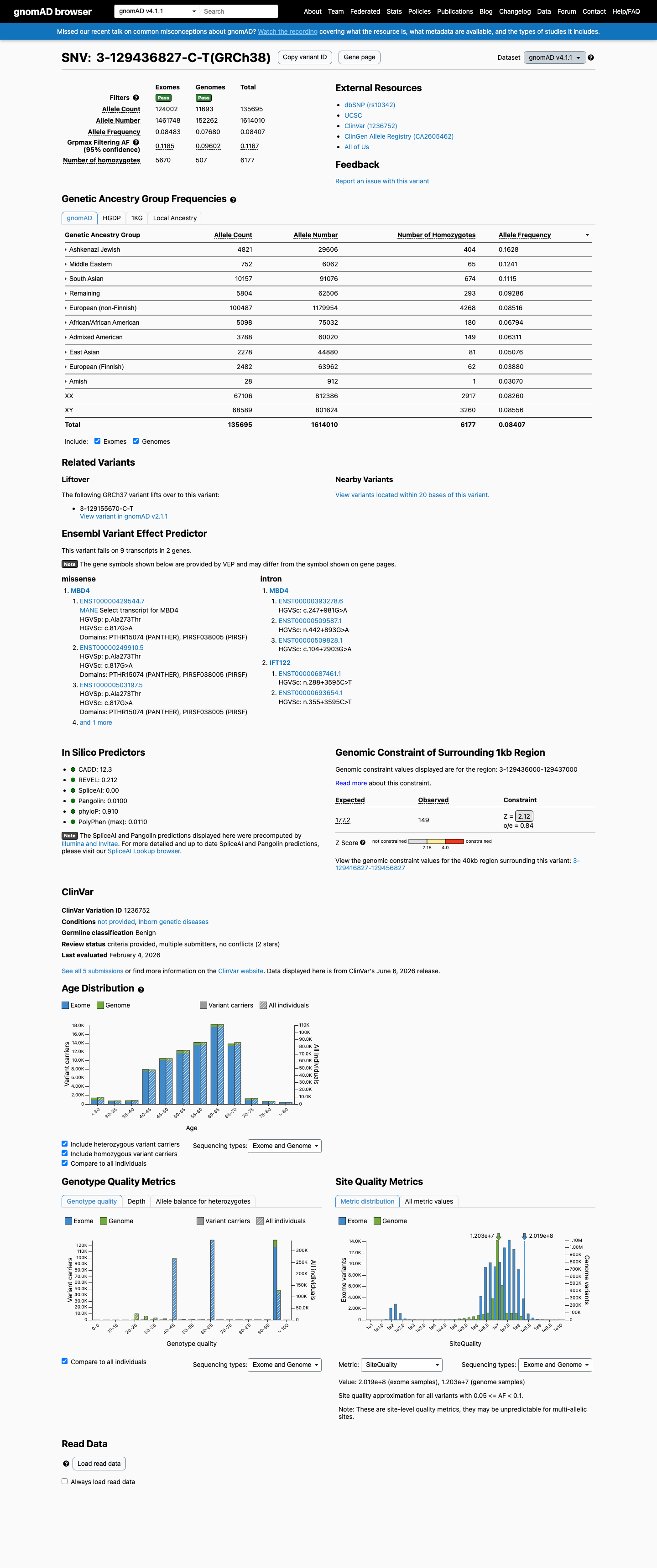
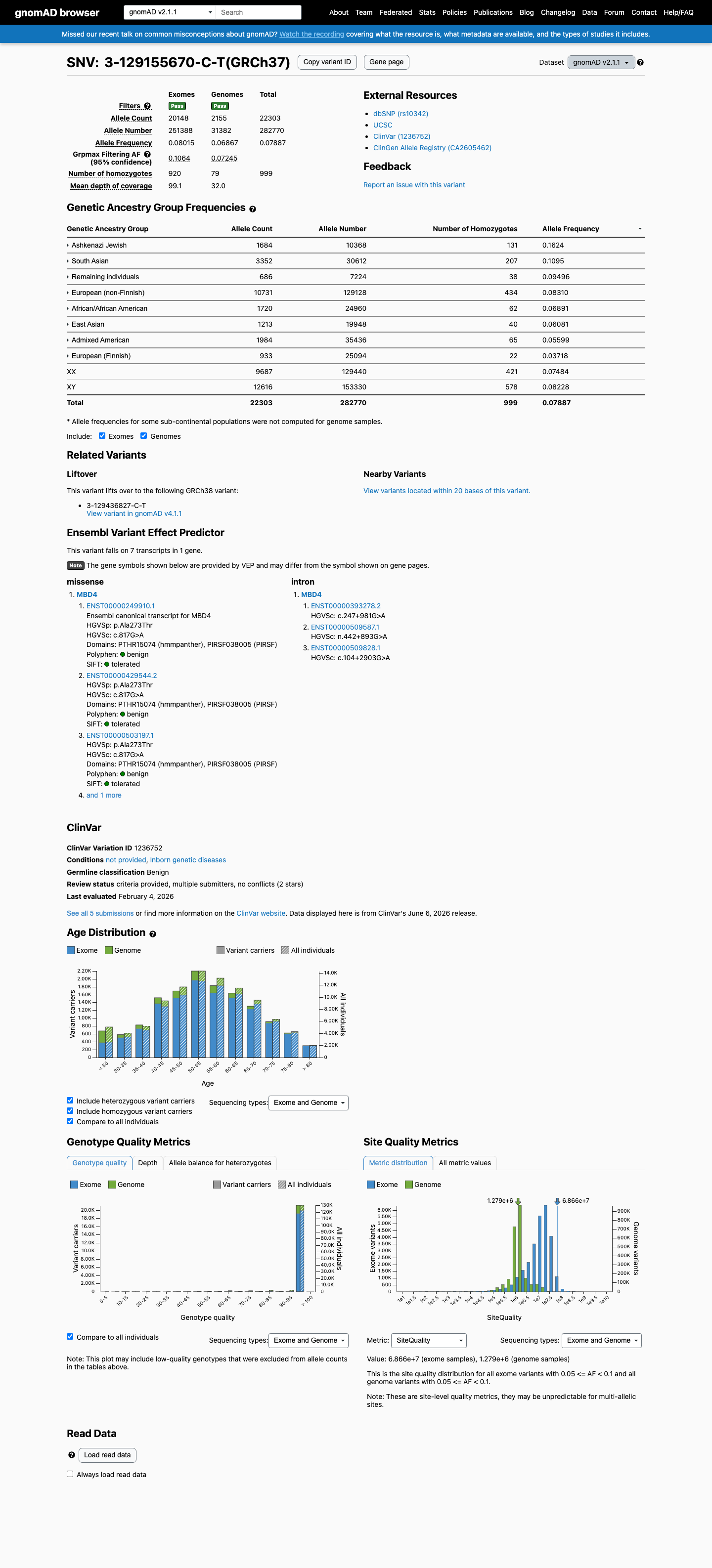
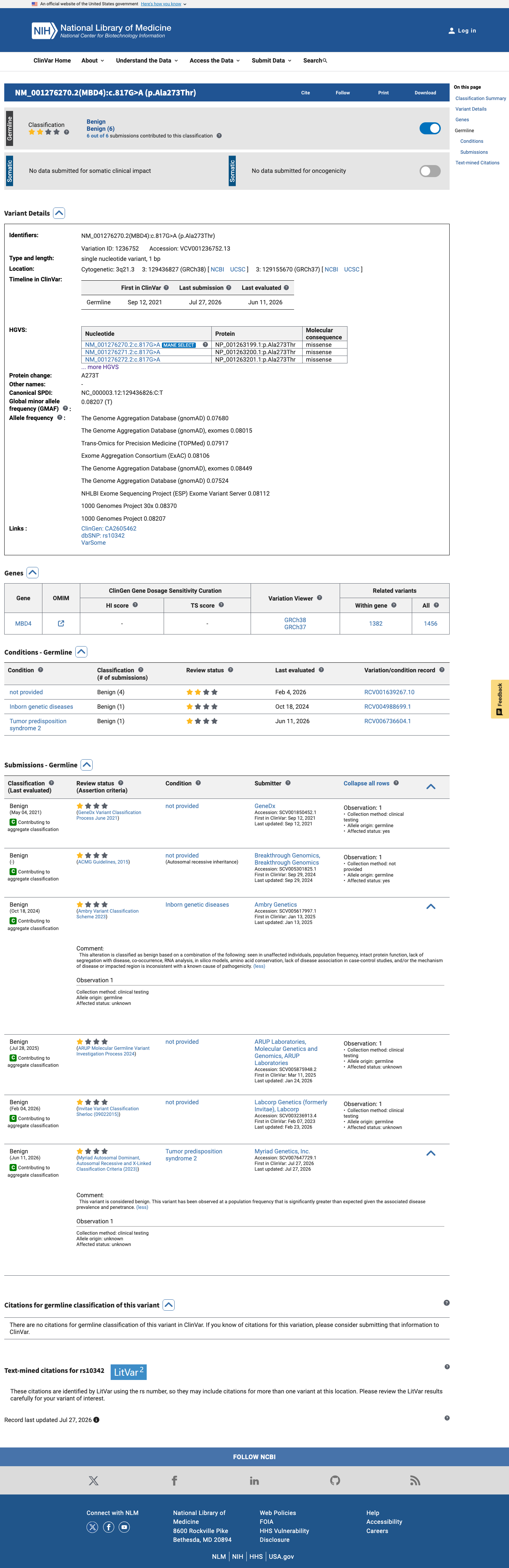
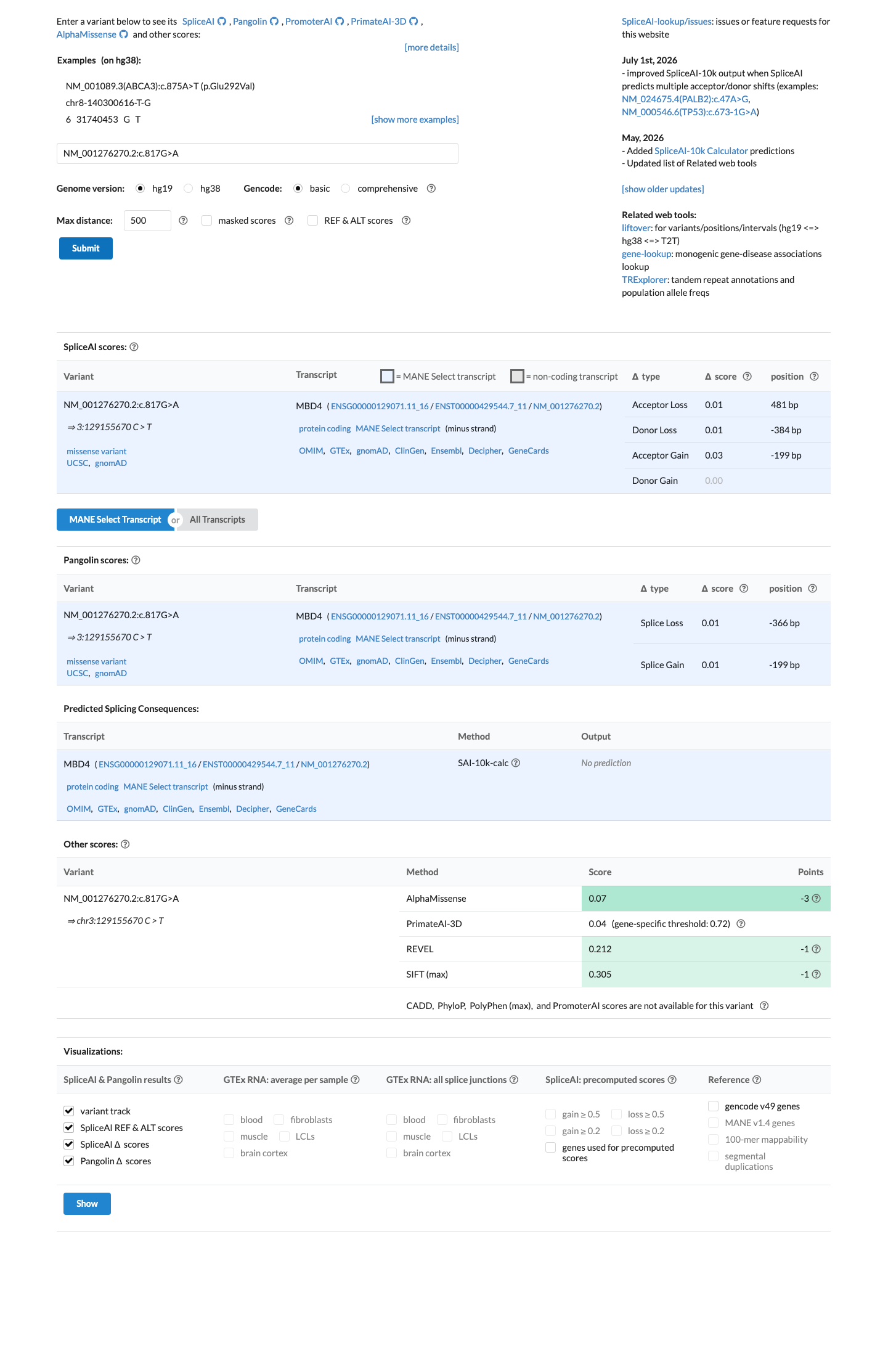
NM_001276270.2:c.817G>A (p.Ala273Thr) in MBD4 is a common polymorphism present at 7.89–8.41% allele frequency across gnomAD datasets with 999–6,177 homozygous individuals, far exceeding the BA1 stand-alone benign threshold of >1%.1 The variant is classified as Benign in ClinVar (Variation ID 1236752) with 2-star review status and five clinical laboratory submissions unanimously agreeing on a benign classification, consistent with the population frequency data.2 Multiple in silico predictors support a benign effect: REVEL score 0.212 and BayesDel score -0.418, with no evidence of splicing impact from SpliceAI.3 No pathogenic evidence was identified: PVS1 is not applicable to this missense variant; no functional studies (PS3), de novo events (PS2/PM6), segregation data (PP1), or case-control enrichment (PS4) were found.4 Based on BA1 alone, this variant meets stand-alone benign criteria. Additional benign evidence from BS1, BS2, and BP4 further supports a benign classification. Classification: BENIGN.5
Final classification
Benign
BA1BS1BS2BP4
MBD4
c.817G>A
p.Ala273Thr
missense
This variant
NM_001276270.2:c.817G>A (p.Ala273Thr) in MBD4 is a common polymorphism present at 7.89–8.41% allele frequency across gnomAD datasets with 999–6,177 homozygous individuals, far exceeding the BA1 stand-alone benign threshold of >1%.
gene-specific framework lacked a usable explicit final combination framework, so generic ACMG/AMP 2015 final-combination rules were applied as fallback; applied criteria: BA1 stand-alone benign, BS1 strong benign, BS2 strong benign, BP4 supporting benign; combination = 1 stand-alone benign + 2 strong benign + 1 supporting benign, which maps to Benign.
Classification rationale
BA1BS1BS2BP4
Benign
MBD4 c.817G>A
missense
BA1 + BS1 + BS2 + BP4
→
Benign
LYFE Sciences is an AI system, and it can make mistakes. Criteria
may be applied incorrectly, sources may be misread, and a confident-looking
classification can still be wrong. Double-check every criterion and
its underlying evidence before relying on any call.
Gene diagram
· NM_001276270.2 · variants mapped to exon structure
MBD4
NM_001276270.2
Fetching transcript structure from UCSC…
Applied criteria · 4 applied · 17 assessed
MetEvidence satisfies this criterion.
Not metEvaluated against available evidence; threshold not reached.
Not assessedApplies in principle, but no evidence was found to evaluate it.
N/ADoesn't apply to this variant type.
Applied · 4
Strength
Supporting
Moderate
Strong
Very strong
BA1
stand-alone
Benign
This variant is present at extremely high allele frequency in population databases, far exceeding the BA1 threshold of >1%. gnomAD v2.1: AF=7.89% (22,303/282,770 alleles, 999 homozygotes). gnomAD v4.1: AF=8.41% (135,695/1,614,010 alleles, 6,177 homozygotes). Highest subpopulation frequency in Ashkenazi Jewish: 16.24% (v2.1) / 16.28% (v4.1). The presence of 999–6,177 homozygotes across gnomAD datasets definitively establishes this as a common benign polymorphism.
gnomAD v2.1: AF=7.89%22303/282
BS1
strong
Benign
Allele frequency far exceeds the BS1 threshold of >0.3%. gnomAD v2.1 AF=7.89% and gnomAD v4.1 AF=8.41% both vastly surpass the 0.3% cutoff. While BA1 (stand-alone benign) supersedes this criterion, the population data independently satisfies BS1 at strong benign strength.
gnomAD v2.1: AF=7.89% >> 0.3% thresholdgnomAD v4.1: AF=8.41% >> 0.3% threshold
BS2
strong
Benign
Observed in 999 homozygous individuals in gnomAD v2.1 and 6,177 homozygous individuals in gnomAD v4.1, definitively confirming observation in healthy adults. For MBD4-associated cancer predisposition syndromes (colorectal oligopolyposis, melanoma), this number of homozygotes is incompatible with a highly penetrant pathogenic role.
gnomAD v2.1: 999 homozygotesgnomAD v4.1: 6177 homozygotes
BP4
supporting
Benign
Multiple lines of computational evidence suggest no impact on gene product. REVEL score is 0.212 (well below the 0.5 pathogenicity threshold), and BayesDel score is -0.418 (negative, predicting benign). SpliceAI identifies no splicing impact. No HCI prior probability score is available for MBD4.
REVEL: 0.212 (below 0.5predicts benign)BayesDel: -0.418 (negative
Assessed · not applied
· 17 not met · 0 not assessed
Pathogenic
PS2
No de novo data available for NM_001276270.2:c.817G>A.
PS3
No well-established functional studies directly testing NM_001276270.2:c.817G>A (p.Ala273Thr) or a systematically characterized range including this residue were identified.
PS4
No case-control or cohort data demonstrating statistically significant enrichment of NM_001276270.2:c.817G>A in affected individuals compared to population controls.
PM1
Residue 273 is not located in a statistically significant mutational hotspot (cancerhotspots.org negative).
PM2
This variant is common in population databases.
PM6
No confirmed de novo occurrence of NM_001276270.2:c.817G>A has been reported.
PP1
No cosegregation data are available for NM_001276270.2:c.817G>A.
PP2
MBD4 is not established as a gene with a low rate of benign missense variation and a high rate of pathogenic missense variants.
PP3
Multiple in silico predictors indicate a benign effect.
PP4
No patient-specific phenotype data are available for this case.
PP5
ClinVar classification for Variation ID 1236752 is Benign (not Pathogenic) with review status 'criteria provided, multiple submitters, no conflicts' (2-star).
Benign
BS3
No well-established in vitro or in vivo functional studies have been performed on NM_001276270.2:c.817G>A (p.Ala273Thr) demonstrating no damaging effect on protein function or splicing.
BS4
No segregation data or family studies are available to assess whether this variant fails to segregate with disease in affected families.
BP1
MBD4 is not established as a gene in which only truncating variants cause disease.
BP2
No evidence of this variant observed in trans with a known pathogenic MBD4 variant.
BP5
No evidence that this variant has been observed in a case with an alternative molecular basis for disease.
BP6
ClinVar Variation ID 1236752 is classified as Benign with review status 'criteria provided, multiple submitters, no conflicts' (2-star).
N/A · 4
PVS1 · PS1 · PM5 · BP7
Research & evidence
Population frequency · supports benign
gnomAD v4.1
gnomAD v2.1
v4.1
This variant is present in gnomAD v4.1 (AF= 0.0840732; MAF= 8.40732%, 135695/1614010 alleles, homozygotes = 6177) and has highest observed frequency in the Ashkenazi Jewish population (AF= 0.162839; MAF= 16.28386%, 4821/29606 alleles, homozygotes = 404); grpmax FAF= 0.116705.
v2.1
This variant is present in gnomAD v2.1 (AF= 0.0788733; MAF= 7.88733%, 22303/282770 alleles, homozygotes = 999) and has highest observed frequency in the Ashkenazi Jewish population (AF= 0.162423; MAF= 16.24228%, 1684/10368 alleles, homozygotes = 131); grpmax FAF= 0.106406.
🇨🇦 CA
This variant is present in gnomAD-Canada v1.0 (AF= 0.09180238870792616, 1691/18420 alleles, homozygotes = 90).
Allele frequency by ancestry
three datasets · side by side
gnomAD v4.1
8.4%
· 135695 / 1,614,010
6177 hom · FAF 12%
6177 hom · FAF 12%
Ashkenazi Jewish 4821 / 29,606 |
16% 404 hom |
Middle Eastern 752 / 6,062 |
12% 65 hom |
South Asian 10157 / 91,076 |
11% 674 hom |
Remaining individuals 5804 / 62,506 |
9.3% 293 hom |
European (non-Finnish) 100487 / 1,179,954 |
8.5% 4268 hom |
African/African American 5098 / 75,032 |
6.8% 180 hom |
Admixed American 3788 / 60,020 |
6.3% 149 hom |
East Asian 2278 / 44,880 |
5.1% 81 hom |
European (Finnish) 2482 / 63,962 |
3.9% 62 hom |
Amish 28 / 912 |
3.1% 1 hom |
gnomAD v2.1
7.9%
· 22303 / 282,770
999 hom · FAF 11%
999 hom · FAF 11%
Ashkenazi Jewish 1684 / 10,368 |
16% 131 hom |
South Asian 3352 / 30,612 |
11% 207 hom |
Remaining individuals 686 / 7,224 |
9.5% 38 hom |
European (non-Finnish) 10731 / 129,128 |
8.3% 434 hom |
African/African American 1720 / 24,960 |
6.9% 62 hom |
East Asian 1213 / 19,948 |
6.1% 40 hom |
Admixed American 1984 / 35,436 |
5.6% 65 hom |
European (Finnish) 933 / 25,094 |
3.7% 22 hom |
gnomAD Canada 🇨🇦
9.2%
· 1691 / 18,420
90 hom · FAF 9.6%
90 hom · FAF 9.6%
indel · split
Middle Eastern 21 / 144 |
15% |
Ashkenazi Jewish 118 / 832 |
14% 14 hom |
Remaining individuals 136 / 1,138 |
12% 9 hom |
South Asian 151 / 1,362 |
11% 9 hom |
European (non-Finnish) 1021 / 11,740 |
8.7% 49 hom |
East Asian 110 / 1,338 |
8.2% 5 hom |
Latino/Admixed American 67 / 838 |
8% 2 hom |
African/African American 67 / 1,020 |
6.6% 2 hom |
+ 1 not observed (European (Finnish))
ClinVar
This variant is present in ClinVar (Variation ID: 1236752); submission details unavailable.
Functional
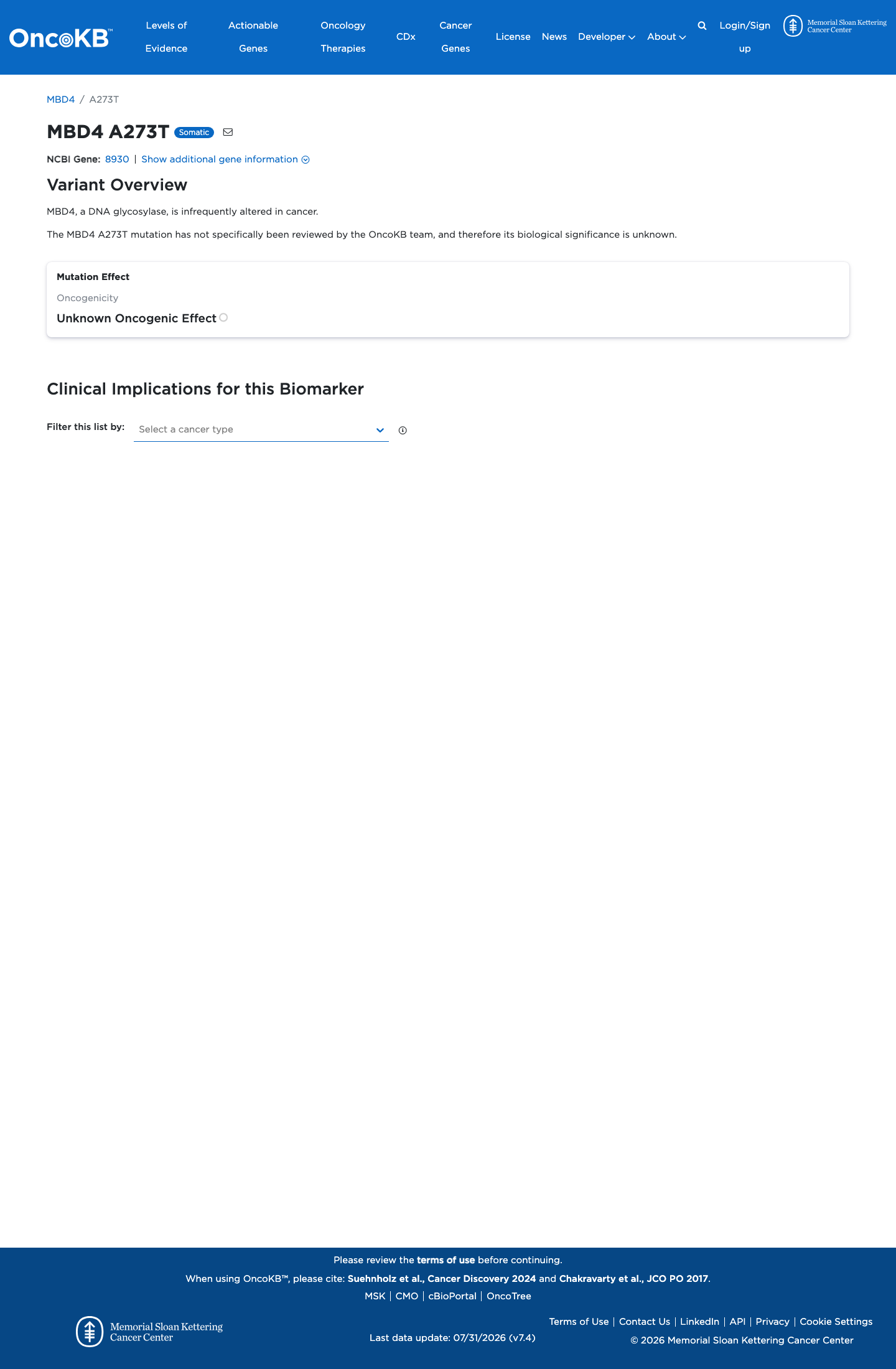
Unknown Oncogenic Effect
OncoKB did not identify variant-specific reviewed functional evidence for this variant; gene-level curated context is available for reviewer follow-up. MBD4, a DNA glycosylase, is infrequently altered in cancer.
COSMIC

Cancer hotspots
Somatic evidence
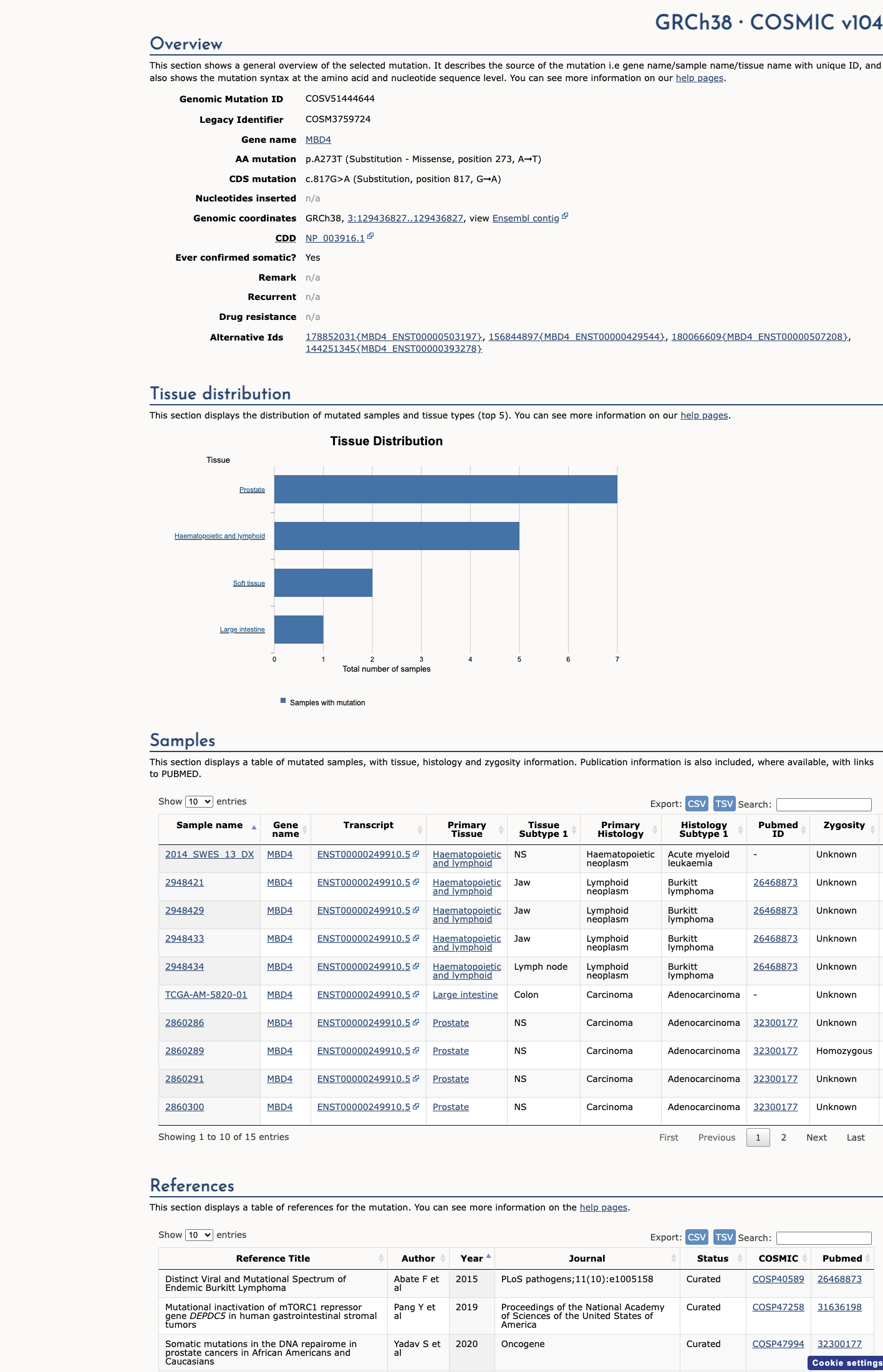
Not in COSMIC / hotspots
COSMIC
This variant does not lie in a statistically significant hotspot. This variant has previously been reported in somatic cancers (COSMIC; COSV51444644, n = 15 times).
Hotspots
This variant does not lie in a statistically significant hotspot.
Sources & reference links
Triaged references · 7 PMIDs not cited in assessment
25730230 ↗
Expanded carrier screening in reproductive medicine-points to consider: a joint statement of the American College of Medical Genetics and Genomics, American College of Obstetricians and Gynecologists, National Society of Genetic Counselors, Perinatal Quality Foundation, and Society for Maternal-Fetal Medicine.
CLINVAR
25741868 ↗
Standards and guidelines for the interpretation of sequence variants: a joint consensus recommendation of the American College of Medical Genetics and Genomics and the Association for Molecular Pathology.
CLINVAR
23169492 ↗
The perspective from EASAC and FEAM on direct-to-consumer genetic testing for health-related purposes.
CLINVAR
22947299 ↗
Specific guidelines for assessing and improving the methodological quality of economic evaluations of newborn screening.
CLINVAR
23037933 ↗
Including the initial newborn screening bloodspot collection device serial number on birth certificates: basis and recommendations from the Secretary of Health and Human Services' Advisory Committee on Heritable Disorders in Newborns and Children.
CLINVAR
28492532 ↗
Sherloc: a comprehensive refinement of the ACMG-AMP variant classification criteria.
CLINVAR